Feeds:
Posts
Comments

Archive for the ‘family’ Category

 . 
[ with 3 poems by Rae Spencer]
 . 
Adaptation
 . 
Some days I hardly remember
what it is to fly
 . 
what loss is
When morning feels like betrayal
and shoulders ache
with the sudden load of gravity
pressed into cruel bones
too human for wings
 . 
As if I never once awoke
hair smelling of clouds
wound in wild knots
and damp with tears
 . 
or slept
curled in a crevice of wind
 . 
Other days I recall myself
grace confined to memory
in which I have never flown
and it was only ever a tale
from childhood
I was never meant to believe
 . 
Rae Spencer
from Watershed, Kelsay Books, American Fork, Utah; © 2023
 . 
❦ ❦ ❦
 . 
A shift in warmth of Pacific seas, a wet winter in the South: throughout January a storm a week, sometimes two, but this afternoon we are braving mud to hike our favorite trail from Carter Falls to Grassy Creek. The little farm pond is full and we see the channel where it overflows to carve a deeper path through last summer’s grasses and sedges. Both white pine groves have evidence of freshets, scoured hardpan courses with needles layered thick along each side. We cross Martin Byrd Road to enter the woods that curve alongside the big cornfield and wonder what we’ll find. Even though the acres are planted in winter rye, how much soil has rushed off those slopes and furrows into Grassy Creek?
 . 
The trail quickly turns downhill and we see the storms’ impact. Red field clay has silted full the first drainage swale and overtopped it to rush down the trail bed in a boiling soupy froth. Exposed roots and deep mud. Our trail crews clean out these erosion control features twice a year but one wet January has damaged the trail more than ten years of hikers’ boots. Too much water, too much incline, too much gravity.
 . 
Neither will nor wisdom inform its seep, writes Rae Spencer of water. It must seek its level, it must flow, it must rush. Water and time alike, each of them relentless and not to be held back. Have I spent too much of my life rushing? Have I abandoned will and wisdom to be always doing, doing? Even now my dreams are filled with urgency, long hallways, behind each door a patient fretting to be seen, and I with no hope of catching up. Waking from such, who would want to get out of bed and get started?
 . 
Better trail design can’t completely compensate for poor tillage and agricultural neglect, but the rest of today’s trail is actually in quite good shape. The outer berm has been mostly raked clear and there are several grade dips and rises that keep water from following the treadway. When we reach the more rustic forest bathing trail, it’s even better – consistent outsloping camber, plenty of runoff. Water’s gonna rush. Life too, I guess. How to prepare? How to respond? How to slow things down for a bit? A walk through quiet woods, a quiet hour with a book of poetry – maybe tonight my dreams will proceed more leisurely.
 . 
❦ ❦ ❦
 . 
Of Warbler and Quail
 . 
Drab little she in the brush
Muttering her song to lure
Someone else
 . 
But only I respond
Drawn across the dune
To listen closer
 . 
As a child I spoke to quail
I whistled out their bobwhite name
To hear them shriek it back
 . 
But this little warbler
outside my beachfront door
Her accent slips my ear
 . 
Measures of water wisdom
Refrains of woven nest
Codas that fall silent
 . 
Because I have come too near
To understanding
What is lovely on this shore
 . 
Of daily tide
Of sandy soil and storms
Of quickening flocks
 . 
That speak their sea-swept names
In secret tangled tongues
Of salty sail and oar
 . 
And then they fly away
While I struggle, yearn to say
What I remember of briars
 . 
Of dry summer streams
And winter dreams
Of silent quail
 . 
Hungry among the thistle
Of home, my distant valley home
So many years from here
 . 
Rae Spencer
from Watershed, Kelsay Books, American Fork, Utah; © 2023
 . 
❦ ❦ ❦
 . 
Memory – home – loss – the path forward: Rae Spencer’s poetry has a distinctly formal feel as she settles deeply into these themes. Formal in the sense of meticulous language, lush natural imagery and description, architectural lines, internal rhyme. These poems need to be read slowly as they linger in the moment before releasing one to ponder and discover the writer’s metaphors, and discovering one’s own.
 . 
Watershed from Kelsay Books is an antidote to compulsion, to insistence, to the headlong rush into the next thing and the next. I am perfectly happy to pause and listen with warbler and bobwhite as the poet weaves from their stories one of longing for home (Of Warbler and Quail). I think I’m ready now for racoon to teach me how to live (Adaptable). At the close of Doppler Effect, I sit and listen long to the change in pitch of life I know I must expect, and prepare for, as my own parents age and travel their final days.
 . 
Poetry, in its phrasing, its junctures, its juxtaposition, often moves at the pace of breath. Speak it aloud, pause when it needs you to. Stop and linger in the midst of these lines so that they may breathe into you.
 . 
 . 
[hint: I re-type the poems for these posts (thank you to my freshman touch typing teacher), fingers slower than scanning eyes, speaking the words individually in my head, each syllable and carriage return (aka line break) – so often in the adagio the lines reveal secrets of how they mean.]
 . 
Rae Spencer lives in Virginia, USA. As well as writing, she is a practicing veterinarian. Of Warbler and Quail first appeared in Bolts of Silk. Gravity first appeared in vox poetica.
 . 
Watershed is available from Kelsay Books HERE. Learn more about Rae HERE.
 . 
❦ ❦ ❦
 . 
Gravity
 . 
Water doesn’t want
It only weighs
 . 
Neither will nor wisdom inform its seep
Downhill, settling to the lowest pool
 . 
Rivers cascade and marshes ooze
Toward inlet and gulf
Where tides surge
 . 
With the arid moon
Sere face lowered
In serene reflection
Over oblivious blue
 . 
Depths that teem with tin and polyp
Oyster clades awash in brine
That neither murmurs nor sighs
Through a shell
 . 
Held to the ear we hear
Blood’s heave
An eternal chorus
Singing sailors to sea
Dreamers to sleep
 . 
Daughters to voice
Their bare feet anchored
In restless churn
On heavy, ancient shores
 . 
Rae Spencer
from Watershed, Kelsay Books, American Fork, Utah; © 2023
 . 
❦ ❦ ❦
 . 
IMG_1948
 . 

Read Full Post »

 . 
[with 3 poems by Debra Kaufman]
 . 
Walking Westerly, My Shadow Precedes Me
 . 
She does not hear a warning
in the wren’s song,
+++++++++ as I do,
or see the ghost moon as an omen.
 . 
She appears to have a jauntier step,
wilder hair, longer, slimmer limbs.
 . 
Perhaps she is the me
I once was –
waitress, dancer, diary keeper.
 . 
Nothing bad
has happened yet.
+++++++++ Soon
 . 
she will trail a dangerous
fragrance, be sniffed out,
tracked, pinned down.
 . 
Wind trembles the beech leaves.
The wren calls again.
 . 
I step toward the past,
she into the future
 . 
Debra Kaufman
from Outwalking the Shadow, Redhawk Press, Hickory, NC; © 2023.
 . 
❦ ❦ ❦
 . 
If you believe that everything is connected;
if you believe that matter and energy are conserved (not to mention angular momentum);
if you believe that the breath you’ve just taken into your body, its oxygen reddening your corpuscles, worked its way up the hill from the great red oak not tumbled in last spring’s tornado, and that when you release it a second from now it will begin to wisp its way back down to wait for the asters you’ve sowed on wind-scoured earth;
if you believe that your body is stardust, its phosphorus and calcium and that fleck of selenium, every element which is heavier than air;
if you believe that no distance is too far and no time too long a thread to tie everything together and extend the connection,
++++++++++ then believe this:
 . 
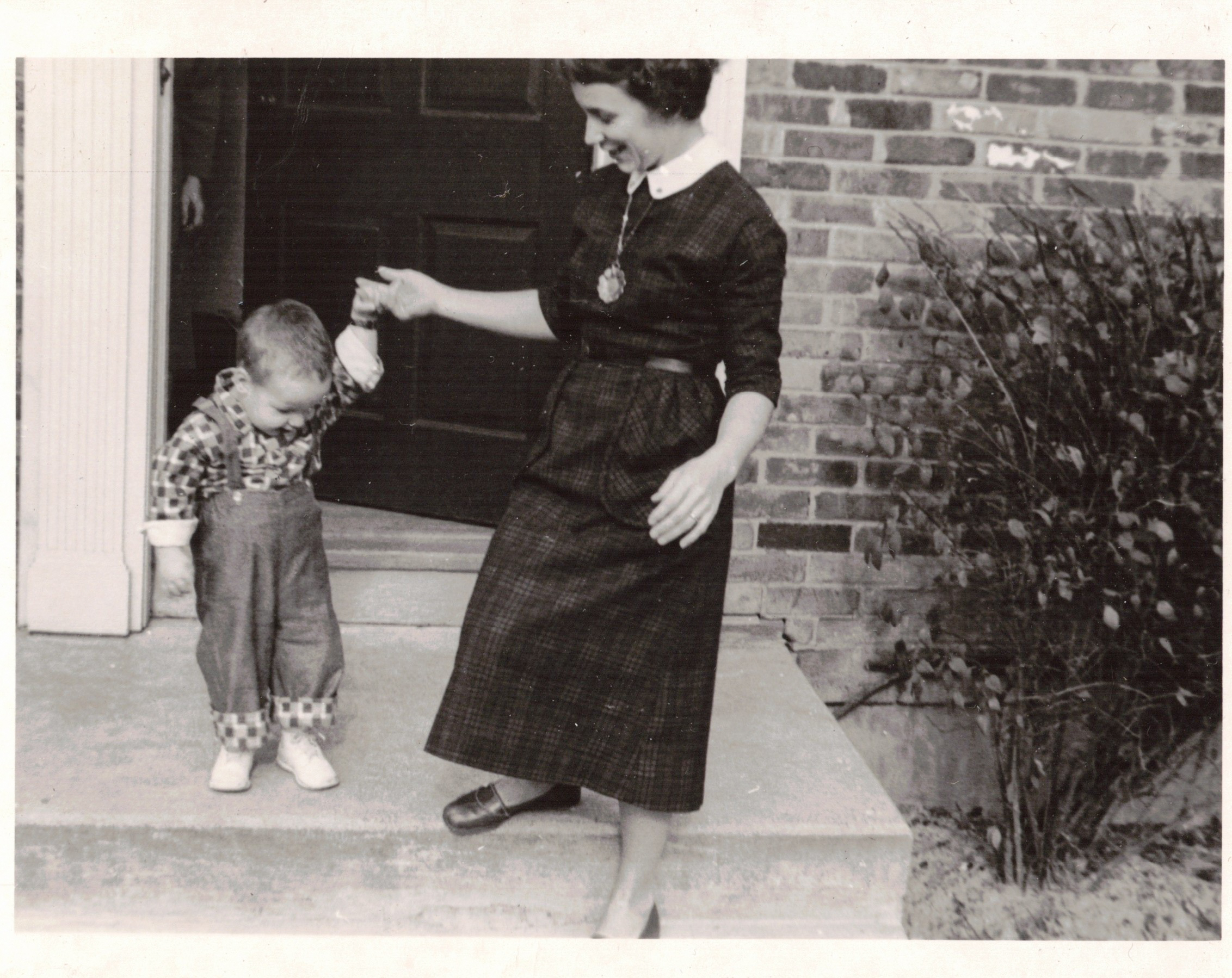
when that wisp of a woman sitting on the couch beside your father and his baby sister, white-haired tiny flit of a woman no more substance than moonbeam, when she smiles it will light up the string of a million smiles stretching back so far that every smile since must take its cue, all the way back to the very first smile twenty-five years (less thirteen days) before you were born.
 . 
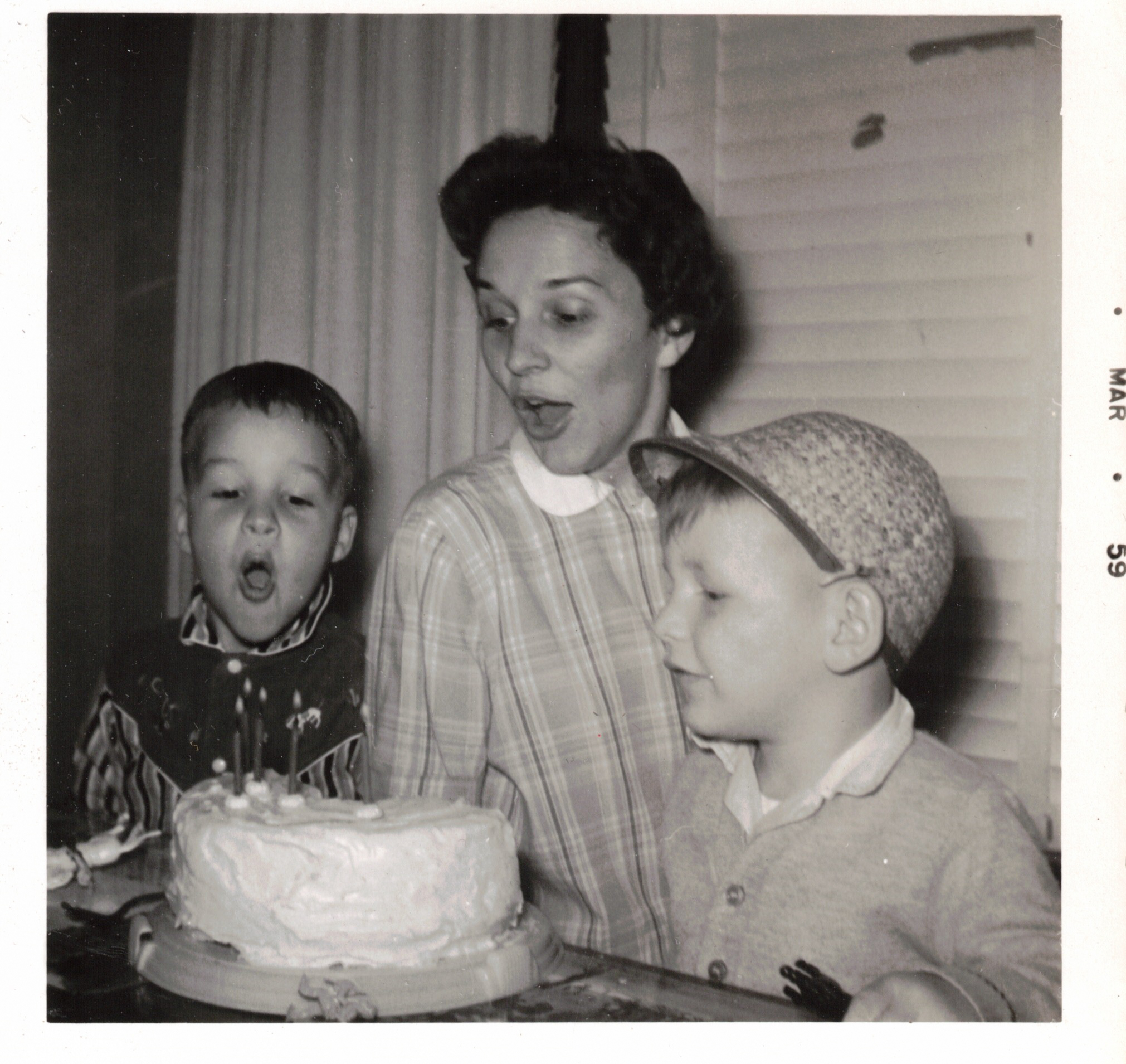
Recall those smiles you can and hold onto them — you dancing while she plays Mozart on the piano and laughs; she holding the cake while you take a deep breath to blow; beaches and playgrounds, jokes and canasta, weddings and first smiles of your own babies shared with her. Most smiles have flown to continue their cycle, petal of a flower she will notice, bug she’ll try to pick up from the carpet, a noise or a vision in some other creature’s thread of existence . . .
 . 
. . . but some precious few smiles are preserved in silver. Layers of atoms on glossy paper. Here’s one that her niece, your cousin, has just handed you, holding its connection to the others over seven decades in the bottom of a carton waiting for your gathering today. You hold it close for her to see and she smiles again.
 . 
Look! Today’s smile! When you see it, recognize its provenance, its taxonomy, its lineage and inheritance from all that have preceded it. Accept its assurance. So much lost, so much consigned to this or that flimsy drawer in the cupboard of memory (yours) and so many keys to so many drawers misplaced (hers), but still firmly by that long and winding thread as tenuous as breath connected. Every wisp connected.
 . 
 . 
❦ ❦ ❦
 . 
The last time my mother
 . 
spoke words I heard
I saw her see me in a flash:
You’re my daughter!
We walked the hall,
a circumference
around the single rooms.
Round and round.
Each time we passed
the common room
she’d point to the Christmas lights.
 . 
On her bed lay a book
of her wedding photos.
I named the names, some small comfort.
I sang “Jacob’s Ladder”
and she smiled in that puzzled way.
 . 
I meant to rub lotion on her legs –
her skin dry, tissue-paper thin –
but they were calling her
for supper. I kissed her cheek.
She kissed my hand,
did not want to let it go.
 . 
I hoped we’d see a few sparrows
out her window, but
dark coming early, I saw only
our ghostly selves reflected there.
 . 
Debra Kaufman
from Outwalking the Shadow, Redhawk Press, Hickory, NC; © 2023.
 . 
 . 
❦ ❦ ❦
 . 
Yet if we do not stare despair in its face
(I hear you say) how will we recognize
 . 
the silver sliver of moon
when it hangs suspended like a dream?
 . 
++++++++++ from Bearing / Witness
 . 
Moonrise this past Monday was 2:37 PM in Elkin, North Carolina, USA. Waxing gibbous, we spot her on the one clear afternoon without rain. We won’t have to worry about finding our way through the darkened house at bedtime. Light will precede us, follow us, attend us. We can’t summon the moon or assign her course; we can only watch and trust she will return. We can only recognize and be grateful.
 . 
I didn’t want to get out of bed that Monday morning. All the motivations and machinations of the preceding week – phone calls, site visits, family conferences – had cooled and dissipated. Who says energy is conserved? I sat at my desk, the to-do list accruing and scrolling in my head, not knowing how to begin. And then there was Debra Kaufman’s new book waiting patiently at the top of the pile. I opened to the first poem. The clamp on my innards released and breath returned.
 .  . 
Moon, and of course shadow, are recurring images in Outwalking the Shadow. It is no coincidence that metaphor and metamorph are nearly homologues. Images may shift their shapes and meanings, may stand in for any number of times and spaces, but moon and shadow link arms, weave a net, cast it out and draw us in. Debra does more than create contrasts. Her poems are not satisfied to simply cast light into the dark umbra of grief. Enter her lines and welcome the shadow, relive it, discover how and who it has made you. Recognize that light blinds when it glares but enlightens when it glimmers, slivers, almost ephemeral as dream.
 . 
Recognize that each of us lives with our shadow, and that even moonlight may cast one. Debra’s book is dedicated to her mother, Kathleen, and many of the poems explore her life, their life together, her final days, thereafter. Debra’s poems encompass much, much more than grieving, however. In many of her lines, I hear her speaking the very phrases I have needed to speak to my own heart. Perhaps you, too, have had mornings when you found it a burden to take even one step, when you felt empty and powerless and alone. These poems admit that. We are human and we carry our shadows. But these poems surprise themselves with sudden flashes and connections – a summoning of crows, a lesson learned, a visitation by spirits. Every time I turn another page, I discover more of what I need. Come, let us walk out together. There may still be joy if we open ourselves.
 . 
 . 
More about Debra Kaufman, Outwalking the Shadow from Redhawk Press, and how to purchase HERE
 . 
❦ ❦ ❦
 . 
Let my heart swing open
 . 
like French doors to a garden of blowsy flowers,
saloon doors where Kitty serves shots of rye,
a screen door with a farm wife waving you in,
 . 
or let my heart be a picture window
through which I see everyone I have ever loved,
my breath steaming the glass, come in,
 . 
we’ll turn up the party lights,
show all the passersby we’re dancing,
or better yet, let’s all spill out into the street,
 . 
my heart a village music festival –
welcome teachers, firefighters, cashiers, nurses,
shysters and spinsters, salsa dancers a skateboarders,
 . 
cat lovers, detasselers, twirlers and high-steppers,
come in you scuffed shoes, rhinestones, flannels,
I’ll be a mirror reflecting all y’all’s kindness,
 . 
your clumsy moves and broken bits,
your sad patience and patient wildness,
your generosity, crankiness, haunted dreams –
 . 
I’ll be the hostess sprinkling blessings like petals,
saying, The universe is here and so are we – 
champagne for everyone!
 . 
Debra Kaufman
from Outwalking the Shadow, Redhawk Press, Hickory, NC; © 2023.
 . 
 . 
❦ ❦ ❦
 . 
 . 
❦ ❦ ❦
 . 
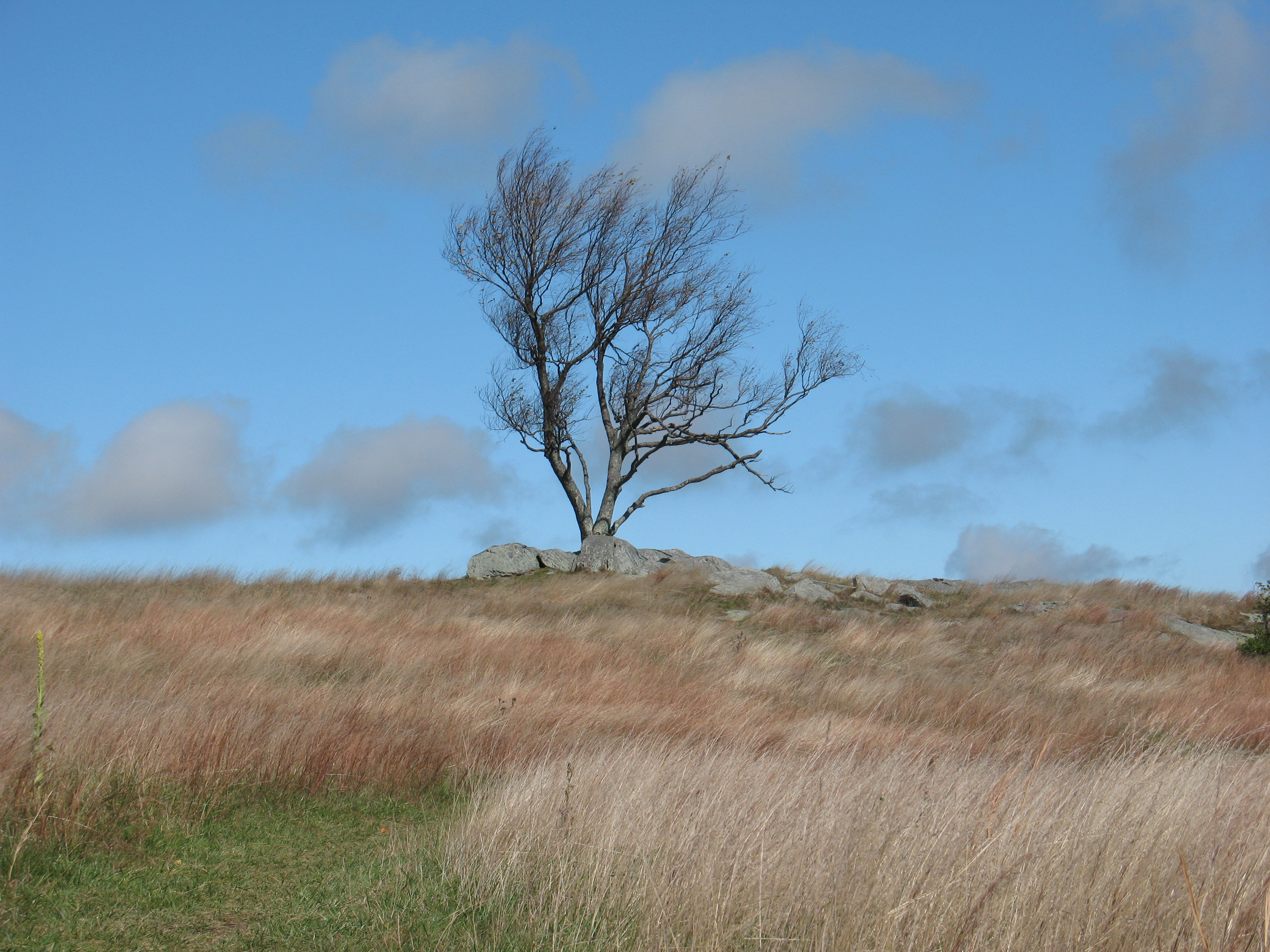
2016-10-17a Doughton Park Tree

Read Full Post »

 . 
[with 3 poems by David Radavich]
 . 
Offering
From one day
to the next
seems a difference
 . 
between drought
and flood,
 . 
corporations
and the poor.
 . 
Should we pack
our suitcase
for the future?
 . 
We bend over
gardenias
in the back yard,
 . 
salvia, rosemary,
daylilies jut now
blazing
 . 
wondering if nature
can withstand
our age,
 . 
sun fighting
with wind and rain,
 . 
wars consuming
everything
 . 
we believe.
 . 
Time to visit
the cemetery, bring
 . 
the pure lilies
we picked
this morning
 . 
as our offering
to the dead,
 . 
We owe them
our knees
and this stab at
 . 
continuing
 . 
paying homage
to names
 . 
and all
that’s green.
 . 
David Radavich
from Here’s Plenty, Červená Barva Press, W. Somerville, MA; © 2023
 . 
❦ ❦ ❦
 . 
“These are monsters migrating.” Thus the boy explains the drawing he’s brought home from kindergarten. Three big ones fly south, dragon-winged, pterodactylloid, gallinaceous. A mighty bruiser gallops on great feet bound to raise dust and thunder, heavy tail thrashing. But here’s one down in the corner foreground, not imposing, non-scary, looking me straight in the eye. Most monsters speed away, thank goodness, but some are willing to stay and make friends.
 . 
Monsters sneak into my head at 3 AM when I return from the bathroom. In the old days, before I retired from medicine, they called me from the ICU or Labor & Delivery and I knew it was time to pull up my pants and find the car keys. Now they spring up when I call them – damn! – and poke me with their spines and cold stiff claws each time my breath attempts to settle. Does anyone escape? Doesn’t everyone with parent, child, grandchild harbor a squirm of worry underneath the bed, ready to pop awake and crawl up between the sheets?
 . 
Monsters seem to be drawn to the idle mind like migrating bats to open, dark caverns. Their scales and markings may vary but they all belong to Class, Order, and Family of What If? Once their migration might have lasted just hours – what if I can’t get his blood pressure up? what if her baby’s head is transverse? – but now they don’t seem to have any finite lifespan. The infinite multiverse fans out from its monstrous 3 AM nidus into a crashing storm of uncertainty. Calm yourself. Smooth those waves of rapid breathing. Wrap the turbulence and darkness until they become a comforting cloak. What . . .
 . 
. . . if you sit down with me here and tell me about these monsters? The boy has a name for each one. He knows their powers and their weaknesses. Far from being fearful, these are friends, some to each other and all of them to him. You wouldn’t want to sit on one – they’re sharp, and they might break! – but it’s amazing to watch them fly and run. In fact, they are all related to each other. They are monster family.
 . 
 . 
❦ ❦ ❦
 . 
Crux
for Shelby
 . 
This is where
boy meets man:
 . 
a space
always alone
 . 
between
water and land,
 . 
fishing
or hiking,
 . 
gathering crayfish,
skipping stones,
 . 
another boss
is another tyrant,
 . 
pay not enough
to make ends meet,
 . 
mouths to feed
at the table,
 . 
gills in the water
needing your lure
 . 
and just the right
throw to home
 . 
sliding in
or head-long,
 . 
swinging high over
that creek
 . 
never knowing
if the vine will hold,
 . 
that’s what being
adult means:
 . 
learning
not to trust,
 . 
pulling everything
you’ve got,
 . 
keeping a sharp eye on
what’s moving
 . 
and then
grab it for grace,
 . 
feed that family
and don’t apologize.
 . 
David Radavich
from Here’s Plenty, Červená Barva Press, W. Somerville, MA; © 2023
 . 
❦ ❦ ❦
 . 
What if my name, instead of “Bill,” were “Boy?” What is the thing against the idea of the thing? And words on a page, are they the one or are they the other? David Radavich, in Here’s Plenty, doesn’t open his palm and hold out to you the answer to such queries, but he leaves plenty of answers scattered among the lilies or still hanging from branches, reddening fruit for us readers to discover. Can the idea of a thing become itself when we bite into it, when we take it into ourselves?
 . 
This is one task and one blessing of poetry – not to be a textbook, lining out chapter and verse; not to be gospel; but to be spell, cast into the world and opening like the petalled layers of a peony. Perhaps we return day by day to discover its transformation, perhaps we grab and thrust our nose deep into the blossom’s perfume and scatter petals all around us. Either way we engage, yes with the words but even more so with ourselves. The real poetry is what we write within while reading what is without.
 . 
David Radavich lives in the world. So apples, seed and stem, peel and core and crisp. Edens and crags. Harsh sharp divisions and tender comings together. Nothing ignored or unnoticed, nothing left out. Everything invited in. You and me, too. Come – there’s plenty.
 . 
 . 
Here’s Plenty is David Radavich’s tenth collection of poetry. He has also published many plays as well as scholarly and informal essays in many countries. The book is available HERE
 . 
 . 
❦ ❦ ❦
 . 
Going Home
 . 
Forget about it.
 . 
The old one wasn’t
worth much
anyway.
 . 
You can do better
tossing a coin
or consulting
some astrologer.
 . 
Choose
where or what
you want to be
 . 
and go there
to take your place
among the yet
to arrive.
 . 
Wave your white
flag to the past
 . 
and make your new
garden bloom
 . 
as if
you had been
 . 
there all along
incognito
 . 
among many
creatures
you don’t know
names for,
 . 
your enemies
forgotten
 . 
and a sky
just as much
your own
 . 
as a new skin.
 . 
David Radavich
from Here’s Plenty, Červená Barva Press, W. Somerville, MA; © 2023
 . 
 . 
❦ ❦ ❦
 . 
2020-06-11a Doughton Park Tree
 . 

Read Full Post »

« Newer Posts - Older Posts »