Feeds:
Posts
Comments

Archive for the ‘family’ Category

 . 
[with 3 poems by Richard Allen Taylor]
 . 
What’s Happening?
+++ after Choices, a watercolor by Catherine Mainous
 . 
Of course, I recognize it right away,
this landscape where past and present
bleed into future, as I have bled,
as we all do. I start green and work
my way up, grasping at blue. Earth
always reaches for sky, the tiniest seed
pokes through saltmarsh and sawgrass,
green fingers periscopes looking for light.
I always look for dawn. No, that’s wrong.
Sometimes, I search for dark and find it.
The light comes later, after regret, guilt.
See how that diffused orange glare
in the corner blurs into a bridge
to nowhere, skeletal structure
never completed. That’s what
you get with unrequited ambition.
Beginning, middle, no end.
A purple cloud in the distance.
A crane untethered.
An unexpected answer
to an unexpected question.
 . 
Richard Allen Taylor
from Letters to Karen Carpenter, Main Street Rag Publishing, Charlotte NC; © 2023
 . 
❦ ❦ ❦
 . 
She doesn’t believe in inertia. If I take both hands off the wheel for a femtosecond, she’s convinced we will instantly swerve into the embankment.
 . 
She does believe in gravity. Since my last birthday she has forbidden me from using the stepladder to hang Christmas lights on the dwarf spruce in our front yard, much less reach to get the star on top.
 . 
She absolutely rejects Heisenberg’s principal of uncertainty. Whether I can detect them or not, my keys are fixed in place right where I left them.
 . 
She’s a little iffy on the conservation of angular momentum. If I accelerate into a curve to maintain a constant forward velocity, she wants to know why I’m speeding.
 . 
She accepts evolutionary biology without complaint but wanders from the straight and narrow of taxonomic hierarchy. Lizards and toads she seeks out as cute; snakes are OK only behind glass; spiders and gigantic roaches, even millipedes, she captures under a paper cup, slides a birthday card beneath, and relocates into the yard; fruit flies and ants must die.
 . 
And the law of love? It is, of course, not exclusively physics and biology. It also includes the law of culture and connection, of which she is founder and curator. When a particular issue of National Geographic reaches its twentieth birthday, she tears out each article worth saving and files it, astrophysics to zoology. She will let me re-read them if I but ask.
 . 
One more thing about the law of love: it seems to disobey Newton’s third law of motion. For each of my own actions – and how often they do violate something – there is a reaction, but thank God not opposite and equal. However sharp her initial glance and inflection, the ultimate consequence so far has been forgiveness. This is one universe I am happy to live in.
 . 
 . 
❦ ❦ ❦
 . 
The Second Law of the Apple
 . 
If the first law was not to take
the first bite, lest you be banished
from the garden, the second law
ought to be to finish what you start,
 . 
meaning the first bite obligates you
to a second, and a third, and so on
until the apple is eaten, except
for the core, which contains
 . 
the seeds, and sine you will be
traveling anyway, away from
the garden that spit you out,
you might as well learn
 . 
banishment from one place is not
the end, but merely another beginning,
and what you do with the seeds
is everything.
 . 
Richard Allen Taylor
from Letters to Karen Carpenter, Main Street Rag Publishing, Charlotte NC; © 2023
 . 
❦ ❦ ❦
 . 
Richard Allen Taylor is part of the holy jangle of things / fastened to the belt loop of a forgetful world. The poems in Letters to Karen Carpenter and Other Poems are able to weave from the commonplace and humbly wonderful things of this world a sweet sadness . . . droll observations . . . life-giving joy. And some good jokes.
 . 
We knew this first collection since Richard’s wife’s death from leukemia would build a house for grief and healing. Who knew that Karen Carpenter would lend such a hand, but Richard weaves remembrance and biography together into powerful metaphors for attachment and loss. These poems speak to grieving with the whispered voice of his late wife, Julie – a mellow bell rings in the canyon. / And the canyon is me – as well as in Richard’s own sure voice of seeking, his wisdom steadily revealed as one that doesn’t cry for answers but is happy to linger with the important questions. All the old questions / that rise in the wake of storms: each of us must confront and accept these questions if we are to be fully alive. Autumn fades, winter enfolds us, but the seasons continue to turn. At the end of everything is not sadness but wonder, friendship, and love.
 . 
 . 
Letters to Karen Carpenter and Other Poems is available from Main Street Rag HERE
 . 
 . 
❦ ❦ ❦
 . 
I Write to You About Julie, My Wife
 . 
I named a star after her. Astronomers call it
HD 10180. Both Julies—the woman I remember
 . 
and her eponymous star—emit a kind and generous
light. The star deserves a name that twinkles, and she
 . 
deserves the star. I never called her HD 10180,
but often call the star Julie. I chose it out of billions
 . 
because, like you, Julie got along so well with others—
none of that blasting the neighbors with deadly gamma
 . 
ray bursts, the way some pulsars do. And like the star,
my wife, when she was alive, had a family that orbited
 . 
her adoringly. Astronomers have identified a possible
gas giant, designated HD 10180g, residing comfortably
 . 
in Julie’s habitable zone, and—though the giant’s crushing
gravity could never support planetary life, they may find
 . 
moons that do. Suspected of strong winds and colorful
bands, without Julie’s life-giving warmth and shine,
 . 
HD 10180g would be little more than a vast frozen cloud,
a derelict adrift in deep space. I wish I could point out Julie
 . 
to you, but it’s in the constellation Hydrus, which is only
observed from the Southern Hemisphere, and, though
 . 
brighter than our own sun, Julie resides one hundred and
twenty-seven light-years away. We’d need a telescope.
 . 
I understand your concern that the striking similarity
between the designations HD 10180 and HD 10180g
 . 
might confuse some observers. Don’t worry.
To anyone who ever saw us together, it’s obvious
 . 
I am the gas giant, and she is the star.
 . 
Richard Allen Taylor
from Letters to Karen Carpenter, Main Street Rag Publishing, Charlotte NC; © 2023
 . 
❦ ❦ ❦
 . 
 . 
❦ ❦ ❦
 . 
ECOPOETRY FOR EARTH DAY 2024
 . 
When we try to pick out anything by itself, we find it hitched to everything else in the Universe.
  +++ — John Muir
 . 
VERSE & IMAGE is seeking poetry to celebrate Earth Day, April 22, throughout National Poetry Month. Do you have a favorite poem that speaks to universal interconnectedness, as in the above quotation? Send it to ecopoetry@griffinpoetry.com by April 10 and we may share it in one of several posts dedicated to living together on our living planet.
 . 
Please read these guidelines:
 . 
Deadline April 10, 2024, midnight Eastern Daylight Time USA
 . 
Send ONE poem by any author except yourself addressing the theme of connections.
 . 
Include the full text of the poem in the body of an email or as a .DOC or .RTF attachment to ecopoetry@griffinpoetry.com. Please add info about where the poem is published.
 . 
Also include a personal statement – how do you feel connected to this poem? What does it mean to you? How has it connected you to the earth? [suggest 100 words or so; may be edited for length]
 . 
Visit GriffinPoetry.com between April 15 and April 30 to see if your poem has been selected for presentation.
 . 
Optional: if you submit one poem by an author other than yourself, you may also submit one poem on the same theme that you have written. We prefer previously published – include acknowledgments.
 . 
❦ ❦ ❦
 . 
Doughton Park Tree 2021-03-23

Read Full Post »

 . 
[with 3 poems by Marilyn Hedgpeth]
 . 
The Lightness of Reprieve
 . 
Standing at our friend’s threshold,
pockets padded with tissues,
we steel ourselves for heartache,
prepare to embrace longer than usual,
voice our true affections,
stutter through farewells.
To our surprise, she rallies,
rises from her sick bed,
responds to the attention,
the memories, the bonds we share.
Glancing back as we leave,
we see her waving from the doorway.
 . 
Later, we knock at the door of a cousin
recovering from a cardiac procedure.
She claims to feel ten years younger.
We fill this bonus time with laughter
and celebrate the lightness of reprieve.
 . 
Arriving home, we cringe to find
ruffled remains of a red-bellied
woodpecker, feathery outline still visible
on our glass door.
We gather its hollow form,
place it tenderly, respectfully,
in a shallow hole, hallowing
the fragility of life
at our own doorstep.
 . 
Marilyn Hedgpeth
from The Lightness of Reprieve, Finishing Line Press, Georgetown, KY; © 2024
 . 
❦ ❦ ❦
 . 
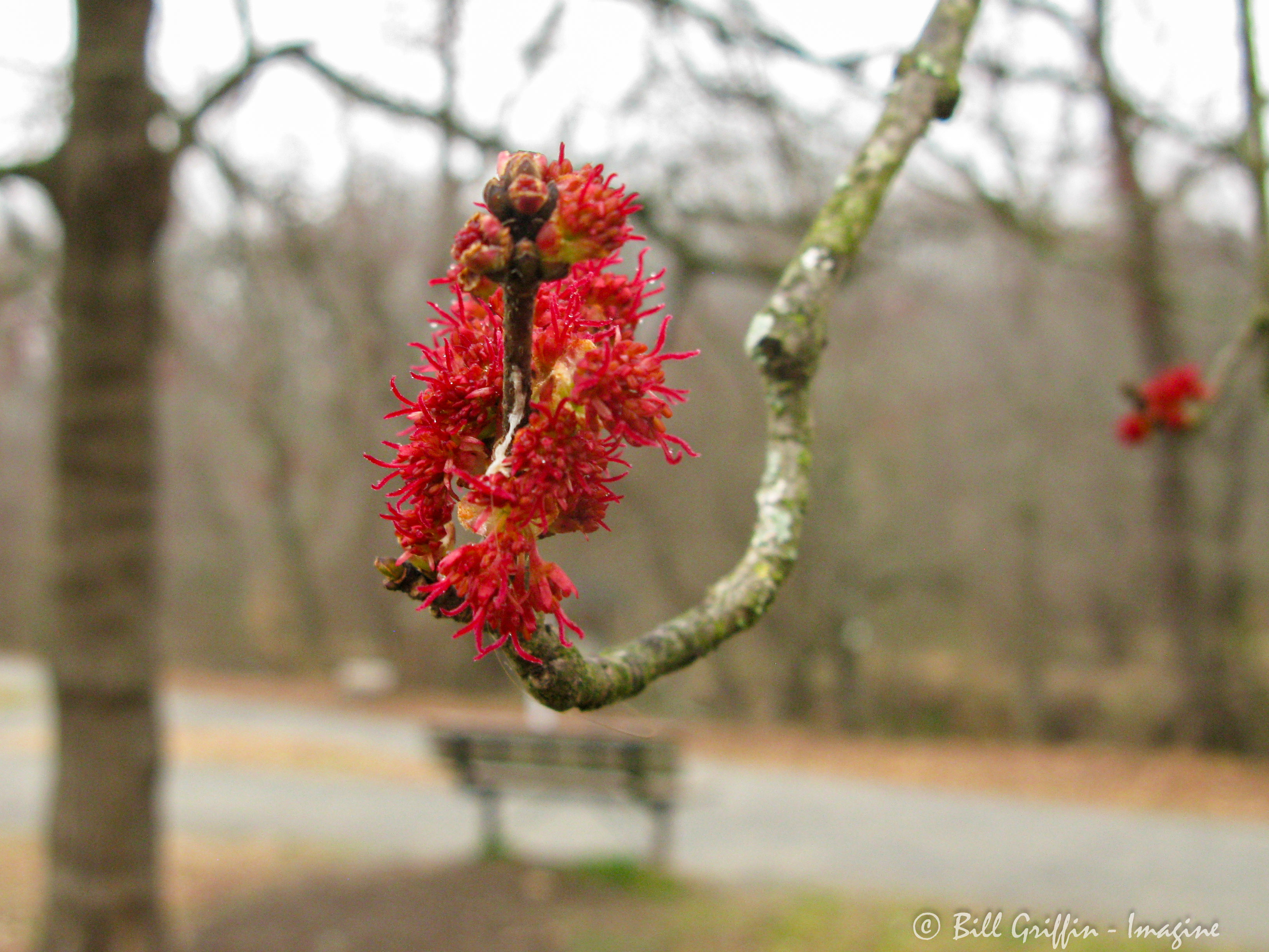
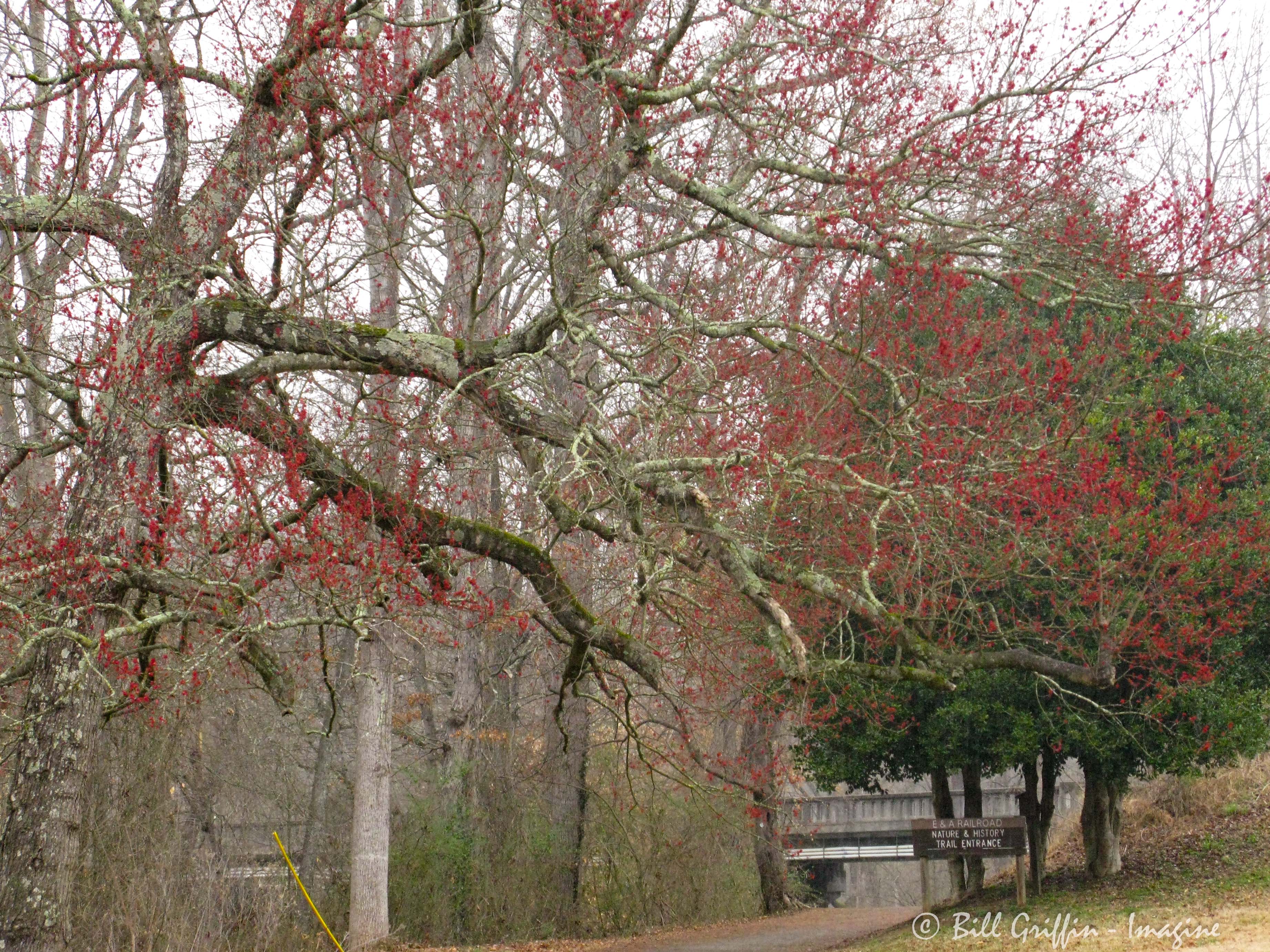
Feb 20, early morning drive: slant light across the fields sets fire to every third tree along the highway. Dark orange, deep red, their crowns glow, a bright haze of flowers at the tips of a million twigs. Almost Spring, and the first maples are blooming.
 . 
Witch hazel has dropped her petals, spent; now maple lifts the baton. Here in the Southeastern USA, maple is one of the earliest trees to bloom. Blossom bud break is triggered in mid-February, primarily by lengthening daylight regardless of weather, weeks before the leaf buds swell and burst. Check the pollen burn in your eyes and nose – you’ll know when those flowers have opened.
 . 
As opposed to most garden flowers which present both pistil and stamen in the same bloom (namely bisexual), maple is, like many trees, monoecious – there are separate male flowers and female flowers on the same tree, even on the same stem. Male red maple flowers look like little ruby crowns of spiky stamens; the female flowers are a bouquet of drooping red pistils.
 . 
But it gets trickier. Some red maples bear only male flowers, while others bear only female (this separation termed dioecious). And individual trees can shift. One year a tree may be male, the next year half and half, the following year all female. The prevalence of Male vs. Female flowers doesn’t seem to be either a cause or an effect of the overall health of the tree. Why?! Why do they do this? What purpose does all this variability serve the tree or the community of red maples?
 . 
I don’t know but the tree knows. Perhaps it’s communicating with all its neighbor maples through its underground network of mycorrhizal fungus, collaborating to decide who’s going to make lots of pollen this year and who’ll make the seeds (and maples do make lots of those little winged seeds). Perhaps their network extends throughout the local woodland and into the next county. Acer rubrum is one of the most plentiful trees east of the Mississippi, from Newfoundland to Florida. Perhaps it creates one vast collective knowing, guiding the roots, the bole, the twigs that will bud into flowers, male or female. Perhaps.
 . 
February into March, every morning the scarlet halo expands. Every day we’re closer to Spring. Every afternoon more sneezes and water from my eyes. Glorious! I trust those maple trees utterly – they certainly know what they’re doing.
 . 
 . 
❦ ❦ ❦
 . 
Mirror Images
 . 
Sliding into a booth,
leather cool to my legs,
we take menus in hand;
we glance around,
tempted by lavish meals
rising before other patrons.
An adjacent mirrored wall
makes the tavern seem
twice its size, twice as lively.
 . 
Across smooth Formica,
you sip ice water,
watching as your doppleganger
tucks a wayward wisp of hair
into her head-scarf.
Maybe that’s an alternate universe,
you say, and this table,
our point of intersection.
Maybe while we grow older, 
grayer, wiser perhaps, 
they grow younger
healthier, more vital and able.
 . 
We toast to what’s possible,
to friendship, regardless.
Condensation drips from our tumblers,
while frost still clings to those
of our glassy companions.
 . 
Marilyn Hedgpeth
from The Lightness of Reprieve, Finishing Line Press, Georgetown, KY; © 2024
 . 
❦ ❦ ❦
 . 
There is, after all, no reprieve. This morning as we’re talking to the palliative care nurse who is  interviewing my mother, my father asks, “Does everyone end up in Hospice?” Or did he say, “Will I end up in Hospice?” It’s a fair question, even for someone not 97 years old. Every year that passes, Dad announces he’s planning to live five more years. One may hope, but perhaps one shouldn’t plan on it.
 . 
The title poem in this first collection by Marilyn Hedgpeth, The Lightness of Reprieve, confronts this reality. Marilyn’s friend will die of cancer very soon and yet the two of them are surprised to share a vibrant afternoon together; Marilyn’s cousin might have died from her heart condition but now feels reborn; Marilyn returns home to confront the death of a beautiful bird on her own doorstep. Other poems throughout the book touch upon our mortality from many different angles, sometimes head on, sometimes in metaphor and with the lightest touch of benediction. I sense a deep abiding theme of sharing. We rarely share with each other this common knowledge that our lives will most definitely end; what we do share is stories and a gift of ripe strawberries; imagination and laughter; silent moments of togetherness; prayer.
 . 
And in sharing don’t we experience reprieve? These are not poems of grief for time lost. These are poems of celebration for time shared. Marilyn has no doubt sat with the bereaved many, many times in her years as a minister, but this is not a book of counsel. These are simply poems of our simple human commonality. I step into the poems and accept my own sadness – sadness lifts as it is borne by many other shoulders. The yoke is not removed from me, but for a few steps along this journey I might almost imagine its lightness.
 . 
 
Marilyn Hedgpeth recently retired as a Presbyterian (USA) Minister of Word and Sacrament after 24 years of “preaching / teaching / leading / loving life.” The Lightness of Reprieve is available from Finishing Line Press HERE
 . 
 . 
❦ ❦ ❦
 . 
Last Leaf
(with a nod to O. Henry)
 . 
One Final Rusty Leaf
clings to the dogwood tree
outside our bedroom window.
Resisting the wind’s wrestling,
it beckons me back to a time
when I painted a single leaf
on our patio wall:
my Hail Mary attempt
to prolong the life of my father
as modern medicine failed,
as the leaves fell.
 . 
Desperate to bring him hope;
venturing outside the boundaries
of my own knowledge and faith,
I scheduled an appointment
with a local healer, Chief Two Trees.
But when travel became impossible,
I resorted to that lone leaf
and a no holds barred prayer.
 . 
After he died, I continued to paint,
self-medicating stroke by stroke,
adding to my winter wall-garden:
fern, forget-me-not, bleeding heart,
wisteria, live-for-ever;
each new leaf, petal, blossom,
balm to my wound.
 . 
Marilyn Hedgpeth
from The Lightness of Reprieve, Finishing Line Press, Georgetown, KY; © 2024
 . 
❦ ❦ ❦
 . 
 . 
2020-06-11a Doughton Park Tree

Read Full Post »

 . 
[with 3 poems from Tar River Poetry]
 . 
Submersible
 . 
+++ “Red Sky at Morning”
++++++ – for Peter Makuck
 . 
All day and into the evening sullen rain has bucketed dow upon us,
and I think of Peter and the blue-black coastal squalls purpling seaward.
 . 
Ignoring heavy weather is what natives do on Emerald Isle. Years ago
I failed to talk him and Phyllis into fleeing Hurricane Florence, a monster
 . 
storm grinding on Wilmington. Likewise, I used to remind my rother
at Kitty Hawk, half-joking, that he lived in the middle of the god-damned
 . 
Atlantic Ocean. He never listened either – even after his son refused
evacuation from Hurricane Isobel and almost drowned inside their cottage
 . 
with his loyal dog and bobbing bamboo furniture. Tenaciously, Peter and
Phyllis have been anchored to their apartment for years, weathering cancer
 . 
treatments and the Pandemic. Finally – like my father decades ago –
Peter had had enough of chemo, remission, drug cocktails and radiation,
 . 
so six weeks back he stopped. Meanwhile the world obsesses over five men
trapped in the submersible Titan, its only hatch bolted from the outside and
 . 
the seven ways it’s supposed to shed weight and resurface from its great drop
down to Titanic’s ghost spines. The one porthole is small. They’re out of air.
 . 
Peter too has begun a long descent through the murky waters of memory,
morphine, and goodby to land finally (I hope) upon the soft silt of forever.
 . 
Everyone’s half-waiting for the last storm to fade and for Peter – teacher, poet,
and sailor – to resurface and note with delight, again, a red sky at night.
 . 
Don Ball
from Tar River Poetry, Volume 63 Number 1, Fall 2023, Greenville NC.
 . 
❦ ❦ ❦
 . 
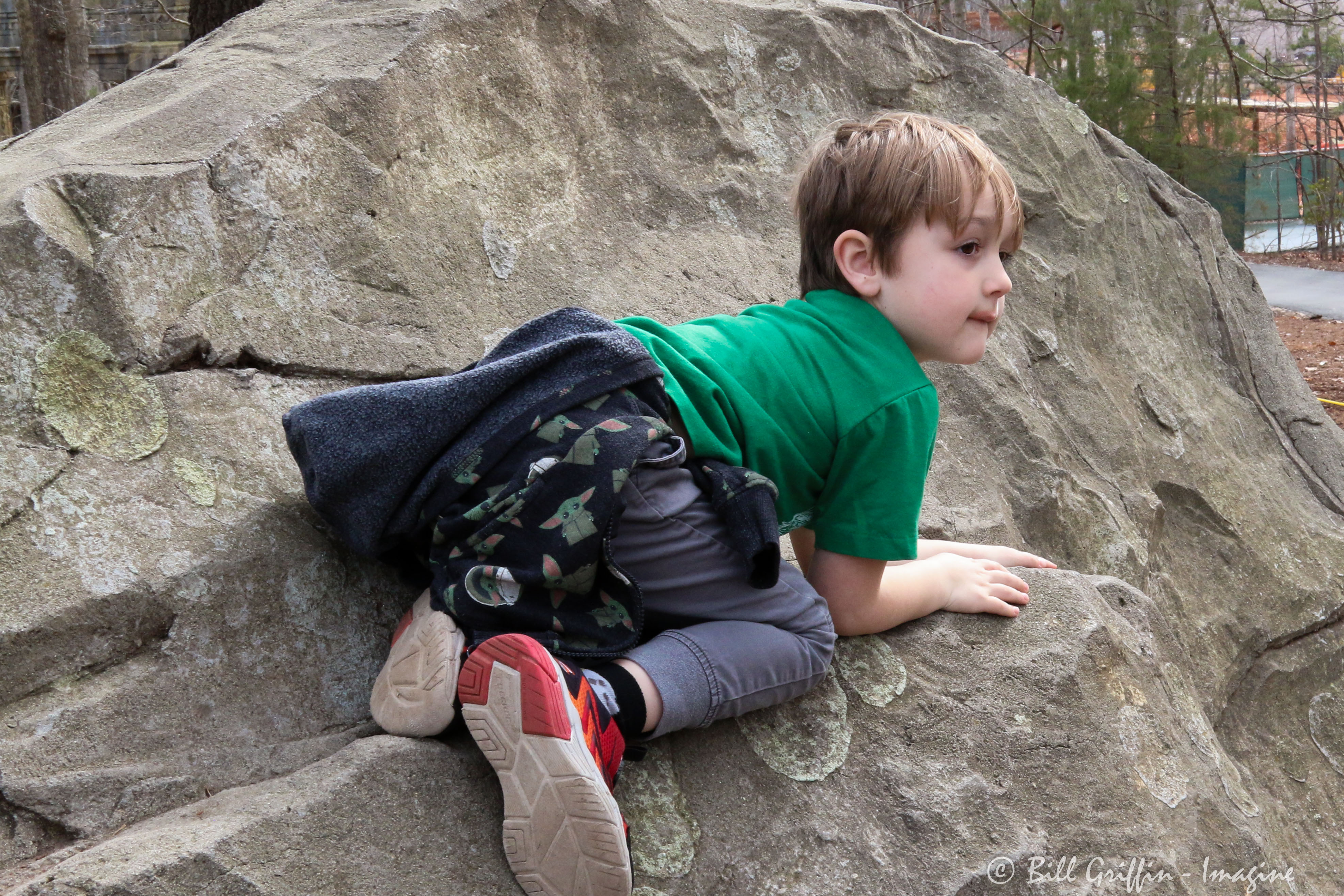
As soon as he hops from the car he’s Tyrannosaurus, miniature dangling forelegs, ferocious jaw gaping as he swivels his head side to side, Linda and me his prey. While we wait for food Chameleon appears, thin compressed lips, deliberate robot-like ratcheting gait, front digits at right angles all asplay. Later we interrupt our walk for him to climb the big rock, Gila Monster, but then he elongates his body along a fissure and becomes Chuckwalla.
 . 
Boys are animals. This boy, though, is the master of animals. Not only in transforming himself one into another but also in the thousand and one details he can tell us about their lives and characteristics. We imagine his kindergarten teacher’s eyebrows rising higher and higher at the revelations he pours forth. And what is the best place to really mix it up with animals? Besides, that is, the back yard – bird feeders, bunnies, snakes, hens – and walks along the greenway – deer, skinks, herons, eagles? Well, of course the North Carolina Zoological Park!
 . 
This is the second straight year we’ve spent my birthday at the Zoo with Bert. And with about a thousand other boys and girls of every possible age, shape, size, and color. Come to the Zoo and see the wild children! What other place can keep kids walking for hours and miles with minimal meltdowns? (And what other place features Polar Bear pee and Gorilla poop, fascinating stuff.) Just pack plenty of snacks and you won’t hear the first whine. And while we adults are rewarded minute by minute with Bert’s company, it’s only fair to end the day with one final reward for him at the gift shop. Another addition to the home menagerie. Next time we’re together, I’ll be sure to keep my fingers to myself when Boy Snapping Turtle meets me at the door.
 . 
 . 
❦ ❦ ❦
 . 
The Dead
 . 
We want to button them to us,
wear them like clothes. We want
to savor our morning café au lait
with them, hold yoga poses,
walk dogs, skateboard, eat sushi,
rake leaves, stream movies, tango
dribble basketballs with them.
We want them to ride beside us,
windows down, singing
along with our favorite playlists.
We want to tuck them in books
to mark our place, jingle them
in our pockets, lucky coins,
hook them over our arms
like umbrellas to keep us dry.
Coming home at night, we want
the porchlight’s yellow halo
to mean they’re waiting up.
As our key turns the lock,
we pray they’ll call out to us
from the empty rooms
of our dark house.
 . 
Janis Harrington
from Tar River Poetry, Volume 63 Number 1, Fall 2023, Greenville NC.
 . 
❦ ❦ ❦
 . 
I first immersed myself in Peter Makuck’s poetry when I was poet-in-residence at the NC Zoo in 2012. I was working on the Poetry of Conservation project, selecting poems by North Carolina writers that might be displayed in the park, and I also published daily posts of my observations (spending all day every day in the Zoo – it doesn’t get better than that!). In my very first post I featured Peter’s poem, My Son Draws an Apple Tree, a beautifully simple poem that cuts to the truth of the bittersweet relationship between father and son. Peter’s collection in which the poem appears, Long Lens, is filled with generous, haunting, contemplative recollections and themes.
 . 
Peter Makuck founded Tar River Poetry and served as its editor for decades during his tenure at East Carolina University. The current issue arrived this week [vol 63, nr 1, fall 2023] and is dedicated to him – he died last year at the age of 83. Peter inspired me through his writing but equally through his generosity and friendship. Somehow we struck up an email correspondence through the years, first about poetry, then about the NC coast, nature sightings, just stuff we discovered we had in common. Even when wearing his editor’s hat – and I have accumulated more rejections than acceptances from him and Luke Whisnant, the current editor – he was never anything but encouraging and giving of himself. He would have liked me to believe that I, even I, could write poetry as worthy as his own.
 . 
 . 
Tar River Poetry is a journal of national stature and reputation, but the three poems I’ve featured today are all by North Carolina writers who appear in this current issue (the wonderful poem One Year Old by Rebecca Baggett is also in this issue but space constraints etc.). Check out TRP and join me in subscribing HERE
 . 
Long Lens by Peter Makuck is available HERE. Learn more about Peter and his other books HERE
 . 
 . 
❦ ❦ ❦
 . 
Picking Up Trash with My Sister
on Crab Orchard Road
 . 
She plunges a foot into the dry ditch,
tosses cans, plastic bottles, empty
cigarette packs onto the gravel road
so we can sort them into garbage
and recycling. As she works she asks,
Is this poison ivy? Is this?, trusting me
to protect her as I’ve trusted her since my beginning,
older sister in pictures at ages five and three,
reading to me as we sit on the sofa,
feet sticking straight out, book open in her lap,
pink cat’s eye classes she pushed with one finger
back up her nose.
 . 
And later, at nine and eleven, trying
to sooth with the only stories that made sense:
we’re fleeing the potato famine in Ireland
or Nazis coming to take us away
that morning we heaped dolls into blankets,
shoved clothes into flowered suitcases, fearing
each floorboard creak might be our father
come home to carry out night’s drunken threat
to shoot our mother.
 . 
My sister stomps a beer can flat,
drops it in her bag, slips a Styrofoam cup
into mine. Who would do this? she says,
shaking her head, pushing dark purple glasses
with one finger back up her nose. She twists the lid
from a water bottle, pours the last sip
over the roots of a wilted aster
 . 
Pam Baggett
from Tar River Poetry, Volume 63 Number 1, Fall 2023, Greenville NC.
 . 
 . 
 . 
❦ ❦ ❦
 . 
IMG_6944
 . 

Read Full Post »

« Newer Posts - Older Posts »