Feeds:
Posts
Comments

Archive for the ‘ecology’ Category

 . 
April 22, 2024
 . 
Whatever attributes we claim as unique to the human species, such as our propensity for art and science and spirituality – these are gifts of the ground. Curiosity and exploration and awe require a world – a ground – to grow up from and in conversation with.
++++++ Eileen Crist, ecologist, 4/22/24, in The Sun, December 2020
 . 
❦ ❦ ❦
 . 
In Memoriam Mae Noblitt
 . 
This is just a place:
we go around, distanced,
yearly in a star’s
 . 
atmosphere, turning
daily into and out of
direct light and
 . 
slanting through the
quadrant seasons: deep
space begins at our
 . 
heels, nearly rousing
us loose: we look up
or out so high, sight’s
 . 
silk almost draws us away:
this is just a place:
currents worry themselves
 . 
coiled and free in airs
and oceans: water picks
up mineral shadow and
 . 
plasm into billions of
designs, frames: trees,
grains, bacteria: but
 . 
is love a reality we
made here ourselves—
and grief—did we design
 . 
that—or do these,
like currents, whine
in and out among us merely
 . 
as we arrive and go:
this is just a place:
the reality we agree with,
 . 
that agrees with us,
outbounding this, arrives
to touch, joining with
 . 
us from far away:
our home which defines
us is elsewhere but not
 . 
so far away we have
forgotten it:
this is just a place.
 . 
A. R. Ammons (1926 – 2001)
from A Coast of Trees by A.R. Ammons. Copyright © 1981 by A.R. Ammons.
 . 
Shared by Jane Hazelman, Elkin, NC, who writes:
 . 
My only comments would be… and it’s interesting, now that I think carefully about it…
This poem caught me at time when I was grieving the loss of my father who died the same week my family moved to NC…. I felt the ground beneath my feet dropping away… I needed an anchor and somehow the poem nudged me to connect my spirit to the natural world of spider silk, streams and trees, breezes – that comfort was all around me, holding me to its self.
 . 
++++++ Jane
 . 
❦ ❦ ❦
 . 
Erase the lines: I pray you not to love classifications.
The thing is like a river, from source to sea-mouth
One flowing life.
++++++ Robinson Jeffers
 . 
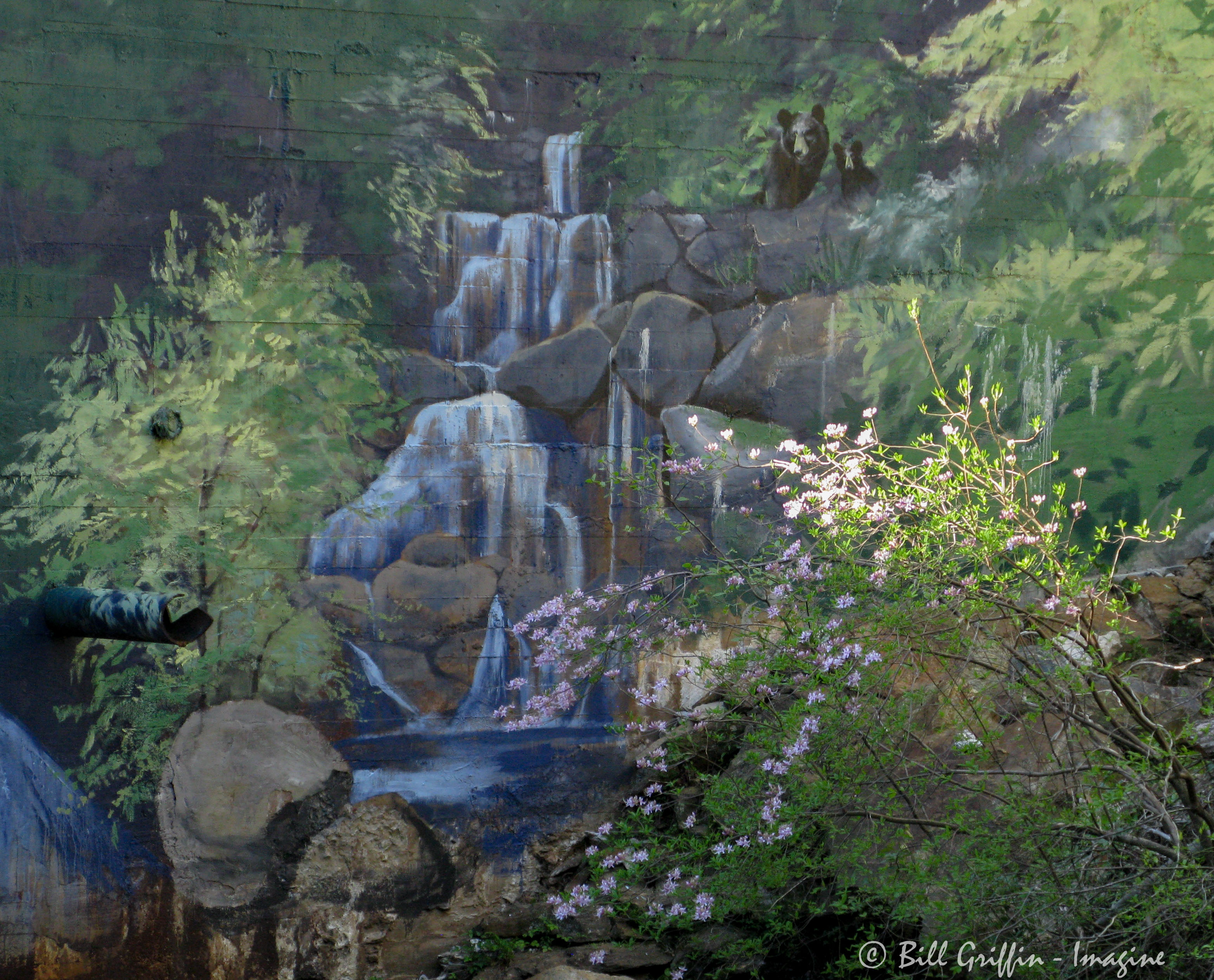
Klondike Lake Dam, mural by Eva Crawford

 . 
❦ ❦ ❦
 . 
The Beauty of Things
 . 
To feel and speak the astonishing beauty of things—earth, stone and water,
Beast, man and woman, sun, moon and stars—
The blood-shot beauty of human nature, its thoughts, frenzies and passions,
And unhuman nature its towering reality—
For man’s half dream; man, you might say, is nature dreaming, but rock
And water and sky are constant—to feel
Greatly, and understand greatly, and express greatly, the natural
Beauty, is the sole business of poetry.
The rest’s diversion: those holy or noble sentiments, the intricate ideas,
The love, lust, longing: reasons, but not the reason.
 . 
Robinson Jeffers (1887 – 1962)
from Poetry, Vol. 77, No. 4, Jan., 1951
 . 
Shared by Catherine Carter, Cullowhee NC, who writes:
 . 
I’ve selected this one because lately I’ve been thinking a lot about paying attention as a holy act, maybe THE holy act, and, if not “the sole business” of poetry, at least a large part of it.  So much of what we lose and destroy is because we won’t or can’t give attention; we think of the tree we cut as “ordinary”, as “just” a tree, of the insects we poison as just flaws in our experience of the world, as if our experiences of the world were all that mattered. 
 . 
Along those lines, I’m also including the final poem from my book, Larvae of the Nearest Stars, “The Promise”.  That poem first appeared in Still: The Journal, October 2017, and was then reprinted in the collection.  Its tone is very different, and I certainly wasn’t thinking about “The Beauty of Things” when I wrote it…but it’s basically promising to do what Jeffers is talking about—paying attention to what’s all around us, what we sweep away or walk right over or destroy without ever knowing it because we think it’s “ordinary.”  And I thought of this one, Bill, because of your wonderful post about the tiny, tiny flowers.
 . 
+++++++ Catherine
 . 
 . 
The Promise
 . 
Life-root, blazing out in your golden rags.
Killdeer, skimming the soccer field,
pealing the glad word of May.  Soft lamb’s
quarter, powdered with pewter dust
that might’ve come from the Horsehead
Nebula, putting spinach to shame
with your mineral riches.  Wood
thrush trilling your deep flute-
notes from the high canopy, almost never
seen.  Tiny henbit, more glamorous
and sexy in your freckled orchid pink
than Marilyn Monroe’s…et cetera.
Et cetera.  The list goes on longer
and deeper than any human voice,
and how many hear any of you
over the clamor of ego and ad,
how many know you were ever
here? Nor can I save you
when they come with the mowers,
the poisons, nor make the world
plant milkweed for its true-born monarchs.
What I can do is what I am
doing:  look for you. Listen
as you proclaim your many
names in all the tongues
of earth.  Speak those names back:
as long as lichens
star this mountain’s boulder-bones
in flat seaglass rosettes, so that even the rock
blooms some wordless joy
into the day’s high air,  I will
not cease.  I will go on
doing my work in this world.
 . 
Catherine Carter
from Larvae of the Nearest Stars, LSU Press.© 2019
 . 
❦ ❦ ❦
 . 
Both from an ecological perspective and from Genesis’ point of view, goodness resides in the community, the web of life, in the relations of the whole biosphere.
++++++ Rabbi Ellen Bernstein
 . 
Look at the animals roaming the forest: God’s spirit dwells within them. Look at the birds flying across the sky: God’s spirit dwells within them. Look at the tiny insects crawling in the grass: God’s spirit dwells within them.
++++++ Pelagius (4th century Celtic theologian)
 . 
 . 
❦ ❦ ❦
 . 
Miracles
 . 
Why, who makes much of a miracle?
As to me I know of nothing else but miracles,
Whether I walk the streets of Manhattan,
Or dart my sight over the roofs of houses toward the sky,
Or wade with naked feet along the beach just in the edge of the water,
Or stand under trees in the woods,
Or talk by day with any one I love, or sleep in the bed at night with any one I love,
Or sit at table at dinner with the rest,
Or look at strangers opposite me riding in the car,
Or watch honey-bees busy around the hive of a summer forenoon,
Or animals feeding in the fields,
Or birds, or the wonderfulness of insects in the air,
Or the wonderfulness of the sundown, or of stars shining so quiet and bright,
Or the exquisite delicate thin curve of the new moon in spring;
These with the rest, one and all, are to me miracles,
The whole referring, yet each distinct and in its place.
 . 
To me every hour of the light and dark is a miracle,
Every cubic inch of space is a miracle,
Every square yard of the surface of the earth is spread with the same,
Every foot of the interior swarms with the same.
 . 
To me the sea is a continual miracle,
The fishes that swim—the rocks—the motion of the waves—the
        ships with men in them,
What stranger miracles are there?
 . 
Walt Whitman (1819 – 1892)
Collected in The Golden Treasury of Poetry ; in the public domain.
 . 
Shared by Nancy Barnett, Eustis FL, who writes:
 . 
My brother Tom was a wonderful gift giver. We had lost our brother Frank in June 1962 when I was 11 years old. Tom gave me a book during that time by Louis Untermeyer, The Golden Treasury of Poetry (1959). 
 . 
When I went back to school in the fall our 6th grade teacher Mrs. Heinlein asked the class to bring something to read aloud and I chose Miracles from Untermeyer’s collection. I loved the image of nature and the hopefulness of life being seen as a miracle. I knew nothing about Walt Whitman then. (The version in The Golden Treasury of Poetry was somewhat sanitized for the young reader.)
 . 
The Poet Laureate Joy Harjo noted that her love of poetry was fostered by the very same book.
 . 
++++++ Nancy
 . 
 . 
❦ ❦ ❦
 . 
Indeed, one outcome of my watch at the mandala has been to realize that we create wonderful places by giving them our attention, not by finding ‘pristine’ places that will bring wonder to us.
++++++ David George Haskell
 . 
from The Forest Unseen: A Year’s Watch in Nature, in which Dr. Haskell spent a year visiting almost every day a small circle of ground in the southern Appalachian forest, his mandala, and simply opened himself to its presence.
 . 
❦ ❦ ❦
 . 
Crane Migration, Platte River
 . 
I am in danger of forgetting the cranes,
their black wavering lines in the sky,
how they came as if from the past,
how they came of one mind,
wheeling, swirling over the river.
I am in danger of losing
the purling sound they make,
and the motion of their long wings.
We had stopped the car on the river road
and got out, you and I,
the wind intermittent in our faces
as if it too came from a distant place
and wavered and began again, gusting.
Line after line of cranes
came out of the horizon,
sliding overhead.
The voices of cranes
harsh and exciting.
Something old in me answered.
What did it say? Maybe it said Kneel.
I almost forgot the ancient sound,
back in time, back, and back.
The road, the two of us at the guardrail,
low scraggle of weeds flattening and rising
in wind. This is what I must retain:
my knees hit the damp sand of the roadside.
This is what I remember:
you knelt too. We were wordless together
before the birds as they landed on the sandbars
and night came on.
 . 
Marjorie Saiser
from The Woman in the Moon, University of Nebraska Press, Backwaters Series, © 2018
 . 
Shared by Michael Beadle, Raleigh NC, who writes:
The opening line to this poem from the anthology The Wonder of Small Things: Poems of Peace and Renewal is a call to us all:  against forgetting. Against ignoring the beauty that startles us. It dares us to step deeper into the mystery, turns us into wide-eyed children again as we look up at the heavens, peer into a clear lake, gaze across a field or behold a magnificent tree or bird. This poem reminds us that nature is within range, that it has not disappeared (yet), though we humans are doing our damnedest to foul up the sky, poison the waters, plunder the earth for profit. This poem is about holding ourselves still in that moment of awe, stopping our busy lives to listen to the wind, to the flap of wings, to the crunch of gravel, the swish of tall grass. In such moments of grace and wonder, we are, quite literally, brought to our knees as we show respect for the world around us, the world that breathes into us, the world we have to be reminded of from time to time that was here long before we were and will be here long after we are gone. 
 . 
++++++ Michael
 . 
 . 
❦ ❦ ❦
 . 
I go to Nature to be soothed and healed, and to have my senses put in tune once more.
++++++ John Burroughs, naturalist
 . 
I believe that there is a subtle magnetism in Nature, which, if we unconsciously yield to it, will direct us aright.
++++++ Henry David Thoreau, fromWalking
 . 
Teach the children. We don’t matter so much, but the children do. Show them daisies and the pale hepatica. Teach them the taste of sassafras and wintergreen. The lives of the blue sailors, mallow, sunbursts, the moccasin-flowers. And the frisky ones – inkberry, lamb’s-quarters, blueberries. And the aromatic ones – rosemary, oregano. Give them peppermint to put in their pockets as they go to school. Give them the fields and the woods and the possibility of the world salvaged from the lords of profit. Stand them in the stream, head them upstream, rejoice as they learn to love this green space they live in, its sticks and leaves and then the silent, beautiful blossoms. Attention is the beginning of devotion.
++++++ Mary Oliver
 . 
❦ ❦ ❦
 . 
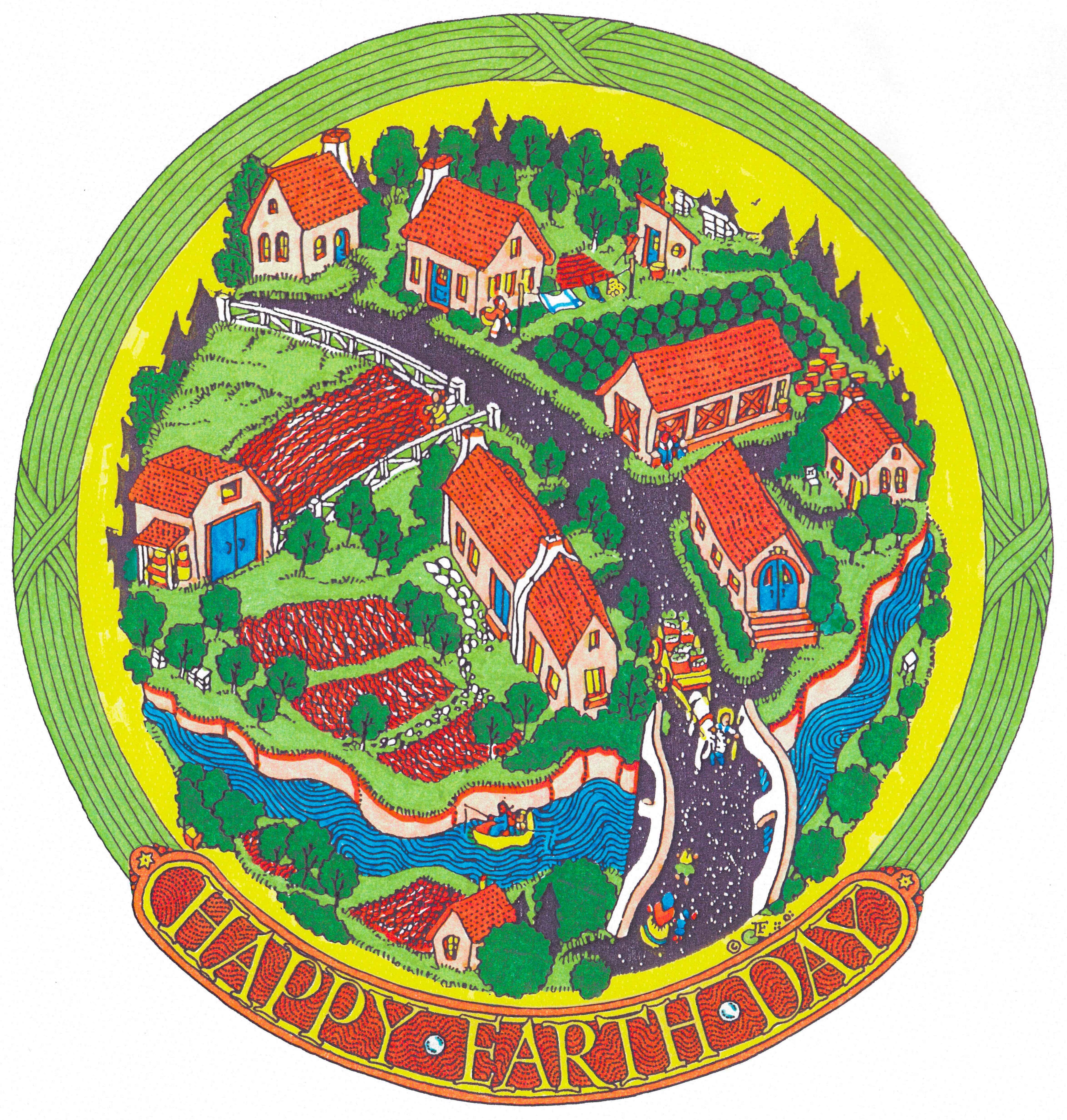
To celebrate EARTH DAY 2024 we are featuring seven posts of poems submitted by readers – poems by William Blake to Walt Whitman, Robinson Jeffers to A.R.Ammons to Linda Pastan, and by a number of contemporary poets. Check in every day or two – connect to the earth and to each other!
 . 
❦ ❦ ❦
 . 
 .
 . 
IMG_0880, tree

Read Full Post »

 .
 . 
April 21, 2024
 . 
For, lo, the winter is past, the rain is over and gone;
The flowers appear on the earth, the time of the singing of birds is come, and the voice of the turtledove is heard in our land;
The fig tree putteth forth her green figs, and the vines with the tender grape give a good smell.
Arise, my love, my fair one, and come away.
++++++ Song of Solomon 2:11-13
 . 
❦ ❦ ❦
 . 
I Open the Window
 . 
What I wanted
wasn’t to let in the wetness.
That can be mopped.
 . 
Nor the cold.
There are blankets.
 . 
What I wanted was
the siren, the thunder, the neighbor,
the fireworks, the dog’s bark.
 . 
Which of them didn’t matter?
 . 
Yes, this world is perfect,
all things as they are.
 . 
But I wanted
not to be
the one sleeping soundly, on a soft pillow,
clean sheets untroubled,
dreaming there still might be time,
 . 
while this everywhere crying
 . 
Jane Hirshfield
from The Asking, Penguin/Random House, © 2023
 . 
Shared by Debra Kaufman, Mebane, NC, who writes:
 . 
I love the subtlety in every poem by Jane Hirsfield. In her new, profound collection, The Asking, every poem is a kind of inquiry that allows readers to join her in generously observing the world and all its beings. She is never assuming, she investigates even the smallest of gestures or creatures, to stay open each day to possibilities, while still acknowledging the darkness.
 . 
++++++ Debra
 . 
❦ ❦ ❦
 . 
. . . the road is found in the persistent walking of it . . .
++++++ Jane Hirshfield
 . 
May your trails be crooked, winding, lonesome, dangerous, leading to the most amazing view.  May your mountains rise into and above the clouds.
++++++ Edward Abbey
 . 
❦ ❦ ❦
 . 
Fall Changes
 . 
I left those three crows
the last corn in my garden,
and not one thanked me.
 . 
++++++ *
 . 
Bright August sunlight
but just north of the woodpile
a November wind.
 . 
++++++ *
 . 
September begins
with a vee of geese flying
and two fat, slow frogs.
 . 
++++++ *
 . 
All night fallen leaves
pile up under the maples—
old thoughts, cast away.
 . 
++++++ *
 . 
A ragged black glove
high in the oak’s bare branches
flies away, cawing.
 . 
++++++ *
 . 
Through the leafless hedge
a neighbor I’ve never met
waves from her window.
 . 
Patricia Hooper
from Wild Persistence, University of Tampa Press, © 2019
 . 
Shared by David Radavich, Charlotte NC, who writes:
 . 
I greatly admire, Patricia Hooper; Fall Changes is from her book Wild Persistence.  I love the quiet interactions in this poem between the human and the non-human natural worlds – so comfortable and easy, so assumed.  The haiku portraits are subtly varied yet intimately linked, and the mere contemplation of trees and birds and frogs leads the witnesses to greet each other in friendly neighborliness even though they are strangers.  This is a gentle masterpiece of evocative scene-painting.
 . 
 The other poem is called New Emigrants from my book  The Countries We Live In (Main Street Rag, 2012).  This is a more incisive critique of climate change and human greed.
 . 
++++++ David
 . 
 . 
New Emigrants
 . 
These maples have lived
here all their lives,
 . 
turned colors by the season,
offered shade, been
neighborly
 . 
on the edge of the city.
 . 
Who would have thought,
after all this time,
 . 
air could become
the enemy?
 . 
Earth has allied itself
with terrorists
 . 
who decry
the wickedness of weeds.
 . 
Water streams in
under cover of drought,
 . 
fire climbs
out with its fierce
fingers.
 . 
Now some are asking
whether it might be better
for the old limbs
 . 
to give place
to homes and people
and their saving chemicals.
 . 
Already I see wise ones
taking their leaves
north to where ice melts
into soft angels.
 . 
David Radavich, Charlotte, NC
from The Countries We Live In, Main Street Rag Publishing, Charlotte NC © 2012
 . 
 . 
❦ ❦ ❦
 . 
i thank You God for most this amazing
day:  for the leaping greenly spirits of trees
and a blue true dream of sky; and for everything
which is natural which is infinite which is yes.
++++++ e.e.cummings
 . 
❦ ❦ ❦
 . 
Voices of the Air
 . 
But then there comes that moment rare
When, for no cause that I can find,
The little voices of the air
Sound above all the sea and wind.
 . 
The sea and wind do then obey
And sighing, sighing double notes
Of double basses, content to play
A droning chord for the little throats—
 . 
The little throats that sing and rise
Up into the light with lovely ease
And a kind of magical, sweet surprise
To hear and know themselves for these—
 . 
For these little voices: the bee, the fly,
The leaf that taps, the pod that breaks,
The breeze on the grass-tops bending by,
The shrill quick sound that the insect makes.
 . 
Katherine Mansfield
from Poems, London: Constable, © 1923 and New York: Alfred A. Knopf, © 1924
 . 
Shared by Tina Baumis, Goose Creek, SC, who writes:
 . 
Ms. Mansfield enlarged the smallest of movements and voices in a Georgia O’Keefe style, drawing us into the captivating moments she observed when drowning out the sea and wind.  We too, can relate to the drone of the bigger sounds in our day to day lives and rediscover wonder, peace, and joy of nature when we allow ourselves time to immerse into nature’s voices. “The leaf that taps, the pod that breaks, The breeze on the grass-tops bending by,” are lines that speak to me.
 . 
I took a walk in the woods
and came out taller than the trees.++++++ Henry David Thoreau
 . 
This quotation elevates your spirits inspiring you to go outdoors to appreciate the magic we often overlook during our full days. Recharge. Serenity. 
 . 
The California Urban Forest Council holds an annual haiku themed contest.  I was fortunate to have my haiku listed on their Facebook pages. On February 17th, 2024, my haiku was posted. An attempt to evoke feelings as Mr. Thoreau’s quote.
++++++ Tina
 . 
positivity
gather under canopy
mood swings lift with breeze
 . 
Christina (Tina) Baumis
 . 
 . 
❦ ❦ ❦
 . 
We cannot be truly ourselves in any adequate manner without all our companion beings throughout the earth.
++++++ Thomas Berry
 . 
❦ ❦ ❦
 . 
Finally, the southwestern US is home to several species of scolecophidian blindsnakes in the genera Rena and Leptotyphlops. These are tiny and have undifferentiated body scales, meaning that all scale rows around the entire body (including the underside) are the same width. They are iridescent and extremely difficult to count, which has given rise to one of my all-time favorite quotes from a scientific paper: “We castigate the ancient lineage that begat Liotyphlops, for it is obviously the worst designed snake from which to obtain systematic data” (Dixon & Kofron 1983). 
 . 
❦ ❦ ❦
 . 
To celebrate EARTH DAY 2024 we are featuring seven posts of poems submitted by readers – poems by William Blake to Walt Whitman, Robinson Jeffers to A.R.Ammons to Linda Pastan, and by a number of contemporary poets. Check in every day or two – connect to the earth and to each other!
 . 
❦ ❦ ❦
 . 
 . 
2018-02-09 Doughton Park Tree . 

Read Full Post »

 . 
April 19, 2024
 . 
…the path to heaven 
doesn’t lie down in flat miles. 
It’s in the imagination 
with which you perceive 
this world 
and the gestures 
with which you honor it.
++++++ Mary Oliver
 . 
❦ ❦ ❦
 . 
Insects with Long Childhoods
 . 
June bug, stag beetle, cicada –
three, seven, thirteen years as larvae
 . 
feasting underground in the gentle
rot of roots and castoffs, gone generations,
 . 
only a few weeks in the light
sharp as the blades of consciousness, incessant
 . 
buzz, cosmic background of loss
threaded through late summer’s throbbing
 . 
days, lush nights, a brevity so full
it must feel like th eternity they came from.
 . 
I have a child who asks a question
of the air’s every hum. He has not learned grief.
 . 
Sky, he says, and shovels soil into his mouth,
let’s it drip out mud.
 . 
Hannah Fries
from ECOTHEO Review, 3/2024
 . 
Shared by Lynda Rush Myers, Durham NC, who writes:
 . 
The poet, Hannah Fries, reminds me of Pattiann Rogers: scientific, technical, yet capturing the dense brevity of her subjects’ lives. The turn of the poem came as a touching surprise.  Every parent can relate.  A child’s word and actions capture his reality. The mother enjoys the unforgettable moment, knowing her son will learn grief all too soon.
 .
++++++ Lynda
 . 
❦ ❦ ❦
 . 
There is only one subject:  what it feels like to be alive.  Nothing is irrelevant.  Nothing is typical.
++++++ Richard Rodriquez, in American Scholar, Spring 2002
 . 
Those who contemplate the beauty of the earth find reserves of strength that will endure as long as life lasts. There is something infinitely healing in the repeated refrains of nature – the assurance that dawn comes after night, and spring after winter. 
++++++ Rachel Carson (1907-1964)
 . 
❦ ❦ ❦
 . 
The Fly
 . 
Little fly,
Thy summer’s play
My thoughtless hand
Has brush’d away.
 . 
Am not I
A fly like thee?
Or art not thou
A man like me?
 . 
For I dance,
And drink, & sing
Till some blind hand
Shall brush my wing.
 . 
If thought is life
And strength and breath,
And the want
Of thought is death,
 . 
Then am I
A happy fly,
If I live
Or if I die.
 . 
William Blake (1757 – 1827)
from Songs of Experience; in the public domain.
 . 
Shared by Paul Karnowski, Asheville NC, who writes:
 . 
I like the connection Blake makes between the narrator and the “trivial” fly.  Humans too easily dismiss the rest of the natural world because we have the ability to “think.”  But it’s the countless thoughtless acts of blind hands – from other humans – that bring about our demise. Life and death connects us all – from the greatest thinker to the lowliest fly. 
 . 
++++++ Paul
 . 
❦ ❦ ❦
 . 
Am I leading the life that my soul, / Mortal or not, wants me to lead is a question / That seems at least as meaningful as the question / Am I leading the life I want to live.
++++++ Carl Dennis, A Chance for the Soul from Practical Gods
 . 
❦ ❦ ❦
 . 
If I Fell
 . 
Crow knows me.
Can see the difference
between me and another.
 . 
Gave me a feather
I keep
in case I need to fly.
 . 
I know Crow
from Blackbird
and Raven
yet wonder
what Crow
would want
to keep
from me.
 . 
Perhaps a token
of my essence
 . 
in case Crow needs
to dream of flying.
 . 
David Dixon
Poetry In Plain Sight 2024, NC Poetry Society
 . 
Shared by Jenny Bates, Germanton, NC, who writes:
 . 
Life is a process of waking up from a long and ancient sleep of the soul. David Dixon embodies this whether he means to or not in his poetry. This poem I chose to send, If I Fell, has also been chosen for 2024 Poetry in Plain Sight through the NC Poetry Society.
As far as my own poem, it is a plea, a prayer that each of us has to fill up the emptiness inside us in different ways…even the Earth. My poem, Conceived and Born is from my Pushcart nominated book, ESSENTIAL.
 . 
++++++ Jenny
 .
 .
Conceived and Born
 .
There’s no suckling here
 .
as though we were
 .
going to get some anyway
 .
The sanctity of Earth is a fast.
 .
The holy presence of prayer a fast.
 .
We are born of a mother that is not
dependent on us.
 .
She is a planet — and a small, fragile
one at that.
 .
Jenny Bates, Germanton NC
from Essential, Redhawk Publications © 2023
 .
 . 
❦ ❦ ❦
 .
And this our life, exempt from public haunt, finds tongues in trees, books in the running brooks, sermons in stones, and good in everything. I would not change it.
++++++ William Shakespeare, As You Like It
 .
❦ ❦ ❦
 .
To celebrate EARTH DAY 2024 we are featuring seven posts of poems submitted by readers – poems by William Blake to Walt Whitman, Robinson Jeffers to A.R.Ammons to Linda Pastan, and by a number of contemporary poets. Check in every day or two – connect to the earth and to each other!
 .
❦ ❦ ❦
 .
 . 
 .

Read Full Post »

« Newer Posts - Older Posts »