Feeds:
Posts
Comments

Archive for the ‘ecology’ Category

 . 
[poems by Veiga Simões, Barbara Conrad, Mary Oliver, Camille Dungy – 
selected and shared by Christina Baumis, David Radavich,
Scott Owens, Bill Griffin] 
 . 
Ao Viandante
(To the Person Who Passes Through This Place)
 . 
You that pass and raise your arm to me
before you hurt me, look at me well.
I am the heat of your home in the cold winter nights.
I am the friendly shade that you find
when walking under the August sun
And my fruits are appetizing freshness
That satisfy your thirst on the way.
I am the friendly beam of your house, the board of your table
the bed in which you rest and the wood of your boat.
I am handle of your hoe, the door of your dwelling
the wood of your cradle and of your own coffin.
I am the bread of goodness and the flower of beauty.
You that pass, look at me well and do no harm.
 . 
Veiga Simões
a tree with a poem on sign beneath it, located in Lisbon, Portugal.
 . 
This poem brings into stark view how we use and harm trees in a final plea from the tree; “You pass, look at me well and do no harm.” The poem certainly made me ponder the consideration of a grove of trees and what they give of themselves for us and our community over generations from their community. As a nature lover who enjoys walks under and among trees, trees had my gratitude already, yet this poem enhanced it even more.  The poem is written almost a caveat, testimonial, or witness statement from the specific tree in Lisbon. The article in which this appeared had a nice side note about the relationship between tree canopies and crime rates, too. – Christina Baumis
 . 
 . 
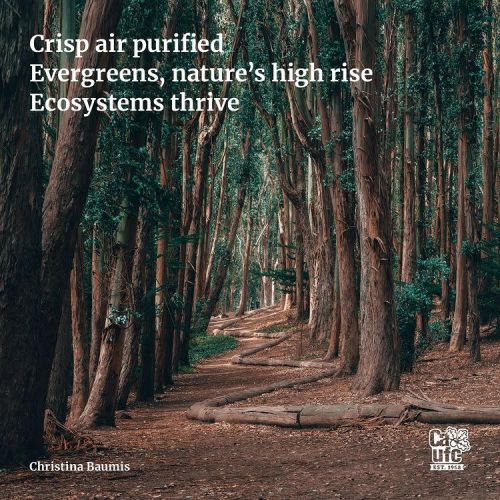
Evergreen trees are like nature’s high rises; their community intermingles to sustain ecosystems as well as us.  Posted on the California Urban Forests Councils’ Facebook Page (published on January 21, 2024) from their Haiku contest 2024.
 . 
❦❦❦
 . 
The last word in ignorance is the man who says of an animal or plant: ‘What good is it?’ If the land mechanism as a whole is good, then every part is good, whether we understand it or not. … To keep every cog and wheel is the first precaution of intelligent tinkering.  – Aldo Leopold
 . 
❦❦❦
 . 
Blue in Winter, Blame the Moon
 . 
+++ after a New York Times article on biological rhythms,
+++ peppered with phrases from the dining section
 . 
Blue in winter, blame the moon, say the scientists
for anyone living dark in the northern latitudes.
 . 
Overeating, sleeping in fits, activity cycles
shifted—even for mutant hamsters and fruit flies.
 . 
We trudge through cabbage season, tongue tingling
at the thought of gumbo and Sazerac, more laissez-faire
 . 
than the fusty French.  Earth spins and the moon
thumps inside our cells.  Trillions of clocks, ticking, ticking.
 . 
The universe feels it.  Some cataclysm must have caused
our nights to topple like this, seasons spliced
 . 
like a butchered hog.  We’re a mélange of earth crust
and asteroid dust—yes, that asteroid,
 . 
ejected into space, continuing as moon, tilting
primordial earth.  We are orbs of something
 . 
we can’t quite claim.  A recipe for stardust.
Chickpeas coming home to roost.
 . 
Barbara Conrad
from There Is a Field, Future Cycle; ©  2018
 . 
I have long been a fan of Barbara Conrad’s poetry, admiring her commitment to social justice causes.  This poem is remarkable for its yoking of the cosmic and the everyday, with climate change radiating in the nexus between galactic forces and routine human activities like eating and sleeping.  Plus lots of colorful imagery you can feel and taste.  The final line is a trenchant joke but also brings the interplanetary down to earth, namely to our dinner tables.  Delicious!  – David Radavich
 . 
 . 
In the New Year
 . 
Ice is on the move—
broken off and floating freely
toward South Georgia Island
with a force to wipe out
indigenous life
and redirect our planet.
 . 
Those of us far away
see mostly waters rising,
rising, claiming
sand and beach houses
and boats of the wealthy
along lapping shores.
 . 
Carving of life
by the power of tides.
 . 
So we arrive at
another year: uprisings,
more ire in politics,
love reduced to islands
under siege,
 . 
we move inward
to protect ourselves—
bold nesting terns
or astronauts
in deepest space.
 . 
David Radavich
from Snapdragon
 . 
❦❦❦
 . 
All ethics so far evolved rest upon a single premise: that the individual is a member of a community of interdependent parts. . . . The land ethic simply enlarges the boundaries of the community to include soils, waters, plants, and animals, or collectively: the land.  – Aldo Leopold
 . 
 . 
❦❦❦
 . 
Wild Geese
You do not have to be good.
You do not have to walk on your knees
for a hundred miles through the desert repenting.
You only have to let the soft animal of your body
love what it loves.
Tell me about despair, yours, and I will tell you mine.
Meanwhile the world goes on.
Meanwhile the sun and the clear pebbles of the rain
are moving across the landscapes,
over the prairies and the deep trees,
the mountains and the rivers.
Meanwhile the wild geese, high in the clean blue air,
are heading home again.
Whoever you are, no matter how lonely,
the world offers itself to your imagination,
calls to you like the wild geese, harsh and exciting –
over and over announcing your place
in the family of things.
 . 
Mary Oliver
from Dream Work, Atlantic Monthly Press; ©  1986.
 . 
One of my favorite poems ever by one of my favorite poets ever. Wild Geese simply reminds me of my place in the intricate web of existence, in the universal community. – Scott Owens
 . 
 . 
Wild and Precious
In Memoriam, Mary Oliver, 1/17/19
 . 
Seen at a distance this time of year
when trees are silhouettes
against a white sky
every shadow, I think,
must be a bird I’d like to identify,
waxwings, falcon, the largest of them
surely a beautiful hawk waiting
to chase a careless squirrel
across the yard and twice
around the trunk of the pecan tree,
rising on perfectly banked wings
so close it could almost reach out
and grasp the tuft of tail fur
dancing behind.
 . 
Often it turns out to be mistletoe,
nest, mere leftover leaves,
but even these speak
of life that was,
that will soon enough return,
and that thankfully always is.
 . 
Mary Oliver, the woman I’ve introduced
to more than 40 years of new students
as one of our greatest living poets,
died today,
but in view of trees, and birds,
and winter skies, and everything
that can be expressed in leaves,
it is impossible to think of her
as ever going away.
 . 
Scott Owens
from Prepositional, Redhawk Publications; © 2022
 . 
❦❦❦
 . 
A philosopher has called this imponderable essence the numenon of material things. It stands in contradistinction to phenomenon, which is ponderable and predictable, even to the tossing and turning of the remotest star. The grouse is the numenon of the north woods, the blue jay of the hickory groves, the whisky-jack of the muskegs, the piñonero of the juniper foothills. – Aldo Leopold
 . 
 . 
❦❦❦
 . 
Trophic Cascade
 . 
After the reintroduction of gray wolves
to Yellowstone and, as anticipated, their culling
of deer, trees grew beyond the deer stunt
of the mid century. In their up reach
songbirds nested, who scattered
seed for underbrush, and in that cover
warrened snowshoe hare. Weasel and water shrew
returned, also vole, and came soon hawk
and falcon, bald eagle, kestrel, and with them
hawk shadow, falcon shadow. Eagle shade
and kestrel shade haunted newly-berried
runnels where mule deer no longer rummaged, cautious
as they were, now, of being surprised by wolves. Berries
brought bear, while undergrowth and willows, growing
now right down to the river, brought beavers,
who dam. Muskrats came to the dams, and tadpoles.
Came, too, the night song of the fathers
of tadpoles. With water striders, the dark
gray American dipper bobbed in fresh pools
of the river, and fish stayed, and the bear, who
fished, also culled deer fawns and to their kill scraps
came vulture and coyote, long gone in the region
until now, and their scat scattered seed, and more
trees, brush, and berries grew up along the river
that had run straight and so flooded but thus dammed,
compelled to meander, is less prone to overrun. Don’t
you tell me this is not the same as my story. All this
life born from one hungry animal, this whole,
new landscape, the course of the river changed,
I know this. I reintroduced myself to myself, this time
a mother. After which, nothing was ever the same.
 . 
Camille T. Dungy
from Trophic Cascade, Wesleyan University Press. August 16, 2021 at Poems.com
 . 
Yesterday walking beside Elkin Creek, Linda and I remarked that Wood Anemone and Star Chickweed like to grow together. Each white bloom points to its friend and neighbor. Why? Just the right balance of sun and shade for them both? Enough nourishment in the leaf mould but not too much? Are their tiny hands clasped beneath the surface in a group hug of mycorrhizal fungus?
 . 
I remind myself that the connections and community are so much vaster than I can even imagine. And I recall this final quotation by Aldo Leopold:
 . 
. . . Modern natural history deals only incidentally with the identity of plants and animals, and only incidentally with their habits and behaviors. It deals principally with their relations to each other, their relations to the soil and water in which they grow, and their relations to the human beings who sing about “my Country” but see little or nothing of its inner workings.  – Aldo Leopold
 . 
[all quotations are from A Sand County Almanac, Oxford University Press. © 1989]
 . 
❦❦❦
 . 
 . 
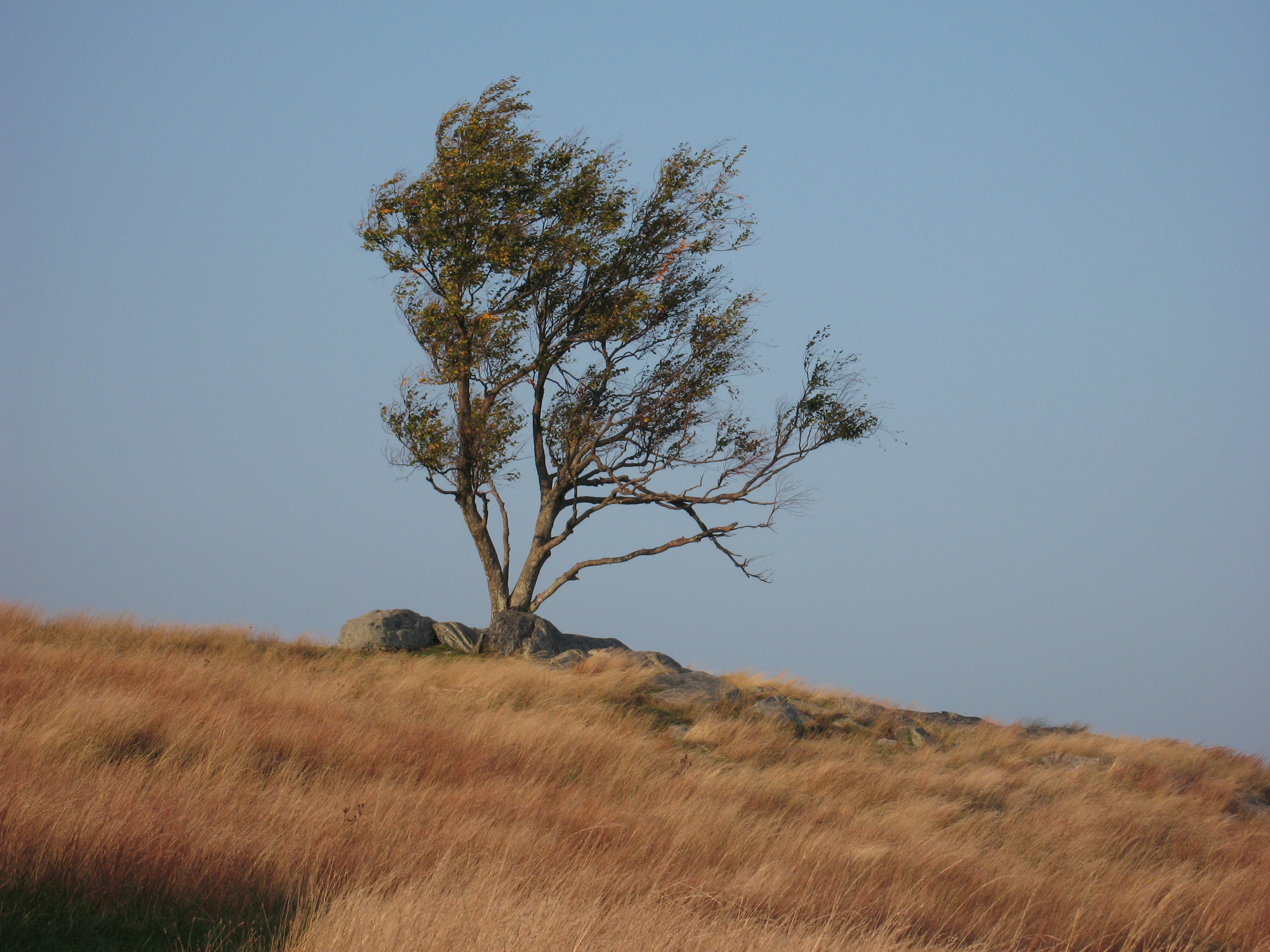
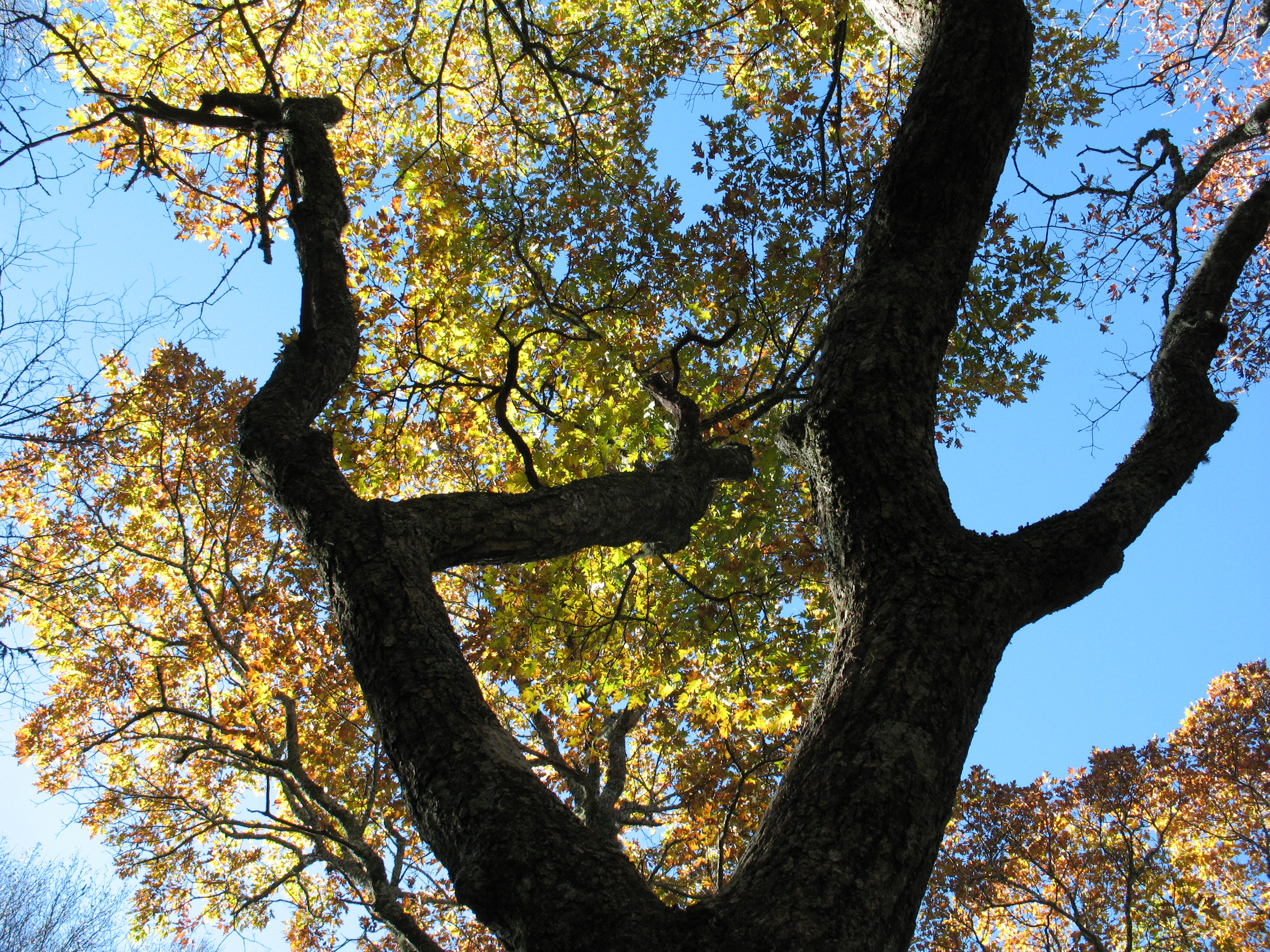
Doughton Park Tree 2016-05-08b

Read Full Post »

 .
 . 
Like a great poet, Nature knows how to produce the greatest effects with the most limited means.  –  Heinrich Heine (1797-1856)
 . 
[poems by Wendell Berry, Gerard Manley Hopkins,
Chapman Hood Frazier, Maria Rouphail, Charles Carr –
shared by Les Brown, Joyce Brown, Joan Barasovska, Bill Griffin]
 . 
What We Need is Here
 . 
Geese appear high over us,
pass, and the sky closes. Abandon,
as in love or sleep, holds
them to their way, clear
in the ancient faith: what we need
is here. And we pray, not
for new earth or heaven, but to be
quiet in heart, and in eye,
clear. What we need is here.
 . 
Wendell Berry
 . 
 . 
When I read What We Need is Here, Mary Oliver’s Wild Geese came to mind. And this poem gives us permission to accept what is here because it is ingrained in our very being as is the flight of geese overhead. Nature can provide all we need. Not explicit, but implicit, in the poem, nature can only provide all we need if we respect and protect it.  –  Les Brown
 . 
 . 
❦ ❦ ❦
 . 
God’s Grandeur
 . 
The world is charged with the grandeur of God.
    It will flame out, like shining from shook foil;
    It gathers to a greatness, like the ooze of oil
Crushed. Why do men then now not reck his rod?
Generations have trod, have trod, have trod;
    And all is seared with trade; bleared, smeared with toil;
    And wears man’s smudge and shares man’s smell: the soil
Is bare now, nor can foot feel, being shod.
 . 
And for all this, nature is never spent;
    There lives the dearest freshness deep down things;
And though the last lights off the black West went
    Oh, morning, at the brown brink eastward, springs —
Because the Holy Ghost over the bent
    World broods with warm breast and with ah! bright wings.
 . 
Gerard Manley Hopkins
Gerard Manley Hopkins: Poems and Prose (Penguin Classics, 1985)
 . 
Selected and shared by Joyce Brown
 . 
❦ ❦ ❦
 . 
Surviving the Six Worlds
     for David Sanipass
 . 
In the sixth world of the Mi’k maq
you walk as if in water
fluid, changing and final.
 . 
Each world a hybrid you move through,
a blink, bend and flutter
where the roots are
and in each power, a sigh or shadow
at the edges of things
that live beyond you
in their hush and whisper.
 . 
Water becomes land
and land, air.
 . 
The golden frog in the dead pool,
the black bear
and, in your long dream, a word
becomes a crow’s call you wake from
that erodes into this life and back again.
 . 
Learn where to walk and where not to,
listen to the wind as if it too might
become you. Discover in your feet
where each path leads. Look,
 . 
a redwing blackbird
settles on the birch branch
and, in its croak, you glide
in a slow melt and shine,
a transparency
as solid as stone
but in a flash, gone.
 . 
Smell the lilac in the wind
and feel how your foot will ache
before finding its step, this your ?
 . 
signature into a white world
where you decay
green and back again.
 . 
Chapman Hood Frasier
from The Lost Books of the Bestiary, V Press LC, February 2023.
 . 
 . 
 . 
I hope you love birds, too.  It is economical.  It saves going to Heaven.  –  Emily Dickinson
 . 
Keep a green tree in your heart and perhaps a song bird will come. –  Chinese proverb
 . 
❦ ❦ ❦
 . 
I Buried a Little Bird Today
 . 
in the backyard
behind the old beech.
What sort of bird I cannot say,
or its age or where in its body
it suffered the fatal flaw.
I only held in one hand
its beating wings, the closed claw
and gaping beak,
its shuddering feathered head.
And when it stopped, I dug a hole
and to the beech I said,
Be kind, be kind.
 . 
Maria Rouphail
from This small house, this big sky (Redhawk Publications, 2025)
 . 
My connection to this poem is as the bird itself. At its dying moments it lies loved and protected in kind hands, as I hope to be. We cannot know, as the speaker cannot know about the bird, what our “fatal flaw” will be. Trust in my loved ones and in a loving God connect me to the little bird buried with compassion under the beech. – Joan Barasovska
 . 
 . 
I was a girl, shy and secretive
 . 
If I just ran fast enough – I was the fastest one –
I knew I could take off, fly, I mean, not sprout wings
or turn into a bird or angel but, as in a recurring dream,
leave the broken sidewalk below, float above the kids
I played with, higher, above the giant sycamore. Higher.
God was sorry I felt so bad.
 . 
Joan Barasovska
from The Power of the Feminine I: Poems from the Feminine Perspective; ThreshPress Midwest (volume 002, 2024)
 . 
IMG_0328
 . 
❦ ❦ ❦
 . 
Appalachian Come Inside
 . 
Morning ends
like a last bite
of apple,
fifty degrees
but who’s counting,
January and coffee
strong enough to hold
my own turns sixty-one,
I would click my heels
if not for their knees.
A tall hickory pitches
a bird at the sky,
noon is a high fly ball,
The New River is quiet
applause,
the air so clean it splashes
the city from my face
and I want to say thank you
but the sun is already
an arm of you’re welcome
around my shoulder.
 . 
Charles Carr
from Autumn Sky Poetry, January 29, 2018.
 . 
Today when I walk outdoors I hope I remember to invite that arm around my shoulder. I confess I need it.  – Bill Griffin
 . 
 . 
If we can believe that we are loved just as we are and that everything else is equally loved, we unveil a cosmic reality that is life-giving and a Christ-like reality that affirms the goodness of all creation. — Barbara Holmes
 . 
❦ ❦ ❦
 . 
 . 
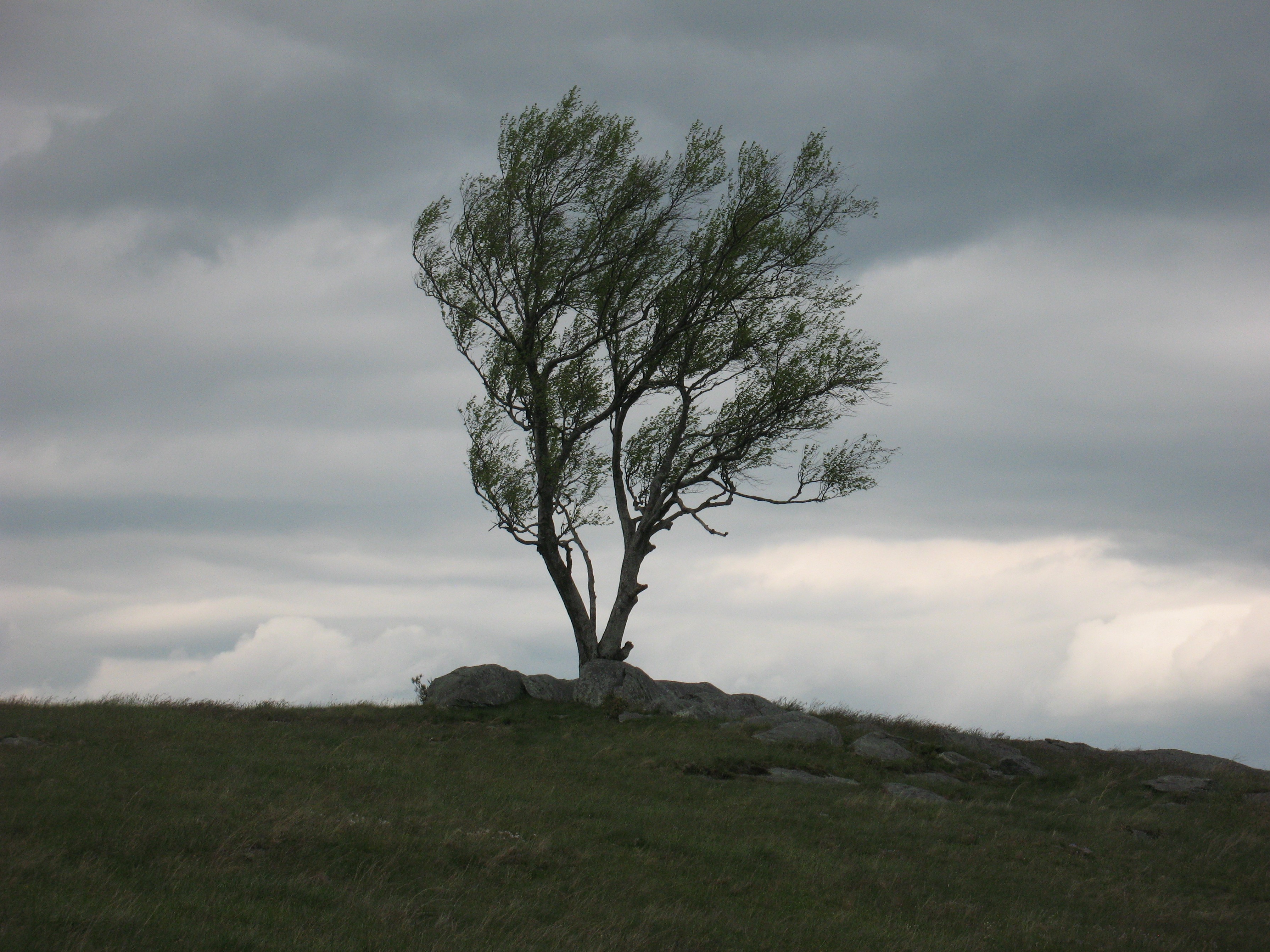
Doughton Park Tree 2020-11-03b
 . 

Read Full Post »

Thunderhead Sandstone outcrop below Ft. Harry Falls, GSMNP

 . 
[with poems about Geology . . . (say what?!)]
 . 
Erosion
 . 
Edges fall first,
silt grains cemented
under thousands of years
sloughed away by wind, rain,
footstep of dog,
sandstone alchemized beneath
weight of mountain
turns sand again
 . 
Subtle rubbing of days shapens us anew,
weathering, the
slowest song of change
 . 
No wonder we wake up some days
wondering at who we used to be.
No wonder we don’t always notice
as our outer edges strip away.
 . 
No wonder the children build castles
made of sand at water’s edge,
even though the castles fall.
 . 
They are practicing for
when they too will feel
what once seemed enduring
slip inside the rising tide.
 . 
Emilie Lygren
from What We Were Born For, Blue Light Press, San Francisco CA. © 2021. Reprinted by permission of the author.
 . 
❦ ❦ ❦
 . 
Geology never intended to trip us up. A mountain’s day is steady and measured, calm as the drip of water, languid as the North Pole’s precession that turns to aim the spinning globe at heaven. All night the mountain’s flow, her stretch, recumbent but restless; at first light she yawns and shudders, her turn and crouch and slow rise; then all morning’s long knotting and gathering to her full height; her relentless stride; a forceful journey, this full day’s labor into evening even as her form, still imposing, diminishes and she reclines.
 . 
Did the mountain even feel the pinprick of water seeping and freezing in minute fissures at her neck? Perhaps a vague itch as lichens scratch to enlarge their circumference, little acid fingernails, a thimbleful of soil. Windborne seeds – would she notice such a light caress when one descends, then its rootlets, its swelling cambium and lignin? One and now another trunk emerges from the crevice, breathing, drinking sunlight, and here comes the day in mammal-time when gravity prevails. A crack, thunder without lightning, slabs and chunks release and roll downslope until they hold at a narrow rib where it crosses below the mountain’s shoulder. Bedrock settled into the new bed it has found.
 . 
Ten thousand human-years pass until you and I puff into view. We slow our pace to climb over and around. Here embedded in the footpath is a softer stratum that has been polished to ebony by a thousand boots. Here alongside the trail we greet the rounder edges and pitted face of earliest falls, sharper clefts and angles  from falls a mountain-day later. Water proving its strength. Lichens still hard at work. Wait a while and this path will open. Geology never intended to trip us up. She simply hopes that we will slow our frantic climbing. Pause here with her for a moment. Look, and simply see.
 . 

USGS map & quartzite vein in Elkmont (?) Sandstone GSMNP

 . 

Common Blue Wood Aster & Thunderhead Sandstone GSMNP

 . 
❦ ❦ ❦
 . 
Anything the River Gives
 . 
Basalt, granite, tourmaline, the male wash
of off-white seed from an elderberry,
the fly’s-eye, pincushion nubbins yellow
balsamroot extrudes from hot spring soil,
confetti of eggshell on a shelf of stone.
Here’s a flotilla of beaver-peeled branches,
a cottonwood mile the shade of your skin.
Every day I bring some small offering
from my morning walk along the river:
something steel, blackened amber with rust,
an odd pin or busing shed by the train
or torqued loose from the track, a mashed penny,
the buddy bulge of snowmelt current.
I lie headlong on a bed of rocks,
dip my cheek in the shallows,
and see the water mid-channel three feet
above my eyes. Overhead the swallows
loop for hornets, stinkbugs, black flies and bees,
gone grass shows a snakeskin shed last summer.
The year’s first flowers are always yellow,
dogtooth violet dangling downcast ans small.
Here is fennel, witches’ broom and bunchgrass,
an ancient horseshoe nailed to a cottonwood
and halfway swallowed in it spunky flesh.
Here is an agate polished over years,
a few bones picked clean and gnawed by mice.
Her is every beautiful rock I’ve seen
in my life, here is my breath still singing
from a reedy flute, here the river
telling my blood your name without end.
Take the sky and wear it, take the moon’s skid
over waves, that monthly jewel.
If there are wounds in this world no love heals,
then the things I haul up – feather and bone,
tonnage of stone and the pale green trumpets
of stump lichens – are ounce by ounce
a weight to counterbalance your doubts.
In another month there won’t be room left
on the windowsills and cluttered shelves,
and still you’ll see me, standing before you,
presenting some husk or rusty souvenir,
anything the river gives, and I believe
you will love.
 . 
Robert Wrigley
from The Ecopoetry Anthology, edited by Ann Fisher-Wirth and Laura-Gray Street, Trinity University Press, San Antonio, TX. © 2020
 . 
❦ ❦ ❦
 . 
“Find yourself a stone, one you can pick up and carry,” our instructor tells us. “Then find me bedrock.” All weekend Elizabeth will be offering us something new every few minutes  – strange vocabulary, stranger stories in deep time, paths upward toward heath balds and downward into the past – but first she offers these two commands. Our substratum. We will build everything upon a stone from the Middle Prong of the Little River, edges knocked round, compressed bits of texture a hundred shades of gray (soon we’ll know to call those bits clasts); and ponderous gray stone rising beside the river, its layers, its planes and fissures (soon we’ll know which is bedding and which foliation). Here we begin our weekend course in the Smokies, 500 million years beneath our feet, asking how it all got here.
 . 
I’m taking my final elective offered by Great Smoky Mountains Institute at Tremont in their Southern Appalachian Naturalist Certification Program – Geology of the Smokies. This is the first time Linda has accompanied me to Tremont, so she’s taking her first course. We know from our readings that these are the most folded, tortured, elevated/eroded/re-elevated/re-eroded square miles in North America. We know that for the next 48 hours we’ll be continuously outdoors except a few hours to eat and sleep. From my previous nine courses, I know Elizabeth Davis as an excellent teacher, patient yet challenging. What we don’t yet fully know is just how truly challenging, physically and intellectually, this weekend is going to be. But here we are on Friday night and we should be getting a clue – Elizabeth is leading us on a hike into pitch darkness, across the shallows on a single-log bridge, and has turned us loose on an island to find our river stones.
 . 
Success. No one falls into the river.
 . 
Tomorrow morning we’ll be picking our way up through a pathless boulder field to a massive outcrop of Thunderhead Sandstone (its compressed sediment, clasts, recycled from the Grenville mountains built almost a billion years ago). We’ll spend the afternoon literally on hands and knees beneath laurel and rhododendron, climbing to a heath bald summit where some really cool rocks are exposed and where we’ll take samples of the low pH soil. Sunday morning we’ll hike a trail so hazardous that the Park won’t even include it on their maps, but along the way we’ll cross major and minor fault lines to discover their rocky transitions, investigate geology’s effect on plant communities, devise some crazy poems and songs about our findings, and end up at beautiful Spruce Flat Falls.
 . 
Late Sunday night, after driving five hours, Linda and I will pull into our driveway and our old bones will creak as we lug our gear back into the house in pitch darkness. At least we don’t have to cross a log bridge to make it to the kitchen door, but when we wake in the morning, stiff and aching, will Linda have a few choice cusswords for me after dragging her along on this adventure? Oh yeah, we’re sore, but only in body. What Linda does have for me is a list of books I need to order. And this proclamation: “You know, after this weekend I really love Geology!”
 . 

Nodding Ladies Tresses growing up through Anakeesta Slate GSMNP

 . 

Elizabeth displays bedding vs cleavage at summit of heath bald near Chimney Tops GSMNP

 . 
❦ ❦ ❦
 . 
The End of the Age
 . 
With wash and ripple and with wave,
Slow moving up the long deserted sand,
The little moon went watching the white tide
Flood in and over, spread above the land,
Flood the low marshes, make a silver cover
Where the green sea-weed in a floating mist
Creeps under branch and over.
The wide water spreads, the night goes up the sky,
The era ends.
 . 
Tomorrow comes warm blood with a new race,
Warm hearts that ache for lovers and for friends,
And the pitiful grace
Of young defeated heads.
Tomorrow comes the sun, color and flush
And anguish. Now let the water wash
OUt of the evening sky the lingering reds,
And spread its coolness higher than the heart
Of every silver bush.
Night circles round the sky. The era ends.
 . 
 . 
Geology
 . 
“Look,” said God;
And with slow fingers
Drew away the mantle rock.
Man followed groping
To touch the flesh of his true mother;
And, standing in great valleys,
He saw the ages passing.
 . 
 . 
Fossil
 . 
I found a little ancient fern
Closed in a reddish shale concretion,
As neatly and ans charmingly shut in
As my grandmother’s face in a daguerreotype,
In a round apricot velvet case.
 . 
Janet Loxley Lewis (1899-1998)
from Poetry Magazine, No. 111, The Poetry Foundation. © June, 1920
 . 
❦ ❦ ❦
 . 
Emilie Lygren has published poems and anthologies and developed dozens of publications focused on outdoor science education. Her first collection of poems, What We Were Born For, was selected by the Young People’s Poet Laureate as the Poetry Foundation’s monthly book pick for February 2022.
 . 
Robert Wrigley has said that “poetry can have a redemptive function. It can look at the chaos you see and make a kind of sense of the smallest part of it.” His poems are concerned with rural Western landscapes and humankind’s place within the natural world.
 . 
Janet Loxley Lewis (1899-1998) wrote novels, stories, and librettos, but she considered poetry the superior form. Theodore Roethke describes her poetry as “marked by an absolute integrity of spirit and often by the finality in phrasing that can accompany such integrity.”
 . 
❦ ❦ ❦
 . 
 . 

Great Smoky Mountains Institute at Tremont GEOLOGY course November, 2024

 .  . 
 Doughton Park Tree 2018-02-09

Read Full Post »

« Newer Posts - Older Posts »