Feeds:
Posts
Comments

Archive for the ‘Christian themes’ Category

[with poems by Helen Losse]

Until we find the communal meaning and significance of the suffering of all life, we will continue to retreat into our individual, small worlds in our misguided quest for personal safety and sanity. – fr. Richard Rohr, Center for Action and Contemplation

Follow a six-year old around the yard when flowers are blooming. Most enticing, of course, is the dandelion puffball. Got to pick that one! It takes several tries for her to blow those little dancing featherettes into the breeze – a few seedlets stick to her unicorn t-shirt, a few in her hair. Will they grow there?

Next comes anything purple or pink. She must add a few grape hyacinths on their too-short stems to the bouquet of daffodils we’re cutting for Grandmommy. And some pink azalea, cut that one, Pappy. Oh my, and look what has opened since the sun came out yesterday! She pulls a single bleeding heart and holds it in her palm. We’ll float it in a paper cup of water so she can take it to Mom this evening.

Finally return to the everywhere-flowers, yellow in everyone’s lawn. Walking around the block it’s Truth or Dare – will they paint your fingers if you pick them? Tooth of the Lion, look at the notched incisored leaves. She chooses the brightest flower. Nothing is a weed if someone loves it.

Which is the theme of Easter and of Helen Losse’s book, A Flower More Enduring: Love redeems. God is God of life.

Yellow Blossoms

populate the uncut yard.
Weeds with purple blooms

create asphalt cracks.
Hardy wildflower,

tall blades of Bermuda grass
widen others. I fall to my knees

on the lawn near a budding
thistle. Saints and angels

present but silent, I pray
for a dandelion heart.

Helen Losse

IMG_2931


.     .     .     .     .     .     .

The poems in Helen Losse’s A Flower More Enduring are intensely personal but enticingly universal. Her conversion to the Roman Catholic Church has brought her assurance but also challenge. She finds herself in the company of Mary and the Saints yet still she seeks and seeks . . . what? Perhaps to discover what she had never expected to find.

And Helen’s readers who come from different faith traditions, I being one, or from no tradition at all, may still discover with her an experience which we never expected: the universe reaching toward us in unconditional love. The outstretched hand of human commonality that might unite us in our suffering. The hand we ourselves lift to return that touch, the reaching which is called hope.

.     .     .     .     .     .     .

I cry out to God

on the night of the knife-wind.
Thoughts rise, incense
under waning moon blows with fog.
Phlox darkens the soggy prairie:
downy phlox, moss pink,
phlox the color of lavender.

O, how I cherish God’s creation:
flora, small rocks, tall hills, mountains,
feral beasts, domesticated pets,
each human soul, the Savior
on the Cross: Eucharistic Morsel:
Source of Grace I can’t store
in a lidded basket.

I am a rabbit returning
each night to a summer garden.
I must eat again & again.

Helen Losse
A Flower More Enduring, Main Street Rag Publishing, © 2021 Helen Losse

.     .     .     .     .     .     .


I stand in the shaded bathroom

with it high useless mirrors
into which I cannot see,
asking, “Are we rich?”

Daddy holds me on his knee
but would never tell me (or
any innocent child)

he doesn’t know how he’ll pat the thirty-seven fifty
house payment due on Friday.

Instead, he explains,
“We are rich in love.”

Helen Losse


.     .     .     .     .     .     .

In the Christian liturgical calendar today, 15 April 2022, is known as Good Friday, three days before Easter. On Sunday morning our little congregation will adorn a rough wooden cross with flowers – death conquered by life. Perhaps there’s a subconscious bit of pagan homage to the vernal equinox, but to my mind the message of new life is our foundation. Consider: no person and no thing exists outside the sphere of God’s universal love of life. In the cosmological sense there is no outside; in the spiritual sense no outsider.

A Crucified God is the dramatic symbol of the one suffering that God fully enters into with us — not just for us, as we were mostly taught to think, but in solidarity with us. The Good News is we do not have to hold that suffering alone. In fact, we cannot hold it alone. As we approach Easter, let us remember that we too can follow this path, actively joining God’s loving solidarity with all. What starts in God ends in God. All of reality is moving toward resurrection.

fr. Richard Rohr, Center for Action and Contemplation: Transformed people working together for a more just and connected world.

.     .     .     .     .     .     .

Dandelion on green lawn

A girl bends low, picks a flower
to give to her mother.

The child loves the flower,
a weed adults tend to favor less.

The child blows seeds from the puffball,
whit feathery globe of potential.

The seed is the heart of the flower:
tiny perhaps but profoundly fecund.

Each seed floats with the wind, grows
where it lands, blossoms in sunshine and rain.

Helen Losse

.     .     .     .     .     .     .

.     .     .     .     .     .     .


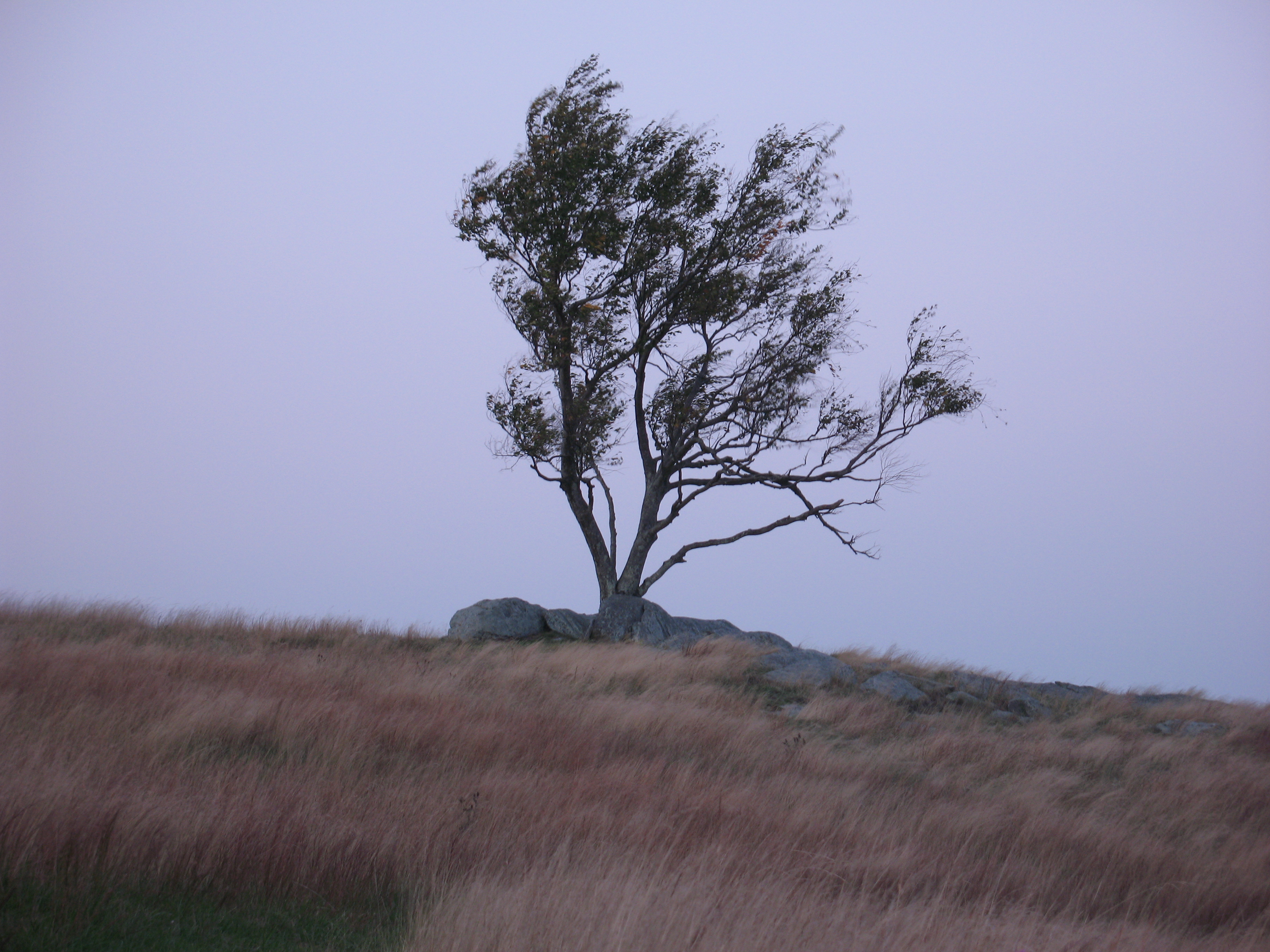
2020-03-07 Doughton Park Tree

Read Full Post »

[New Year’s Eve, poems by Mary Oliver and Jane Mead]

“Are spirits’ lives so short?” asked Scrooge.
“My life upon this globe is very brief,” replied the Ghost. “It ends to-night.”

The worm Ouroboros eats its tail, every day renewed, ever renewing. Cycles unending. The Neuse River snakes to New Bern, clouds lift inland, each little feeder stream is filled. Rain, ice, lichen eat the stone, phosphate creeps its migration through generations: rock to soil, leaf to masticator, herbivore to predator and all decomposing back to soil. I breathe out what the tree breathes in and breathes out for me to breathe. And the cycle we mark today: the dying Year gives birth to the New.

So many cycles. One enormous round. Every thing connected, interconnected, and we sense ourselves as spokes of the wheel or sometimes the never-ceasing motion of its rim that grinds along the path that is our life. As daylight diminishes it grows harder to hold onto our imagining of that wheel, its endless turning, that path it pursues still stretching on beyond the horizon. Harder to hold onto hope that the path’s end is indeterminate and out of sight.

Yes, it grows harder in these years of death’s overwhelming harvest to push aside imagining our own death. Too many deaths, COVID and otherwise, to pay attention; too many deaths to ignore a single one. In a few minutes I’ll set this page aside when my son arrives. He’ll leave Amelia here while the rest of the family attends their next-door neighbor’s funeral. A sudden death – our friend M was not old or ill. A shock to the fragile wall we build around our own mortality. Linda and I find ourselves tallying all the deaths that have touched us this month. The man who fixes our cars. A friend’s best friend. Names and faces more than we ever expect, doesn’t it seem? Death hunches at our shoulder, sometimes intrusive, sometimes silently lingering, sometimes perched like a moth that’s invisible until it flies into our face.

Tonight at midnight we will celebrate the Newborn Year but perhaps with even more enthusiasm we’ll celebrate a moment’s permission to ignore its haggard, dissipated forebear. The Old Year dies in winter darkness; death, the ultimate consuming dark. But notice – twelve days enfold the span of solstice to new year’s morning. The Ghost of Christmas Present senescent and dying yet retains some presence within us. Twelve days already lengthening, light seeping in even before the old year succumbs. Perhaps endings and beginnings are false markings along the ever-flowing course. Perhaps encircled by death it is possible, vital even, to engage with life. Perhaps death itself is not darkness but enfolding light.

.     .     .     .     .     .     .

.     .     .     .     .     .     .

White Owl Flies Into and Out of the Field

Coming down out of the freezing sky
with its depths of light,
like an angel, or a Buddha with wings,
it was beautiful, and accurate,
striking the snow and whatever was there
with a force that left the imprint
of the tips of its wings — five feet apart —
and the grabbing thrust of its feet,
and the indentation of what had been running
through the white valleys of the snow —
and then it rose, gracefully,
and flew back to the frozen marshes
to lurk there, like a little lighthouse,
in the blue shadows —
so I thought:
maybe death isn’t darkness, after all,
but so much light wrapping itself around us —

as soft as feathers —
that we are instantly weary of looking, and looking,
and shut our eyes, not without amazement,
and let ourselves be carried,
as through the translucence of mica,
to the river that is without the least dapple or shadow,
that is nothing but light — scalding, aortal light —
in which we are washed and washed
out of our bones.

Mary Oliver  — 1935-2019
this poem first appeared in The New Yorker, January 2, 1989


.     .     .     .     .     .     .

I Wonder if I Will Miss the Moss

I wonder if I will miss the moss
after I fly off as much as I miss it now
just thinking about leaving.

There were stones of many colors.
There were sticks holding both
lichen and moss.
There were red gates with old
hand-forged hardware.
There were fields of dry grass
smelling of first rain
then of new mud. There was mud,
and there was the walking,
all the beautiful walking,
and it alone filled me –
the smells, the scratchy grass heads.
All the sleeping under bushes,
once waking to vultures above, peering down
with their bent heads they way they do,
caricatures of interest and curiosity.
Once too a lizard.
Once too a kangaroo rat.
Once too a rat.
They did not say I belonged to them,
but I did.

Whenever the experiment on and of
my life begins to draw to a close
I’ll go back to the place that held me
and be held. It’s O.K. I think
I did what I could. I think
I sang some, I think I held my hand out.

Jane Mead — 1958-2019
this poem first appeared in The New Yorker, September 20, 2021

.     .     .     .     .     .     .

Mary Oliver was a guide to the intersection between human life and the natural world; her voice affirms the expression of person in nature in person and affirms that no voice can fully express that oneness. Jane Mead, who for years was Poet-in-Residence at Wake Forest University in Winston-Salem, NC, expected poetry to move people to preserve the earth; at the end of her life she was a guide to the landscape and ecology of dying.

.     .     .     .     .     .     .


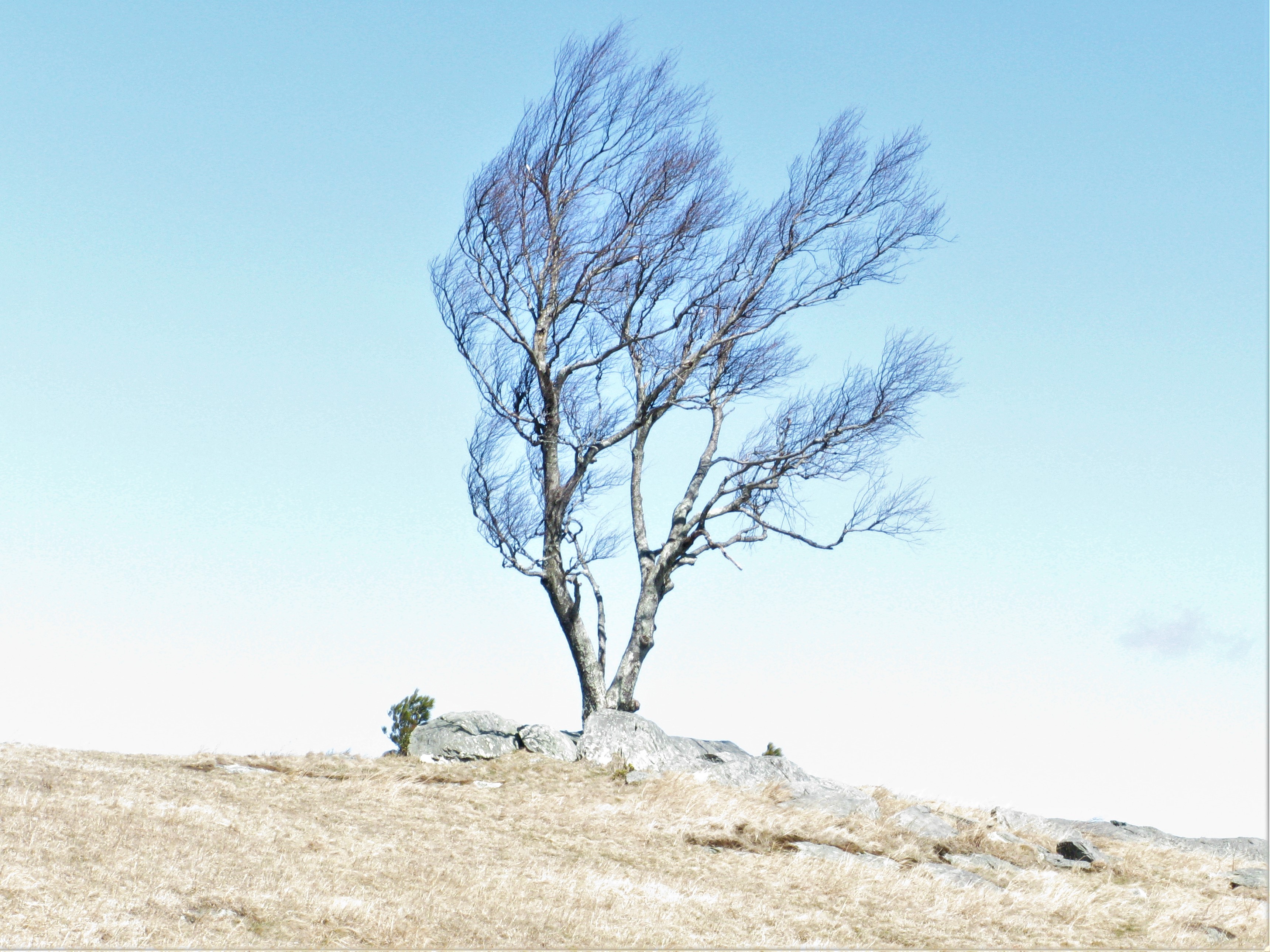
Doughton Park Tree 2021-10-23

Read Full Post »


North Carolina Poets for Christmas

Sam Ragan ++++++++.+.+. (1915-1996)
Carol Bessent Hayman ++.+ (1927-2017)
Reynolds Price ++           ++.(1933-2011)
Anthony S. Abbott ++++……. (1935-2020)

.     .     .     .     .     .     .

Winter Watch

In those winter fields
Where only the dead grass
Hides the movement of mice
And the loping fox long away
From hunters, horn and dog,
Walking and watching wind bend
Bare branches at the wood’s edge.
This then is the beginning,
The walk and the waiting,
Winter is a time of waiting,
The pause, the slowed feet,
The watching, the waiting.

Sam Ragan
from Collected Poems of Sam Ragan, St. Andrews Press, Laurinburg NC, © Sam Ragan 1990

.     .     .     .     .     .     .

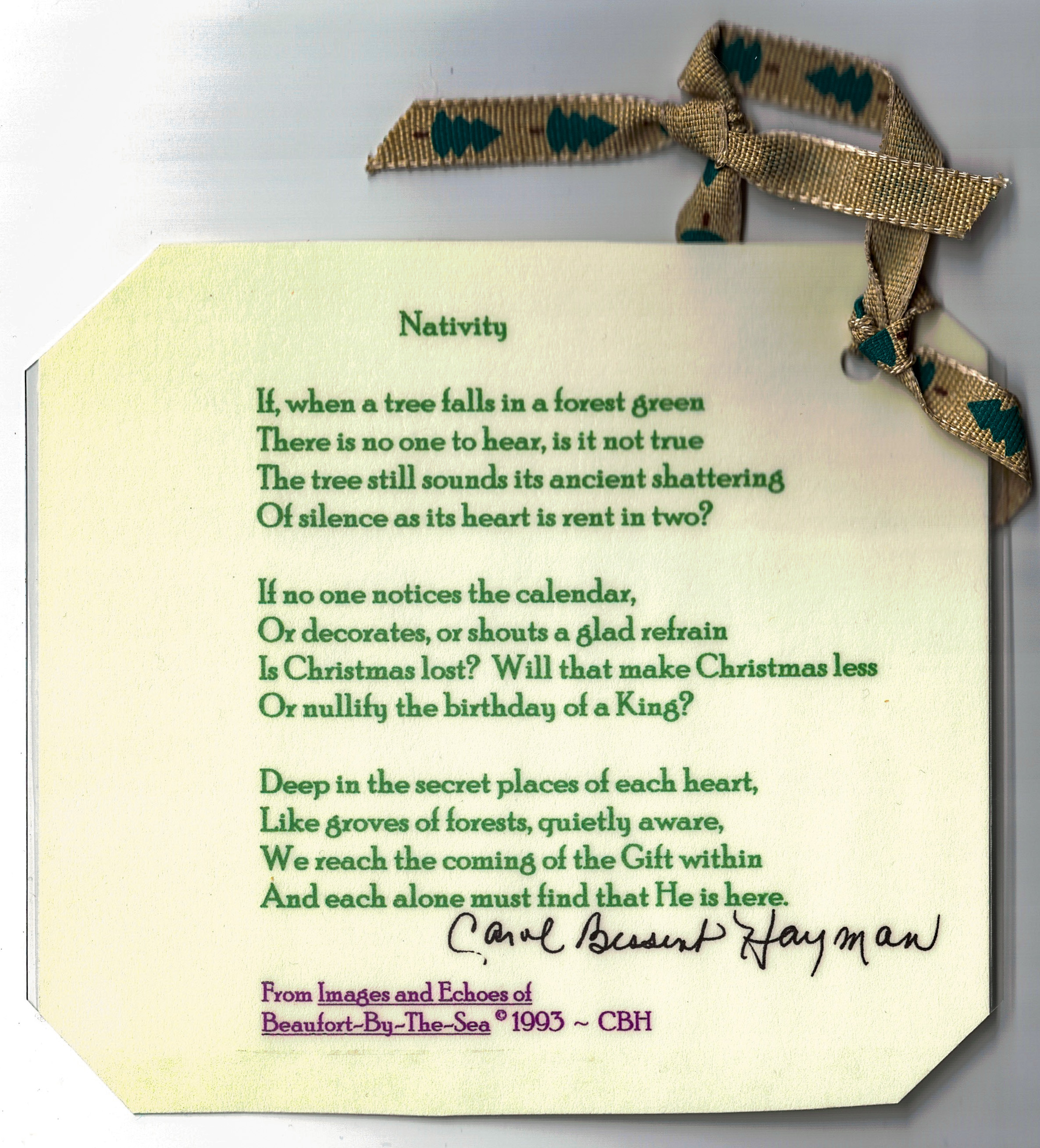
Nativity

If, when a tree falls in a forest green
There is no one to hear, is it not true
The tree still sounds its ancient shattering
Of silence as its heart is rent in two?

If no one notices the calendar,
Or decorates, or shouts a glad refrain
is Christmas lost? Will that make Christmas less
Or nullify the birthday of a King?

Deep in the secret places of each heart,
Like groves of forests, quietly aware,
we reach the coming of the Gift within
And each alone must find that He is here.

Carol Bessent Hayman
from Images and Echoes of Beaufort-By-The-Sea, © 1993 Carol Bessent Hayman

.     .     .     .     .     .     .


A Christmas Night

It was a cold night
And there was ice on the road,
Our car started to slide
As it moved up the small hill,
And the headlights caught the old man
In a thin jacket
Pushing a cart filled with sticks.
There were some bundles and a package
Piled on top, and the old man
Grinned and waved at us
As he pushed the cart
Into the yard of the ligglt house
Where a single light shone.
The tires gripped the road
And we drove on into the darkness,
But suddenly it was warm.

Sam Ragan
from Collected Poems of Sam Ragan, St. Andrews Press, Laurinburg NC, © Sam Ragan 1990

.     .     .     .     .     .     .


A Heron, A Deer – A Single Day

A dull tin noon and, struck down on us
From the crest of pines, a heron – the one
That’s brought me each winter solstice
For twenty-six years now whatever code

I’ve earned for the past year, need for the next:
Vast as a stork in a child’s old reader
And fierce in the head as a demon deputed
To pluck out human eyes in vengeance,
Bolt them down hot.
++++++++++++++++ Yet our two faces
Broaden – eased, assured once more
Of witness at least: our names a precise
Address still known to Guidance Central.

Midnight mist and roaring cold,
We roll toward home from Christmas-eve dinner;
And there in the glen, frozen at the verge,
A six-point buck, young in eye
And grace of joint but flat-eternal
In steady witness. We slow to spare him –
Or think to spare a soulless thing.

He spares us. Sustaining our glare
A long instant of still composure,
His eyes consume whatever we show.
Then in a solemn choice to leave,
He melts a huge body, graceful as girls,
Through two strands ov vicious barbed-wire

We pass unscathed, drive in silence
A last slow mile, then both laugh sudden
At the sight of home. Seen, well-seen
But spared to pass.

Reynolds Price
collect in Word and Witness: 100 Years of North Carolina Poetry, Carolina Academic Press, © North Carolina Poetry Society 1999

.     .     .     .     .     .     .


The New Magi

It is dusk. The sun has tipped backward
behind the old town hall. Inside the patterned
windows of the church, candles not to candles
until it seems the world is only light
and festive voices singing, “Silent Night.”

Out of the dark the siren wails, once,
twice, a third time, and grinding ears
disturb the “all is bright,” while somewhere
in another town a black man in a stocking cap
folds quilts around himself to stop the night.

Out of the dark the siren wails ans somewhere
in another town a woman flushes yesterday’s news
from under the rest room door and a red-haired girl
with shrouded eyes holds out her hand
to strangers walking through the station’s

swinging doors. Where is the star that calls you,
black man? Where is the star that seeks you,
woman? Where is the star that lifts you, shrouded
girl? Walk to us, now, over the battered highways.
Walk to us slowly over the rutted roads.

Walk to the siren’s wail, and the grunting sound
of fire in the night. Throw open the church’s door.
Walk with your papers and your quilts and the sorrow
in your eyes, bringing your gifts past the carpet
of our candles to the manger’s straw. Kneel and turn

And bid us follow with our light up the long aisle
out, out into the grace of the beckoning night.

Anthony S. Abbott
from New & Selected Poems, 1989-2009, Lorimer Press, Davidson NC, © Anthony S. Abbott 2009

IMG_9285

.     .     .     .     .     .     .

In a Bus Station on Christmas Eve

There are still travelers
Even at this late hour.
A radio is playing “Joy To the World.”
They sit and stare,
Clutching packages
Wraped as they are wrapped,
With some of the corners torn

Sam Ragan
from Collected Poems of Sam Ragan, St. Andrews Press, Laurinburg NC, © Sam Ragan 1990

.     .     .     .     .     .     .

Sam Ragan served as NC Poet Laureate from 1982 until his death in 1996. He had a long career in journalism at various publications and from 1969 to 1996 was owner, publisher, and editor of The Pilot in Southern Pines, NC. Sam received about every possible NC literary award, including the North Carolina Award in Fine Arts, the Roanoke-Chowan, Parker and Morrison Awards; the North Caroliniana Society Award; and has been inducted into the North Carolina Journalism Hall of Fame and North Carolina Literary Hall of Fame.

Carol Bessent Hayman was the first Poet Laureate of Carteret County and the city of Beaufort, NC. She was a 50-year member of the National League of American Pen Women, served as Southeast editor for their national publication, The Pen Woman, and was a member of the National Board. She was a member of the founding board of N.C. Writers Network, taught many workshops, and published hundreds of poems and five books of poetry.

Reynolds Price, a native of Macon, NC, taught literature at Duke University for 53 years and was James B. Duke Professor of English. In 1962, his novel A Long and Happy Life received the William Faulkner Award. He went on to publish fiction, poetry, essays, and plays and is equally known as the venerated educator of generations of Duke students. For the last third of his life he was confined to a wheelchair due to paralysis resulting from complications of a spinal tumor; his memoir A Whole New Life: An Illness and a Healing has been an inspiration to thousands.

Tony Abbott was a beloved professor of modern drama and American literature at Davidson University (NC). He touched many lives with his deep compassion and spiritual seeking, not only the lives of his students but of everyone who knew him, worked with him, read with him, read his work. His first book of poems, The Girl in the Yellow Raincoat, was nominated for a Pulitzer Prize. He went on to write three novels, four books of literary criticism, and eight volumes of poetry, his last, Dark Side of North, published posthumously in 2021 by Press 53. His tenure on the Board of Directors of the NC Poetry Society has left an influence of creativity, collegiality, and craft that continues today.

IMG_2548


.     .     .     .     .     .     .


IMG_1827

Read Full Post »

« Newer Posts - Older Posts »