Feeds:
Posts
Comments

Archive for the ‘Christian themes’ Category

 . 
[excerpts and art from
The Donkey’s Dream, Barbara Helen Berger]
 . 
Once there was a gray donkey. He was
walking along as usual, with a load on
his back. A man was leading him. And
as they walked on and on through the
starry night, the donkey began to dream.
 . 
 . 
He dreamed he was carrying a city,
with gates and towers and temple domes.
He dreamed a child cried in the city.
And doves flew all around.
 . 
 . 
He dreamed he was carrying a ship.
I rocked like a cradle. It shone like the moon.
And the sea danced all around.
 . 
 . 
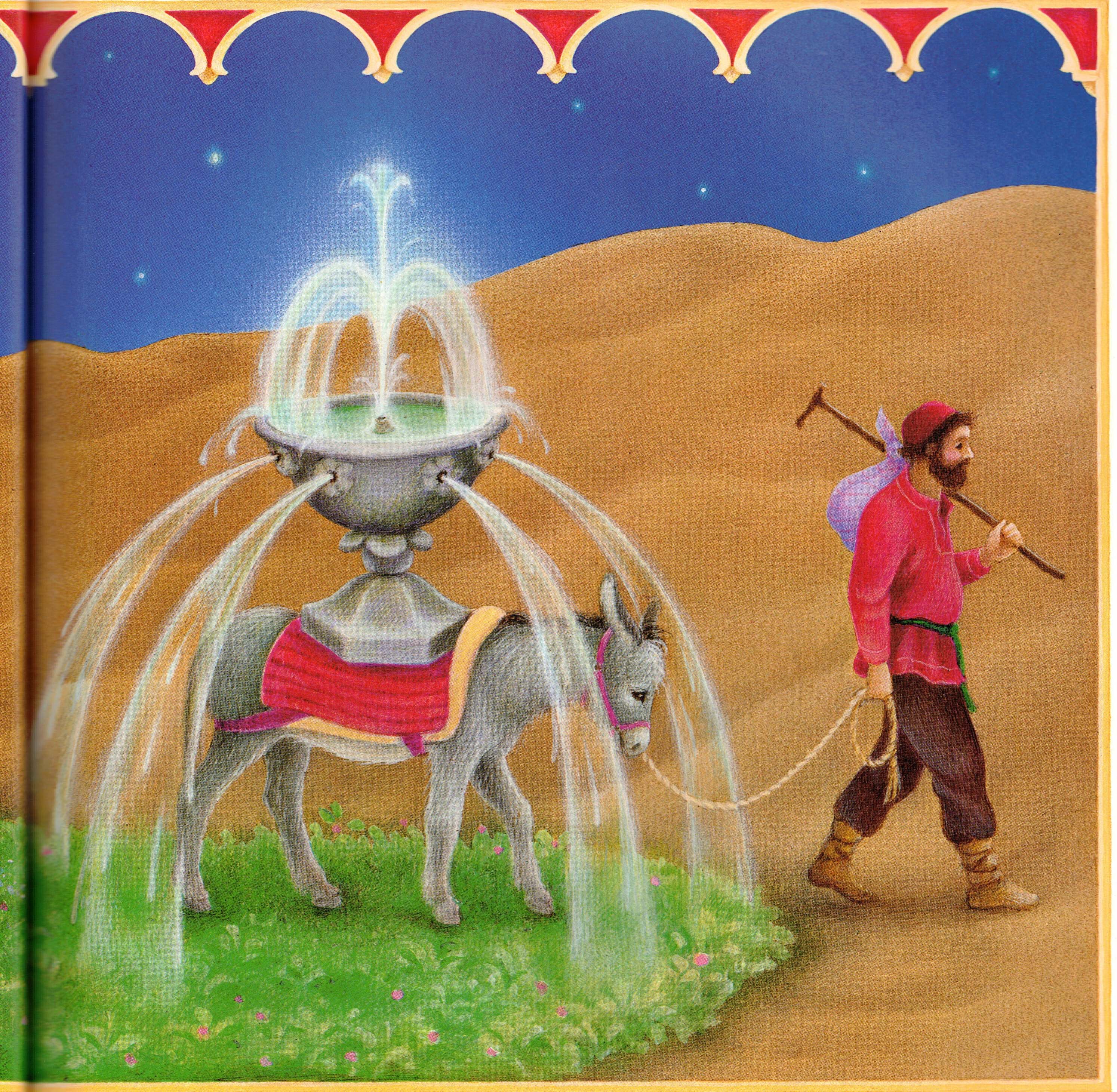
He dreamed he was carrying a fountain.
Its waters splashed and sang like a child’s laughter.
And a garden sprang from the desert sand all around.
 . 
 . 
He dreamed he was carrying a rose, soft as a
mother’s touch and sweet as the sleep of a baby.
Angels stood all around.
 . 
Then he dreamed he was carrying a lady full of heaven.
They had come to a town. But only the village dogs
ran to greet them.
 . 
 . 
❦ ❦ ❦
 . 
The donkey’s lot in life is to carry. He is bred to carry. All his days are carrying, and if he remarks upon a particular burden or complains, well, for the donkey tomorrow will still be carrying.
 . 
As for us all. So much we carry. So many things, and heavy. My dreams, as the donkey’s, are mostly of things I have carried or will carry or am still carrying. Burdensome. Worrisome. Or have I misinterpreted my dreams? Beside our bed, Linda keeps a little handbook of Jungian dream symbology. But can dreams be constrained to pages and print?
 . 
The world is heavy upon the donkey’s back. He is tired, he labors beneath the weight, and yet his dreams are of light and beauty entering the world. For the donkey, as for us, the longest night seems always to stretch before. And yet a star lights his trough. He sees his burden with new eyes and his weariness is no more.
 . 
In this dark and heavy world, is it still possible to dream of light?
 . 
And, dreaming of light, is it possible we will wake?
 . 
 . 
❦ ❦ ❦
 . 
But the donkey was left alone outside.
He had walked so long, his back was
aching and his legs were sore. One star
high above him shone in the watering
trough below. The tired donkey drank.
 . 
 . 
Just then a cry rang out in the cave.
And its echo rang like a bell,
over the hills, all around. The night
was so still, even the stars heard it.
The man came out of the cave.
He whispered to the donkey, “Come.”
 . 
 . 
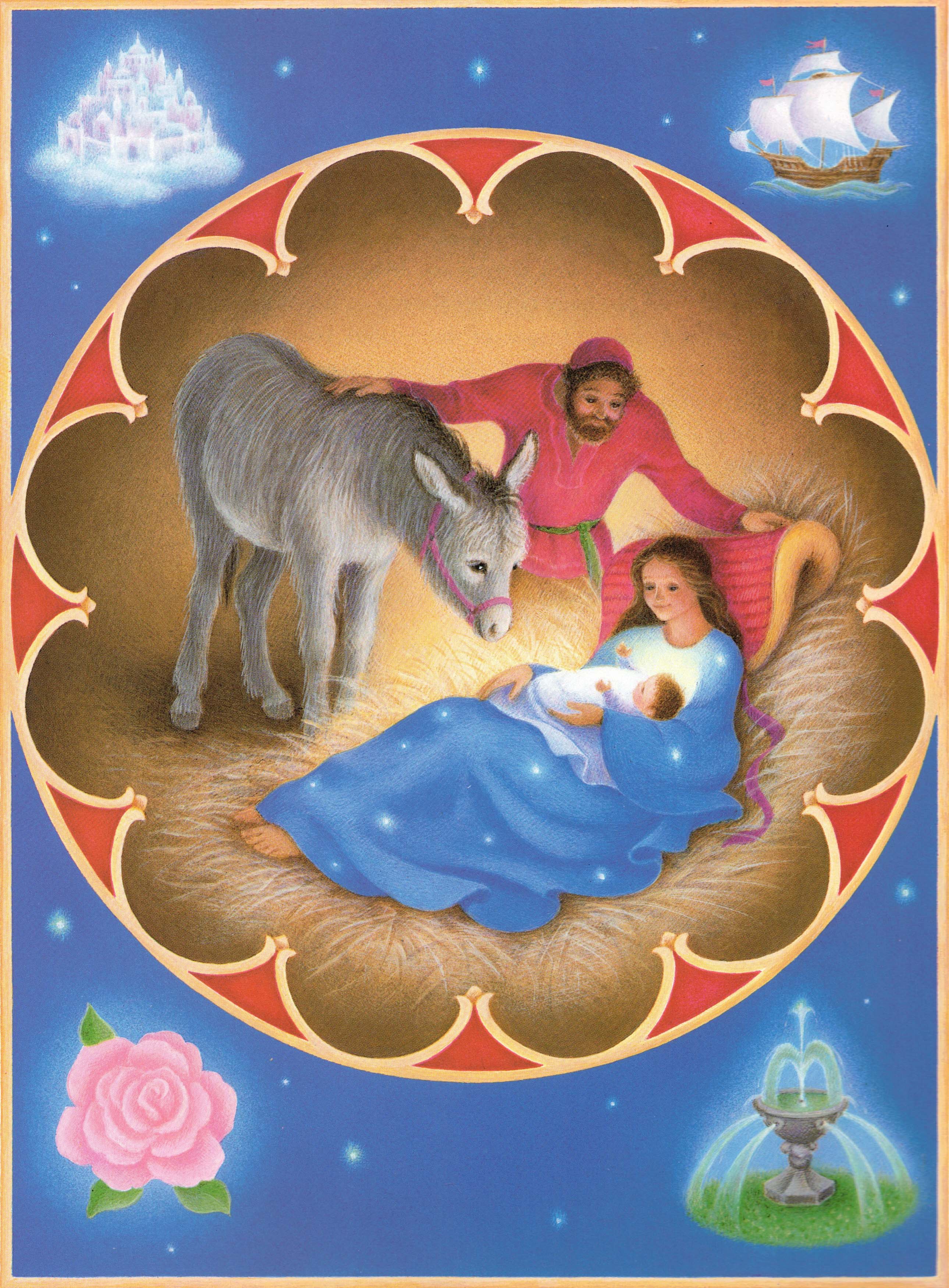
Together they went inside the cave, where they lady lay
on a bed of hay. The donkey’s saddle was her pillow.
She smiled. “Come,” she said to the donkey.
“See what we have carried all this way, you and I.”
 . 
 . 
And suddenly, the donkey was not
tired anymore, though he had carried
a city, a ship, a fountain, a rose,
and all the heavens on his back.
 . 
❦ ❦ ❦
 . 
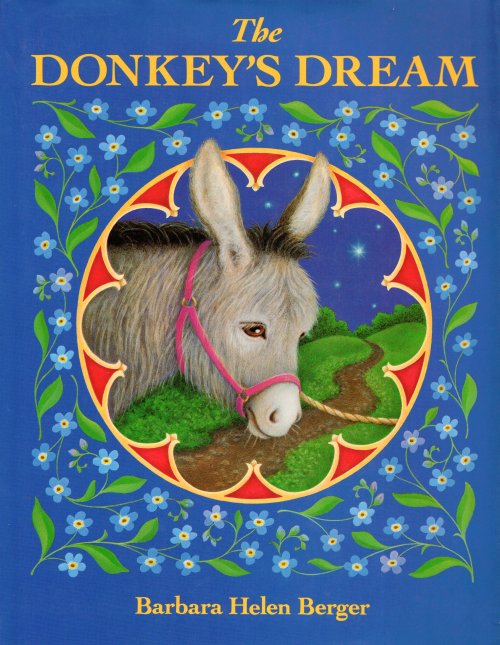
The Donkey’s Dream, written and illustrated by Barbara Helen Berger; Philomel Books, New York NY; © 1885 by Barbara Helen Berger
 . 
 . 
Merry Christmas, Maya! (Michael & Diane, too.)
 . 
❦ ❦ ❦
 . 
IMG_7952
 . 
 . 

Read Full Post »

 . 
[with 3 poems by Marilyn Hedgpeth]
 . 
The Lightness of Reprieve
 . 
Standing at our friend’s threshold,
pockets padded with tissues,
we steel ourselves for heartache,
prepare to embrace longer than usual,
voice our true affections,
stutter through farewells.
To our surprise, she rallies,
rises from her sick bed,
responds to the attention,
the memories, the bonds we share.
Glancing back as we leave,
we see her waving from the doorway.
 . 
Later, we knock at the door of a cousin
recovering from a cardiac procedure.
She claims to feel ten years younger.
We fill this bonus time with laughter
and celebrate the lightness of reprieve.
 . 
Arriving home, we cringe to find
ruffled remains of a red-bellied
woodpecker, feathery outline still visible
on our glass door.
We gather its hollow form,
place it tenderly, respectfully,
in a shallow hole, hallowing
the fragility of life
at our own doorstep.
 . 
Marilyn Hedgpeth
from The Lightness of Reprieve, Finishing Line Press, Georgetown, KY; © 2024
 . 
❦ ❦ ❦
 . 
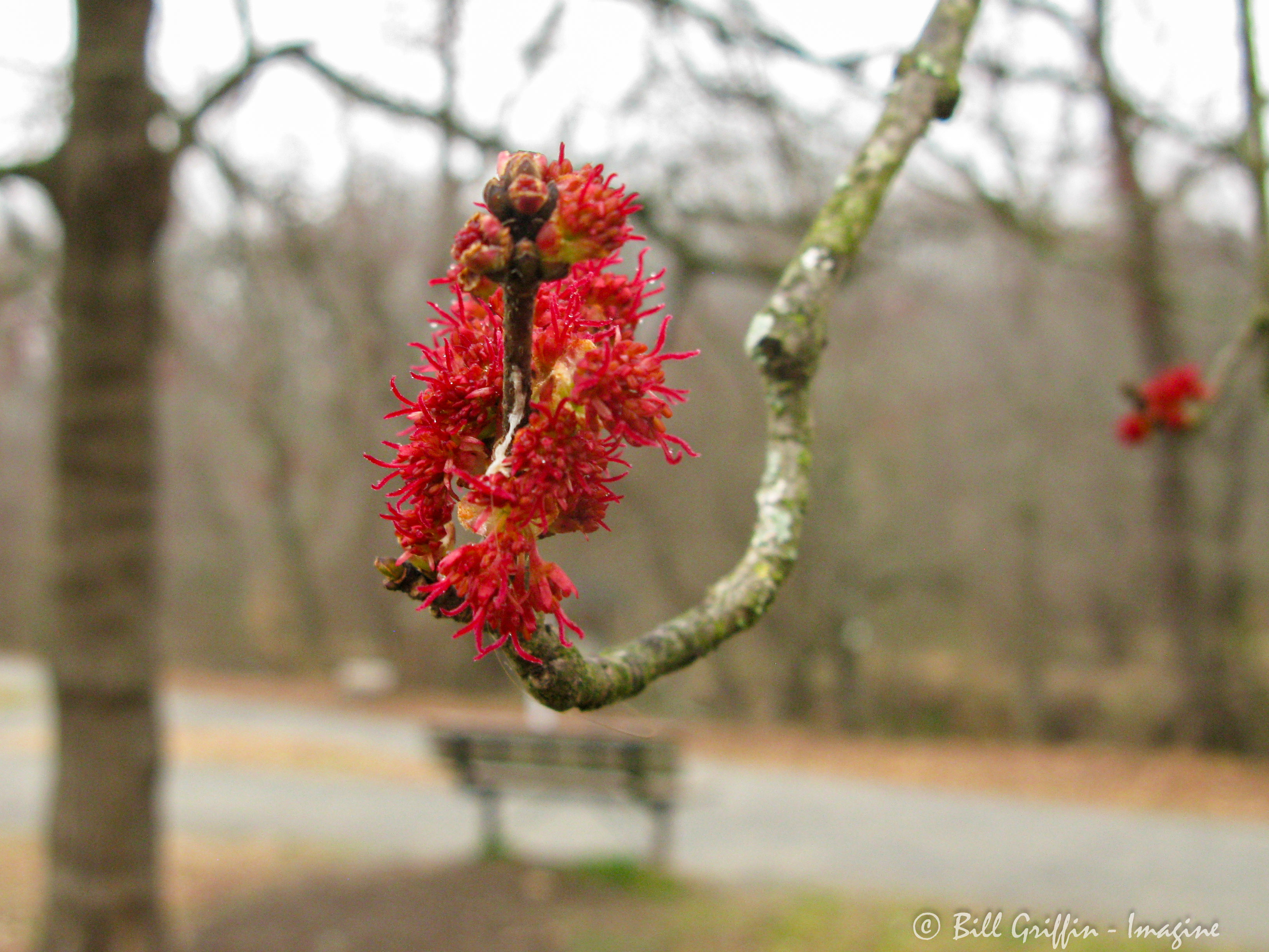
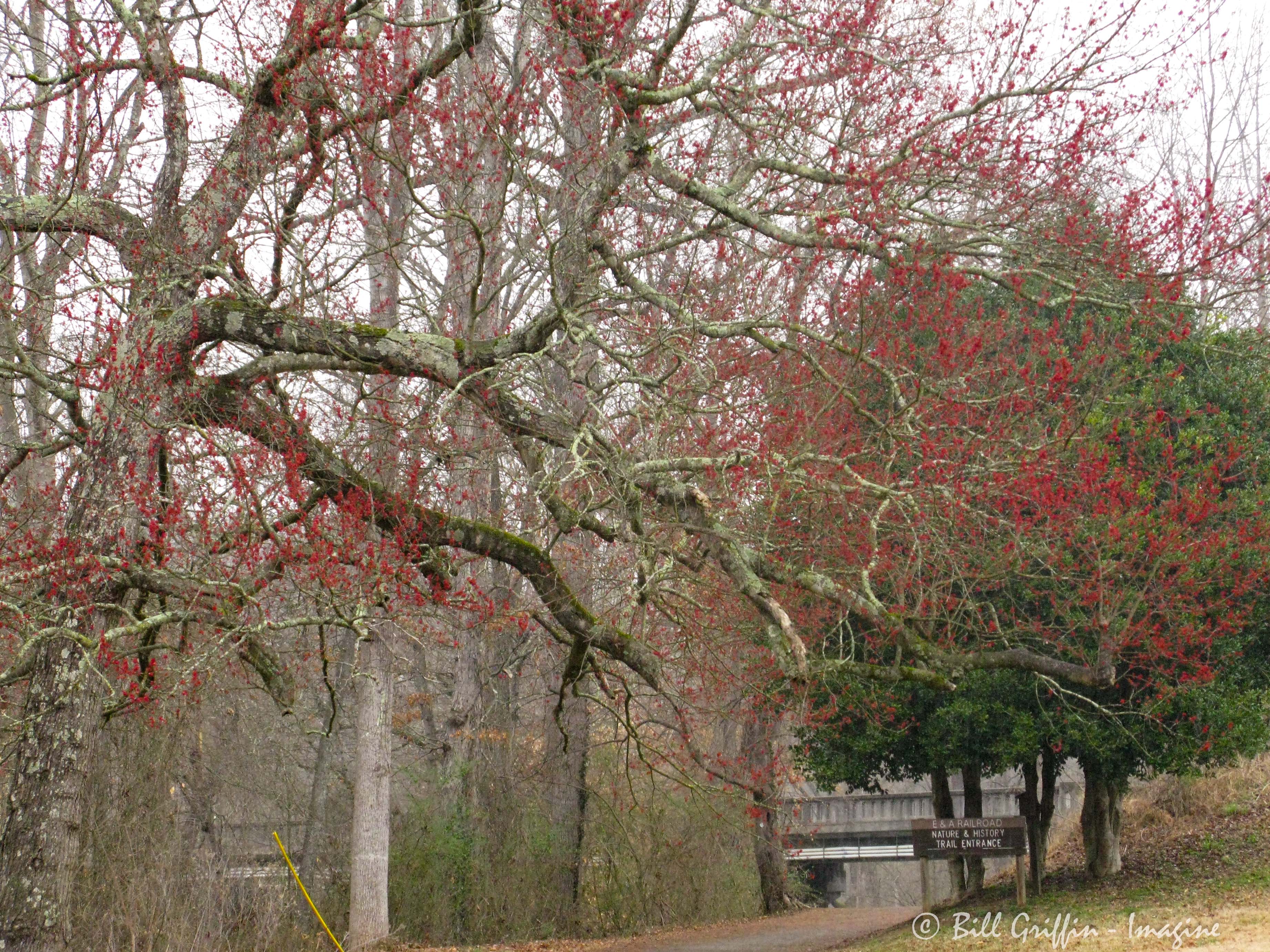
Feb 20, early morning drive: slant light across the fields sets fire to every third tree along the highway. Dark orange, deep red, their crowns glow, a bright haze of flowers at the tips of a million twigs. Almost Spring, and the first maples are blooming.
 . 
Witch hazel has dropped her petals, spent; now maple lifts the baton. Here in the Southeastern USA, maple is one of the earliest trees to bloom. Blossom bud break is triggered in mid-February, primarily by lengthening daylight regardless of weather, weeks before the leaf buds swell and burst. Check the pollen burn in your eyes and nose – you’ll know when those flowers have opened.
 . 
As opposed to most garden flowers which present both pistil and stamen in the same bloom (namely bisexual), maple is, like many trees, monoecious – there are separate male flowers and female flowers on the same tree, even on the same stem. Male red maple flowers look like little ruby crowns of spiky stamens; the female flowers are a bouquet of drooping red pistils.
 . 
But it gets trickier. Some red maples bear only male flowers, while others bear only female (this separation termed dioecious). And individual trees can shift. One year a tree may be male, the next year half and half, the following year all female. The prevalence of Male vs. Female flowers doesn’t seem to be either a cause or an effect of the overall health of the tree. Why?! Why do they do this? What purpose does all this variability serve the tree or the community of red maples?
 . 
I don’t know but the tree knows. Perhaps it’s communicating with all its neighbor maples through its underground network of mycorrhizal fungus, collaborating to decide who’s going to make lots of pollen this year and who’ll make the seeds (and maples do make lots of those little winged seeds). Perhaps their network extends throughout the local woodland and into the next county. Acer rubrum is one of the most plentiful trees east of the Mississippi, from Newfoundland to Florida. Perhaps it creates one vast collective knowing, guiding the roots, the bole, the twigs that will bud into flowers, male or female. Perhaps.
 . 
February into March, every morning the scarlet halo expands. Every day we’re closer to Spring. Every afternoon more sneezes and water from my eyes. Glorious! I trust those maple trees utterly – they certainly know what they’re doing.
 . 
 . 
❦ ❦ ❦
 . 
Mirror Images
 . 
Sliding into a booth,
leather cool to my legs,
we take menus in hand;
we glance around,
tempted by lavish meals
rising before other patrons.
An adjacent mirrored wall
makes the tavern seem
twice its size, twice as lively.
 . 
Across smooth Formica,
you sip ice water,
watching as your doppleganger
tucks a wayward wisp of hair
into her head-scarf.
Maybe that’s an alternate universe,
you say, and this table,
our point of intersection.
Maybe while we grow older, 
grayer, wiser perhaps, 
they grow younger
healthier, more vital and able.
 . 
We toast to what’s possible,
to friendship, regardless.
Condensation drips from our tumblers,
while frost still clings to those
of our glassy companions.
 . 
Marilyn Hedgpeth
from The Lightness of Reprieve, Finishing Line Press, Georgetown, KY; © 2024
 . 
❦ ❦ ❦
 . 
There is, after all, no reprieve. This morning as we’re talking to the palliative care nurse who is  interviewing my mother, my father asks, “Does everyone end up in Hospice?” Or did he say, “Will I end up in Hospice?” It’s a fair question, even for someone not 97 years old. Every year that passes, Dad announces he’s planning to live five more years. One may hope, but perhaps one shouldn’t plan on it.
 . 
The title poem in this first collection by Marilyn Hedgpeth, The Lightness of Reprieve, confronts this reality. Marilyn’s friend will die of cancer very soon and yet the two of them are surprised to share a vibrant afternoon together; Marilyn’s cousin might have died from her heart condition but now feels reborn; Marilyn returns home to confront the death of a beautiful bird on her own doorstep. Other poems throughout the book touch upon our mortality from many different angles, sometimes head on, sometimes in metaphor and with the lightest touch of benediction. I sense a deep abiding theme of sharing. We rarely share with each other this common knowledge that our lives will most definitely end; what we do share is stories and a gift of ripe strawberries; imagination and laughter; silent moments of togetherness; prayer.
 . 
And in sharing don’t we experience reprieve? These are not poems of grief for time lost. These are poems of celebration for time shared. Marilyn has no doubt sat with the bereaved many, many times in her years as a minister, but this is not a book of counsel. These are simply poems of our simple human commonality. I step into the poems and accept my own sadness – sadness lifts as it is borne by many other shoulders. The yoke is not removed from me, but for a few steps along this journey I might almost imagine its lightness.
 . 
 
Marilyn Hedgpeth recently retired as a Presbyterian (USA) Minister of Word and Sacrament after 24 years of “preaching / teaching / leading / loving life.” The Lightness of Reprieve is available from Finishing Line Press HERE
 . 
 . 
❦ ❦ ❦
 . 
Last Leaf
(with a nod to O. Henry)
 . 
One Final Rusty Leaf
clings to the dogwood tree
outside our bedroom window.
Resisting the wind’s wrestling,
it beckons me back to a time
when I painted a single leaf
on our patio wall:
my Hail Mary attempt
to prolong the life of my father
as modern medicine failed,
as the leaves fell.
 . 
Desperate to bring him hope;
venturing outside the boundaries
of my own knowledge and faith,
I scheduled an appointment
with a local healer, Chief Two Trees.
But when travel became impossible,
I resorted to that lone leaf
and a no holds barred prayer.
 . 
After he died, I continued to paint,
self-medicating stroke by stroke,
adding to my winter wall-garden:
fern, forget-me-not, bleeding heart,
wisteria, live-for-ever;
each new leaf, petal, blossom,
balm to my wound.
 . 
Marilyn Hedgpeth
from The Lightness of Reprieve, Finishing Line Press, Georgetown, KY; © 2024
 . 
❦ ❦ ❦
 . 
 . 
2020-06-11a Doughton Park Tree

Read Full Post »

 . 
[with 3 poems by Stephen Dunn]
 . 
Returning from an Artist’s Studio
 . 
Late at night in my one life
I see fireflies scintillating a field
and a fullish moon up there working
on its reputation, which I thought
was secure. And though I’m not one
to stop my car for beauty
I stop, get out, begin to understand
how the first stories winked
of another world. It’s as if
I’m witness to some quiet carnival
of the gods, or the unrisen dead
speaking in code.
 . 
Insects are eating each other. Stunned
beyond fear, mice are being given
their first and last flights,
talons holding them dear.
The fox has found a warren.
Everything I can’t see
is at least as real as what I can.
If I stand here long enough
I’ll hear a bark and a squeal.
 . 
The artist had an eye for exaggerated sunsets
splashed with rain, odd collisions
of roots, animals, seeds.
I didn’t like a thing I saw,
so much effort to be strange.
The moon is hanging from a leafy branch.
The fireflies are libidinous
and will not be denied.
 . 
Stephen Dunn
from Different Hours, W.W.Norton & Company, New York, NY. © 2000
 . 
❦ ❦ ❦
 . 
Its birthday is three days from now: Monday, December 25. It will be two years old. Call it, perhaps, a mote which from where we stand is invisible. Or better, call it an eye, one that sees into almost everything. Best of all, in this season of visionaries who seek truth and meaning as they follow stars, call this a new-born star. There it glints, locked in thrall of its own near infinitely larger star, to which it turns its back and pays no attention at all.
 . 
The James Webb Space Telescope launched from Kourou, French Guiana, on December 25, 2021. Within a few weeks it maneuvered into its orbit around the Sun, 1.5 million km from Earth, and unfolded its mirror of bright hexagons, gold-plated beryllium, the ommatidia of its compound eye. It sees the light of galaxies emitted 13.1 billion years in the past (13.1 billion light-years distant). It is already shattering theories about the earliest times of our universe’s creation. Primordial black holes, early giant stars, galaxy clusters – is this inconceivable vastness really the Universe of which our own little planet is the center?
 . 
We choose December 25 to celebrate the birthday of a human being who represents God’s tangible presence here on earth. Immanuel, God-with-us. Jesus, in halo orbit around the Lagrange point of God’s gravitational unity – in the phraseology of Process Theology, “perfectly synchronized to God at all moments of life”; “fully and in every way responsive to God’s call.” This is how I yearn to experience my God – fully present in the wild aster seeds I gathered and sowed yesterday, and equally present throughout a universe spanning some 10*30 cubic light years. If the JWST reveals more wonders and marvels than I could ever dream, do I deny the nature of reality or shall I enlarge my notion of God?
 . 
Here’s my mission this Christmas season. First, to shift myself off center. As much as I’m able, to remember that the Universe does not really revolve around me; to open myself to the persuasive power of love pushing me to its Lagrange point. Second, to unfold my compound eye. To look out as far as it takes, and as deep within, to discover God in constant process of moving and becoming. And at the same time to discover what it is that I am called to become.
 . 
 , 
❦ ❦ ❦
 . 
Before the Sky Darkens
 . 
Sunsets, incipient storms, the tableaus
of melancholy – maybe these are
the Saturday night-events
to take your best girl to. At least then
there might be moments of vanishing beauty
before the sky darkens,
and the expectation of happiness
would hardly exist
and therefore might be possible.
 . 
More and more you learn to live
with the unacceptable.
You sense the ever-hidden God
retreating even farther,
terrified or embarrassed.
You might as well be a clown,
big silly clothes, no evidence of desire.
 . 
That’s how you feel, say, on a Tuesday.
Then out of the daily wreckage
comes an invitation
with your name on it. Or more likely,
that best girl of yours offers you,
once again, a small local kindness.
 . 
You open your windows to good air
blowing in from who knows where,
which you gulp and deeply inhale
as if you have a death sentence. You have.
All your life, it seems, you’ve been appealing it.
Night sweats and useless strategem. Reprieves.
 . 
Stephen Dunn
from Different Hours, W.W.Norton & Company, New York, NY. © 2000
 . 
❦ ❦ ❦
 . 
So many bookcases. In this house are many mansions. A few days ago, on one of the less accessible shelves, I noticed a book I hadn’t opened in years. I couldn’t recall the specifics of the poems it contains but just looking at its cover recalled emotions from when I last read it: warmth, questioning, surprise, discovery, assurance that this process of living is valid, valuable, and even in its fearfulness to be cherished. Then I opened Stephen Dunn’s Different Hours and found this:
 . 
 . 
Twenty-three Christmases ago. I wonder how my parents selected this particular book for me? It had just been published but I don’t imagine it greeting folks boisterously as they entered the door at Barnes & Noble. Did Mom and Dad realize the book would win the 2001 Pulitzer Prize for Poetry? As well as I can recall, the only other book of poetry they every bought me was Maya Angelou. And then there’s the inscription, from “Dad and Mom,” although this is certainly my mother’s handwriting, still elegant and strong at the beginning of the century.
 . 
All these questions. In spite of them, I see that it was the perfect book for me then and that this is the perfect week to rediscover it. Stephen Dunn explores love, its foolishness and its bedrock. He explores death, of those people and things we love and our own racing toward us. And within the “different hours” of doubt and questioning, of emptiness and aimlessness, he hints at hope and wonder within this elusive reality we occupy.
 . 
After Christmas, as new books heap themselves on my desk, I’ll return this one to its safe berth. Whenever I next happen to chance upon it, I know it will again be the perfect time.
 . 
❦ ❦ ❦
 . 
The Metaphysicians of South Jersey
 . 
Because in large cities the famous truths
already had been plumbed and debated,
the metaphysicians of South Jersey lowered
their gaze, just tried to be themselves.
They’d gather at coffee shops in Vineland
and deserted shacks deep in the Pine Barrens.
Nothing they came up with mattered
so they were free to be eclectic, and as odd
as getting to the heart of things demanded.
They walked undisguised on the boardwalk.
At the Hamilton Mall they blended
with the bargain-hunters and the feckless.
Almost everything amazed them,
the last hour of a county fair,
blueberry fields covered with mist.
They sought the approximate weight of sadness,
its measure and coloration. But they liked
a good ball game too, well pitched, lots of zeroes
on the scoreboard. At night when they lay down,
exhausted and enthralled, their spouses knew
it was too soon to ask any hard questions.
Come breakfast, as always, the metaphysicians
would begin to list the many small things
they’d observed and thought, unable to stop talking
about this place and what a world it was.
 . 
Stephen Dunn
from Different Hours, W.W.Norton & Company, New York, NY. © 2000
 . 
❦ ❦ ❦
 . 
The James Webb Space Telescope is located near (in a “halo orbit” that keeps it in the vicinity of) the Sun-Earth L2 Lagrange Point. A Lagrange Point is an area of gravitational equilibrium in relationship to two massive bodies: Sun-Earth, Earth-Moon, etc. Positioning JWST in this way requires less energy to maintain and allows a longer functional lifespan.
 . 
More about the James Webb Space Telescope, and some literally awesome photographs, HERE
 . 
More about Process Theology, which states that each instant of Being is ever in the process of Becoming, HERE
 . 
Stephen Dunn (1939-2021) as described by The Poetry Foundation: Dunn’s poetry reflects the social, cultural, psychological, and philosophical territory of the American middle class; his intelligent, lyrical poems narrate the regular episodes of an everyman speaker’s growth, both as an individual and as part of a married—and later divorced—couple. His poetry is concerned with the anxieties, fears, joys, and problems of how to coexist in the world with all those who are part of our daily lives.
 . 
 . 
❦ ❦ ❦
 . 
 . 

Read Full Post »

« Newer Posts - Older Posts »