Feeds:
Posts
Comments

Posts Tagged ‘Tar River Poetry’

 . 
[with poems from Tar River Poetry by Michael Gaspeny,
Grey Brown, and Sydney Lea]
 . 
Burying the Runt
 . 
Rain so long
the dusty pink bucket
outside the basement brims
and a puny squirrel floats
++++ ++++ ++++ ++++ face down.
 . 
I dig a hole in the azalea bed
near the stair well. The ground splits
++++ into a glove
++++ ++++ with root threads for fingers.
++++ ++++ ++++ I trickle
++++ ++++ ++++ the bucket into its palm.
++++ ++++ The runt’s round stare catches the sun.
 . 
I cover the fuzzy ribs. Close the glove. Smooth
++++ the hole. ++++ Bless the soul
++++ ++++ in case
++++ there’s somewhere else.
 . 
Michael Gaspeny
from Tar River Poetry, Volume 64 Number 2, Spring 2025
 . 
❦ ❦ ❦
 . 
Perhaps bedtime reading infiltrates one’s dreams. I selected this particular book imagining it might hold the secret, and then hold that secret out to me in revelation: Where is God? Was I wrong to expect to find God in a book, when pretty much everything else I’ve ever wanted to find was in books? Or if the thing itself is not in a book at least the book is able to make the thing comprehensible, graspable, whole. Oh my, how that word creeps in, whole. I had read this author’s contemplations about becoming one’s complete and perfect self, wholly connected and part of the universe which is God, and now here I am halfway through her book, whose theme is “relational holism.”
 . 
But where am I really? These woods are dark and close. I can’t quite see what is screeching high up amidst the branches, but it sounds like quantum entanglement and Jungian archetypes. Assuming I do wake in the morning, I will recall snatches of dreams about trying to put things together that refuse to fit. Long halls and which of these closed doors is the one I’m meant to open? Being surrounded by people I could swear I should know but who don’t know me.
 . 
The title of this microessay is Manipulative Intelligence, subtitle The Paradox of a Trillion Synapses. Consider me a wholly average representative of my genus and species. I can read without glasses as long as the light is bright, but I can’t see remotely as well at distance as a hawk or as an owl at midnight. I can smell bread baking but the remainder of the world’s vast olfactory tapestry of edibles which is plain as the nose on a bear’s face is inscrutable to me. I can hear a C minor chord sung by a competent quartet but the deer can hear me coming a concert hall away. And I can’t imagine that those huge cetaceans with their massive cerebral cortices are thinking whalethoughts any less profound than my humanthoughts. What does that leave, then, to account for the relentless invasive proliferation of persons, for 9 billion homo sapiens infesting the earth?
 . 
Manipulative intelligence is the inborn gift of fiddling with things. Manual fiddling progresses to building machines capable of even bigger and faster fiddling. If there is one trait that makes humans unique, it is that we have fiddled with, changed, and are continuing to alter our surroundings. Not just for protection or dwelling, bowerbirds and beeswax, but we have manipulated our entire biosphere. The venture capitalists say, “Way to go!” while the rest of us who live on Planet Earth, including the hawks and owls and bears and deer and whales and bowerbirds and bees, say “What the fuck!” But here’s the paradox: besides imagining that our big heads are a fiddling gift, we also contend that our trillion+ synapses have made us the only creatures capable of encountering the Giver. And something about the way our limbic systems interconnect with our frontal lobes has also convinced us that we are God’s favorite.
 . 
Back to my book and my dreams. A hundred more pages of Ilia Delio to go. I promise I’ll make it to the finish line. To God. I will lie back and let Carl Jung sort out my dreams. Meanwhile this morning has presented a rare couple of hours with absolutely no prescribed fiddlings. Sitting on the porch while the house wren lets everyone in earshot know he has a nest and a mate here, while the beech and maple deepen the shade across the deck slats minute by minute, while I hold my notebook on my lap but don’t get another line written beyond Trillion Synapses, I’m thinking. Empty thoughts with no script or outline and no polysyllabic labels. Non-fiddling thoughts. I think Ilia is right. God is not out there. God is in here.
 . 
 . 
The Not-Yet God: Carl Jung, Teilhard de Chardin, and the Relational Whole by Ilia Delio, O.S.F. Orbis Books, Maryknoll NY. © 2023
 . 
 . 
❦ ❦ ❦
 . 
Family Plot
 . 
Once on a cruise,
my mother spent the week
not letting my father find her.
 . 
Behind a book,
hunkered in a deck chair,
she would see him coming
 . 
and dash starboard
then dash again if need be.
She thought him ridiculous
 . 
disco dancing at 70,
his shorts and tube socks.
Why couldn’t he just read?
 . 
His second wife
insisted on his cremation
and I imagined my father
 . 
dancing into flames.
Now my mother
rolls alone under
 . 
the grass and plastic flowers
of a double plot, bought
too soon.
 . 
She draws the soil
up under her chin
but still does not miss him.
 . 
She wonders what will happen
to the space beside her.
She would not mind
 . 
if someone else moved in,
perhaps someone sensible,
someone who reads.
 . 
Grey Brown
from Tar River Poetry, Volume 64 Number 2, Spring 2025
 . 
❦ ❦ ❦
 . 
I treasure my memories of Tar River Poetry founding editor Peter Makuck. I met him first and formally through rejection letters, as kind as any, and later an occasional acceptance, O Frabjous Day! Later yet we met in person a few times at statewide poetry meetings. Bit by bit we discovered many more things in common – Ohio and Kent State, Bogue Banks, birding – and also shared more poetry with each other. I featured a poem by Peter during my tenure as Poet in Residence at the NC Zoo. Several times a year he would send me a poem he’d discovered that he thought I’d appreciate. And of course I was reading everything Peter published.
 . 
Peter Makuck was a truly generous and warm person. And creative, and insightful, and true. I am thankful to Advisory Editor Luke Whisnant for furthering the work Peter began at Tar River Poetry, and I am very grateful to the newest Editors, Charmaine Cadeau and Helena Feder, for Volume 64 Number 2. And here’s a shout out to everyone else whose name appears inside the front cover:
Advisory Board: Chris Abani, Alice Allan, Stephanie Bolster, Jane Hirshfield, Brandon Krieg, Dorianne Laux, Amit Majmudar, Matthew Buckley Smith
Interns: Onyx Bradley, Rebecca Donaldson, Paige Osché (hey Onyx, I’m the one who took that photo of you presenting at the NC Museum of Art in 2023 and sent to John Hoppenthaler)
 . 
Peter Makuck, Distinguished Professor Emeritus at East Carolina University, died in 2023 at the age of 83.
 . 
 . 
❦ ❦ ❦
 . 
Jeremiad
 . 
I should say it aloud, Don’t listen to me, one more old man
++ rebuking the younger
as old people will, a man half ashamed to be partway
++ launched into unspoken rant
just now by the sound – of all things on earth – of a nearby
++ pileated woodpecker
in awakening hardwoods behind the house, a sound that
++ occasions my own yen to squawk
at some innocent I see only in mind, Take out those Air Pods
++ or whatever they’re called
and hear this beat, pure percussion, granted, no music
++ beyond its simple tock
but somehow entailing a tune because, as Keats, though
++ himself no more than a stripling,
so rightly noted, Heard melodies are sweet but those unheard /
++ Are sweeter,
and true enough, that red-crowned bird offers up its song
++ without singing,
song of those hardwoods soon to burst into their million
++ shades of green,
of the ducklike calls from the pondside wood frogs, of
++ actual ducks, and so on and on.
Listen! I shout in silence, that tock contriving for us the
++ springtime dream
we’ll wake from, sadly, and into which so many have never
++ fallen, really,
and can’t, what with shells and mortars raking the world and
++ lethal airplanes aloft –
not like the two fabulous peregrine falcons racing this morning
++ majestically
across our lawn: no, not like bombers and drones that mob
++ the sky like bees –
no, not like bees that wills warm here soon, as the
++ woodpecker’s unheard strains declare
while I rebuke some unknown someone, and the soundless,
++ song may in fact scold me,
a man, judgmental, self-centered, who dares, in the midst of
++ all this abundance, to suffer
his thirst for more and looks around for even more, on the
++ verge of tears,
thrusting up his springtime lust as some old-fashioned
++ cartoon beggar
might hold up his cup – which may mean the man has
++ simply been wrong in this censure here
of the one or ones he’s conjured and cursed, and might have
++ done better with fingers in ears.
 . 
Sydney Lea
from Tar River Poetry, Volume 64 Number 2, Spring 2025
 . 
❦ ❦ ❦
 . 
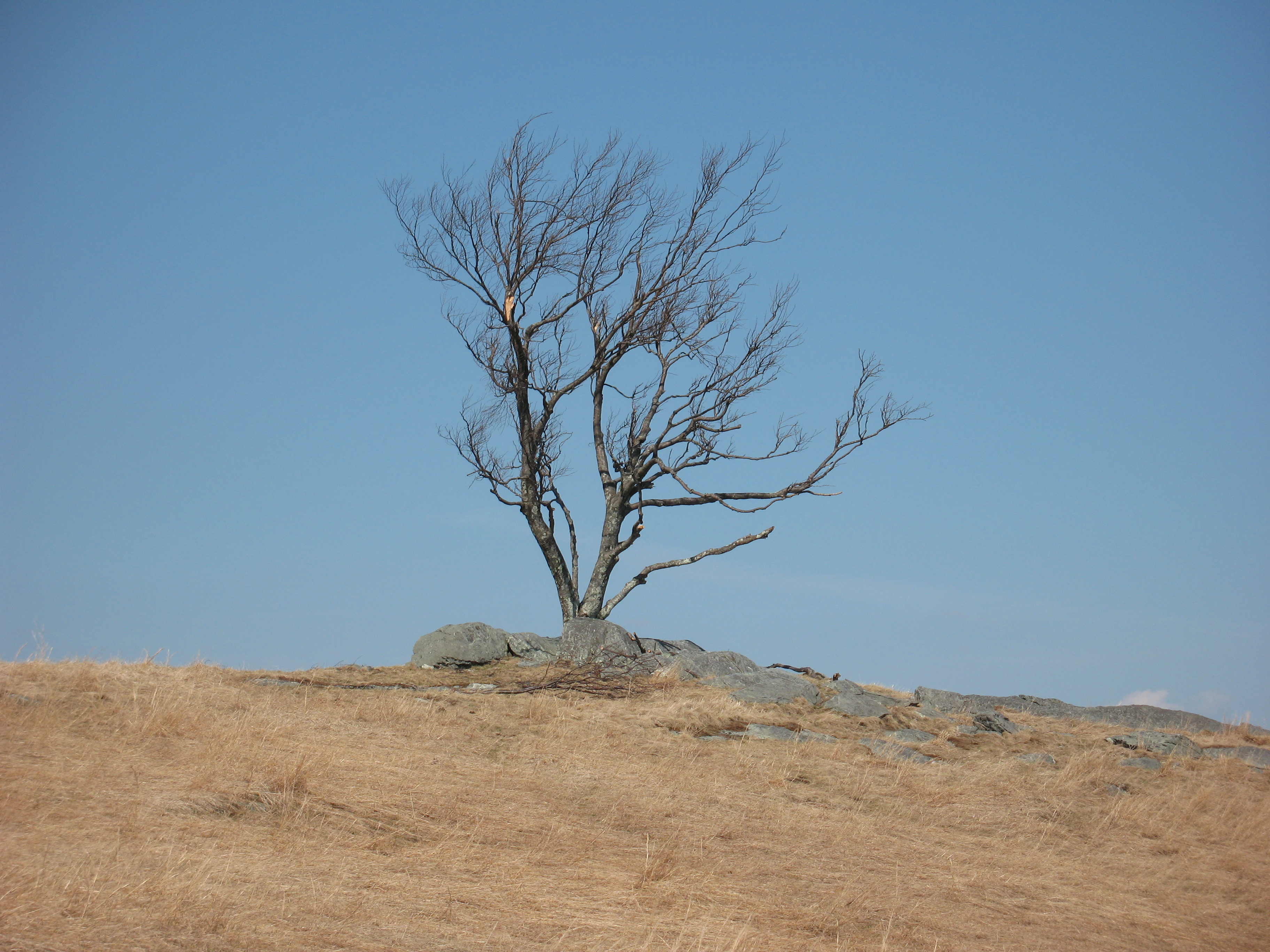
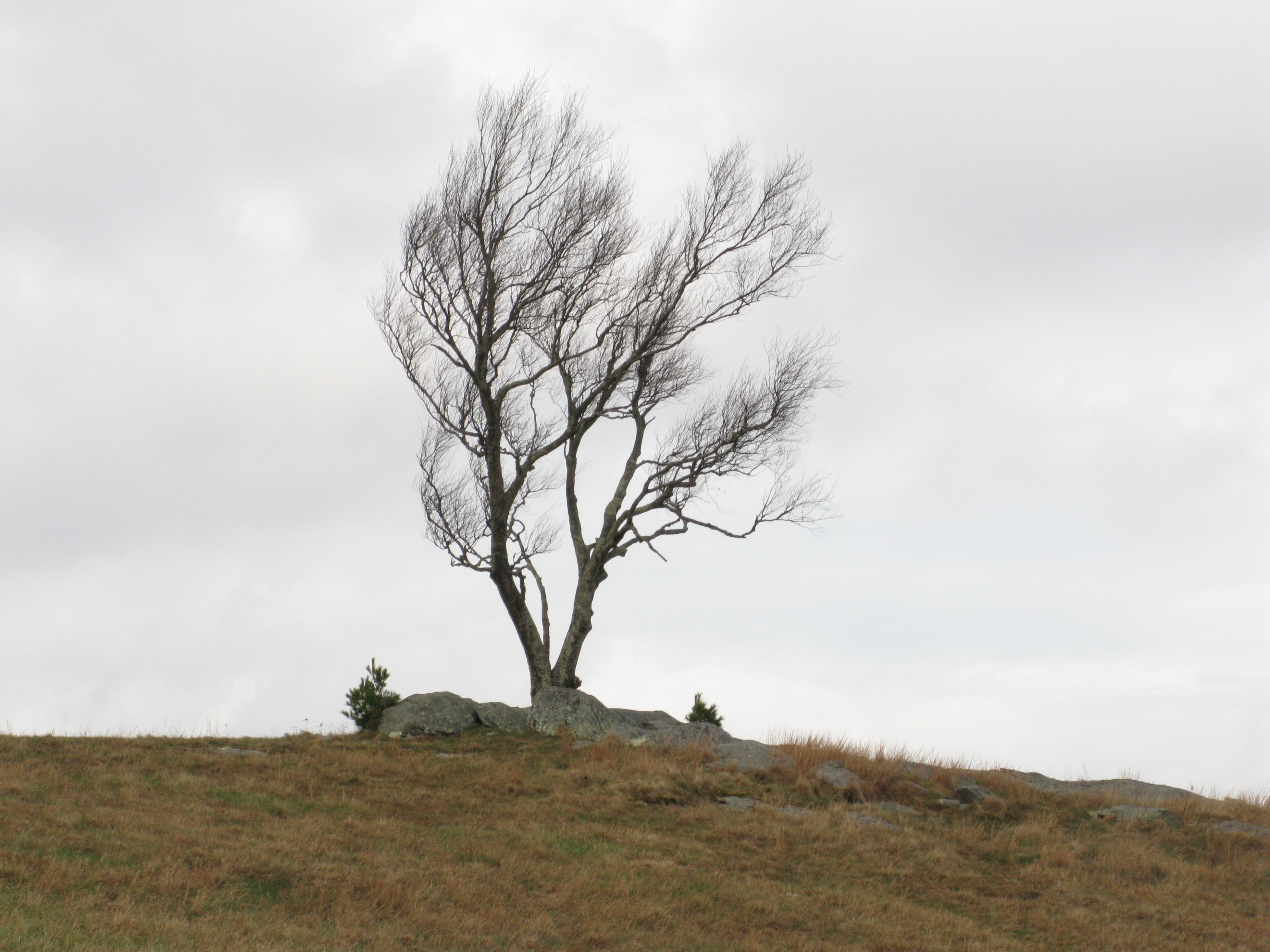
IMG_0768, tree
 . 

Read Full Post »

 . 
[with 3 poems from Tar River Poetry]
 . 
Submersible
 . 
+++ “Red Sky at Morning”
++++++ – for Peter Makuck
 . 
All day and into the evening sullen rain has bucketed dow upon us,
and I think of Peter and the blue-black coastal squalls purpling seaward.
 . 
Ignoring heavy weather is what natives do on Emerald Isle. Years ago
I failed to talk him and Phyllis into fleeing Hurricane Florence, a monster
 . 
storm grinding on Wilmington. Likewise, I used to remind my rother
at Kitty Hawk, half-joking, that he lived in the middle of the god-damned
 . 
Atlantic Ocean. He never listened either – even after his son refused
evacuation from Hurricane Isobel and almost drowned inside their cottage
 . 
with his loyal dog and bobbing bamboo furniture. Tenaciously, Peter and
Phyllis have been anchored to their apartment for years, weathering cancer
 . 
treatments and the Pandemic. Finally – like my father decades ago –
Peter had had enough of chemo, remission, drug cocktails and radiation,
 . 
so six weeks back he stopped. Meanwhile the world obsesses over five men
trapped in the submersible Titan, its only hatch bolted from the outside and
 . 
the seven ways it’s supposed to shed weight and resurface from its great drop
down to Titanic’s ghost spines. The one porthole is small. They’re out of air.
 . 
Peter too has begun a long descent through the murky waters of memory,
morphine, and goodby to land finally (I hope) upon the soft silt of forever.
 . 
Everyone’s half-waiting for the last storm to fade and for Peter – teacher, poet,
and sailor – to resurface and note with delight, again, a red sky at night.
 . 
Don Ball
from Tar River Poetry, Volume 63 Number 1, Fall 2023, Greenville NC.
 . 
❦ ❦ ❦
 . 
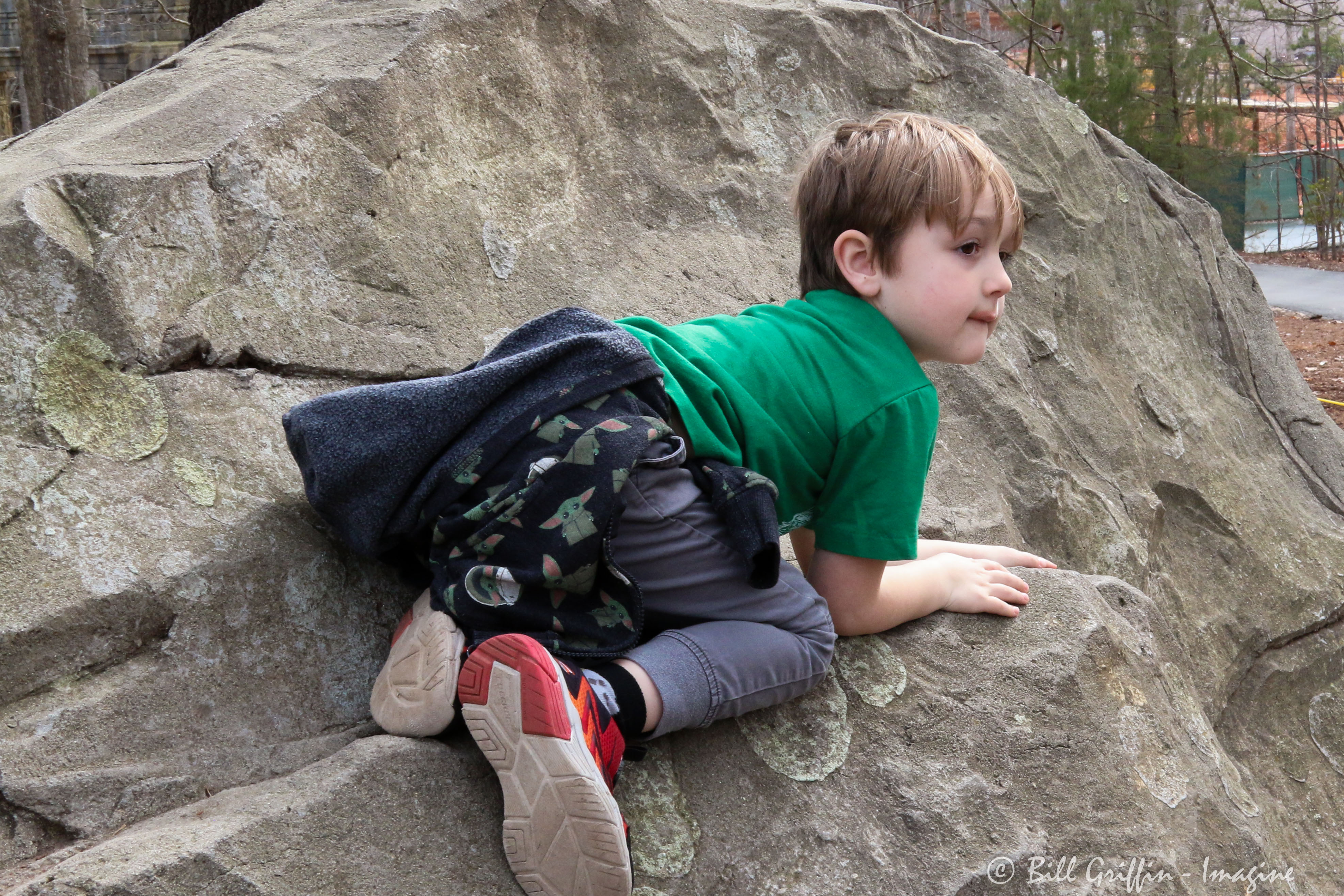
As soon as he hops from the car he’s Tyrannosaurus, miniature dangling forelegs, ferocious jaw gaping as he swivels his head side to side, Linda and me his prey. While we wait for food Chameleon appears, thin compressed lips, deliberate robot-like ratcheting gait, front digits at right angles all asplay. Later we interrupt our walk for him to climb the big rock, Gila Monster, but then he elongates his body along a fissure and becomes Chuckwalla.
 . 
Boys are animals. This boy, though, is the master of animals. Not only in transforming himself one into another but also in the thousand and one details he can tell us about their lives and characteristics. We imagine his kindergarten teacher’s eyebrows rising higher and higher at the revelations he pours forth. And what is the best place to really mix it up with animals? Besides, that is, the back yard – bird feeders, bunnies, snakes, hens – and walks along the greenway – deer, skinks, herons, eagles? Well, of course the North Carolina Zoological Park!
 . 
This is the second straight year we’ve spent my birthday at the Zoo with Bert. And with about a thousand other boys and girls of every possible age, shape, size, and color. Come to the Zoo and see the wild children! What other place can keep kids walking for hours and miles with minimal meltdowns? (And what other place features Polar Bear pee and Gorilla poop, fascinating stuff.) Just pack plenty of snacks and you won’t hear the first whine. And while we adults are rewarded minute by minute with Bert’s company, it’s only fair to end the day with one final reward for him at the gift shop. Another addition to the home menagerie. Next time we’re together, I’ll be sure to keep my fingers to myself when Boy Snapping Turtle meets me at the door.
 . 
 . 
❦ ❦ ❦
 . 
The Dead
 . 
We want to button them to us,
wear them like clothes. We want
to savor our morning café au lait
with them, hold yoga poses,
walk dogs, skateboard, eat sushi,
rake leaves, stream movies, tango
dribble basketballs with them.
We want them to ride beside us,
windows down, singing
along with our favorite playlists.
We want to tuck them in books
to mark our place, jingle them
in our pockets, lucky coins,
hook them over our arms
like umbrellas to keep us dry.
Coming home at night, we want
the porchlight’s yellow halo
to mean they’re waiting up.
As our key turns the lock,
we pray they’ll call out to us
from the empty rooms
of our dark house.
 . 
Janis Harrington
from Tar River Poetry, Volume 63 Number 1, Fall 2023, Greenville NC.
 . 
❦ ❦ ❦
 . 
I first immersed myself in Peter Makuck’s poetry when I was poet-in-residence at the NC Zoo in 2012. I was working on the Poetry of Conservation project, selecting poems by North Carolina writers that might be displayed in the park, and I also published daily posts of my observations (spending all day every day in the Zoo – it doesn’t get better than that!). In my very first post I featured Peter’s poem, My Son Draws an Apple Tree, a beautifully simple poem that cuts to the truth of the bittersweet relationship between father and son. Peter’s collection in which the poem appears, Long Lens, is filled with generous, haunting, contemplative recollections and themes.
 . 
Peter Makuck founded Tar River Poetry and served as its editor for decades during his tenure at East Carolina University. The current issue arrived this week [vol 63, nr 1, fall 2023] and is dedicated to him – he died last year at the age of 83. Peter inspired me through his writing but equally through his generosity and friendship. Somehow we struck up an email correspondence through the years, first about poetry, then about the NC coast, nature sightings, just stuff we discovered we had in common. Even when wearing his editor’s hat – and I have accumulated more rejections than acceptances from him and Luke Whisnant, the current editor – he was never anything but encouraging and giving of himself. He would have liked me to believe that I, even I, could write poetry as worthy as his own.
 . 
 . 
Tar River Poetry is a journal of national stature and reputation, but the three poems I’ve featured today are all by North Carolina writers who appear in this current issue (the wonderful poem One Year Old by Rebecca Baggett is also in this issue but space constraints etc.). Check out TRP and join me in subscribing HERE
 . 
Long Lens by Peter Makuck is available HERE. Learn more about Peter and his other books HERE
 . 
 . 
❦ ❦ ❦
 . 
Picking Up Trash with My Sister
on Crab Orchard Road
 . 
She plunges a foot into the dry ditch,
tosses cans, plastic bottles, empty
cigarette packs onto the gravel road
so we can sort them into garbage
and recycling. As she works she asks,
Is this poison ivy? Is this?, trusting me
to protect her as I’ve trusted her since my beginning,
older sister in pictures at ages five and three,
reading to me as we sit on the sofa,
feet sticking straight out, book open in her lap,
pink cat’s eye classes she pushed with one finger
back up her nose.
 . 
And later, at nine and eleven, trying
to sooth with the only stories that made sense:
we’re fleeing the potato famine in Ireland
or Nazis coming to take us away
that morning we heaped dolls into blankets,
shoved clothes into flowered suitcases, fearing
each floorboard creak might be our father
come home to carry out night’s drunken threat
to shoot our mother.
 . 
My sister stomps a beer can flat,
drops it in her bag, slips a Styrofoam cup
into mine. Who would do this? she says,
shaking her head, pushing dark purple glasses
with one finger back up her nose. She twists the lid
from a water bottle, pours the last sip
over the roots of a wilted aster
 . 
Pam Baggett
from Tar River Poetry, Volume 63 Number 1, Fall 2023, Greenville NC.
 . 
 . 
 . 
❦ ❦ ❦
 . 
IMG_6944
 . 

Read Full Post »

[with 3 selections from Tar River Poetry]
Letter to the Archaeologists of the Post-Anthropocene
You know already what fools we were,
how like the dog that starts itself awake
we jumped and bared our teeth
and turned to chase our tail, our fury
rising as we spun – and how, unlike the dog,
we did not hold our caught selves
gently, surprised to be at once the captive
and the captor, but chewed our own flesh
bloody, sure we were destroying that
which would destroy us. You already know
we killed our saviors, set fire
to our home, and ate
our bitter hearts. We said
because we owned what we destroyed
it was ours for the destruction,
and we destroyed it
to prove that it was ours.
You know all that.
You may not know, however,
just how much
we loved what we destroyed, how much
we longed to have it love us –
how even the cruelest among us
would stop sometimes to watch
the polluted sky at sunset
turning gold then pink then indigo.
Shane Sheely
from Tar River Poetry, Volume 62, Number 2. Spring 2023. © 2023 TRP
❦ ❦ ❦
Some ten years ago I became a phyto-heterotroph. Many people have asked whether it was a difficult transition and whether I have regrets. Not at all! To borrow a phrase from the general domain of heterotrophs, “Life is good.”
This week I’ve been reintroduced to a community of fellow heterotrophs after a year’s absence. We met in the woods on Grassy Creek’s Forest Bathing trail as they emerged  from the shady gloom, pale as the moon, a little creepy. Their scaly jointed fingers that are not fingers poked up from the leaf mould. They nodded their heads which are not heads. Not human, not fungus. What?
These are plants, flowering plants, but stark white, utterly absent chlorophyll : Ghost Pipes (Heath family, Ericaceae, same family as rhododendron, azalea, huckleberry, but so eerily different). Kneel to inspect the nodding head and you’ll see that it’s a flower, one at the apex of each stem, and indeed shaped like the flowers on my blueberry bushes beside the driveway. I remember the first time I saw these odd creatures in the southern Appalachians, thriving in rich mesic woodland, clustered in deep shade with no need for photons. I was taught that they are white because they’re parasitic, taking nourishment from the roots of trees.
Heterotrophic – fed by others. The opposite of autotrophic, feeding oneself. Most of the Plant Kingdom are autotrophs, industriously creating sugar and cellulose from the nothing of light and CO2. Quite a number in Kingdom Protist are autotrophs (algae, for example), and even a few in the Bacteria Kingdom (cyanobacteria). All the rest of us are unable to feed ourselves. I can make Vitamin D when sunlight strikes my skin, but as an obligate heterotroph I must consume autotrophs to survive.
Personal and Planetary Health—The Connection With Dietary Choices. This is the title of a feature editorial in the Journal of the American Medical Society (June 6, 2023; Volume 329, Number 21). It isn’t difficult to imagine the message the editorialist will promote, but it is novel to emphasize the connection between choices that lead to personal well-being and and choices that promote global health. To quote: Physicians have historically focused on patient health and relegated planetary health to environmentalists and lawmakers. However, dietary choices are the largest driver of chronic diseases. National surveys indicate less than 5% of the US population meets dietary fiber recommendations due to inadequate plant-based food intake. Plant-based diets are also associated with reduced incidence of chronic diseases such as obesity, cardiovascular disease, diabetes, chronic kidney disease, and cancer in multiple studies.
I became a phyto-heterotroph (it’s easier to spell vegetarian) not for personal health but to reduce my ecological footprint. Eating plants instead of eating things that eat plants has a frankly unbelieveable impact on agricultural water consumption, loss of habitat to grazing and animal feedstock production, and methane and nitrous oxide production (25 times and 298 times more potent greenhouse gases than CO2). Even the most diehard omni-heterotroph could probably tolerate a phyto-heterotroph diet one or two days a week.
And those Ghost Pipes (Monotropa uniflora) – I read this week that they are actually myco-heterotrophs. Their roots entangle with and suck sugar from the fungal filaments of the mycorrhizal network that permeates all healthy soil. Alas, all fungi are themselves heterotrophs. They reciprocate with green plants to provide minerals and water in exchange for sugar, some of which they evidently pass on to the Ghost Pipes. Without GREEN, none of us would be here.
❦ ❦ ❦
Because the Demented World Repeats Itself
In Europe again tonight,
a human being is dying
under a bombed-to-rubble house
or in the street – bicycle basket
spilling its loaf of bread.
This particular human is dying
whose dying makes me despair
though I’m no one in particular
and they’re no one in particular
to me. I’m just another human
who will be dying, but not yet,
and who lies warm under my quilt
of many blessings, wondering
what can be done about humans
when I can’t dissuade the sparrow
who attacks our window
slamming and slamming
his reflection – the enemy
he keeps seeing but not
seeing as himself.
Susan Cohen
from Tar River Poetry, Volume 62, Number 2. Spring 2023. © 2023 TRP
❦ ❦ ❦
I don’t subscribe to many literary journals, but I don’t let my Tar River Poetry lapse. Volume 62/Number 2 arrived last week containing a few familiar names but many more names that I now want to remain familiar with. Micro-themes seem to weave through its fifty pages of poetry like a carrier wave that fills the room with music. A few poems juxtaposed are having a conversation, but when the next in line picks up the thread the color and texture have suddenly shifted again. Always something new, always engaging, deeply felt, deeply connecting. Thank you to Luke Whisnant and all the perceptive editors who send me a fresh volume twice a year.
Tar River Poetry is published twice yearly with the support of the Department of English, East Carolina University. http://tarriverpoetry.com. 113 Erwin Hall, Mail Stop 159, ECU, East Fifth Street, Greenville NC 27858-4353.
Shane Sheely has published three books of poetry and directs and teaches in the creative writing MFA program at University of Missouri-St. Louis.
Susan Cohen, author of three full-length poetry collections, is a former journalist living in Berkeley, California.
Steve Cushman’s first poetry collection, How Birds Fly, won the 2018 Lena Shull Book Award of the North Carolina Poetry Society.
❦ ❦ ❦
The Candiru Fish is So Small It Could Swim Up Your Urethra
is what Mrs. Hart, my 9th grade biology teacher, said
thirty-some years ago, so when Julie says let’s go skinny
dipping, instead of being excited I’m transported back to
Mrs. Hart’s class in St. Petersburg where all we had to cool
us off on those Florida afternoons was one lone window unit,
so we sweated through her lectures until the day we sat up
straight and listened as she discussed urethras and penises
and the dangers lurking beneath the surface. Come on, Julie
is saying, naked now, her clothes in a stack at the shore,
her pale shoulders bouncing up and down at the water’s surface.
I strip bare, tell myself we’re nowhere near the Amazon River,
run with everything I have into the water, into Julie’s arms,
and again she’s rescuing me from myself, from my silly fears,
and those murky, dangerous things, seen and unseen.
Steve Cushman
from Tar River Poetry, Volume 62, Number 2. Spring 2023. © 2023 TRP
❦ ❦ ❦
Doughton Park Tree 2020-11-22

Read Full Post »

Older Posts »