Feeds:
Posts
Comments

Posts Tagged ‘Redhawk Publications’

 . 
[with 3 poems by Ana Pugatch]
 . 
My Mother’s Visit
 . 
The woman sensed that I now
looked down on her. That the earth
had turned slowly
 . 
into night. That her kin would only be
a distant moon. She watched
shards of light slice through the bamboo
 . 
thicket, the stars’ edges harden
and cool. In daytime she marveled
at the strength of a water buffalo, how
 . 
it shoulders could shift continents.
But I knew it would never be
enough.
 . 
We looked down
from the bamboo raft, and below
the glass surface saw
 . 
what flickered in turbid
darkness. Like my mother I thought
of the day when the river
 . 
would freeze over –
and how I’d give up everything
to feel its final stillness.
 . 
Ana Pugatch
from Engrams, Seven Years in Asia, winner of the 2022 Lena Shull Book Award of the North Carolina Poetry Society; Redhawk Publications, Hickory, NC; © 2023
 . 
❦ ❦ ❦
 . 
Above the river a west-facing ridge, protected, always cool and moist, and a narrow rustic trail that veers from the main — this is the path I take the day after Christmas. Winter brown, mossy stones and lichen, these are all I expect today, but here and there are premonitions. Ruddy toothed leaves, foamflower will bloom in March; bright green variegated heartleaf hides beneath pine needles today but soon will hide its own little brown jugs. So much muted beauty to share, but what is this! Hepatica is blooming!
 . 
Right here along this little path is the first place I ever discovered native hepatica in Elkin. (I still clearly remember where I was standing when I added my first bird to my life list decades ago, a chestnut-sided warbler — do normal people hold onto these sorts of memories?) But this is December — the earliest we ever see hepatica in bloom is late February, preceding even the rush of trout lilies. Nevertheless here is one plant with a flower and two swelling buds. Too, too early. Winter too warm. I can’t say I’m filled with happy thoughts for our planet.
 . 
A few days later I’m back with a camera. I can’t say I’m filled with happy thoughts of botany and phenology. Last night my brother and sister and I had a lengthy conference about our Mom’s decline. Tomorrow I’ll be sitting down with her and Dad to discuss a palliative care consultation and possibly moving to a higher level of care. I have to watch my footing carefully on parts of this trail – exposed stones, roots, erosion. Going downhill is when you’re most likely to fall. Mom’s descent has been steady for years, gradual, but the path ahead appears much steeper.
 . 
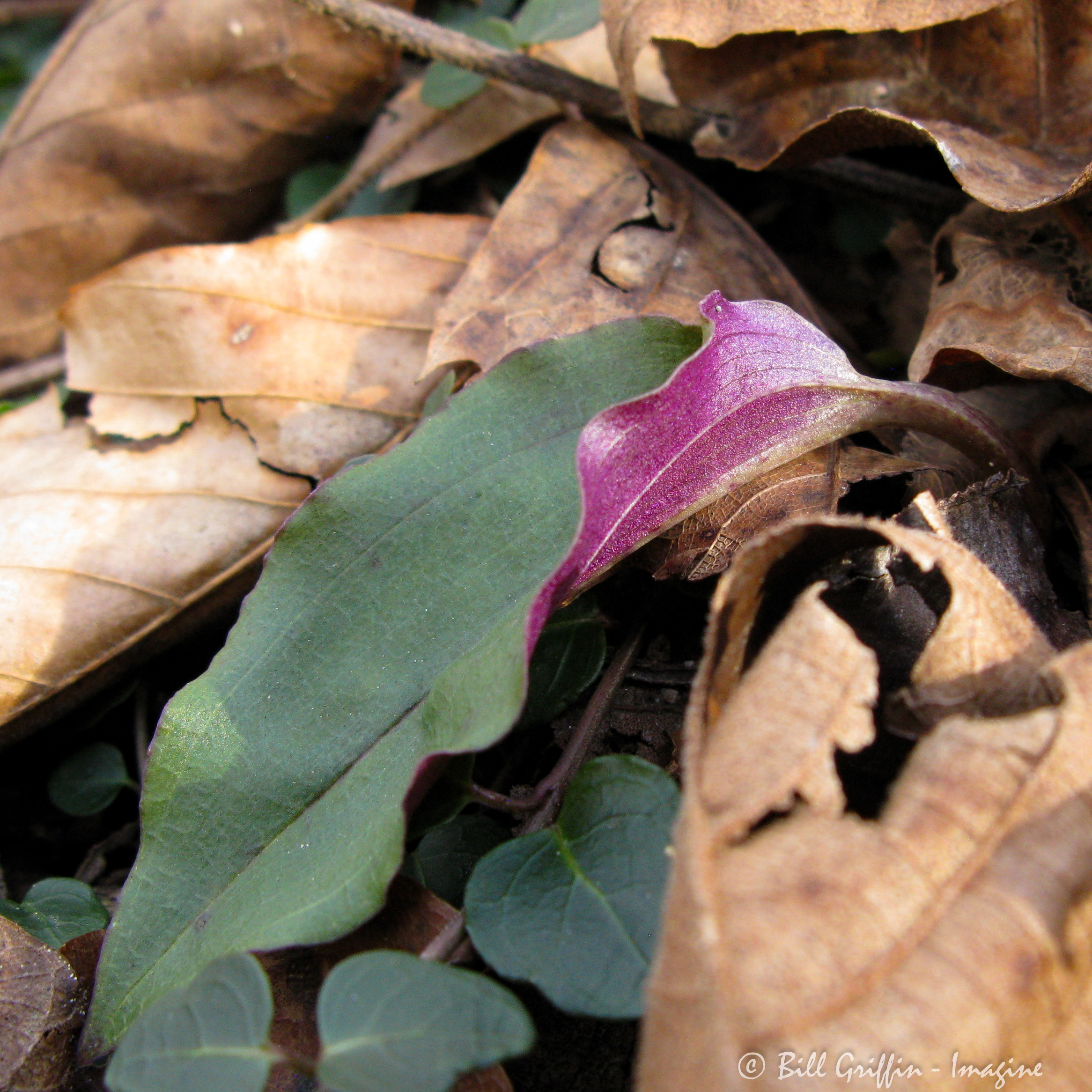
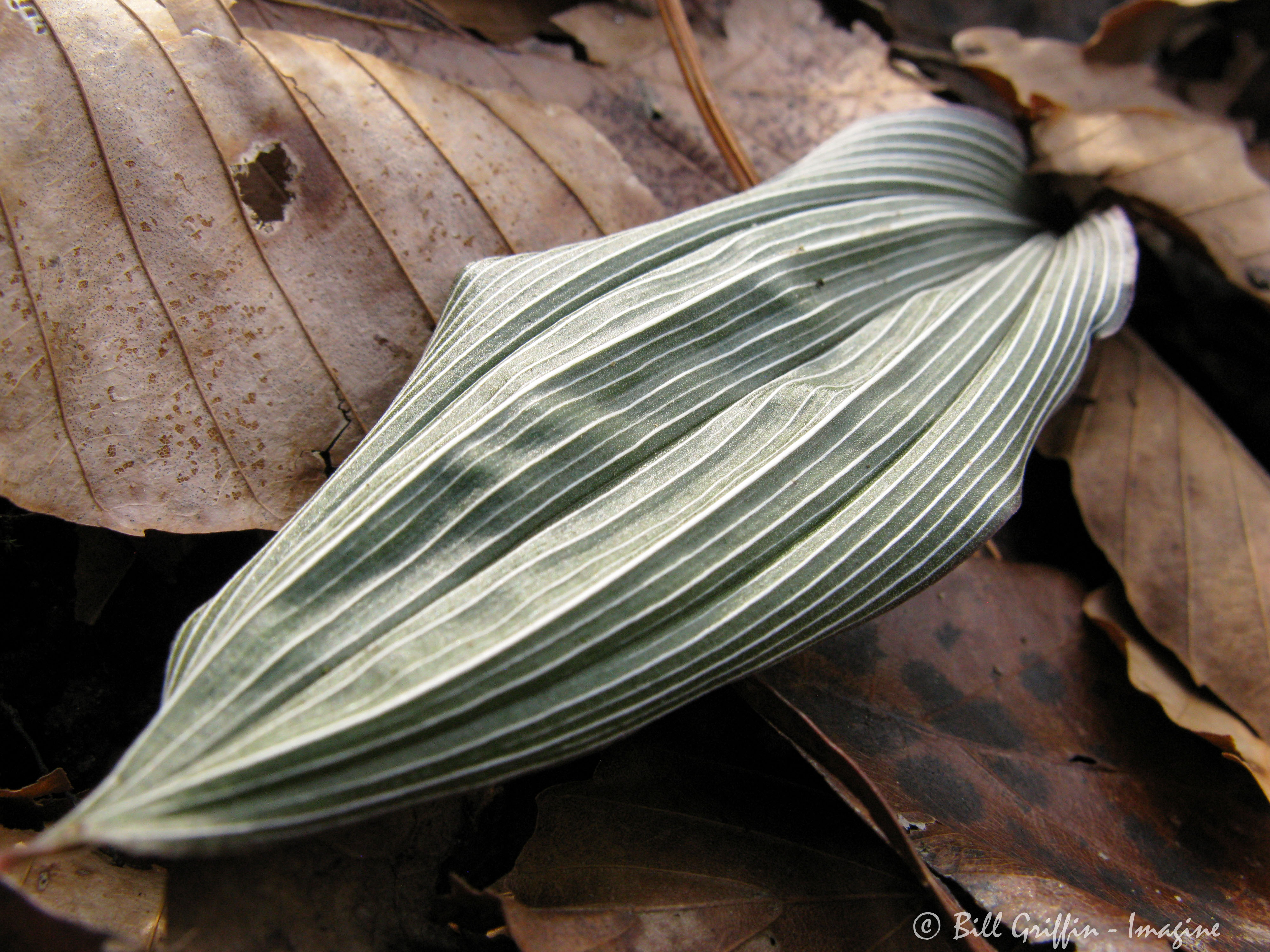
This is interesting – a single clump of pinstriped leaves, Adam-and-Eve Orchid. And Cranefly Orchid with its magenta underleaf is plentiful here. When the surrounding trees lose their leaves these orchids make sugar from winter sun. Their own leaves will fade and disappear before spikes of tiny flowers appear  mid-summer. Similar for the hepatica: last year’s flecked and nibbled liver-lobed leaves are making way for new green even now. Diminished light, cold and frost, life makes what it can of every season. I bend lower for a better look at each delicate yet resolute little family of leaves. Not a single flower to be found today.
 . 
 . 
❦ ❦ ❦
 . 
The Nightjar
+++ for S.
 . 
In the evenings you fold your wings
in a hammock on the porch.
 . 
your jaw clicks in imitation
of car locks. Your hair grows dark
to form a nest, twilight clouds:
 . 
a puff of throat. Mangrove roots
of a slow entanglement; filaments of stars
hang above us.
 . 
Don’t forget you say with the fan-eyes
of your tail as you fly away
 . 
each morning. You’re known
to frequent other lives, exhale their smoke,
catch tiny deaths on the temple’s
 . 
low wall. You’re known
for your camouflage, the concealment
of thoughts in daylight.
 . 
But I’ll still hold you, hoping
you’ll stay. Even if your ones are hollow,
 . 
fragile – I know one day you’ll roost
on steady ground.
 . 
Ana Pugatch
from Engrams, Seven Years in Asia, winner of the 2022 Lena Shull Book Award of the North Carolina Poetry Society; Redhawk Publications, Hickory, NC; © 2023
 . 
❦ ❦ ❦
 . 
Where does a memory live? Where does its root take hold, where is its safe repository? The sudden intake of breath at one sepia photo slipped from a pile of many others? A brief waft of scent upon opening a long-closed drawer? A word spoken in an unknown language ferrying meaning beyond its meaning? A phrase written in a notebook long misplaced? A dream?
 . 
Perhaps our memories are truly embedded in biochemical engrams deep in our hippocampus, hard-wired each in its own bud of synapse, but where is the map to its local address? Ana Pugatch knows to follow the narrow alleys and unmarked streets. Her poems are visions, aromas, sensations that may chill or warm. That may be fearful and unsettling or openly inviting. Her memories weave a world for me. Her world opens me to my own alleys, dim at times but becoming brighter; she opens me to streets I had forgotten. Or have yet to travel.
 . 
 . 
Is it because the world is so big and there are so many of us in it that we react by closing ourselves and retreating? Are we threatened by the rush and clamor of ideas, practices, cultures? Is that why we draw a line around our tribe and push all others away? We imagine that to survive we must deny, even destroy, everything outside our comfortable patch of expectations. To my mind, humankind’s survival depends on just the opposite. We can’t close the door but most open it. Perhaps we do feel frightened when confronted with anything that challenges our assumptions, whether a person, an artifact, an idea. Perhaps. And perhaps responding to novelty with imagination rather than rebuff is what allowed Homo sapiens to expand while Homo neanderthalensis dwindled and disappeared (except for the handful of Neanderthal genes we’ve acquired and still carry!).
 . 
Within poetry is concealed the map to our local memories. And in poetry we encounter shared memory and experience, doorways that may lead us out of our cloister and into the embrace of the different, the foreign, the alien, the frightening. As I read Ana Pugatch’s sensitive and sometimes ephemeral visions of her years in China and Thailand, and now of her presence in North Carolina, I am not an impartial observer watching a travelogue. I connect with those struggles. We are human, she and I and all the people she encounters. From the strangeness I feel a common thread winding around my heart. May that thread continue to pull me forward, and outward.
 . 
 . 
Engrams, Seven Years in Asia is available from Redhawk Publications.
The Lena Shull Book Award for a full length poetry manuscript is sponsored annually by the North Carolina Poetry Society. Submission period opens June 15, 2024.
 . 
 . 
❦ ❦ ❦
 . 
Unfurnished
 . 
I would write down the date if I knew
which day it was.
It’s Tuesday, I think,
and the baby cries upstairs.
 . 
I’ve never seen the family;
I only know them by
the red and gold characters posted
on their door.
 . 
Their laundry hangs
on the lines above mine;
Cantonese echoes through
my empty rooms.
 . 
We share the same view of Zhuhai.
We share that space of sky and trees
and we open our doors
when it rains.
 . 
Ana Pugatch
from Engrams, Seven Years in Asia, winner of the 2022 Lena Shull Book Award of the North Carolina Poetry Society; Redhawk Publications, Hickory, NC; © 2023
 . 
❦ ❦ ❦
 . 
 . 
❦ ❦ ❦
 . 
2018-02-09 Doughton Park Tree

Read Full Post »

[with 3 poems by Scott Owens]

. . . walls that don’t line up, some bricks
uneven, some not quite the right size,
and that’s what the mortar’s for,
the gray areas of tolerance,
forgiveness, understanding,
empathetic appreciation of things
being left imperfect, only as good
as we can stand to make them be.
+++++++ from Reclamation

E&A Nature Trail, Elkin rec center, Mountains-to-Sea, Forest Bathing – none of these trails today. Instead Mom and Dad and I walk their customary course behind the townhouse, traversing maybe 200 meters of blacktop. They tap their canes on the far curb to mark the first turnaround; it’s a little uphill and a lot slower approaching the second turn but then all downhill back to their doorway. Some days we keep going a little farther. This afternoon we feel like it’s been enough.

And why do we spend 45 minutes on our little trek, 3 or 4 careful steps per meter? Just needing the exercise? A breath of fresh air? Halfway through our circuit, Maggie’s owner appears and drops her leash, little fluffdog who gallops to Dad because she knows he always carries biscuits in his pockets. Norris stops to share the latest (oldest) joke. Here’s Peggy to check on how Mom and Dad made it through family travels over New Year’s (and to say Hi to this particular family person still staying with them tonight). Wave at Julia who’s expecting company for supper, wave at the FEDEX guy. Comment on all the little gardens behind each townhouse – Nice wreath! Is that a new bench?

This slow-gaited noticeably-hunched deliberate meander is the mortar of Mom and Dad’s days. These few folks they greet, and never overlook the dogs, are their neighborhood. “I’m going to get better, I’m going to walk farther,” says Dad, but even this afternoon it no doubt strengthens him just as much to hear, “I just can’t believe you’re 96.” Acceptance, understanding, empathy for the relentlessness of aging and decline – these hold the chipped, uneven bricks together. Let’s take another walk tomorrow, no matter how meager, no matter how slow.

And you can keep an eye out with me – I have yet to catch Dad slipping those dog biscuits into his pocket.

❦ ❦ ❦

Common Ground

My brother has never kept a single lake,
a single lost grave to himself.
Always he calls, then waits until I
can come, lets me lead the way,
find it like the first time,
proclaiming the names I know, the shapes
of bird and stone, cloud and tree.

Once in the same day I saw
a kestrel, a mantis, an arrowhead
and took it as a sign, though since
I have seen each in their own days
and miles away from each other.

I do not believe God will bend
to kiss this mouth. I do not believe
the wine will turn to blood. But something
knows the moment of sunflower,
the time of crow’s open wing,
the span of moss growing on rock,
and water washing it away.

In the pictures I remember, there is you
letting me stand on the fallen tree
as if it were mine. There is you
letting my arm rest on top of yours
around our mother. There is you
lifting me up to the limb I couldn’t reach.

This is the faith I’ve wanted, to know
that even now we are capable of such
sacrifice, such willingness to love.

Scott Owens
from Prepositional, New and Selected Poems, Redhawk Publications, The Catawba Valley Community College Press, © 2022 Scott Owens.

❦ ❦ ❦

Scott Owens travels through life in this solid, substantial collection of poems, Prepositional. He is coming from it, being of it, finding its deep inside and its dark under, discovering its thrall over and above. And as Scott sees through and into life, he invites us to accompany, to courageously push things forward.

As the newest in a long line of books from a prolific poet, this collection yet seems to be an inflection, an exhalation of breath long held. These poems walked a long way to take their seats here. Some are new but all have been selected to become new. Or maybe it’s their relationships to each other that have grown new, as Scott explains in 13 Ways of Prepositions: every way a squirrel can be / in relation to a tree. These are poems about poetry, its art, its craft, but more so the arising of something greater out of something lesser. These are poems about students and teaching and being a student; these are poems about family ties in every Venn you can imagine. All these poems have gathered here, though, for a common purpose: to water the seeds of relationship; to somehow connect with each other and with you and me, their readers.

When I finished the last poem and laid the book down, this is the reverberation I still heard ringing in my mind: “The world is a wonderful place. You are a wonderful person. I’d like the two of us to sit down and share something of these two wonderful facts.”

❦ ❦ ❦

Words and What They Say

Some say you can’t tell anything
from the language that people use,
that Eskimos in fact have no
more words for snow than we,
nor Anglo-Saxons more
for cut, stab, thrust,
and the fact that our words for animals
when we eat them, beef, pork,
poultry, all come from French
doesn’t prove they’re better
cooks or bigger carnivores,
any more than 23 acronyms
for laughter shows that texting
teens just want to have fun,
but when I hear my carful of 2nd graders
from Sandy Ford Montessori School
making up names for the sun,
and the moon, and the stars that only
come out when you’re camping and the fire
goes out, and you turn off your flashlights
while our mother holds you in her arms,
I can’t help but believe
that not only is there hope for us all
but that the hope we have
is strongest when we find a way
to put it into words.

Scott Owens
from Prepositional, New and Selected Poems, Redhawk Publications, The Catawba Valley Community College Press, © 2022 Scott Owens.


❦ ❦ ❦

Of

Poetry is contrary to productivity.
Poetry encourages idleness.
Poetry stands at the window
because it is curious about the flowers,
this flower with its yellow fringed face
around its one brown eye.
Poetry stands at the window
because it is curious about the trees,
this tree with heart-shaped leaves,
some turning yellow in the first
days of fall, some fallen off and still
the limbs reaching up to the sky.
Poetry stands at the window
because it is curious about the sky,
how it got there, where it goes,
what it’s like where it ends.
Poetry wants the window down.
Poetry walks back and forth
through a field going nowhere.
Poetry thinks it’s okay to look
at the same sky day after day,
sometimes minutes at a time,
sometimes with no other purpose
but remembering blue.

Poetry refuses to follow the rules
of efficiency: get in line,
speak only when spoken to,
never say anything that would embarrass your mother.

The first poem ever written was a drum.
The first poem ever written was a foot
tapping on the side of the crib.
The first poem ever written was a rope
slapping the red clay playground
of William Blake Elementary School.

It is not necessary for poetry
to be beautiful
though sometimes it is.
It is not required of poetry
that it be profound
though it rarely closes its eyes.
It is not expected that the face
of poetry be etched with tears,
the hair dripping with sweat,
the mouth expressing awe.
Poetry owes nothing to anyone.

Still, poetry wakes up each morning,
walks to the edge of the world
and jumps, believing one time
it will fly, believing one time
the dive will not end, believing one time
an answer will rise from somewhere beyond.

Scott Owens
from Prepositional, New and Selected Poems, Redhawk Publications, The Catawba Valley Community College Press, © 2022 Scott Owens.

❦ ❦ ❦

Redhawk Publications; The Catawba Valley Community College Press;
2550 US Hwy 709 SE; Hickory, NC 28602.
Prepositional, New and Selected Poems by Scott Owens.

❦ ❦ ❦

Read Full Post »


[with 4 poems by Joan Barasovska]

In just a few days our home planet will reach that point in its yearlong circumsolar peregrination at which it will feel the maximum effect of its 23 degree axial tilt off the perpendicular. In other words, today is way too close to the solstice for us to have waited until 3:30 to begin our 5 mile hike.

Byrd’s Branch to Grassy Creek and out to the far terminus of Forest Bathing: when we turn at last to retrace our steps we see that the shadows have lengthened into no shadows at all. Splitting the utter stillness as we skirt Klondike Lake, fifty geese suddenly spook and lift and wheel over us. The urgency of their wings is the sound night makes when it is falling too fast. As we leave the creek and climb up from the shadowy vale, we do regain a bit of skyglow from the western horizon, that thin chill winter platinum that can’t penetrate between the gray trunks closing around us but which persists in the pale leaves covering the path. Light still leads us on.

Serenely quiet here. No breath of breeze, no quarreling crows, no road noise. The squirrels have hushed their startled rattling up the hickory trees. We can’t see into the cloaked woods; we imagine we’re entirely alone until our last companion calls. A Towhee sings his plaintive two-note motet, his mate answers, and they ferry us along the trail.

Here’s the road crossing, isolated rural lane. Only another mile to our car – a mile through Mr. Byrd’s close-planted white pine woodlot. Shall I describe the pathway leading down into the embrace of those lowering dense-woven needled boughs?

It’s dark!

❦ ❦ ❦

Sore Throat

The best light in our rowhouse on St. James Street
is from the tall front windows in the living room.
I wait by the window in my pajamas for Dr. Barol
to ring the doorbell and for his jolly voice.
I’m to sit on the piano bench where he can see best,
his black leather bag beside me, its jaw wide open.
He stands above me in horn-rimmed glasses and bow tie,
shakes down the mercury in his glass thermometer.
He tells me to say AH and says, Open wide.
My tonsils are infected again, he tells my mother.

I want him to convince her to pity me.
Tell her I must stay in bed for a week.
Tell her to be nicer when she talks to me.
Don’t tell my mother that sickness
is what I crave most of all.
I’m sure he can tell. He’s shined a light
in my throat and ears so many times
he must know my trick.
I’m a little girl who believes she can
make herself sick just by being sad.

The nurse at school, Mrs. Marx, knows me well.
She rolls crinkly paper down the padded leather
table so I can rest with her if no one else is there.
She plays the opera music she loves on her radio.
I know she knows my secret, but maybe
she forgives me. From the bottom of my being
I want the gentleness that only sickness gets you.

But it doesn’t really work that way.
My throat is so sore. My mother’s angry
that I’m sick again. She has too much to do.
She makes me Cream of Wheat
with brown sugar. She pours medicine
from a brown bottle into a spoon.
She takes my temperature, gives me baby aspirin,
puts cool washcloths on my forehead, changes
the sheets. She does all that she should do.
I need what I can’t name.

Joan Barasovska
from Orange Tulips, Redhawk Publications, The Catawba Valley Community College Press, Hickory NC, © 2022

❦ ❦ ❦

Darkness. It creeps to overtake you whether you mark its arrival or not. Once surrounded, engulfed, overwhelmed, you may imagine that the darkness is all. That there is no way out, that there is nothing other than darkness.

Joan Barasovska’s Orange Tulips, a memoir in narrative verse, is a path into darkness. The world of this girl child opens with joy but already hints of inexplicable sadness; the adult journeys through suffering, doubt, pain, the wrenching temptation of hopelessness. Despair is palpable.

But no life is a single arc. There are many stories and their outcomes are not foreordained. An unexpected door may open into light. The arc of another person entwines with our own and we are touched, changed. As memoir, Joan’s story begs to be read cover to cover, front to back in a single sitting. I am lifted into the promise of light by the possibility of healing and redemption in its final pages. I am finished with the book, but it is not finished with me.

❦ ❦ ❦

1963

I’m a merry Girl Scout in green uniform
and felt beret. My troop is walking east across
the Schuylkill River Bridge. It’s an old bridge,
prickly sandstone under our palms.

You can sit on the ledge if you’re brave.
You can stand on the ledge if you’re foolish.
We look between the columns way down ito the water.
How deep is it? Miss Kelly doesn’t know.

What I care about, in one breath, is the impact of a fall.
The magnet of the gray river. The sick.
I don’t ask Miss Kelly why people jump.
She knows about hikes, knots, campfires.
Starting today, I’m the authority on jumping.

Merit badges, saddle shoes, jokes I am famous for.
I am nine, maybe ten.
Now I have a secret so strong it makes me dizzy.
On my honor, for God and my country,
it’s 1963 and I have fallen down.

Joan Barasovska
from Orange Tulips, Redhawk Publications, The Catawba Valley Community College Press, Hickory NC, © 2022

❦ ❦ ❦

All Wrong

Done so many things wrong
I don’t know if I can do right.
+++++++++++++ – Tracy Chapman

The built world defeats me.
My apartment, the building
where I answer phones,
the sidewalks I walk on,
have all done great things
to my nothing at all.

If I were in charge
this city would be empty,
wind blowing soot.
Just look at me!
A shandah, disgrace,
such a smart girl,
dropout, breakdown,
breakup, crackup.

I am twenty.
I read long novels.
I walk and walk.
I only feel well
on trains and buses.
I draw odd diagrams
in small books.

I don’t wonder
why I’m done for.

I only want to be
as useful as a sidewalk,
to hammer one nail straight.

Joan Barasovska
from Orange Tulips, Redhawk Publications, The Catawba Valley Community College Press, Hickory NC, © 2022

❦ ❦ ❦

The Day I Walked on Fire

it wasn’t fire
it was gingko leaves
the sun lit them yellow
they were juicy with heat

the day I walked on ginkgo leaves
I imagined they were fire
that my shoes were melting
that my feet were burning

and I felt no pain
on that autumn day
when I burned to be
a holy woman

Joan Barasovska
from Orange Tulips, Redhawk Publications, The Catawba Valley Community College Press, Hickory NC, © 2022

❦ ❦ ❦

2017-02-11 Doughton Park Tree

Read Full Post »

« Newer Posts - Older Posts »