. .
Posts Tagged ‘poetry’
Neck and Neck
Posted in family, Photography, poetry, tagged Bill Griffin, Galileo Press, imagery, Jan LaPerle, nature, nature photography, poetry on September 15, 2023| 4 Comments »
.
[with 3 poems by Jan LaPerle]
.
Cupboard
.
One day I decide I’ll do something
good for people,
but I forget, then I nap.
My daughter wants to make
lemon cake so we do that.
I stand on the stool
and begin this great hunt
for poppy seeds.
Hours pass, and I’m on my tiptoes.
I stop searching for a minute to listen
to the wind. The branches snapping.
My daughter ran off agin to her swing,
her swing tied to the branch
of the tree she climbs,
the tree run through with electric wires
in the yard she flies her kite in.
She flies it high as the cell tower.
Her dragon kite breathing fire.
Her dragon kite headed in a nosedive
straight into those electric lines.
I can’t do anything about anything.
I’m trapped in the cupboard
forgetting what I’m searching for.
I dust the spice tops; they go on forever.
My hair too tight in its bobby pins.
Here as good as any place to pray.
.
Jan LaPerle
from Maybe the Land Sings Back, Galileo Press, Aiken, SC. © 2022
.
❦ ❦ ❦
.
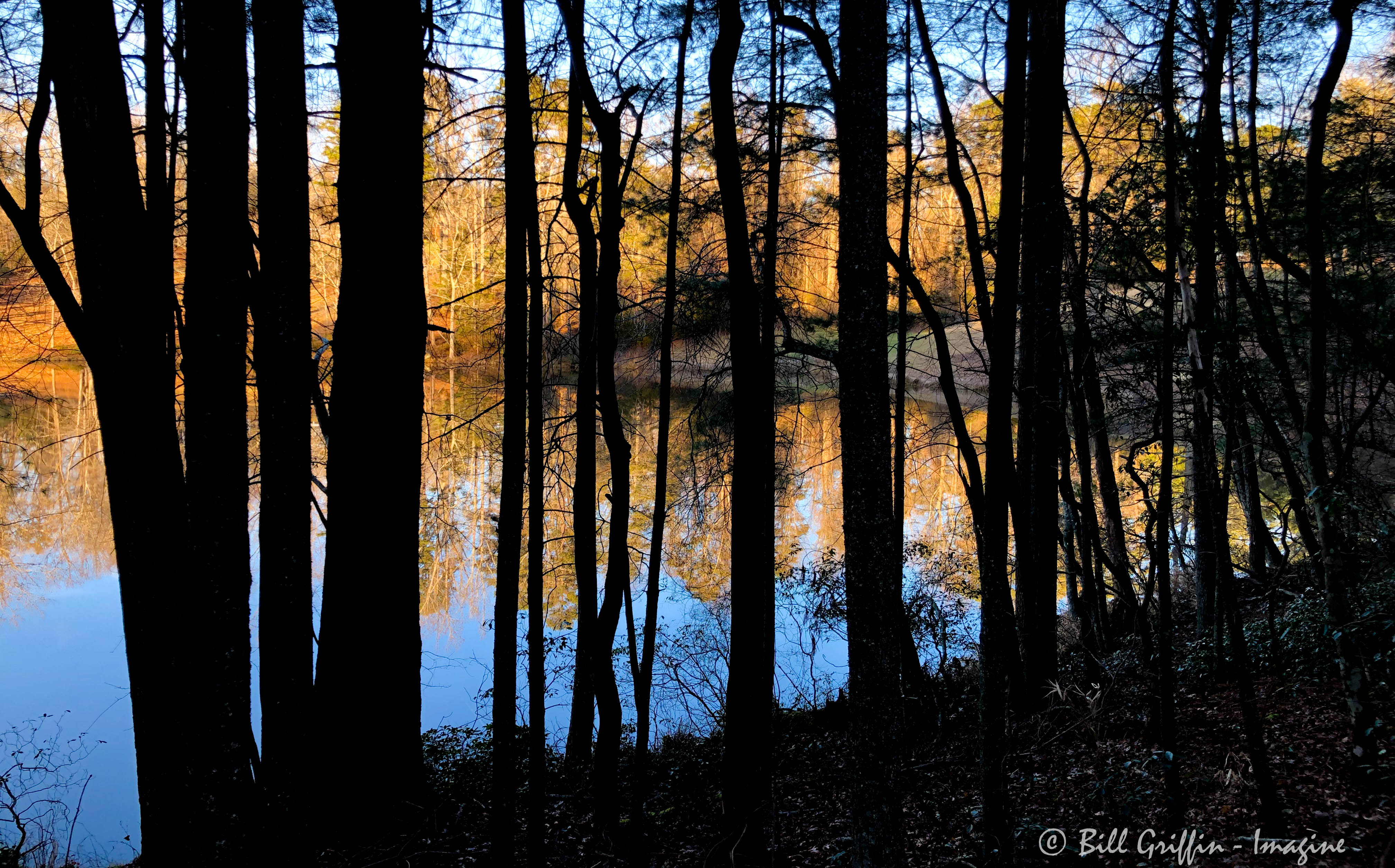
The dark and the light are neck and neck again. When dark creeps in the light just doesn’t seem to have much of a chance. This is a close as we come to living dangerously – taking a walk in the woods on an afternoon that promises thunderstorms. Today Linda and I are at Friendship Trail, part of the Mountains-to-Sea Trail east of town. Such a lovely name – almost no one walks here but when we do cross paths the others always smile. Perhaps they’re filled with the same thoughts as the two of us: cool shade, gentle slopes, chuckling creek. Green welcome.
.
Only a lumpy heap of black sky to the north, that’s all we could see from the parking lot. For the moment sun slants through the pines and tuliptrees. Cicadas sing. Into our third mile, though, shadows begin to deepen and the leaves get nervous. We can still see blinks of blue straight up through the branches but dark is moving in, shouldering it all aside. A stick drops from height to land at my feet. Will a widow-maker be next?
.
What gives dark its edge? Why its power to blot out a cheery afternoon and replace it with foreboding? Dark needn’t even knock yet I open the door to it.
.
Dark 4 AM’s are worst although understandable: the hour when the soul’s earthly tether / gently uncoils its smoky grasp / as tenuous as breath.* If I awaken at such an hour I immediately implore myself, “Don’t think, don’t think of . . . ,” but so swiftly the dark lines up its charges, some sharp as yesterday, some rank with decades, some uncertain ever to arrive at all but all too easily imagined. Dark loves the quiet unprotected moment.
.
But why, then, into light and airy freedom of mind is dark also able to intrude? I discover myself on a rural highway, green tunnel and morning dew, but instead of anticipating certain joy around the next bend I am reliving random moments of my own stupidity or, worse, recreating injuries and insults in some delusion that this heaps coals upon the heads of my enemies. Not Buddha but someone apparently equally enlightened said that to hold a grudge is to drink poison while imagining it will kill your foes. Here I am fueling the dark with anti-matter I’ve brought to the bonfire myself. This negativity, what could be more precisely the opposite of experiencing life in the moment? I open dark’s door myself.
.
Take a deep breath. Give my heart a good airing. No blame, no shame, just look straight up through the branches and accept what you see. Gray now, but not black. Threatening gusts have settled back to cooling breeze; just a few cold drops on my neck and no more. Here is the edge of the woods, the field, our car up ahead. Linda and I say, as we tend to, “Well, we carried our umbrellas and that’s what kept it from raining on us.” For a stretch it seemed neck and neck, but even so this hour has been full of green welcome. If at this moment we were instead dripping, shoes aslosh, about to shiver, we could still likely bring ourselves to say, even as we are about to now, “That was a wonderful walk.”
.
❦
.
The dark and the light are neck and neck again. So they seem to be in every poem by Jan LaPerle. Maybe the Land Sings Back is not a book of platitudes and happy endings. In fact, this is the anti-platitude book. But neither do these lines ever surrender to unremitting darkness. Despair dances with hope even if they are both stepping on each other’s feet. Gray sadness cracks and a thin bright line of joy refracts into color down the wall. These poems accept the small daily trials we might think inconsequential as well as the towering existential anxieties we have to admit if we are alive in this century. These poems offer us the chance to share all of these and in doing so they invite us to become more human.
.
Many of these poems are constructed as a series of observations. No, not observations, not apart from the experience but within the experience: these poems are a series of lived moments. Our image of the writer – her age and circumstance, her partner and parent relationships, what she fears and what she loves – is not constructed from what we are told or shown but from sharing the experiences as she does. She struggles to find meaning. So do we. She is surprised that a small act can dispel loneliness or that a small memory can carry a huge weight of joy. We experience surprise at the very moment she does. I have been blown through this collection by a wind of anticipation and revelation and promise. At the end I am simply convinced that, even though neck and neck, the dark doesn’t have much of a chance.
❦
.
Maybe the Land Sings Back, Jan LaPerle, Galileo Press, Aiken, SC. © 2022. Jan LaPerle lives in Kentucky with her husband and daughter, and is a master sergeant in the U.S. Army at Fort Knox. Galileo Press was founded in 1979 by Julia Wendell and Jack Stephens, now lives in Aiken, South Carolina, and also publishes the journal Free State Review.
.
[* from Circadian (Welcome Morning) by Bill Griffin, published 2005 in Bay Leaves by the Poetry Council of North Carolina and collected in Crossing the River, Main Street Rag Publishing, Charlotte, NC. © 2017)]
.
.
❦ ❦ ❦
.
Dear Tuth Fary
.
This is the beginning of my
daughter’s letter, and in it folds
a tiny tooth, small as the foot of the mouse
we caught this morning in a trap
that looks like a hallway to heaven.
The light at the end illuminating a dollop
of peanut butter, heaven enough
for the mouse who was still alive,
still zipping its stringy tail back and forth
across the hardwood. My daughter
and I went outside to set it free, left the tea
warm on the counter, the teabag
with one of those little paper sayings,
The earth laughs in flowers, but there’s no laughing here,
just ice creeping across everything, making us feel
even more zippered-in, my daughter
on the threshold right before the cry.
She could go either way, and this is always
up to me to maneuver. So I make up some life
for this mouse to get back to, some little car,
tiny house, little teacup tinier than a mouse tooth.
Isn’t it all so cute? Isn’t it great, how I can
hold the world in the light like this?
I cannot talk to her about why the mouse
went in there, the temptation, peanut butter
and loneliness, the pinhole of light in all the darkness,
like when she woke in the middle of the night
and came to my door to say, so sweetly, Hi mama,
which I snuffed out quickly with all my middle-aged
darkness. Midnight breath its own nightmare.
In the morning, I go to my coffee, my office
in the attic where I belong, and the squirrels
scrabble across the shingles and we laugh a little,
we being me and the comic part of me that
pops her head through the skylight to talk
to the critters above and below, and I can hear
it all from there. The inconsequential-ness
of my life is a cinch on my heart. The sweetness, too,
of my little girl growing in the most beautiful person
I have ever seen. That’s enough.
The dark and the light are neck and neck again.
I am freezing from my heart up.
I am right here, rooting from the window.
.
Jan LaPerle
from Maybe the Land Sings Back, Galileo Press, Aiken, SC. © 2022
.
❦ ❦ ❦
.
Big Quiet Things
.
Forever we remember her
on our way to the coast,
in the back seat, quiet
for a million miles,
watching movies with
headphones on and
then, as if a word were
a thing, as if quiet
were an ocean,
and out of it: CRAB!
And years now later,
my husband can say it
or I can say it,
and we are warmed together
even when all around us,
sinking us, pulling us under,
a riptide. And it feels
impossible. And there’s
nothing to hold onto.
Silence for a million miles.
Then out of it
a word, and then more where
that one came from,
all washing up, and the sun
warm, the sand
here with us,
waiting with us.
.
Jan LaPerle
from Maybe the Land Sings Back, Galileo Press, Aiken, SC. © 2022
.
.
❦ ❦ ❦
.
Expected and Unexpected
Posted in Imagery, Photography, poetry, tagged Bill Griffin, FATES, imagery, Katherine Soniat, nature, nature photography, nature poetry, NC Poets, poetry, Southern writing, Starfish Wash-Up on September 8, 2023| 4 Comments »
.
[with two poems by Katherine Soniat]
.
The Right Frequency
.
allows the next stillness to occur. Welcome each space
as it appears but confirm slowly –
++++ ++++ ++++ ++++ ++++ ++++ as if an adage drifting
down through centuries of smoke.
.
Try a later roll in summer grass with its sundial fingers
holding you on top the seven-veiled mysteries
of green.
.
Above that, motionless clouds predict it’s never lickety-split
to the apparent state that counts.
++++ ++++ ++++ ++++ ++++ Urn, goat, and crimson altar-cloth
are flighty suggestions, hard to pin down despite humans
and their sharpened articles of faith.
.
Tie a select few to the calf-bell of dogma, then with due respect
leave the dotted lines.
.
Maybe even get off your mount (the high one) and walk beside
those roped or chained, and stumbling.
.
Each time you are kind, feel how your breath changes,
the frequency of birds at dusk settling in.
.
Be aware. ++++ ++++ ++++ One pivotal moment
++++ does not foreshadow a calmer forever on earth.
.
Katherine Soniat
from Starfish Wash-Up
.
❦ ❦ ❦
.
The fence will squander its energy through juicy longstem grasses, nutsedges, greeny ferns, the unimpeded conduction of their potassium solute intracellular conduit. Grounded, not shocking. And so the cattle farmer may be forgiven for having applied his two-foot swath of herbicide all down the half mile of the fence’s length. Nevertheless, even months later we measure this still brown compacted earth and imagine what’s been lost. We do not expect to find the blossoms of September a year ago.
.
Nevertheless, here they are. Oh yes, beyond the fence’s reach where moisture seeps down from the upslope we find exactly what we expected: Ironweed, Cardinal Flower, Crownbeard. And within the fence’s boundary, where grazers have not been re-introduced this summer, we are not at all surprised to discover swath upon swath of Meadow Beauties. But here before us we suddenly come upon precisely what we had not expected to discover: two low herbs with blue thumbnail flowers.
.
The hikers walking up behind me are a little rattled when I shout, “Look at this!” I point out the swoop of curving stamens and the spotted lower petals and they say, “How nice,” then move along down the trail possibly hoping I won’t be following them too closely, but as of this moment I am having a very good day.
.
❦
.
Katherine Soniat’s poems do not enter at the front door and take a companionable seat at the kitchen table. They shift, they transform, they bury their meaning then suddenly burst forth. To read Starfish Wash-Up, I find I must lay my expectations aside. If I stare at the lines too hard they elude me, but then pages later the unexpected connection emerges and allows itself to be recognized. Soniat describes this as “a dissolving context in which time and space blur – only to reassemble in as part of the vaguely familiar.” The themes I sense, across time and generations, are father / daughter, separation / blame, searching / belonging. The two poems I’ve chosen here display these in their own right without requiring the context of the entire collection to fully convey meaning. To read most of the poems, though, one must read all the poems.
.
This is an unusual and unique book, disturbing at times. The entire volume is titled FATES and it actually includes full-length works by three poets: The Medea Notebooks by Ann Pedone, Starfish Wash-Up by Katherine Soniat, and overflow of an unknown self by D. M. Spitzer. The three collections are completely different in style but their themes and tropes intertwine and challenge. I am repeatedly wrenched from my comfortable perch and yanked into these narratives. As Ann Pedone writes in Jason Confronts Medea, We soak our bodies in the oil of words / all our lives and yet now / after the thousands we have / spoken to each other / you are as strange to me / as the dark-eared goats / feeding on the grasses / beneath your feet.
.
FATES: The Medea Notebooks / Starfish Wash-Up / overflow of an unknown self. Ann Pedone, Katherine Soniat, D. M. Spitzer. Etruscan Press, Wilkes-Barre, PA, © 2021.
.
.
.
❦ ❦ ❦
.
Kingdom
.
There could have been time for another life before the strong March wind
swept us from us from all-fours, and dropped us near water.
Mirrors waiting.
.
No denying that the Nth degree of the unknown is upon us, and there’s no hint
of direction for our wasted planet. Our run at flamboyantly hot lifestyles shrunk
the ice (and more) to pieces. Huff ant strut, and we’ve about destroyed
the globe.
.
We mark time, belch, and remain on the lookout for chatter, though truth is
we are most awkward within the family circle where the food tastes good
bu the term lineage shows ugly signs of meltdown.
++++ ++++ ++++ ++++ ++++ ++++ ++++ ++++ Who sits where
at the last family feast (?) when any mention of disagreement is met
with angular glares of Thou shalt not repeat tales of personal or climate crisis.
And thou shalt instead sip all thy wine then nod at the endlessly grinning?
.
My determined place at that annual folly? I doze with my clutch of poems
in the family broom-closet – me, yet another calculated risk to the authenticity
of family history.
++++ ++++ ++++ Cursing in couplets, tweeting of human drift measured in masses:
poor continental wanderers – lost infants, men and women. The elders choking on
water, while in my pine-oiled burrow I grow heavy and sniff broom straw – one
way back to the lost animal kingdom.
.
Katherine Soniat
from Starfish Wash-Up
.
❦ ❦ ❦
.
.
❦ ❦ ❦
.
Join me in celebrating the release of my newest poetry collection, How We All Fly, from The Orchard Street Press.
.
Poet Patricia Hooper comments: “Through close observations of the physical world, these clear, direct poems yield insights into the corresponding life of the spirit.” And Rebecca Baggett says this: “Throughout these poems, but particularly toward the collection’s end, How We All Fly leads the reader up and onward, infusing even inevitable losses with tenderness, trust, and hope.”
.
Thank you for your support, both of the writing you discover here in my weekly posts and of the literary arts!
.
You may purchase a copy of How We All Fly directly from me by mailing a check for $15 (postage included) to this address:
++++++ 131 Bon Aire Rd.
++++++ Elkin, NC 28621
Please make your check payable to Bill Griffin.
.
If you would prefer to pay via PayPal or Zelle, please contact me for transaction details at:
++++++ comments@griffinpoetry.com
.
.
[Patricia Hooper is author of Wild Persistence, University of Tampa Press. Rebecca Baggett’s most recent book is The Woman Who Lives Without Money, Regal House Publishing.]
.
❦ ❦ ❦
.
Water Dreams
Posted in Ecopoetry, Imagery, Photography, poetry, tagged Bill Griffin, Ecopoetry, Jack Coulehan, nature, nature photography, nature poetry, poetry, The Talking Cure on September 1, 2023| 10 Comments »
.
[ with 3 poems by Jack Coulehan]
.
Darwin’s Prayer
++++ He saw Darwin on his knees, and there
++++ was no difference between prayer and
++++ pulling a worm from the grass.
++++++++ Roger McDonald, Mr. Darwin’s Shooter
.
Bright bunches
of gardenias
bloom in November,
.
the loam at their feet
moistened by dew
and spongy with debris.
.
As I fill my container
with handfuls of earth
alive with these
.
marvelous worms,
perfected in being
by the wisdom
.
of randomness,
I’m astonished
by gratitude.
.
from The Talking Cure: New and Selected Poems. Plain View Press, Austin TX, © 2020
.
❦ ❦ ❦
.
Last night the storm whispered its secrets into my dreams. A long dryness, a vain hoping. This morning the drought has ended and flood warnings will as well in an hour or so. Linda and I head to the E&A rail trail beside Elkin Creek to laugh and point at the heights reached by frothy current. To breathe in the hot seethe and funk of saturated forest. To celebrate.
.
The sadness of the creek slams us, stops us, stills us. Its churning water is the color of pumpkin soup; Spike the Heron does not stalk here; the rattle of Kingfisher is silent, fled. Oh yes, we generally get muddy after a downpour, but never this bad. Miles from here, north of Carter Falls, the dry weeks have parched and cracked 500 acres of tobacco field. No riparian buffer, no catchment pond, not one single fuck does the tobacco farmer give for all of us downstream: when rain eventually returns it can’t slow itself, can’t soak the earth. It has no choice but to sluice foaming into the creek carrying inch-acres of red clay with it.
.
❦
.
The poems in Jack Coulehan’s The Talking Cure are expansive; they span the human experience and human influence. Many of his poems have arisen from his decades as teacher, physician, healer; the lines are populated by his patients and their struggles. So often these lines also reflect his own struggle, both to heal and be healed. Other poems explore his family through the generations. Others reflect his deep relationship with literary figures that formed him and with teachers who informed him.
.
In all of these poems I sense a web of connection. As humans we must all struggle to discover our purpose in being. In this struggle each of us is touched by the people we allow to approach us, to close in, to climb over the wall. And each of us touches others and touches the earth: the human experience and the human influence.
.
I selected these three poems in particular for their focused peering into that influence, and also for their universality. Jack Coulehan is a humanist, a person who believes that human beings have it within their power to improve the lives of other people whom they are willing to touch. So often, so easily and thoughtlessly, so many of us focus only on our power to dominate, to harm. We easily destroy the earth itself without even noticing. Let us stop and think. Let us feel. Let us touch and allow ourselves to be touched. Perhaps each of our individual lives can enlarge its span. The power of many begins with the power of one.
.
We are all downstream from someone, and all upstream.
.
.
❦ ❦ ❦
.
The Cherry Orchard
++++ If a great many remedies
++++ are suggested for some disease,
++++ it means the disease is incurable.
++++++++ Chekhov, The Cherry Orchard
.
The end of the century
has come upon us
without a sign of release
or the beginning of justice.
We’re selling the orchard
to pay our debts
and reminiscing about
love’s excitements,
life’s mistakes. I suspect
a century ago the hearts
of the people sitting here
were just as generous,
intense, and cruel as ours.
.
A miniature flower
thrives in the moisture
and dust of a broken
pavement – this is the gist
of the matter. We want
so strongly to believe
the flower will spread
everywhere. How quickly
it dies! If the disease
had a cure, we would not need
so many remedies.
.
Jack Coulehan
from The Talking Cure: New and Selected Poems. Plain View Press, Austin TX, © 2020
.
❦ ❦ ❦
.
.
Garden of Endurance
++++ Cassia grandis, Costa Rica
.
Cassia fruit covers the forest floor,
a blanket of black sausage stinking
in the heat as it decomposes,
a mote in the eye of permanence.
.
Built for grinding by gigantic teeth,
Cassia’s fibrous case condemns its seeds
to suffering, with neither mastodon
nor megatherium alive to free them
.
and distribute their undigested life
in mounds of shit. Its glory left behind
by climate, tooth, and claw, Cassia
endures by the grace of rodents
.
that gnaw its weakest fibers
and let a few fertile seeds escape
before they rot. Anachronistic
fruit, your survival – sweet tickle
.
of a breeze, illusion of peace,
diminishment that overcomes
extinction – is an inheritance
for my kind, too. A hopeful omen.
.
Jack Coulehan
from The Talking Cure: New and Selected Poems. Plain View Press, Austin TX, © 2020
.
For additional poems by Jack Coulehan, see last week’s post, Plow Straight, from August 25, 2023.
.
.
❦ ❦ ❦
.
Join me in celebrating the release of my newest poetry collection, How We All Fly, from The Orchard Street Press.
.
Poet Patricia Hooper comments: “Through close observations of the physical world, these clear, direct poems yield insights into the corresponding life of the spirit.” And Rebecca Baggett says this: “Throughout these poems, but particularly toward the collection’s end, How We All Fly leads the reader up and onward, infusing even inevitable losses with tenderness, trust, and hope.”
.
You may sample the opening poem from the collection here:
Thank you for your support, both of the writing you discover here and of the literary arts!
.
You may purchase a copy of How We All Fly directly from me by mailing a check for $15 (postage included) to this address:
++++++ 131 Bon Aire Rd.
++++++ Elkin, NC 28621
Please make your check payable to Bill Griffin.
.
If you would prefer to pay via PayPal, please contact me for transaction details at:
++++++ comments@griffinpoetry.com
.
.
[Patricia Hooper is author of Wild Persistence, University of Tampa Press. Rebecca Baggett’s most recent book is The Woman Who Lives Without Money, Regal House Publishing.]
.
❦ ❦ ❦
.
.


[…] About […]