Feeds:
Posts
Comments

Posts Tagged ‘poetry’

Southern Lobelia, Lobelia amoena, Campanulaceae (Bellflower family)

[with poems by Robert Frost, Paulann Peterson, Edwin Markham]

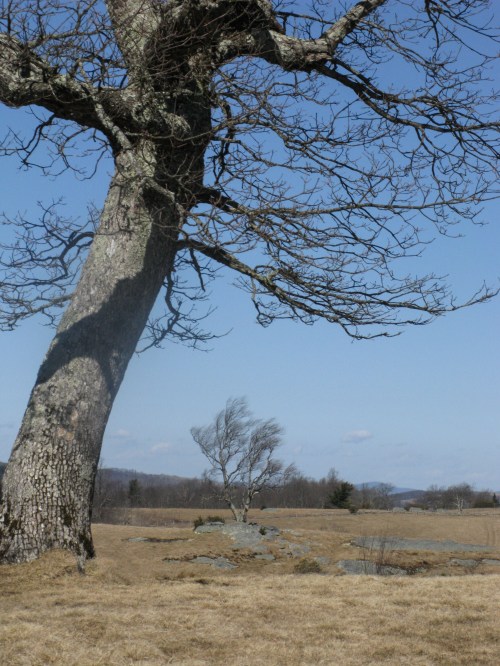
Tree At My Window

Tree at my window, window tree,
My sash is lowered when night comes on;
But let there never be curtain drawn
Between you and me.

Vague dream head lifted out of the ground,
And thing next most diffuse to cloud,
Not all your light tongues talking aloud
Could be profound.

But tree, I have seen you taken and tossed,
And if you have seen me when I slept,
You have seen me when I was taken and swept
And all but lost.

That day she put our heads together,
Fate had her imagination about her,
Your head so much concerned with outer,
Mine with inner, weather.

Robert Frost (1874-1963)

.     .     .     .     .     .     .

Why the Aging Poet Continues to Write

At a coneflower’s seed-making center,
hundreds of tiny dark florets—
each stiff and sharp—
take turns oozing
their flashes of pollen.
A flagrant
bee-stopping show.

Making a bright circle,
the outermost spiky blossoms
open first to then fade.
Shrinking day by day,
the ring of yellow flame
moves inward.
That heart—what’s at
the flower’s very core—
blazes last.

Paulann Petersen, from Understory, Lost Horse Press, 2013

.     .     .     .     .     .     .

These two poems are collected in The Poetry of Impermanence, Mindfulness, and Joy; edited by John Brehm; Wisdom Publications, 2017.

Spreading False Foxglove, Aureolaria patula, Scrophulariaceae (Figwort family)

.     .     .     .     .     .     .

No plant community is static. Even the “climax forest” is in constant flux, the flow that is the marker of time’s passage, that is time. All things flow: change, the primary mutable immutable that creates reality.

Observe the climax forest for enough generations (its generations, not ours) and see that its steady state is illusion. Water cycles, carbon cycles, death and reclamation and regeneration: constant flux. Apt metaphor for our life as human individuals. Observe the plant community’s encroachers and invaders, its fuzzy boundaries, its balance never balanced for long – also a metaphor for human communities.

During pandemic if there is one factor that underlies our existential fears it must be separation from community. How small has our circle shrunk? How unwilling are we to step outside or let in the unknown? Anger, anxiety, dread: they must all have the same roots.

When the soil is shallow the tree sends its roots wider. When moisture or minerals are scarce the rootlets’ embrace by mycorrhizal fungi becomes even more welcome.

Human ecology: I watch the Zoom gallery nod and smile and imagine that they are seeing me, too. I step off the trail when other hikers pass but we wave and share a few words at distance. I sit nearby during Linda’s long phone calls with sisters: essential, restoring, redeeming. I even (gasp!) write a few letters. Aren’t we all reaching out to discover some new way of connecting, some way amidst the flux to re-forge community?

Wider, draw the circle wider!

.     .     .     .     .     .     .

He drew a circle that shut me out-
Heretic, rebel, a thing to flout.
But love and I had the wit to win:
We drew a circle and took him in!

Outwitted – Edwin Markham (1852-1940)

.     .     .     .     .     .     .

Many thanks to the organizers and instructors of Great Smoky Mountains Institute at Tremont who continue their mission of connecting people with nature even during pandemics. Their science-based educational programs have evolved with science-based precautions and modifications to allow small communities to form for a weekend at a time.

One word sums the program and purpose of Great Smoky Mountains National Park: BIODIVERSITY. These photos are from the September 2020 GSMIT program Southern Appalachian Ecology. Immersed in that diversity, I continue to absorb the enrichment, root, stem and blossom, of that community of seekers.


.     .     .     .     .     .     .

Read Full Post »

Southern Harebell, Campanula divaricata, Campanulaceae (Bellflower) family

[with two poems by Lola Haskins]

I sat in the ophthalmologist’s office reading Lola Haskins and wondering. I’ve put off this visit due to COVID and I’m overdue, seeing Dr. Bondalapati for the first time. She is new here, just moved to Elkin from Chapel Hill with her family last summer. Most of her staff I’ve known for years, although it is still welcoming to be recognized behind the mask.

All of us masked. Wondering. Are our precautions enough? Is it OK to be together like this?

Isn’t it remarkable how much eyes alone can communicate? Eyebrows bobbing, winky lids, wrinkly skin of brow and temple, lovely corrugator muscles. I left the office happy to have seen my new doctor and Deanna, Karen, all the others.

Bridge the separations. Make community. Take nothing for granted.

I am also restored and innervated by Lola Haskins’s poems. I heard her read several years ago and just bought her collection, how small, confronting morning (Jacar Press, 2016). Isn’t it remarkable how much a few words and a few lines alone can communicate? Seeing through another’s eyes. Another’s voice in my ears . . .

. . . like happiness // it materialized so gradually / that I never even for a moment // saw it coming

.     .     .     .     .     .     .

The Cabin at Fakahatchee Strand

by morning the water has turned such
silver I want to put it on i know

it would only flutter off my skin
like a bird too quick to follow

but i don’t care i want it anyway
and i want that tangle of cattail

and black rush too the way i want
to be perpetually waking to

yet another gift like the single gator
stretched out on the muck

where pond has begun to thicken
to swamp like happiness

it materialized so gradually
that i never even for a moment

saw it coming

.

Lola Haskins, from how small, confronting morning (Jacar Press, 2016)

.     .     .     .     .     .     .

Flight

if i eat feathers asks the child
will i be able to fly?

you already can says her mother
any night
the lightness in you my lift you
from your cot
that’s why i close the windows

when i get old enough the child
wonders

will you open them? oh yes
comes the answer

(sorrowing) that’s what
mothers do

.

Lola Haskins, from how small, confronting morning (Jacar Press, 2016)

.     .     .     .     .     .     .

Haskins writes with the startling freedom and grace of a kite flying, and with the variety and assurance of invention that reveal, in image after image, the dream behind the waking world.
W.S.Merwin, winner of the Pulitzer Prize and former U. S. Poet Laureate

.     .     .     .     .     .     .

IMG_0877

Read Full Post »

Appalachian Trail near Clingman’s Dome, 2003

[with two poems by Kathryn Stripling Byer]

.     .     .     .     .     .     .

Summer has skimmed the high ridge like a chimney swift, rarely perching for long. Now on September mornings you can see your breath. First frost certainly won’t dally. Above 6,000 feet you wonder, Where is the South in Southern Appalachians?

And what about these bleached spines and gnarled knucklebones? This phalanx of snags that palisades the highest elevations against the green upon green below? The balsam wooly adelgid arrived on Clingman’s Dome in 1957. By the 1980’s the tiny insect invader from Europe, order Hemiptera, had destroyed more than 90% of the Fraser Fir in Great Smoky Mountains National Park.

This year, though, the Park Service has declared a tenuous truce. Some of those dead snags are forty years old but younger trees spared by the adelgid have matured and are making fertile cones. The very oldest trees, with thicker bark, also seem less susceptible. The insects are still around but you have to hunt for them, whereas during the earliest infestations biologists described the branches covered in wooly bugs as if they had been “whitewashed.”

What is the fulcrum of this new equilibrium? Perhaps the adelgid found easy pickings among whole communities weakened for decades by acid deposition, bad air. Coal-burning power plants up the Appalachian ridge to Canada have added scrubbers. The red spruce that had stopped growing in the ‘80’s are laying on new rings of cambrium. Leave a patch of ground alone long enough and it will grow into what it is meant to be.

Or will it? Depends on what you mean by leave alone. The fir that survive are a little more resistant to the insect, a little more acid tolerant. But what happens as their subalpine microclimate becomes less like Canada and more like Atlanta? Scrubbers remove the nitrogen and sulfur that oxidize to form acids but when you burn carbon you get carbon dioxide. Can’t scrub that out. How many degrees of warming can Fraser fir tolerate? Go higher, it gets cooler. Here in the Park you can’t go any higher than Clingman’s Dome.

Mountain Angelica, Angelica triquinata (Apiaceae - parsley family)

.     .     .     .     .     .     .

Last week I shared two poems from Kathryn Stripling Byer’s first book (1986). The two poems that follow here are from her final book, Trawling the Silences, published in 2019 two years after her death.

Kay Byer takes me into wild places and she brings me home. She names the earth, just naming a thing is a prayer, and she leaves nameless the mysteries that mist from her verses into my soul. She has left this earth, and she has left this earth to me to hold close for the days I will remain. Notice. Learn. Cherish. Tell it.

.     .     .     .     .     .     .

Three for My Trail Guide
for Jim

1.

Ascent

Before I can catch
my breath you right away
start to identify

Wild Ginger,
Mayapple,
Bloodroot.

I’m dizzy with switchbacks
I see rising into
the hardwoods you hail

Sarvis,
Sycamore,
Tulip Tree.

Trillium sweeps down
the hillside like angel wings
come to rest creekside.

You chanting hepatica,
stonecrop, anemone,
we climb until

we reach the summit,
where underfoot
some stubborn lichen

you can’t name
has already claimed
the best view.

2.

Star Grass

You name it
and there it is
at the edge
of the outcropping
over the Gorge.

Not to worry,
I placate the ravens
that harry us,
we won’t be lingering
long in your aerie.

See? Even now we are
striding away
into star grass,
its small spikes of clear
recognizable light.

3.

Galax

Squatting behind bushes,
I smell it nearby, neither bear scat

nor carrion vine, to which naturalists
liken its scent, but the breath

of an old woman lowering herself
to her chamber pot, sighing

as I heard her sigh while I tried
not to listen. Hoisting my backpack

I leave her behind in the underbrush,
glad to be back on the trail

with you, sidestepping tree stump
and blowdown, splashing through

creek bed, striding from switch back
to switch back toward sky we see,

step by step, open its window,
when, almost to summit, I stop.

Breathing hard. The scent
of her following me.

Kathryn Stripling Byer, from Trawling the Silences (Jacar Press, 2019)

.     .     .     .     .     .     .

Silvery Glade Fern, Deparia acrostichoides (Dryopteridaceae - Wood Fern Family)

.     .     .     .     .     .     .

Trawling the Silences

This end-of-March day, I’d rather watch hawks surf the
thermals than contemplate what lies ahead.
Or behind in its wake. In the few hours left, let me keep
my doubts shut, my windows wide open, their sheer curtains
billowing. It’s March, after all, having come in
a lamb and departing a lioness, stalking my back yard,

leaving her paw prints alongside the patient ephemerals
rising again out of leaf litter. Squirrel corn. Spring beauty.
The first rue anemone. Today I would rather
read field guides, repeating the whimsical names
of our nice-dwelling mussels about to be wiped out by backhoes
and bulldozers. Pimpleback, Snuffbucket. Monkeyface
Pearlymussel. Don’t let their names be forgotten,
I’d pray if I prayed, though just naming a thing is a prayer,

wrote Simone Weil, turning her face to the almighty
silences. The silences. Where would we be
without them, what were we, what will we be, oh to be,
and again be, that damn linking verb. I’d rather be tracking
my lioness up to the rim of that mountain top,
I’d rather let be and let go. Let the anemone
cling, the hawks soar, the lioness squander another day
trying to find what she’s looking for. Give her another day,
I ask the Almighty. Give the birds one more day
scolding the rapscallion squirrels stealing birdseed.
I rest my case, carapace, my own little voice trawling
the silences, the bully wind boasting its presence in present-tense,
no linking verb to shut down the show. Let
my lioness lounge in the sally grass. Licking her paws.

Kathryn Stripling Byer, from Trawling the Silences (Jacar Press, 2019)


.     .     .     .     .     .     .

Spruce-Fir forests covered vast areas of the Southeast when glaciers reached their southernmost extent 18,000 years ago. As the glaciers retreated north the Spruce-Fir communities also retreated to higher elevations and now remain only along the highest peaks and ridges above 4,000 feet elevation, mostly higher. Clingman’s Dome at 6643 feet is the highest point in Great Smoky Mountains National Park and indeed along the entire Appalachian Trail. Its impressive swath of Spruce-Fir is also home to the rare Jordan’s Red-Cheeked salamander (Plethodon jordani) found only in the Park. The naturally acid soil and severe climate limit biodiversity compared to lower elevations, but other distinctive high elevation species include mountain ash (Rose family), mountain wood sorrel, mountain asters, glade fern. After sixty years the Fraser Fir seem to be surviving the balsam wooly adelgid invasion, air pollution, acid rain; it remains to be seen how long they will remain in the face of advancing climate change.

from SNAKE DEN RIDGE, A BESTIARY, illustration by Linda French Griffin

from SNAKE DEN RIDGE, A BESTIARY, illustration by Linda French Griffin

.     .     .     .     .     .     .

Photos by Bill Griffin from Southern Appalachian Naturalist Certification Program; Southern Appalachian Ecology, September 2020, Great Smokies Institute at Tremont; instructors Jeremy Lloyd and Elizabeth Davis.


.     .     .     .     .     .     .

IMG_1822

IMG_1609

Read Full Post »

« Newer Posts - Older Posts »