Feeds:
Posts
Comments

Posts Tagged ‘NC Poetry Society’

 . 
[with 3 poems by Cheryl Wilder]
 . 
Anything That Happens
 . 
Until I was twenty, I believed anything
wouldn’t happen to me.
 . 
Walking from the car,
leaving you behind,
 . 
sirens whining louder as they closed on us;
I didn’t understand anything
 . 
had just happened.
People said it wasn’t my fault
 . 
and for reassurance,
It could have been me. But
 . 
I heard what they didn’t say.
I’m so glad it wasn’t.
 . 
Cheryl Wilder
from Anything That Happens, Press 53, Winston-Salem NC; © 2021.
 . 
❦ ❦ ❦
 . 
It’s 1990 and my kids are cruising toward teenagerdom. Every week in the throw-away medical journals that cross my desk there’s at least one article with a title like We Never Even Suspected, or Why Me? The doctor or doctor’s spouse laments about their teen who is (pick one): flunking out of college; a closet alcoholic; pregnant out of wedlock; addicted to Percocet. That becomes the one article I am compelled to read before assigning the journal to the round file. It’s a solid principal of statistics: if it happened to them it’s that much less likely to happen to me.
 . 
Because today in 1990 my kids are, well, not perfect but above average. They are so good. And I am so good. Whatever that other doctor did to cause his child to go wrong, I would never do that. Because somehow at this interchange along the cosmic highway I am totally in charge of (and totally to blame for) all the choices my kids are making and will make.
 . 
And responsible, of course, for all the rest, now and forever after. Are my parents happy? Is my wife fulfilled? Are my grandkids smart? Is there crabgrass in the flower bed? (Well, maybe I am responsible for that one.) Don’t worry, I am not poised here to write an article titled Everything That Would Have Been Better if I Were Better. That’s between me and 4 AM.
 . 
Instead, I’m attempting a more compelling practice. A practice without textbooks or certification exams. One that requires nothing but offers everything. A practice never free from pain but sometimes tinged with joy. All that this practice endeavors is to prod a slight change in phraseology, poke a minor shift in frame of reference. When I learn of your misfortune, when you tell me about your pain, when I recognize that you are suffering, I will try my best not to say to myself I’m glad that isn’t me, and instead I will say, That is me.
 . 
 . 
❦ ❦ ❦
 . 
Xing
 . 
I don’t know how I brought a child
into the world when I can’t reconcile
 . 
if crashing a car and a friend’s skull
is karmic debt created
 . 
or payment for a past immoral act.
I open doors and say thank you and do not try
 . 
to behave in a way I cannot afford.
There’s no barometer, no way to know
 . 
if the pendulum is swinging
away or toward, how many pay-it-forwards it takes
 . 
before I break even at the gambling table.
I cold blend in with the pure
 . 
if it weren’t for the scars that don’t fade
no matter how many turtles I save,
 . 
so am I all that surprised
when my little boy tells me
 . 
of his palpable fear
to cross the street.
 . 
Cheryl Wilder
from Anything That Happens, Press 53, Winston-Salem NC; © 2021.
 . 
❦ ❦ ❦
 . 
Sostenuto – a musical notation indicating a passage sustained to the utmost. Unrelenting. Imagine a violin’s piercing note, almost impossibly high and rising, horsehair glissando across the E-string. Now it’s joined in harmony by the A-string, discordant, the two dancing and warring with each other. They weave pitch and volume but never rest, sostenuto. You lean forward on the edge of your hard seat, your teeth are on edge, you want, you need, you crave desperately some resolution.
 . 
Cheryl Wilder sustains tension throughout sixty-four pages to the ultimate climax of Anything That Happens. Her story is too piercing: one tastes blood and tears. She lives every moment with that high, sharp note, days and years of guilt and pain – she has irretrievably damaged her friend – and then also weaves discordant disharmonies from her cold relationship with her mother and her non-relationship with her father. More than once I had to lay the book aside and breathe deeply to slow my pounding heart.
 . 
And more than once I resisted the urge to flip pages to the end. Who doesn’t crave resolution? What follows in this post today is the book’s penultimate poem. Some hurt can never be removed. No one can return to the moment before anything happens. Scars are just that, permanent marks and reminders of pain. How do any of us go on living? How? I invite you to enter the music of this book, its atonality and discord, one poem after another, until you reach its final page.
 . 
 . 
Anything That Happens by Cheryl Wilder is a Tom Lombardo Poetry Selection and is available at Press 53. Among other awards, the book was a finalist for the 2022 Brockman-Campbell Award of the North Carolina Poetry Society; read an additional poem from the collection and celebrate 90 years of NCPS HERE.
 . 
 . 
❦ ❦ ❦
 . 
Home Safe
 . 
Friends visit the hospital
where I am not wanted. It’s just as well
 . 
that I stay in bed, carve poplar
into a shield I can place between
 . 
myself and others, learn you wake
from a coma by the drop
 . 
of my manslaughter charge. Years pass
before I hear your voice again,
 . 
asking me to lunch over the phone, your mother
telling me I am only allowed in her home
 . 
because you found my number
on your own. You reach for my arm
 . 
to steady your walk, lean close
to see me in focus, your smile wide
 . 
on one side of your face, brightened even more
at the restaurant when you flirt with the waiter.
 . 
That is enough, to see a glimpse of the friend
I once knew, but then you reach cross the table
 . 
for my hands, look at me to say
what you defied your mother to say,
 . 
It’s not your fault. Over and again,
I forgive you. You can’t remember
 . 
the night I cannot forget, but you know
your words are my salvation.
 . 
There is no talk of next time.
You get out of the car and walk
 . 
into the house, back to your mother
who can breathe once again.
 . 
Cheryl Wilder
from Anything That Happens, Press 53, Winston-Salem NC; © 2021.
 . 
❦ ❦ ❦
 . 
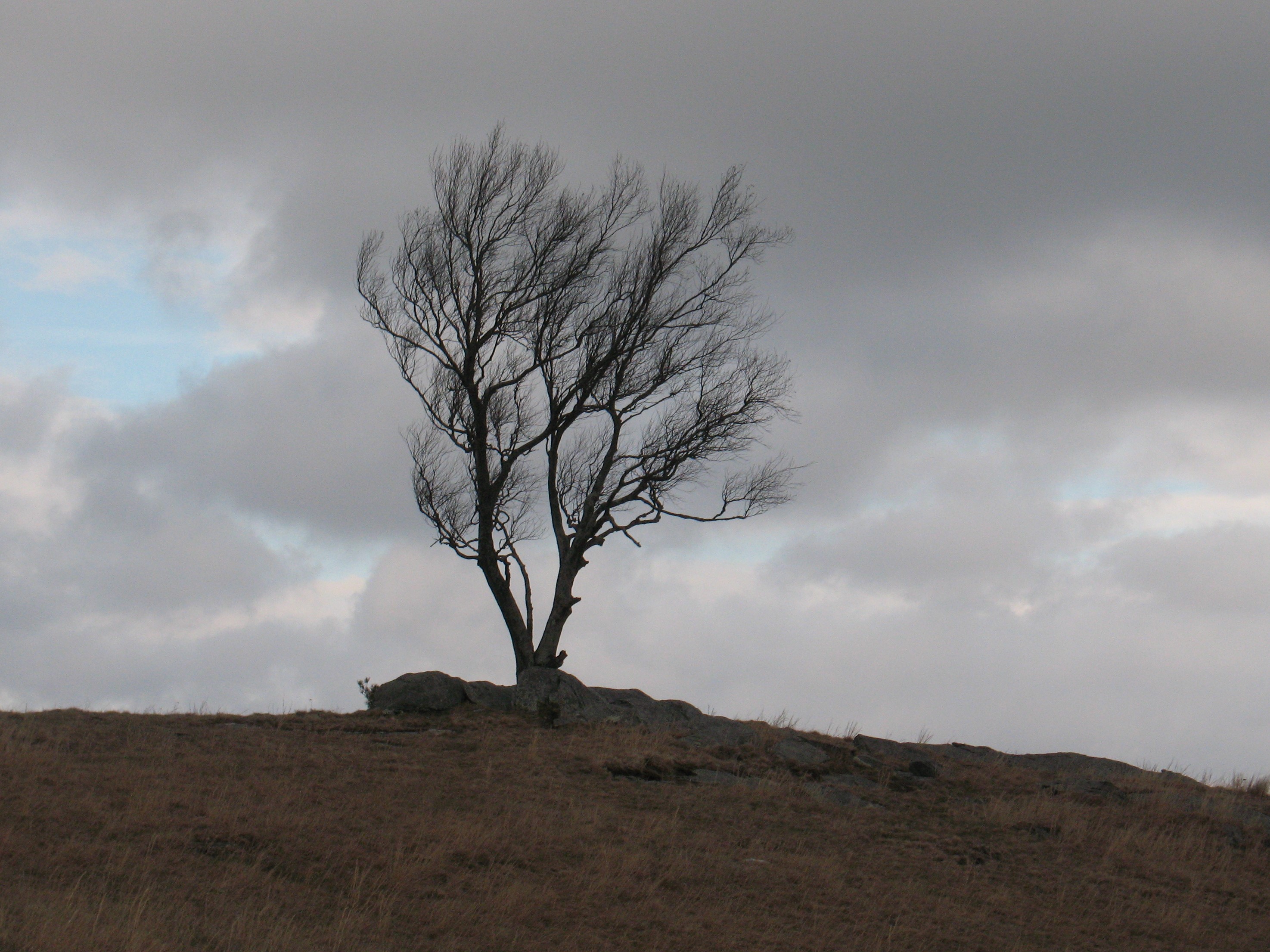
Doughton Park Tree 2017-03-06a
 . 

Read Full Post »

 . 
[with poems by Michael Hettich, Kenneth Chamlee, Katherine Soniat]
 . 
First View – Chicago Lakes
 . 
Sleet needles past my fastened collar
as we rise into the house of rain.
Mr. Byers of the Mountain News
has horsed us up this flyspeck path
with avowals of Alpine views but
now is silent. I think he has missed
the spur trail. My blood is gelid,
fingers numb beyond recovery.
Clouds tickle and drip and when we crest
this timbered ridge I will ask that-Oh!
Sublime cirque! The Alps surpassed again!
Stay the mules-I must-I need my paints,
stool. Fifteen minutes, please you; see how
the near lake mirrors the breaking storm
with light fine as milkweed fluff, that one
pearled peak soft as the edge of heaven!
 . 
Kenneth Chamlee
from The Best Material for the Artist in the World; Albert Bierstadt, a Biography in Poems, Stephen F. Austin University Press, Nacogdoches TX; © 2023. Finalist for the 2024 Brockman-Campbell Award for the best book of poetry published by a North Carolina writer.
 . 
❦ ❦ ❦
 . 
First Nature, Once Removed
 . 
Is childhood different from any body of (loose) clothing or rising water? Make
of it what you will. +++ I did. +++ +++ Some are grounded by target practice
 . 
but return with leaks known as homesickness for life. +++ +++ Wobbly
flotilla of cargo I was . . . no water-wings to inflate. Imagine those wings
 . 
I did not have +++ but suspected were present +++ when it was calm enough
to reflect and pull faces into focus. +++ +++ Wishing is like sadness at sea.
 . 
Say, you are on a beach with waves – the circular myth of family collapsing.
I had this part-time job of being a daughter apart – job that paid in tips
 . 
for those with damp inward pauses. +++ +++ Deep water girl
who keeps washing up anywhere. +++ +++ +++ Everywhere.
 . 
I was a surprise to those gathered in bed. +++ How I rose to float in
on a man and woman dancing in bed. +++ +++ Or were they clouds?
 . 
I could not keep them straight +++ +++ (though they were trying
hard to act happy) +++ like knives flying simultaneously as birds
 . 
at twilight.
 . 
Katherine Soniat
from Fates: Starfish Washup, Etruscan Press, Wilkes University, Wilkes-Barre PA; © 2023. Finalist for the 2024 Brockman-Campbell Award for the best book of poetry published by a North Carolina writer.
 . 
 . 
❦ ❦ ❦
 . 
The Parents
 . 
One morning, my wife and I followed our eight-year-old
daughter along a crowded beach
just far enough behind her that she wasn’t aware
we followed, as she walked with her energetic stride,
swinging her arms as though she were singing.
 . 
We marveled at her independence, at her
fearlessness; we compared her to other
children we knew, who would never have ventured
so far with such self-confidence.
 . 
We were congratulating ourselves on our excellent parenting
skills, laughing proudly at her spirit,
wondering where she was going with such
lively determination, when she stopped
 . 
and turned to look back: she was crying, with such
deep heaves she could hardly, breathe, desperately
lost. She’d been frantically looking for us
and the place we’d left our towels–she feared
we’d forgotten her, gone home without her.
 . 
What could we say, kneeling beside her
in the bright sun–we’d been right there
the whole time, behind her, laughing affectionately
at the way she walked, as she walked
 . 
the wrong direction to find us, at the way
she looked from behind as she searched for us,
as she howled in such terror
we thought she was singing?
 . 
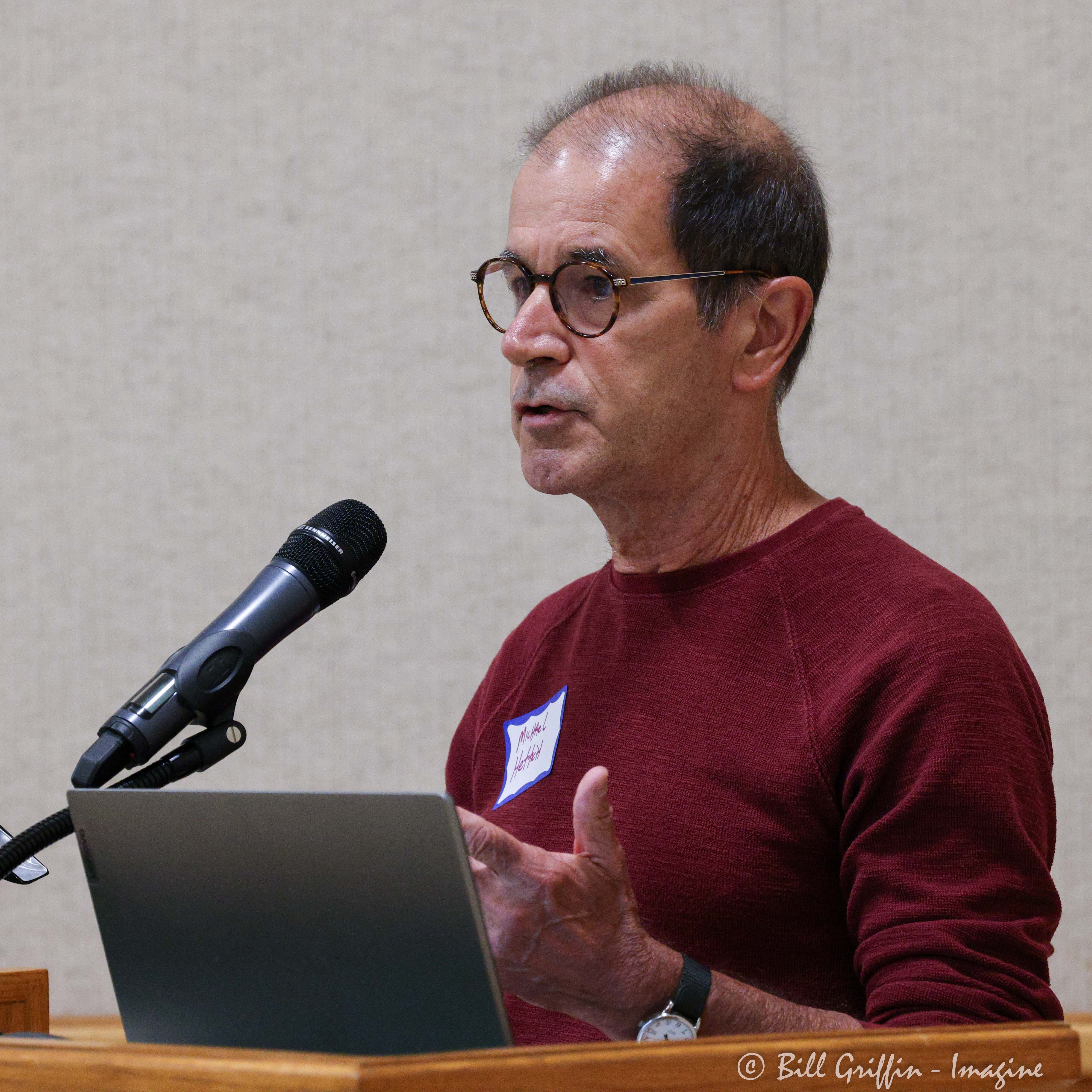
Michael Hettich
from The Halo of Bees: New & Selected Poems, 1990-2022, Press 53, Winston-Salem NC; © 2023. Winner of the 2024 Brockman-Campbell Award for the best book of poetry published by a North Carolina writer.
 . 
 . 
❦ ❦ ❦
 . 
Which is better, to expect beauty and encounter exactly that, or to arrive without expectation or anticipation and be surprised by joy? Which is worse, to open the window on a forecast of sun and discover drizzle, or to walk around every day under a cloud with no awareness of a sun above? Which is worse, to tool around for years just one county removed from your anger, or to cross the line and smack into it head on? Which is better, fond memories of the past or even fonder memories of the future?
 . 
Each of today’s three poems appears in books selected by Eric Pankey, this year’s judge of the Brockman-Campbell Award of the North Carolina Poetry Society: winner Michael Hettich for The Halo of Bees and finalists Kenneth Chamlee, The Best Material for the Artist in the World, and Katherine Soniat, Starfish Washup. What if everything we can sense and see turns into something wholly unexpected? Don’t the most beautiful creatures sometime pack the deadliest stings? What if even time itself slips us up, the solid past dissolving into mist and mud, this moment twisting inside out like a Moebius strip? What if a poem doesn’t begin or flow or lead us where we anticipated, and what if it doesn’t end as we hoped?
 . 
 . 
Emerging from COVID’s virtual meetingspaces two years ago, the NC Poetry Society made a studied decision to emerge as well from its long tradition of meeting four times each year in Southern Pines at Weymouth Center for the Arts & Humanities. Last September’s meeting convened at the North Carolina Museum of Art in Raleigh. Each September meeting serves to showcase readings by contest winners: the Brockman-Campbell Book Award (NCPS); the Lena Shull Poetry Manuscript Award (NCPS); the Randall Jarrell Poetry Competition (NC Writers Network); the Susan Laughter Meyers Poetry Fellowship (NCPS and co-sponsor Weymouth Center for the Arts and Humanities); and the Jackie Shelton Green Performance Poetry Prize (NCPS in partnership with NC Literary Review and East Carolina University).
 . 
This September 14 NCPS gathered at the North Carolina Arboretum outside Asheville. As if award winning readings in such a beautiful venue were not enough, the afternoon program connected the gardens, mountains, and wild spaces into a workshop by Kathrine Cays, “Writing the Natural World.” Kathrine offered many prompts and led a guided meditation to coax us to listen to the voices of earth and sky around us, and to the voice within us that reaches to connect with nature. (See last week’s poem by Mary Oliver, Sleeping in the Forest, which Kathrine read to open her workshop.) How can I sense the communities and individuals that create my world? What do flower, tree, bird, beetle want to say to each other, and to me? How can I discover my true place on earth and return gratitude and reverence in a way that sustains me, and sustains the earth?
 . 
 . 
 . 
 . 
 . 
❦ ❦ ❦
 . 
2024 Contest Winners
 . 
Brockman-Campbell Award: given annually to the best book of poetry published by a North Carolina poet during the past year
Winner: Michael Hettich, The Halo of Bees
Finalist: Katherine Soniat, Starfish Washup
 . 
Lena Shull Award: honors the best manuscript of unpublished poetry written by a native or resident of North Carolina
Winner: Doug Sutton-Ramspeck, Smoke Memories
Honorable Mention: Maura High, Field as Auditorium
Honorable Mention: Becky Nichole James, Little Draughts and Hurricanes
 . 
Susan Laughter Meyers Fellowship: in honor of the life and work of Susan Laughter Meyers; co-sponsor Weymouth Center for the Arts and Humanities
Winner: John Amen
Honorable Mention: Maria Martin, Terri McCord, Claudine R. Moreau, Erica Takacs
 . 
Jaki Shelton Green Performance Poetry Prize: honors the best performance poem by a writer who fits the NCLR definition of a North Carolina writer; co-sponsor North Carolina Literary Review / East Carolina University
1st Place: Edward Mabrey
2nd Place: Jess Kennedy
3rd Place: Marcial “CL” Harper
Honorable Mention: Alessandra Nysether-Santos, Regina YC Garcia, Brenda Bailey
 . 
Randall Jarrell Poetry Competition: one poem by any writer who is a legal resident of North Carolina or a member of the North Carolina Writers’ Network; sponsored by NCWN
Winner: Lee Stockdale
Honorable Mention: Jackson Benton, Mary Alice Dixon
More information about all North Carolina Poetry Society contests HERE
 . 
❦ ❦ ❦
 . 
 . 
 . 

Read Full Post »

 . 
[with 3 poems by Ana Pugatch]
 . 
My Mother’s Visit
 . 
The woman sensed that I now
looked down on her. That the earth
had turned slowly
 . 
into night. That her kin would only be
a distant moon. She watched
shards of light slice through the bamboo
 . 
thicket, the stars’ edges harden
and cool. In daytime she marveled
at the strength of a water buffalo, how
 . 
it shoulders could shift continents.
But I knew it would never be
enough.
 . 
We looked down
from the bamboo raft, and below
the glass surface saw
 . 
what flickered in turbid
darkness. Like my mother I thought
of the day when the river
 . 
would freeze over –
and how I’d give up everything
to feel its final stillness.
 . 
Ana Pugatch
from Engrams, Seven Years in Asia, winner of the 2022 Lena Shull Book Award of the North Carolina Poetry Society; Redhawk Publications, Hickory, NC; © 2023
 . 
❦ ❦ ❦
 . 
Above the river a west-facing ridge, protected, always cool and moist, and a narrow rustic trail that veers from the main — this is the path I take the day after Christmas. Winter brown, mossy stones and lichen, these are all I expect today, but here and there are premonitions. Ruddy toothed leaves, foamflower will bloom in March; bright green variegated heartleaf hides beneath pine needles today but soon will hide its own little brown jugs. So much muted beauty to share, but what is this! Hepatica is blooming!
 . 
Right here along this little path is the first place I ever discovered native hepatica in Elkin. (I still clearly remember where I was standing when I added my first bird to my life list decades ago, a chestnut-sided warbler — do normal people hold onto these sorts of memories?) But this is December — the earliest we ever see hepatica in bloom is late February, preceding even the rush of trout lilies. Nevertheless here is one plant with a flower and two swelling buds. Too, too early. Winter too warm. I can’t say I’m filled with happy thoughts for our planet.
 . 
A few days later I’m back with a camera. I can’t say I’m filled with happy thoughts of botany and phenology. Last night my brother and sister and I had a lengthy conference about our Mom’s decline. Tomorrow I’ll be sitting down with her and Dad to discuss a palliative care consultation and possibly moving to a higher level of care. I have to watch my footing carefully on parts of this trail – exposed stones, roots, erosion. Going downhill is when you’re most likely to fall. Mom’s descent has been steady for years, gradual, but the path ahead appears much steeper.
 . 
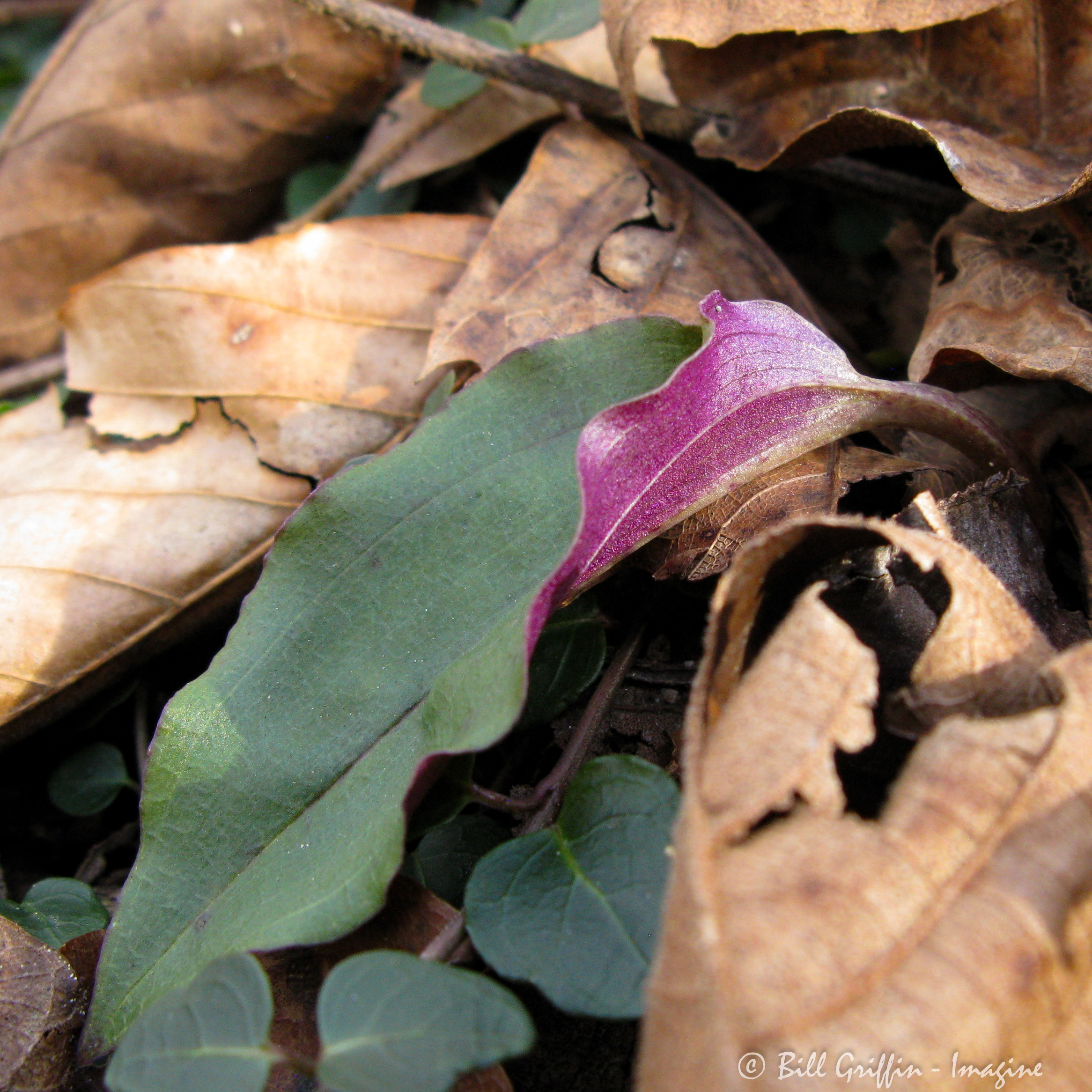
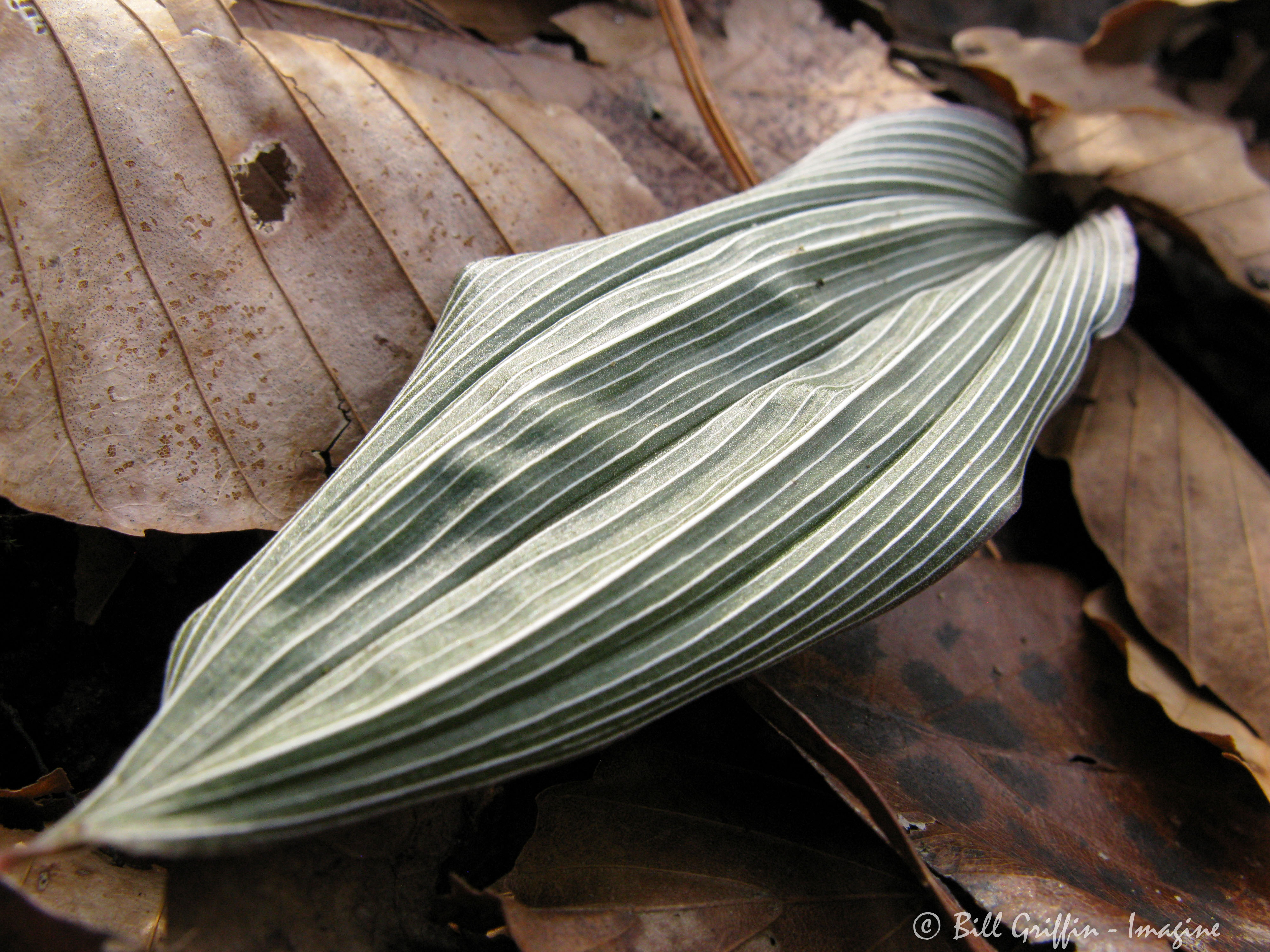
This is interesting – a single clump of pinstriped leaves, Adam-and-Eve Orchid. And Cranefly Orchid with its magenta underleaf is plentiful here. When the surrounding trees lose their leaves these orchids make sugar from winter sun. Their own leaves will fade and disappear before spikes of tiny flowers appear  mid-summer. Similar for the hepatica: last year’s flecked and nibbled liver-lobed leaves are making way for new green even now. Diminished light, cold and frost, life makes what it can of every season. I bend lower for a better look at each delicate yet resolute little family of leaves. Not a single flower to be found today.
 . 
 . 
❦ ❦ ❦
 . 
The Nightjar
+++ for S.
 . 
In the evenings you fold your wings
in a hammock on the porch.
 . 
your jaw clicks in imitation
of car locks. Your hair grows dark
to form a nest, twilight clouds:
 . 
a puff of throat. Mangrove roots
of a slow entanglement; filaments of stars
hang above us.
 . 
Don’t forget you say with the fan-eyes
of your tail as you fly away
 . 
each morning. You’re known
to frequent other lives, exhale their smoke,
catch tiny deaths on the temple’s
 . 
low wall. You’re known
for your camouflage, the concealment
of thoughts in daylight.
 . 
But I’ll still hold you, hoping
you’ll stay. Even if your ones are hollow,
 . 
fragile – I know one day you’ll roost
on steady ground.
 . 
Ana Pugatch
from Engrams, Seven Years in Asia, winner of the 2022 Lena Shull Book Award of the North Carolina Poetry Society; Redhawk Publications, Hickory, NC; © 2023
 . 
❦ ❦ ❦
 . 
Where does a memory live? Where does its root take hold, where is its safe repository? The sudden intake of breath at one sepia photo slipped from a pile of many others? A brief waft of scent upon opening a long-closed drawer? A word spoken in an unknown language ferrying meaning beyond its meaning? A phrase written in a notebook long misplaced? A dream?
 . 
Perhaps our memories are truly embedded in biochemical engrams deep in our hippocampus, hard-wired each in its own bud of synapse, but where is the map to its local address? Ana Pugatch knows to follow the narrow alleys and unmarked streets. Her poems are visions, aromas, sensations that may chill or warm. That may be fearful and unsettling or openly inviting. Her memories weave a world for me. Her world opens me to my own alleys, dim at times but becoming brighter; she opens me to streets I had forgotten. Or have yet to travel.
 . 
 . 
Is it because the world is so big and there are so many of us in it that we react by closing ourselves and retreating? Are we threatened by the rush and clamor of ideas, practices, cultures? Is that why we draw a line around our tribe and push all others away? We imagine that to survive we must deny, even destroy, everything outside our comfortable patch of expectations. To my mind, humankind’s survival depends on just the opposite. We can’t close the door but most open it. Perhaps we do feel frightened when confronted with anything that challenges our assumptions, whether a person, an artifact, an idea. Perhaps. And perhaps responding to novelty with imagination rather than rebuff is what allowed Homo sapiens to expand while Homo neanderthalensis dwindled and disappeared (except for the handful of Neanderthal genes we’ve acquired and still carry!).
 . 
Within poetry is concealed the map to our local memories. And in poetry we encounter shared memory and experience, doorways that may lead us out of our cloister and into the embrace of the different, the foreign, the alien, the frightening. As I read Ana Pugatch’s sensitive and sometimes ephemeral visions of her years in China and Thailand, and now of her presence in North Carolina, I am not an impartial observer watching a travelogue. I connect with those struggles. We are human, she and I and all the people she encounters. From the strangeness I feel a common thread winding around my heart. May that thread continue to pull me forward, and outward.
 . 
 . 
Engrams, Seven Years in Asia is available from Redhawk Publications.
The Lena Shull Book Award for a full length poetry manuscript is sponsored annually by the North Carolina Poetry Society. Submission period opens June 15, 2024.
 . 
 . 
❦ ❦ ❦
 . 
Unfurnished
 . 
I would write down the date if I knew
which day it was.
It’s Tuesday, I think,
and the baby cries upstairs.
 . 
I’ve never seen the family;
I only know them by
the red and gold characters posted
on their door.
 . 
Their laundry hangs
on the lines above mine;
Cantonese echoes through
my empty rooms.
 . 
We share the same view of Zhuhai.
We share that space of sky and trees
and we open our doors
when it rains.
 . 
Ana Pugatch
from Engrams, Seven Years in Asia, winner of the 2022 Lena Shull Book Award of the North Carolina Poetry Society; Redhawk Publications, Hickory, NC; © 2023
 . 
❦ ❦ ❦
 . 
 . 
❦ ❦ ❦
 . 
2018-02-09 Doughton Park Tree

Read Full Post »

« Newer Posts - Older Posts »