Feeds:
Posts
Comments

Posts Tagged ‘nature photography’

[with 3 selections from Tar River Poetry]
Letter to the Archaeologists of the Post-Anthropocene
You know already what fools we were,
how like the dog that starts itself awake
we jumped and bared our teeth
and turned to chase our tail, our fury
rising as we spun – and how, unlike the dog,
we did not hold our caught selves
gently, surprised to be at once the captive
and the captor, but chewed our own flesh
bloody, sure we were destroying that
which would destroy us. You already know
we killed our saviors, set fire
to our home, and ate
our bitter hearts. We said
because we owned what we destroyed
it was ours for the destruction,
and we destroyed it
to prove that it was ours.
You know all that.
You may not know, however,
just how much
we loved what we destroyed, how much
we longed to have it love us –
how even the cruelest among us
would stop sometimes to watch
the polluted sky at sunset
turning gold then pink then indigo.
Shane Sheely
from Tar River Poetry, Volume 62, Number 2. Spring 2023. © 2023 TRP
❦ ❦ ❦
Some ten years ago I became a phyto-heterotroph. Many people have asked whether it was a difficult transition and whether I have regrets. Not at all! To borrow a phrase from the general domain of heterotrophs, “Life is good.”
This week I’ve been reintroduced to a community of fellow heterotrophs after a year’s absence. We met in the woods on Grassy Creek’s Forest Bathing trail as they emerged  from the shady gloom, pale as the moon, a little creepy. Their scaly jointed fingers that are not fingers poked up from the leaf mould. They nodded their heads which are not heads. Not human, not fungus. What?
These are plants, flowering plants, but stark white, utterly absent chlorophyll : Ghost Pipes (Heath family, Ericaceae, same family as rhododendron, azalea, huckleberry, but so eerily different). Kneel to inspect the nodding head and you’ll see that it’s a flower, one at the apex of each stem, and indeed shaped like the flowers on my blueberry bushes beside the driveway. I remember the first time I saw these odd creatures in the southern Appalachians, thriving in rich mesic woodland, clustered in deep shade with no need for photons. I was taught that they are white because they’re parasitic, taking nourishment from the roots of trees.
Heterotrophic – fed by others. The opposite of autotrophic, feeding oneself. Most of the Plant Kingdom are autotrophs, industriously creating sugar and cellulose from the nothing of light and CO2. Quite a number in Kingdom Protist are autotrophs (algae, for example), and even a few in the Bacteria Kingdom (cyanobacteria). All the rest of us are unable to feed ourselves. I can make Vitamin D when sunlight strikes my skin, but as an obligate heterotroph I must consume autotrophs to survive.
Personal and Planetary Health—The Connection With Dietary Choices. This is the title of a feature editorial in the Journal of the American Medical Society (June 6, 2023; Volume 329, Number 21). It isn’t difficult to imagine the message the editorialist will promote, but it is novel to emphasize the connection between choices that lead to personal well-being and and choices that promote global health. To quote: Physicians have historically focused on patient health and relegated planetary health to environmentalists and lawmakers. However, dietary choices are the largest driver of chronic diseases. National surveys indicate less than 5% of the US population meets dietary fiber recommendations due to inadequate plant-based food intake. Plant-based diets are also associated with reduced incidence of chronic diseases such as obesity, cardiovascular disease, diabetes, chronic kidney disease, and cancer in multiple studies.
I became a phyto-heterotroph (it’s easier to spell vegetarian) not for personal health but to reduce my ecological footprint. Eating plants instead of eating things that eat plants has a frankly unbelieveable impact on agricultural water consumption, loss of habitat to grazing and animal feedstock production, and methane and nitrous oxide production (25 times and 298 times more potent greenhouse gases than CO2). Even the most diehard omni-heterotroph could probably tolerate a phyto-heterotroph diet one or two days a week.
And those Ghost Pipes (Monotropa uniflora) – I read this week that they are actually myco-heterotrophs. Their roots entangle with and suck sugar from the fungal filaments of the mycorrhizal network that permeates all healthy soil. Alas, all fungi are themselves heterotrophs. They reciprocate with green plants to provide minerals and water in exchange for sugar, some of which they evidently pass on to the Ghost Pipes. Without GREEN, none of us would be here.
❦ ❦ ❦
Because the Demented World Repeats Itself
In Europe again tonight,
a human being is dying
under a bombed-to-rubble house
or in the street – bicycle basket
spilling its loaf of bread.
This particular human is dying
whose dying makes me despair
though I’m no one in particular
and they’re no one in particular
to me. I’m just another human
who will be dying, but not yet,
and who lies warm under my quilt
of many blessings, wondering
what can be done about humans
when I can’t dissuade the sparrow
who attacks our window
slamming and slamming
his reflection – the enemy
he keeps seeing but not
seeing as himself.
Susan Cohen
from Tar River Poetry, Volume 62, Number 2. Spring 2023. © 2023 TRP
❦ ❦ ❦
I don’t subscribe to many literary journals, but I don’t let my Tar River Poetry lapse. Volume 62/Number 2 arrived last week containing a few familiar names but many more names that I now want to remain familiar with. Micro-themes seem to weave through its fifty pages of poetry like a carrier wave that fills the room with music. A few poems juxtaposed are having a conversation, but when the next in line picks up the thread the color and texture have suddenly shifted again. Always something new, always engaging, deeply felt, deeply connecting. Thank you to Luke Whisnant and all the perceptive editors who send me a fresh volume twice a year.
Tar River Poetry is published twice yearly with the support of the Department of English, East Carolina University. http://tarriverpoetry.com. 113 Erwin Hall, Mail Stop 159, ECU, East Fifth Street, Greenville NC 27858-4353.
Shane Sheely has published three books of poetry and directs and teaches in the creative writing MFA program at University of Missouri-St. Louis.
Susan Cohen, author of three full-length poetry collections, is a former journalist living in Berkeley, California.
Steve Cushman’s first poetry collection, How Birds Fly, won the 2018 Lena Shull Book Award of the North Carolina Poetry Society.
❦ ❦ ❦
The Candiru Fish is So Small It Could Swim Up Your Urethra
is what Mrs. Hart, my 9th grade biology teacher, said
thirty-some years ago, so when Julie says let’s go skinny
dipping, instead of being excited I’m transported back to
Mrs. Hart’s class in St. Petersburg where all we had to cool
us off on those Florida afternoons was one lone window unit,
so we sweated through her lectures until the day we sat up
straight and listened as she discussed urethras and penises
and the dangers lurking beneath the surface. Come on, Julie
is saying, naked now, her clothes in a stack at the shore,
her pale shoulders bouncing up and down at the water’s surface.
I strip bare, tell myself we’re nowhere near the Amazon River,
run with everything I have into the water, into Julie’s arms,
and again she’s rescuing me from myself, from my silly fears,
and those murky, dangerous things, seen and unseen.
Steve Cushman
from Tar River Poetry, Volume 62, Number 2. Spring 2023. © 2023 TRP
❦ ❦ ❦
Doughton Park Tree 2020-11-22

Read Full Post »

[with poems from PINESONG 2023, NC Poetry Society Anthology]


Ghazal: Ghost Apples (Kent County, Michigan)


Ice-encrusted boughs from which transparent versions
of apples hang – each fragile as hand-blown glass.
+++
Their history: fruit on the cusp of rot, winter storm trundling
down a hillside, sleet coating each apple in sudden glass.
+++
Viscous fruit leaked from apertures until only icy shells
remained – December trees bearing quicksilver bulbs of glass.
+++
Imagine them a vivid red or green, like cascades of apples
even humble grocery stores offer on the far side of plate glass.
+++
If we shattered these globes, would they taste like hard cider
or the cloying sweetness of pulp, like edible versions of glass?
++++++
Soon these crystalline shells will melt to nothingness, the way
we all disappear. Beloved, step lightly upon grief’s bitter glass.
+++
Lavonne Adams
Joanna Catherine Scott Award First Place, Pinesong 2023
+++
❦ ❦ ❦
+++
Diversity often blooms at the edge. This little trail heading out from Isaac’s Trail Head on the MST is limn upon limn . . . boundary . . . transition. The wide riparian border along Grassy Creek attracts neotropical migrants for a rest stop each spring; Louisiana Waterthrush, White-Eyed Vireo, and Common Yellowthroat stay behind to breed here. The footpath parallels a pasture fenceline, and while cows with their calves stand flank-deep in meadow grass and blackberry bramble, all manner of wildflowers hug the margin of No Grazing: Blue Toadflax, Venus’s Looking Glass, Carolina Crane’s-Bill. Leaving creekside, the trail is hemmed by a moist rising woodland: Rattlesnake Fern, Sensitive Fern, Southern Lady Fern. And by the end of summer, if the farmer hasn’t sprayed, the trail edges will fill with Blue-Curl, Cardinal Flower, Goldenrod, Wingstem.
+++
Smaller fields and many interruptions make for many edges; diversity begets diversity. At one point along the trail a wide acreage of corn abuts a small hay field of mixed grasses. The corn field is solemn in its solitude; above the hay the air is filled with swallows, Bluebirds and Phoebes perch along the wire, and as we hike past we’re apt to flush an Indigo Bunting foraging.
+++
But then there are Cowbirds. For centuries they followed prairie bison herds and no doubt also the woodland bison of the Carolina piedmont. Now they follow every human disturbance, common in cow pasture but just as common on suburban lawns. Cowbirds are exclusively brood parasites, known to lay their eggs in the nests of over 220 other species. To their detriment. Kirtland’s Warbler has been pushed beyond the edge of “endangered” by Cowbird predation, and most birds do not have the ability to recognize the foreign eggs which will hatch and out-compete the rightful occupants. How to resist? Escape the edges. Reverse the fragmentation. Cowbirds will not follow into deep woods – warblers nesting deep in the forest are safe.
+++
It isn’t the Cowbird that threatens wood warblers, whip-poor-wills, vireos. It is shrinking habitat. Many species thrive at the edge. Some, though, require wide wild expanses. How much wild can we leave?
+++
+++
Upon which side of the boundary does poetry perch, thrive or decline? And what would it look like, that restored, invigorated poetry habitat, a definite nudge toward thriving? More fifth graders setting pen to page and seeing their lines is print, as they have in this year’s annual Pinesong anthology by the North Carolina Poetry Society? More opportunities and promptings to write – whatever one’s background, training, preferred theme, chosen form? And more readers?
+++
That’s where we come in. This morning I broke a nice sweat hiking miles along meadow and creek, through upland forest to lakeshore and back. This afternoon with feet up I’ve covered another rewarding meander through the pages of Pinesong. Student poets, grades 4 through undergrad; dozens more of adult poets, many names entirely new to me. I’ve traveled new places, I’ve encountered the unexpected and enlightening, I’ve paused long to reflect, and I’ve even laughed out loud. As Robert Frost wrote in The Pasture: “You come, too.”
+++
❦ ❦ ❦
+++
Eleven Lines In Search of the Perfect Rhyme
+++
Is it accidental that bereft almost rhymes with death?
+++
Watching geese rise in a chevron formation The New River
at Grassy Creek, flying south to warmer waters, I think of how
+++
sons and daughters grow up, how the nest – that like death
almost rhymes with bereft, – empties with their flight.
+++
How these words fly out of my mouth like startled birds.
+++
How we dream of loved ones who are dead. How we forget
what happened in the dream, what we did, what we said.
+++
How there are hundreds of ways to leave, not only the 50 ways
in Paul Simon’s song, and thousands of ways to grieve, bereft.
+++
How you can both the lover leaving and the lover left.
+++
Beth Copeland
Carol Bessent Hayman Poetry of Love Award Honorable Mention, Pinesong 2023
+++
❦ ❦ ❦
+++
Pinesong is the annual publication of contest winning poems by the North Carolina Poetry Society, founded in 1932. Pinesong 2023 is Number 59, edited by Sherry Pedersen-Thrasher with assistance from Joan Barasovska. This year’s volume is dedicated to David Radavich, former NCPS President and steadfast supporter of poetry and the arts.
+++
You can learn more about North Carolina Poetry Society and its contests, plus read previous years’ editions of Pinesong . . . here.
+++
If you would like to purchase Pinesong ($12, postage included) please contact NCPS Vice President of Membership Joan Barasovska: msjoan9[at]gmail[dot]com
+++
A free issue of Pinesong is available to all NCPS members in good standing who request ($2 mailing expense). Please contact Joan, as above.
+++
❦ ❦ ❦
+++
2020-09-08b Doughton Park Tree

Read Full Post »

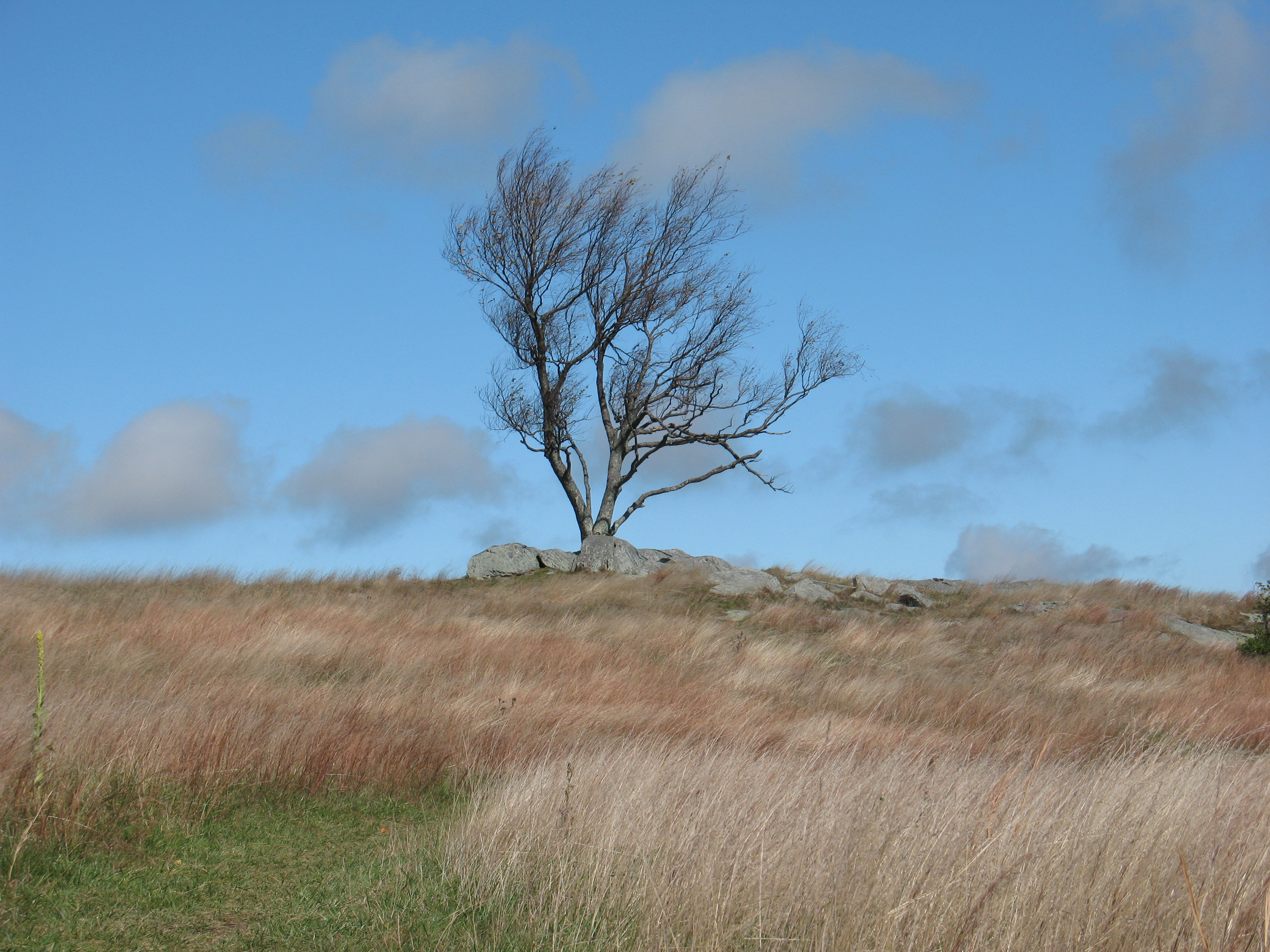
[This is a re-posting of one of my personal favorites, from July 27, 2020. May we each discover what is most perfectly suited to our individual nature; may we discover the perfect curvature and gravity of the universe. And may we continue to re-discover the poetry of the late David Treadway Manning, one of my favorite human beings.

I am re-posting rather than creating an original offering for this date because our neighborhood is still digging out from a tornado that struck us on April 28, 2023. No people injured, many hundreds of trees down, brighter wider horizons absent their green banners, a few nights of darker skies and brighter stars and the company of the waxing moon.    —-   Bill ]

Young Isaac is strolling through the orchard, another undifferentiated non-linear autumn afternoon of this perplexing equation we call life. Some of the fruit has detached itself and translocated several meters closer to the center of the earth. It has begun, with the help of fermenting microorganisms, to succumb to entropy. Isaac steps in it. He slips.

Isaac’s 70 kilograms, density of water, accelerate at 9.8 meters per second per second. Suddenly prone, the gravity of the situation strikes him. There, 10 centimeters from the tip of his nose, lies a perfect red spheroid. Glossy. Fragrant. The tiny lenticels on its taut unblemished skin are arranged with the symmetry of stars distributed across the heavenly sphere. “What an apple!” young Isaac exclaims, “Artios!” (his years of Greek instruction now finally relevant): That which is perfectly suited to its nature. The essence of appleness.

And how will Isaac’s own essence be transformed by this epiphany? How will yours and mine? No longer undifferentiated, will he discover his many gifts and their ideal trajectory? Will we ours? For are we not each of us an essence, our process of formation either distracted and garbled by the noisy physics of our history and our surroundings or alternatively able to grasp that trajectory perfectly suited to our unique nature? Besides mass and density and the ability to struggle upright against gravity, don’t we human animals also possess the agency of choice and change and discovery?

Isaac sits up and regards the apple. You know where this is headed. It will be 218 years before young Albert slips and falls and realizes that what Isaac experienced is actually the curvature of space. Meanwhile why don’t we all, each of us, sit up and regard our nature. Artios! To become that which is the perfect expression of our nature. It’s about time.

.     .     .     .     .     .     .

I have been a DAVID MANNING fan since I first sat up and discovered poetry. Whether he does it with a compassion that draws me deeper into the circle of human family or with a wry and pointed barb that makes me snort, he regards human nature and tells its truths. I will be the first person in line when his NEW AND SELECTED is released from PRESS 53 later this year.

And I have been favored to preview the manuscript. Wandering these wonderful poems spanning decades I enter an inner landscape and pass from reader to personal companion. There is a deep imagination at work; there is joy and no lack of laughter and sometimes a little weirdness; there are bright moments of insight and connection.

Most of all there is WONDER. No aspect of our human situation or our confounding universe goes unnoticed. David’s artistry gathers a desert landscape, a snatch of opera, a funky conversation and weaves from them with perfect sense and sensitivity an affirmation. When I reach the final page I say, “YES, that is the way it is.”

.     .     .     .     .     .     .

Sailing with Anne

Santa Monica, California, 1950

After her sailing class we cast off
into the ruffled Pacific blue, tide
incoming, echoes of great breakers
lapping the dock. She-the sailor,
the tiller, mine.

As we headed west, tacking
into a strong breeze I remember
marveling at who she was
to do these things. I imagined her
at the helm become Anne Bonny,
running a four-master down,
the setting sun turning red lights
in her hair.

I hope we left something there-
if only a boat paint-scrape
or salt spray from her hair.
Maybe something from that day
was never lost, but joined
the Pacific’s history, some trace
still riding the blue circuit
between the poles, with the sea-grape
and tiny life that make the coral.

.     .     .     .     .     .     .

Star Journey

Sometimes at night I return

to the Griffith Park planetarium

where stars from the surrounding hills

come out to music.

North of Los Feliz

I step from city lights into the night

sky of Patagonia with its wind-swept shores

under the warm lights of Fornax,

Fomalhaut, Alpha Crucis, a bright canopy

of southern stars, to music-Gymnopedie,

Satie’s barefoot dance.

Then, under the soft night sky,

I take off my shoes

and find my way into the stars.

.     .     .     .     .     .     .

David Manning’s NEW AND SELECTED POEMS is anticipated later this year from Press 53.

Star Journey first appeared in KaKalaK 2017 – Anthology of Carolina Poets
Sailing with Anne first appeared in Pinesong: The North Carolina Poetry Society

.     .     .     .     .     .     .

.     .     .     .     .     .     .

IMG_0880

Read Full Post »

« Newer Posts - Older Posts »