Feeds:
Posts
Comments

Posts Tagged ‘main street rag’


[with 4 poems by Ruth Moose]

I’m driving from Elkin up to Dobson, our county seat, smack in the center of Surry. About half way there, as Mountain Park Road peels off to the left, Poplar Springs Road completes its transformation to Zephyr Road. I love that – Zephyr Road. There are farms and rolling hills and plenty of zephyrs, though some of them are perfumed with a whiff of chicken house or skunk. Soon winter wheat will green the fields, then Spring will raise corn, soybeans, finally tobacco. Off to the south you can see vineyards pruned and expectant.

While the pastures are still winter brown, pay attention. Look, there’s one – close to that big oak in the middle of an empty field, a little patch of green. Come March you’ll spy the yellow nod of daffodils. Why out there of all places?

Those daffodil plots, slowly spreading, most likely once knelt at the front stoop of a farm cabin. A century ago, even longer? No sign of it from the road but if I walked around the oak I might scuff up a few squared off stones that were its foundation or that hoisted a step up to the porch. The daffodils remember. And maybe it was the same man and the woman who hoed the corn, milked the cow, every winter killed the hog, two together across the years who some quiet evenings found an hour to sit on that porch, maybe they’re the ones who named the wagon track below the field Zephyr Road. I love that.


.     .     .     .     .     .     .

Ruth Moose’s poems reflect the North Carolina icon she is. She draws on generations of memory to weave her stories and sketch her vivid images of locality and personality. Her sly wit, cloaked but never hidden by gentility, brings out the quirky individuality of the denizens of her world, real and imagined. And she reveals the deep, deep heart of longing, loss and yearning, our fragile mortality.

These poems are from three of her collections spanning decades. Ruth has also published novels, many short stories including two collections, and has won many awards and fellowships. Charles Edward Eaton said of her: Few writers can handle both prose and poetry, but Ruth Moose does them equally well, and with this double grasp has become one of North Carolina’s best writers. Ruth taught creative writing at the University of North Carolina until her retirement and she continues to support the creative life our home state.

.     .     .     .     .     .     .

Smith Grove

There is a heaven
for farmhouses.
Acres of them
lit by cloud hills
that plunge and wind
past creeks
where cows crowd on hot days.
A million windows watch
where farm wives waited,
minded those who came,
those who left,
counted the colors
of morning, evenings,
the sky at noon.
From back door stoops
they marked storm clouds,
summers rent with heat lightning,
saying both aloud and under
their tongues the chant
of superstitions, old tales,
familiar talk until the dark
dissolved.

In the museum
of porch swings and farm tools,
kitchen work is rusted,
thick with the oven of meals,
baked enamel, porcelain polished
like plates.

from Smith Grove, Sow’s Ear Press, Abingdon, Virginia, 1997
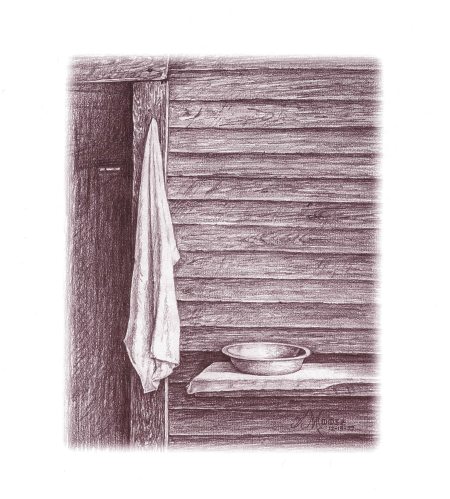
Illustrations are by Ruth’s husband the late Talmadge Moose, widely published and displayed artist and illustrator; read more at Life As He Saw It in Our State Magazine, April, 2011, by Ruth Moose.

.     .     .     .     .     .     .

.     .     .     .     .     .     .

Making the Bed

No matter how well
or worse the sleep
someone must take
the four cornered world
and set it straight.
Two can do it better,
take turns with edges,
coverlet, shams,
blanket and bolster,
wait in turn.

You can do it in the dark,
by feel, familiarity,
plumping feathers or foam.
You know your own scent,
shallow spots your knees
seek, the place you
fall into, dark and faraway,
taking you back or forward
like a train, all scenes
lighted cars you can look into,
out again. You hear the engine
that goes nowhere, the solitary
shriek as daybreak unrolls,
all wrappings out like flowers.

We go on with our lives.

from Making the Bed, Pure Heart Press / Main Street Rag Publishing, 1995

.     .     .     .     .     .     .

.     .     .     .     .     .     .

Almost a Pantoum on Being

A script is not needed; our place is already there.
We come into the world naked, unafraid.
Helpless we learn as we go, if somebody cares.
From water we swim, kicking into blue air.

We come into the world naked, unafraid.
The spell is everywhere, something the soul knows.
From water we swim, kicking into blue air.
Alive as the earth is alive and newly green.

The spell is everywhere, something the soul knows.
No angels hover over us, sit on our shoulders.
We are alive as the earth is alive and newly green.
Taking the flight one wing at a time.

No angels hover over us, sit on our shoulders.
Celebration waits in the arms of others.
We learn the dance one step at a time.
Moving to tunes heard in our heads.
No script is needed. Our place is already there.

.     .     .     .     .     .     .

How I Think It Will Be

My mother never talked about that winter
she had a husband in the VA hospital
not knowing how or if or when
he’d recover, three children sick
with the big red measles and twelve
inches of show on the ground
for over a week. She mentioned
it once, that’s all I remember
and the sound of her sewing
machine late, late into the night.
What did she sew? Her sanity?
Her soul? I only know I woke
suddenly, had gone from hot to cool,
my fever broken, my pillow wet.
I felt her hand on my forehead,
her touch, her voice as I left
that darkness and came into light.

I imagine it will be as she said then,
“Oh, here you are.”

both selections from The Librarian and Other Poems, Main Street Rag Publishing 2009
dedicated to HWLWG – HE WHO LEFT WITHOUT GOODBYE

.     .     .     .     .     .     .

Chatham Arts Council bio of Ruth Moose
Poetry Foundation listing


.     .     .     .     .     .     .
IMG_0768

Read Full Post »

Let’s meet at Grandview above the New River Gorge while the sun is still working its way through the pine and bare hickory. The hardcore birders left from Shelter #4 hours ago but we will follow the same course down the abandoned mining road to the River. We will follow the wild flowers. We will walk into Spring.

We don’t see a lot blooming up here at the end of April, elevation 2,500 feet in the West Virginia Appalachians. Beneath the trees and in the sunny patches the landscape is still mostly brown, but that doesn’t hold for long. Trailing arbutus and trout lily greet us in the first quarter mile, wake robin and four more species of trillium pop up along the course of the trail, wild iris and asters appear by the time we’ve descended 1,000 feet to river’s edge – all of Spring blooming in one morning.

And just in case we miss something we have a guide: my wife’s sister Jodi French-Burr, National Park Service ranger, naturalist, and interpreter. She’ll be kneeling in the duff gently parting the leaves so we can see the wild ginger blossoms. She’ll have at the tip of her tongue the name of every growing thing we discover. She’ll tell us the history of this winding trail and point out relics and landmarks along the way. And she will usually laugh at my jokes.

Come and convince yourself that the earth is filled with beauty.

Bring water and a snack. RESERVATIONS requested by April 21, 2020: 304-465-2632 or jodi_french-burr@nps.gov.

[UPDATE 3/23/2020 — due to the COVID-19 Pandemic many NPS and New River Gorge activities may have to be canceled or rescheduled. Be sure the check this site for the latest info:

https://www.nps.gov/neri/planyourvisit/wildflower-weekend.htm

BUT . . . outdoor activities with family and small groups (maintaining your social distancing) are just what THIS doctor orders! Get out into nature! Viruses hate sunlight! . . . . . . . . Bill G  ]


Erythronium americana — Trout Lily (Dog-tooth Violet, yellow adder’s tongue, fawn lily)

.     .     .     .     .     .     .

Deborah H. Doolittle has created a unique botanical and poetic experience with her collection Floribunda, a true garden of verse. The focal point of each poem is a particular flower, from Cowslip to Gardenia, but the speaker or the style of each poem is a giant of literature, from William Blake and Lewis Carroll to Sylvia Plath and Wallace Stevens. To wander the garden path of Deborah’s poetry is to smell the fragrance and delight in the colors but also to abide in the company of great writers, Deborah H. Doolittle not the least of them. Open to any page and converse.

[all selections are from Floribunda, © Deborah H. Doolittle, Main Street Rag Publishing Company, 2017]

Hepatica americana — Round-lobed Hepatica

.     .     .     .     .     .     .

Emily Dickinson’s Wild Flowers

The way she dressed a flower was
just that extravagant.
The haute couture of wild flowers!
wild flowers! her element.

To that pale cheek she called petal,
she pressed both stem and leaf –
the lupine, like crinoline; sweet
clover, tight Damascus weave.

She had played the part of Botanist,
a child’s specialty.
Swamp candles shed no brighter light
in Latin for the bee.

Grasses of Parnassus, skullcap
of the tiny laces,
she pressed herself soft as a moth
treading through her pages.

Antennaria solitaria — Solitary Pussytoes

.     .     .     .     .     .     .

Henry David Thoreau and the Sunflower

Who among us has not followed the sun
and hated the clouds that hid its shining face?
Who else but us can claim that we have traced
across the sky the very path it runs?

We’ve traveled much through Concord, you and I.
The widest fields are fenced and most contain
cattle or corn or the stock of kitchen
gardens. The farmers never wonder why

your seeds proliferate upon their grounds.
I know how the wind blows the smallest crumb
and how the bees and birds know where to come.
The two of us, like them, know no such bounds.

The hedgerows and stonewalls can’t grow taller.
The sun is but a star and you’re its flower.

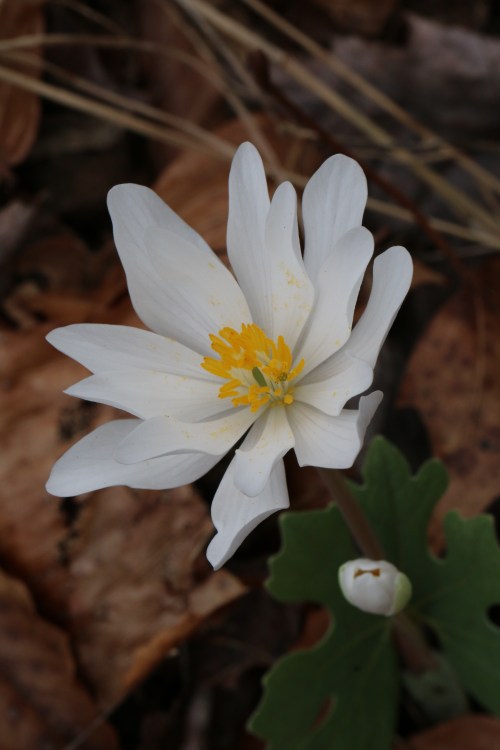
Sanguinaria canadensis — Bloodroot

.     .     .     .     .     .     .

Sylvia Plath and the Impatiens

Unlike my empty hands,
it does not just lie there
with its flowers opening

upon white bed linen.
All its seeds jettisoned,
its future guaranteed

for at least another
season, this jewel-weed,
asks for nothing that I

cannot give it. It basks
in my sunlight, breathes in
my exhalations as fast

as I can breathe them out,
again. Still, we are both
waiting for the nurses

to make their rounds, the sun
to rise up, then subside,
for the moon and the stars

to appear and disappear,
for winter’s frost to turn
us into limp black rags.

Asarum virginicum – Heart-leaf Ginger (Little Brown Jugs)

.     .     .     .     .     .     .

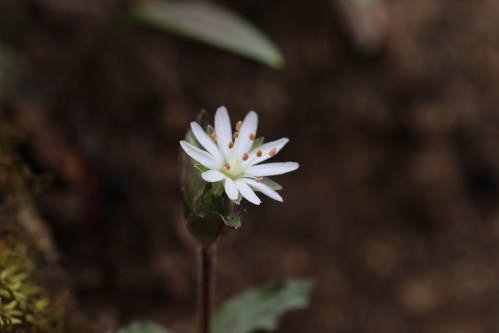
The other way to walk into Spring, although it takes a month or two, is to stroll along the same trail every day. Linda and I walk the Elkin Valley Trail Association Nature Trail along Big Elkin Creek at least three days a week. First appears trout lily, hepatica close behind, then every day or two there’s a new species in sequence: pussy-toes, wild ginger, bloodroot, rue anemone, star chickweed. In a month there will be foamflower, bellwort, jewel-weed, jack-in-the-pulpit. The photos in this post were all blooming on the same day, March 16, 2020.

Anemonella thalictroides — Rue Anemone

.     .     .     .     .     .     .

Deborah H. Doolittle moved from her birthplace in Hartford, Connecticutt through many different landscapes and gardens before settling in Jacksonville, North Carolina. She has an MA in Women’s Studies and and MFA in Creative Writing and teaches at Coastal Carolina Community College. She serves on the Board of the North Carolina Poetry Society and she loves flowers.

Stellaria pubera – Star Chickweed

.     .     .     .     .     .     .

IMG_0880

Read Full Post »

Waiting for you is full of everything except you.

It didn’t start out to be Valentine’s Day. You and I prefer Hatteras and Pea Island in the off season. I wanted to see the winter migrant visitors again and you don’t mind long walks in freezing spray. How amazing you are. You began telling our friends, “He wants to see the snow geese,” in a tone that sounded like you looked forward to them, too. Amazing.

When we pulled into the First Colony Inn there were big pink and red plywood hearts under the pine trees. Who knew! Godiva on the pillows and champagne in the mini-fridge. Each afternoon we explored another iced-over marsh, the entirely vacant Elizabethan Gardens, narrow lines of threatened dunes; each night we made a small supper in our room, wore caps & jackets while the wind discovered new cracks around the windows. Not really roughing it, not so self-sufficient – but sufficient as two selves. Us. Being each other’s present. Chocolate optional.

Snow Geese 2015-02_72

Chen caerulescens, Pea Island Wildlife Refuge


*     *     *     *     *

I’ve read most of Mark Smith-Soto’s previous books and I always pause and savor when I discover him again in The Sun. I carefully packed his newest, Time Pieces, for the February trip to the Outer banks. Waited for the stillness of sunset across Roanoke Sound, drew another blanket around my shoulders. How does he do it? How capture the small moment that stretches wide the reader’s heart? Not because the poem has cast searchlights into the grand gnostic meaningfulness of the universe, but because the poem is just itself, the poet is himself, the moment is this moment. And we always have been and are still becoming ourselves.

*      *      *      *      *

Present

Waiting for you at our favorite table by
the window decorated with a rough decal
of a giant coffee cup, I stare at the long,
gray, rain-washed, car-clotted street, the tip

of my tongue fretting against a cracked
tooth. You’re half an your late. You wouldn’t wait.
The coffee is so dark and smooth it lingers like
a song. There are clouds and telephone poles

and two tattooed youngsters smoking outside
the window; inside, all is chatter and clatter,
French pastries in the toaster oven, giggly laughter.
Waiting for you is full of everything except you.

And for this gift, at least, I must thank you:
this moment so completely mine.

*      *      *      *      *

Linda_2015-02_Pea Island_resize-1

Present first appeared in Sounds of Poets Cooking, Jacar Press

Time Pieces is available from Main Street Rag Publishing

Read more selections of Mark’s poetry from The Sun.  In fact, subscribe.  Now!

Mark Smith-Soto’s bio is available at the Poetry Foundation.

*      *      *      *      *

IMG_6432

Read Full Post »

Older Posts »