Feeds:
Posts
Comments

Posts Tagged ‘Jack Coulehan’

 . 
[ with 3 poems by Jack Coulehan]
 . 
Darwin’s Prayer
++++ He saw Darwin on his knees, and there
++++ was no difference between prayer and
++++ pulling a worm from the grass.
++++++++ Roger McDonald, Mr. Darwin’s Shooter
 . 
Bright bunches
of gardenias
bloom in November,
 . 
the loam at their feet
moistened by dew
and spongy with debris.
 . 
As I fill my container
with handfuls of earth
alive with these
 . 
marvelous worms,
perfected in being
by the wisdom
 . 
of randomness,
I’m astonished
by gratitude.
 . 
from The Talking Cure: New and Selected Poems. Plain View Press, Austin TX, © 2020
 . 
❦ ❦ ❦
 . 
Last night the storm whispered its secrets into my dreams. A long dryness, a vain hoping. This morning the drought has ended and flood warnings will as well in an hour or so. Linda and I head to the E&A rail trail beside Elkin Creek to laugh and point at the heights reached by frothy current. To breathe in the hot seethe and funk of saturated forest. To celebrate.
 . 
The sadness of the creek slams us, stops us, stills us. Its churning water is the color of pumpkin soup; Spike the Heron does not stalk here; the rattle of Kingfisher is silent, fled. Oh yes, we generally get muddy after a downpour, but never this bad. Miles from here, north of Carter Falls, the dry weeks have parched and cracked 500 acres of tobacco field. No riparian buffer, no catchment pond, not one single fuck does the tobacco farmer give for all of us downstream: when rain eventually returns it can’t slow itself, can’t soak the earth. It has no choice but to sluice foaming into the creek carrying inch-acres of red clay with it.
 . 
 . 
The poems in Jack Coulehan’s The Talking Cure are expansive; they span the human experience and human influence. Many of his poems have arisen from his decades as teacher, physician, healer; the lines are populated by his patients and their struggles. So often these lines also reflect his own struggle, both to heal and be healed. Other poems explore his family through the generations. Others reflect his deep relationship with literary figures that formed him and with teachers who informed him.
 . 
In all of these poems I sense a web of connection. As humans we must all struggle to discover our purpose in being. In this struggle each of us is touched by the people we allow to approach us, to close in, to climb over the wall. And each of us touches others and touches the earth: the human experience and the human influence.
 . 
I selected these three poems in particular for their focused peering into that influence, and also for their universality. Jack Coulehan is a humanist, a person who believes that human beings have it within their power to improve the lives of other people whom they are willing to touch. So often, so easily and thoughtlessly, so many of us focus only on our power to dominate, to harm. We easily destroy the earth itself without even noticing. Let us stop and think. Let us feel. Let us touch and allow ourselves to be touched. Perhaps each of our individual lives can enlarge its span. The power of many begins with the power of one.
 . 
We are all downstream from someone, and all upstream.
 . 
 . 
❦ ❦ ❦
 . 
The Cherry Orchard
++++ If a great many remedies
++++ are suggested for some disease,
++++ it means the disease is incurable.
++++++++ Chekhov, The Cherry Orchard
 . 
The end of the century
has come upon us
without a sign of release
or the beginning of justice.
We’re selling the orchard
to pay our debts
and reminiscing about
love’s excitements,
life’s mistakes. I suspect
a century ago the hearts
of the people sitting here
were just as generous,
intense, and cruel as ours.
 . 
A miniature flower
thrives in the moisture
and dust of a broken
pavement – this is the gist
of the matter. We want
so strongly to believe
the flower will spread
everywhere. How quickly
it dies! If the disease
had a cure, we would not need
so many remedies.
 . 
Jack Coulehan
from The Talking Cure: New and Selected Poems. Plain View Press, Austin TX, © 2020
 . 
❦ ❦ ❦
 . 
Garden of Endurance
++++ Cassia grandis, Costa Rica
 . 
Cassia fruit covers the forest floor,
a blanket of black sausage stinking
in the heat as it decomposes,
a mote in the eye of permanence.
 . 
Built for grinding by gigantic teeth,
Cassia’s fibrous case condemns its seeds
to suffering, with neither mastodon
nor megatherium alive to free them
 . 
and distribute their undigested life
in mounds of shit. Its glory left behind
by climate, tooth, and claw, Cassia
endures by the grace of rodents
 . 
that gnaw its weakest fibers
and let a few fertile seeds escape
before they rot. Anachronistic
fruit, your survival – sweet tickle
 . 
of a breeze, illusion of peace,
diminishment that overcomes
extinction – is an inheritance
for my kind, too. A hopeful omen.
 . 
Jack Coulehan
from The Talking Cure: New and Selected Poems. Plain View Press, Austin TX, © 2020
 . 
For additional poems by Jack Coulehan, see last week’s post, Plow Straight, from August 25, 2023.
 . 
 . 
❦ ❦ ❦
 . 
Join me in celebrating the release of my newest poetry collection, How We All Fly, from The Orchard Street Press.
 . 
Poet Patricia Hooper comments: “Through close observations of the physical world, these clear, direct poems yield insights into the corresponding life of the spirit.” And Rebecca Baggett says this: “Throughout these poems, but particularly toward the collection’s end, How We All Fly leads the reader up and onward, infusing even inevitable losses with tenderness, trust, and hope.”
You may sample the opening poem from the collection here:
Thank you for your support, both of the writing you discover here and of the literary arts!
 . 
You may purchase a copy of How We All Fly directly from me by mailing a check for $15 (postage included) to this address:
++++++ 131 Bon Aire Rd.
++++++ Elkin, NC 28621
Please make your check payable to Bill Griffin.
 . 
If you would prefer to pay via PayPal, please contact me for transaction details at:
++++++ comments@griffinpoetry.com
 . 
 . 
[Patricia Hooper is author of Wild Persistence, University of Tampa Press. Rebecca Baggett’s most recent book is The Woman Who Lives Without Money, Regal House Publishing.]
 . 
❦ ❦ ❦
 . 
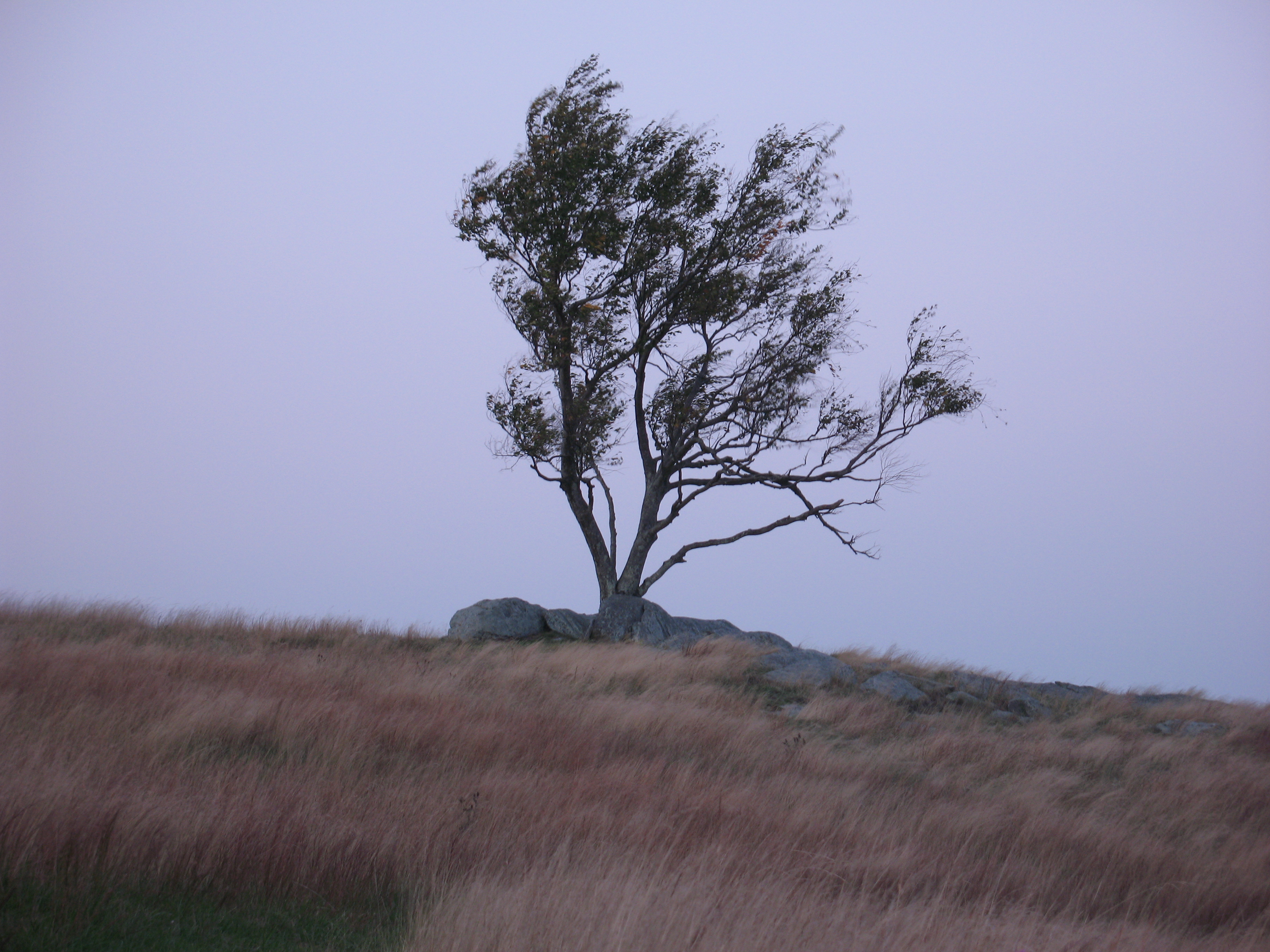
IMG_0880, tree
 . 

Read Full Post »

 . 
[with poetry by Dr. Jack Coulehan]
 . 
The Act of Love
 . 
How foolish Celia must look
to the Haitian cab driver
on the Medicaid run!
 . 
She wears a white communion dress
the week before Easter, a sign
she brings me something more pressing
 . 
than the pain in her shoulder
and the son who doesn’t talk to her
because his wife is embarrassed.
 . 
Her hips creak in conversation,
her knees grind, but even crepitant joints
are modestly silent and stand aside
 . 
when Celia hands me a potted plant
for my office – an act of Christian love,
she says, not a sign of being personal.
 . 
As for me, I’m stunned
out of the ordinary anger
at failing to help her
 . 
by the waxy leaves of her gesture
and I receive this wafer of the season,
heartbroken for no reason.
 . 
Jack Coulehan
from The Talking Cure: New and Selected Poems. Plain View Press, Austin TX, © 2020
 . 
❦ ❦ ❦
 . 
To plow a furrow straight, keep your eyes on the far edge of the field, not back over your shoulder. I didn’t much take my own advice, seems like, those forty years as a small town family doc. Most of the time I recall just struggling to make sure the big wheels were turning while the mud got deeper. Towards the end I could see the hedgerow approaching and I recognized what was calling – to have one last face to face with my patients. Except there was precious little face to face during those final six months. Pandemic saw to that.
 . 
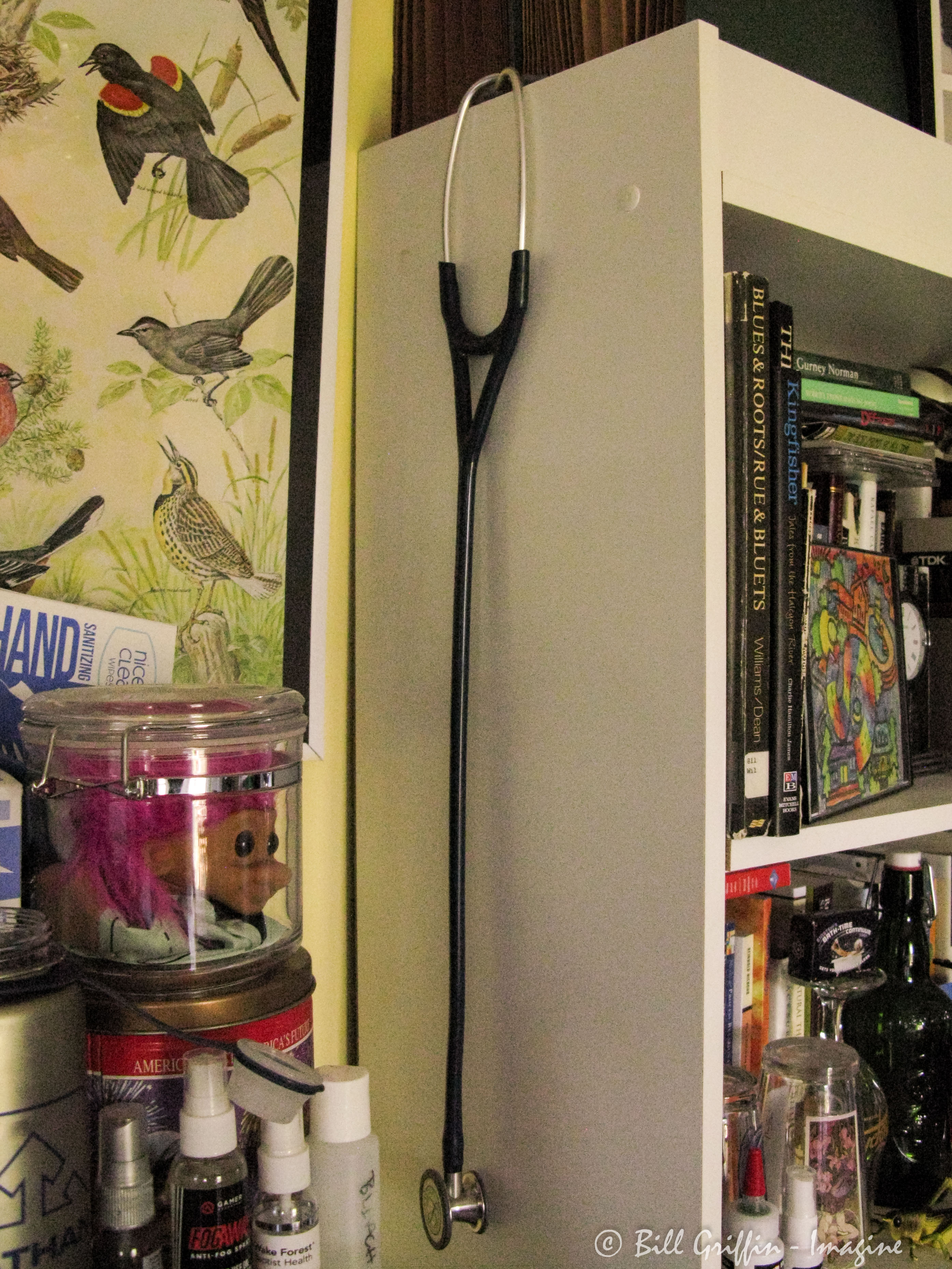
And when you finally run out of field? Wedge around and plow a parallel straight back? Or hop down, push through the hedge. See what’s waiting next field over. OK, OK enough with all this rural agronomy metaphor. It’s three years now since I, as we say, hung up the stethoscope. The anxiety dreams have settled down to just once or twice a week, or else I sleep through and don’t remember them. I passed a former patient on the nature trail last week and she didn’t recognize me. The off duty anonymity I craved for years in this little cloistered town, well, here it is. And so . . .
 . 
. . . I ask myself what those forty years meant. Anything? Did I do good? Did I make a difference? Does anyone besides me remember? Perfect time to open this book of poems by Dr. Jack Coulehan MD. I’ve picked it up a dozen times but laid it back down. I know his name from chance meetings in the pages of JAMA and Annals of Internal Medicine. I see that he once directed the Stony Brook Center for Medical Humanities. How does anyone make sense of anything? He’s bound to have the prescription.
 . 
The Talking Cure – yes, that’s it: the first hard lesson I learned and the one I never stopped relearning. Biochemistry, microbiology, pharmacology and all the rest, those were fun. Difficult and challenging, but just what I loved. What was hard, what caused this introvert to gulp and begin to sweat, was opening the door and be expected to sit down with a stranger and talk. And now I’m thinking back forty-three years, to the first week of my Family Medicine Residency at Duke: before I opened that first door to a new patient, I sat with my mentor and began to learn, not to talk, but to listen.
 . 
Forty years of listening. The times I failed to communicate, augured in, crashed and burned and the patient’s resultant look of anger or distrust or despair, those are all still bright daggers in my side. But the many times we connected, the moments of trust and understanding, those may not be as clarified or stark but they have left a golden glow on my western horizon. Listening is learned; listening is work; listening is an active intervention. Here comes Linda. Here comes seven-year old Amelia. There is always more listening to be done.
 . 
 . 
❦ ❦ ❦
 . 
Poem for David
The day you died your sheepish letter came
begging me to write Dilaudid for the pain.
On flying home – your goddamn migraines
back again. After the second bleed
your mother was as good as dead, your dad
a wreck. You begged me to forgive your sick
activities last year, frightening my kids,
bringing meth into my home. I’m clean,
you wrote, Rehabbed in the Vets for months.
 . 
Your drowning made the local Evening News –
a body bobbing at the rocks a quarter mile
beyond the rapids. Swimming when a seizure
took him. An accident, they said. But no.
You hated water, had never learned to swim.
Heroin, Dilaudid, meth. Your manic flight
to help the victims of explosions, earthquakes,
fires – your merciless adrenalin.
Chaos and emptiness tracked you home.
 . 
In our Appalachian town, I stood like wax
beside your open casket. Above you –
an arrangement of roses from a woman
names Terri. I hovered near the guttered flame
your father had become, recalling the months
you spent tending the wounded in Vietnam,
your endless shifts in hospitals back home.
I pictured forgiveness – an orchard
carpeted with apples, bruised and fallen.
 . 
Jack Coulehan
from The Talking Cure: New and Selected Poems. Plain View Press, Austin TX, © 2020
 . 
 .  .  .  .  .  .  .  . 
❦ ❦ ❦
 .  .  .  .  .  .  .  .  .  . 
The Talking Cure
+++ for David Pearson, MD
 . 
At eighty-one, my friend, who once was told
he’d never graduate in medicine
because his heart was tender, climbs the stairs
after seeing his last patient. For years
he’s helped a retired lieutenant examine
the slippage of his inner knots by talking.
 . 
We sip iced tea. They don’t teach the talking
treatment anymore. We used to be told
that words matter. Remember? He’s examined
syllables and silence as his medicine
for decades. His cheeks ravaged by the years
on steroids, twitch with dampness, and he stares
 . 
at melting ice cubes. He recalls the stairs
to paradise – that’s irony talking
though regret – and he’s dissecting the years
with sharp New England. wit. I never told
him of my weakness, but he knew. Has medicine
hardened his heart? I avoid examining
 . 
mine, not today, as we examine
the world through a kitchen window, and I stare
at Narragansett Bay, a medicine
just visible between the trees. Talking
rakes up leaves. What’s beneath? Truth be told,
neither of us has ended where those years,
 . 
when youth seduced us, promised. Every year
accounted for, but when I examine
my conscience – and expression that tells
a lot about my childhood – what stares
at me is gratitude, not guilt. Talking
to my friend this afternoon is a medicine
 . 
that pares away scarred skin, a medicine
of acceptance – his fighting for years
to be heard, the ease with which I talked
a good game – all of which we examine
with astonishment. I descend the stairs
to the door as we continue talking
 . 
of medicine and our examined
routes, frenetic years, a world that stares
at pain without telling while we do the talking.
 . 
Jack Coulehan
from The Talking Cure: New and Selected Poems. Plain View Press, Austin TX, © 2020
 . 
❦ ❦ ❦
 . 
Jack Coulehan is a Professor Emeritus of Family, Population, and Preventive Medicine at Stony Brook University, and Senior Fellow of the Center for Medical Humanities, Compassionate Care, and Bioethics. Jack graduated from St. Vincent College (BA) and the University of Pittsburgh (MD, MPH), completed his residency in internal medicine at the University of Pennsylvania and Wake Forest University, and did a fellowship in community health at the University of Pittsburgh.  On the medical faculty at Pitt, he co-founded the Center for Medical Ethics and the Western Pennsylvania Ethics Consortium. Along with Marian Block, Jack developed one of the first doctor-patient communication courses required for students in American medical schools.
 . 
Jack’s poems and essays appear frequently in medical journals and literary magazines, and are widely anthologized. Twice a finalist in national small press poetry contests, Jack is the author of seven collections of his poems, including most recently The Talking Cure: New and Selected Poems (2020). His award-winning textbook The Medical Interview: Mastering Skills for Clinical Practice is now in its 5th edition. Jack edited Chekhov’s Doctors, a collection of Anton Chekhov’s stories with physician protagonists, and co-edited three anthologies of poems by physicians, Blood & Bone, Primary Care, and Grit, Gravity, and Grace.
 . 
 . 
❦ ❦ ❦
 . 
 . 
2020-09-08b Doughton Park Tree

Read Full Post »

[poems from VISIONS INTERNATIONAL by Jack Coulehan and Stan Absher]

Mysterious hominid group left a big legacy in the Philippines . . .
+++++++++++++++++ SCIENCE NEWS, Vol. 200 No. 5, September 11, 2021

The black bear in last night’s dream was only mildly interested in the sunflower seeds I offered. It ate one mouthful to be polite. Dang that bear smelled funky, exactly like Pip, my ancient Cairn Terrier, times ten. And the bear was obviously itchy – I reached gingerly to scratch near the bare patch on its back. Telling myself, “This is a bear. Wild. Be gentle.”

The bear wandered away to sun itself in the hay. I’ll bet my cousins were happy whenever the sun came out. That cave in the Altai Mountains in Siberia looks pretty dank and funky. The locals named it Denisova after the old hermit who lived there, Dyonisiy, and when they found a girl’s finger bone fossil way back in the shadows in 2008 they named her Denisova, too. My cousin.

Well, not a close cousin. Completely different side of the family, actually, those funky Denisovans, though we have some grins at reunions. Lately it turns out some closer relatives used to hang out in that cave at times. Real close – Neanderthals. Kissing cousins. I’ll bet we all dream of scratching bears.

.     .     .     .     .     .     .

Neanderthal

My three percent that came from you
is chopped and sprinkled like confetti
among my twenty thousand genes.
Just junk, os so the experts tell me.
A legacy as mute as the hundred

millennia that passed before we met,
though I sense echoes of your voice,
your lyric bird-like tongue, and glimpse
the clan, the tools, the hunt. I feel
your hunger, fear, and satisfaction.

Ancient cousin, what can you teach me
about becoming human? Brutality?
My species doesn’t need your help for that.
Reverence for the earth? We understand
but choose ambition and destruction.

When I visualize beyond the fog of time
your presence, receding ice appears,
a camp of ten or twelve around the fire.
You are sitting beside a peculiar
stranger, so different from the others.
You reach for her hand. She offers it.

Jack Coulehan, from Visions International #104, © 2021 Visions International Arts Synergy

.     .     .     .     .     .     .

These poems by Jack Coulehan and Stan Absher are from the most recent edition of Visions International, a small but tenacious journal published continuously for over 40 years by Visions International Arts Synergy, reprinted by permission. I asked the founding editor, Bradley R. Strahan, for a little history:

“As to me and the journal, we’re inseparable. I started it in 1979 in D.C. at the Writers Center. I have done just about everything on it except printing and art work. For the first couple of dozen issues I had someone do the layout but after that I’ve done it myself on an old fashioned light table. It’s a 501(c)3 non-profit and it definitely is.

“As for just me, after retiring early, 1990, from the Feds I taught for 12 years at Georgetown University, then 2+ years in the Balkans as a Fulbrighter. After that I moved to Austin where I taught part time at U.T. for several years. During my travels I’ve kept the magazine going with 2 issues published in Macedonia and then 2 in Ireland and then one by the University of Liege in Belgium. [We have] a subscriber base that includes several major libraries like Yale, U. Cal., U. NY, U. Penn, etc.” ####### — Bradley Strahan

The journal is illustrated by Malaika Favorite. The poetry takes you around the world and deep into your own psyche. Contact and subscribe at:

http://www.visionsi.com/
Black Buzzard Press / 7742 Fairway Rd / Woodway, TX 76712 USA

.     .     .     .     .     .     .

Every time I read a poem by Stan Absher I feel a pinch of my soul rolled between the fingers of God. Softened and warmed, ready to be restored and molded that much closer to the shape it was meant for.

.     .     .     .     .     .     .

We Lay Our Burdens on Time

Head bent to earth it carries them off.
We hear it shuffle its leaden feet
and wheeze and cough.

Poor thing, we think, the swelling
ankles, the rheumy eyes
that look at us without seeing,

at each trembling step
it drops something we gave it –
a grief, a pang of regret,

a vow we thought would outlive it.
It even forgets its own cruelty,
what it filched from us, a bit

of stature or memory or cheer,
what it plentifully gave
of sickness and despair,

it forgets, and doesn’t care,
stands mumbling in the street,
staggers to the corner bar.

Stan Absher, from Visions International #104, © 2021 Visions International Arts Synergy

.     .     .     .     .     .     .

.     .     .     .     .     .     .

IMG_1827

Read Full Post »