Feeds:
Posts
Comments

Posts Tagged ‘Jacar Press’

 . 
[with poems from Duet by Dorianne Laux and Joseph Millar]
 . 
Listening to Paul Simon
 . 
Such a brave generation.
We marched onto the streets
in our T-shirts and jeans, holding
the hand of the stranger next to us
with a trust I can’t summon now,
our voices raised in song.
Our rooms were lit by candlelight,
wax dripping on the table, then
onto the floor, leaving dusty
starbursts we’d pop off
with the edge of a butter knife
when it was time to move.
But before we packed and drove
into the middle of our lives
we watched the leaves outside
the window shift in the wind
and listened to Paul Simon,
his tindery voice, then fell back
into our solitude, leveled our eyes
on the American horizon
that promised us everything
and knew it was never true:
smoke and cinders, insubstantial
as fingerprints on glass.
It isn’t easy to give up hope,
to escape a dream. We shed
our clothes and cut our hair,
our former beauty piled at our feet.
And still the music lived inside us,
whole worlds unmaking us in the dark,
so that sleeping and waking we heard
the train’s distant whistle, steel
trestles shivering across the land
that was still our in our bones and hearts,
its lone headlamp searching the weedy
stockyards, the damp, gray rags of fog.
 . 
Dorianne Laux and Joseph Millar
from Duet, Jacar Press, Durham, NC; © 2016
 . 
❦ ❦ ❦
 . 
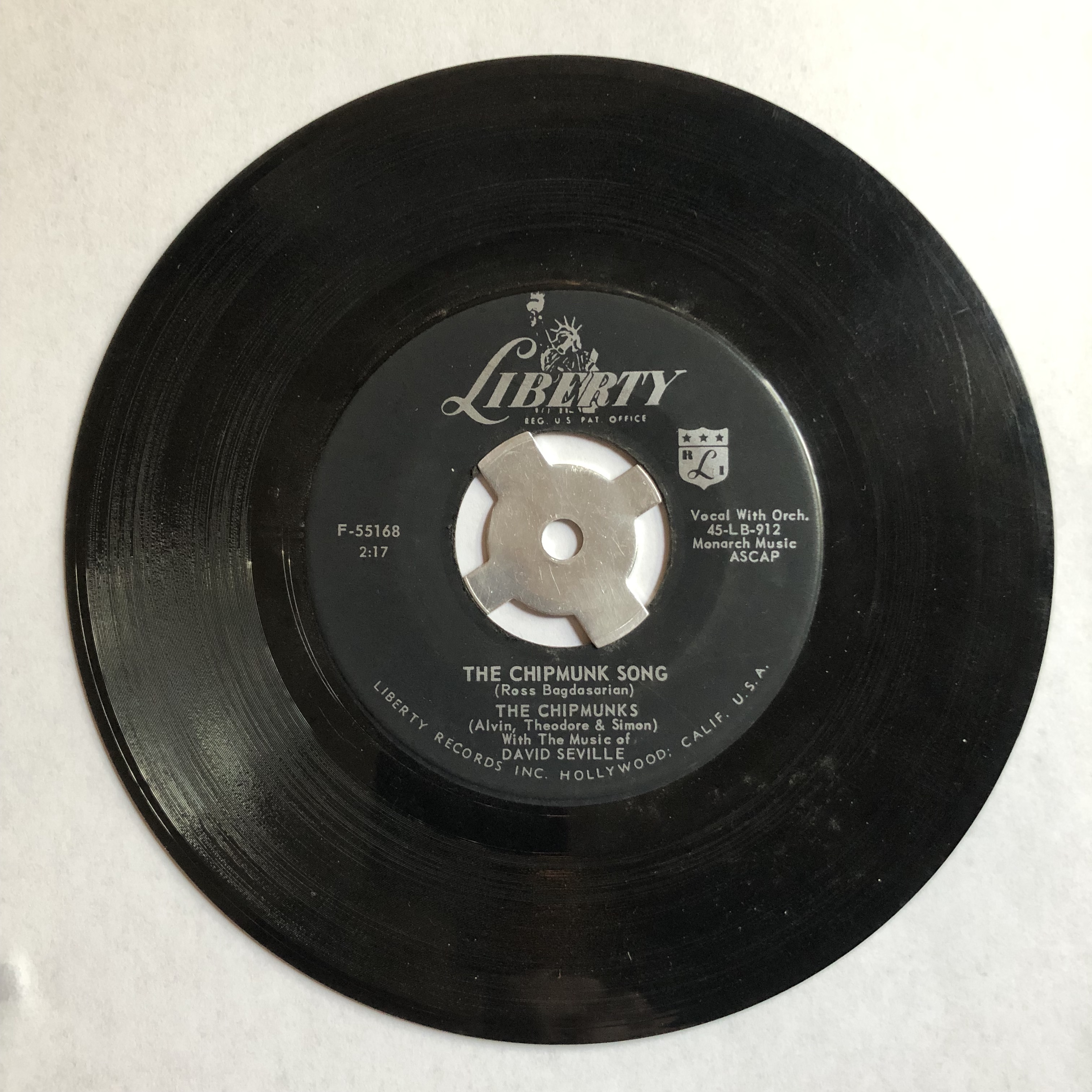
Here I am again, six years old this time, sitting cross-legged on the floor beside the pinnacle of 1959 technology. I wind it up, carefully lay the 6-inch plastic disc on the little turntable (it’s bright yellow plastic, I will never forget that), and position the needle at the outer groove. The wind-up box is white and red and has a picture of Mickey Mouse grinning; it looks like Mickey’s arm is what holds the stylus. The needle itself juts from a hollow flat cylinder, sort of like a tuna can with perforations; the little holes are what transmit the sound. No electronics, no electricity involved.
 . 
I push a lever and the disk begins to rotate. The needle finds its groove (at least a decade before finding one’s groove will mean anything to me) and in between all the scratches from a hundred earlier renditions – music! The little record finishes, I lift the needle from where it’s begun making little whump whump sounds with each revolution, I place the needle back at groove one, and it starts all over again.
 . 
And even so my mother remained sane to her dying day.
 . 
As the years passed, Mom and Dad began to let me listen to their records on the Hi-Fi (mono, not stereo; Uncle Carlyle soldered it himself). It never seemed to drive them crazy to hear Peter and the Wolf or The Music Man a dozen times a day, or even Bobby Darin singing Mack the Knife. Hard core. Finally the big day – I was 11, I had saved my birthday money, I had laid awake at night tallying which of their songs were included: I bought my first LP, Introducing . . . The Beatles.
 . 
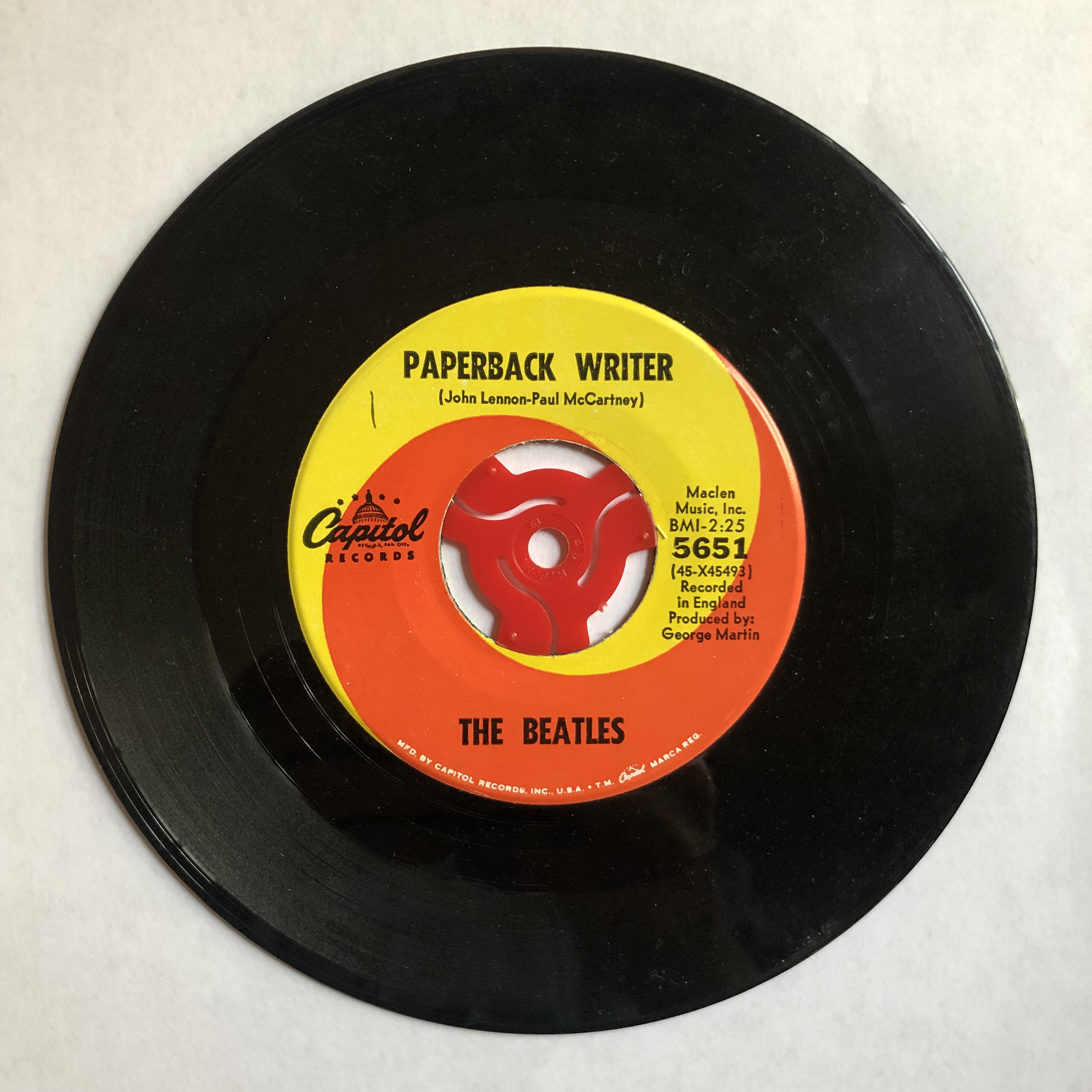
Introducing . . . is an anomaly in Beatles discography. It was released by Vee-Jay Records because Capitol/EMI had farted around about agreeing to a first USA Beatles album and Vee-Jay scooped them. Apparently it was only on the market for a year or so before the suits prevailed and forced them to cease and desist. Anyhow, I listened to that vinyl disc about a thousand times before I bought Beatles ‘65. In fact, I might just go slap it on the old turntable right now. Scratches and all. Please, please me!
 . 

 . 
 . 
And that little yellow record? Easter Parade. Sixty-five years later I still find no evidence that there has ever been such a parade, but now the melody has wormed it’s way in again: “In your Easter bonnet, with all the frills upon it . . .” And even so, my mother somehow remained sane.
 . 
 . 
❦ ❦ ❦
Mick Jagger (World Tour, 2008)
 . 
He stands on stage
after spot-lit stage, yowling
with his rubber mouth. If you
turn off the sound he’s
a ruminating bovine,
a baby’s face tasting his first
sour orange or spitting
spooned oatmeal out.
Rugose cheeks and beef
jerky jowls, shrubby hair
waxed, roughed up, arms
slung dome-ward, twisted
branches of a tough tree, knees
stomping high as his sunken chest.
Oddities aside, he’s a hybrid
of stamina and slouch,
tummy pooch, pouches under
his famous invasive rolling eyes.
He flutters like the pages
of a dirty book, doing
the sombrero dance, rocking
the microphone’s
round black foot, one hand
gripping the skinny metal rod,
the other pumping its victory fist
like he’s flushing a chain toilet.
Old as the moon and sleek
as a puma circling the herd.
The vein in this forehead
pops. His hands drop into fists.
he bows like a beggar then rises
like a monarch. Sir Mick,
our bony ruler. Jagger, slumping
off stage shining with sweat.
O please don’t die. Not now,
not ever, not yet.
 . 
Dorianne Laux and Joseph Millar
from Duet, Jacar Press, Durham, NC; © 2016
 . 
 . 
❦ ❦ ❦
 . 
Uno Voce – when Sandy Beam rehearsed an a capella selection, he required us to blend our tone with each person singing near us until it was as if we all sang with one voice. Vibrato is anathema; sibilance is sin! Of course, Sandy would have been happiest if we had all been boy sopranos, but at least we could strive for that brilliant transparent evocation of light he desired.
 . 
Light and truth evoked by a single voice – not at all unlike these poems in Duet. They are each about music – Bo Diddley, Lightnin’ Hopkins, Paul Simon, James Taylor, Ladysmith Black Mambazo, Cher. They build a portrait in layers of color, tone, and years, filled with the music that infuses our past and vibrates in our bones to create our present. And they are written by the duet of Dorianne Laux and Joseph Millar, but the tones and melodies blend until we readers hear a single voice.
 . 
Not an ear worm in the bunch.
 . 
 . 
Duet is one in the continuation of the Greatest Hits Series, originally conceived by editor Jennifer Bosveld at Pudding House Press in 2000 and acquired by Sammy Greenspan of Kattywampus Press in 2010. Jacar Press was asked to take over the series under the careful eye of series editor David Rigsbee in 2017. More about the book, the Series, and Jacar Press HERE
 . 
 . 
❦ ❦ ❦
 . 
 . 
 . 
❦ ❦ ❦
 . 
 . 
 . 

Read Full Post »

[with two poems by Julie Suk]

Silence does not exist for me. I’ve had my tinnitus mapped by an audiologist: four different frequencies in each ear, one or two dominant (louder!). One tone (on the left) is pitched so low that the only time I’ve heard it was before sunrise in Shining Rock Wilderness (near Mt. Pisgah) – no wind, no birdsong, no people, no machines. The other tones are high pitched, constant whining needles of sound, minor chords that never resolve.

I’ve heard that some people are driven insane by tinnitus. Perhaps you’d better be extra vigilant when you’re around me. Somehow, though, I’ve been blessed with the gift of mostly ignoring it, not caring. I can’t remember a life before I heard this daily continuous ringing screech. Where did it come from? All that target practice earning Marksmanship Merit Badge in Boy Scouts? All those lawns mowed as a kid? All those Grateful Dead and J. Geils Band concerts?

Intrusive noise. Which of us in 2021 doesn’t suffer from such? Thank you, iPhone, for telling me my screen time increased 23% last week. Add to that I’m a terrible meditator. If I try to empty my mind what immediately creeps in to fill the vacuum is regret and guilt for every screwup I’ve ever committed in my entire life. What works better for me is poetry. Feet flat on floor. Deep breaths, in and out. Open the book. Read a page. Stare unfocused into space. What tinnitus?

.     .     .     .     .     .     .

At first I’m tempted to apologize for introducing Julie Suk with an essay that endeavors to wring a smile, but no, the light touch is not inappropriate. The poems in Astonished to Wake, Julie Suk’s sixth book published in 2016 when she was 92, are often about loss and all of them are about her own impermanence – they are solemn but they are never grim. The poems are simply perfectly human.

We all share one thing on this earth – our own mortality. Admitting that, we may be open to discover that we share much more: grief that we must live through and live beyond; loves that are no longer present but which still warm us like the dying fire’s embers; moments of joy, however brief.

As I sit down for a couple of hours to re-read this book in its entirety I become thoughtful, reflective, connected, grave, but not sad. And the only ringing I hear is Julie’s words.

.     .     .     .     .     .     .

Migrations

A stretto of rain on the windowpane,
a swirl of bees caught in the creek’s overflow,
the yard going under.

Remember how replete our lives once were,
brimming over, the future a muted thunder
drawing us close.

Hold me, hold me

meaning I was fearful the same as you.

Drowning in sweet addictions,
we paused in a childlike daze –

no way to foresee
how and when we’d be swept away,

our bones washed up long after –
perhaps a fragment carved into a flute,

breath,
once again, floating through the wilderness.

.     .     .     .     .     .     .

Between Lives

And what if it’s true that the life we’ve lived
flashes by at the moment of death?

Not even for an instant would I want repeated
the boring drone of guilt,
nor the shabby aftermaths of desire.

The black tunnel lit with epiphanies
would be my take –

sighs of contentment, laughter, a wild calling out –

and at the end,
a brief flaring of the one we’d hoped to become
escorting us into the light.

Julie Suk, from Astonished to Wake, © 2016 Jacar Press

.     .     .     .     .     .     .

.     .     .     .     .     .     .

Julie Suk (born Julie Madison Gaillard; 1924) is a prize-winning American poet and writer from Charlotte, North Carolina. She is the author of six volumes of poetry – The Medicine Woman (St. Andrews Press, 1980), Heartwood (Briarpatch Press, 1991), The Angel of Obsession (The University of Arkansas Press, 1992), The Dark Takes Aim (Autumn House Press, 2003), Lie Down With Me (Autumn House Press, 2011), and Astonished To Wake (Jacar Press, 2016), and co-editor of Bear Crossings: an Anthology of North American Poets. She is included in The Autumn House Anthology of Contemporary American Poetry. Her poems have appeared in many literary journals including The Georgia Review, Great River Review, The Laurel Review, Ploughshares, Poetry, Shenandoah, and TriQuarterly.

[Bio from Wikipedia]

.     .     .     .     .     .     .

IMG_6944

Read Full Post »

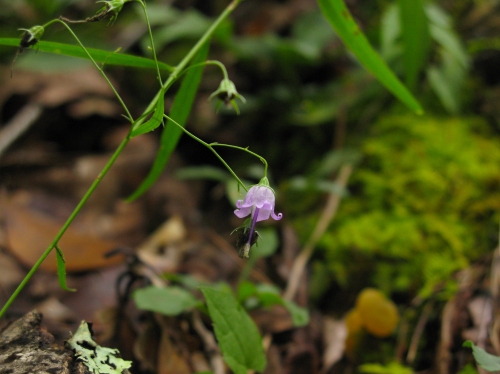
Southern Harebell, Campanula divaricata, Campanulaceae (Bellflower) family

[with two poems by Lola Haskins]

I sat in the ophthalmologist’s office reading Lola Haskins and wondering. I’ve put off this visit due to COVID and I’m overdue, seeing Dr. Bondalapati for the first time. She is new here, just moved to Elkin from Chapel Hill with her family last summer. Most of her staff I’ve known for years, although it is still welcoming to be recognized behind the mask.

All of us masked. Wondering. Are our precautions enough? Is it OK to be together like this?

Isn’t it remarkable how much eyes alone can communicate? Eyebrows bobbing, winky lids, wrinkly skin of brow and temple, lovely corrugator muscles. I left the office happy to have seen my new doctor and Deanna, Karen, all the others.

Bridge the separations. Make community. Take nothing for granted.

I am also restored and innervated by Lola Haskins’s poems. I heard her read several years ago and just bought her collection, how small, confronting morning (Jacar Press, 2016). Isn’t it remarkable how much a few words and a few lines alone can communicate? Seeing through another’s eyes. Another’s voice in my ears . . .

. . . like happiness // it materialized so gradually / that I never even for a moment // saw it coming

.     .     .     .     .     .     .

The Cabin at Fakahatchee Strand

by morning the water has turned such
silver I want to put it on i know

it would only flutter off my skin
like a bird too quick to follow

but i don’t care i want it anyway
and i want that tangle of cattail

and black rush too the way i want
to be perpetually waking to

yet another gift like the single gator
stretched out on the muck

where pond has begun to thicken
to swamp like happiness

it materialized so gradually
that i never even for a moment

saw it coming

.

Lola Haskins, from how small, confronting morning (Jacar Press, 2016)

.     .     .     .     .     .     .

Flight

if i eat feathers asks the child
will i be able to fly?

you already can says her mother
any night
the lightness in you my lift you
from your cot
that’s why i close the windows

when i get old enough the child
wonders

will you open them? oh yes
comes the answer

(sorrowing) that’s what
mothers do

.

Lola Haskins, from how small, confronting morning (Jacar Press, 2016)

.     .     .     .     .     .     .

Haskins writes with the startling freedom and grace of a kite flying, and with the variety and assurance of invention that reveal, in image after image, the dream behind the waking world.
W.S.Merwin, winner of the Pulitzer Prize and former U. S. Poet Laureate

.     .     .     .     .     .     .

IMG_0877

Read Full Post »

« Newer Posts - Older Posts »