Feeds:
Posts
Comments

Posts Tagged ‘GSMNP’

[with two poems by Kathryn Stripling Byer]

Hepatica: its flowers spring up in March before its new leaves. Quick! Before arching limbs furl their green sails and hijack the wind of sunlight, quickly make your tiny seeds from last year’s photons! New leaves will have all summer and fall to glean what the canopy misses.

When Linda and I discover the first hepatica blooming along Elkin Creek each spring we take heart. The world is not such a grim and wintry place. One morning last April we counted 50 individual plants along a mile of trail. Such bounty! How they thrive! How our hearts do!

A few weeks ago I walked one mile of nature trail at Chimneys picnic area in Great Smoky Mountains National Park. At the end of September hepatica leaves are glossy, taut, ready to overwinter. As I strolled the cove, deep cathedral of old growth hardwoods, I estimated within 5,280 feet I saw 50,000 individual hepatica plants.
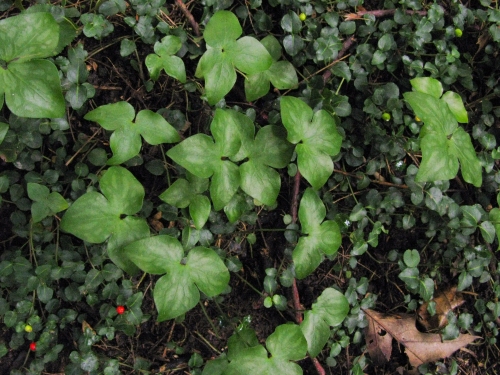
Sharp-lobed Hepatica, Hepatica acutiloba, Ranunculaceae, buttercup family

Life wants more of itself. Life wants to fill every niche. How many generations, how many hundred, did it take to create this mountain cove topography? Mossed, leafy, pits and mounds left by an ancient giant fallen. The light gap its falling created. Explosion of variety in the margins. Trunks of all sizes and ages in the understory, massive individuals creating the canopy. I didn’t know a black cherry, a silverbell, ever got this big!

Leave a patch of ground alone long enough and it will grow into what it is meant to be. Mountain flanks and shoulders for protection, rain upon rain, limestone subsoil for minerals – the old growth cove hardwood community shelters biodiversity approaching a tropical rainforest. These few sections in the Smokies that the loggers never reached are still revealing new species. Life wants more.

And to what purpose? What is it good for? I could probably list a few dozen reasons the undisturbed and unmanipulated forest is good for me and good for you. But how about this – the thousands of reasons it is simply good for itself.
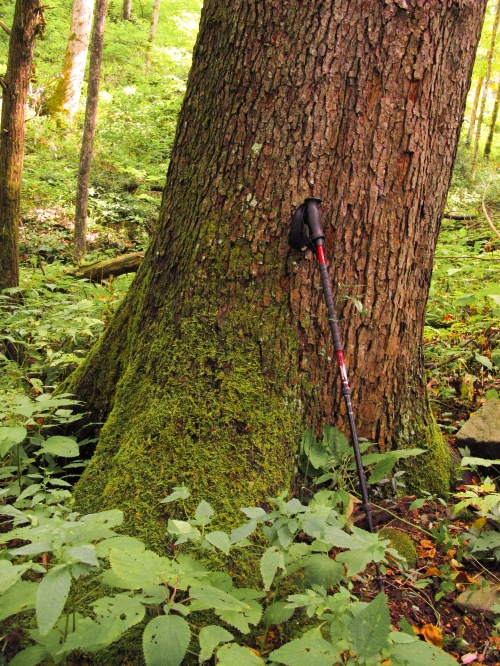
Black Cherry, a BIG one, Prunus serotina, Rosaceae, rose family

.     .     .     .     .     .     .

Kathryn Stripling Byer (1944-2017) was North Carolina Poet Laureate from 2005-2009 and the first woman to hold that position. She and her family lived in the mountains of western NC (she taught and was poet-in-residence at Western Carolina University); her grace and generosity reached throughout the southeast and beyond. She was teacher and mentor but, even more, she encouraged and celebrated the creative spirit wherever and in whomever it was found. Even me. Thinking of her today brings me joy.

I have gone back to Kay’s first book for these two poems. The Girl in the Midst of the Harvest was her debut collection (Texas Tech Press, 1986) and was re-issued by Press 53 (Winston-Salem, NC) in 2013.

.     .     .     .     .     .     .

The Backwoods

Great-grandmother carried the cadence of Genesis.
Girl cousins up late at family reunions,
we made her an Indian, although her forebears
were Irish. Before her lay darkness, the empty fields
barren as desert until she came forward,
the sweat on her high cheekbones gleaming like eyes
we imagined surrounding her, bob-cat and red fox,
the last of the sleek, singing wolves. Every evening
she shouldered her how and walked home
through the tasselling corn. The Good Lord only knows
what bare feet stalked the backwoods in those days,
what waited behind every woodpile! She brought forth
a daughter with black hair that never curled.
Shy as a fieldmouse, that girl fell in love
with a man scything hay in the twilight. They kissed
twice. A moment she stood in her white dress
and smiled back at us, then she grew fat and sighed
in the kitchen. Four daughter she bore,
and the three who survived scarlet fever
wove grass in their brown hair and danced every night
with the fireflies. They galloped on wild horse
bareback until they got married and gave birth
to us, Southern Belles who could sit in a parlor
all evening and never complain. We could faint
in a handsome man’s arms. We could charm a
a stone wall. But we never forgot the back door,
how to disappear into the darkness, our crinolines rustling
like cornstalks between our legs. We told
this story so well, we inherit its black earth
where women hoe all night, inscrutable as Indians.
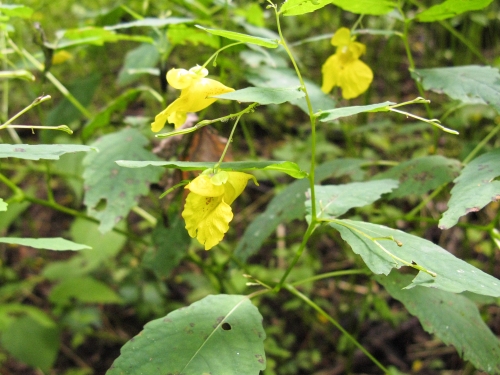
Pale jewelweed, Impatiens pallida, Balsaminaceae, touch-me-not family

.     .     .     .     .     .     .

Frost

“Shake the cold from our hands,” you call, running ahead
of me onto the frozen grass. Look, in the garden
your father wrests vines from a tripod of bamboo stakes.
Okra’s grown weary with mourning another year
gone and just yesterday, Darling,
they wore yellow buds in their hair. Like you

twisting a puny chrysanthemum into your tangles
and galloping off on a broomstick. Down Caney Fork
scarecrows come hobbling like old soldiers
leaving their cornfields. They’ll sit by the river
and talk about what the crows told them: a hard winter
coming. Those windy crows, all they keep saying
is cold, cold, and when I see clouds swept
like ice down the creek, I believe them
too easily. Why must the maple leaves rattle

Remember me, as if someday
I’ll forget there were thousands came
falling the morning I felt for the first time you
shiver inside me, no fish as I thought you would be
but a mouse in its burrow? Now you sit in sand
and make birthday cakes, blowing out candles
that aren’t there. I blow on my hands
like an old woman taking no heed of a child
who believes time can be shaken from her like water.

poems by Kathryn Stripling Byer
from The Girl in the Midst of the Harvest, Press 53, © 2013 Kathryn Stripling Byer
first published by Texas Tech Press, January 15, 1986
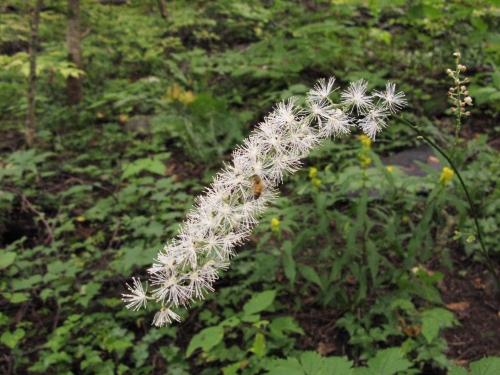
 

Mountain bugbane, Cimicifuga americana, Ranunculaceae, buttercup family

.     .     .     .     .     .     .

Mountain Cove plant communities occur in sheltered areas with abundant rainfall in mid- to lower-elevation areas of the Southern Appalachians. Especially the Rich Cove Forest subset, with less acidic and more rich mineral soils, is home to a huge diversity of tree species, flowering plants and ferns, insects, reptiles and amphibians. Original (old growth) forests will have massive individual trees hundreds of years old mixed with trees of all ages where a giant has fallen and allowed sunlight to reach the forest floor. There are a number of these areas where loggers never reached in GSMNP, such as Chimneys and near Cades Cove.

.     .     .     .     .     .     .

All photos by Bill Griffin from Southern Appalachian Naturalist Certification Program; Southern Appalachian Ecology, September 2020, Great Smokies Institute at Tremont; instructors Jeremy Lloyd and Elizabeth Davis.


.     .     .     .     .     .     .


Read Full Post »

[with two poems by Debra Kaufman]

Deep shade, red spruce, heavy moss – the trail switches up, cuts back, winds steadily higher. We can smell the transition, conifer tang, slow decomposition. We can feel it on our faces, in our pores, sweat cooling, wraith of mist blown up the ridge to envelope us. And we feel it somewhere deeper.

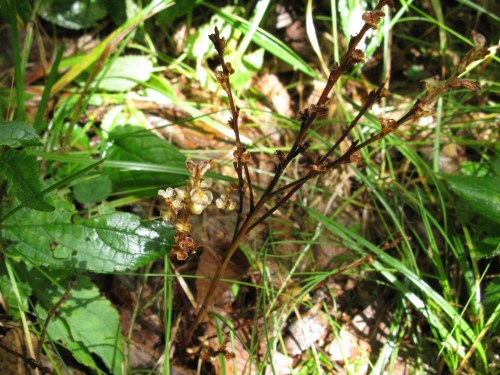
Something changes, so gradual we sense it before we know it. Daylight creeps through, one tree with toothed sun-colored leaves, then two; smell of spring and sweet flowering even at the end of autumn; witch hobble and pale mountain asters give way to dwarf goldenrod. Look, here are beech drops, flowers faded, seeds set, never green, their skinny bodies and appendages like effigies set among the trees they parasitize. We stop and breathe. Again, deeper. This is beech gap.

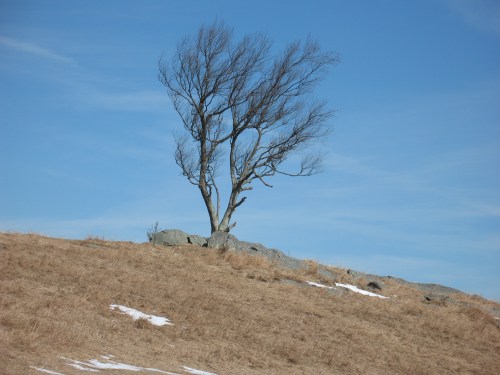
Leave a patch of ground alone long enough and it will grow into what it is meant to be. Its personality is in its community. Why does this beech gap persist? Its elders, Fagus grandifolia, stunted and twisted in communion with mountain maple, wood ferns, sedges – why not fir and spruce intruding? Elevation, precipitation, mountain aspect, soil pH? Centuries-old seed repository in the duff? Visitation by warblers, jays, and small mast-seeking mammals? Protection by allelopathic residues? Protection by mountain spirits?

All of these may define but don’t explain. It is the community that becomes itself: shallow spreading roots and pervasive mycelia, leaf and frond, sporangium and ovule, every one essential to the personality of place.

And you and I? We may choose how tall we stand. We choose which way we face, whether we learn from our elders, teach our children. We rest here for a few minutes and commune with this other. The silence of a ridge-crest glade: fragile or resilient? Retreat or restoration? Will we descend from the mountain and bring this peace, this purpose, into our own communities?

Beech drops, Epifagus virginiana, Orobanchaceae (Broomrape family)


.     .     .     .     .     .     .

These two poems by Debra Kaufman speak to me of reverence and restlessness, of longing for community and the fear of isolation. Are we welcome on this earth and will we welcome others? Will we create more than we destroy?

As described on the cover of her book, God Shattered, Kaufman discovers how personal disillusionment can be a guide to finding the godly within ourselves. These poems lead us to contemplate and understand our place in this fragile world.

.     .     .     .     .     .     .

Great White
An angel is nothing but a shark well-governed.
– Herman Melville, Moby Dick

Everyone carries a shadow.
The less it is embodied in the conscious self,
the blacker and denser it is.

Does a savage self always lurk
just below the surface,
on the hunt, no matter

our good intentions? Is our higher
nature ready to do battle against the dark,
harpoon at the ready?

If, as the Buddha says, there is no I,
does awareness reside
between empty spaces?

I understand so little.
But I can see Aleppo is rubble,
its people scattered;

anyone who listens can hear the cries
of girls being shuttled into brothels,
can imagine comforting someone suffering

here or half the world away.
How do we stop what is sacred
from being ravaged,

witness life out of balance yet not despair?
There must be ways
toward doing what is right.

Why else, as Job asked, would
light be given to a man
whose way is hidden?

The great white shark
is nearly extinct. It can sense
a beating heart over a mile a way.

.     .     .     .     .     .     .

Welcome

You, one of seven billion born
helpless, nearly hairless,

one more chimp-cousin
in our midst:

Will you be swaddled,
neglected, anointed,

will you breathe air
that smells like rain?

Which foods will sustain you,
upon what ground

will you walk? What storm,
fires, floods will sweep

over you, what languages
will you learn, what

dances, what prayers?
Here is my hope for you,

little stranger: may you feel
beholden to this wondrous planet,

may you take your hungry,
humble place in it,

may you dedicate your life
to making it a world worth

revering, holding, passing on.

poems by Debra Kaufman from God Shattered, Jacar Press, © 2019

.     .     .     .     .     .     .

Debra Kaufman grew up in the Midwest but has lived in North Carolina for thirty years. She has published three poetry chapbooks and four full length poetry collections: God Shattered, Delicate Thefts, The Next Moment, and A Certain Light.

.     .     .     .     .     .     .

The Beech Gap is a rare subtype of Northern Hardwood Forest, found scattered in small patches surrounded by Fraser Fir and Red Spruce in Great Smoky Mountains National Park and elsewhere at the highest elevations of the Southern Appalachians. The Beech, mixed with small numbers of Buckeye, Birch, and Maple species, are stunted by the cold climate and high winds, with an open understory but relatively rich herb layer. Some patches in the Smokies are fenced to prevent destruction by invasive non-native wild pigs. Why this seemingly stable climax plant community remains stable and is not overtaken by Spruce-Fir remains a mystery.


.     .     .     .     .     .     .

All photos by Bill Griffin from Southern Appalachian Naturalist Certification Program on Southern Appalachian Ecology, September 2020, Great Smokies Institute at Tremont; instructors Jeremy Lloyd and Elizabeth Davis.
.     .     .     .     .     .     .
 

IMG_7952


Read Full Post »

[with two poems by Malaika King Albrecht]

The lesson you need is the one you weren’t looking for.

The lesson you keep is the one you didn’t want.

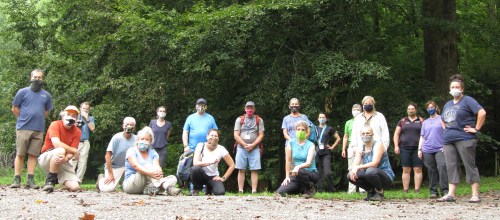
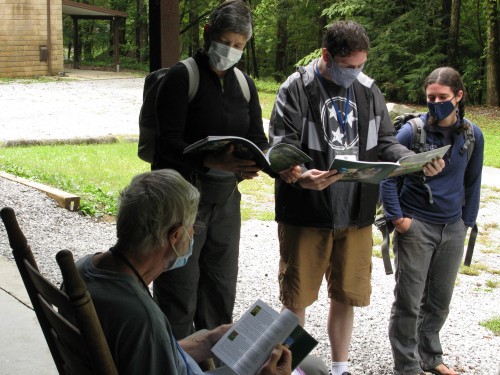
Our final exercise is to sit. Not in the open air pavilion where we’ve weathered hours of presentations and discussion. And not by any means moving along the trails we’ve hiked for hours encountering a new species every minute. Now at the close of our weekend naturalist course on plants of the Smokies we are instructed to stop, settle, sit. We are to find a green thing we don’t know or one we’ve have ignored and sit for half an hour. Pay attention. Become intimate.

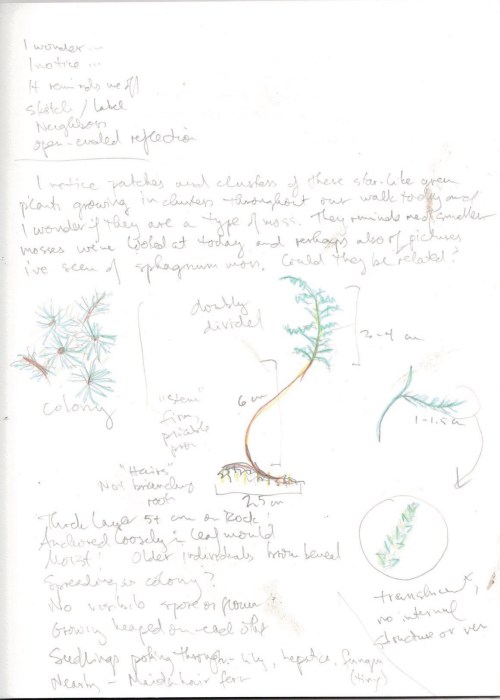
I choose to sketch a bryophyte not much bigger than my thumb. Perhaps I’ll never know its true name – starmoss? sphagnum? – but we could become friends. I won’t even give it a name. Be satisfied sometimes simply to explore, to know first with all my senses, that is what I’m learning. Where does it like to lie and spread? Whom does it choose for neighbors? How does it make its living? Naming can come later.

Moss with Doghobble leaf

Look at us all, scattered like toadstools across this mountain glade quietly noticing. For now the birds and insects get to make all the noise. Eventually our quiet must end and we gather one last time for closing and summarizing and making sense. Now Tonya has a surprise. A worm snake, while she sat, has burrowed, well, wormed into her open sandals and curled around her toe. She untangles it and cradles it for us all to see while it tries to bite her with its mere slit of a mouth, better suited for eating slugs. If we were quiet, if we paid attention, if we sat long enough would we be reclaimed by moss and crawling things and become a haven for all that is small and necessary?

We eat our lunch along the trail, we travel back to Tremont, we pack our cars. At the parking lot I congratulate Tonya upon completing her final course and receiving her Naturalist Certification. I tell her, I’m still only half way through.

Tonya turns to me. She sets down her pack. She is solid, present, her eyes deep and full as a hardwood cove. Help the new ones, she pleads. Share what you know.

And during the five hour drive back to my foothills what image recurs? Not family characteristics that differentiate Brassicaceae, Lamiaceae, Asteraceae; not frond morphology and sorus distribution. No, the image I can’t escape is of the two first-timers in our course turning a leaf over and over in their hands, turning the leaves of a guidebook, excited, figuring things out. And of me a pace or two removed, watching them, adding nothing.

Sometimes I think I have the perfect temperament and skill set to be a moss-covered log slowly digested by fungal mycelia. Ah, the long and placid observations I would make. But that’s not the lesson I need or the lesson I will keep. Instead, this: don’t imagine you know so much. But know that what you do know has value when you share it. Know that its only value is in the sharing. You have joined the circle of seekers. Now open the circle wide.

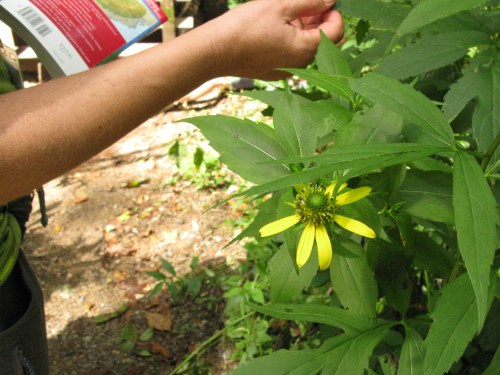
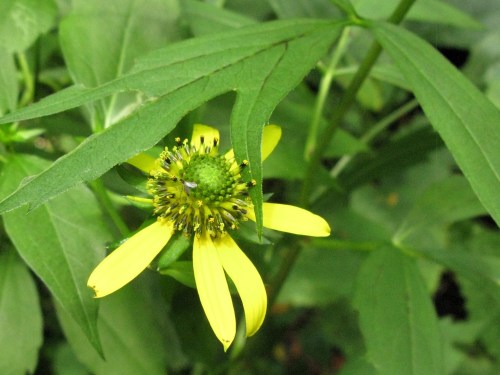
Rudbeckia lacianata; Cutleaf Coneflower; Asteraceae

Rudbeckia lacianata

.     .     .     .     .     .     .

A week ago I shared here two poems by Malaika King Albrecht from her most recent book. I’m not finished with her. Something about this collection of poetry has become very necessary for me as I continue to pile and compile the lessons from my most recent course in the Southern Appalachian Naturalist Certification Program at Great Smoky Mountains Institute at Tremont. The quantity of information itself is just shy of infinite. I’m working through a book titled, Botany in a Day, which would more realistically be In a Couple of Years. Just the new vocabulary reminds me of starting Med school (that was 1974 – what am I doing here?!) or maybe of being smacked with a breaker at Fort Macon beach.

But being overwhelmed with information is the trees, it is not the forest. That is why I need poetry. I will study the taxonomy but poetry will teach me the connections. I will feel like I can never know enough but poetry will teach me to live with and love the mystery. I will work on what to know but poetry will teach me how to know.

Malaika’s collection is just the solace and challenge and promise needed. Her poems can be grounded in the senses but spiral into the imagined and unimagined. I would say her poems make connections but even more they open me to make connections. It can be the difference between burying myself in the Field Guides and opening myself to the field.

Thanks again, Malaika!

.     .     .     .     .     .     .

Following the Wind

Everything leaves a mark:
dull grass in the morning where the raccoon
ambled away full of cat food,
antler scratches along the willow oak,
and tracks and scat everywhere.

I know what stirs in this forest:
Deer nosing the horse path,
red fox slitting the tall switch grass,
rabbit bounding, freezing, and hopping again.

At the edge of Loftin Woods, I fall
for the wind, the way it parts the grass,
makes branches speak
and vultures glide their shallow V’s.

If sky holds our dreams,
then earth, our memories,
and wind, only the now
of this moment calling,
calling from everywhere.

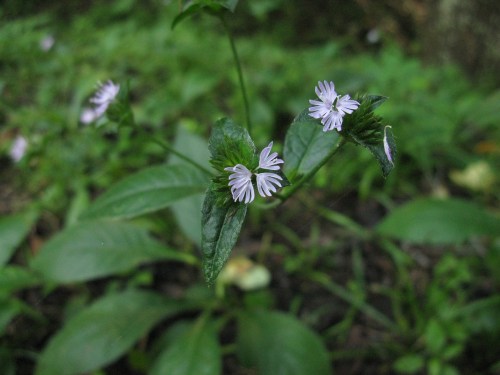
Elephantopus carolinianus; Elephant Foot; Asteraceae

.     .     .     .     .     .     .

Praise Song for What Is

Praise the frozen rain, the icicles daggering
the trees, the gray snow sludge. Praise
the shiver, the wet wind cutting through clothes,
the frozen water troughs. Blessed be
the hard frost, the frozen pond,
the apple sapling snapped in half.

Praise autumn and spring, the hot then cold
then hot again. Praise the corn mazes,
the haystacks, the reaping what we’ve sown.
Blessed be the fig tree, the honeycomb, the hive.
Praise the kudzu, the poison ivy,
the forsythia shouting yellow at a fence.

Praise the mosquito, the itch,
the scratch. Praise the heat waves,
the asphalt, the stopped
highway traffic. Blessed be
the dusty, the wilted, the dry
husks of corn in summer drought.

Praise the possum lumbering
into the chicken coop,
the fox slinging the wood’s edge.
The owl, the hawk, blessed be
their swift descent to prey.
Praise the failures, the losses. Blessed be
the broken path that brought me here.

.     .     .     .     .     .     .

From The Stumble Fields, Malaika King Albrecht. Main Street Rag Publishing Company, Charlotte, North Carolina. © 2020.

Botany in a Day, The Patterns Method of Plan Identification; Thomas J. Elpel; HOPS Press, LLC; © 2018; An Herbal Field Guide to Plant Families of North America

Wildflowers of Tennessee the Ohio Valley and the Southern Appalachians; Dennis Horn and Tavia Hathcart; Partners Publishing © 2018; The Official Field Guide of the Tennessee Native Plant Society


.     .     .     .     .     .     .

Read Full Post »

« Newer Posts - Older Posts »