Feeds:
Posts
Comments

Posts Tagged ‘Great Smoky Mountains Institute at Tremont’

[with two poems by Malaika King Albrecht]

Charismatic Megafauna is what people hope to see when they visit Great Smoky Mountains National Park. If traffic barely creeps approaching Cades Cove there must be a black bear feeding near a pullout; if traffic stops altogether Mama has cubs. And if cars are pulled over for a mile along the prairie verge leading to Oconaluftee Visitor Center it means elk are grazing the pasture.

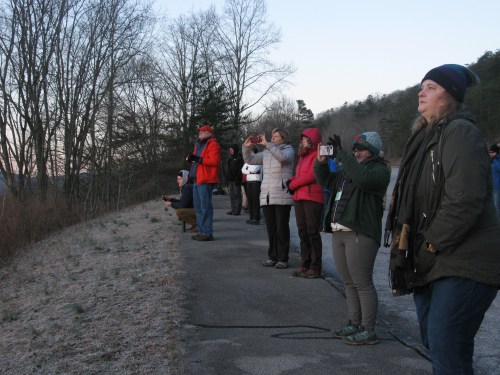
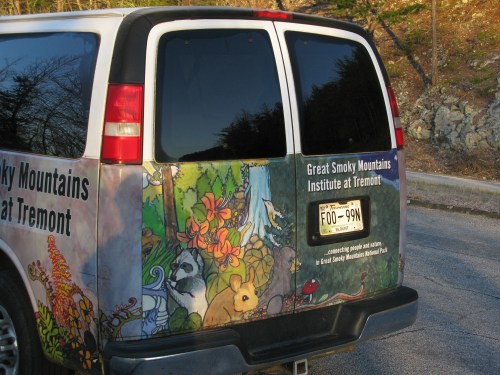
From the center lane I saw the big bull with six-foot rack and a harem of twenty and I slowed but I didn’t stop: the gate into Tremont would only be open from 4:00 to 5:00. It takes at least an hour up and over New Found Gap down to Sugarlands and on west into the Park. Fifteen of us will be arriving for a naturalist course on this final weekend in August, hoping to get personal with that other charismatic Kingdom – Plantae.

Lobelia cardinalis; Cardinal Flower; Campanulaceae

Trees, ferns, and flowers certainly draw many to the Smokies, if only for the deep summer shade and restorative air. Some people are even known to kneel. As winter unscrews her frozen vice we hurry to see ephemerals – trailing arbutus, hepatica, bloodroot. Then arrives the princess of spring’s reign, Trillium, including uncommon Catesby’s and Vasey’s. As we wind through the seasons we lust for phacelia, fringed orchids, lady’s slippers. But what about now at the tail end of summer?

Summer, the season of yellow: asters, wild sunflowers, goldenrod (19 species in the Park), but driving west on I-40 didn’t every weedy median present us with all these and more Asteraceae? Solid gold at 70 mph. Time to slow down. The hour for Latin and Linnaeus is after vespers with our books and guides. In this moment the growl of Harleys on Little River Road can’t penetrate the glade. The rumble of the river into its Sinks reaches us only as subsonic reassurance through our soles. All light has slipped bent drifted through tuliptree and hemlock to recline with us among shaggy green. We are crouched among the ferns.
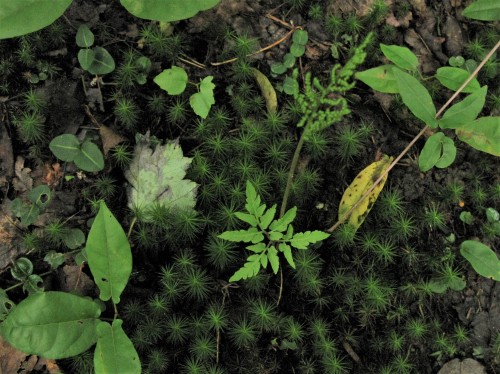
Botrychium dissectum; Common Grape Fern; Ophioglossaceae

So many different kinds of ferns. Notice blade and stipe, dimensions and symmetries. We “frondle” them to read the hieroglyphics of their spores. We smell them. We struggle to know their names.

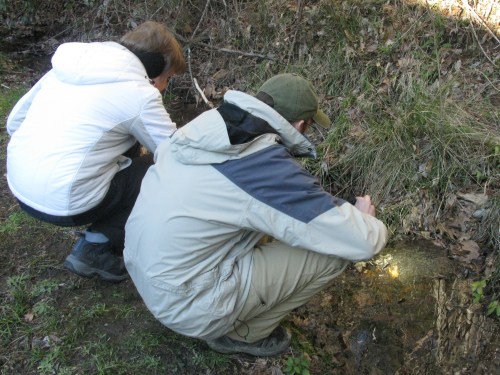
But here’s another fern-like frond, toothed and divided but with a tell-tale: a spike of yellow flowers like sequins in the wildwood. Lean closer. Five-petaled, many threads of stamens, Rose family. Agrimonia, harvestlice, swamp agrimony, but let us name it rose-among-the-ferns. Let us name ourselves sit-and-notice. Call us one-more-among-all-small-things. Look closely. Kneel. The least among the most is what we have come here to discover.
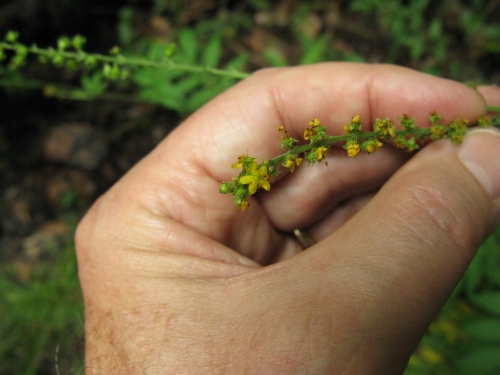
Agrimonia parviflora; Harvestlice Agrimony; Rosaceae

.     .     .     .     .     .     .

Before, during, and after my summer visit to Great Smoky Mountains Institute at Tremont I have been reading Malaika King Albrecht’s newest book of poetry, The Stumble Fields. If a work of art could be a facial expression her book would be a quiet, welcoming smile – the kind that lets you know she is about to share a great confidence. Her poems are revealing in the way sitting patiently in a quiet glade will gradually begin to reveal its true life.

And the spirit that often winds among her lines is, to me, that same spirit that leads us to desire to live truly in this world. Not to skip along its edges but to draw fully and be drawn deeply into it, discovering our selves as we discover the truths of our co-travelers. It is the naturalist urge – to find our connections at every stratum and station.

I am thankful to be connected to Malaika through her words.

.     .     .     .     .     .     .

Lactuca floridana; Florida Blue Lettuce; Asteraceae

Loftin Woods

I’ve wanted to be a single story,
so I could tell you a happy ending
but every breath’s different.
In these woods I’m lost enough
to notice but not lost enough to care.
I find my body when the barred owl
startles the air. I find
my body where white trillium
catches light. I find my body
in the music of cantering horses
singing to sky. Today I could fall
right through this fabric of grass.

.     .     .     .     .     .     .
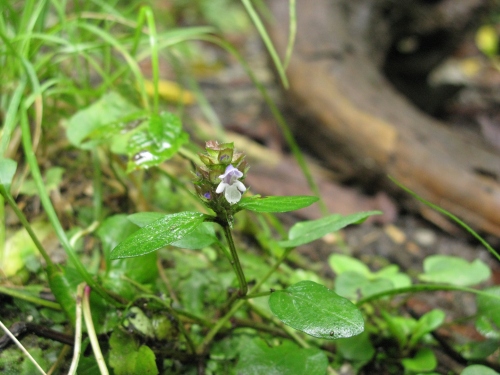
Prunella vulgaris; Heall All; Lamiaceae

Silver Tangle of Brambles at Midnight

Late night you remember God’s first language
is silence. The space between heart beats,

the pause before someone says, Yes,
a brief moment before ebb becomes flow.

So you say, Fine. Don’t talk to me
like God’s a stubborn ghost.

You say, I’ll hear messages
whether you speak or not.

Every closed-door signals detour,
and each broken heart demands

sitting quietly for a time.

.     .     .     .     .     .     .

From The Stumble Fields, Malaika King Albrecht. Main Street Rag Publishing Company, Charlotte, North Carolina. © 2020.
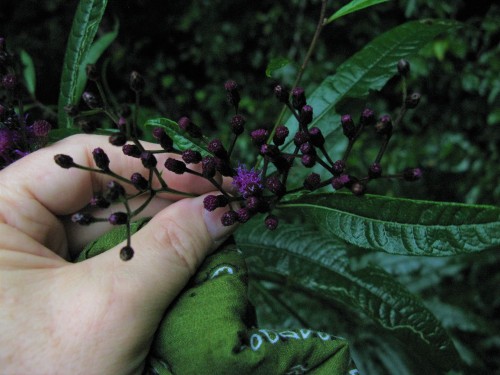
Vernonia flaccidifolia; Tennessee Iron Weed; Asteraceae

.     .     .     .     .     .     .

IMG_0880


Read Full Post »

I remember the first bird that counted. Clarification: I remember the first bird I counted.

Mom and Dad had rented a cabin so we could join them for a long weekend on Skyline Drive in the Shenandoahs, June, 1988. Did they think their grandkids were Nature undernourished? Mountain vistas, enfolding trees, night sky – we even saw a bobcat at dusk one evening. Maybe I was undernourished.

The second morning we hiked up a lonely trail in deep shade that suddenly brightened. A forest giant had fallen and invited into its space the sun and the sky. And birdsong. (Prime transitional habitat, I’ve since learned.)

Mom spotted a yellow streak come to rest on a bare branch and begin to sing. I focused. What is this?! Never had one of these on the feeder outside my dorm window, never saw one snagging worms on the front lawn. And listen to it sing! What?!

That Chestnut Sided Warbler is the first bird in my list. Well, make that lists: pocket notebooks, index cards, the backs of trail maps. And of the course the database on my hard drive, which has swelled to megabytes. But what’s the big deal? Thirty-five years old and writing down the name of a bird? What?

I wasn’t a Nature-deprived child. We played outdoors until the street lights blinked on. Caught fireflies in our hands and honey bees in jars. Raised tadpoles to peepers. Camps, beach trips, hiking, Scouts; I was out in Nature pretty much, but I count that CSW as the moment I began to notice. This is not just an unpopulated landscape, not a homogenous backdrop for picnics or games or a nice walk. These are things. Individuals. Differentiated. Species. I start by counting birds but then I notice wildflowers and take up botany, notice one side of the ridge has more blossoms and different, it’s geology, get down on my knees for the tiniest blooms and dang there’s a beetle, entomology.

Pretty soon I want to notice it all, the great grand beautiful interconnected mess, ecology, the parts and the whole. I’m becoming a Naturalist – someone who pays attention. Someone who notices.

Chestnut Sided Warbler in Virginia was my gateway drug. How much was I missing all those years before? Now I can’t help but notice. Blame the wrens that scold me every morning in the driveway. Blame my friend Mike who is always so careful to step over every millipede on the trail. Blame Amelia my granddaughter as she watches the crocuses open. And after last weekend blame Emily Stein* as my chief enabler, she and the other twenty hard core Naturalists I joined at Tremont in the Smokies for an intense course in “Skills for Sharing Nature.” As always, begin with some questions:

Where have I come from to reach this place? Why do I care? What is my personal story? What do I have to share?

The answers may arrive like spring buds that swell along the flank of the mountain seeking the summit, a lifetime of questions and answers, but now it’s time to screw up my courage and take Step 2: I’m going to get you hooked on Nature, too. Come here a minute. Try my binoculars. See that little dab of brown fluff that just flew up to that branch? Yes, that’s the one. Let’s see what he has to tell us.

.     .     .     .     .     .     .

* Emily Stein: Great Smoky Mountains Institute at Tremont naturalist educator, youth programs coordinator, and instructor for the February 2020 course “Skills for Sharing Nature,” part of the Southern Appalachian Naturalist Certification Program (SANCP). More information at www.gsmit.org

.     .     .     .     .     .     .

Prayer for the Great Family

Gratitude to Mother Earth, sailing through night and day—
and to her soil: rich, rare, and sweet
in our minds so be it

Gratitude to Plants, the sun-facing light-changing leaf
and fine root-hairs; standing still through wind
and rain; their dance is in the flowing spiral grain
in our minds so be it

Gratitude to Air, bearing the soaring Swift and the silent
Owl at dawn. Breath of our song
clear spirit breeze
in our minds so be it

Gratitude to Wild Beings, our brothers, teaching secrets,
freedoms, and ways, who share with us their milk;
self-complete, brave, and aware
in our minds so be it

Gratitude to Water: clouds, lakes, rivers, glaciers;
holding or releasing; streaming through all
our bodies salty seas
in our minds so be it

Gratitude to the Sun: blinding pulsing light through
trunks of trees, through mists, warming caves where
bears and snakes sleep—he who wakes us—
in our minds so be it

Gratitude to the Great Sky
who holds billions of stars—and goes yet beyond that—
beyond all powers, and thoughts
and yet is within us—
Grandfather Space.
The Mind is his Wife.

so be it.

Gary Snyder (after a Mohawk prayer)
from EARTH PRAYERS, edited by Elizabeth Roberts and Elias Amidon, HarperSanFrancisco, 1991

.     .     .     .     .     .     .


.     .     .     .     .     .     .

IMG_6944

Read Full Post »

« Newer Posts