Feeds:
Posts
Comments

Posts Tagged ‘family’

 . 
[with 3 poems by Gail Peck]
 . 
Prayer
 . 
Please let me see
 . 
the cow’s big eyes
the goldenrod
 . 
the coffee in my cup
turning color with cream
 . 
all that painters have made
stone sculpture in a field
 . 
family photographs
old letters
 . 
poems and stories
that funny looking bug
 . 
I can’t catch
how to read the clouds
 . 
if there’s a bee in the flower
I lean to
 . 
color of fruit
sheen of silk
 . 
what time it is
my bright painted toes
 . 
label on the wine bottle
I like to study
 . 
how full to pour my glass
word and words and words
 . 
and faces of those I love
yes   mostly those
 . 
Gail Peck
from In the Shadow of Beauty, Finishing Line Press, Georgetown KY; © 2025
 . 
❦ ❦ ❦
 . 
The question is not what you look at, but what you see.
++++++++++++++++++++++++++++++++ — Henry David Thoreau
 . 
Toward the end I took over the ritual, but when had it begun? I had never paid much attention to the cut flowers in the vase on the dining room table until I became complicit in their procurement. When Dad relinquished driving . . . correction, when we made Dad give up driving at age 96, it fell to one of us to take him to Trader Joe’s every week for flowers. Mom came along with us as long as she was physically able – was she choosing the flowers she liked or the ones Dad wanted her to choose?
 . 
When it became too much to shepherd two elders on walkers and still push a shopping cart, it became just Dad doing the choosing. Same variety every week, pink or mauve Alstroemeria, Peruvian Lily – I truly think Mom would have been equally happy with anything from TJ’s lush bank of bouquets, but these in particular held their petals longer, according to Dad. Most blooms would last until next week’s shopping, and even then Dad would order us to separate out any stems that still seemed fresh. Thrifty. A good provider. The manager in charge. My Dad. The flowers were one last affirmation of his life-long identity.
 . 
What do we see when we look at another person’s life? We are adrift in the ocean of “Why did she do that?” and “Why does he act that way?” Rocked by chop and foam, no safe or simple way to dive deep, a fathomless conversation. We observe from arm’s length how the one we love reacts, their judgements and choices, but the water is opaque; what impulse impels the rudder? Did Dad keep flowers on the table to make Mom happy, or did he do it to feel happy about being seen to be making Mom happy?
 . 
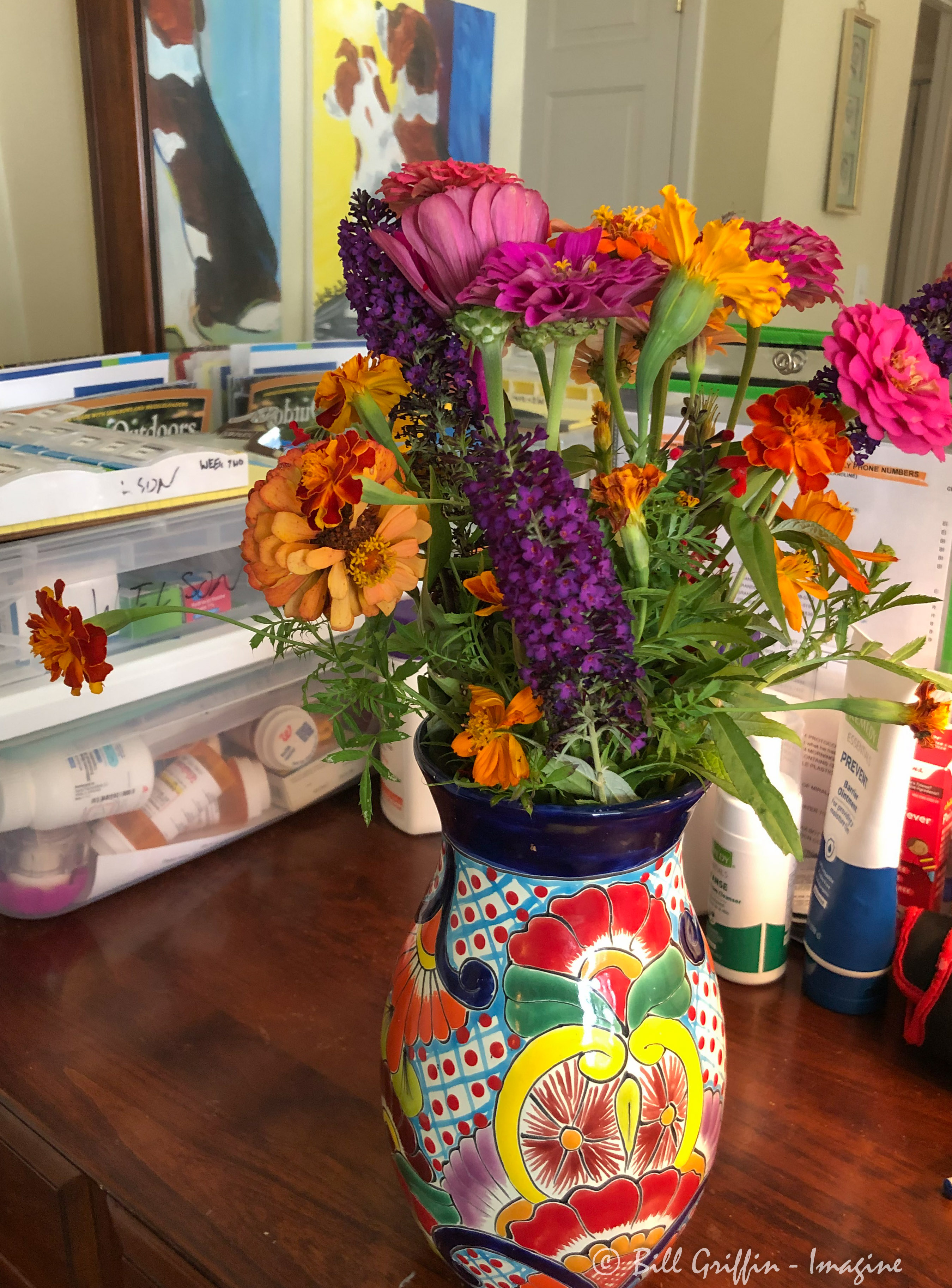
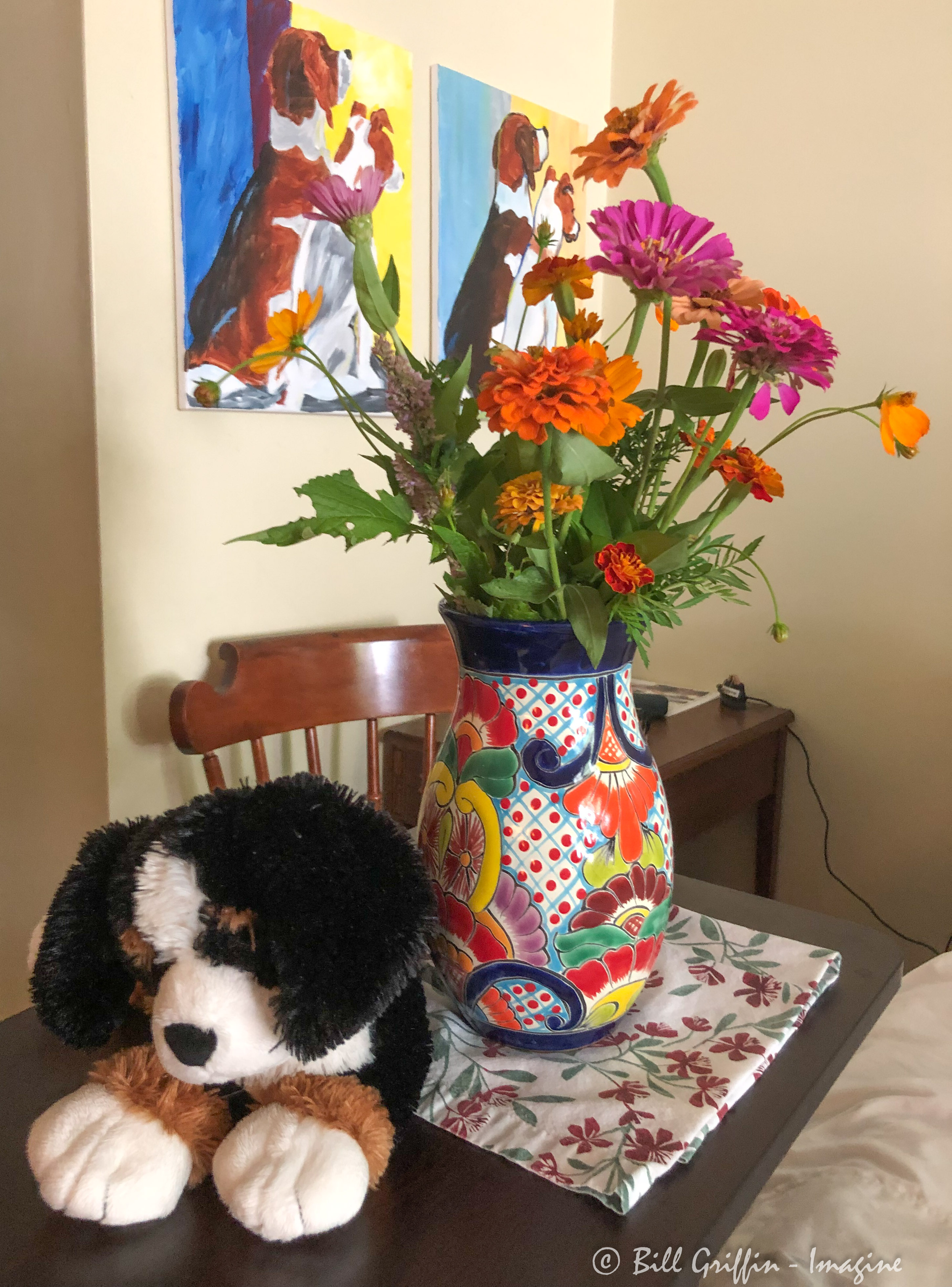
During the last months Mom lived I brought her flowers from my own gardens. First Lenten Rose (Hellebore) and Redbud branches, then Daffodils and Narcissus that kept blooming for a solid month. As the weather warmed I shared Beebalm and Anise Hyssop my son-in-law had started for me in his greenhouse, then the cavalcade of Asters, Black-Eyed Susans giving way to Marigolds and Zinnias, the first year I’d planted such. I think I brought them every week to make Mom happy, a last chance for a final gift just from me. But I think I was also incredulous that my lackadaisical gardening could produce such bounty – I was showing off.
 . 
I would place a few long stems in a fluted vase on the tiny kitchen table where Mom read the comics each morning; another small vase beside her accustomed seat on the couch; finally all vases came to rest beside her bed where she spent most of her final weeks. It never failed. She would, with effort, turn her head and spy my offering. Then she would look at me and smile.
 . 
 . 
❦ ❦ ❦
 . 
Leaving
 . 
Once you are left
you are always left
a clock ticking backwards
 . 
You tried to crawl out the window
when your father packed his suitcase
and were pulled back
You opened the door
and ran after the car until breathless
 . 
Why does the sound of a train whistle
not make you sad when one
took your mother away for months
 . 
Perhaps because your grandmother
played The Lonesome Railroad Blues
on her harmonica and the dog danced
 . 
The calendar nailed to the wall
turned one month over another
until winter was gone
 . 
Daffodils bloomed    the dogwood
reopened Christ’s wounds
 . 
Curious girl who gathered flowers
from fields and pulled petals
from daisies – he loves me, he . . .
 . 
Gail Peck
from In the Shadow of Beauty, Finishing Line Press, Georgetown KY; © 2025
 . 
❦ ❦ ❦
 . 
Your family, like mine, has stories you break out at every gathering, dust off, polish up, and share good as new. I’m sure Dad is glad we finally quit telling the one about him breaking a full bottle of ketchup at the diner in Parkersburg, West Virginia when we were teenagers. Then again there are probably any number of stories that deserve more retellings than they get. Stories make us a family. What will happen to the stories that no one keeps alive?
 . 
Gail Peck’s In the Shadow of Beauty tells stories that make a family. The stories are cut flowers and lace, and they are rancid wounds and meanness. The people we want to love can hurt us the most. The people we want to hold onto forever will all leave us in time. We seek meaning by revisiting and reliving the turning points as well as the ho-hum trivial passages that have somehow hooked themselves into our memory. For most people, we will never truly grasp their intent or purpose, but when we’re brave enough to re-experience how they have affected us, we might discover our own purpose.
 . 
Gail often uses photographs of her family, which capture a single moment without judgement or commentary, to rekindle events to which she then applies the art of poetic commentary and judgement. This book is their lives as well as hers. At one point Gail admits she does not know where the ashes of her sister are scattered but she still wants hers to mingle with them. She reveals her bonds with her mother as a many-faceted jewel, some faces bright crystal but others tarnished. And Gail inspires me to keep visiting, keep remembering, keep looking and never be satisfied that I have seen all there is to see in my own stories and my family’s. As she confesses in Arranging Flowers:
I can’t cut a flower without thinking of her,
and I may go again to place some
on her grave, but I’ll have no desire
to continue. Once you sever the stems
you know to make the most of it,
and isn’t that why we love them,
their beauty, the petals that will fall.
 . 
 . 
In the Shadow of Beauty, poems by Gail Peck, is available from Finishing Line Press HERE
Enjoy poems from an earlier book by Gail Peck, The Braided Light, at last week’s issue of VERSE & IMAGE
 . 
 . 
❦ ❦ ❦
 . 
Past Tense
 . 
How quickly it passes
from is to was
 . 
from has to had –
as quick as a bird
 . 
flies from a windowsill –
you hear its song
 . 
but no longer see it.
They’d slit her gown
 . 
up the back
to spread beneath her.
 . 
Small, embroidered roses
at the top with beads
 . 
in each center.
The eyes don’t totally close
 . 
near the end
and once the hands cooled
 . 
we knew
and I know almost no Bible verses
 . 
but it came to me
when they removed the body
And the peace of God, which surpasses
all understanding
 . 
for she was a godly woman,
my mother.
 . 
Dress her in pink
with the white lace blouse
 . 
for she loved white –
white of the lily, white of the clouds.
 . 
Gail Peck
from In the Shadow of Beauty, Finishing Line Press, Georgetown KY; © 2025
 . 
❦ ❦ ❦
 . 
 . 
❦ ❦ ❦
 . 
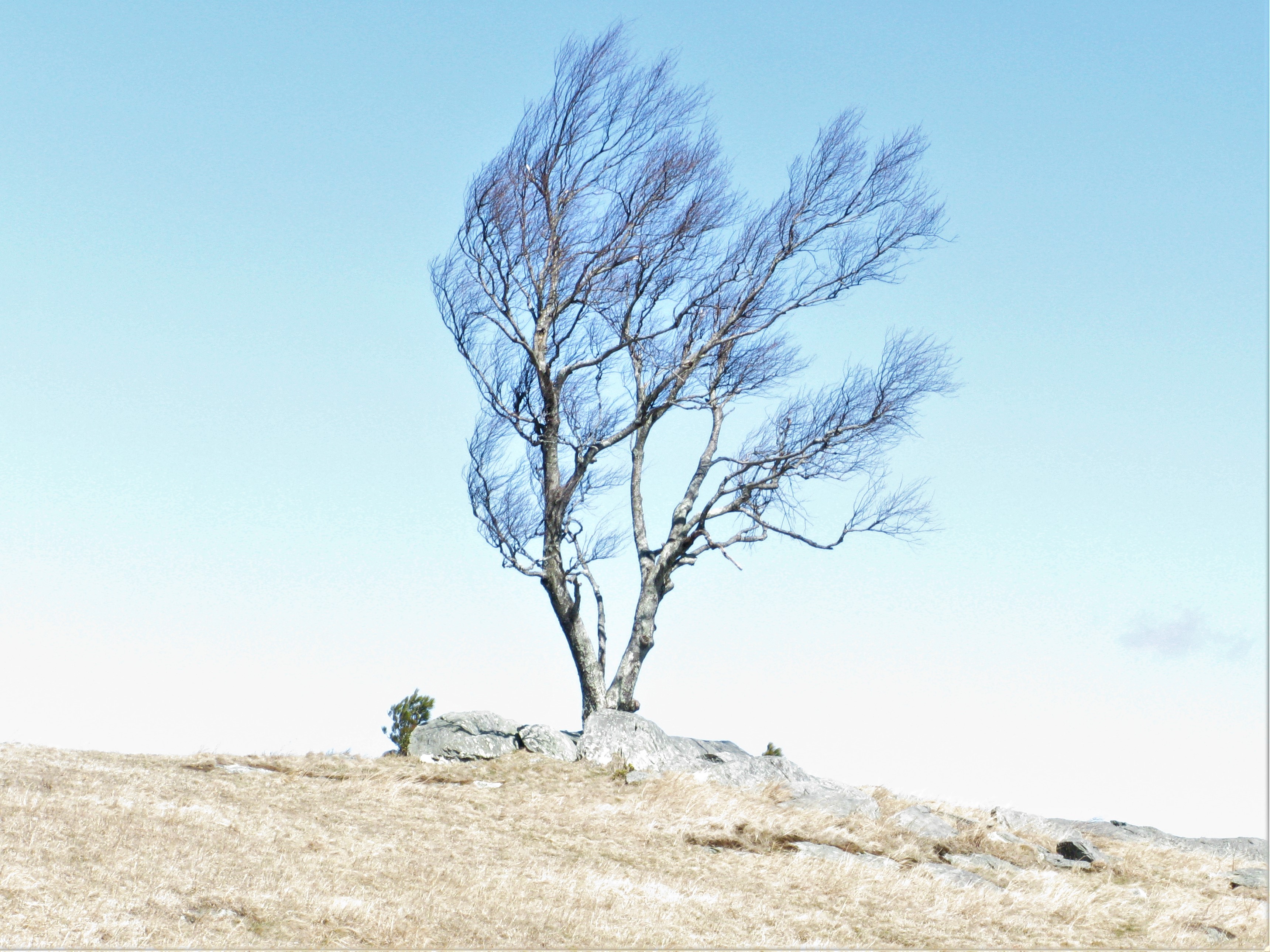
Doughton Park Tree 2020-03-07

Read Full Post »

 . 
[with 3 poems by Cheryl Wilder]
 . 
Anything That Happens
 . 
Until I was twenty, I believed anything
wouldn’t happen to me.
 . 
Walking from the car,
leaving you behind,
 . 
sirens whining louder as they closed on us;
I didn’t understand anything
 . 
had just happened.
People said it wasn’t my fault
 . 
and for reassurance,
It could have been me. But
 . 
I heard what they didn’t say.
I’m so glad it wasn’t.
 . 
Cheryl Wilder
from Anything That Happens, Press 53, Winston-Salem NC; © 2021.
 . 
❦ ❦ ❦
 . 
It’s 1990 and my kids are cruising toward teenagerdom. Every week in the throw-away medical journals that cross my desk there’s at least one article with a title like We Never Even Suspected, or Why Me? The doctor or doctor’s spouse laments about their teen who is (pick one): flunking out of college; a closet alcoholic; pregnant out of wedlock; addicted to Percocet. That becomes the one article I am compelled to read before assigning the journal to the round file. It’s a solid principal of statistics: if it happened to them it’s that much less likely to happen to me.
 . 
Because today in 1990 my kids are, well, not perfect but above average. They are so good. And I am so good. Whatever that other doctor did to cause his child to go wrong, I would never do that. Because somehow at this interchange along the cosmic highway I am totally in charge of (and totally to blame for) all the choices my kids are making and will make.
 . 
And responsible, of course, for all the rest, now and forever after. Are my parents happy? Is my wife fulfilled? Are my grandkids smart? Is there crabgrass in the flower bed? (Well, maybe I am responsible for that one.) Don’t worry, I am not poised here to write an article titled Everything That Would Have Been Better if I Were Better. That’s between me and 4 AM.
 . 
Instead, I’m attempting a more compelling practice. A practice without textbooks or certification exams. One that requires nothing but offers everything. A practice never free from pain but sometimes tinged with joy. All that this practice endeavors is to prod a slight change in phraseology, poke a minor shift in frame of reference. When I learn of your misfortune, when you tell me about your pain, when I recognize that you are suffering, I will try my best not to say to myself I’m glad that isn’t me, and instead I will say, That is me.
 . 
 . 
❦ ❦ ❦
 . 
Xing
 . 
I don’t know how I brought a child
into the world when I can’t reconcile
 . 
if crashing a car and a friend’s skull
is karmic debt created
 . 
or payment for a past immoral act.
I open doors and say thank you and do not try
 . 
to behave in a way I cannot afford.
There’s no barometer, no way to know
 . 
if the pendulum is swinging
away or toward, how many pay-it-forwards it takes
 . 
before I break even at the gambling table.
I cold blend in with the pure
 . 
if it weren’t for the scars that don’t fade
no matter how many turtles I save,
 . 
so am I all that surprised
when my little boy tells me
 . 
of his palpable fear
to cross the street.
 . 
Cheryl Wilder
from Anything That Happens, Press 53, Winston-Salem NC; © 2021.
 . 
❦ ❦ ❦
 . 
Sostenuto – a musical notation indicating a passage sustained to the utmost. Unrelenting. Imagine a violin’s piercing note, almost impossibly high and rising, horsehair glissando across the E-string. Now it’s joined in harmony by the A-string, discordant, the two dancing and warring with each other. They weave pitch and volume but never rest, sostenuto. You lean forward on the edge of your hard seat, your teeth are on edge, you want, you need, you crave desperately some resolution.
 . 
Cheryl Wilder sustains tension throughout sixty-four pages to the ultimate climax of Anything That Happens. Her story is too piercing: one tastes blood and tears. She lives every moment with that high, sharp note, days and years of guilt and pain – she has irretrievably damaged her friend – and then also weaves discordant disharmonies from her cold relationship with her mother and her non-relationship with her father. More than once I had to lay the book aside and breathe deeply to slow my pounding heart.
 . 
And more than once I resisted the urge to flip pages to the end. Who doesn’t crave resolution? What follows in this post today is the book’s penultimate poem. Some hurt can never be removed. No one can return to the moment before anything happens. Scars are just that, permanent marks and reminders of pain. How do any of us go on living? How? I invite you to enter the music of this book, its atonality and discord, one poem after another, until you reach its final page.
 . 
 . 
Anything That Happens by Cheryl Wilder is a Tom Lombardo Poetry Selection and is available at Press 53. Among other awards, the book was a finalist for the 2022 Brockman-Campbell Award of the North Carolina Poetry Society; read an additional poem from the collection and celebrate 90 years of NCPS HERE.
 . 
 . 
❦ ❦ ❦
 . 
Home Safe
 . 
Friends visit the hospital
where I am not wanted. It’s just as well
 . 
that I stay in bed, carve poplar
into a shield I can place between
 . 
myself and others, learn you wake
from a coma by the drop
 . 
of my manslaughter charge. Years pass
before I hear your voice again,
 . 
asking me to lunch over the phone, your mother
telling me I am only allowed in her home
 . 
because you found my number
on your own. You reach for my arm
 . 
to steady your walk, lean close
to see me in focus, your smile wide
 . 
on one side of your face, brightened even more
at the restaurant when you flirt with the waiter.
 . 
That is enough, to see a glimpse of the friend
I once knew, but then you reach cross the table
 . 
for my hands, look at me to say
what you defied your mother to say,
 . 
It’s not your fault. Over and again,
I forgive you. You can’t remember
 . 
the night I cannot forget, but you know
your words are my salvation.
 . 
There is no talk of next time.
You get out of the car and walk
 . 
into the house, back to your mother
who can breathe once again.
 . 
Cheryl Wilder
from Anything That Happens, Press 53, Winston-Salem NC; © 2021.
 . 
❦ ❦ ❦
 . 
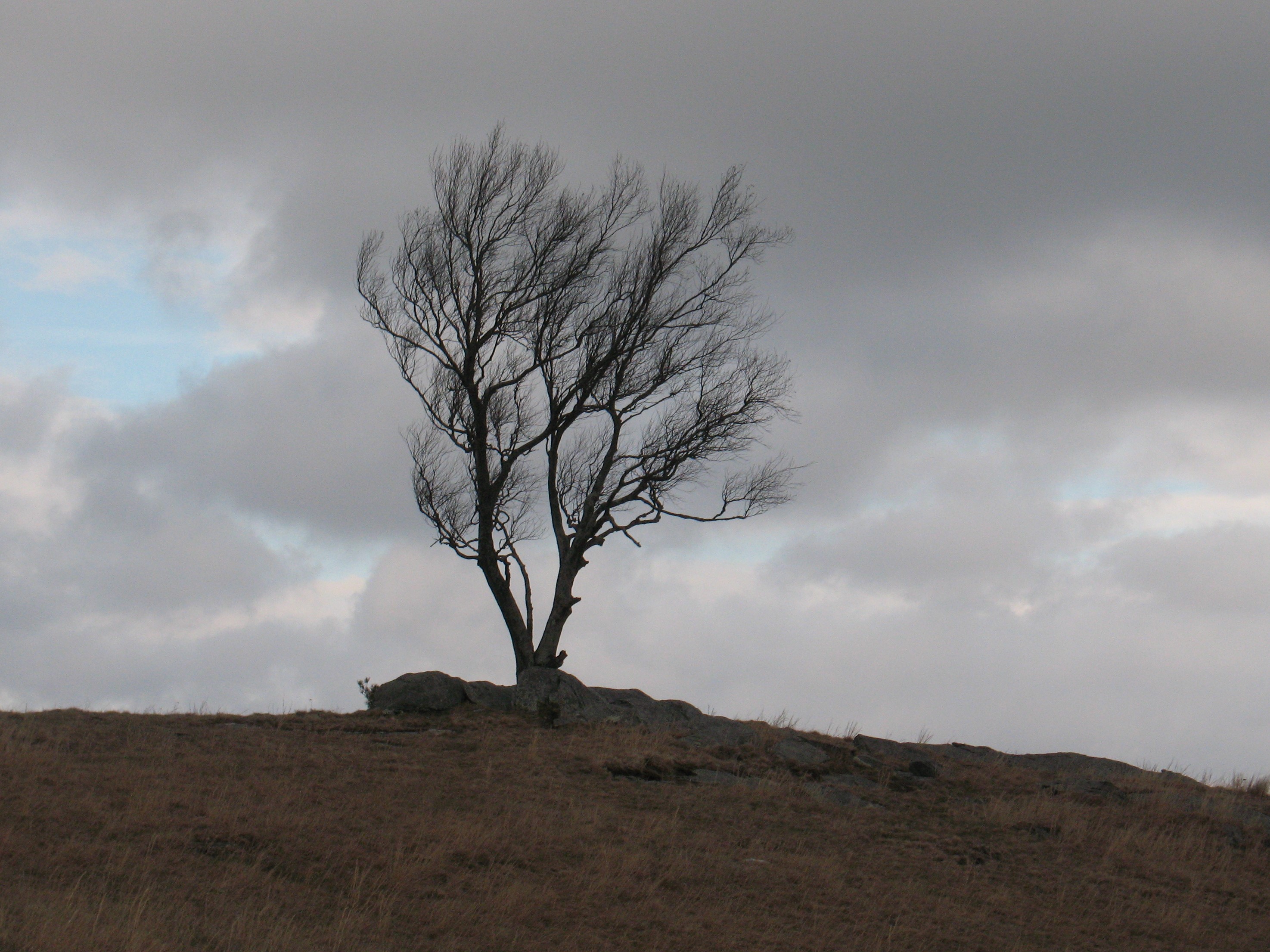
Doughton Park Tree 2017-03-06a
 . 

Read Full Post »

 . 
[with 3 poems by Terri Kirby Erickson]
 . 
In the Midst of Grief, a Heron
 . 
Healing begins with the blue heron hunting
in the frigid water of a shallow pond.
 . 
Wings folded, neck tucked into its feathered
breast, it stands motionless in a shelter
 . 
made of branches, alone save for its shadow.
What would it hurt to loosen our grip
 . 
on grief? To allow the soft gray-blue
of a heron’s body to soothe our eyes, tired
 . 
of shedding tears? This day will never come
again and the heron will soon fly. Already,
 . 
the light is fading, taking with it all the time
that has ever passed. Let this peace soak
 . 
into our skin like medicine, remain with us
long after the heron is gone.
 . 
Terri Kirby Erickson
from Night Talks, New & Selected Poems, Press 53, Winston-Salem NC; © 2023
 . 
❦ ❦ ❦
 . 
Mike and Johnny Slattery would have been there, from three doors down on Marcia Road. My little brother Bobby, of course. I can picture the house right now as if standing there, the shape of our living room in that L-shaped ranch in the square-grid new-built neighborhood in Memphis. There’s the door that leads into Mom’s kitchen, to the right the little hallway to the front door, outside another ten steps to the carport and driveway where we played marbles or rode our bikes down to the street. Beside me is the corner cupboard Nana gave us, before me the cherry table Dad broke last year when he fell.
 . 
Most everything else from my nine-year old birthday party has faded. How many other boys Mom invited and gathered in from the homes around, what kind of cake, the candles and singing – all now clouded and indistinct.
 . 
One moment, though, remains untarnished. It’s been polished these sixty years hence by recollection and reflection. Mom thought to include one boy the rest of us didn’t play with very often. Maybe there was something a little different about him. To this day I can’t tell you his name. As the other boys present their gifts, brightly wrapped in colorful paper, he gives me a big smile and hands me his – a lump of crumpled tin foil. I peel it apart. Inside are six quarters.
 . 
I don’t remember any of the other presents I received that day. Why has this one stuck with me? I can testify I was surely no less selfish and self-absorbed than any other nine-year old, but with some vague child’s awareness I realized in that moment the boy was giving me all he had. Maybe he didn’t have a mom with time to go to the store or wrap a present. Maybe he’d never been invited to a birthday party. Today, writing these lines, I still feel a strange heaviness when I think about his gesture, a forlorn sadness but also a rich touch of awe and gratitude.
 . 
That smile – he was so happy to hand me that gift. From him to me. Thank you, thank you, little boy.
 . 
 . 
❦ ❦ ❦
 . 
The Letter
 . 
Northing is ordinary – not condensation on a pane
of glass – that streak of sunlight, yellow
as lemons, in the neighbor’s backyard. Trees
 . 
are rustling tender new leaves, and our lawn
is as thick as a wool rug. Even the scent of coffee
 . 
wafting from the kitchen is a miracle,
a woman walking her little dog down the sidewalk,
its leash as taught as rigging. Yet, every house
 . 
hides something that hurts, even as we call to one
another, good morning, good morning
 . 
our faces open as a letter lying on a table, the kind
that makes our hands shake when we find it
in the mailbox, that we only read once.
 . 
Terri Kirby Erickson
from Night Talks, New & Selected Poems, Press 53, Winston-Salem NC; © 2023
 . 
❦ ❦ ❦
 . 
We can be generous giving money and things, and this week in the USA we generously give thanks, but where else does generosity slip in? Generous with advice, oh my yes aren’t we all, and woe to those who don’t take it. Generous with encouragement and acceptance, and who gets to decide what’s worthy of encouragement and what acceptable? Apparently it’s actually quite easy to be giving without being generous at all. We’ve had to make a rule at our house to keep the after-school peace: Pappy doesn’t try to eat Amelia’s snacks. Last week, though, Amelia had a sweet she really wanted to finish herself but offered me a bite. Generosity – it doesn’t have much to do with deserving or keeping score; it has more to do with making sacrifices and sharing the joy.
 . 
I think of myself as a reasonably generous person, and then I read Terri Kirby Erickson’s poetry. These people, these moments remembered and shared, these talks over breakfast or long into the night that leave each speaker that much richer, these also leave me richer, fuller, more human. In Night Talks, Terri presents about sixty new poems along with grateful selections from her six previous books, combined and swirled like the best layer cake you ever set fork to, perfect for morning on the porch with coffee or with evening lamplight leaning back into the sofa.
 . 
After returning to this book over and over, I can finally name the spirit that suffuses Terri’s work and that warms the reader – generosity. There is harm and hazard in Terri’s writer’s life, there is grief and loss and no denying them. These poems look into the darkness and discover light, even if only the pinpricks of stars overhead. These poems never overlook a radiant dawn – they always expect it. And it doesn’t hurt a bit that Terri is the impresario of image, the titan of the turn of phrase: summer wants [to] / hitch a ride on the back of a broad-winged hawk / to places where the stars feel like chips of ice / sliding down September’s throat.
 . 
How does her poetry restore and replenish its deeply generous spirit on every new page? Try on this bit of spiritual etymology: From gratitude comes generosity; from generosity comes giving. With recollection and reflection, let me polish up my gratitude. Let’s see where it take me.
 . 
 . 
❦ ❦ ❦
 . 
Moon Walk
++++ for my brother
 . 
Sunburned, bellies full of fried pompano, sweet
corn, and garden tomatoes purchased at a roadside
stand manned by a farmer with more fingers than
teeth—my family huddled around a rented black
and white TV set the shape and size of a two-slot
toaster, watching Neil Armstrong and Buzz Aldrin
hop like bunnies on the rough surface of the same
waxing moon that shone through our beach cottage
windows. I was eleven years old, bucktoothed and
long-legged—my brother a year younger and, most
days, followed his big sister like Mercury orbiting
the sun. Mom and Dad sat side by side on the faux
leather, sand-dusted couch, and Grandma, never one
to hold still for long, stood by her grandson’s hard-
backed chair, her hair a nimbus of silver from the soft
glow of a television screen where a miracle unfolded
before our eyes. But grown men wearing fishbowls
on their heads, bouncing from one crater to the next,
seemed less real to my brother and me than Saturday
morning cartoons. And all the while, we could hear
waves slapping the surf and wind whipping across
the dunes—and the taste on every tongue was salt
and more salt. So when I picture the summer of ’69
at Long Beach, North Carolina, as history rolled out
the red carpet leading to a future none of us could
foresee, my heart breaks like an egg against the rim
of what comes next. But let’s pretend for the length
of this poem, that my brother’s blood remains safe
inside his veins, Grandma’s darkening mole as benign
as a monastery full of monks, and our parents, unable
to imagine the depth and breadth of grief. Here, there
is only goodness and mercy, the light of a million stars,
and the moon close enough now for anyone to touch.
 . 
Terri Kirby Erickson
from Night Talks, New & Selected Poems, Press 53, Winston-Salem NC; © 2023
 . 
 . 
Night Talks, New & Selected Poems, by Terri Kirby Erickson, is available at Press 53 in Winston-Salem NC along with five other collections by Terri.
 . 
❦ ❦ ❦
 . 
 . 
❦ ❦ ❦

Read Full Post »

« Newer Posts - Older Posts »