Feeds:
Posts
Comments

Posts Tagged ‘family’

 . 
[with 3 poems by Joan Barasovska]
 . 
The Box
 . 
They are quiet in their photographs,
my mother’s dead.
 . 
They speak to me, entreat me to explain.
 . 
A magnifying glass held to their fading faces
proves scant help.
 . 
To listen, I must listen to myself,
to memory.
 . 
Joan Barasovska
from Unblessed, Unsung, Main Street Rag Enterprises, Edinboro PA; © 2025
 . 
❦ ❦ ❦
 . 
To speak with the dead, one must listen to oneself.
 . 
Before my mother died we talked about dying. Her dying. When I helped her fill out the living will forms. Before the first visit from the palliative care nurse. As her health took yet another sudden stepwise decline. I asked her, not at all for the first time, “Do you want to go to the doctor? To the hospital?” “No. No.” And then we didn’t talk about it any more.
 . 
Instead we talked with the dead. Some people approaching the end of their life close themselves off. They draw the veil about their diminishment and turn inward. My mother, though, turned outward, like a great flower that slowly pivots throughout the day to face the sun. Like one of those giant radio telescopes that can hear the earliest whispers of creation, she became a passive receptor who welcomed anything anyone desired to bring her. I brought her the dead.
 . 
Photographs of the dead. Some were in antique frames, some dropping from ancient scrapbooks, most of them loose in envelopes or the bottom of cartons. She and I collected them all into a grand new album and along the way we told each other stories. “Isn’t that Lucy and Ted just married? Linda and I met them at Nana’s reunion 50 years ago. And there’s you with Lucy, both teenagers. Now here’s Carlyle in the little car Grandpop built for him. I guess it was already obvious he’d be crazy for cars the rest of his life.”
 . 
Some stories she told me; some I imagined while she fingered the photos and nodded in silence. At the moment of shutterclick, each photo was created within its world of vast significance. Those worlds dissipate, decrescendo in brilliance like photons that have traveled light-years to reach our eyes, red-shifted with distance in an expanding universe. But during those moments together my mother could enter their world and hear them, the dead, their voices.
 . 
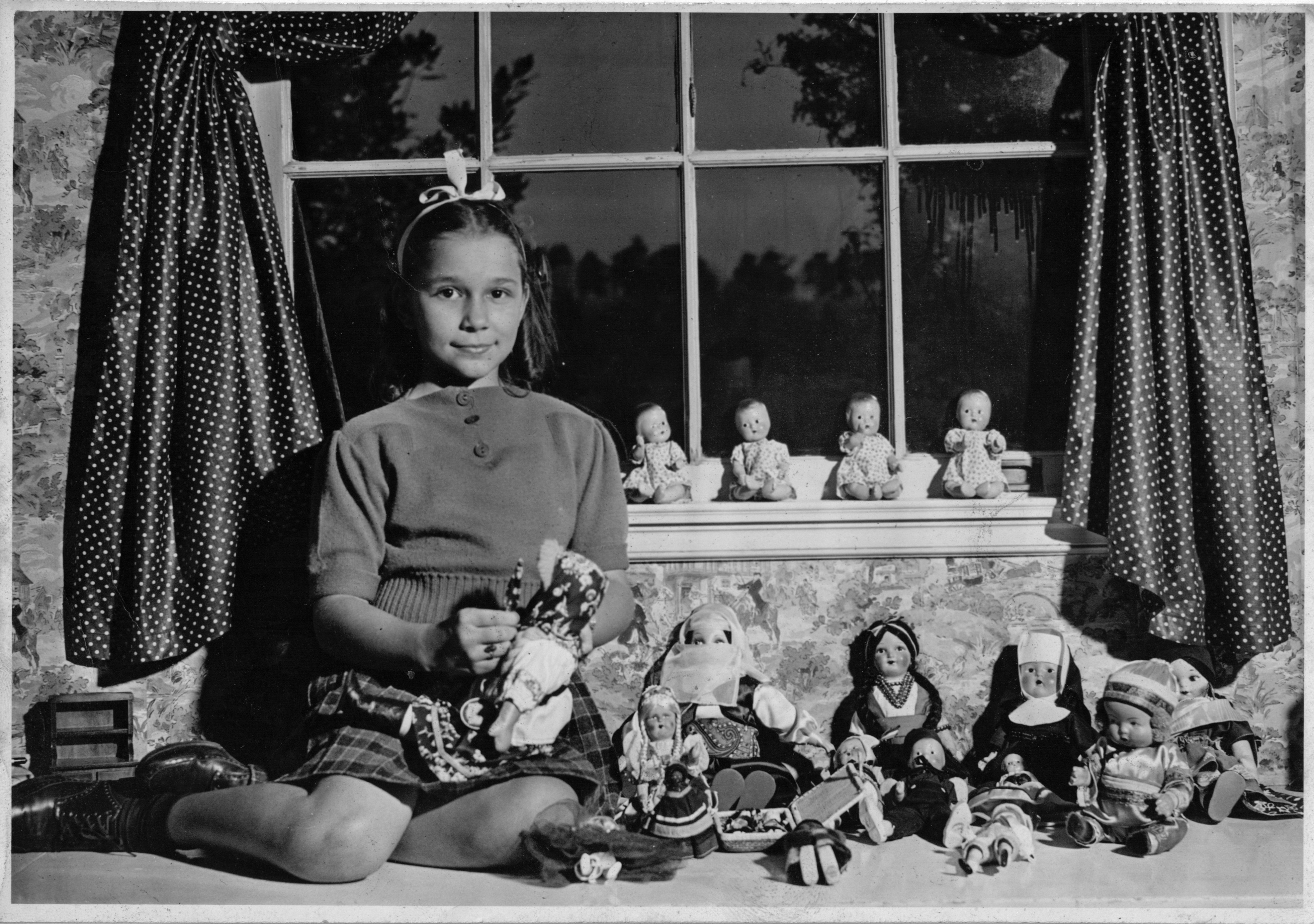
Next month it will have been a year since my mother exhaled her last breath. Her living essence has joined the whispers of the cosmos. Her essence still lives in me and all who knew her and who have not yet joined the dead. Yesterday I found a photo Grandpop took of Mom at age 10 surrounded by her wonderful collection of dolls. There it is, that hint of a smile on her lips, in her eyes, the joyful teasing hint I have seen in person a million times. But looking at that photo is not when I miss her most. The pang of absence strikes me most sharply when a random question pops into my head: “Did you have boy friends before Dad? What was it like to be living 500 miles from Nana and Grandpop when I was born? Who is that standing behind you in this photo?”
 . 
Some of the questions I may once have asked but don’t recall her answers. Most are questions it never occurred to me to ask while we were together on the earth. Now when I pull that grand album off the shelf, her picture will also be among those gone mute. But not completely so. Memory tangles and untangles itself to create new stories. I will listen to my heart. I am now the one who must speak with the dead.
 . 
 . 
❦ ❦ ❦
 . 
In Shul on Rosh Hashonah
 . 
Elizabeth is home with the baby; Ben sits beside his sons
on the hard bench. All three wear yarmulkes, Ben is draped
in his tallis – Reuben and Joseph are too young. The black
straps of tefillin tightly encircle his left hand and arm;
the boxes press into his forehead and bicep.
 . 
The drone of men praying, the vibrato of the old rebbe raised
above their voices, the distant murmur and rustle of women
and girls in the balcony above, and Ben’s own chanted Hebrew,
eyes closed, davening deeply – all are as necessary and familiar
as his heart’s beats and his quiet breaths.
 . 
His boys can barely wait for the blowing of the shofar,
the twisted, ridged ram’s horn the see near the ark.
Ben hears Joe whisper to Rube, “When?” and Rube’s loud
“Shush!” Ben is clean-shaven, unlike the older men. He goes
daily to Boris Adelman, the barber on 21st Street, who keeps
a chin mug painted with his name, Benjamin Nax, on a shelf.
His disc of soap, his ivory brush. Boris strops the razor on a
lng leather strap It’s sinful to let his mind wander like this
on a Day of Awe. He gives thanks for his children: Rube,
a little man; Joseph, their angel. now Elsie.
 . 
He was once a boy sitting with is father and grandfathers
in shul. His chest hollows around their absence. They could easily
be dead, and his uncles and mother, lined up to be shot on the
edge of a ditch. No wisdom from grandfathers for his boys.
 . 
The cantor raised the shofar to his lips and fills his lungs.
Joe has fallen asleep leaning against him, and starts awake at the
first blast. Intervals of blast and chant: Tekia! Sevarim! T’ruah!
Renew our days! Mercy is aroused! Judgement is removed!
Reverberating in the small chilly building, this uncanny sound
of the desert, the First Temple, the shtetl, and the ninety-nine
synagogues of Minsk.
 . 
Ben takes his boys’ hands, and the three are surrounded
on the sidewalk by greetings: L’shonah tovah! Gut yontif!
A gut gebentsht yor! It isn’t his name, Benjamin Nax.
It was changed at Ellis Island, from Binyomin Nakhimovsky.
What is there to believe, in America?
 . 
Joan Barasovska
from Unblessed, Unsung, Main Street Rag Enterprises, Edinboro PA; © 2025
 . 
❦ ❦ ❦
 .  .  .  .  . 
Love flares in the sleeper’s dream,
blue as a Sabbath candle flame, warm as
the kitchen of her grandmother’s house.
from Elizabeth’s Travels
 . 
Her story begins in cruelty concealed and unspoken. It wends its way through hardship and regret, between guilt and resentment. It ends as it started, in death. But that is not all. That is only one harsh thread of the story. The story feeds itself with family love and devotion. It clings to hope in darkness. The story opens its pages because of the expansive heart of the one who desires to be its guardian, its intrepid explorer, its teller. Thus the journey of Unblessed, Unsung by Joan Barasovska.
 . 
There is a bit of mountain trail that winds across a mile or two of bald slopes at Bluff Ridge along the Blue Ridge Parkway. If the summer grass has grown waist high and the cows have not been pastured there this season, the trail is obscured, untraceable except for this: in the 1930’s, the Civilian Conservation Corps placed concrete markers, posts two feet tall, to guide the hiker along the path. Joan has found her own waypoints to reveal her own path into her past: a few fading sepia photographs; recollections written down by cousins; conversations with a last survivor. To these she has applied the poet’s toolkit, observation and imagination, to render this book and bring it to life.
 . 
Some of the questions Joan must ask about her grandparents have discernable answers. Where did they grow up? What year did they arrive in America? But many answers are as intangible as smoke from an extinguished candle and as difficult to clasp. Joan uses what clues she can amass – a facial expression in an old photo; a fragment of tale from a distant cousin – to build an enlarging picture. If we don’t always know exactly how this man and that woman felt, at least we know that they did feel and we can hope to project their circumstances into our own dilemmas and responses. Considering another person’s memories is a fruitful impetus to reliving our own memories. At the beginning of Unblessed, Unsung Joan quotes Zora Neale Hurston: There is no agony like bearing an untold story inside you. Here is a story borne and bared. May these poems now weave and tangle more stories, a never-completed tapestry.
 . 
 . 
Joan Barasovska lives in Orange County, North Carolina, USA, and has authored three previous poetry collections. Unblessed, Unsung is available from MAIN STREET RAG.
 . 
 . 
❦ ❦ ❦
 . 
Listen
 . 
If I told you I hear their voices
in the apartment on Christian Street,
would you visit there with me?
 . 
At the table where they take their meals,
or by the stove, where Elizabeth stands,
adding potatoes to stretch a soup?
 . 
Between husband and wife,
what heat, what chill, what
balance of force and yield?
 . 
The rooms are scrubbed raw-clean,
it’s crowded, voices are raised,
the three children witness everything.
 . 
It’s a time before parents learned
to safeguard childhood. If I told you I hear
cruelty, in word if not in deed, trust me.
 . 
Joan Barasovska
from Unblessed, Unsung, Main Street Rag Enterprises, Edinboro PA; © 2025
 . 
❦ ❦ ❦
 . 
 . 
 . 

Read Full Post »

 . 
[with 3 poems by Michael Dechane]
 . 
Something So Obvious
 . 
In the hardest days
with their outstretched nights,
whatever is beautiful
in the world recedes.
Light leaches from everything
we see, then. We can’t touch
ordinary goodnesses we might have
let buoy us. All of it fails. Sometimes,
we have to begin again
with something so obvious
and tired as the sunrise.
The wind in long grass.
The light holding back
our eyes from what is under
the surface of the water.
Then, the same light giving
a wrinkled glimpse of stones,
silt, and dark fronds waving
when we shift our stance
half a pace, or even turn
the angle of our face.
Some belief that goodness keeps,
that it might come back one day –
what could that mean today
when there is only the sun
returning in a flat peach wash,
the burning usher of another
Tuesday, coming in with the clanks
and grinding sounds of the city
shaking itself off, reanimating?
A waking we might observe
in colors we may discern
as all the life we lost burns out
of sight, beyond us now, as memory.
 . 
Michael Dechane
from The Long Invisible, Wildhouse Poetry, an imprint of Wildhouse Publishing. © 2024
 . 
❦ ❦ ❦
 . 
If nothing else will happen
to witness so much alive
may be enough. . . .
from New Year’s Day
 . 
How much joy would it take to counterbalance the suffering of your normal lifespan? How would you quantify it, inchoate summation of glad moments over time divided by accrued heartache, grief, shame? What calculus might determine that life is worth living?
 . 
Last week in California a 26-year old man blew up a fertility clinic and himself. In an online manifest he described himself as “pro-mortalist.” Life is not worth living – bringing new life into the world is a crime. He is an extreme example of adherents of radical utilitarian philosophy. To achieve “the greatest good for the greatest number,” when society burns in chaos and personal joy is not to be found, when “good” is a rare and even unattainable commodity, the calculus of this logic dictates that numbers must be slashed. Decimated.
 . 
How much joy would it take? This morning I lean against the kitchen counter while my son stirs a pot on the stove. He is making his special stone-ground grits, with butter and cream, to take to Granddaddy in the nursing home. We talk about Granddaddy and my son’s reluctance to visit him, to open up to him. We talk about food and the kids and what remarkables we’ve each seen in the woods lately. For half an hour we are simply present for each other.
 . 
How much joy? My son is cooking in my kitchen because he now lives here with me. His marriage of twenty-three years has dissolved. Who can fathom the grief and shame he feels? My grief is bottomless. What can balance such an emptiness? Tonight my son’s daughter will visit to flip cartwheels in our front yard and help my son at the grill. She will pretend to be the maitre d’hotel while she sets the table on the porch and takes our orders. We will eat together. Soon he will drive her home and read Harry Potter before she falls asleep.
 . 
Why must there be any calculus at all? Throw it out. This moment is enough.
 . 
 . 
❦ ❦ ❦
 . 
Meditation on the Heart
 . 
And then, one day, you see
the copper teakettle on the stove
settled on its iron throne, precisely
in its place in the kitchen landscape.
Where, all these years, it has been
let’s not say faithfully. Not exactly.
But in its home, hallowed within
a scene so familiar it seems known.
The faint blue streaks of verdigris,
even the dullness of the handle,
become beautiful in this long-arriving
moment of recognition. Beneath
its dinge in the pockets of its dents glows
an undiminished gleam. Every morning
it has been lifted, filled, and carried.
Each day, it pours,. But you so rarely
touch it between its burning hours. Now
it is you that is filled as you long
for what you cannot see or say but sing.
 . 
Michael Dechane
from The Long Invisible, Wildhouse Poetry, an imprint of Wildhouse Publishing. © 2024
 . 
❦ ❦ ❦
 . 
At first the poems of The Long Invisible overpower me with sadness. I have to stop after each page and inventory my own life. I grieve for the inhabitants of these lines. I recall a poem by David Manning – Where does the fire go / when it goes out? Do our mistakes extinguish all the good we’ve ever done? Or that we’ve experienced?
 . 
I am rubbish at meditation. As soon as I try to sit in the moment all my failures and painful moments of the past jostle in beside me. Better to read a book of poems like Michael’s. Every moment is true. Pain and epiphany commingle. Here comes a bear, and wild flora, pelicans, all the things we love together. And love itself proves it is no stranger. Here it flares, even when we thought it had gone out.
 . 
We may be rubbish at love, but love is good at us. It doesn’t weigh the balance or work the calculus to some final solution. We only have to give love such a small piece of ourselves. Like poets do. Like this poet does, whose book in what it reveals and what it shares gives us not just a bit of himself but a bit of each one of us as well. Which must certainly be the greatest gift of all.
 . 
 . 
The Long Invisible by Michael Dechane is available from Wildhouse Poetry.
 . 
 . 
❦ ❦ ❦
 . 
What I’ve Come to Love
 . 
The texture of finely grated ginger.
 . 
Fernet’s herbal alchemy,
its tincture when I close the day.
 . 
All the surprising variegations in a cloud.
 . 
And seven black cows my neighbor keeps.
 . 
Some modest disappointments –
the kind that help me
know I’ve asked too much
and not enough.
 . 
Those parts of myself I kept
locked up on a kind of death row.
 . 
A list that needs
to interrupt me into attentiveness.
 . 
How this, a poem,
can move me beyond
what I knew, then further,
past what I can imagine.
 . 
I’ve come to love portals
into universes that do not exist
until we say they do.
 . 
Whoever you are, I love
your power. I hope it gives life
and sustains goodness for you, and everyone
connected to you: every one of us.
 . 
I know that I’ve come to love
may not love me back
yet. May I keep on loving
then. Keep practicing on stones,
long grass in the grips of a wind,
water, every way that it might be.
 . 
What a help that will be to me
as I turn, at last, to you.
The one I could not know
I was meant and made to love.
I am a stranger, a faceless other,
but you have invited me in.
You give me this time with you.
Forgive me for not believing sooner
in the gift of generosity,
in the hospitable spirit you have
harbored within, all these years, for us.
 . 
Michael Dechane
from The Long Invisible, Wildhouse Poetry, an imprint of Wildhouse Publishing. © 2024
 . 
❦ ❦ ❦
 . 
Doughton Park Tree 2014-07-13
 . 

Read Full Post »

  . 
[5 poems by winners of NC Poetry Society student contests]
  . 
Fear
  . 
There I stood upon the water
Looking out to foreign lands
Separated by the oceans
I take a breath and clench my hands
I take a step and close my eyes
And jump across to the other side
I land in all the sandy rubble
And I looked back and saw a puddle!
  . 
Juliet Geracitano
5th grade, Audrey W. Garrett Elementary School, Mebane, NC
Third Place, Travis Tuck Jordan Award of NC Poetry Society
  . 
  . 
❦ ❦ ❦
  . 
It is impossible to convey the enthusiasm and joy that radiates from these students as they step up to the microphone to read their poems. Some of them have to climb a rostrum to be visible behind the lectern. Some of them have arrived cloaked in adulthood. All of them lean in, open to the page which holds their lines, and when they have finished, look up at us with a glorious victorious smile. And they see us smiling right back as we applaud.
  . 
Each year the North Carolina Poetry Society sponsors five different contests open to students stratified by grade level, from 3rd grade through college undergraduates. Winning poems are published in the annual anthology Pinesong, and each May the Society holds Sam Ragan Awards Day at Weymouth Center for the Arts & Humanities to give these winning poems voice. The poems reprinted here are a small sampling of those read by their winning authors on May 10, 2025. Contact this site (comments@griffinpoetry.com) if you would like to purchase Pinesong, which also includes the winners of the eleven adult contests
  . 
❦ ❦ ❦
  . 
The Reservoir
  . 
The sky has emptied itself, curving in cloudy
porcelain over the few dwellers, here,
trembling
and the small pieces of bare water
settle beneath.
  . 
Beside the bridge to Highway 73
(we’ve driven by it every week this November)
a heron bends double
  . 
with the draggled trees, ribs of logs soft with rot,
over everything the film of silk like
skin, exposed.
  . 
The reeds
and the heron’s feathers
and what’s left of the water
flutter with the dark wind.
  . 
The sky cannot protect them from this –
a huddling in the newly foreign crevices beneath
the upturned bowl.
  . 
Sometimes I think that the world pours out
all that it has – all of itself – on us
and still it is not enough.
  . 
Lillian Skolrood
9th grade, Sparrow Academy, Cornelius, NC
Third Place, Joan Scott Environment Award of NC Poetry Society
  . 
  . 
❦ ❦ ❦
  . 
Pat Riviere-Seel served as this year’s judge of the Sherry Pruitt Award for students in grades 10 through 12. Besides her own numerous publications and writing awards, Pat has been a forceful and relentless supporter of the literary arts for decades. She offered this challenge to these students and to all of us:
  . 
I’m wearing several hats today, but the most important one is the one as your cheerleader. As I read the more than one hundred poems in the high school student contest, I realized just how fortunate we are in this state, in this country, to have a new generation of poets who use their poems to tell their truth, to shine a light on what is often a dark and disturbing time. Some of the poems were overtly political; others were intensely personal. All contained important truths and are necessary.
  . 
At this time in our country when the arts are under attack, when books are being banned, and our nation’s history and culture are being perverted by a political agenda of hate, please know this: Your words matter. Your poems matter. You are not alone. For every poem that you write, know there are at least a dozen more people who will find themselves in your words-their joys, their sorrows, their fears, their hopes and dreams. You-each one of you-are the only one who can write your poems. If you do not write them, no one will. And that would be a big loss.
  . 
The politicians and the performers will not save us. They may have political power at the moment, but words-your words-also have power. And that power-unlike political power-is lasting.
  . 
Poetry cleanses.  Poetry gives us back our soul, both individually and collectively. Keep writing. Be fearless. Do not ever let anyone censor or silence you.
– Pat Riviere-Seel
  . 
❦ ❦ ❦
  . 
Fly Me to the Moon
  . 
There’s war in Ukraine, chaos in Gaza,
while I sit at the piano, looking at the keys.
  . 
It’s just practice, nothing to worry about, but
my eyes start to burn. I think of leaving, not
  . 
coming back. I look at the pages and look
at the teacher, ready to move on. I try
  . 
to sight read but can’t shape my hands
fast enough, left in the notes and chords.
  . 
The tempo is too fast, the piece once sung
by Sinatra. No tears come as I find the notes.
  . 
In another sky, I know there are missiles,
to destroy concert halls and opera houses.
  . 
After, I walk through a desert into the dark
abyss, shot by starlight, to a melancholy song.
  . 
Vicky Teng
10th grade, Marvin Ridge High School, Waxhaw, NC
Third Place, Sherry Pruitt Award of the NC Poetry Society
  . 
  . 
❦ ❦ ❦
  . 
I Would Bleed
  . 
I want to be a wild thing
And soar high on feathered wings
I want to scar the dirt with heavy claws
And watch a vulture feed
  . 
I want to be untamable
And bite the hand that feeds
I want to escape this poison air
And I want to scream
  . 
I want to be the loudest beast
And roar louder than a waterfall sings
I want to stomp and dance without rhythm
And I want to breathe
  . 
I will be a guardian
And keep the tall grass green
I want to see the stars again
And for that I would bleed
  . 
Sam Kawalec
10th grade, R. J. Reynolds High School, Winston-Salem, NC
Honorable Mention, Sherry Pruitt Award of the NC Poetry Society
  . 
  . 
❦ ❦ ❦
  . 
Pelmeni / Russian Dumpling
  . 
It is New Year’s Eve, and I am making pelmeni and thinking only of you.
Russian dumplings, I used to watch my mother fold them; delicately and properly.
She never let me do it.
I fold the flour into the dough, and it swirls in a cloud, landing on my shirt.
I am nineteen, but with this powdered coating, I am seven, and ten, and twelve again.
  . 
How do I love you?
I never learned it. It was not something I could watch my mother do.
I did not watch her and know how to touch. How to hold your hand, to grab you and say
I love I love you I love you; can you feel it?
  . 
I blunder through, an attempt to be gentle, but I am butchering it.
The meat is falling out of the dough, red against white. Flesh-like.
Is this what my heart looks like to you? Exposed, Unnatural?
My mother said if I don’t pinch the corners hard enough the entire pelmen will explode.
Let me patch it back up. Let me hide it away.
  . 
I place the finished ones onto a plate. They sit with a resoluteness that seems final.
‘Yes, here is my place on this plate.’
Oh, little dumpling, if you only knew the boiling pot that waits to greet you!
You will hiss as you enter and sink silently to the very bottom.
  . 
I plop the dumpling in, and a droplet of boiling water flies out and lands on my arm.
I jerk it away, instinctual.
How do the pelmeni do it? Hiss, and die, and resurface?
How much bravery in one small pocket?
  . 
I do not know how to ask for you.
I sit, pelmen-like, waiting for you to read my thoughts.
Waiting for you to understand the extent of my want.
How deep is it buried? At the very bottom of the pot?
  . 
Masha Dixon
Sophomore, University of North Carolina, Chapel Hill, NC
Second Place, Undergraduate Award of the NC Poetry Society
  . 
  . 
❦ ❦ ❦
 . 
  . 
The Student Contests of the North Carolina Poetry Society open for submissions each year on November 1, with a deadline of January 31. Check HERE for guidelines and details.
Travis Tuck Jordan Award for students in Grades 3 – 5.
Endowed by Dorothy and Oscar Pederson
Joan Scott Memorial Award for poems about the environment, students in Grades 5 – 9.
Endowed by contributions in memory of Joan Scott and by the Board of the NC Poetry Society.
Mary Chilton Award for students in Grades 6 – 9.
Sponsored by Tori Reynolds
Sherry Pruitt Award for students in Grades 10 – 12
Endowed by Gail Peck
Undergraduate Award for students attending a North Carolina college or university or whose parents or guardians live in the state of North Carolina .
Endowed by the Judith C. Beale Bequest
  . 
  . 
❦ ❦ ❦
  . 
  . 

Read Full Post »

« Newer Posts - Older Posts »