Feeds:
Posts
Comments

Posts Tagged ‘ecology’

[with 3 poems by Scott Owens]

Which came first? Separate a few of the living creatures in the photo above and see what you can identify: the distinctive mottled leaf of Saxifrage; beneath it a glimpse of moss, its diminutive creeping green; a big hairy leaf, I should know that one but I don’t. Down in the damp there’s bound to be a little township of bacteria, waterbears, wormy things, arthropods.

And what’s that right in the center? A little stemmed goblet corroded like verdigris growing out of that patch of gray-green flakes (squamules)? Center stage – lichen, probably Cladonia pyxidata. Its tiny cup is pebbled within by extra lichen bits growing there (more squamules!) and some of the rough and powdery appearance may be an obligate lichen-loving fungus taken up residence. So which came first in this little community of many kingdoms and phyla?

Most likely the lichen comes first. It can hold onto bare rock where nothing else lives. It gathers moisture into itself out of the very air and how could a wandering moss spore resist? Anything drifting by may land and latch. Plus that little lichen chemical factory can break down rock so that others may use the minerals. Pretty soon a Saxifrage seed finds just enough earth to sprout and enough wet to grow and wedge its roots further into rock (saxifrage = rock-breaker). Everything discovers what they need; everyone adds to the life of the community.

What gifts may I add to my little community? A bit of cautious optimism and encouragement. An appreciation for all living things (OK, yes, that does extend to human beings, at least I’m trying my best). Appreciation of a good joke and appreciation as well of the folks who tell bad jokes. Curiosity and a sense of wonder. The world’s best recipe for Nutty Fingers.

We all need something but we all bring something. Who knows, maybe what I’ve got is just what you need. When one really gets down to it, all the stuff growing in that photo looks pretty haphazard and messy. Just like a real community. Just like life.

And if you know what that hairy leaf is, please tell me!

.     .     .     .     .     .     .

In the Cathedral of Fallen Trees

Each time he thinks something special
will happen, he’ll see the sky resting
on bent backs of trees, he’ll find
the wind hiding in hands of leaves,

he’ll read some secret love scratched
in the skin of a tree just fallen.
Because he found that trees were not
forever, that even trees he knew

grew recklessly towards falling,
he gave in to the wisteria’s plan
to glorify the dead. He sat down
beneath the arches of limbs reaching

over him, felt the light spread
through stained glass windows of leaves,
saw every stump as a silent altar,
each branch a pulpit’s tongue.

He did not expect the hawk to be here.
He had no design to find the meaning
of wild ginger, to see leaves soaked
with slime trails of things just past.

He thought only to listen
to the persistent breathing of tres,
to quiet whispers of leaves in wind,
secrets written in storied rings.

Each time he thinks something special
will happen. He returns with a handful
of dirt, a stone shaped like a bowl,
a small tree once rootbound against a larger.

Scott Owens
from Sky Full of Stars and Dreaming, Red Hawk Publications, © 2021

.     .     .     .     .     .     .


I’ve admired Scott Owens for many years, not only as a poet but even more so as a builder of community. Scott’s writing wields its openness, its wonder, its unflinching honesty to invite us to realize we are all part of one human family. As in his poem, Words and What They Say: the hope we have / grows stronger / when we can put it into words. Not only words – in everything else he does Scott is building as well. He teaches, he mentors, he makes opportunities happen for the people around him. Perhaps his poems are a window into why he values people as he does, and why he works so hard to make hope a reality.

Sky Full of Stars and Dreaming is Scott Owens’s sixteenth poetry collection. He is Professor of Poetry at Lenoir Rhyne University, former editor of Wild Goose Poetry Review and Southern Poetry Review, and he owns and operates Taste Full Beans Coffeehouse and Gallery where he coordinates innumerable readings and open mics, including POETRY HICKORY, and enlarges the community of creativity.

.     .     .     .     .     .     .


The Possibility of Substance Beyond Reflection

I didn’t see the V of geese fly overhead in the slate gray sky as I sat waiting for a reading in my Prius in front of the Royal Bean Coffee House & Gift Shop in Raleigh, NC.

What I saw was the V of geese presumably flying overhead in the slate gray sky reflected in the slate gray hood of the Honda CRV parked before me in front of the Royal Bean Coffee House & Gift Shop in Raleigh, NC.

And they took a long time to travel such a short distance, up one quarter panel, across one contoured crease, then the broad canvas of the hood’s main body, down the other crease and onto the edge of the opposite quarter panel before

disappearing into the unreflective nothingness beyond, where even they had to question just how real they were or just how real they might have been.

Scott Owens
from Sky Full of Stars and Dreaming, Red Hawk Publications, © 2021

.     .     .     .     .     .     .

Sharing a Drink on My 55th Birthday

Sharing a drink on my 55th birthday,
my son, his tongue firmly planted
in his cheek, asks what advice I have
for those not yet as old as I,
and I, having had too much to drink,
miss his humor and tell him
always get up at 5
as if you don’t want to miss
any part of any day you can manage.
Clean up your own mess
and don’t clean up after those who won’t.
Take the long way home,
hoping to see something new,
or something you don’t
want to not see again.
Stay up late, drink in as much
of every day as you can.
Be drunk on life, on love, on trees,
on mountains, on spring,
on rivers that go the way
they know to go,
on words, on art, on dancing,
on poetry, on the newborn
fighting against nonexistence,
on night skies, on dreams, on mere minutes,
on the ocean that stretches beyond
what you ever imagined forever could be.
And when someone asks you
what advice you have, give them,
as you’ve given everyone and everything,
the best of what you have.

Scott Owens
from Sky Full of Stars and Dreaming, Red Hawk Publications, © 2021

.     .     .     .     .     .     .


.     .     .     .     .     .     .
 

*** Extra Geek Credit — the lichen Cladonia pyxidata is host to the lichenicolous (lives on lichens) fungus Lichenoconium pyxidatae. Such fungi are parasites of their lichen host and mostly specific to a single genus or even to single species of lichen, but although some may be pathogens for the lichen in many cases the relationship is commensal. No harm done. Join the party!
Read Full Post »

[with two poems by Robert Pack]

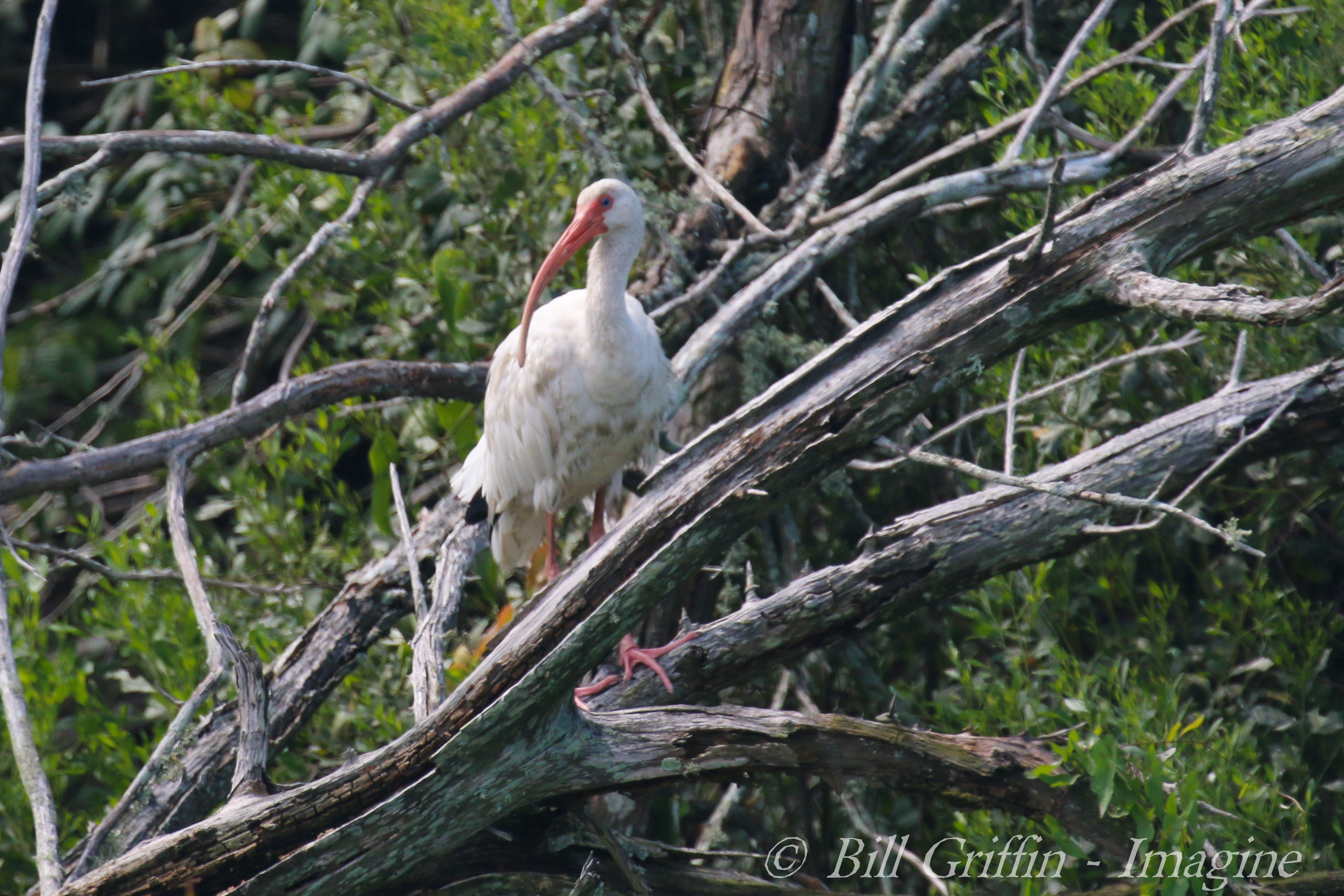
We almost didn’t walk that extra trail. It was noon when my grandson and I finished the 3.3 mile Elliot Coues loop at Fort Macon State Park. Across the salt marsh we’d watched egrets glide and settle; crouched for fiddler crabs and ducked for banana spiders in the maritime forest; climbed the highest dunes on Bogue Banks for a view of Beaufort Inlet. Now we were sweaty, parched, almost back to the car when we came to the little afterthought of a side trail.

We almost didn’t walk down to the sound and around the tannic pond. Almost passed without noticing the sleek ratsnake where it eyed us motionless from the bank before it glided back into the sedges. Almost didn’t turn up the short spur to discover the ibis ignoring us, nonchalant, preening.

Almost didn’t but we did. Maybe my grandson will remember saying, “Come on, Pappy, that’s enough pictures,” or maybe he will remember the glistening head, jewel eye, periscope neck while we waited a full minute for the snake to flick its tongue a second time.

Rat Snake, Elaphe [Pantherophis] obsoleta

.     .     .     .     .     .     .

For that which befalleth the sons of men befalleth the beasts; as the one dieth, so dieth the other; yea, they all have one breath. +++++++++Ecclesiastes, Three

My introduction to Robert Pack was as co-editor with Jay Parini of Poems for a Small Planet: Contemporary American Nature Poetry (1993). This year I bought his most recent book, All One Breath (Green Writers Press, 2019). Bob Pack has been called one of America’s best “nature poets” but the “nature” of his poems opens its arms wide to embrace every human experience. Perhaps that’s the final task of poetry: to acknowledge and explore every thing we have in common with each other and with every creature, particle, planet.

These two poems speak to me as old guy who wants to show my grandkids all I see. And as young guy still with everything to learn.

.     .     .     .     .     .     .

Crossing the Bridge

++++++++++++For Stanley Bates

++++When old age shall this generation waste,
++++Thou shalt remain in midst of other woe
++++Than ours, a friend to man, to whom thou sayest:
++++Beauty is Truth, Truth Beauty,
++++That is all ye know on earth, and all ye need
++++to know.
++++ ++++from “Ode on a Grecian Urn,” John Keats

And now it is my generation
that has gone to waste.
I have outlasted my best friends;
no one is left but me
and this elusive, talking urn.
So I will play along with this
engaging fantasy as if
the late philosopher Stan Bates
and his exploratory mind were here
to tease me with the concept of
statically engraved eternity
and help me to distract myself
from the engulfing sense of emptiness
by thinking about thinking while
assuming thought is able to
protect us from the thoughts we think:
discoursing with a meditative urn,
conversing with you when you are not here.
I will interrogate the urn
by asking what it means by its
notorious and enigmatic claim
that Truth and Beauty are identical,
and I’ll conjecture that the far side
of the urn, the side I cannot see,
shows a tableau of a familiar scene
in early spring of a carousing stream
still edged with a fine filigree of ice
and highlighted with puffs of mist
like miniature ghosts. Across the stream
a tree has fallen like a walkway
for a spirit, should he need a passage
to the undepicted shrubbery
beyond the sleek stones on the other bank.
The spirit is, of course, invisible,
as you are now, but I can hear
his wafted flute notes as he passes by
in lilting harmony with the swirled stream’s
incantatory whispering –
as Keats could hear soft sweetness in
the silence of those “unheard melodies”
and I can hear you praising the audacity
of Keats’s baffling paradox.
I’m guessing that you would agree that this
impressionistic woodland scene
is beautiful and I’d be pleased to have
the urn give it artistic permanence,
but since all permanence is an
illusion, the urn’s vain assertion
in undoubting certainty
cannot be true, yet knowing that
it is not true – nothing is true
that does not change and disappear –
surely is true, despite our wish that we
might be less permanently sorrowful,
and sorrow no more than a shadow
on fresh snow, the murmuring of wind
amid the drying meadow grass.
But I cannot delude myself or long
be unaware of the surrounding emptiness,
pretending that you’re here and we
are entertained by speculating what
the urn might understand about
our need for solace in its offering
of friendship to its onlookers.
Stan Bates, philosopher, is gone – he is
not here on earth to quip he is not here.
Consummate connoisseur of classical
conundrums, maestro of mimetic mirth,
steadfast, devoted, generous – it’s true,
as well, he was a realist of woe
for whom grief was the bond for all of us.
And I think that it is beautiful.
There is a slender, sloping bridge
of wooden planks and wooden rails that I
have crossed a thousand times on my way home
and paused to watch the white-tailed deer
come out to drink, arpeggios
of water sliding silver from their lips,
and I can recollect those seasons when
determined beavers made a dam
and built a hutch, a perfect dome
Euclid himself might have designed,
and once at dusk, but only once,
I saw a pygmy owl swoop down
on soundless, outstretched wings
to snatch a vole beneath the snow,
his golden eyes like harvest moons
whose radiance delineates the dark.
I’d need a million, eulogizing urns
to keep such earthly memories alive,
even for just a fleeting interval –
as if, dear Stan, they could be kept for you.

Robert Pack, from All One Breath, Green Writers Press, Brattleboro, Vermont, © 2019.


.     .     .     .     .     .     .

.     .     .     .     .     .     .

Giving Thanks

Two ponderosa pines define
the entryway that leads –
this clear and midday afternoon –
down to the shore of Holland Lake.
My son helps lift my outworn body
over the smooth gunnel of our fishing boat,
and off we go in the direction of
the gliding loons who dip and disappear,
leaving behind the lilting echoes
of their melancholy calls.
Framed by a could, and eagle
streaks toward its enormous nest
above the forest maze
and misty labyrinth.
++++ The mountain on the lake’s far side
offers meadow of gold Balsamroot;
a pregnant doe lifts up her head,
pausing at the water’s boundary.
About four boat lengths past
the swirl where the resounding waterfall
foams out and merges with the lake,
a cove reveals a beaver’s hutch
remarkably symmetrical –
each branch and twig packing into place –
suggesting some unchangeable design
has been revealed to me.
Simply to look, to hold in memory,
was all that my senses needed to achieve,
and all wished-for contentment could embrace.
But not quite so – such satisfaction
left still more to be desired:
++++ I needed to express
imagined gratitude
for pulsing light reflected from
round purple stones that murmured
with the undulating tide.
I needed to bestow high praise,
as if such praise could be received
and sheltered safely in the forest haze;
I needed to give thanks for symmetry,
and all its variants
in the unfolding Aspen leaves,
in the emerging needles
nearly shining row by row
on the awakened Tamaracks.
I needed to commend
the shaded slopes and crevices
for their fine tints and multimarked hues;
I was uplifted and impelled
to offer unrequited praise
for the melodic interlude
of disappearing loons –
as if such mournful singing was
and unanticipated gift beyond.


Robert Pack, from All One Breath, Green Writers Press, Brattleboro, Vermont, © 2019.

.     .     .     .     .     .     .

Needham’s Skimmer, Libellula needhami

.     .     .     .     .     .     .

Photos by Bill Griffin. Header art by Linda French Griffin.


.     .     .     .     .     .     .

2020-11-03b Doughton Park Tree

Read Full Post »

[with poems by Dana Gioia, Eric Tretheway, Raymond Carver]

Do unto those downstream as you would have those upstream do unto you.
++++++++++++ — Wendell Berry

Upstream a hemlock is dying. Riparian giant, it drops needles, roots loosen, and during a thunderstorm it crashes. No more cloak of deep shade for the musical first order stream. Warming water can’t carry oxygen. At the next rainfall the current clouds with silt.

Stonefly and mayfly nymphs smother. Every gilled thing diminishes. Shiners depart their riffles or starve. Brookies follow.

We are all downstream. Maybe the hemlock was maimed by acid rain, sulfur oxides from a power plant 500 miles north. Maybe it couldn’t withstand the attack of invaders (adelgids) from 5,000 miles east. Maybe cycles of heat and drought had robbed its resilience.

All connected. Not a metaphor – a gut truth. That first order stream feeds the Chattahoochee and Atlanta’s millions drink. This morning I made my coffee from a cloud stalled over the Blue Ridge. We are all downstream. Watchful, listening, thirsty.

.     .     .     .     .     .     .

Stonefly nymph, shed skin after emergence of adult


.     .     .     .     .     .     .

Becoming a Redwood
++++ Dana Gioia

Stand in a field long enough, and the sounds
start up again. The crickets, the invisible
toad who claims that change is possible,

And all the other life too small to name.
First one, then another, until innumerable
they merge into the single voice of a summer hill.

Yes, it’s hard to stand still, hour after hour,
fixed as a fencepost, hearing the steers
snort in the dark pasture, smelling the manure.

And paralyzed by the mystery of how a stone
can bear to be a stone, the pain
the grass endures breaking through the earth’s crust.

Unimaginable the redwoods on the far hill,
rooted for centuries, the living wood grown tall
and thickened with a hundred thousand days of light.

The old windmill creaks in perfect time
to the wind shaking the miles of pasture grass,
and the last farmhouse light goes off.

Something moves nearby. Coyotes hunt
these hills and packs of feral dogs.
But standing here at night accepts all that.

You are your own pale shadow in the quarter moon,
moving more slowly than the crippled stars,
part of the moonlight as the moonlight falls,

Part of the grass that answers the wind,
part of the midnight’s watchfulness that knows
there is no silence but when danger comes.

from The Gods of Winter. Copyright © 1991 by Dana Gioia. Graywolf Press, St. Paul, Minnesota, http://www.graywolfpress.org. Reprinted in Poems for a Small Planet: Contemporary American Nature Poetry. Edited by Robert Pack & Jay Parini, A Bread Loaf Anthology, © 1993, Middlebury College Press.

.     .     .     .     .     .     .

Resurrection at West Lake
++++ Eric Tretheway (1943-2014)

Ringed by dark palisades
of spruce and this cold, black
bowl of water, I understand again
about words, how folded wings

can open, lift into flight:
love, when it batters us,
or death, when we sense its swoop,
a wendigo stirring in shadows.

This one-crow sky leans on my bowels.
My eyes are admonished
by witch fingers of naked poplars
forming their mute adjurations.

And social voices fall silent too:
crows, chickadees, whiskeyjacks
contain their clatter, squirrels
grow mute as pinecones.

Up on the ridge behind me
thin, bone-white remnants
of the deepest snowdrifts glow,
skeletal under the hackmatacks.

Out of these enigmatic evergreens,
around imponderable granite mounds,
beneath one flapping black rag
of crow, spring’s surge begins again.

from Poems for a Small Planet: Contemporary American Nature Poetry, edited by Robert Pack & Jay Parini, A Bread Loaf Anthology, © 1993, Middlebury College Press.

.     .     .     .     .     .     .

Whitetail Shiner, Cyprinella galactura

.     .     .     .     .     .     .

Three days is about the longest I could live without water. You too. Aquatic ecology – it’s all about us. For our final class exercise, Erin gives us twelve factors and has us draw lines to depict how each impacts the other. Swirls and waves and cycles. I used green ink to show beneficial effects and red for detrimental:


Add your own lines and circles!

.     .     .     .     .     .     .

The River
++++ Raymond Carver (1938-1988)

I waded, deepening, into the dark water.
Evening, and the push
and swirl of the river as it closed
around my legs and held on.
Young grisle broke water.
Parr darted one way, smolt another.
Gravel turned under my boots as I edged out.
Watched by the furious eyes of king salmon.
Their immense heads turned slowly,
eyes burning with fury, as they hung
in the deep current.
They were there. I felt them there,
and my skin prickled. But
there was something else.
I braced with the wind on my neck.
Felt the hair rise
as something touched my boot.
Grew afraid at what I couldn’t see.
Then of everything that filled my eyes –
that other shore hung with heavy branches,
the dark mountain range behind.
And this river that had suddenly
grown black and swift.
I drew breath and cast anyway.
Prayed nothing would strike.

from POETRY, June, 1986. The Poetry Foundation.

.     .     .     .     .     .     .

Measuring Turbidity — Little River


Measuring dissolved oxygen


Measuring pH


The Southern Appalachian Naturalist Certification Program is an adult education opportunity created and administered by Great Smoky Mountains Institute at Tremont and the University of Tennessee, Knoxville. Their mission – connecting people with nature. SANCP certification requires completing eight weekend-long courses; I took my first course, Birds of the Smokies, in May, 2017, and finished my final course, Aquatic Ecology, on July 25, 2021.

Many thanks to the ecology superpowers of Erin Canter, Manager of Science Literacy and Research and master of making connections; to John DiDiego, GSMIT Education Director; and to Jeremy Lloyd, Manager of Field and College Programs.

Field diagram by Bill Griffin. All photographs by Bill Griffin. Header art by Linda French Griffin.

.     .     .     .     .     .     .

2020-09-08b Doughton Park Tree

Read Full Post »

« Newer Posts - Older Posts »