Feeds:
Posts
Comments

Posts Tagged ‘David Radavich’

 . 
[with 3 poems by David Radavich]
 . 
Turtle
 . 
Its stomach brushes ground
as by long acquaintance,
 . 
one foot then another, one leaf,
slow digestion, eyes alert
 . 
like high-beams
in the wind-swept night,
 . 
hard against the air yet telling
stories as a stained-glass
 . 
window, victory
over hastening death,
 . 
comrade of dust and mud
and golden squares like armor
 . 
glinting whenever sun
arcs its sacrifice –
 . 
just so I think of you
unfolding a yellowed piece
 . 
of paper, words
you never meant to say
 . 
crawling their careful
way into my bone-frame,
 . 
softer than
the moon starting
 . 
to curl
into dawn
 . 
David Radavich
from Canonicals – Love’s Hours
 . 
❦ ❦ ❦
 . 
At 17 she had a boyfriend (briefly) whose language she did not speak. The two would sit at the back of the bus through the turns and hesitations of the clamorous diesel-fumed city and communicate with their lips, although words are not what passed between them. When they came up for breath it was no use to tell him about the menacing gothic facade they were passing or comment on the uniformed school children being led across the bridge. He would stare at her and she back at him until they reached her stop. Come inside? What am I saying, and what do you think I mean? Well,  Tschuβ until tomorrow after school.
 . 
Some would say that no boy and girl at 17 ever speak the same language. Some say man and woman never at any age. Cynics. Nevertheless, when the girl’s best friend, who commanded some phrases the boy could grasp, had to call him one evening to convey a final message from the girl – angry? sad? frustrated? – and cancel any further bus rides, she still could never quite understand how it all had gone so wrong. An inter-language dictionary proved no help at all. Decades later she would still wake at 3 AM and feel the fool, although a few latent hippocampal neurons, hers and no doubt his as well, continued to fire, “What if? What if?” One tattered shred of recollection with lint of vocabulary she could have pieced together if she had tried still labored to remind her of this: when they had turned toward each other and he placed his hand at her neck, fingers in her soft short hair, they had seemed to understand each other well enough.
 . 
 . 
Time is both a bewildering tangle and a firm reassurance in these poems by David Radavich from Canonicals – Love’s Hours. It is a book of hours matins to vespers  but also a book of days and years. The images can be elusive, like moonlight through restless leaves, yet remain rich in their enticement. And what message does this subtle, earthbound, exalted language, this language both  precise and intangible, what does it desire to convey? The object, the “you,” is it a focus for affection and gratitude or a saving grace always just beyond reach? Each word lovingly selected, placed, ordered: these poems understand you, the reader, and they invite you with all hopefulness and promise to understand them.
 . 
Canonicals  – Love’s Hours by David Radavich, Finishing Line Press, Georgetown, KY. © 2019 [author biography and book purchase HERE]
 . 
 . 
❦ ❦ ❦
 . 
Argus
 . 
Quietly, quietly
dawn takes its place
 . 
among the world’s
elements –
 . 
There will be rapes today,
and military coups,
 . 
also gay
birthdays, painful
 . 
dyings and forlorn lovers
discovering their first infatuation
 . 
with another body.
 . 
Let me be there for it all,
all seasons, all temperaments
 . 
seeing
the round circus
 . 
black and gold as autumn
spinning into night
 . 
love turning
a corner
 . 
into open doors
that lead to bright air
 . 
blowing
many leaves
 . 
David Radavich
from Canonicals – Love’s Hours
 . 
❦ ❦ ❦
 . 
Cyclical
 . 
To rediscover.
 . 
To find again what
has been lost
for more than thirty years.
 . 
A stolen ring
on someone else’s
hand, gold around a gun
 . 
or maybe you
clutching my heart
like a bandit.
 . 
In any case
 . 
it reappears, this missing
self, this jewel tossed
in some closet,
 . 
the world turns
so that China ends up
 . 
and we are land
at the sphere’s bottom
 . 
rediscovering what
 . 
has been lost by many others
and found again like
 . 
sunrise,
like buds breaking.
 . 
David Radavich
from Canonicals – Love’s Hours
 . 
 . 
❦ ❦ ❦
 . 
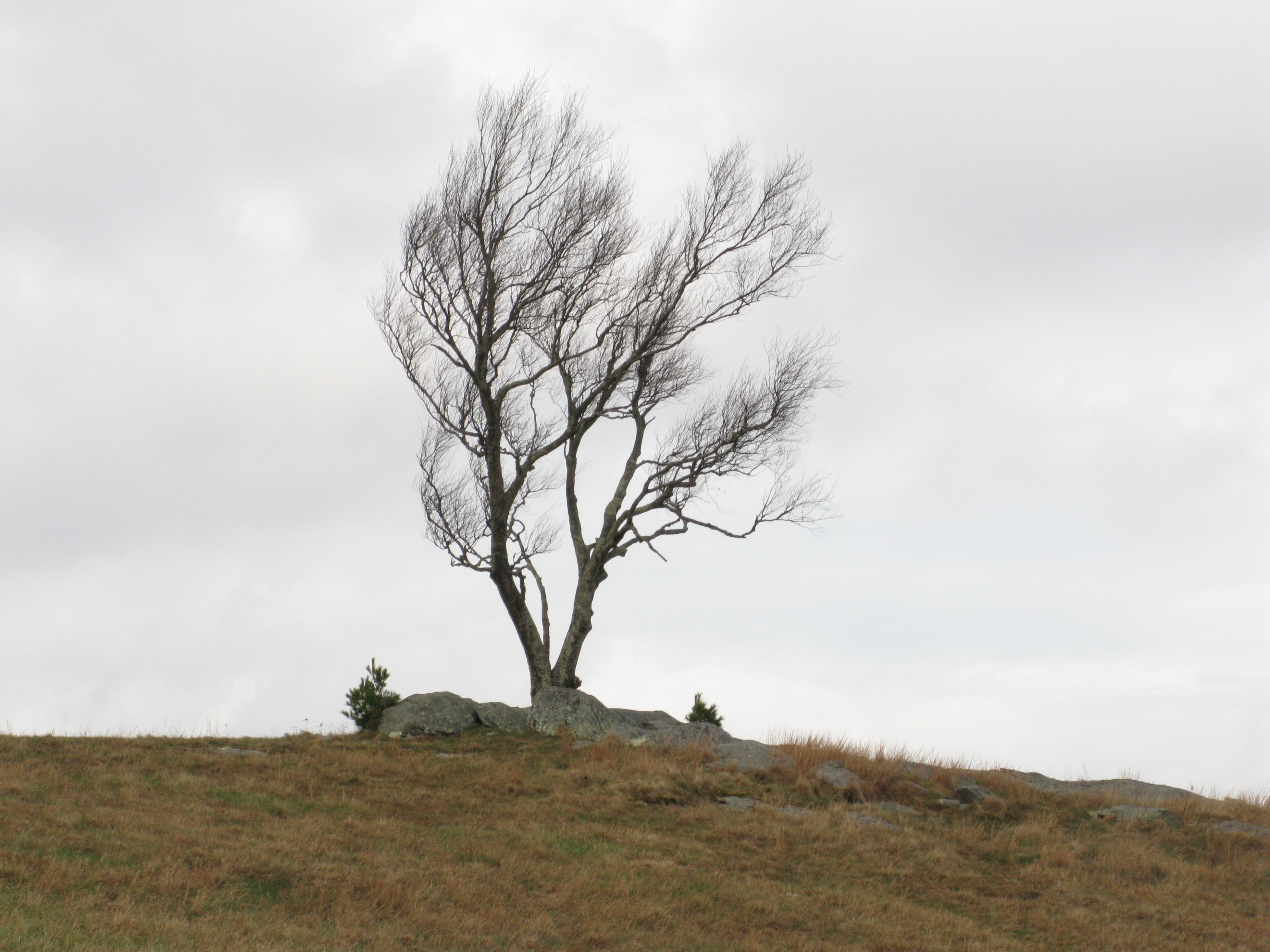
Doughton Park Tree 2020-11-22
 . 

Read Full Post »


[with poems by Jennifer Atkinson, David Radavich,
Barbara Bloom, Diane Seuss]

Today is Earth Day, April 22. Yesterday, today, and tomorrow we are publishing posts for Earth Day featuring poems submitted by our readers that touch the theme, Wild & Rewild.

Rewilding is a conservation effort aimed at restoring habitat, revitalizing ecosystems, and reintroducing animals and plants that historically occupied these wild spaces.
Rewilding may be as small as converting cow pasture to a bit of riparian Piedmont Prairie along the Mitchell River in Surry County, NC.
It may be as large as creating wildlife corridors down the chain of the Rockies for migrating pronghorns.
It may be as simple as replacing introduced invasives in your yard with native species; as complex as legislation to set aside vast tracts as wilderness.

How does the poet encounter and respond to wildness? A native wildflower struggling in an urban park? A remote mountaintop far from human presence? A wild voice speaking to the heart; wild urges propelling the soul into the unknown?

A wild call from the past, the present, into the future?
For Earth Day 2023, touch the wild. Rewild yourself.

Thank you to the readers of these pages
who have responded to my call for poems this Earth Day.
Watch for new posts on April 21, April 22, and April 23.

All photographs were taken April 11-17, 2023,
along the Elkin & Allegheny Nature Trail,
part of the Mountains-to-Sea Trail in North Carolina, USA.

Earth Day 2023 art by Linda French Griffin.

❦ ❦ ❦

Landscape with Jeffers and the Connecticut River

Oat stalks hang their oat-heavy heads.
Panic grass shakes in the wind
off a goldfinch’s wing. Cause,
++++ ++++ ++++ ++++ ++++ effect, and cause.

Drone, like the bee, of goldenrod and aster,
tool of the stick-tight and cockleburr,
I park and wade into high riverside grasses.

A dog gnaws on a box turtle, a spider rides
a floating log, straining the air of its midges and leafbits.
A fisherman lazy as late summer current,
++++ ++++ ++++ ++++ casts, reels, and casts.

It occurs to me I am alive, which is to say
I won’t be soon. Robinson Jeffers
from Carmel Point, in “an unbroken field of poppy and lupin”

ashamed of us all (of himself ), took solace in time,
in salt, water, and rock, in knowing
all things human “will ebb, and all/
++++ ++++ ++++ ++++ Their works dissolve.”

Me, too. And I’m not always so patient. I’ve caught myself
wishing our spoiler species gone, just swept away,
returned to rust and compost for more deserving earthly forms.

Meanwhile, flint arrowheads turn up among the plastic
picnic sporks, the glacial crags and bottom silt.
Hawks roost across the river on the now defunct
++++ ++++ ++++ ++++ ++++ nuclear power plant cooling tower,

flotsam left at the human high water mark.
Like mussel shells, like driftwood or seedpod,
like the current’s corrugations in the sand.

Here, on this side, a woodchuck sits up, lustrous,
fat on her chestnut haunches, (she thinks herself
queen of her narrow realm) and munches
++++ ++++ ++++ ++++ the fisherman’s crust.

Who wouldn’t smile? Who doesn’t pity—and love—
the woodchuck not only despite but for her like-human smugness?
How can I not through her intercession forgive
++++ ++++ ++++ ++++ ++++ for now a few things human.

Jennifer Atkinson
Selected by Bill Griffin; from the book THE THINKING EYE, Parlor Press
Appeared online at Poem-a-Day, Poems.com, on March 13, 2023

Jennifer Atkinson’s comments: “But how do we live with our knowledge and the emotional cloud of fear, guilt, anger, grief, and helplessness, a cloud that surrounds us, each of us alone, and all of us together? That cloud has become intrinsic to my ecopoetical work. Burdened with the beauty and loss and malicious awfulness ahead, weighted with the anxiety that hits whenever a winter day dawns without frost on the ground or another ‘unprecedented’ downpour rings in the gutter, how do I live?”

Who wouldn’t despair? Who wouldn’t smile? The daily slog through politics and pollution is too heavy to be borne. The daily green that lights my kitchen window while I make coffee is too beautiful to bear. This poem drives me into the inescapable reality of damaged Earth but also offers a leafy twig of hope.

– Bill Griffin / Elkin, North Carolina

[and I couldn’t resist that title after all the Robinson Jeffers I’ve been reading this past year.]

❦ ❦ ❦

Back Woods

Only in the hills behind
comes solace,

winter white against
the brown verticality of reaching

bare as need,
a few lingering green

hold-outs
crying for mercy,

leaves curled
atop themselves quiet

as abandoned
lovers.

I have already
sided with the deep creviced

ravine and its snow
cheeks incised

with cares in shadow

under a sun that
promises

open sky
open hearts.

David Radavich
first published in Blueline in 2008

This poem is marked by jagged line lengths and abrupt stanza breaks that emphasize the rawness and otherness of the natural world. The speaker feels attracted to the sharp contrasts in color and juxtaposition of “creviced ravine” with the softer “snow cheeks,” but s/he is nonetheless distant from it and can only admire the scene from afar with a kind of wishful, empathetic watching.

– David Radavich / Charlotte, North Carolina

❦ ❦ ❦

Night Swim: Phosphorescence

We’d run down the path to the dock,
our feet knowing the rocks, never stumbling,
never falling, and we’d jump right in,
the ocean calm under the summer stars,
and swim out a little ways,
lifting our hands out of the water
to watch the drops linger and fall from our fingers,
like pearls, like diamonds, and kick our legs hard
for the trail of bright silver we’d leave behind-
and finally climb out, trembling with the chill,
sorry to wipe those jewels from our bodies.

Barbara Bloom
originally published in Pulling Down the Heavens (Hummingbird Press, 2017).

I grew up on a remote coastal homestead in British Columbia, Canada. Living in such a wild and demanding place has shaped the way I see the world. The poem demonstrates how as children we were amazed by the natural world around us, but saw no separation: it was ours to be experienced. I now live in Bellingham, Washington, not too far from where I lived as a child, and surrounded by much of the same beauty and wildness. I count myself lucky for that!

– Barbara Bloom / Bellingham, Washington

❦ ❦ ❦

Young Hare

Oh my love, Albrecht Dürer, your hare
is not a spectacle, it is not an exploding hare,
it is not a projection of the young hare
within you, the gentleness in you, or a disassembled hare,
nor a subliminal or concealed hare,
nor is it the imagination as hare

nor the soul as a long-eared, soft-eared hare,
Dürer, you painted this hare,
some say you killed a field hare
and brought it into your studio, or bagged a live hare
and caged it so you could look hard at a wild hare
without it running off into thorn bushes as hares

will do, and you sketched the hare
and laid down a watercolor wash over the hare
and then meticulously painted in all the browns of hare,
toast brown, tawny, dim, pipe-tobacco brown of hare,
olive, fawn, topaz, bone brown until the hare
became dimensional under your hand, the thick hare

fur, the mottled shag, the nobility of the nose, the hare
toenails, black and sharp and curved, and the dense hare
ears, pod-shaped, articulated, substantial, erect, hare
whiskers and eyebrows, their wiry grace, the ruff of hare
neck fur, the multi-directional fur over the thick hare
haunches, and did I say the dark inside the hare

ears, how I want to follow the darkness of the hare
and stroke the dark within its ears, to feel the hare
ears with my fingers, and the white tuft, the hare
anomaly you painted on its side, and the fleshy hare
cheeks, how I want to squeeze them, and the hare
reticence, how I want to explore it, and the downturned hare

eye, it will not acknowledge or appease, the black-brown hare
eye in which you painted the reflection of a window in the hare
pupil, maybe your studio window, in the hare’s
eye, why does that window feel so intimate in the hare’s
unreadable eye, why do I press my face to the window to see the hare
as you see it, raising your chin to look and then back to the hare

on the page, the thin hair of your brush and your own hair
waving gold down your back, hair I see as you see the hare.
In the hare’s eye you see me there, my swaying black hair.

Diane Seuss
Selected by Joan Barasovska; appears in Still Life with Two Dead Peacocks and a Girl (Graywolf Press, 2018). Albrecht Dürer’s painting is titled “Young Hare.”

I’ve selected this ekphrastic poem because it reflects the artist’s fascination with capturing an exact likeness of nature, his extravagant love of the animal so clearly displayed, and the paradox of killing or caging the hare in order to worship it. Diane Seuss’s masterful craft—see the line endings—and genius for description are on display here.

– Joan Barasovska / Chapel Hill, North Carolina

❦ ❦ ❦

Read Full Post »


[poems by David Radavich, Peter Makuck,
Paul Jones, Sam Barbee]

Earth Song

It is something between
lament and celebration,

perhaps both at once,
perpetually mourning yet

dancing in survival

like the seed that
disappears one whole season
then erupts in a plume
of green or garish purple.

Animals hear it, even plants,
but rarely humans

who are too busy raking
off what they can never get
enough of, this free air

that awards us love
in every verse.

Listen to the chorus
tonight and always,
so long as we’re alive

among the sentience
even now chanting
all around us
like bells or birds.

David Radavich

❦ ❦ ❦

I am trying to listen, Earth. I hear the celebration, I breathe it in, I feel it in my chest and beneath my feet. But I hear the lament as well. Loud, always louder. Is it even possible for me to give more than I take, or is despair all that is left for me? Left for us?

What can this one single person do to preserve you, Earth?

Earlier this year I took a hike in the Smokies with a lichenologist. Oh Smokies, your blue mist horizons, your saturated earth and clear chattering streams. Oh you temperate rainforest, your endless variety of creatures that creep and buzz and flit. Oh you breathless diversity of trees and flowers, heath and ferns, every patch of everything alive.

But this was a winter hike. The hardwoods were bare, the understory brown. After a brief chill shower, though, and how often it showers, nondescript grey patches on every branch, bark, and stone turned green – lichens photosynthesizing.

This is where the lichenologist explained the term poikilohydric – lichens passively soak up moisture from the air and passively release it when the air is less humid. They can’t actively retain water. They’re just little sponges. One little sponge isn’t likely to create those blue mist horizons or temperate fecundity, but in the Smokies everything is covered in lichen. Kneel and examine any rock – you’re not likely to discover much actual “rock” showing.

One lichen might not do much but billions of little sponges actually do moderate the microclimate about them. They contribute their small yet huge part to Great Smokies National Park possessing greater biodiversity than the Amazon rainforest.

One person’s contribution may not seem like much but there are billions of us. Small changes are the stream running a little clearer and colder so the brookie can spawn. Small changes are one more monarch laying her hundred eggs. Small changes are the wood thrush discovering insects for her chicks when they hatch.

Read below for some ideas about small changes. Celebrate each one. And thank you, Earth, for the opportunities.

❦ ❦ ❦

Red Foxes at Pahaska Tepee

In an isolated no-frills cabin
on the banks of the Shoshone,
we spent two nights on the site
of Wild Bill Cody’s hunting camp,
but unlike Bill, I had no gun
+++++ to discourage the bears.

Make noise when you walk the trails,
they told us at the office,
and don’t go into the woods after dark.

As a kid growing up in the country,
I read about Cody,
+++++ Crockett, and Boone,
had a pistol and two rifles,
hunted rabbit and squirrels for the table,
trapped muskrat, fox, and mink for the money,
often missing the bus into school.

Behind our cabin one morning,
I spotted five deer
and a fawn feeding among the aspens.
At first I thought they were shadows.
+++++ A few minutes later,
my binoculars brought a fox up close,
black forelegs and white-tipped tail.

I couldn’t stop watching her
down on a path by the riverbank.
I’d never seen one playfully roll in the dust,
or stretch out while her two kits
+++++ nipped at each other,
and tumbled over their mother.

Years ago
+++++ when I saw a fox
it was held in the jaws of my trap –
five bucks bounty from the farmer’s grange,
another buck and a half for the pelt.
+++++ Who was I?
What was I doing?
I must have imagined I was Crockett.
What stays
from one of those mornings
is a red fox, bloody foreleg tight in my trap.
She was just standing there panting
with her tongue out
like my good dog Jonesy on a hot day.

But now as I watched, she jumped up,
this red fox mom,
+++++ looked right at me, frozen,
flanked by her two kits.
I was dangerous,
I didn’t deserve this gift of seeing.

Something stirred in the bushes beside me.
When I looked up again and tried to refocus,
they were gone,
+++++ +++++ and the riverbank empty.

Peter Makuck
from Mandatory Evacuation, BOA Editions Ltd, Rochester NY, © 2016

❦ ❦ ❦

Earth, you’re looking stressed. Getting a little balder – someone cutting down your forests to raise cattle? Dryer – rivers become trickles, aquifers squeezed, not enough water to go around? Dirtier – nitrates in your ponds, forever chemicals (PFAS) in your streams, microplastics in everydamnthing? And of course hotter, always hotter?

O Earth, we’re all feeling stressed, too. We don’t need to be the pika at the top of Bear Tooth Pass with no higher to go to cool off – we know we’re all running out of everything and especially time. Habitat loss, phenological mismatch, aridification, salinization, sea level rise – all accelerating.

What do we do?

Perhaps one response parallels the Naturalist method: notice; ask questions; make connections; tell about it. With one added step – take action. A big action, a little action, a lot of actions but make sure to choose something that makes you happy. Earth Day Every Day is celebration, not burden.

One idea: plant native. Non-native trees and shrubs are plant deserts for birds and butterflies but my Serviceberry feeds the neighborhood all three seasons: kinglets and chickadees eat the buds, wrens and bluebirds feed babies caterpillars and other insects, robins and waxwings arrive in the fall for berries. And my soul is fed every spring by the starry petals falling like late snow.

Another idea: eat closer to the ground. If not every meal then at least a few meals. Eat things that sprout instead of eating things that eat things that sprout. Growing one pound of protein from beans requires 2,270 gallons of water. One pound of beef protein uses 13,438 gallons. One acre can produce 250 pounds of beef or 20,000 pounds of potatoes. (And we’re not even considering the powerful greenhouse gas methane = cow farts).

Here are a few interesting readable resources. SHARE YOUR OWN FAVORITES WITH US IN YOUR COMMENTS!

Earth Day 2022 – Invest in Our Planet

World Water Day

Water footprint of your favorite food & bev

Tips from 2019 World Water Day

How much water do you save the planet if you eat less meat?

101 tips to save water at home

GreenMATCH – becoming ecofriendly

30 tips to be ecofriendly today

❦ ❦ ❦

At The Big Sweep

No one likes to wade
knee deep in the creek
to pull out plastic
snags from the places
turtles seek the sun.
I pretend I do
to do the hard work
that needs to be done.
I take what I have
of magic, of what
I found of pleasure,
in cleaning the creek.
I remember why
I hate what mud can
do to weigh plastic,
to make the load twist
and shudder and shift.
My feet find new paths
in the sucking mud,
some purchases on stone,
that lead to the bank.
My slow slogs resets
stream’s rushing free flow.
I remember nights
I couldn’t fall asleep
on a mountain train
how it like the creek
would twist, turn, and shift
along the river.
I got off the train
and it moved again.
More smoothly or so,
it seemed as distance
grew and the river
ran in parallel.
I knew then, as here,
that joy comes when work
and journeys are done.

Paul Jones


This poem in honor of the Big Sweep was first published by Silver Birch Press in their Saving the Earth series.
Paul writes: The Big Sweep is a continuing volunteer effort to free the waterways and other natural areas of litter – especially plastic. Some may find these efforts a pleasure, but for me these necessary tasks are more rewarding in retrospect when you can see the results from a distance in time and space. Writing is, of course, similar as are taxing trips on rattling trains.


❦ ❦ ❦

Flowers Mean May

April’s rimless wet
++++++++++++ wagers grief’s roulette.
Blooms rattle,
++++++++ frenetic mesh.
Prod imperfection;
++++++++++++ spatter flimsy rosette:
desperate for a kindly set
++++++++++++++++ to count-off
and confirm us.
++++++++++ Hold dear.
Tactic of desire –
++++++++++ odd-numbered
to denote She Loves Me. . . .

I stroll the peristyle
++++++++++++ encircled
with springtime bouquet.
++++++++++++++++ Piecemeal fragrance
to wilt all winter weed.
++++++++++++++ Appetite of delicate petals
on cue:
++++ summon like addiction
Snatch a daisy
++++++++ off the edge,
eager to dissect our fate.
++++++++++++++++ Each casualty
may heal, while any sum
++++++++++++++++ must be forgiven –
abide pledge
++++++++ as she may love me not.

Sam Barbee
from The Writer’s Morning Out on-line site in Pittsboro, April 2020

❦ ❦ ❦

Early in April I asked readers to share a favorite poem that celebrates the interdependence and interconnection of all life on earth. I am including their offerings in three posts before, on, and after Earth Day, April 22. Thank you to all those who responded, and thanks to all of you who read this page and share in the celebration of life on earth.

❦ Bill Griffin ❦

2016-10-17a Doughton Park Tree


Read Full Post »

« Newer Posts - Older Posts »