Feeds:
Posts
Comments

[with 3 poems by Denise Levertov]

. . . Who can utter the poignance of all that is constantly threatened . . .

Toward the end of March Amelia and I explored the vernal pool near Dutchman Creek and discovered frog eggs with hundreds of newly hatched tadpoles. We visited a couple more times to watch them grow (no legs yet!). Week before last I was walking along the creek on my own and decided to check their progress.

I edged through the muck and grass, taller now, leaned over the little pool, and counted all the tadpoles. There were exactly zero. None. Well, I did scare off a few big second-year tads, but all of the little black wigglers were gone.

I stared a long time. Plenty of water. A little algae, weeds and water plants. Maybe they were all hiding under leaves. I leaned all the way down. What is that in the water there, arc of a cylinder covered with hieroglyphics, almost stepped on it? I poked with my stick and a 3-foot long Northern Water Snake shot sinusoidal through the water then veered back towards me and disappeared into a hole, I guess, because I never could spot it again.

Hungry snake, OK, gotta eat, but did you have to finish off every one? Isn’t there some sort of ecological balance that guarantees next year’s balmy spring evenings on the porch listening to peepers, tree frogs, and the long mellifluous trill of the American toad? I guess the older, bigger tads were experienced, too wily to be caught, better at hiding themselves in the silt, so maybe a few will indeed live to sing. I don’t think I’ll be telling Amelia about the snake any time soon, though.

.     .     .     .     .     .     .

This afternoon I walk down to the creek to see what’s become of the pool after a two-week dry spell. One year it dried up altogether. Still plenty of muck; grass and weeds even higher. The pool has shrunk but as I thread my way closer there are two big plops and a swirl of silt slowly settling. And there they are: brand new, a couple of hundred little black tadpole wigglers, freshly hatched.

More life, says Nature. More, please.

.     .     .     .     .     .     .

Three poems by Denise Levertov

bring the planet / into the haven it is to be known

.     .     .     .     .     .     .

Web

+++++Intricate and untraceable
+++++weaving and interweaving,
+++++dark strand with light:

+++++designed, beyond
+++++all spiderly contrivance,
+++++to link, not to entrap:

elation, grief, joy, contrition, entwined:
shaking, changing,
++++++++++forever
+++++++++++++++forming,
++++++++++++++++++++transforming:

all praise,
+++++all praise to the
+++++++++++++++great web.

– Denise Levertov

.     .     .     .     .     .     .

In California: Morning, Evening, Late January

Pale, the enkindled,
light
advancing,
emblazoning
summits of palm and pine,

the dew
lingering,
scripture of
scintillas.

Soon the roar
of mowers
cropping the already short
grass of lawns,

men with long-nozzled
cylinders of pesticide
poking at weeds,
at moss in cracks of cement,

and louder roar
of helicopters off to spray
vineyards where braceros try
to hold their breath,

and in the distance, bulldozers, excavators,
babel of destructive construction.

Banded by deep
oakshadow, airy
shadow of eucalyptus,

miner’s lettuce,
tender, untasted,
and other grass, unmown,
luxuriant,
no green more brilliant.

Fragile paradise.

. . . .

At day’s end the whole sky,
vast unstinting, flooded with transparent
mauve,
tint of wisteria,
cloudless
over the malls, the industrial parks.

the homes with the lights going on,
the homeless arranging their bundles.

. . . .

Who can utter
the poignance of all that is constantly
threatened, invaded, expended

and constantly
nevertheless
persists in beauty,

tranquil as this young moon
just risen and slowly
drinking light
from the vanished sun.

Who can utter
the praise of such generosity
or the shame?

– Denise Levertov

.     .     .     .     .     .     .

Tragic Error

The earth is the Lord’s, we gabbled,
and the fullness thereof
while we looted and pillaged, claiming indemnity:
the fullness thereof
given over to us, to our use
while we preened ourselves, sure of our power,
wilful or ignorant, through the centuries

Miswritten, misread, that charge:
subdue was the false, the misplaced word in the story.
Surely we were to have been
earth’s mind, mirror, reflective source.
Surely our task
was to have been
to love the earth,
to dress and keep it like Eden’s garden.

That wold have been our dominion:
to be those cells of earth’s body that could
perceive and imagine, could bring the planet
into the haven it is to be known,
(as the eye blesses the hand, perceiving
its form and the work it can do).

– Denise Levertov

all selections are from The Life Around Us, selected poems on nature, by Denise Levertov, New Directions Books, 1997

.     .     .     .     .     .     .

Denise Levertov (1923-1997) was a naturalized American poet born in England. Her first book of poetry was published shortly after World War II; she moved to the U.S. in 1948 and became influenced by the Black Mountain Poets and William Carlos Williams such that her writing ultimately came to express a uniquely American voice with a world vision. Her poems are often strongly ecological and political. She writes in the forward to The Life Around Us: As I have quite frequently found myself obliged to skip back and forth from book to book when reading to audiences composed of people whose work and vocation was in ecology, conservation, and restoration, it was suggested that I put together a selection of thematically relevant poems, which would be useful not only to the many earth-science people who, I have found, do love poetry, but also to the general public.

Poetry Foundation
Academy of American Poets
Works by Denise Levertov
Chronology of Denise Levertov’s life

.     .     .     .     .     .     .

Header Artwork © Linda French Griffin
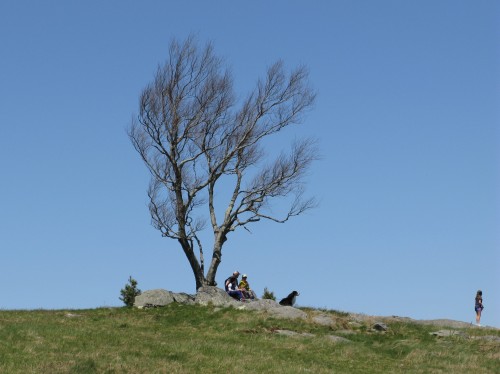
Doughton Park Tree -- 5/1/2021

[poems by Galway Kinnell, Yusef Komunyakaa, Robert Frost]

April 22, 2031 – Rover Shēn zhī (Deep Knowing) prepares to analyze its 50 meter drill core sample from the Martian south polar ice cap. Strata of grit, water ice, mineral dust – wise Rover’s AI chooses to begin by studying a faintly pigmented layer at 17.5 meters. Very promising.

Yes, there is life on Mars.

And this is what the Rover does not discover – a single species of microorganism spending its long cold days and nights in solitary, independent, utterly lonely metabolic isolation.

Instead Shēn zhī’s electron microscopy, nuclear magnetic resonance, and biochemical probes reveal several varieties of cell structures not unlike Archaea from deep ocean sites on Earth, a dozen species that mirror bacteria isolated from Antarctic cores, crystalline nucleotides indistinguishable from viruses, even twisted proteins – prions. All of these merrily feed and feed upon each other in homeostatic bliss, coevolved for a billion years: an ecological community.

.     .     .     .     .     .     .

an offering from Sharon Sharp . . .

Daybreak

On the tidal mud, just before sunset,
dozens of starfishes
were creeping. It was
as though the mud were a sky
and enormous, imperfect stars
moved across it as slowly
as the actual stars cross heaven.
All at once they stopped,
and as if they had simply
increased their receptivity
to gravity they sank down
into the mud; they faded down
into it and lay still; and by the time
pink of sunset broke across them
they were as invisible
as the true stars at daybreak.

“Daybreak” by Galway Kinnell (1927-2014), from The Forgotten Language: Contemporary Poets and Nature, ed. Christopher Merrill, Peregrine Smith Books, Salt Lake City, UT, 1991

.     .     .     .     .     .     .

Life is community. Even you, homeostatically blissful Human, are a community of bacteria, protists, tiny ectoparasites in every pore, even Archaea in your gut. I feed my Archaea a cup of Greek yoghurt every morning and they are so serenely blissful. If you could count all the cells that comprise the unitary psychosocially distinct and identifiable YOU, less than half of them would be human cells. You and I couldn’t begin to live and remain healthy without those wonderful gut bacteria. How much more so mycorrhizal fungi and diatoms. Life is beautiful.

Earth Day is about the web of all life on planet Earth; no single organism remains completely solitary, independent, or isolated. If, through our actions or inactions, we create an Earth that makes it impossible for a certain species to survive, then our own species is that much impoverished and our own survival that much diminished. If, by our attention, understanding, and reverence, we permit the web to grow, extend, deepen, thrive, then our own species thrives. And thriving is defined only partially by strength, health, and numbers; for a human being to truly thrive also involves participating in the epiphany of connection to all living things. Community is life.

.     .     .     .     .     .     .

Crossing a City Highway

The city at 3 a.m. is an ungodly mask
the approaching day hides behind
& from, the coyote nosing forth,
the muscles of something ahead,

& a fiery blaze of eighteen-wheelers
zoom out of the curved night trees,
along the rim of absolute chance.
A question hangs in the oily air.

She knows he will follow her scent
left in the poisoned grass & buzz
of chainsaws, if he can unweave
a circle of traps around the subdivision.

For a breathy moment, she stops
on the world’s edge, & then quick as that
masters the stars & again slips the noose
& darts straight between sedans & SUVs.

Don’t try to hide from her kind of blues
or the dead nomads who walked trails
now paved by wanderlust, an epoch
somewhere between tamed & wild.

If it were Monday instead of Sunday
the outcome may be different,
but she’s now in Central Park
searching for a Seneca village

among painted stones & shrubs,
where she’s never been, & lucky
she hasn’t forgotten how to jig
& kill her way home.

“Crossing a City Highway” by Yusef Komunyakaa, Poetry, January, 2016

.     .     .     .     .     .     .

The Oven Bird

There is a singer everyone has heard,
Loud, a mid-summer and a mid-wood bird,
Who makes the solid tree trunks sound again.
He says that leaves are old and that for flowers
Mid-summer is to spring as one to ten.
He says the early petal-fall is past
When pear and cherry bloom went down in showers
On sunny days a moment overcast;
And comes that other fall we name the fall.
He says the highway dust is over all.
The bird would cease and be as other birds
But that he knows in singing not to sing.
The question that he frames in all but words
Is what to make of a diminished thing.

“The Oven Bird” by Robert Frost (1874-1963)

.     .     .     .     .     .     .

[Bad news for Shēn zhī: an unanticipated feature of Martian metabolism is that the cells require elements from Groups 8, 9, 10 of the Periodic Table for electron transport during energy transfer – they “eat” iron, cobalt, nickel, and rhodium. Within a few weeks many of the Rover’s critical microconnectors begin to fail. EarthLink in Ningbo goes dark. Bits of Shēn zhī drop to the Martian substrate. The Rover ultimately pinpoints the cause and transmits a warning: “Do Not Come Here.”

Unfortunately its message is garbled and received by other Martian Rovers as, “Come Here!” Within fifteen years they have all arrived at the southern plateau and become fodder for the Martian ecological community.

Which thrives.]

.     .     .     .     .     .     .

.     .     .     .     .     .     .


[original artwork by Linda French Griffin (c) 2021]

[poems by George Oppen, Jenny Bates, Matthew Olzmann, Dianna Pinckney]

an offering from Pat Riviere-Seel . . .

  PSALM
-Veritas sequitur …
– George Oppen –

In the small beauty of the forest
The wild deer bedding down—
That they are there!

Their eyes
Effortless, the soft lips
Nuzzle and the alien small teeth
Tear at the grass

The roots of it
Dangle from their mouths
Scattering earth in the strange woods.
They who are there.

Their paths
Nibbled thru the fields, the leaves that shade them
Hang in the distances
Of sun

The small nouns
Crying faith
In this in which the wild deer
Startle, and stare out.

Psalm” by George Oppen, from New Collected Poems, copyright © 1975 by George Oppen, New Directions Publishing Corporation

.     .     .     .     .     .     .

In the introduction to The Ecopoetry Anthology, Laura-Gray Street speaks of George Oppen’s “Psalm” and her epiphany in reading it: language – the Word – is not something that separates us from and elevates us above the rest of this planet. Rather, language is an integral part of our biological selves. The roots of it / Dangle from [our] mouths. We are language-making creatures in the same way that spiders are web-making creatures.

What does the language make of us as we make it? I watch my wife Linda French Griffin at her drawing table. She moves her pencil point across white paper and images take form and grow out of nothing to expand and link and resolve into something entirely new – as I look at her drawings I’m filled with feelings and ideas that grow out of nothing but are linked to all I have felt and known up until that point, and yet are entirely new. Reading a poem, writing a poem, may give substance to inchoate urges we had tried imperfectly to permit to lead us into a new place. Language conjures spirits that clothe themselves with the flesh of newly perceived reality. Language makes us a new person.

Several friends have offered poems that speak to them about our Earth and which offer to gather us all in together to celebrate Earth Day! I’m posting their offerings April 21, 22, and 23. What do you see? What do you hear? What do you notice? What do you feel? How are you changed? What will you do?


.     .     .     .     .     .     .

an offering from Jenny Bates, her poem . . .

Doubts in Other Latitudes

You will not find them on any

geologist’s map; artifacts discarded
glimpses inset
in moments
stagger out of time.

Tippling trinities disrupt
the rhythmic landscape;
beer bottles

####pop cans
########chip bags
foul party of litter.

Earth ambitious
not without
want of amusement
yet with great
vision

####energy

########patience
its commitment of being mindful
confidence to complete its life,

a solitary endeavour.

Terra firma watches human struggle
from a caged window,
doubting its endorsement of evolution.
Dreams of smooth skinned ammonites

from the Jurassic,

Dinosaurs enjoying retirement
in geologic armchairs.

I do not make rubbish, says the ground
as I stir the forest leaves.

“Doubts in Other Latitudes” by Jenny Bates from Visitations (Hermit Feathers Press, 2019)

.     .     .     .     .     .     .

an offering from Lisa Zerkle . . .

Commencement Speech, Delivered to a Herd of Walrus Calves
– Matthew Olzmann –

Young walruses, we all must adapt! For example,
some of your ancestors gouged the world
with four tusks, but you can grow only two.
It’s hard to say what evolution plans for your kind,
but if given a choice,
you should put in a request for thumbs.
Anyway, congratulations! You’re entering
a world that’s increasingly hostile and cruel
and full of people who’ll never take you seriously
though that will be a mistake on their end.
You are more tenacious than they know.
You’ll be a fierce and loyal defender
of those you love. You will fight polar bears
when they attack your friends and sometimes you’ll win.
Of course, odds always favor the polar bear,
but that’s not the point. The point is courage.
The point is bravery. The point is you are all fighters
even when the fight in which you find yourself
ensures unpleasant things will happen to you.
For example, the bear will gnaw apart your skull
or neck until you stop that persistent twitching;
it will eat your skin, all of it, then blubber, then muscle,
then the tears of your loved ones, in that order;
it will savor every bite, and you will just
suffer and suffer until the emptiness can wash over you.
The good news is: things change!
For example: the environment.
Climate change, indeed, is bad for you,
but it’s worse for polar bears whose conservation status
is now listed as “vulnerable” which is one step removed
from “endangered” which is one step removed
from “extinct” which is a synonym
for Hooray! None of you get eaten!
I suppose this will make some people sad.
Even now, they’re posting pictures
of disconsolate polar bears on melting ice floes
drifting toward a well-deserved oblivion.
They say, We need to stop this!
They say, We need to do something, now!
These people are not your friends.
One cannot be on both Team Walrus and Team Polar Bear
at the same time. I’m not saying these people are evil;
I’m saying, it’s time to choose a side.
I’m saying sharpen your tusks, young calves;
your enemies are devious. You need to train
yourself to do what they won’t expect.
For example: use computers, invest
in renewable energies, read Zbigniew Herbert.
Unrelatedly: your whiskers make you appear
to have mustaches, which, seeing as you’re
not even toddlers, is remarkably unsettling.
Babies that look like grown men freak me out.
Like those medieval paintings by so-called masters
where they’d make the face of little baby Jesus
look like an ancient constipated banker.
If that’s what God really looks like,
it’s no wonder we’ve done what we’ve done to the Earth.
Maybe you can repair what we spent lifetimes taking apart.
Replace some screws. Oil some hinges.
This might sound impossible, but have you ever
looked at yourselves? Seriously—take a quick look
and tell me how a walrus face is possible;
everything about it defies the laws of physics.

You will exist beyond the reach of nature.
You will learn to slow your own heartbeat to preserve oxygen
while diving to depths of over 900 feet.
You will stay awake for up to three consecutive days
while swimming on the open sea.
And when the ocean is too rough—
so terrible with longing, so ruptured with heartache—
you’ll find a small island of stone or ice offering refuge.
It will be difficult to climb from the water,
but because there’s hope for us all,
you will hoist yourself up,
using only your front teeth to drag your body
onto the shore.

Commencement Speech, Delivered to a Herd of Walrus Calves” by Matthew Olzmann from POETRY, Published in Issue 19, 2020

.     .     .     .     .     .     .

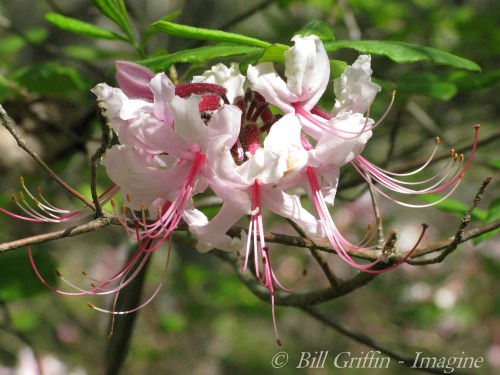
Bloodroot; Sanguinaria canadensis; Mountains-to-Sea Trail above Brinegar Cabin


An offering from Diana Pinckney, her poem . . .

Clapper Rails

Thin, dark flitting invisible
through reedy creeks, these

calls and cackles gleeful
the sun has seeped into trees.

A raucous crowd, near, but not of
the ocean. Who cares if your eyes

ever glimpse a flurry, one or two
fluttering their wings, less graceful

than chickens careening
old barnyards. Marsh hens

natives called them, tracked
and trapped, such poultry

made a foul meal. So tough
no one dared fry or bake.

They ride tides, float eggs in pluff-mud
and shrill black waters. You know

they are close, answering each
other over oyster beds, blue crabs,

every scuttling appetite, the night
grasses alive with hoots rising,

a party you love to be near, not of.

“Clapper Rails” by Diana Pinckney, first published in Wild Goose Poetry Review and collected in Green Daughters, Lorimer Press, © 2011 Diana Pinckney

.     .     .     .     .     .     .

+     +     +     +     +

[original artwork by Linda French Griffin (c) 2021]