Feeds:
Posts
Comments

Season of Waiting


North Carolina Poets for Christmas

Sam Ragan ++++++++.+.+. (1915-1996)
Carol Bessent Hayman ++.+ (1927-2017)
Reynolds Price ++           ++.(1933-2011)
Anthony S. Abbott ++++……. (1935-2020)

.     .     .     .     .     .     .

Winter Watch

In those winter fields
Where only the dead grass
Hides the movement of mice
And the loping fox long away
From hunters, horn and dog,
Walking and watching wind bend
Bare branches at the wood’s edge.
This then is the beginning,
The walk and the waiting,
Winter is a time of waiting,
The pause, the slowed feet,
The watching, the waiting.

Sam Ragan
from Collected Poems of Sam Ragan, St. Andrews Press, Laurinburg NC, © Sam Ragan 1990

.     .     .     .     .     .     .

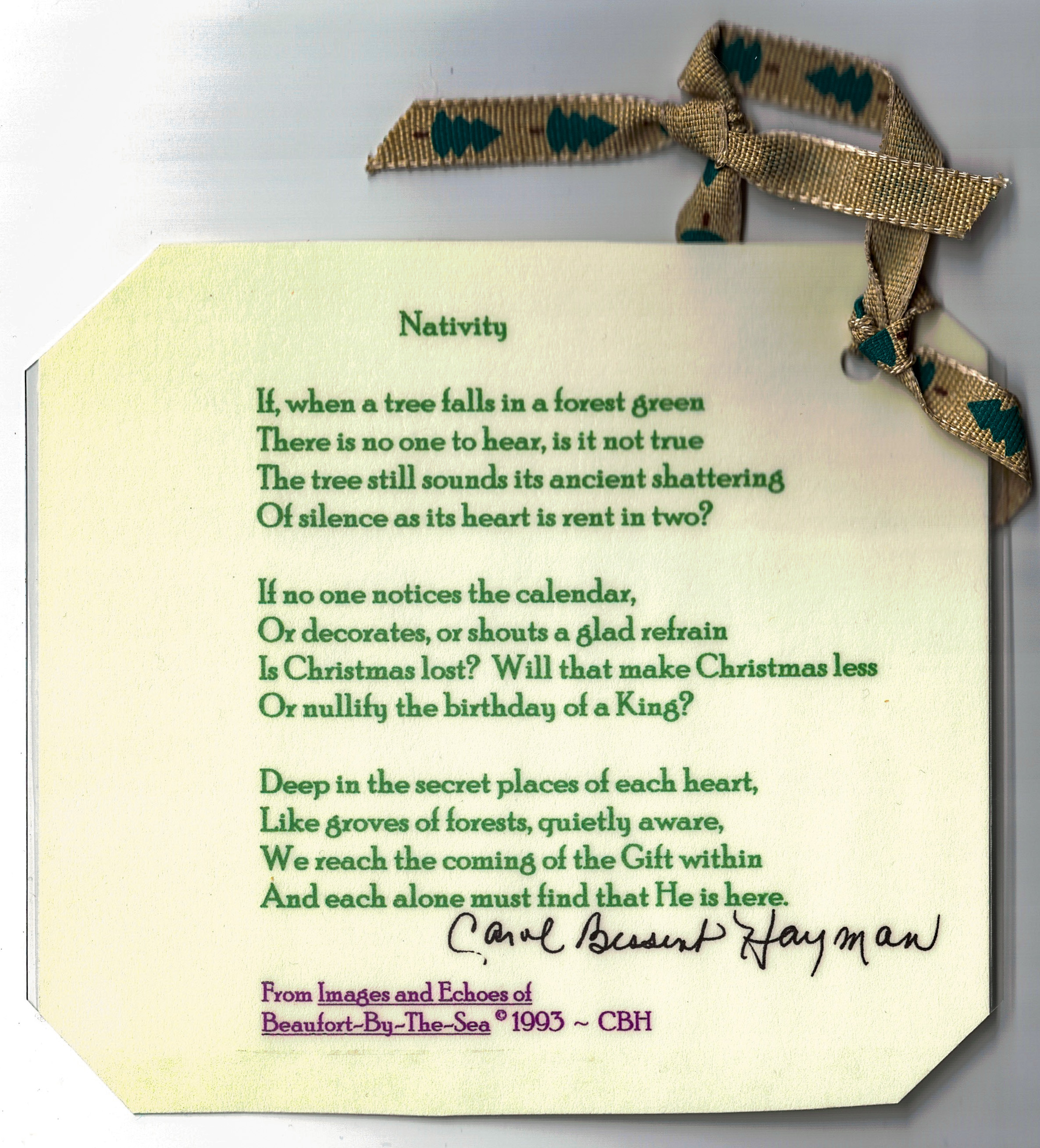
Nativity

If, when a tree falls in a forest green
There is no one to hear, is it not true
The tree still sounds its ancient shattering
Of silence as its heart is rent in two?

If no one notices the calendar,
Or decorates, or shouts a glad refrain
is Christmas lost? Will that make Christmas less
Or nullify the birthday of a King?

Deep in the secret places of each heart,
Like groves of forests, quietly aware,
we reach the coming of the Gift within
And each alone must find that He is here.

Carol Bessent Hayman
from Images and Echoes of Beaufort-By-The-Sea, © 1993 Carol Bessent Hayman
.     .     .     .     .     .     .


A Christmas Night

It was a cold night
And there was ice on the road,
Our car started to slide
As it moved up the small hill,
And the headlights caught the old man
In a thin jacket
Pushing a cart filled with sticks.
There were some bundles and a package
Piled on top, and the old man
Grinned and waved at us
As he pushed the cart
Into the yard of the ligglt house
Where a single light shone.
The tires gripped the road
And we drove on into the darkness,
But suddenly it was warm.

Sam Ragan
from Collected Poems of Sam Ragan, St. Andrews Press, Laurinburg NC, © Sam Ragan 1990

.     .     .     .     .     .     .


A Heron, A Deer – A Single Day

A dull tin noon and, struck down on us
From the crest of pines, a heron – the one
That’s brought me each winter solstice
For twenty-six years now whatever code

I’ve earned for the past year, need for the next:
Vast as a stork in a child’s old reader
And fierce in the head as a demon deputed
To pluck out human eyes in vengeance,
Bolt them down hot.
++++++++++++++++ Yet our two faces
Broaden – eased, assured once more
Of witness at least: our names a precise
Address still known to Guidance Central.

Midnight mist and roaring cold,
We roll toward home from Christmas-eve dinner;
And there in the glen, frozen at the verge,
A six-point buck, young in eye
And grace of joint but flat-eternal
In steady witness. We slow to spare him –
Or think to spare a soulless thing.

He spares us. Sustaining our glare
A long instant of still composure,
His eyes consume whatever we show.
Then in a solemn choice to leave,
He melts a huge body, graceful as girls,
Through two strands ov vicious barbed-wire

We pass unscathed, drive in silence
A last slow mile, then both laugh sudden
At the sight of home. Seen, well-seen
But spared to pass.

Reynolds Price
collect in Word and Witness: 100 Years of North Carolina Poetry, Carolina Academic Press, © North Carolina Poetry Society 1999

.     .     .     .     .     .     .


The New Magi

It is dusk. The sun has tipped backward
behind the old town hall. Inside the patterned
windows of the church, candles not to candles
until it seems the world is only light
and festive voices singing, “Silent Night.”

Out of the dark the siren wails, once,
twice, a third time, and grinding ears
disturb the “all is bright,” while somewhere
in another town a black man in a stocking cap
folds quilts around himself to stop the night.

Out of the dark the siren wails ans somewhere
in another town a woman flushes yesterday’s news
from under the rest room door and a red-haired girl
with shrouded eyes holds out her hand
to strangers walking through the station’s

swinging doors. Where is the star that calls you,
black man? Where is the star that seeks you,
woman? Where is the star that lifts you, shrouded
girl? Walk to us, now, over the battered highways.
Walk to us slowly over the rutted roads.

Walk to the siren’s wail, and the grunting sound
of fire in the night. Throw open the church’s door.
Walk with your papers and your quilts and the sorrow
in your eyes, bringing your gifts past the carpet
of our candles to the manger’s straw. Kneel and turn

And bid us follow with our light up the long aisle
out, out into the grace of the beckoning night.

Anthony S. Abbott
from New & Selected Poems, 1989-2009, Lorimer Press, Davidson NC, © Anthony S. Abbott 2009

IMG_9285

.     .     .     .     .     .     .

In a Bus Station on Christmas Eve

There are still travelers
Even at this late hour.
A radio is playing “Joy To the World.”
They sit and stare,
Clutching packages
Wraped as they are wrapped,
With some of the corners torn

Sam Ragan
from Collected Poems of Sam Ragan, St. Andrews Press, Laurinburg NC, © Sam Ragan 1990

.     .     .     .     .     .     .

Sam Ragan served as NC Poet Laureate from 1982 until his death in 1996. He had a long career in journalism at various publications and from 1969 to 1996 was owner, publisher, and editor of The Pilot in Southern Pines, NC. Sam received about every possible NC literary award, including the North Carolina Award in Fine Arts, the Roanoke-Chowan, Parker and Morrison Awards; the North Caroliniana Society Award; and has been inducted into the North Carolina Journalism Hall of Fame and North Carolina Literary Hall of Fame.

Carol Bessent Hayman was the first Poet Laureate of Carteret County and the city of Beaufort, NC. She was a 50-year member of the National League of American Pen Women, served as Southeast editor for their national publication, The Pen Woman, and was a member of the National Board. She was a member of the founding board of N.C. Writers Network, taught many workshops, and published hundreds of poems and five books of poetry.

Reynolds Price, a native of Macon, NC, taught literature at Duke University for 53 years and was James B. Duke Professor of English. In 1962, his novel A Long and Happy Life received the William Faulkner Award. He went on to publish fiction, poetry, essays, and plays and is equally known as the venerated educator of generations of Duke students. For the last third of his life he was confined to a wheelchair due to paralysis resulting from complications of a spinal tumor; his memoir A Whole New Life: An Illness and a Healing has been an inspiration to thousands.

Tony Abbott was a beloved professor of modern drama and American literature at Davidson University (NC). He touched many lives with his deep compassion and spiritual seeking, not only the lives of his students but of everyone who knew him, worked with him, read with him, read his work. His first book of poems, The Girl in the Yellow Raincoat, was nominated for a Pulitzer Prize. He went on to write three novels, four books of literary criticism, and eight volumes of poetry, his last, Dark Side of North, published posthumously in 2021 by Press 53. His tenure on the Board of Directors of the NC Poetry Society has left an influence of creativity, collegiality, and craft that continues today.

IMG_2548


.     .     .     .     .     .     .


IMG_1827


[with 3 poems from When There Were Horses]

Once upon a time there was a little boy . . . . a frisson of anticipation: the four-year old’s attention is now riveted on Pappy. What mischief will the boy in the story create, what adventure awaits, what danger?

When my grandson used to ask me to tell him a story it was a gift to both of us. Often the stories sprouted spontaneously from our pretending and play, their main characters usually some of his favorite companions like Mousey and Blue Rat. What joy and entertainment when you engage with the characters in a narrative! Even more so if you identify with the characters – their plight, their seeking, their discoveries strike a resonant chord in your own heart. You live a little richer and fuller through them.

But what if you are them?! What if you are the little boy in the story unfolding? What if a door opens and you enter the story and it becomes an extension of your own? The gift the teller gives you in that moment can’t be measured.

So many of the poems in Pat Riviere-Seel’s new book, When There Were Horses, open that door for me. I enter the lines. Not only do I engage, not only identify, but I become a part of the narrative. The resonance moves me to reflect on my own arc, my own plight and seeking. How does that happen?

How does poetry do that stuff? Mmmm, mystery and magic. Art and invitation. I admit I don’t actually know the details or specifics of many of Pat’s narratives but even so I have come to feel a part of them. When I get past asking, “What does she mean by that?” and just enter the flow of how she is creating meaning, then her poems crack open new earth. There, beneath the mud of daily routine, behind the obfuscation of some constant ringing little voice in my head, something waits. Waiting to sprout and bloom. Waiting to sing a new song. Waiting and wanting to peel back all that separates us from each other, and from our inner self. Something is beneath the surface, waiting to break our heart, and to heal it.

.     .     .     .     .     .     .

From the Almanac of Broken Things

I choose this earth that breaks
my heart again and again,

the woods for the way trees
bend, fall, and return to dirt.

I choose the sand dollar, the nautilus
that in brokenness finds new creation.

I choose the favorite doll that no longer cries,
loved into silence, into rags.

I choose the memory of a stranger’s touch
that lifted my face above water. Because

I did not drown, I choose morning,
the gauzy-gray dawn that returns.

I choose the once-wild Palomino
whose beauty can never be tamed.

I choose light from long dead stars
that illuminates without heat.

I choose March with its promise of spring,
the warm days that tease, the blizzard

that insulates and warms the bulbs, the seeds,
all that lies beneath the surface, waiting.

Pat Riviere-Seel
inspired by Linda Pastan’s poem The Almanac of Last Things


.     .     .     .     .     .     .

What the Moon Knows

She knows shadow, how to
slip behind clouds. She’s perfected
the art of disappearing. She knows
how to empty herself into the sky,
whisper light into darkness.
She knows the power of silence,
how to keep secrets, even as men
leave footprints in the dust, try to claim her.
Waxing and waning, she summons
the tides. Whole and holy symbol,
she remains perfect truth, tranquility.
Friend and muse, she knows the hearts
of lovers and lunatics. She knows
she is not the only one that fills the sky,
but the sky is her only home.

Pat Riviere-Seel


.     .     .     .     .     .     .

Enough

Ahead, I see her watching me, pity
or compassion, hard to tell
from this distance. I want to ask her,
my future self, what she knows
and when she knew it. I want to know
whose laughter fills her hours? Does she
still dance? Still run? What does she know
of grace? These days I know so little.

But she’s still faithful, the self I look back
to see at dawn, a quarter century ago,
running out Colbert Creek road between
woods and murmur of the South Toe River, two-lane
Highway 80 South, past Mount Mitchell Golf Course,
down macadam that turns into gravel, clatter across
the low water bridge, out Rock Creek Road,
before she turns toward her dusty driveway,
past grape vines, the garden where the black cat
waits to walk her home. She’s the one who
declared, I am enough. She’s kept her promise.
But now, knowledge brings scraps
falling from bone that offers proof
something happened here in this lost country –
three deaths, one new love.

Pat Riviere-Seel
all selections from When There Were Horses, © 2021 Pat Riviere-Seel, Main Street Rag Publishing, Charlotte NC

.     .     .     .     .     .     .

.     .     .     .     .     .     .

FULL DISCLOSURE: Pat Riviere-Seel is my cousin. Third cousin one generation removed is how I think we figured it. Pat and I first met twenty years ago at a North Carolina Poetry Society meeting at Weymouth Center for the Arts and Humanities in Southern Pines. During a break we were sharing casually about what we’d been doing lately and she mentioned her recent family reunion in Lewisville, NC.

“We met at an old Methodist Church in Lewisville where my Great-Great-Grandfather is buried.”

“No way, we had a family reunion in Lewisville a few years ago and we met at a church, might be the same one, where my Great-Great-Great-Grandfather is buried. His name was J.N.S. Daub.’

“Uh, hmm, mine is named Daub, too. Reverend Daub.”

“I’ve got a photo of the headstone at home. I’ll send you a copy.”

Sure enough, one and the same Daub. That was my maternal Great-Grandmother’s maiden name. Three Daub sisters married three McBride brothers. So Pat and my Mom are third cousins (although separated in age by more than a generation).

All those years, something beneath the surface, waiting.

– – – B

.     .     .     .     .     .     .

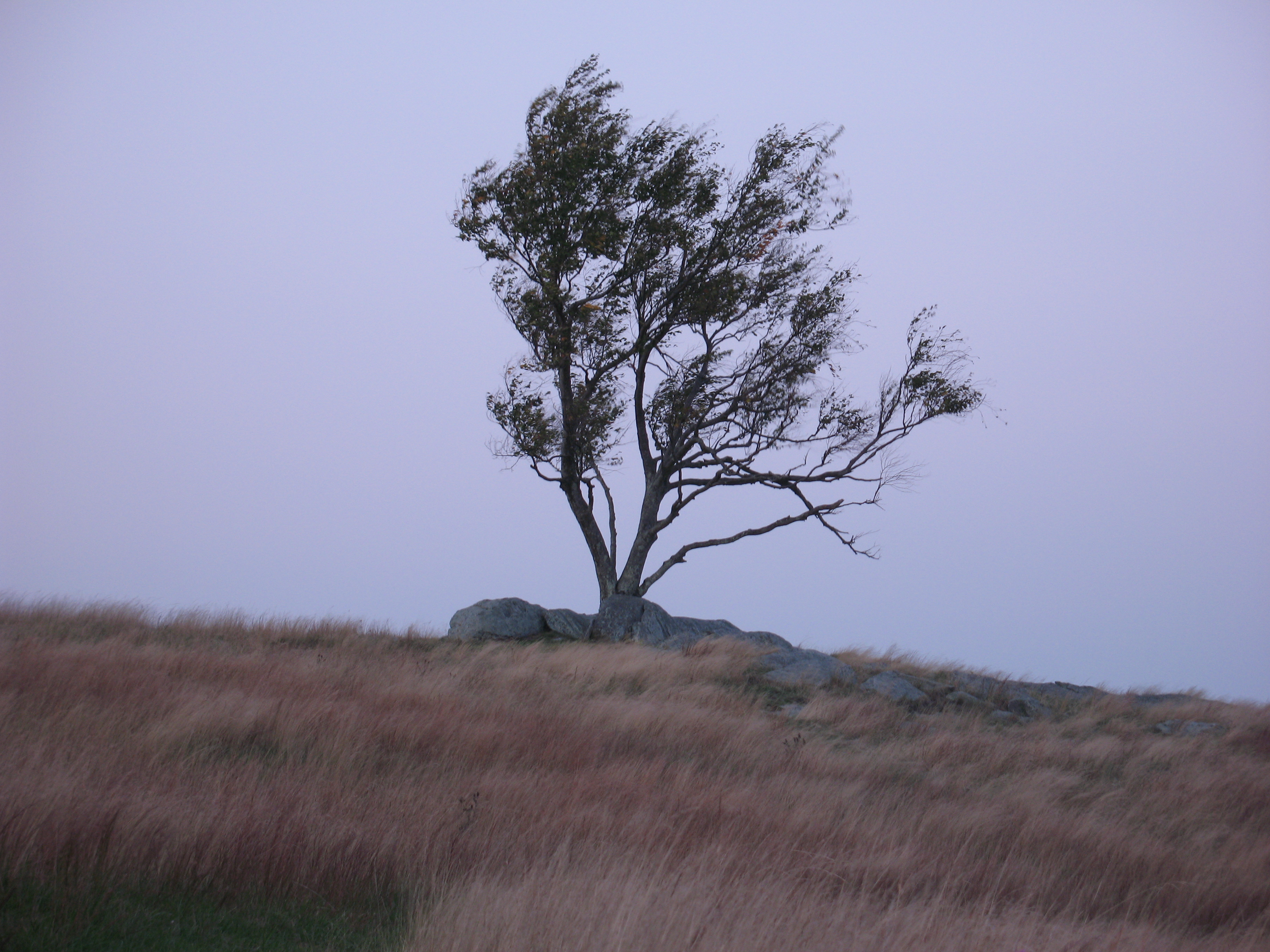
2020-11-03a Doughton Park Tree


Merlin & Kestrel

I thought I saw a Merlin. Facing into the stiff onshore breeze, harrying above the dunes: fierce raptor profile, fleet spitfire, wings cocked at the wrist – falcon.

I wanted to think it was a Merlin I saw, last week at Bogue Banks for Thanksgiving, as it veered away from me, slipped sideways and rolled, master of current and draft. I still wanted it to be a Merlin when it arced back overhead, whirled into a perfect stall, snatched a perch at the tip of the spar where the surf warning flag flies.

It drank some water trapped in a crease of the wood. Tawny waistcoat, single-barred tail, face tattoos – this hunter was not a Merlin. Just its much more common little cousin.

Why did my heart skip when I first spotted it? Why did I want so much for it to be a Merlin? I haven’t seen one in years; I’ve only ever seen a very few. The last time I saw a Merlin, Linda and I were alone together on a rare vacation, January in Nags Head, doing what we love: hiking the dunes and maritime forest and half-freezing ourselves in the salt rime. Driving to Hatteras next day we spotted a Merlin perched above the salt marsh, watchful in regal disdain. Merlin – rare visitor from the mysterious north. Merlin, power and magic. Merlin mythic. Merlin romantic.

Is it just its name that makes it so? Falco columbarius per Linnaeus, Esmerejón in Spain and Mexico, Dværgfalk in Denmark and Norway, 55 names listed in Cornell Ornithology. Learning its name accompanies learning its field marks, habitat, range. But what do I really know about Merlin? How to read shifting wind while stalking the wood rat a hundred yards below? Folded wings, little rocket, full velocity strike , blood and hair? What name, Dream Hunter, do you give yourself?

We see the Merlin’s little cousins all the time here in the NC foothills, especially in winter perched on wires above the mouse-gleaned fields. I saw one driving home from the beach. Actually, four. And last week my brain knew what I was seeing above the strand even before my eye would admit it, even before it swooped in for me to take closer look . . .

. . . and turned upon the current of air. Watchful for movement in the sand, ultraviolet signature of mouse urine, it raised its wings, their sharp fast flutter, fixed, motionless on high. Only one little falcon can do that. And I know its name.

.     .     .     .     .     .     .

The Windhover
Gerard Manley Hopkins – 1844-1889

I caught this morning morning’s minion, king-
++ dom of daylight’s dauphin, dapple-dawn-drawn Falcon, in his riding
++ Of the rolling level underneath him steady air, and striding
High there, how he rung upon the rein of a wimpling wing
In his ecstasy! then off, off forth on swing,
++ As a skate’s heel sweeps smooth on a bow-bend: the hurl and gliding
++ Rebuffed the big wind. My heart in hiding
Stirred for a bird,—the achieve of; the mastery of the thing!

Brute beauty and valour and act, oh, air, pride, plume, here
++ Buckle! AND the fire that breaks from thee then, a billion
Times told lovelier, more dangerous, O my chevalier!

++ No wonder of it: shéer plód makes plough down sillion
Shine, and blue-bleak embers, ah my dear,
++ Fall, gall themselves, and gash gold-vermillion.

[This poem is in the public domain.]

.     .     .     .     .     .     .

.     .     .     .     .     .     .


Windhover is a British name for the European Kestrel, Falco tinnunculus, a dead ringer for its close relative the American Kestrel, Falco sparverius. They are the smallest of the falcons and one of the very few birds that can hover motionless in still air, in this case watching for its usual prey, the field mouse.

The Windhover has long been one of my favorite poems. Oh my, where does this magical and mysterious language come from?! What hidden realm is revealed in these lines? Read it aloud to hear Hopkins’s incantatory music. How does he do it?

One of my most striking memories is the Saturday morning Tony Abbott recited The Windhover at Weymouth Center for the Arts and Humanities to call to order a meeting of the North Carolina Poetry Society. As he approached its last line Tony slowed , each word deliberate, and upon gash gold-vermilion there was one unified sharp intake of breath among the entire congregation before we erupted in applause.

Gerard Manley Hopkins was a Jesuit priest; he dedicated The Windhover To Christ our Lord. The poem, like the fierce undaunted Kestrel, breaks open the blue-bleak embers of our dull, unreflective spirits to reveal the fire, the power, and the glorious mystery of creation which surrounds us.

[more Gerard Manley Hopkins at The Poetry Foundation]


.     .     .     .     .     .     .

.     .     .     .     .     .     .

2019-02-09 Doughton Park Tree