Feeds:
Posts
Comments
 . 
April 17, 2024
 . 
While calling ourselves intelligent, we’ve lost touch with the natural world. As a result, we’ve lost touch with our own souls. I believe we can’t access our full intelligence and wisdom without some real connection to nature.
I think of soul as anything’s ultimate meaning which is held within. Soul is the blueprint inside of every created thing telling it what it is and what it can become. When we meet anything at that level, we will respect, protect, and love it.
++++++ Richard Rohr
 . 
❦ ❦ ❦
 . 
This Hill
 . 
this hill
crossed with broken pines and maples
lumpy with the burial mounds
of uprooted hemlocks (hurricane
of ‘thirty-eight) ++ out of their rotting hearts
generations rise trying once more
to become the forest
 . 
just beyond them
tall enough to be called trees
in their youth like aspen++ a bouquet
of young beech is gathered
 . 
they still wear last summer’s leaves
the lightest brown almost translucent
how their stubbornness decorates
the winter woods
 . 
on this narrow path
ice holds the black undecaying
oak leaves in its crackling grip
oh ++ it’s become too hard to walk
++ ++ ++ a sunny patch ++ I’m suddenly
in water to my ankles ++ April
 . 
Grace Paley (1922-2007)
from Fidelity, Farrar, Straus, and Giroux © 2008
 . 
Shared by Joan Barasovska, Chapel Hill NC, who writes:
 . 
I’m precisely connected to this poem in several ways. Grace Paley grew up in New York City — I grew up in nearby Philadelphia — but writes occasionally about her connection to the natural world, as I do. I live in a wooded area, and although the trees surrounding me aren’t birches or aspens, in mid-March they are bare and some “still wear last summer’s leaves.” When Paley wrote “This Hill” she was an older woman, and walking in the woods was becoming difficult, though the desire was there, all true for me.
 . 
++++++ Joan
 . 
 . 
The Day I Walked on Fire
 . 
it wasn’t fire
it was ginkgo leaves
the sun lit them yellow
they were juicy with heat
 . 
the day I walked on ginkgo leaves
I imagined they were fire
that my shoes were melting
that my feet were burning
 . 
and I felt no pain
on that autumn day
when I burned to be
a holy woman
 . 
Joan Barasovska
from Orange Tulips, Redhawk Publishing, © 2022
 . 
IMG_1677.jpg
 . 
❦ ❦ ❦
 . 
When power leads man toward arrogance, poetry reminds him of his limitations. When power narrows the areas of man’s concern, poetry reminds him of the richness and diversity of his existence. When power corrupts, poetry cleanses.
++++++ John Fitzgerald Kennedy
 . 
❦ ❦ ❦
 . 
Trees
 . 
I think that I shall never see
A poem lovely as a tree.
 . 
A tree whose hungry mouth is prest
Against the earth’s sweet flowing breast;
 . 
A tree that looks at God all day,
And lifts her leafy arms to pray;
 . 
A tree that may in summer wear
A nest of robins in her hair;
 . 
Upon whose bosom snow has lain;
Who intimately lives with rain.
 . 
Poems are made by fools like me,
But only God can make a tree.
 . 
Joyce Kilmer (1886 – 1918)
https://poets.org/poem/trees; this poem is in the public domain
 . 
Shared by Dee Neil, Elkin NC, who writes:
 . 
We recited this poem every day in Mrs. Black’s first grade class and I have always loved it. I was supposed to go camping there [Joyce Kilmer Memorial Forest in western North Carolina] with my son’s family last summer, but I fell and broke my arm the week before we were scheduled to go. Still on my bucket list for this year. This is on the back of a hiking journal my daughter-in-law made for me for the trip.
 . 
++++++ Dee
 . 
❦ ❦ ❦
 . 
Paying attention is a form of reciprocity with the living world, receiving the gifts with open eyes and open heart. 
++++++ Robin Wall Kimmerer
 . 
Margaret&Birds
 . 
❦ ❦ ❦
 . 
Banding Hummingbirds 
 . 
+++ San Pedro River, Arizona
 . 
+++ +++ I, who know nothing of ornithology,
wear sticker number nineteen. This release,
the last of the day, is mine. Under the awning
the ornithologist at the table puts a straw to her lips
and blows, parting the feathers to check for mites.
There are mites.
 . 
+++ +++ She cradles the bird in one hand,
sexes it, names the species (Anna’s), and figures
the approximate age. Places it in a miniature sling
and weighs it, wraps the metal band around one leg.
I walk over to the designated grassy area,
both hands in my pockets.
 . 
+++ +++ +++ The day is raw.
When it’s time, I hold out a palm, now warm.
The assistant fits the tubes of a stethoscope
to my ears, pressing the disc against my bird.
I hear a low whir, a tiny motor running in my hand.
Up to twelve hundred beats a minute, she says.
 . 
+++ I, who know so little,
barely take a breath. My bird’s head is a knob
of red iridescence on the fleshy pad of my hand.
I am nothing but a convenient warming bench,
yet for now I am that bench. Warm.
His breast is thin-bone hollow, she says,
 . 
+++ +++ where he should be round.
His eyes dark and still, his feet tucked
behind his body. He lies there, that tiny motor.
I don’t think of years ago, my mother, my father-
those I loved who, having lain down, never rose up.
For once, I know the worth,
 . 
++++++ at least to me.  What I don’t know
is whether this bird in hand will rouse
the way he did earlier, pinched between thumb
and index finger and tipped toward a feeder,
when he drank with conspicuous hunger.
You could see the tongue.
 . 
Susan Laughter Meyers
from My Dear, Dear Stagger Grass, Winner of the 2012 Cider Press Review Editor’s Prize
 . 
Shared by Richard Allen Taylor, Myrtle Beach SC, who writes:
 . 
I was wracking my brain and finally it occurred to me to look on my bookshelf for Susan Laughter Meyers’s My Dear, Dear Stagger Grass. There are actually several poems in the book that might be candidates for Earth Day, but I was especially attracted to this one for several reasons. It reminds me that sometimes you can tell the story through the images (even if literal) rather than trying to “explain.” (I need to be reminded of that every day, it seems.) The poem has a little mystery. (Why are they banding the hummingbirds? Do the mites present a danger to their health? Are the bones in the chest supposed to be hollow or has the bird been sick? I’ll have to look this stuff up or else I won’t sleep tonight.) 
++++++ Richard
 . 
❦ ❦ ❦
 . 
. . . when man and nature
got married they agreed never to divorce although
they knew they could never be happy & would have only
the one child Art who would bring mostly grief
to them both . . .
++++++ Firewood, Midquest, Fred Chappell
 . 
 . 
❦ ❦ ❦
 . 
To celebrate EARTH DAY 2024 we are featuring seven posts of poems submitted by readers – poems by William Blake to Walt Whitman, Robinson Jeffers to A.R.Ammons to Linda Pastan, and by a number of contemporary poets. Check in every day or two – connect to the earth and to each other!
 . 
❦ ❦ ❦
 . 
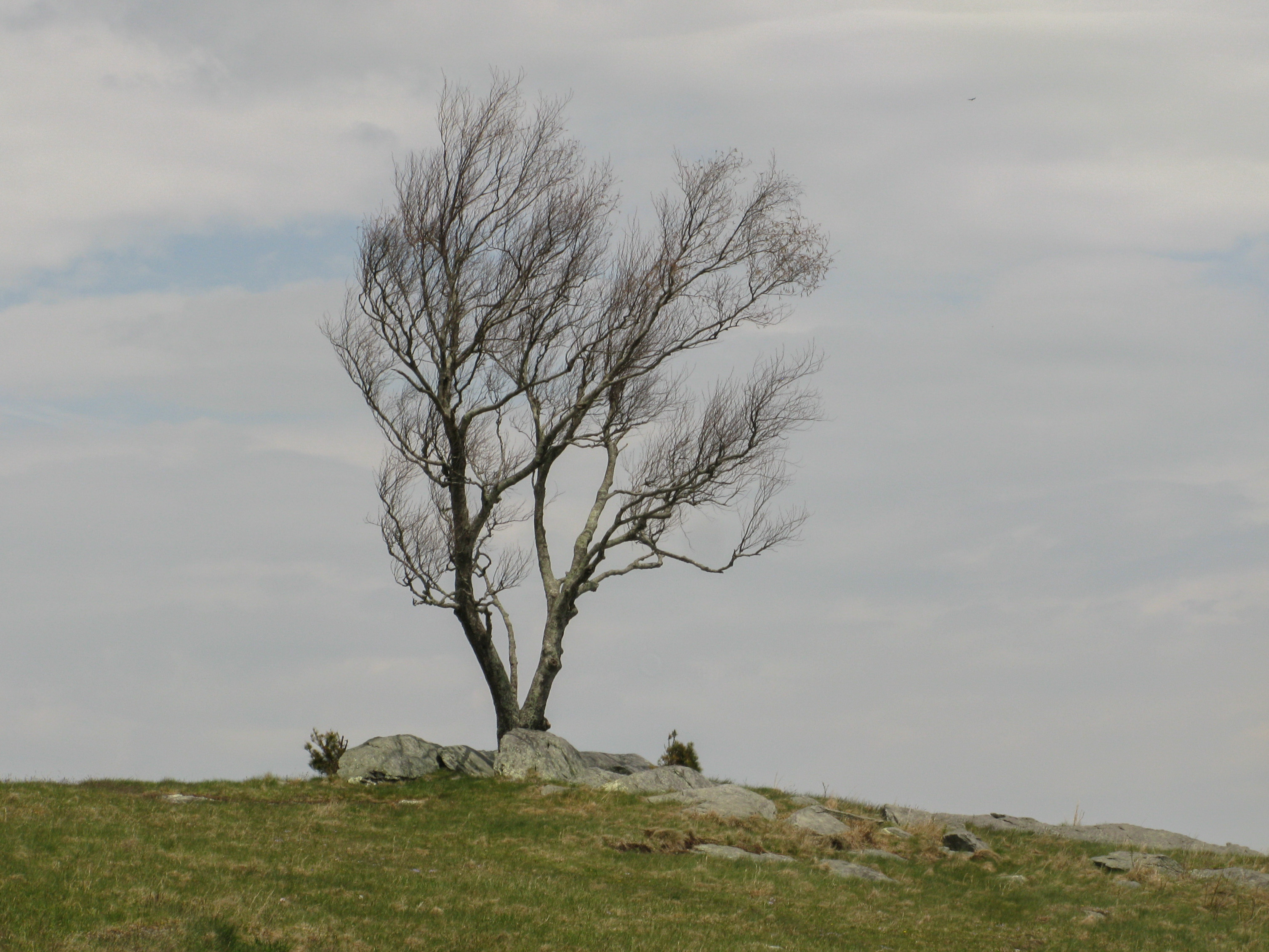
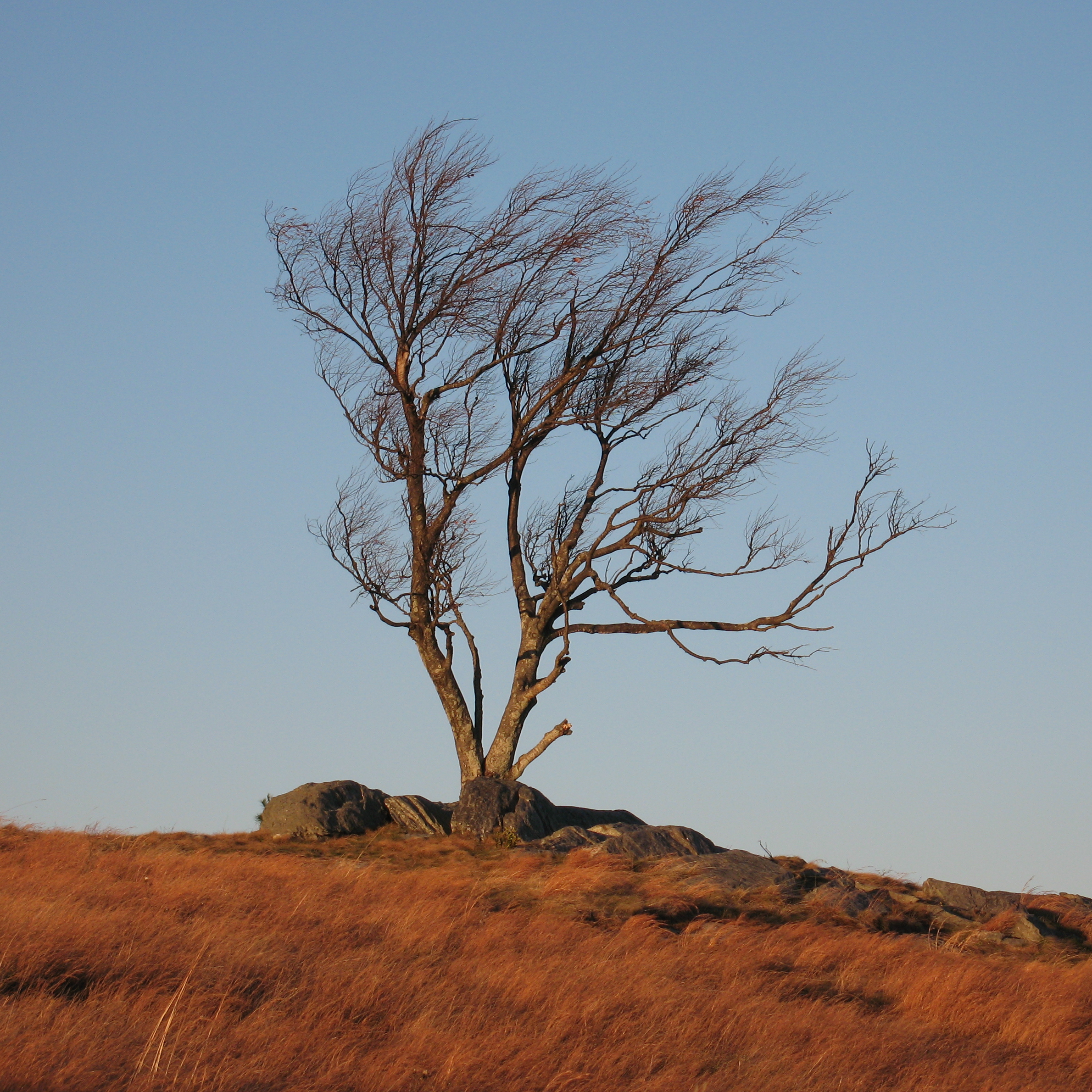
Doughton Park Tree 2021-10-23
 . 
 . 
 . 
April 15, 2024
 . 
In the end we will conserve only what we love.  
+++ We love only what we understand. 
++++++ We will understand only what we are taught.
+++++++++ Baba Dioum, Senegalese environmentalist
 . 
Everyone enjoys the smell of earth after rain. No one wants to cough every breath.
Everyone thirsts for a drink of cool water. No one wants to sicken from drinking it.
Everyone needs bread. No one wants to go hungry.
 . 
On April 22, 2024 every human being will wake up on the only planet where humans can live (well, not counting a handful of folks waking up on the International Space Station). Seems like cause enough to celebrate! To be honest, though, the threat of what we have lost and are losing so often seems much greater than the joy of what we have saved and are preserving.
 . 
How far have we come since the first Earth Day in 1970? It was just eight years earlier that Rachel Carson published Silent Spring, the wake up call to industrial pollution and the poisoning of the earth. In 1970 there was no Environmental Protection Agency, no Occupational Health and Safety Administration, no Clean Air Act or Clean Water Act. When we protested air and water pollution, we had little inkling of the even greater threat; we couldn’t imagine needing an Intergovernmental Panel on Climate Change.
 . 
Twenty million Americans marched, demonstrated, and celebrated that first Earth Day. Ten percent of the nation’s population. I was a junior in high school photographing our events for the year book: carrying a coffin through the parking lot to signify the dying planet. Earth Day is now celebrated in 193 countries; one billion people are expected to commemorate Earth Day 2024. That still leaves some eight billion to get on board. Legislation and politics won’t take us there. In the end we will conserve only what we love.
 . 
❦ ❦ ❦
 . 
I think it pisses God off if you walk by the color purple in a field somewhere and don’t notice it. People think pleasing God is all God cares about. But any fool living in the world can see it always trying to please us back. . 
+++++++++ Alice Walker, The Color Purple
 . 
 . 
❦ ❦ ❦
 . 
The Field Index
Abandoned field, Orange County, North Carolina
 . 
Asters: lesser stars in these constellations, for the native bees, late-summer smatterings of a color I might call blue, blue petals and fireworks along the margins of the track, and
 . 
broomsedge, bluestems: stooped in the fall and shimmering, shivering in the wind, spinning out seed, bird fodder, tangled (insert here) into brambles, blackberries, this year’s, last year’s canes knotting and weaving, and
 . 
crabgrass: crabby claw and crab leg of a herb: edges into the wilding mint and onion grass, the tall stands of raggedy, wing-stemmed (my favorite) crownbeard gone to seed, where I am with my small dog, and
 . 
dogwood: not here yet, but it will come; also redbud (q.v.) and holly; the birds will bring it, in their guts, its white bracts and inconspicuous flowers, its small understory leaves will open and turn into the sunlight, before the canopy leafs out and shades
 . 
exotics: migrants, stowaways and hitchhikers, too much at home; see invasives, stiff-stemmed privet with its small dark leaves, and the clustered graceful arcs of autumn olive, honeysuckle vines, dead stiltgrass flopped into heaps, good for nothing except time
 . 
ferns: rise and unfurl like our letter f, old as fossils, here before letters and fiddles and bows and Michaux and his acrostics, first and last green under the trees, with
 . 
ghost plants: the ancestors, clusters rising from damp, unsunned patches of leaves along the margins of wood;  also: smatterings of green-and-gold, the droop-headed goldenrod
 . 
honeysuckle: announcing itself in scent on the wind and winding up and around the living and the dead: colors coral (see natives), creamy white curling to yellow (see exotics)
 . 
invasives, see exotics; index of vexed and vicious cycles; see also, kill
 . 
jaywalkers: I, alive, among others, on and off the old farm road, on pirate paths, seed-spreader, compacting soil, alarming insects and deer, stealing berries and sprigs and twigs and clumps of lichen or moss, colored leaves, I
 . 
kill: by ice and drought, sapsuckers, larvae, blight, competition, succession (it happens, why do I grieve?), deer rub and browse, humans; see jaywalkers
 . 
loblolly pine: its spiny cones and bundles of three long needles green, or fallen and draped in the shrubberies; aka oldfield pine, straight up, above all, old-meadow native homesteader in the lobby-lolly soil of this wide floodplain
 . 
milkweed: var. swamp milkweed, its pink inflorescence and faint scent, drawing monarchs among butterflies and pollinators, queen of weeds, fecund, its large brittle-dry pods burst and spewing cloudy seed over the bewilding meadow
 . 
 . 
natives: as in, before our time here, before this language and its metaphors and usages, before people, and which we watch with sorrow as they fall back and dwindle, are cut down; see exotics, see
 . 
oaks, passim, and Osage orange, spiny along the branch bank, its large green nobble-skinned fruit fallen in the path and long grass, bitter, slow to blacken and rot, unscavenged by all but small seed-eaters
 . 
persimmon (native), privet (not; see exotics): one, provender for all comers, all creatures, i.e., small bell-shaped flowers, small sweet ripe fruits; the other just minding its own business, i.e., to thrive
 . 
Queen Anne’s lace: umbels and fine-cut leaves, branching stems, aka wild carrot and medicine, queen unknown and from elsewhere, and the lace medallions for her bodice and gown, for her headdress, her cuff, all scattered to the people (winged and crawling insects), self-seeding
 . 
red cedar: modest, upright, native, pioneer in this process of succession, spindle of evergreen and scent rolled between the fingers (here I am again, breaking the rule of no taking and leaving of souvenirs); and redbud: see understory, flights of pink-purple blossom in the spring woods, pleiades, announcing light and wings again, after all that
 . 
stiltgrass: Japanese, Microstegium vimineum, in summer blithe, feathery and green under the trees over creeper and grass, but poor food, tick haven (see exotics; see also  jaywalkers); and sweetgum: all over this old field, native and opportunistic, prolific and prodigal, Liquidambar of the spiny round seedhead and star-shaped, lobed leaves, their margins calling to mind (my mind) calligraphy or the gestures of dance, delight of form that is mutable and has prickly edges, deliquescence, decadence, a nuisance, really
 . 
tulip tree: tulipifera, the saplings standing here and there, innocuous, like any other small tree, but give them time, they’ll rise; the yellow-and-pale green petals of their flowers say in English “tulip,” the Tutelo-Saponi name lost, yellow-green the heartwood, yellow the leaves in fall, and early to fall
 . 
azalea
 . 
understory: native holly and redbud and dogwood, parsimonious and irregular in habit, sparse fruit, sparse flower; now also autumn olive, privet, and exotic forbs and grasses, the introduced and naturalized, myself and dog under the canopy
 . 
vines: Virginia creeper, close-to-ground native; grape vine, gangly fox grape, looping and loping up branch and stem, dbh often equal to small trees; poison ivy, not the inconspicuous three-leaved forb of the northlands, but (learn this, human) rampant, thick-stemmed, hairy vine, stuck fast to the trunks of trees
 . 
winged elm: small tree of delicate, dry stem, and long, corky flanges along its branches; old (to my eye) before it’s old, strange (to my eye); unknowable why those wings
 . 
x: Xanthium through Xyris in Radford’s Manual, as in chicory and the yellow-eyed grass; also, a sign for canceling and for marking you are here, this is the place, this, my mark, my thumbprint
 . 
yellow poplar: see tulip tree and weep
 . 
zigzag: of silk in the web of the orb-weaving spider, homespun look-at-me and distraction, quirk among zoologies of abandoned gardens and meadows; zee, zed, the end of bee flights and alphabets
 . 
Maura High
 .
 . 
Notes:
Acrostic: Med. Lat. acrostichis, from Gk. akrostikhis, from akros“at the end, outermost” (from PIE root *ak– “be sharp, rise (out) to a point, pierce”) + stikhos “line of verse,” literally “row, line,” from PIE root *steigh- “to stride, step, rise” [Online Etymological Dictionary]. The Christmas fern’s botanical name is Plystichum acrostichoides (Michaux) Schott.
André Michaux (1746 –1802), French botanist, author of Flora Boreali-Americana (1803; “The Flora of North America”), made at least five visits to North Carolina.
Loblolly: Pinus taeda, From Wikipedia: The word “loblolly” is a combination of “lob,” referring to the thick, heavy bubbling of cooking porridge, and “lolly,” an old British dialect word for broth, soup, or any other food boiled in a pot. In the southern United States, the word is used to mean “a mudhole; a mire,” a sense derived from an allusion to the consistency of porridge. The pine is generally found in lowlands and swampy areas.
Manual of the Vascular Flora of the Carolinas, by Albert E. Radford, Harry E. Ahles, and C. Ritchie Bell (Chapel Hill: University of North Carolina Press, 1968). Commonly known as Radford.
Pleiades, Gk., perhaps literally “constellation of doves” from a shortened form of peleiades, plural of peleias“dove” (from PIE root *pel-“dark-colored, gray”) [Online Etymological Dictionary].
 . 
Shared by Paul Jones, Chapel Hill NC, who writes:
 . 
Maura High knows her field from A to Z. She sings individual songs of the particularity of the place so clearly and precisely that we learn and love the place as she does. Field Index is an ideal field guide to place and the places of nature that compose this quilted lively patch of our earth.
 . 
Every day as I walk my own favorite patch of the planet, Merritt’s Pasture and Morgan Creek, I keep Field Index in mind as a guide that shows how to attend to this world and to prepare for the next.
 , 
+++++++ Paul
 . 
 . 
On an Okra Flower
 . 
A pollinating wasp sliding
from white lip to purple darkness,
the shadow-heart so deep inside,
the plant, itself, tall African
in the kitchen garden’s last row,
speaks of passage and endurance,
those far too common abstractions,
made real here in the summer heat.
 . 
Let it lead us, serve as a guide,
tell how each struggle leads to bliss
and what to bless when we decide
to see the past and present blend
into what we need to know
– a mind aware or in a trance? –
what to keep close, what to shun
made real hear in the summer heat.
 . 
What song can a wasp sing gliding
the flower’s dark throat? A long kiss
like winged tongues tangled deep inside –
a blind passion, an obsession.
I hear it as a prayer now,
music for the world’s whirling dance.
Sound, sight and scent. An orison
made real here in the summer heat
 . 
Paul Jones
from Something Wonderful, Redhawk Publications, Hickory NC, © 2021
 . 
❦ ❦ ❦
 . 
A man’s feet must be planted in his country, but his eyes should survey the world.
++++++++ George Santayana
 . 
To celebrate EARTH DAY 2024 we are featuring seven posts of poems submitted by readers – poems by William Blake to Walt Whitman, Robinson Jeffers to A.R.Ammons to Linda Pastan, and a number of contemporary poets. Check in every day or two – connect to the earth and to each other!
 . 
 . 
Doughton Park Tree 4/30/2022

Signature

 . 
[with 3 poems from Visions International]
 . 
The Tending
 . 
Each day made a play for eternity then,
just as now each day shrinks
to a blurry moment’s recall. But still
there is the flat porch roof where a child
would lie down to watch
the clouds slowly changing shape,
 . 
or the blue, unfathomable sky
opening over, and puzzle where he was
before birth, before conception,
or if the world of sensation
had wiped his angel memory.
Cypress-tree shadow reached, as they
 . 
still do, across the lawn at evening,
and again I twist backwards
through a wooden sash window
into the long unoccupied bedroom
of my parents. Old clothes,
a straw-hat clinging to a wall, a stopped
 . 
alarm clock on the mantel.
And here, a navy-striped bolster,
the dent left by their sleeping heads
imagined as touchable still,
the love between us arguing against loss,
the tending they brought
 . 
to each sadness and terror of thought,
but more to an obvious wound –
the skinned knee dabbed
with Dettol; a beaker of oatmeal tipped
into a cold bath as a salve
for sunburn; a sewing needle squeezed
 . 
from a pin cushion bristling
with needles, the small hand held
forward into light, the gentle, tortuous
teasing out of a thistle thorn
and this placed – a charm,
frail tiny, golden – on the child’ palm
 . 
Patrick Deeley – Dublin, Ireland
 . 
❦ ❦ ❦
 . 
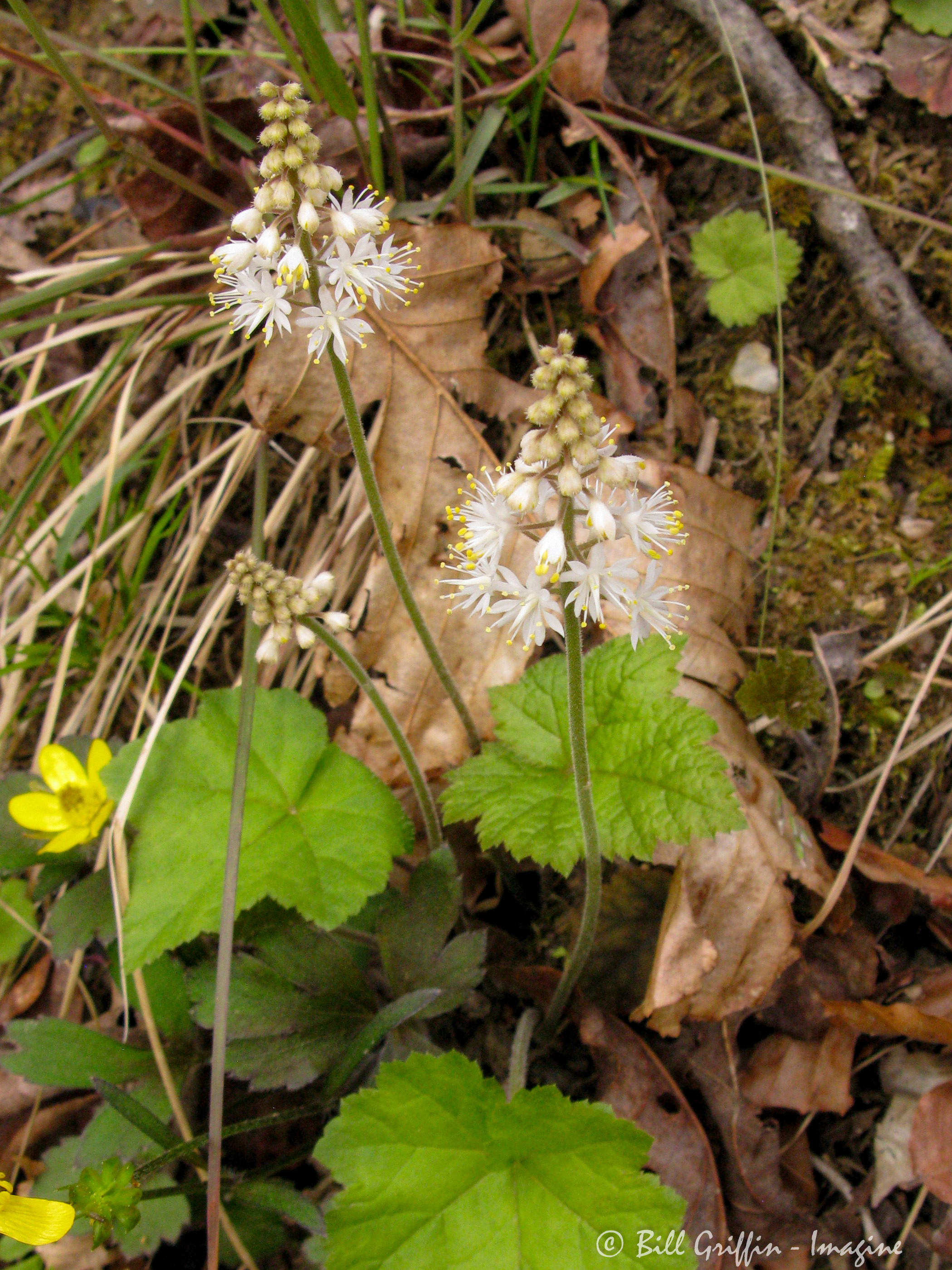
Foamflower
 . 
The last day of March – at the edge of the woods red maple, always impatient, always profligate, spreads its arms to offer a jillion winged seeds, the fire at its twigtips cooled to pale smolder. Deeper beneath the canopy leafbuds are swelling on oak and hickory, tangible pressured suspense, not yet quite to bursting. Ephemerals race to make sugar from thin sunlight before the overstory closes and their beds grow dark. Trout lily and hepatica already bloomed out; bloodroot roaring full throat; rue anemone flinging itself in galaxies up the ridge.
 . 
And what’s this? Foamflower has poked its first slender finger up between last year’s coppered leaves. A pale nubbin, a lifting spike, two or three then tomorrow a full maypole of tiny florets to comprise the rising inflorescence. Tiarella cordifolia, little crowns with heart-shaped leaves. What is its occupation in this temperate glade? What does it promise me other than its beauty?
 . 
Has it promised me anything? Should it? Perhaps I can tell you a story about the company foamflower keeps in this beech-dominated neighborhood: pussytoes, star chickweed, the throng of early blooming companions. Perhaps I’ll kneel to discover its native bee pollinators or wonder how its minute seeds disperse themselves. I might even recognize these felsic outcroppings and recall its family name, Saxifrage, Stone-breaker. But Lord of creation, save me from asking, “What good is it to me?” Expect a poultice of its leaves to heal my burns and scalds? Brew a tea to soothe my mouth and brighten my eye? Shall I read in its signature only whatever good use I can make of it?
 . 
On the seventh day the Lord looked out upon everything created and declared, “It is good!” And then rested. Never let me rest until I have looked around me, all around, water and stone, flower and tree, worm and beetle, turtle and bird, each of them good, in themselves and of themselves. Each one living usefulness that comprises its own being. What is my occupation in this temperate glade? What may I promise all these that surround me? To be a good companion in the community of all.
 . 
 . 
❦ ❦ ❦
 . 
O Doves
(Lima, Peru, 6 am)
and he saw the Spirit of God descent like a dove . . . Matthew 3:16
 . 
Shy ones, the shades of buttermilk
and cirrus cloud,
 . 
forgive the man and woman
cursing the scrabble of your bones on the
bedroom window ledge.
 . 
They are harried creatures
waking out of sleep’s egg
to the greasy clot of day.
 . 
They know only hunger,
which is the world’s stark treason,
 . 
and the mockery of iridescent necks
pecking the gray flagstones for crumbs.
 . 
How can they love the immaculate
cooing of your beaks so high in the blue air,
 . 
having forgotten the signs
of invisible things?
 . 
Maria Rouphail – Raleigh, North Carolina, USA
 . 
❦ ❦ ❦
 . 
the gilded angel on the spire / draws the sun to its dewy face
 . 
landscapes advance / and dig their hooks in the elongated shadow/ you drag behind you
 . 
a child’s sleep soothed by rain’s ticking / on the other side of the earth
 . 
an accordion of hands fixing my hair
 . 
I smooth my quilt, where her dress scraps are stitched
 . 
a pair of wired gold rim glasses / like John Lennon’s
 . 
the water above the springs squeaks like pebbles
 . 
Here is the plain brown envelope with the hand-printed address and the Pete Seeger postal stamp. I slip out the slender booklet, cardstock cover illustrated by Malaika Favorite. Inside a listing of poems and their poets – Bulgaria, North Carolina, Wales, Macedonia, Texas, Ireland. And then the saddle-stapled pages, their lines wandering in the familiar, distinctive font, and the words . . . language . . . images.
 . 
After reading many issues of Visions International over many years, I still wonder how editor Bradley Strahan draws these voices to him. How he creates this international community of human soul. I wonder how he accomplishes it, but I may be learning a bit of what he is listening for, what he seeks and chooses as he compiles each collection. Even more compelling than the stories the poems tell are their images: elemental, bedrock, true. I read phrases that ring with harmonies I’ve never quite heard before and yet they strike as perfectly right and correct. The language is new and yet it enters me and becomes me. (And I have to confess, there is just something about those Irish poets.)
 . 
Here are old neighbors, like Maria Rouphail from Raleigh and Jessie Carty from Huntersville, but here are my new old neighbors from every corner of the earth, all drawn together through their poems. Drop Bradley a line and join the community.
 . 
Visions International / 309 Lakeside Drive / Garner, NC 27529 – 4 issues = $25
 . 
 . 
❦ ❦ ❦
 . 
Drive
. . . roll down the window, and let the wind blow back your hair.
+++ – Bruce Springsteen, Thunder Road
 . 
My first love and I would circle the Blue Ridge
listening to Thunder Road, caught in a spiral –
the song, the earth, and us – a springboard
for leaping. Ancient and settled,
those mountains, a silhouette absorbing music
from our high school parties at the VFW.
Moths and gnats reduced to a fever
clouding porchlights, while kissing was its own
stratosphere. Who needed to breathe anyway?
Not when you’re a new mythology
sharing sixpacks of beer and meadows jacked
in the sweet everlasting – a wildflower
native to the state from which we’d grown.
We kept the geographies of each other’s
bodies beneath our tongues, but the sky
was an impossible parallel. Never mind that
we craved nothing linear. He and I, divergent lines,
a palm reader would have said about the future,
lanterning us in, cloud-swept from the open road.
W didn’t we marry at eighteen, honeymoon
nearby at the Peaks of Otter like all the other
teenage brides? You never asked me if I wanted to
stop. The truth is, I didn’t. I needed to witness
the horizon unobstructed by mountains
where trees shook colors from their crowns,
their roots tangled in bedrock. It was
something of a dance, the way our feet flew
over tar and gravel, spun around blind turns.
The valley that had fevered and pushed us out,
lay spent and sprawled beneath the open windows.
Those nights we rumbled through, we left nothing
but music growing fainter until it was gone.
 . 
Laura Ross – Mount Dora, Florida, USA
 . 
❦ ❦ ❦
 . 
 . 
 .