Feeds:
Posts
Comments

How Do Crayfish Taste?

Upload Burrowing Crayfish, Cambarus dubius

[with poems by Lesley Wheeler and Bill Griffin]

How? Crayfish taste with their skin. Well, not skin precisely: cuticle is what their carapace is called, their shell, made of chitin. (Read to the end for a science geek discussion of chitin vs. keratin.) It’s hard and it’s tough but it has chemoreceptors that detect dissolved molecules. With their skin, crayfish taste the water. Or smell it.

Taste and smell, inseparable as yeast and flour. Apart only mildly interesting, but mix them together and suddenly it’s 1979, Durham, that little red house on Green Street, waiting at the table with your toddler for hot bread from the oven. Or if you’re Crayfish maybe a tasty caddisfly larva. Or perhaps that taste/smell is Otter on the prowl and it’s time to find a rock.

This big guy (guy: we have our ways of knowing these things, though we don’t like to pry when those pincers are cocked) is possibly an Upland Burrowing Crayfish, Cambarus dubius. Yes, he really is blue; I swear I didn’t touch the hue sliders. (Read to the end for a science geek discussion of crustacean blueness). He was tooling across the level patch near the creek below our house where the Sewer Authority crews clear a path to check their access ports. Lovely spot for a walk, although you might catch the occasional whiff of fabric softener lightly swirled with hydrogen sulfide and anaerobic bacteria. Poop perfume.

Ah, ineffable links, scent and memory. Strolling down the aisle at Food Lion I pass the Downy and my olfactory bulb & hippocampus spark to tell me I’m hiking beside the autumn creek. And look! A Crayfish!

Mountains-to-Sea Trail with Sassafras; near Elkin, NC and Isaac's trailhead

.     .     .     .     .     .

I don’t believe I’ve missed reading an issue of Cave Wall since its inception. Editors Rhett Iseman Trull and Jeff Trull never fail to craft a collection that sparks neurons I’ve been neglecting. In the same way that a forgotten aroma can open a memory door into all the senses, a poem can flash and growl and shudder the reader with sudden insight. Circles, ripples, connections. My college English prof taught a whole semester on it: epiphany. Or an even better word (thank you Caren Stuart for this indispensable addition to the lexicon) – the gasp-sigh.

Invocation by Lesley Wheeler appears in Cave Wall Number 16 (Spring 2020). Something here is thirsty . . . something is called to wake up! How much of each of us is mud, condensation? Shall we pause a moment for spore and mire to convene again within us?

Worship begins with invocation, a call to the divine presence to enter this place. But since divine mystery comprises the entire universe, every boson and lepton, where can we sojourn where the divine is not? Perhaps practicing invocation we are really calling ourselves. Enter this moment. Reside here. Abide with the mystery. Wake up!

.     .     .     .     .     .

Invocation

Bottomland: rouse. Sedge, knotweed:
time to rally. You’ve been lost
in thought, ebb and fuming flood,
since the glacier, thin winters
digging for turtles in cold mud.
Valley was tundra. Elk and moose
drank at water’s brink while firs
invented shade. Panthers melted

into the dark, but spore and mire could
convene again. Softness feed us
and eat our footholds away. Something
here is thirst for living’s every
rivulet, hospitable and
treacherous in her oblivion.
Misty divots. Condensation
beads on the throat, where pulses drum.

What kind of god is this? Her name
just a hieroglyph drawn in muck
by a tentative finger. No
answer but a hissing river.
Drowsy spirit, I’m pleading. Take
this blood shed unseasonably,
mineral gift. Be comfort. Be
danger. Of sleep, of trough. Wake up.

Lesley Wheeler, in Cave Wall Number 16, Spring 2020

Lesley Wheeler is a poet, novelist, scholar, and blogger. She is the poetry editor of Shenandoah.

Sassafras, Sassafras albidum, illustrating the three lobe types

.     .     .     .     .     .

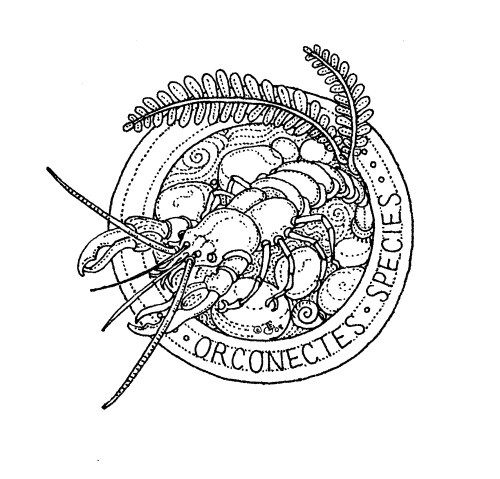
The following poem appears in Snake Den Ridge: a Bestiary (2008, March Street Press). Linda and I collaborated on the book and her illustration appears below (at the time she agreed to interrupt her many other projects because I promised to dedicate the book to my friend Mike Barnett – I can’t even calculate the hours she spent drawing or the height of the field guides and science books piled beside her on her desk).

Crayfish

Just wiggle this rock
and the stream
hums a whole new flavor –
in the turbulence I taste
last night’s shower
on the Ridge
and this morning’s stirring
of awakened larvae.
Tailflap, legtips,
cuticle,
all of me every moment
strummed by roil and eddy,
random caress
of molecules,
divine order of chaos.

I’ll tell you a secret –
God is deliciousness!,

the constant inconstancy
of current
that reveals my breakfast
or Otter on the prowl,
and just maybe
the passing of a lovely
arthropod I long to meet.

Join me! Immerse yourself,
not in Inadu Creek
but in your own lifestream.
Savor it, sense it as I do
in every part of you.

Bill Griffin, in Snake Den Ridge: a Bestiary (2008, March Street Press)

Illustrations by Linda French Griffin.
 

.     .     .     .     .     .

Chitin is the hard part of invertebrates: cicada exoskeleton, crayfish and lobster shell, squid beaks (and vertebrate fish scales). Keratin is the hard outer part of vertebrates: bird feathers, tiger claws, what little hair I have left. The two are chemically completely different but function in the same way, for protection and structure.

Chitin is a polymer of sugars, glucose with added nitrogen = glucosamine (a polysaccharide), the stuff I take for my bad knee. Keratin is a polymer of amino acids, namely a protein (polypeptide). Here are two more factoids you can’t possibly live without: Keratin resists digestion, which is why cats hark up hairballs. Spider silk is classified as keratin, although production of the protein probably evolved independently of the process in vertebrates.

Crustacyanin is not a Spongebob character. It’s what makes this crayfish blue. Crustacyanin is a carotenoid, which are pigment proteins found in everything from tomatoes to pink flamingos. The crustacyanin is made from stacks of another carotenoid protein (astaxanthin), which itself is red, but depending how many and how it’s stacked can actually reflect the blue portion of the spectrum. Blue crayfish (also look up Blue Lobsters) have a genetic variation in their stacking. If you steam them (perish the thought!!!) the astaxanthin comes unstacked and that’s why cooked crabs, lobsters, and crayfish are bright red.

Brushy mountains reflected in compound eye

.     .     .     .     .     .


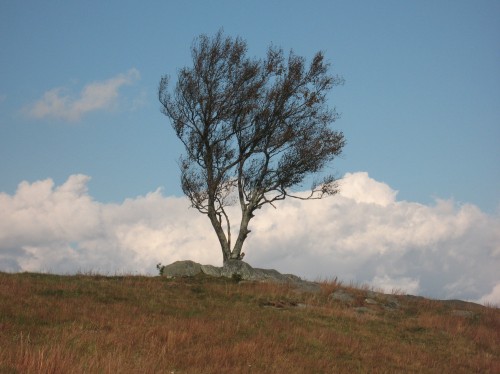
2016-10-17b Doughton Park Tree

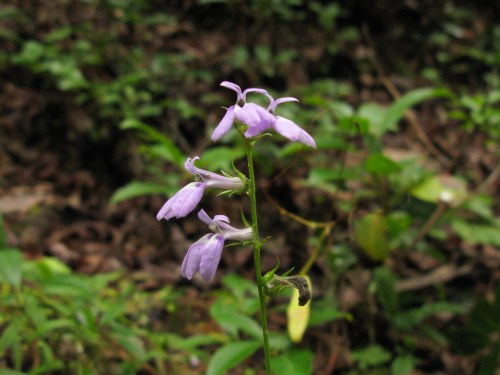
Southern Lobelia, Lobelia amoena, Campanulaceae (Bellflower family)

[with poems by Robert Frost, Paulann Peterson, Edwin Markham]

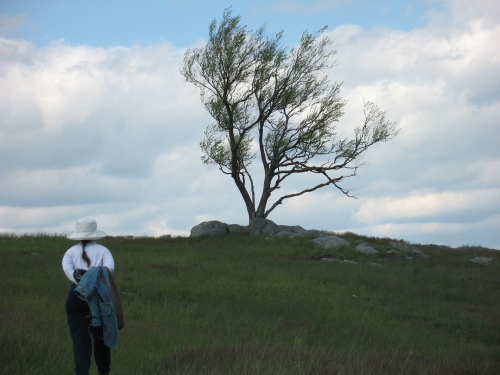
Tree At My Window

Tree at my window, window tree,
My sash is lowered when night comes on;
But let there never be curtain drawn
Between you and me.

Vague dream head lifted out of the ground,
And thing next most diffuse to cloud,
Not all your light tongues talking aloud
Could be profound.

But tree, I have seen you taken and tossed,
And if you have seen me when I slept,
You have seen me when I was taken and swept
And all but lost.

That day she put our heads together,
Fate had her imagination about her,
Your head so much concerned with outer,
Mine with inner, weather.

Robert Frost (1874-1963)

.     .     .     .     .     .     .

Why the Aging Poet Continues to Write

At a coneflower’s seed-making center,
hundreds of tiny dark florets—
each stiff and sharp—
take turns oozing
their flashes of pollen.
A flagrant
bee-stopping show.

Making a bright circle,
the outermost spiky blossoms
open first to then fade.
Shrinking day by day,
the ring of yellow flame
moves inward.
That heart—what’s at
the flower’s very core—
blazes last.

Paulann Petersen, from Understory, Lost Horse Press, 2013

.     .     .     .     .     .     .

These two poems are collected in The Poetry of Impermanence, Mindfulness, and Joy; edited by John Brehm; Wisdom Publications, 2017.

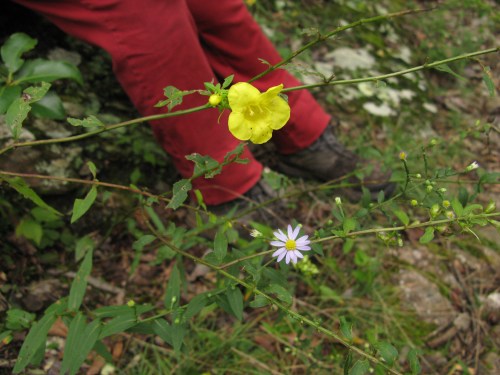
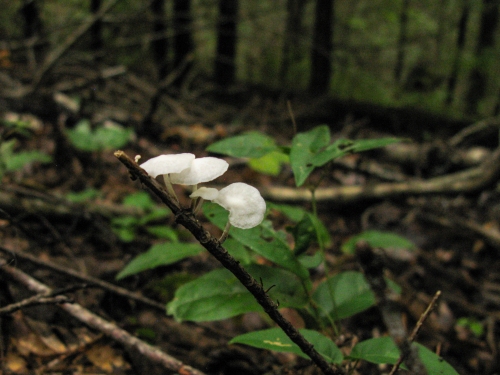
Spreading False Foxglove, Aureolaria patula, Scrophulariaceae (Figwort family)

.     .     .     .     .     .     .

No plant community is static. Even the “climax forest” is in constant flux, the flow that is the marker of time’s passage, that is time. All things flow: change, the primary mutable immutable that creates reality.

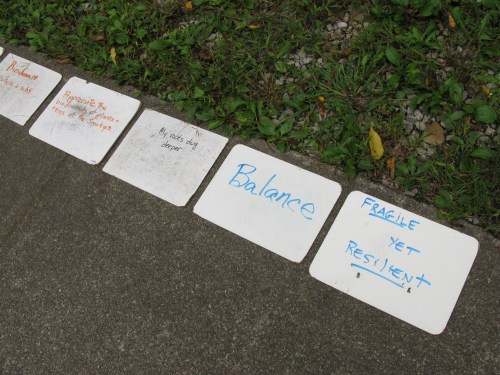
Observe the climax forest for enough generations (its generations, not ours) and see that its steady state is illusion. Water cycles, carbon cycles, death and reclamation and regeneration: constant flux. Apt metaphor for our life as human individuals. Observe the plant community’s encroachers and invaders, its fuzzy boundaries, its balance never balanced for long – also a metaphor for human communities.

During pandemic if there is one factor that underlies our existential fears it must be separation from community. How small has our circle shrunk? How unwilling are we to step outside or let in the unknown? Anger, anxiety, dread: they must all have the same roots.

When the soil is shallow the tree sends its roots wider. When moisture or minerals are scarce the rootlets’ embrace by mycorrhizal fungi becomes even more welcome.

Human ecology: I watch the Zoom gallery nod and smile and imagine that they are seeing me, too. I step off the trail when other hikers pass but we wave and share a few words at distance. I sit nearby during Linda’s long phone calls with sisters: essential, restoring, redeeming. I even (gasp!) write a few letters. Aren’t we all reaching out to discover some new way of connecting, some way amidst the flux to re-forge community?

Wider, draw the circle wider!

.     .     .     .     .     .     .

He drew a circle that shut me out-
Heretic, rebel, a thing to flout.
But love and I had the wit to win:
We drew a circle and took him in!

Outwitted – Edwin Markham (1852-1940)

.     .     .     .     .     .     .

Many thanks to the organizers and instructors of Great Smoky Mountains Institute at Tremont who continue their mission of connecting people with nature even during pandemics. Their science-based educational programs have evolved with science-based precautions and modifications to allow small communities to form for a weekend at a time.

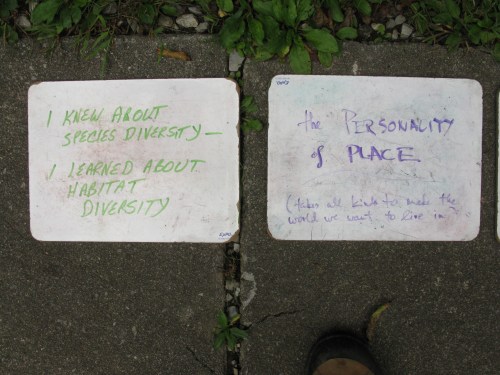
One word sums the program and purpose of Great Smoky Mountains National Park: BIODIVERSITY. These photos are from the September 2020 GSMIT program Southern Appalachian Ecology. Immersed in that diversity, I continue to absorb the enrichment, root, stem and blossom, of that community of seekers.


.     .     .     .     .     .     .

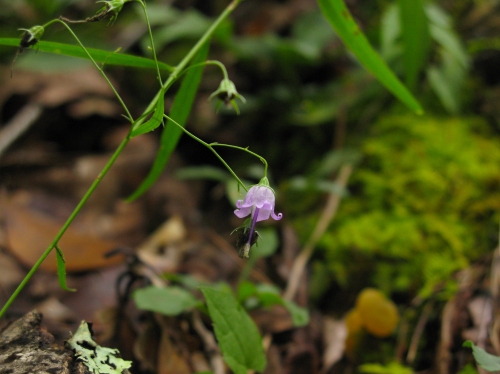
Southern Harebell, Campanula divaricata, Campanulaceae (Bellflower) family

[with two poems by Lola Haskins]

I sat in the ophthalmologist’s office reading Lola Haskins and wondering. I’ve put off this visit due to COVID and I’m overdue, seeing Dr. Bondalapati for the first time. She is new here, just moved to Elkin from Chapel Hill with her family last summer. Most of her staff I’ve known for years, although it is still welcoming to be recognized behind the mask.

All of us masked. Wondering. Are our precautions enough? Is it OK to be together like this?

Isn’t it remarkable how much eyes alone can communicate? Eyebrows bobbing, winky lids, wrinkly skin of brow and temple, lovely corrugator muscles. I left the office happy to have seen my new doctor and Deanna, Karen, all the others.

Bridge the separations. Make community. Take nothing for granted.

I am also restored and innervated by Lola Haskins’s poems. I heard her read several years ago and just bought her collection, how small, confronting morning (Jacar Press, 2016). Isn’t it remarkable how much a few words and a few lines alone can communicate? Seeing through another’s eyes. Another’s voice in my ears . . .

. . . like happiness // it materialized so gradually / that I never even for a moment // saw it coming

.     .     .     .     .     .     .

The Cabin at Fakahatchee Strand

by morning the water has turned such
silver I want to put it on i know

it would only flutter off my skin
like a bird too quick to follow

but i don’t care i want it anyway
and i want that tangle of cattail

and black rush too the way i want
to be perpetually waking to

yet another gift like the single gator
stretched out on the muck

where pond has begun to thicken
to swamp like happiness

it materialized so gradually
that i never even for a moment

saw it coming

.

Lola Haskins, from how small, confronting morning (Jacar Press, 2016)

.     .     .     .     .     .     .

Flight

if i eat feathers asks the child
will i be able to fly?

you already can says her mother
any night
the lightness in you my lift you
from your cot
that’s why i close the windows

when i get old enough the child
wonders

will you open them? oh yes
comes the answer

(sorrowing) that’s what
mothers do

.

Lola Haskins, from how small, confronting morning (Jacar Press, 2016)

.     .     .     .     .     .     .

Haskins writes with the startling freedom and grace of a kite flying, and with the variety and assurance of invention that reveal, in image after image, the dream behind the waking world.
W.S.Merwin, winner of the Pulitzer Prize and former U. S. Poet Laureate

.     .     .     .     .     .     .

IMG_0877