[with 4 poems by Stephen Cushman]
What did Daddy Buffalo say to his little boy when he dropped him off at school?
“Bi Son.”
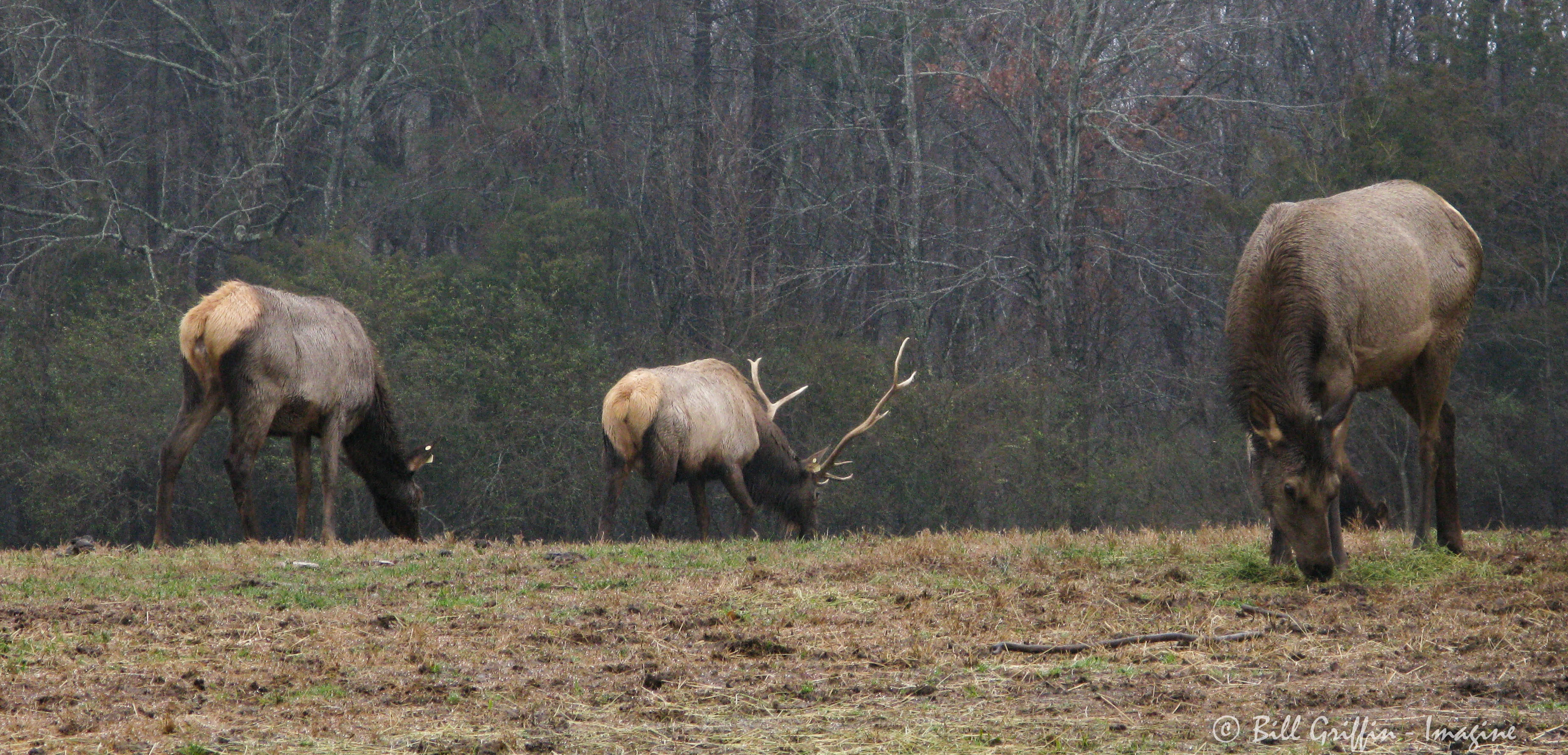
Bert (5) and I watch the little herd of elk graze along the gentle Uwharrie slope. They are all females except one chesty bull with a rack of antlers twice as tall as Bert. Every few minutes he raises his head and eyes us. He ignores six bison when they approach from the east, although drawing near they snort and the white-rumped cow elk back away. Grazing resumes.
Bert is the animal man. He will correct you immediately if you refer to bison as “buffalo,” whether in his home menagerie of plastic creatures or here at the North Carolina Zoological Park near Asheboro. Bison and elk once roamed the Carolina piedmont prairie; their grazing plus fires from lightning and intentional burns by indigenous tribes maintained the open expanses encountered by European settlers. Today we learn that the last native eastern bison was killed by hunters in 1799. And from Zoo interpretive displays we also learn that what we see here are Woodland Bison from Canada, a different subspecies from the slightly smaller Plains Bison we’ve watched at Yellowstone.
We’ve also learned something else this morning: these are not elk!
Cervus canadensis is one of the largest species of the deer family, Cervidae. When English settlers arrived in North America, they named creatures they met to match vaguely similar species back home, taxonomy be damned. (European Robins are not even in the same Family as American Robins.) In English the word Elk refers to the European moose, Alces alces, also Family Cervidae, but by the 17th century moose had been extirpated from the British Isles. Having never seen one, for most Englishmen the concept of Elk had grown a little fuzzy. They may have just used the word to mean Big Deer, and these were definitely some big deer.
So if we don’t want to be a big disappointment to Bert by calling bison “buffalo,” what shall we call elk? Wapiti, derived from a Shawnee and Cree word for “white rump,” is the term for Cervus canadensis preferred by Zoo educators and taxonomists. It is the same species reintroduced to Yellowstone in Montana and to North Carolina in Great Smoky Mountains National Park, and native across Canada and Alaska (with subspecies in China and Siberia). Wapiti and Bison, preserving the Atlantic piedmont prairie ecosystem for thousands of years, we bow to you.
❦ ❦ ❦
Not all English settlers called the big deer Elk. The native British Red Deer, Cervus elaphus, is a dead ringer for Cervus canadensis. Until the advent of molecular phylogenetics, in fact, the two were considered to be the same species. Sir William Talbot’s 1672 English translation of John Lederer’s Latin Discoveries called the North American species Red Deer, but noted in parentheses that they were for their unusual largeness improperly termed Elks by ignorant people. *
❦ ❦ ❦
The Rain in Maine
fell also on the Etchemins, their name for us
humans, us builders of fish weirs,
us real people, as opposed to monsters,
animals, or the ghosts of others
back for a visit to glacial moraine
above the beach where clamming thrived
and the canoe route south could make good use
of easy portage across a bar
exposed at low tide, for which they also
must have had words, maybe one meaning
the waters inhale or the earth whale breaches,
as they would have had words for various arrowheads,
the kind meant for deer rather than seals
or for making war on trespassing tribes,
who bad as they were weren’t so pathetic
as to need such abstractions
as religion, as nature, as beauty removed
from whatever gray weather the eagle glides through.
Stephen Cushman
from Keep the Feast, Louisiana State University Press, © 2022

❦ ❦ ❦
Stephen Cushman’s book is a feast – of imagining, of unexpected encounters and epiphany, of wordplay, of luscious sensuality and sheer rejoicing – but after reading and re-reading I am still asking myself if there is one specific feast he’s admonishing us to keep. The miraculous feast at Cana, stale water becoming wine that exceeds even the host’s best vintage? The poet’s groaning board of allusion and figurative language? A banquet of awe and praise in the presence of the numinous? Biophilic diversity shared with all creatures and creation?
Keep all these feasts. Attend and partake. Pry open mind and soul and feel the inrush of delight. Keep the Feast relishes the twists and turns, the movement, the sink of stomach as the bottom drops out and the soar of heart when the object of adoration appears. The middle section, a long poem of 26 verses with the same title as the book, is loosely configured like Psalm 119, but it is as if the Psalmist, Jalāl al-Dīn Rumi, and Steve Martin spent all night together on Mt. Ararat – the mystical language of prophesy and ecstasy with a 21st century voice. Look out, Reader! You may remain hungry for more.
Stephen Cushman is general editor of the fourth edition of the Princeton Encyclopedia of Poetry and Poetics (2012) and Robert C. Taylor Professor of English at the University of Virginia. Keep the Feast is his seventh collection of poetry.
❦ ❦ ❦
from Keep the Feast
section 23
Whither can thy servant turn
+++++ and not find thee there before him?
Whither can his eye revolve
+++++ and not see dust thou art raising?
How can his ear, even if deaf,
+++++ shut out the buzz of constant current
charging the wind with thy high voltage
+++++ and effervescing through his blood stream?
Behold, how doggedly days do their job
+++++ and how the hours persevere!
Soon they will demolish thy servant
+++++ and dismantle his worshipful voice.
If he should cover his head with ashes,
+++++ pay him not the slightest mind.
Do not let him get away
+++++ with some glib quip or facile finale.
Stephen Cushman
from Keep the Feast, Louisiana State University Press, © 2022

❦ ❦ ❦
Green Zebra
++++ Live in each season as it passes; breathe the air, drink the drink,
++++ taste the fruit, and resign yourself to the influence of each.
+++++++ – HDT
Help, Theophrastus,
or you, lewd Linnaeus,
with classes for plants and Sexual System
That borders on porn, “nine men in the chamber
of only one bride” sounds pretty wild
and might keep her happy, that passel of stamens
for only one pistil,
+++++ +++++ +++++ but where is the wild
found anymore,
what’s the vicinity
that hasn’t been tilled by husbandry wholly
to nothing but cult, -ivated, -ivar;
+++++ +++++ +++++ +++++ take Adoration,
cocktail hybrid, or flat-globe Celebrity
or even Enchantment, all engineered
one way or another,
+++++ +++++ +++++ while here we were thinking,
when madly monandrous
+++++ +++++ +++++ +++and mounted like wolves
howling full moon beyond the tame pale,
we had evaded human improvement,
+++++ +++++ +++++ +++++ only to find
in ancient love manuals
+++++ +++++ +++++ we might as well be
a Cherokee Purple, another Big Rainbow,
or this zingy beauty with flavorful flesh
striped green and yellow.
Stephen Cushman
from Keep the Feast, Louisiana State University Press, © 2022
❦ ❦ ❦
Woe to Us Hypocrites
Hemingway’s fantasy
of days when we’re free
to shoot whom we please
hasn’t got a chance
luckily for us
who trust we’re the marksmen
and never the targets
so when you come home
from drudging through Monday
to news an old enemy,
nasty-cuss nemesis,
had open-heart surgery,
don’t whoop and cheer,
just send him a card,
maybe some mums,
that dish of green beans
you’ve nearly perfected,
garlic, hot chili oil,
and bow to hypocrisy
for keeping the peace
with smiling mimesis
in spite of the anger
for which we’re still liable
to judgement and fire;
there must be a reason
it’s a translator’s freebie,
a piece of the Greek
that’s English to us.
Stephen Cushman
from Keep the Feast, Louisiana State University Press, © 2022

Wingspan
❦ ❦ ❦
* Elk history and taxonomy on Wikipedia





 V E R S E and I M A G E
Glad to hear from you Jenny. May life continue to surprise . . . ---B