Feeds:
Posts
Comments

Archive for the ‘Photography’ Category

I thought I saw a Merlin. Facing into the stiff onshore breeze, harrying above the dunes: fierce raptor profile, fleet spitfire, wings cocked at the wrist – falcon.

I wanted to think it was a Merlin I saw, last week at Bogue Banks for Thanksgiving, as it veered away from me, slipped sideways and rolled, master of current and draft. I still wanted it to be a Merlin when it arced back overhead, whirled into a perfect stall, snatched a perch at the tip of the spar where the surf warning flag flies.

It drank some water trapped in a crease of the wood. Tawny waistcoat, single-barred tail, face tattoos – this hunter was not a Merlin. Just its much more common little cousin.

Why did my heart skip when I first spotted it? Why did I want so much for it to be a Merlin? I haven’t seen one in years; I’ve only ever seen a very few. The last time I saw a Merlin, Linda and I were alone together on a rare vacation, January in Nags Head, doing what we love: hiking the dunes and maritime forest and half-freezing ourselves in the salt rime. Driving to Hatteras next day we spotted a Merlin perched above the salt marsh, watchful in regal disdain. Merlin – rare visitor from the mysterious north. Merlin, power and magic. Merlin mythic. Merlin romantic.

Is it just its name that makes it so? Falco columbarius per Linnaeus, Esmerejón in Spain and Mexico, Dværgfalk in Denmark and Norway, 55 names listed in Cornell Ornithology. Learning its name accompanies learning its field marks, habitat, range. But what do I really know about Merlin? How to read shifting wind while stalking the wood rat a hundred yards below? Folded wings, little rocket, full velocity strike , blood and hair? What name, Dream Hunter, do you give yourself?

We see the Merlin’s little cousins all the time here in the NC foothills, especially in winter perched on wires above the mouse-gleaned fields. I saw one driving home from the beach. Actually, four. And last week my brain knew what I was seeing above the strand even before my eye would admit it, even before it swooped in for me to take closer look . . .

. . . and turned upon the current of air. Watchful for movement in the sand, ultraviolet signature of mouse urine, it raised its wings, their sharp fast flutter, fixed, motionless on high. Only one little falcon can do that. And I know its name.

.     .     .     .     .     .     .

The Windhover
Gerard Manley Hopkins – 1844-1889

I caught this morning morning’s minion, king-
++ dom of daylight’s dauphin, dapple-dawn-drawn Falcon, in his riding
++ Of the rolling level underneath him steady air, and striding
High there, how he rung upon the rein of a wimpling wing
In his ecstasy! then off, off forth on swing,
++ As a skate’s heel sweeps smooth on a bow-bend: the hurl and gliding
++ Rebuffed the big wind. My heart in hiding
Stirred for a bird,—the achieve of; the mastery of the thing!

Brute beauty and valour and act, oh, air, pride, plume, here
++ Buckle! AND the fire that breaks from thee then, a billion
Times told lovelier, more dangerous, O my chevalier!

++ No wonder of it: shéer plód makes plough down sillion
Shine, and blue-bleak embers, ah my dear,
++ Fall, gall themselves, and gash gold-vermillion.

[This poem is in the public domain.]

.     .     .     .     .     .     .
.     .     .     .     .     .     .


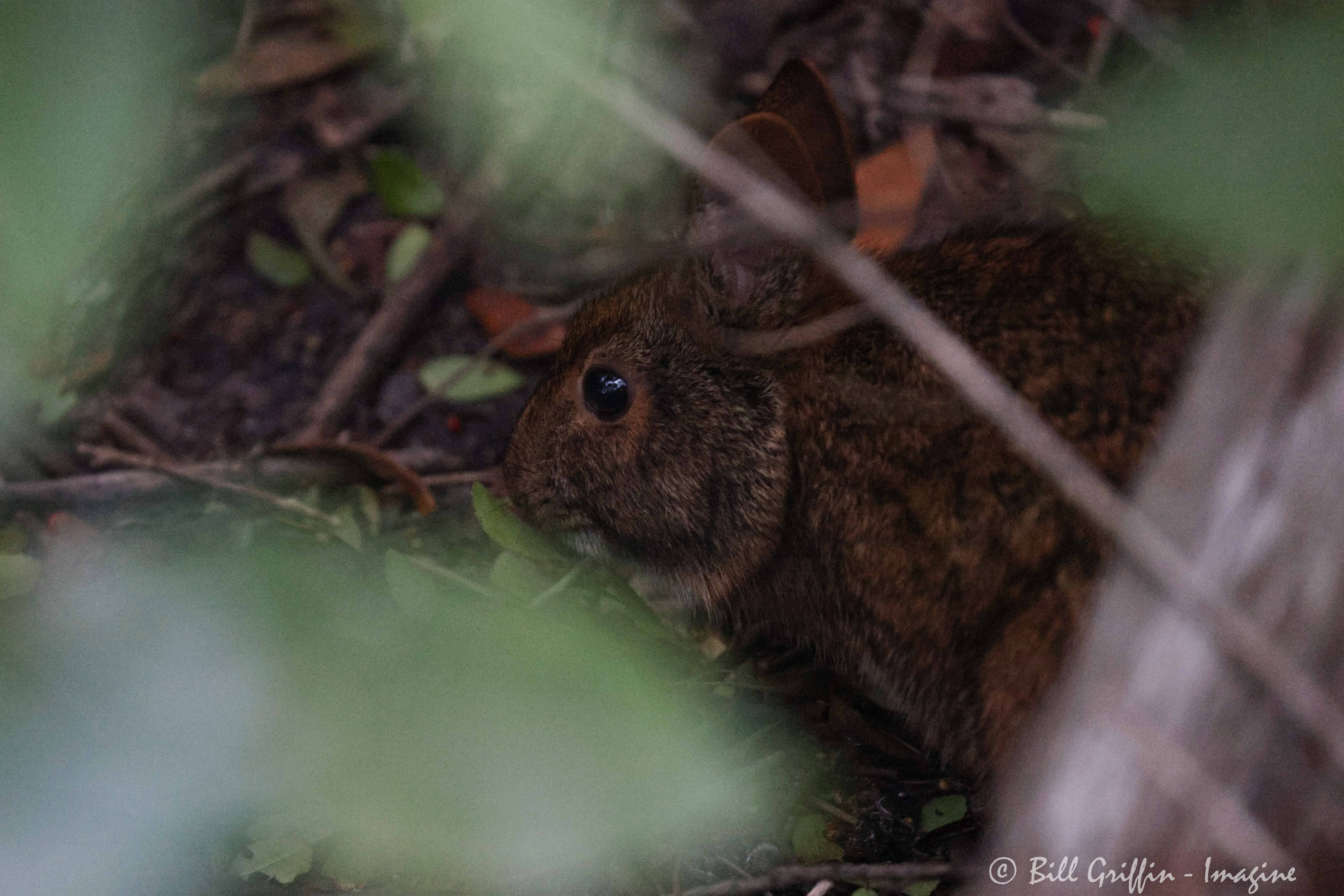
Windhover is a British name for the European Kestrel, Falco tinnunculus, a dead ringer for its close relative the American Kestrel, Falco sparverius. They are the smallest of the falcons and one of the very few birds that can hover motionless in still air, in this case watching for its usual prey, the field mouse.

The Windhover has long been one of my favorite poems. Oh my, where does this magical and mysterious language come from?! What hidden realm is revealed in these lines? Read it aloud to hear Hopkins’s incantatory music. How does he do it?

One of my most striking memories is the Saturday morning Tony Abbott recited The Windhover at Weymouth Center for the Arts and Humanities to call to order a meeting of the North Carolina Poetry Society. As he approached its last line Tony slowed , each word deliberate, and upon gash gold-vermilion there was one unified sharp intake of breath among the entire congregation before we erupted in applause.

Gerard Manley Hopkins was a Jesuit priest; he dedicated The Windhover To Christ our Lord. The poem, like the fierce undaunted Kestrel, breaks open the blue-bleak embers of our dull, unreflective spirits to reveal the fire, the power, and the glorious mystery of creation which surrounds us.

[more Gerard Manley Hopkins at The Poetry Foundation]


.     .     .     .     .     .     .

.     .     .     .     .     .     .

2019-02-09 Doughton Park Tree

Read Full Post »

Theodore Roosevelt Nature Trail, Bogue Banks, NC -- and Great Blue, Ardea herodias

[with 3 poems by Larry Sorkin]

I know Larry Sorkin from his poetry. Oh, I’ve met Larry in person a few times, spoken with him more than once, but within his poems he allows me to know him. Wryly humorous, himself often the butt. Fallible & vulnerable. Honest about all that, and open. Intentional; seeking. But most of all Larry Sorkin’s poems, and I must assume he himself, are inviting. Each one, in its own way, offers itself up as an invitation.

Larry Sorkin’s book, Uncomfortable Minds, is all invitation. Share with him this confusing chaotic journey. Share defeat, share contemplation or discovery or joy. Share any of the countless back roads and detours and destinations we human beings travel. This is the invitation – to join him in the garden.

Perhaps the garden is metaphor for our toil, for our occasional scarlet tomato of success, for our physical pleasures. But our toil, triumph, pleasure are not what bless us with words that would unlock the puzzle. What does it take, then, to right this finely wrought chaos? It seems to take being present, as these poems are, to each other. And being present to our own gifted, fractured, seeking self. We’re best when we do this together. And you, yes you, are invited. Join me in the garden.

.     .     .     .     .     .     .

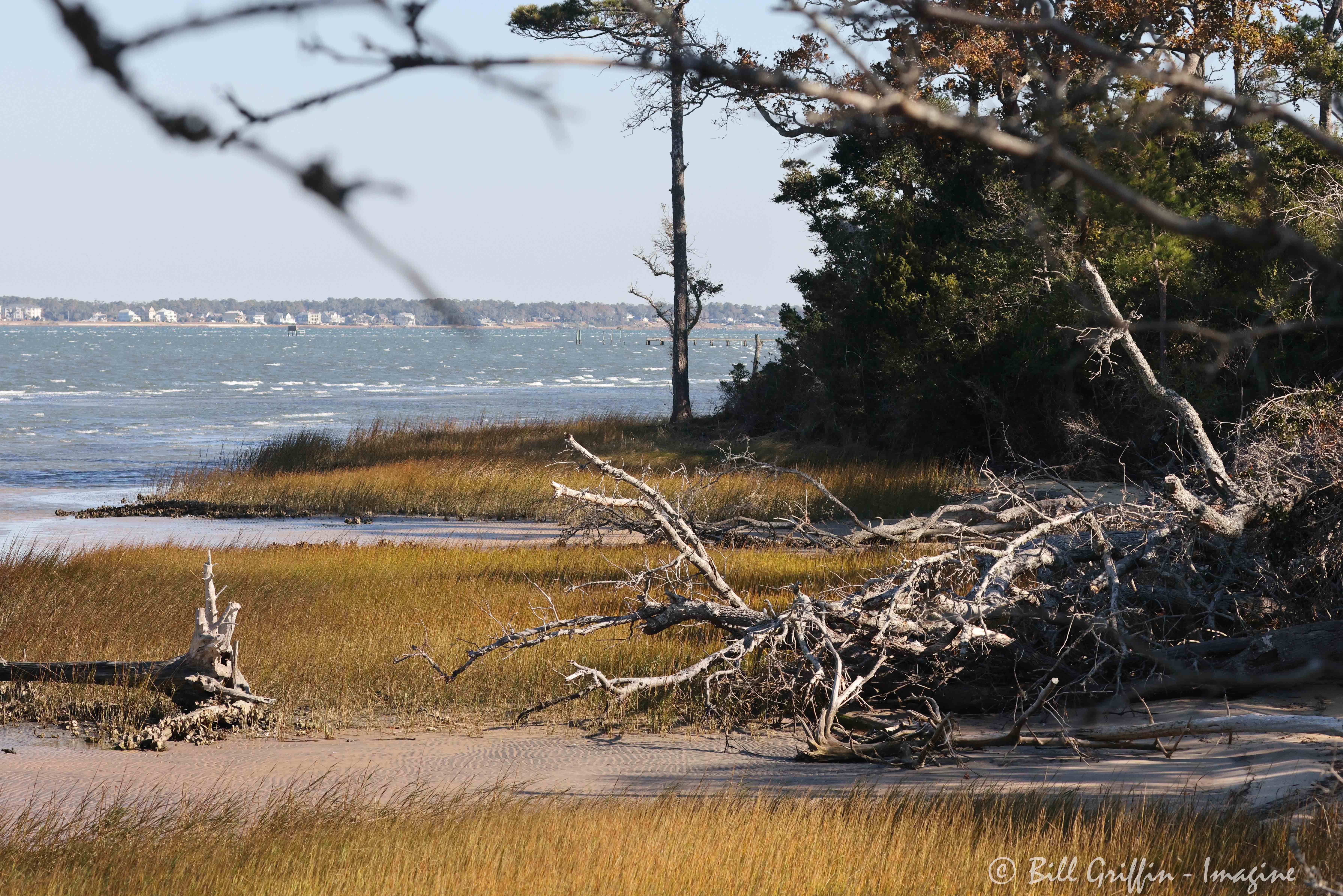
Theodore Roosevelt Nature Trail, Bogue Banks, NC

.     .     .     .     .     .     .

Neither This, Nor That – Upanishads

Today I’m nagged by knowing
I don’t. I’ve lost those few

words that
would unlock

the puzzle, set
right this finely

wrought chaos – aren’t you
looking for this too, the lost

quote gone from
book or memory of

our conversations. Friend,
I know we won’t

find it plowing
and pressing seeds

into dirt, not in scarlet
tomatoes that come

later, not even in
the fine meal

we’ll make of them. Does it
matter? Join me

in the garden.

Larry Sorkin

.     .     .     .     .     .     .

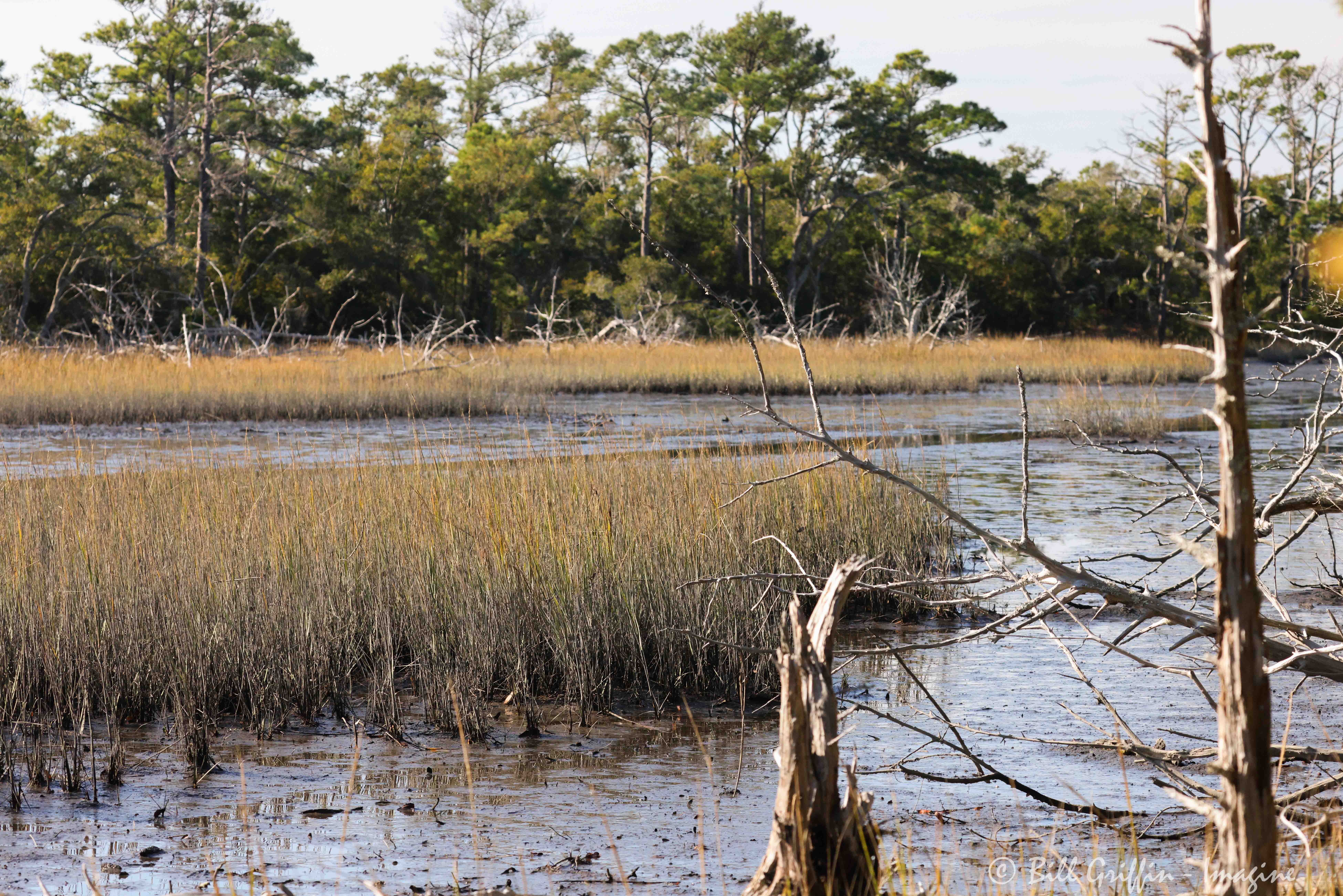
Theodore Roosevelt Nature Trail, Bogue Banks, NC

.     .     .     .     .     .     .

Pursuit

of a solitary
morning’s ringside

seat to inhale
the ceaseless

erosion of this
folded Appalachian

ridge into a flat
plain interrupted by an Astaire

and Rogers pair of bluebirds that
tap dance on the porch

rail, each waving a single
wing to the other. I call my mate, a string

can line strung across seventy miles to share
a play by play of the ritual

as the male turns
away and she

waves and he
sings and waves and turns

back and so an hour
vanishes, while she and I

murmur our own
shorthand semaphore.

Larry Sorkin

.     .     .     .     .     .     .

I Have Nothing

this morning, bits
of nothing found among the clean

stones that pepper the drive where two
tiny sky-blue eggs crack open. One

empty, not quite dry. I lift
with thumb and forefinger as it

crumbles to my clumsy
touch. I leave the other, half

full of liquid sun. How
fragile the chance of what

gets to breathe
and sing. I carry the broken

bits back on my right
palm held open, outstretched, an

offering. I carry them
to you, Reader, before this

world as we know it sinks
like a skipping

stone below a cosmic
wave.

Larry Sorkin

all selections from Uncomfortable Minds, © 2021 by Larry Sorkin; Bonhomie Press, an imprint of Mango Publishing Group, Coral Gables, FL.

.     .     .     .     .     .     .

Nothing can be hard to tell apart from everything. A bit of cracked shell reveals deep truth – how fragile, how transitory. That includes you and me, Bub. I think I’ll celebrate. What a privilege to ride this mossy stone as it skips around its star. I’ll celebrate this, too: for twenty years I’ve been trying to write a poem about that little semaphore thing that bluebirds do with their wings to bond with their mates, and now Larry Sorkin has given me one that is perfect. From nothing . . . everything. Thank you, Friend!

.     .     .     .     .     .     .

Theodore Roosevelt Nature Trail, Bogue Banks, NC


2020-06-11a Doughton Park Tree

Read Full Post »

[with 3 poems by Melinda Thomsen]

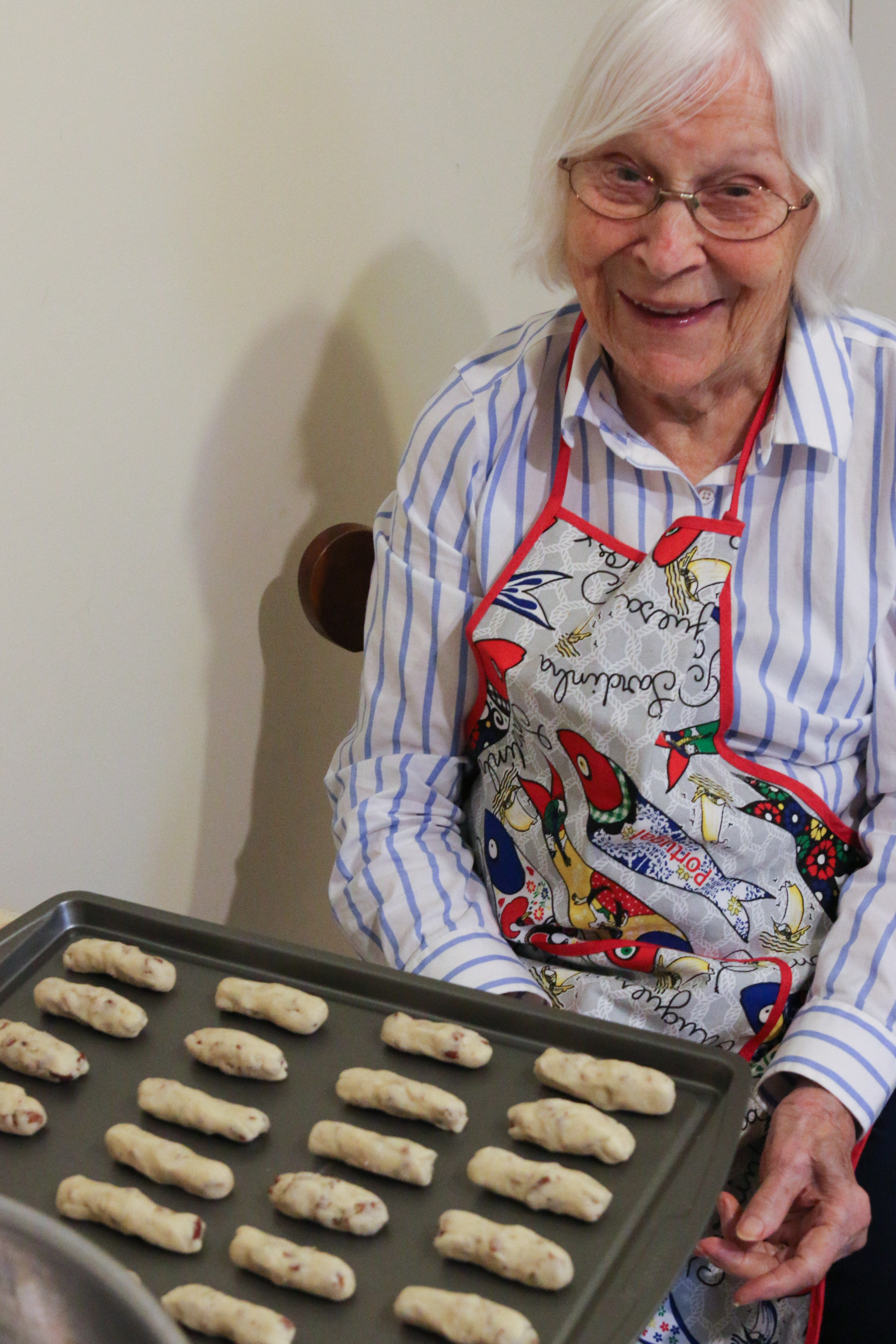
How about you cream the butter and sugar while I chop the pecans? At 93 Mom does not need to be wielding the big chef’s knife. Last week I bought vanilla, nuts, butter, and a couple of new cookie sheets at Harris Teeter while shopping with Dad. This morning I pre-measured the sugar and flour into ziplocks before I left the house. This afternoon Mom woke up early from her nap, so excited to be baking cookies for Thanksgiving.

Whenever we visited Nana while I was growing up, we kids (and Dad, too) couldn’t wait to visit the little village of tins that would have sprung up like magic on her kitchen counter. Homemade fudge, humdingers, Moravian Christmas cookies. And there were always, there had to be, nutty fingers. When I got married she bequeathed me the recipe and that’s how I labeled the index card – Nana’s Nutty Fingers.

Nana’s only daughter – my Mom – hasn’t made nutty fingers since any of us can remember. Last night I printed a copy of the recipe and scribbled out my fraction calculations to double it. When I walk into Mom’s kitchen today, though, she already has the recipe laid out on the counter.

The original – centered on page 53 of What’s Cooking?, compiled by the Winston-Salem Woman’s Club in 1948, “Pecan Fingers” contributed by Ellen Cooke, alias Nana. It’s identical to the recipe we’ve used all these years as long as you realize that 4X sugar means granulated.

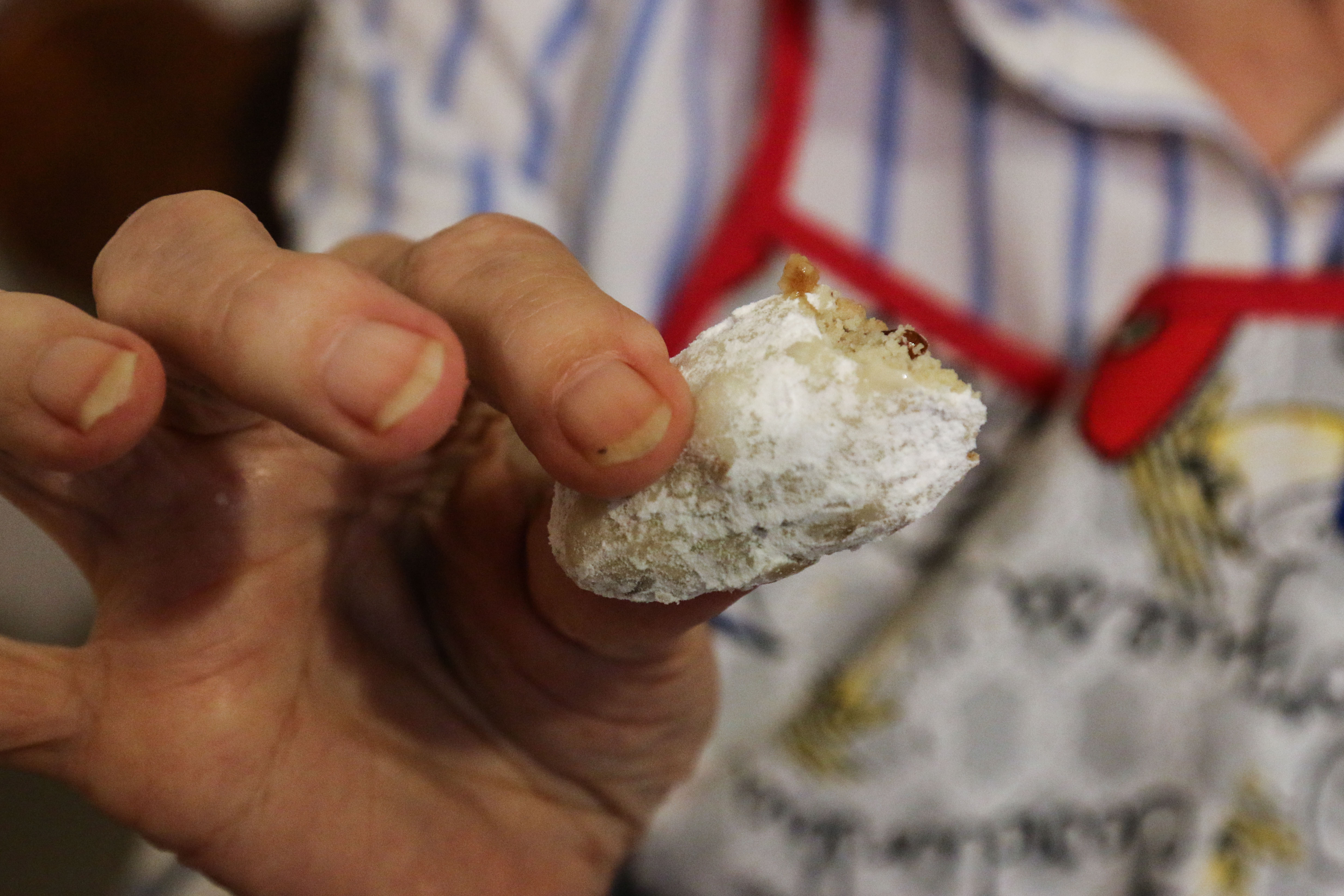
O Baby, in about an hour their home is smelling good, and all the laughs and stories we share during the making are even more delicious. Good job, Mom, high five. Dad pronounces these the best nutty fingers he’s ever tasted and the powdered sugar down his sweater affirms. When granddaughter Claire arrives from Maine for Thanksgiving, there just might be a couple left for her.

Maybe.

.     .     .     .     .     .     .

Sweet Potato Casserole

One poet says she waits to hear what
the words are trying to say. Meanwhile,

a documentary shows fifty pounds of yams,
gathered in one plastic basket, heaved up

to a migrant from Chihuahua, standing
in a school bus. The bus trudges through

the turned fields of North Carolina, a taxi
with an open top and wooden slats for sides

reaping filled baskets. Another poet hopes
the best wind finds me ready to wrestle it

to the page. As farm workers examine
and measure, sweet potatoes lift skyward.

Thousands of roots piled up in moving crates,
all hand gathered, are waiting for words.

Gently but quickly, these men harvest,
and I keep searching for nouns so small

but will swell in the mind to voice the labor
and sweat of my Thanksgiving dinner.

A friend tells me, if you think one person
can’t make a change, you’ve never been in bed

with a mosquito. Advice swirls like gnats
while I peel yams, whose discarded skins,

the width of fingers, almost rise as hands
to choke my verbs. Still, I dot mashed sweet

potatoes with mini marshmallows before
placing the heavy pan in a 375 degree oven.

Melinda Thomsen

.     .     .     .     .     .     .

Melinda Thomsen’s book Armature lives in the personal moments that create each day of our lives. The title refers to the skeletal framework a sculptor uses to support her clay model. She adds form and matter to shape the work into three dimensions. The book’s framework includes descriptions of four castings of Degas’ Dancer Looking at the Sole of Her Right Foot; the poems throughout add shape and form through their close observation and grounded presence within the many places they dwell.

Armature, © 2021 Melinda Thomsen, Hermit Feathers Press, Clemmons, North Carolina

.     .     .     .     .     .     .

Old Tractor Equipment

Their armature emerges from
a forging of farm equipment:
rasps, chains, gears, and pipes.

Metal tractor parts fashioned
a horse whose neck
and ligaments are strong

enough to face the wind
with a mane of almost twenty
flat files billowing in the breeze.

We all move this way, right?
After years of pulling it
together in cut and paste jobs

of bad or non choices,
even if our hearts resemble
rusted tractor ball bearings,

we construct and forge ourselves
from a hodgepodge of muzzles
and flanks in to running mares,

stalky goats, or bold stallions.
Walk over to us, and see our
sprocket nut nostrils flare.

Look at these haunches
made of 20th century shovels
and lawnmower parts.

A trip of goats and a pigpen
of swine have propane
tank bellies, pulley hooks

for horns, and porcine
snouts are marked
by stainless steel forks.

Nearby, bric-a-brac horses
cast galloping shadows
as we roam and graze.

Melinda Thomsen

[Melinda notes: Jonathan Bowling is a sculptor based in Greenville, NC. His field of sculptures is on the corner of Dickinson and Atlantic Avenues.]


.     .     .     .     .     .     .

Whirligig Park in Wilson, NC

I come from a nearby
town whose herons
sport feathers of golf club

handles and clipper beaks
flash shadows on the walls.
But here, looking up at all

these odd parts forged
into metal marionettes
with no strings or motor,

I see thy leave it to wind.
A cloud-laden morning
moves in and fifty feet

above, a front propeller
turns and two farmers
quickly cut a metal log.

Their saw’s teeth drag across
the tree as if their first stroke,
and behind them, a dog sits

whose tail wags at each cut.
It seems the earth begs us
to twirl, even if our spirits

have been sapped to rust,
even if our most dead
selves dwell in squeaking.

Melinda Thomsen

[Besides Wilson’s Whirligig Park, Vollis Simpson’s kinetic art is also on permanent display at the North Carolina Museum of Art.]

.     .     .     .     .     .     .

.     .     .     .     .     .     .
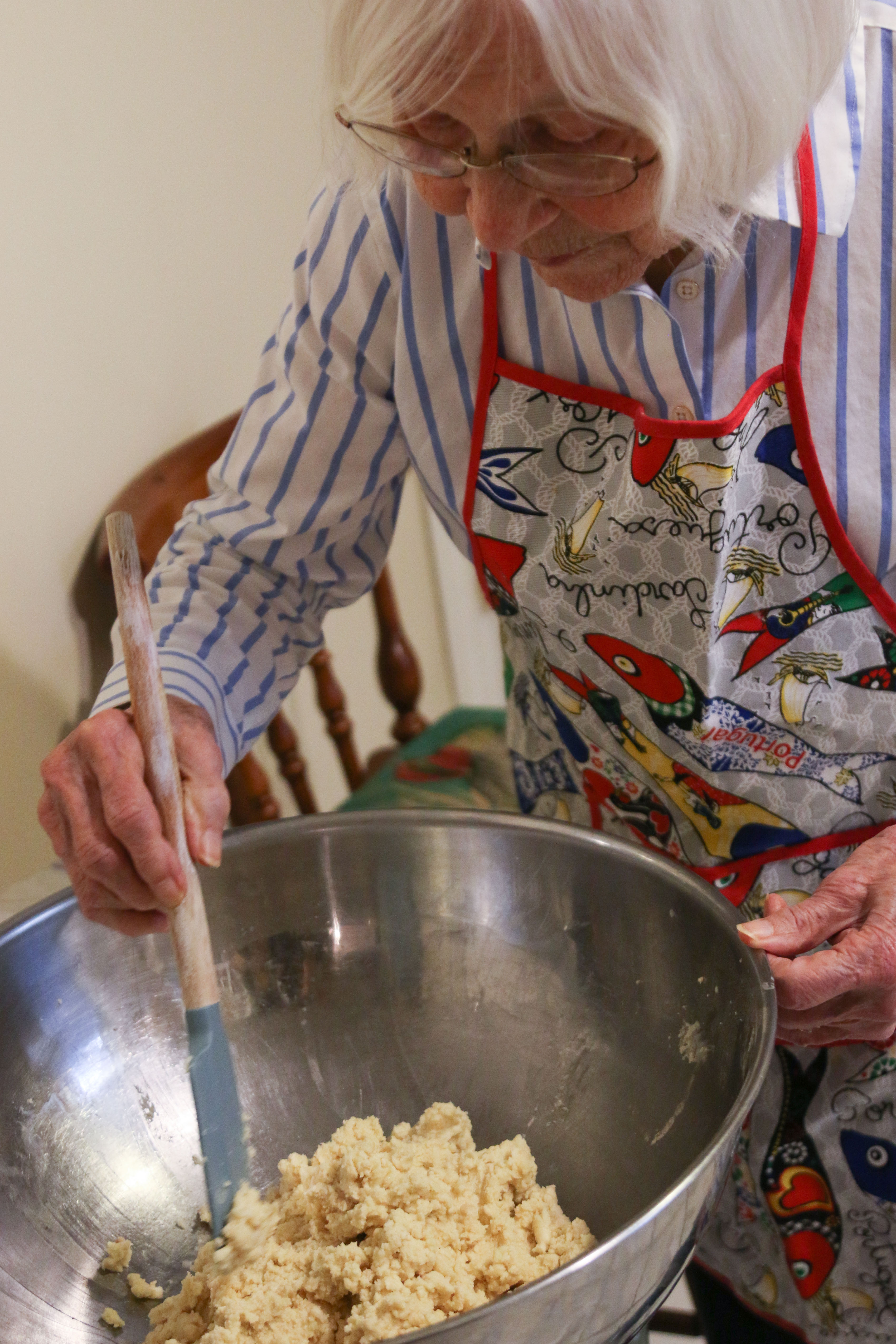
Postscript: My children and their kids have always called my Mom Grandmommy. My brother’s three girls, however, know their grandmother as Nana. Of course. The nutty finger legacy lives on.

.     .     .     .     .     .     .

2016-10-17b Doughton Park Tree

Read Full Post »

« Newer Posts - Older Posts »