Feeds:
Posts
Comments

Archive for the ‘Photography’ Category

[with 4 poems by Stephen Cushman]

What did Daddy Buffalo say to his little boy when he dropped him off at school?

Bi Son.

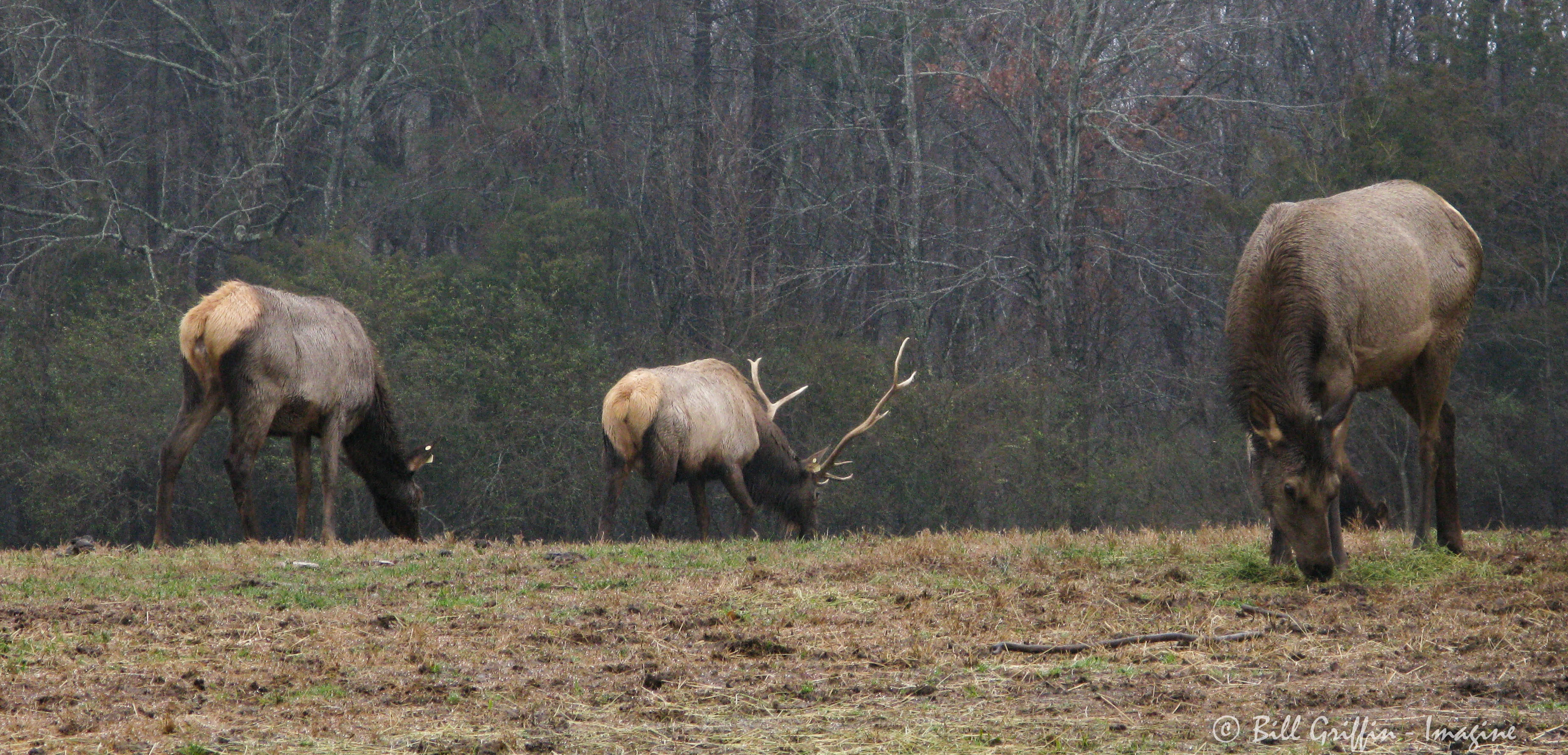
Bert (5) and I watch the little herd of elk graze along the gentle Uwharrie slope. They are all females except one chesty bull with a rack of antlers twice as tall as Bert. Every few minutes he raises his head and eyes us. He ignores six bison when they approach from the east, although drawing near they snort and the white-rumped cow elk back away. Grazing resumes.

Bert is the animal man. He will correct you immediately if you refer to bison as “buffalo,” whether in his home menagerie of plastic creatures or here at the North Carolina Zoological Park near Asheboro. Bison and elk once roamed the Carolina piedmont prairie; their grazing plus fires from lightning and intentional burns by indigenous tribes maintained the open expanses encountered by European settlers. Today we learn that the last native eastern bison was killed by hunters in 1799. And from Zoo interpretive displays we also learn that what we see here are Woodland Bison from Canada, a different subspecies from the slightly smaller Plains Bison we’ve watched at Yellowstone.

We’ve also learned something else this morning: these are not elk!

Cervus canadensis is one of the largest species of the deer family, Cervidae. When English settlers arrived in North America, they named creatures they met to match vaguely similar species back home, taxonomy be damned. (European Robins are not even in the same Family as American Robins.) In English the word Elk refers to the European moose, Alces alces, also Family Cervidae, but by the 17th century moose had been extirpated from the British Isles. Having never seen one, for most Englishmen the concept of Elk had grown a little fuzzy. They may have just used the word to mean Big Deer, and these were definitely some big deer.

So if we don’t want to be a big disappointment to Bert by calling bison “buffalo,” what shall we call elk? Wapiti, derived from a Shawnee and Cree word for “white rump,” is the term for Cervus canadensis preferred by Zoo educators and taxonomists. It is the same species reintroduced to Yellowstone in Montana and to North Carolina in Great Smoky Mountains National Park, and native across Canada and Alaska (with subspecies in China and Siberia). Wapiti and Bison, preserving the Atlantic piedmont prairie ecosystem for thousands of years, we bow to you.

❦ ❦ ❦

Not all English settlers called the big deer Elk. The native British Red Deer, Cervus elaphus, is a dead ringer for Cervus canadensis. Until the advent of molecular phylogenetics, in fact, the two were considered to be the same species. Sir William Talbot’s 1672 English translation of John Lederer’s Latin Discoveries called the North American species Red Deer, but noted in parentheses that they were for their unusual largeness improperly termed Elks by ignorant people. *

❦ ❦ ❦

The Rain in Maine

fell also on the Etchemins, their name for us
humans, us builders of fish weirs,

us real people, as opposed to monsters,
animals, or the ghosts of others

back for a visit to glacial moraine
above the beach where clamming thrived

and the canoe route south could make good use
of easy portage across a bar

exposed at low tide, for which they also
must have had words, maybe one meaning

the waters inhale or the earth whale breaches,
as they would have had words for various arrowheads,

the kind meant for deer rather than seals
or for making war on trespassing tribes,

who bad as they were weren’t so pathetic
as to need such abstractions

as religion, as nature, as beauty removed
from whatever gray weather the eagle glides through.

Stephen Cushman
from Keep the Feast, Louisiana State University Press, © 2022

❦ ❦ ❦

Stephen Cushman’s book is a feast – of imagining, of unexpected encounters and epiphany, of wordplay, of luscious sensuality and sheer rejoicing – but after reading and re-reading I am still asking myself if there is one specific feast he’s admonishing us to keep. The miraculous feast at Cana, stale water becoming wine that exceeds even the host’s best vintage? The poet’s groaning board of allusion and figurative language? A banquet of awe and praise in the presence of the numinous? Biophilic diversity shared with all creatures and creation?

Keep all these feasts. Attend and partake. Pry open mind and soul and feel the inrush of delight. Keep the Feast relishes the twists and turns, the movement, the sink of stomach as the bottom drops out and the soar of heart when the object of adoration appears. The middle section, a long poem of 26 verses with the same title as the book, is loosely configured like Psalm 119, but it is as if the Psalmist, Jalāl al-Dīn Rumi, and Steve Martin spent all night together on Mt. Ararat – the mystical language of prophesy and ecstasy with a 21st century voice. Look out, Reader! You may remain hungry for more.

Stephen Cushman is general editor of the fourth edition of the Princeton Encyclopedia of Poetry and Poetics (2012) and Robert C. Taylor Professor of English at the University of Virginia. Keep the Feast is his seventh collection of poetry.

❦ ❦ ❦

from Keep the Feast
section 23

Whither can thy servant turn
+++++ and not find thee there before him?
Whither can his eye revolve
+++++ and not see dust thou art raising?
How can his ear, even if deaf,
+++++ shut out the buzz of constant current
charging the wind with thy high voltage
+++++ and effervescing through his blood stream?
Behold, how doggedly days do their job
+++++ and how the hours persevere!
Soon they will demolish thy servant
+++++ and dismantle his worshipful voice.
If he should cover his head with ashes,
+++++ pay him not the slightest mind.
Do not let him get away
+++++ with some glib quip or facile finale.

Stephen Cushman
from Keep the Feast, Louisiana State University Press, © 2022

❦ ❦ ❦

Green Zebra
++++ Live in each season as it passes; breathe the air, drink the drink,
++++ taste the fruit, and resign yourself to the influence of each.
+++++++ – HDT

Help, Theophrastus,
or you, lewd Linnaeus,
with classes for plants and Sexual System

That borders on porn, “nine men in the chamber
of only one bride” sounds pretty wild
and might keep her happy, that passel of stamens
for only one pistil,
+++++ +++++ +++++ but where is the wild
found anymore,
what’s the vicinity
that hasn’t been tilled by husbandry wholly
to nothing but cult, -ivated, -ivar;
+++++ +++++ +++++ +++++ take Adoration,
cocktail hybrid, or flat-globe Celebrity
or even Enchantment, all engineered
one way or another,
+++++ +++++ +++++ while here we were thinking,
when madly monandrous

+++++ +++++ +++++ +++and mounted like wolves
howling full moon beyond the tame pale,
we had evaded human improvement,
+++++ +++++ +++++ +++++ only to find
in ancient love manuals
+++++ +++++ +++++ we might as well be
a Cherokee Purple, another Big Rainbow,

or this zingy beauty with flavorful flesh
striped green and yellow.

Stephen Cushman
from Keep the Feast, Louisiana State University Press, © 2022

❦ ❦ ❦

Woe to Us Hypocrites

Hemingway’s fantasy
of days when we’re free
to shoot whom we please
hasn’t got a chance
luckily for us
who trust we’re the marksmen
and never the targets
so when you come home
from drudging through Monday
to news an old enemy,
nasty-cuss nemesis,
had open-heart surgery,
don’t whoop and cheer,
just send him a card,
maybe some mums,
that dish of green beans
you’ve nearly perfected,
garlic, hot chili oil,
and bow to hypocrisy
for keeping the peace
with smiling mimesis
in spite of the anger
for which we’re still liable
to judgement and fire;
there must be a reason
it’s a translator’s freebie,
a piece of the Greek
that’s English to us.

Stephen Cushman
from Keep the Feast, Louisiana State University Press, © 2022

Wingspan

❦ ❦ ❦

* Elk history and taxonomy on Wikipedia


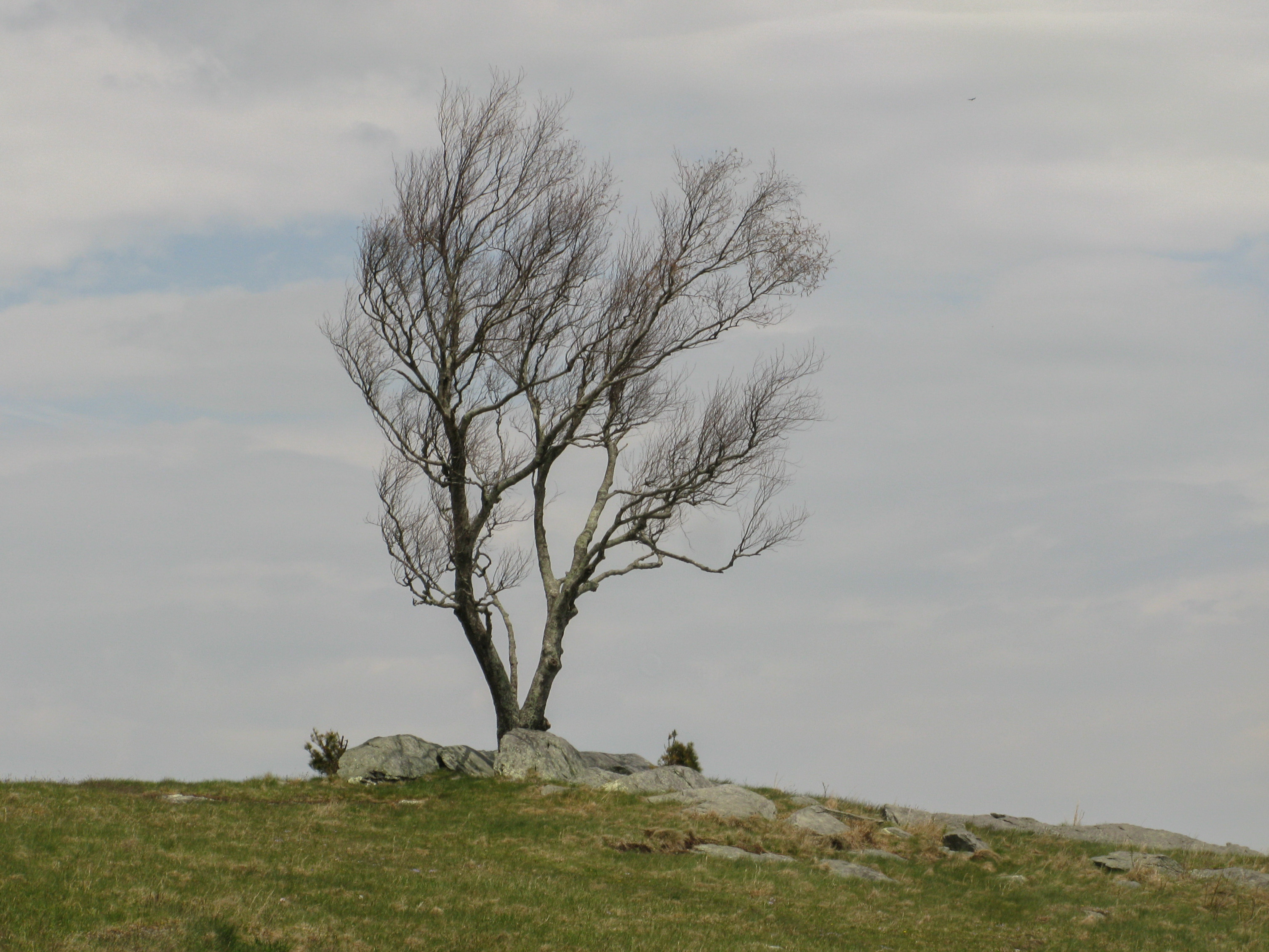
2020-09-08b Doughton Park Tree

Read Full Post »

[with selections from Ordering the Storm]

Reading a good book of poems is like traveling unknown terrain at night, glimpsing in each lightning bolt a swatch of vastness.Philip Brady

A good book of poetry is a book of poems. This statement is not a tautology. A good book of poetry comprises a book of poems that are selected, ordered, arranged, and presented in a way that illuminates the vastness.

This statement is also not an equation exhibiting the commutative property: a book of poetry that is a book of good poems is not necessarily a good book, or not as good is it could be if the poems are not selected and ordered in a such way as to make them greater than their whole. The mystery, then, is how to order the storm.

It is a mystery that will not be dispelled but may be entered and engaged. An overstuffed folder accumulating pages of script for years, a hundred computer files with their changeable names and endless revisions, how to gather and sort and create a collection? How to turn them all into a book that not only a friend or an editor but also the unknown lover of poetry would want to read? Would enjoy? Would come away from having glimpsed a swatch or two of vastness? Those are the questions posed by a book residing on my desk for the past year, Ordering the Storm: How to Put Together a Book of Poems, edited by Susan Grimm.

❦ ❦ ❦

Once or twice I have become so addled while trying to pull together a manuscript of poems that I’ve spread all my poems around me in a circle. The first step is in finding a poem beautiful enough to make a beginning. Then the next poem seems to flow naturally from the choice of that poem. Together, a group of poems begins to tell a story. . . . The poem that belongs no place often has no place in the book. Once in a while I’ll try to cram something in, but it’s awkward, and seldom works out well. Sooner or later that tooth will have to come out. You sacrifice individual poems for the sake of the book as a whole . . . . All of this can turn the making of a book into an unpleasant process, painful, like therapy. – Liz Rosenberg

❦ ❦ ❦

As an African-American, published by Black Sparrow Press for over thirty years, I was outside the teensy Black literary mainstream. I was effectively alone in the Southwestern United States. To the good, this made man an instant authority on “thangs Black.” But there was no Maxwell Perkins in my future. I could “do” whatever I wanted. To the bad, I was undereducated and tended to dismiss even sound advice if vaguely perceived as racist, and did not always know what I wanted, at first. Worse, I was not clear on what my options were when arranging poems or stories into a dynamic order that would complement, enhance or further illuminate them.

Developing poetically required that I get a grasp on my initial sense of an ordered universe, which then seemed multi-leveled a the source: from within (I needed things highly organized in play and work environments); from fairly strict, vigilant and punitive parents; and, from an intense love of reading, calculated to escape the emotional and intellectual damage of the school system in which I was trapped. . . .

. . . What kind of response to I want the reader to have when they’ve finished my book, given all possible demographics? Ideally, I hope my reader will be revitalized by the end of the process, gratified, or profoundly moved. I want my reader to perhaps feel the need to linger and savor, or to simply sit with me for a thoughtful length of silence. I want to have touched them, across space and time. I want them to taste my youth and enjoy my sassiness. I want them to be excited by my concerns and ideas. I want them to bemoan my losses and, my trials. I want them to sample all life as it has defined me. I want them to have moved through my flesh. – Wanda Coleman

❦ ❦ ❦

I wonder whether a whole book of poems might not have affinities with a ceremony, a kind of service which would have many of the qualities of a public event to which people come in hopes of some kind of nourishment for their minds and spirits. The explicit language might be “secular” or “sacred” – I’m in favor of keeping the overt God-talk to a minimum and throwing the clichès out completely, though I’ve not always kept either principle – but I like the notion. I also like the idea of ending with some intimation of hope, some glimpse of shelter and safety in this dangerous world. My most recent book Deerflies (WordTech Editions, 2004) ended with such a poem:

Small Night Song from Oneonta

It’s good that the world has more beauty
than it needs. It’s good to walk into
the smooth Catskill night and discover

that the night has no edges, no sympathy,
no grievance against me, that any place I step
will hold me firm, not like a lover,

not like a child. It’s good to be a child,
and then for years to be something else,
and then something else. It’s a hard world

but the rain is persistent, the deer
are quiet and discreet, and for ages now
the trees have known how to dream their way up.

A man with a pack on his shoulder
saunters down the path below me, knowing
the lights he sees ahead are burning for him.

– Jeff Gundy

❦ ❦ ❦

❦ ❦ ❦

Ordering the Storm includes an introduction by Susan Grimm and eleven essays by poets such as the writers sampled above as well as Beckian Fritz Goldberg, Carolyne Wright, and Maggie Anderson. Each explores their own experiences and insights in creating order from the chaos of individual poems. The book is published by Cleveland State University Poetry Center (© 2006, Cleveland OH) with the support of the Ohio Arts Council.

I read and re-read this book while collating my own short collection of 30+ poems, How We All Fly, which will appear sometime in 2023 from The Orchard Street Press (Gates Mills, OH, editor Jack Kristofco). I can’t say Ordering the Storm provided me with an algebraic equation along the lines of a + b + c . . . for sequencing my poems, but it did fill my head with images and insistent questions. Perhaps a reader of the collection will one day let me know whether they glimpse any swatches of vastness.

IMG_0768, tree

Read Full Post »

[with 3 poems by Rebecca Baggett]

How many grooves are there in a 12-inch 33 ⅓ rpm long-play record? The seven-year old doesn’t think us a bit odd when we fish out the big black discs and set them spinning: Burl Ives, Disney Princess theme songs, John Denver and the Muppets. She sings along with Miss Piggy, “Five Go-old Rings!” Would she have hopped off the couch last night and boogied with us to The James Gang cranked to the max on Funk 48?

We still have a landline at our house and until recently a rotary dial phone in the basement. I just read that only this year is Chuckie Cheese phasing out software updates shipped on 3.5 inch disks – which the article called “floppies” (remember? 5 ¼ inch, 360 kb, don’t toss them into a drawer with any magnets). Physical artifacts may be relegated to the landfill, but words remain our tools even if we’ve never knapped a flint. Dial it for me. The car won’t crank. Meet me at half-past (fractional arc of an analog circle?).

Last week I checked in at radiology for an x-ray. The young woman entered all my identifiers and when she got to my email address, she remarked, “Gee, AOL, I haven’t heard that one in a while.” Darlin’, that just means I’ve been jacked into the internet since before you were born. Juggling floppies. Writing DOS batch files before breakfast. And I’ll bet you don’t even know how many grooves.

Just one. That’s all it takes to be real groovy.

❦ ❦ ❦

Before the Stories Begin

Before the stories begin, the mothers die,
setting their daughters adrift, little coracles
bobbing rudderless, at the mercy of river currents
and ocean tides. Abandoned in forests so thick
no light touches their ferny floors, imprisoned
in crumbling towers guarded by rampant brambles,
banished to the dank depths of castle kitchens.

But here is the alternate reading:
Before the stories can begin, the mothers must die,
setting their daughters free – released from cautioning
fingers and pursed lips, from disapproving quirks
of a brow, from warnings weighted with echoes of warnings,
the line of foremothers frowning down the generations.

The daughters find themselves oddly light,
abruptly free to renounce titles and abandon kingdoms
for life on the high seas, to fall in love with a man-beast
deep in the forest, a stable boy, a fairy godmother.
To seclude themselves in towers full of groaning
bookshelves, to spend their days squinting
at the twisting calligraphy of ancient manuscripts,
to aim telescopes toward the night skies,
to rename all the stars.

Rebecca Baggett
from The Woman Who Lives Without Money, Regal House Publishing, Raleigh, NC, © 2022

❦ ❦ ❦

Words are artifacts by which we might glimpse the world. Words are not the world; words do not contain the world nor create the world; words are simply pebbles someone has painted, incised, knapped and dropped along the path. But Oh, how words may guide us along that path!

Rebecca Baggett is an inherent and inveterate sesquipedalian, as she confesses in the poem by that title in her book, The Woman Who Lives Without Money: a lover of complicated ‘foot-and-a-half long’ words. And yet the words she uses to craft these mysterious, marvelous, poignant, sad, hilarious poems are seemingly simple words. Everyone knows these words, these comfortable and familiar words. How Rebecca has painted, incised, and knapped these words, though! How she has lined them up and breathed into them meaning they had only dreamed of. How wonderful is the world she reveals in this ethereal and at once solid collection of words, such telling artifacts, these powerful words.

The Woman Who Lives Without Money (Regal House Publishing, 2022) is the winner of the 2020 Terry J. Cox Poetry Award. Rebecca has also published four chapbooks, including God Puts on the Body of a Deer, winner of the 2010 Main Street Rag Chapbook Contest. She was born in coastal North Carolina and his lived her adult life in Athens, Georgia.

❦ ❦ ❦

Weeping Willow

The willow missed
the children, their chatter –
like squirrels, but more various
and musical – missed
the sparrow-light bodies pressed
against her, the secrets
they whispered, how thy clung
to her branches with their small
hands, the way their legs twined
around her.

++++++++++ Nothing inhabited her
like that, nothing loved
so fiercely or so foolishly.
They believed they would be
hers forever,
++++++++++ did not understand,
at all, necessity, compulsion,

letting go

Rebecca Baggett
from The Woman Who Lives Without Money, Regal House Publishing, Raleigh, NC, © 2022

❦ ❦ ❦

Chestnut

I touched a chestnut sapling
in the Georgia mountains.

My friend writes of the great trees
and their vanishing,

but I have seen a young chestnut,
tender and green, rising from its ashes.

I, too, write of loss and grief,
the hollow they carve

in the chest,
but that hollow may shelter

some new thing,
a life I could not

have imagined or wished,
a life I would never

have chosen. I have seen
the chestnut rising,

luminous,
from its own bones,

from the ash of its first life.

Rebecca Baggett
from The Woman Who Lives Without Money, Regal House Publishing, Raleigh, NC, © 2022

❦ ❦ ❦

❦ ❦ ❦

Doughton Park Tree 4/30/2022

Read Full Post »

« Newer Posts - Older Posts »