Feeds:
Posts
Comments

Archive for the ‘Ecopoetry’ Category

 . 
[with poetry by Mary Oliver and Tennyson]
 . 
On Winter’s Margin
 . 
On winter’s margin, see the small birds now
With half-forged memories come flocking home
To gardens famous for their charity.
The green globe’s broken; vines like tangled veins
Hang at the entrance to the silent wood.
 . 
With half a loaf, I am the prince of crumbs;
By time snow’s down, the birds amassed will sing
Like children for their sire to walk aborad!
But what I love, is the gray stubborn hawk
Who floats alone beyond the frozen vines;
And what I dream of are the patient deer
Who stand on legs like reeds and drink the wind; –
 . 
They are what saves the world: who choose to grow
Thin to a starting point beyond this squalor.
 . 
Mary Oliver
from Devotions, the Selected Poems of Mary Oliver, Penguin Press © 2017; originally collected in No Voyage and Other Poems, Houghton Mifflin © 1965
 . 
❦ ❦ ❦
 . 
In the Spring a young man’s fancy lightly turns to thoughts of . . . phenological mismatch.
 . 
Ah, Alfred Tennyson, better you had continued to tramp the heath and weald of old Locksley Hall and turned away from your infatuations with the inconstant and unreachable Amy. Look here! Amidst the brittle stems of last summer’s arboreal plumage and almost buried beneath autumn’s comforter, an eyelet of green! Gently peel aside the brown leavings of solemn beech and discover: seven pale lilac petals and their swarm of stamens. February 18 and Hepatica has begun to bloom!
 . 
So I hope we’ll be greeted tomorrow, February 22, on our first naturalist walk of the season. Now and every three weeks through April we will tally the progression of blooming along the Elkin Creek Nature Trail. Native wildflowers, these spring ephemerals make their living here beneath the beech / oak canopy. Hepatica, Trout Lily, Bloodroot, Foamflower, they will quickly extend their leaves into the sun before its light can be obscured by budbreak among the overarching trees. Phenological escape – the urgent days of photosynthesis before the canopy closes. These low growing herbs must earn most of their entire year’s salary in just two or three weeks.
 . 
How do they know? What triggers the perennials to leaf and bloom; what swells and opens the leaf buds overhead? What is the key to understanding their phenology (def. – the study of cyclical biological phenomena)? Warming. Soil temperature and air temperature. But some plants are more sensitive to temperature changes and the warming of planet earth than others. In North America, deciduous trees are the most sensitive to warming trends that determine when they will break bud and unfurl leaves. Beech, oak, maple they leaf out earlier as average temperatures increase; Hepatica may not, and so the window of sunlight opportunity shortens.
 . 
This is just one example of phenological mismatch. Imagine how it might affect interconnected species that gradually diverge, out of synch. Will Hepatica have time to turn photons into the sugars it must store for the next long darkness? Will its pollinators and its seed dispersers still thrive in the altered forest? What will our spring walks look like in ten years? in twenty? Alfred Tennyson, I’m afraid there are days I share your melancholy.
 . 
 . 
❦ ❦ ❦
 . 
Wild Geese
 . 
You do not have to be good.
You do not have to walk on your knees
for a hundred miles through the desert repenting.
You only have to let the soft animal of your body
+++ love what it loves.
Tell me about despair, yours, and I will tell you mine.
Meanwhile the world goes on.
Meanwhile the sun and the clear pebbles of the rain
are moving across the landscapes,
over the prairies and the deep trees,
the mountains and the rivers.
Meanwhile the wild geese, high in the clean blue air,
are heading home again.
Whoever you are, no matter how lonely,
the world offers itself to your imagination,
calls to you like the wild geese, harsh and exciting –
over and over announcing your place
in the family of things.
 . 
Mary Oliver
from Devotions, the Selected Poems of Mary Oliver, Penguin Press © 2017; originally collected in Dream Work, Grove/Atlantic Inc. © 1986.
 . 
❦ ❦ ❦
 . 
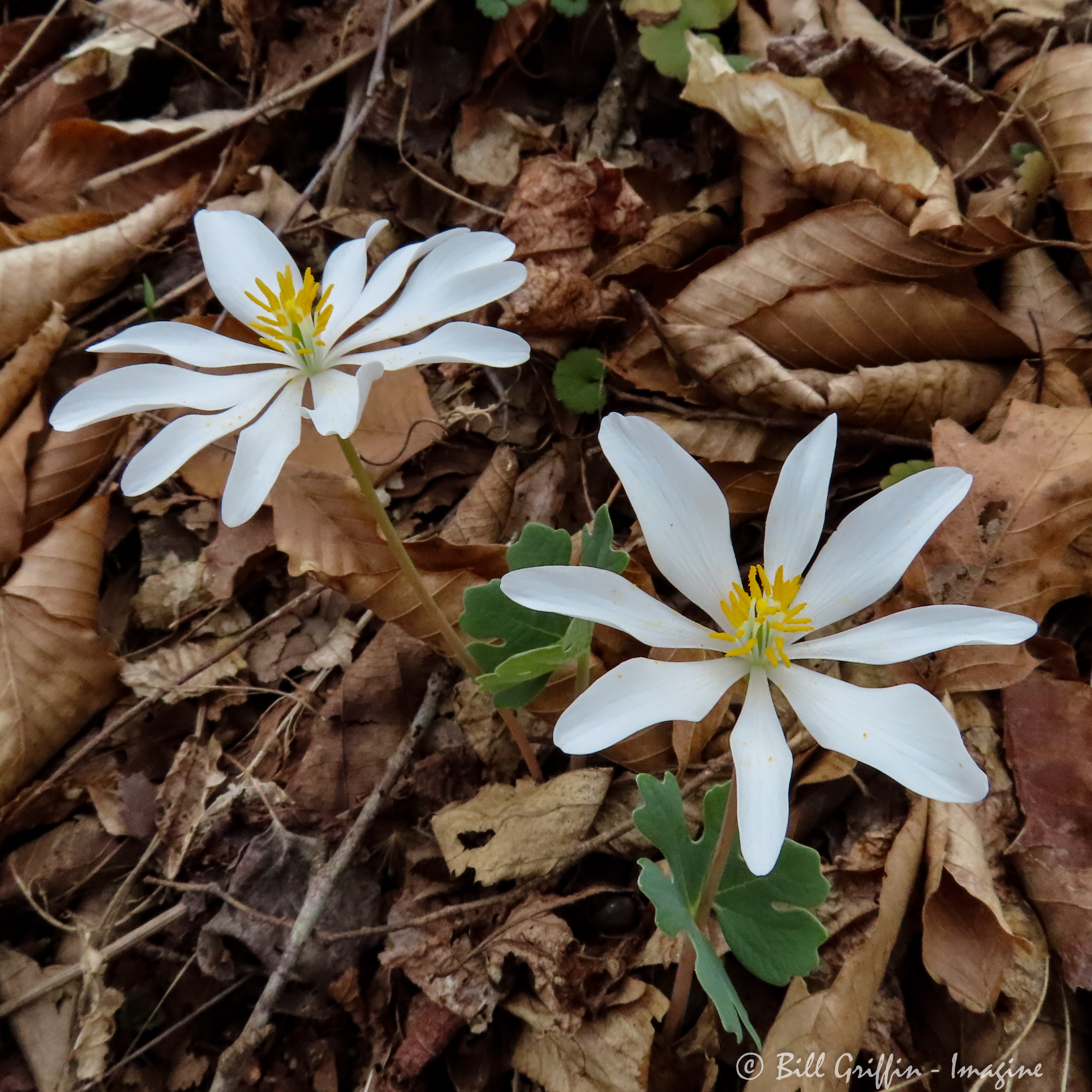
A week after our group walked the trail I am still happy for what the forest shared with us. Yes, one Trout Lily had stretched and curved its petals to open a small yellow flower. Yes, one Hepatica, among the many other slumbering liver-lobed leaves, presented the cold morning after freezing night with a single pale lilac bloom. We knelt closer for its even more remarkable surprise: beneath the blossom nodded two more, sepals already empty of petals and gone to seed. The spring ephemerals know their business and their name. They make more of themselves and fill the world whether we are watching or not.
 . 
I have been watching these flowers but not nearly long enough nor often enough. Nevertheless one remembers – color and scent may spark a flicker of joy into a life that threatens to cloak each day with darkness. On our walk, beside a particular beech tree no different from the hundreds around us, I recall the first time I ever discovered Hepatica blooming in our woods. That year it was the only one I found and I returned to it day after day until it faded. Now here it is again, the very plant. Its leaves are pocked and burnt orange from their long winter’s work. If it has buds, they are still hiding. As yet no new spring foliage. But I will be back to share this brief season with it. Perhaps we will bloom together.
 . 
 . 
❦ ❦ ❦
 . 
Spring
 . 
Somewhere
++ a black bear
++ ++ has just risen from sleep
++ ++ ++ and is staring
 . 
down the mountain.
++ All night
++ ++ in the brisk and shallow restlessness
++ ++ ++ of early spring
 . 
I think of her,
++ her four black fists
++ ++ flicking the gravel,
++ ++ ++ her tongue
 . 
like a red fire
++ touching the grass,
++ ++ the cold water.
++ ++ There is only one question;
 . 
how to love this world.
++ I think of her
++ ++ rising
++ ++ ++ like a black and leafy ledge
 . 
to sharpen her claws against
++ the silence
++ ++ of the trees.
++ ++ ++ Whatever else
 . 
my life is
++ with its poems
++ ++ and its music
++ ++ ++ and its glass cities,
 . 
it is also this dazzling darkness
++ coming
++ ++ down the mountain,
++ ++ ++ breathing and tasting;
 . 
all day I think of her –
++ her white teeth,
++ ++ her wordlessness,
++ ++ ++ her perfect love.
 . 
Mary Oliver
from Devotions, the Selected Poems of Mary Oliver, Penguin Press © 2017; originally collected in House of Light, Beacon Press © 1990.
 . 
❦ ❦ ❦
 . 
Here in closing a few lush stanzas from the overpowering lyric Locksley Hall by Alfred Lord Tennyson:
 . 
Here about the beach I wander’d, nourishing a youth sublime
With the fairy tales of science, and the long result of Time;
 . 
When the centuries behind me like a fruitful land reposed;
When I clung to all the present for the promise that it closed:
 . 
When I dipt into the future far as human eye could see;
Saw the Vision of the world and all the wonder that would be.—
 . 
In the Spring a fuller crimson comes upon the robin’s breast;
In the Spring the wanton lapwing gets himself another crest;
 . 
In the Spring a livelier iris changes on the burnish’d dove;
In the Spring a young man’s fancy lightly turns to thoughts of love.
 . 
Read Locksley Hall in its entirety at The Poetry Foundation
Purchase Mary Oliver’s Devotions at Penguin/Random House
Cutting edge phenological research at Nature.com
 . 
❦ ❦ ❦
 . 
2019-02-09 Doughton Park Tree
 . 

Read Full Post »

 . 
[with 3 poems by Robert Morgan]
 . 
Flight of the Mountains
 . 
Steep shoals
pyramid in the west,
high groves and
sacred
burial ranges
piled like thunderheads,
flap one on the
other to
high haze,
ladder up to the
dam holding back sky.
The great wings
back
each other
up all the way
to the final gap.
Clear weather
files the nick
sharp as
a gunsight.
I mean to climb
up there,
over the hogbacks and
heavy buttresses,
knowing hollows
and marshes
of meander
separate the
rough topologies to
sit at the tip
of the breaking
looking over.
 . 
Robert Morgan
from Collected Early Poems of Robert Morgan, Press 53, Winston-Salem NC; Carolina Classics Editions; © 2024
originally published in Land Diving, Louisiana State University Press; © 1976
 . 
❦ ❦ ❦
 . 
And those walls rest / like successive stages of etymology / on foundations and / castellations of temple-brothels / over cellar libraries. +++++ Tell
 . 
I’m six and we’re driving from our home in Memphis to visit Grandmother and Granddaddy in Hamlet, North Carolina. Pre I-40, two long days on blacktop. The car games I can play with my little brother have already gone flat: Cow Checkers, 10 points for a white horse, 100 points for a white mule. Now Mom is entertaining me with the Alphabet game. We have to spot items along the two-lane that start with each letter in sequence.
 . 
Airplane, Barn, lady wearing a Coat . . . now I’m stuck on M. We’re still driving through the low rolling hills of western Tennessee, its antediluvian coastal plane, and Mom guides me to look out the front windshield. “How far do you think you can see?” I can’t even guess. “That’s a mile, Billy. You can see at least a Mile.”
 . 
I am astonished. Up until that very moment a Mile was an abstract concept equivalent to a very, very, long way. Much too far to walk, impossible that it could actually be a tangible thing, and here I was seeing one! This was also around the time in my life when I realized that I could not NOT read the billboards and road signs. I could no longer unsee the words all around me that suddenly meant. Words were warping my consciousness. Words surrounded me, more real than the objects they represent.
 . 
Stratigraphy, the study of layers, is the deep domicile of archaeologists and geologists. Etymology is the archaeology of words, their first seeds, their roots and stems; etymology is the geology of language. How have the million intersections of grunts and grammar, symbology and syntax come to map and define our thinking? How can a handful of inchoate squiggles clustered into three or four recognizable tropes bring us to tears or make us fighting mad? And why do we persist in arranging them and rearranging them in desperate hope of creating something truly new?
 . 
Logos – In the beginning was the Word, and the Word was with God, and the Word was God. I will keep reading my glossaries and dictionaries. Footers and pilings of words will rise to gables and mansards and shelter me. Layer upon layer I will walk the strata of explication and illumination and poetry. Look, there ahead, a bright light – it can’t be more than a Mile!
 . 
 . 
❦ ❦ ❦
 . 
Tell
 . 
Coming on a hill many stories
above the grasslands
and wastes of far-reaching canals.
Rain and high wind have exposed
bits of pottery and brick
around the summit.
A wall corner shows. Digging,
fortresses filled with blowing
dirt raise battlements
built on the ruins of others
ancient to them.
And those walls rest
like successive stages of
etymology on the foundations and
castellations of temple-brothels
over cellar libraries.
Peeling off a few more centuries finds
a mausoleum unsealed and robbed
before the body melted.
Shoveling through silt, lamina
of urns, weapons, after
a few thousand years to arrive
beyond assembling and restoration
at virgin soil, without clue,
no origin. There at the center
of the first hill just
sandstorms leveling and filling
all depressions, building ramps
up and over walls, and below that
nothing but mud where once
some river anointing
the steppes turned back to the sea,
and dust saying anathema.
 . 
Robert Morgan
from Collected Early Poems of Robert Morgan, Press 53, Winston-Salem NC; Carolina Classics Editions; © 2024
originally published in Land Diving, Louisiana State University Press; © 1976
 . 
❦ ❦ ❦
 . 
. . . You are one gene / in the cells of the body of language. +++ 
+++++++++++++++++++++++++++++ from Mockingbird
 . 
The fourth book in Robert Morgan’s Collected Early Poems is Trunk & Thicket. It begins with him opening an ancient trunk in the dusty attic of his grandparents’ home, breaking the rustmolten lock to delve its layers of artifacts and treasures and paper in a drymelt. The long poem, 25 pages, goes on to climb the trunk of his family tree, fall more than once between the branches, and thrash through tangled thickets of every memory and relic and Uncle that have folded and switched him into his own personal landscape. The tale follows no clear trodden footpath but is a bushwhacking through the clutch of briars to find one and then another sacred landmark.
 . 
And the words, the words! The language of mountains and one-room churches and generations stretching beyond sight in the blue mist of ridges sits down at a rough trestle table with galaxies and particles and the fierce tokamak of the overhead sun. Some of these words were already chafed and well-worn when they clambered from the barque on the Carolina coast; some bite our tongues with the sharp teeth of ions and new-minted fire. Especially in the final long poem, Mockingbird, Robert Morgan calls together a congregation of words that shout as language receives a powerful new baptism. Proverbs and parables. Exhortation and invitation.
 . 
Exalted and utterly common. Words are the leafmould that almost conceal heartleaves of wild ginger in February. Words are the green plant that thrives unseen in this cold atmosphere, that will not discourage a closer look. Words are the purple stems parting and recumbent buds opening. Despair, if you will, that there is no light left in the world, but then nevertheless kneel and touch and discover, before Spring is even a rustling gestation in your belly, that the words of earth are making flowers.
 . 
 . 
The Collected Early Poems of Robert Morgan, available HERE from Press 53, reprints in their entirety his first four published volumes: Zirconia Poems (1969); Red Owl (1972); Land Diving (1976); Trunk & Thicket (1978).
 . 
Read additional selections from this new book at last week’s VERSE & IMAGE.
 . 
 . 
❦ ❦ ❦
 . 
Mockingbird
[excerpt – introduction]
 . 
While the bee sleeps in the southern night
and weeds weigh under dowries of dew,
above the distant honky-tonk of falls in
the July dark, before the katydids, when
the only frost is lunar, a voice that
raises the hackles on mountains and chills
the barometric spine, that radios through
many channels in the crab orchard and from
maples above the road. What madrigalist
watering the night with polyphony?
You could see orchestras and oratorios
in the polyglot dark, not so much a
mocking of the many-voiced populations
as a gathering to unlikely congregation
of all song, an anthology including
rooster and cricket broadcast from an ounce
of hot flesh through its briar tongue and filling
the hollows and thickets and dry ditches of
the river valley, and soaking under eaves
to the inner ear’s accelerator,
circling quick into sleep and bombarding
the ledges of dream.
+++++++++++++ It is my time then;
I surface like a drowned man after three
days and lie trembling with attention to
the heart’s perpetual bass. The dark belongs
to me, the peak of alert night. Mama said,
Then is the time to think about God and
feel close to him. But I float in a
sentient medium that amplifies the
distant creek rubbing its rocks, and mist
muddying the weeds by the dusty road,
and I hear the big distance between stars
where two almost light in the oak by the
window. The ascending particle
contraltos. The river’s a great liquid
bird singing all day between boulders,
over logs and around bushy islands.
Empties through the gorge its burden without
lessening. All night sings under westering
stars, loudest in the dark before day.
++++++++++ And then –
 . 
Robert Morgan
from Collected Early Poems of Robert Morgan, Press 53, Winston-Salem NC; Carolina Classics Editions; © 2024
originally published in Trunk & Thicket, L’Epervier Press; © 1978
 . 
❦ ❦ ❦
 .  . 
Doughton Park Tree 2016-10-17a

Read Full Post »

Thunderhead Sandstone outcrop below Ft. Harry Falls, GSMNP

 . 
[with poems about Geology . . . (say what?!)]
 . 
Erosion
 . 
Edges fall first,
silt grains cemented
under thousands of years
sloughed away by wind, rain,
footstep of dog,
sandstone alchemized beneath
weight of mountain
turns sand again
 . 
Subtle rubbing of days shapens us anew,
weathering, the
slowest song of change
 . 
No wonder we wake up some days
wondering at who we used to be.
No wonder we don’t always notice
as our outer edges strip away.
 . 
No wonder the children build castles
made of sand at water’s edge,
even though the castles fall.
 . 
They are practicing for
when they too will feel
what once seemed enduring
slip inside the rising tide.
 . 
Emilie Lygren
from What We Were Born For, Blue Light Press, San Francisco CA. © 2021. Reprinted by permission of the author.
 . 
❦ ❦ ❦
 . 
Geology never intended to trip us up. A mountain’s day is steady and measured, calm as the drip of water, languid as the North Pole’s precession that turns to aim the spinning globe at heaven. All night the mountain’s flow, her stretch, recumbent but restless; at first light she yawns and shudders, her turn and crouch and slow rise; then all morning’s long knotting and gathering to her full height; her relentless stride; a forceful journey, this full day’s labor into evening even as her form, still imposing, diminishes and she reclines.
 . 
Did the mountain even feel the pinprick of water seeping and freezing in minute fissures at her neck? Perhaps a vague itch as lichens scratch to enlarge their circumference, little acid fingernails, a thimbleful of soil. Windborne seeds – would she notice such a light caress when one descends, then its rootlets, its swelling cambium and lignin? One and now another trunk emerges from the crevice, breathing, drinking sunlight, and here comes the day in mammal-time when gravity prevails. A crack, thunder without lightning, slabs and chunks release and roll downslope until they hold at a narrow rib where it crosses below the mountain’s shoulder. Bedrock settled into the new bed it has found.
 . 
Ten thousand human-years pass until you and I puff into view. We slow our pace to climb over and around. Here embedded in the footpath is a softer stratum that has been polished to ebony by a thousand boots. Here alongside the trail we greet the rounder edges and pitted face of earliest falls, sharper clefts and angles  from falls a mountain-day later. Water proving its strength. Lichens still hard at work. Wait a while and this path will open. Geology never intended to trip us up. She simply hopes that we will slow our frantic climbing. Pause here with her for a moment. Look, and simply see.
 . 

USGS map & quartzite vein in Elkmont (?) Sandstone GSMNP

 . 

Common Blue Wood Aster & Thunderhead Sandstone GSMNP

 . 
❦ ❦ ❦
 . 
Anything the River Gives
 . 
Basalt, granite, tourmaline, the male wash
of off-white seed from an elderberry,
the fly’s-eye, pincushion nubbins yellow
balsamroot extrudes from hot spring soil,
confetti of eggshell on a shelf of stone.
Here’s a flotilla of beaver-peeled branches,
a cottonwood mile the shade of your skin.
Every day I bring some small offering
from my morning walk along the river:
something steel, blackened amber with rust,
an odd pin or busing shed by the train
or torqued loose from the track, a mashed penny,
the buddy bulge of snowmelt current.
I lie headlong on a bed of rocks,
dip my cheek in the shallows,
and see the water mid-channel three feet
above my eyes. Overhead the swallows
loop for hornets, stinkbugs, black flies and bees,
gone grass shows a snakeskin shed last summer.
The year’s first flowers are always yellow,
dogtooth violet dangling downcast ans small.
Here is fennel, witches’ broom and bunchgrass,
an ancient horseshoe nailed to a cottonwood
and halfway swallowed in it spunky flesh.
Here is an agate polished over years,
a few bones picked clean and gnawed by mice.
Her is every beautiful rock I’ve seen
in my life, here is my breath still singing
from a reedy flute, here the river
telling my blood your name without end.
Take the sky and wear it, take the moon’s skid
over waves, that monthly jewel.
If there are wounds in this world no love heals,
then the things I haul up – feather and bone,
tonnage of stone and the pale green trumpets
of stump lichens – are ounce by ounce
a weight to counterbalance your doubts.
In another month there won’t be room left
on the windowsills and cluttered shelves,
and still you’ll see me, standing before you,
presenting some husk or rusty souvenir,
anything the river gives, and I believe
you will love.
 . 
Robert Wrigley
from The Ecopoetry Anthology, edited by Ann Fisher-Wirth and Laura-Gray Street, Trinity University Press, San Antonio, TX. © 2020
 . 
❦ ❦ ❦
 . 
“Find yourself a stone, one you can pick up and carry,” our instructor tells us. “Then find me bedrock.” All weekend Elizabeth will be offering us something new every few minutes  – strange vocabulary, stranger stories in deep time, paths upward toward heath balds and downward into the past – but first she offers these two commands. Our substratum. We will build everything upon a stone from the Middle Prong of the Little River, edges knocked round, compressed bits of texture a hundred shades of gray (soon we’ll know to call those bits clasts); and ponderous gray stone rising beside the river, its layers, its planes and fissures (soon we’ll know which is bedding and which foliation). Here we begin our weekend course in the Smokies, 500 million years beneath our feet, asking how it all got here.
 . 
I’m taking my final elective offered by Great Smoky Mountains Institute at Tremont in their Southern Appalachian Naturalist Certification Program – Geology of the Smokies. This is the first time Linda has accompanied me to Tremont, so she’s taking her first course. We know from our readings that these are the most folded, tortured, elevated/eroded/re-elevated/re-eroded square miles in North America. We know that for the next 48 hours we’ll be continuously outdoors except a few hours to eat and sleep. From my previous nine courses, I know Elizabeth Davis as an excellent teacher, patient yet challenging. What we don’t yet fully know is just how truly challenging, physically and intellectually, this weekend is going to be. But here we are on Friday night and we should be getting a clue – Elizabeth is leading us on a hike into pitch darkness, across the shallows on a single-log bridge, and has turned us loose on an island to find our river stones.
 . 
Success. No one falls into the river.
 . 
Tomorrow morning we’ll be picking our way up through a pathless boulder field to a massive outcrop of Thunderhead Sandstone (its compressed sediment, clasts, recycled from the Grenville mountains built almost a billion years ago). We’ll spend the afternoon literally on hands and knees beneath laurel and rhododendron, climbing to a heath bald summit where some really cool rocks are exposed and where we’ll take samples of the low pH soil. Sunday morning we’ll hike a trail so hazardous that the Park won’t even include it on their maps, but along the way we’ll cross major and minor fault lines to discover their rocky transitions, investigate geology’s effect on plant communities, devise some crazy poems and songs about our findings, and end up at beautiful Spruce Flat Falls.
 . 
Late Sunday night, after driving five hours, Linda and I will pull into our driveway and our old bones will creak as we lug our gear back into the house in pitch darkness. At least we don’t have to cross a log bridge to make it to the kitchen door, but when we wake in the morning, stiff and aching, will Linda have a few choice cusswords for me after dragging her along on this adventure? Oh yeah, we’re sore, but only in body. What Linda does have for me is a list of books I need to order. And this proclamation: “You know, after this weekend I really love Geology!”
 . 

Nodding Ladies Tresses growing up through Anakeesta Slate GSMNP

 . 

Elizabeth displays bedding vs cleavage at summit of heath bald near Chimney Tops GSMNP

 . 
❦ ❦ ❦
 . 
The End of the Age
 . 
With wash and ripple and with wave,
Slow moving up the long deserted sand,
The little moon went watching the white tide
Flood in and over, spread above the land,
Flood the low marshes, make a silver cover
Where the green sea-weed in a floating mist
Creeps under branch and over.
The wide water spreads, the night goes up the sky,
The era ends.
 . 
Tomorrow comes warm blood with a new race,
Warm hearts that ache for lovers and for friends,
And the pitiful grace
Of young defeated heads.
Tomorrow comes the sun, color and flush
And anguish. Now let the water wash
OUt of the evening sky the lingering reds,
And spread its coolness higher than the heart
Of every silver bush.
Night circles round the sky. The era ends.
 . 
 . 
Geology
 . 
“Look,” said God;
And with slow fingers
Drew away the mantle rock.
Man followed groping
To touch the flesh of his true mother;
And, standing in great valleys,
He saw the ages passing.
 . 
 . 
Fossil
 . 
I found a little ancient fern
Closed in a reddish shale concretion,
As neatly and ans charmingly shut in
As my grandmother’s face in a daguerreotype,
In a round apricot velvet case.
 . 
Janet Loxley Lewis (1899-1998)
from Poetry Magazine, No. 111, The Poetry Foundation. © June, 1920
 . 
❦ ❦ ❦
 . 
Emilie Lygren has published poems and anthologies and developed dozens of publications focused on outdoor science education. Her first collection of poems, What We Were Born For, was selected by the Young People’s Poet Laureate as the Poetry Foundation’s monthly book pick for February 2022.
 . 
Robert Wrigley has said that “poetry can have a redemptive function. It can look at the chaos you see and make a kind of sense of the smallest part of it.” His poems are concerned with rural Western landscapes and humankind’s place within the natural world.
 . 
Janet Loxley Lewis (1899-1998) wrote novels, stories, and librettos, but she considered poetry the superior form. Theodore Roethke describes her poetry as “marked by an absolute integrity of spirit and often by the finality in phrasing that can accompany such integrity.”
 . 
❦ ❦ ❦
 . 
 . 

Great Smoky Mountains Institute at Tremont GEOLOGY course November, 2024

 .  . 
 Doughton Park Tree 2018-02-09

Read Full Post »

« Newer Posts - Older Posts »