Feeds:
Posts
Comments

Archive for October, 2024

 . 
[with 4 poems from Speaking for Everyone]
 . 
Epiphany
 . 
searching through the turning worlds,
+++ eruptions on the sun,
+++ disruptions in the atmosphere, pulsing past
+++ our planet’s pinpoint in the sea
+++ of swirling masses,
+++ gasses, dark and light – – –
+++ measuring for meaning, straining for the
+++ +++ second
+++ when what wasn’t is what was
 . 
we gather cinders on our shoes
+++ sediment from galaxies
+++ glimmer in the minerals
+++ like dusty road outside Damascus,
+++ shimmer in the flint for flames
+++ that find our face,
 . 
+++ and burn our searching shadow
+++ forever in the steps we leave behind
 . 
John Kristofco
from Speaking for Everyone, edited by Eric Greinke © 2024
 . 
❦ ❦ ❦
 . 
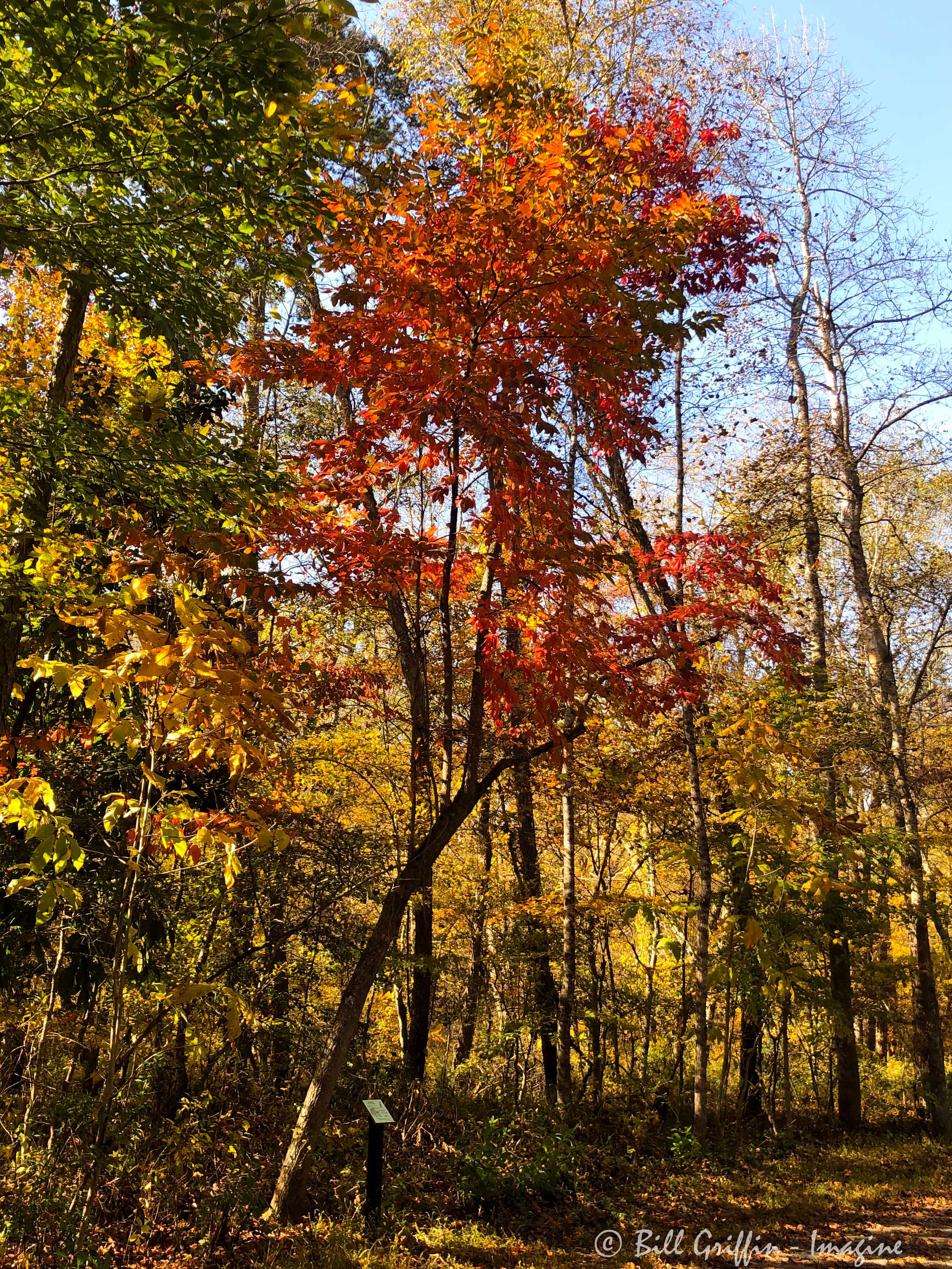
To my eyes, this is peak. Route 421 is still mostly flanked with green but Tuliptrees have begun to sauté a rich buttery roux. Here and there a Maple tries on its copper halo against the background of lime and salmon that renders the entire crown translucent. Sumac is on fire. Among the many trees barely shifted it is contrast that stands out. That catches the eye.
 . 
Especially this one fellow who won’t be held back. His spine is curved, he has to lean out and away from the big guys overshadowing, but he has completely cloaked himself in deep, mature red. In every other season, Sourwood conceals himself within the massing forest, but in October he glows.
 . 
This morning Dad’s occupational therapist is timing his glow. How long can he stand up? Dad grips the walker, gravity slowly claiming him until we prompt him to read the hats on top of the wardrobe. For a moment he’s upright but then gradually curls again. Two minutes fifty before he has to sit back down. Rest a bit and then we’ll try again, and again, three times to really see what he’s got. He won’t be held back. And when she repeats the test next week will he strike another personal best?
 . 
Tough old Sourwood. In summer the tent caterpillars find you delectable and leave bald spots and frizz. In winter we discover no single limb is straight, no trunk unbowed. But in spring you blossom, florets too small to be showy, too high at your pinnacle for us to notice, that is until after the pollinators have had their way with you and you carpet our path with tiny creamy castoff bells. Your promise: somewhere there’s going to be honey.
 . 
 . 
❦ ❦ ❦
 . 
A Brief History of Trees
 . 
This is the space where the trees stood
before we cut them down to make boats
that would take us to another country
whose trees we cut down to make houses.
Then we grew new trees
so we had wood for our arrows
to shoot at the enemies whose trees
we turned into musical instruments.
We grew more trees
to sell to our friends who had made money
out of theirs, and we bought up all the forests
to make paper, and cut faster
than the trees could grow. Then we printed
the history of trees
so our descendants could read
about the creatures who lived among them
and about how we feared the dark forests
with their eyes of night and insects
thirsting for blood. It was all
to make room for sunlight, we say,
and to make the world safe. And we close
with a postscript that admits
it may all have been a mistake, but how
could we have known, when we were strong,
that we would grow bored with music
and forget how to read?
 . 
David Chorlton
from Speaking for Everyone, edited by Eric Greinke © 2024
 . 
❦ ❦ ❦
 . 
The Day the Cow Jumped Over the Moon
 . 
No one waw it coming
though in retrospect
it seems obvious, inevitable.
 . 
Even the moon was surprised
though some would say
it was in a better position
 . 
than anyone else
to see the big picture.
How did we miss it?
 . 
So much destruction,
bodies buried under buildings,
the waters rising.
 . 
Some must be responsible.
We need a congressional investigation,
discussion on Sunday talk shows.
 . 
Nothing with ever be the same
until the Super Bowl again
becomes the headline above the fold
 . 
and everyone returns to the meadow
to stand around mooing,
chewing their cuds.
 . 
Joyce Meyers
from Speaking for Everyone, edited by Eric Greinke © 2024
 . 
❦ ❦ ❦
 . 
“ . . . poems that express collective consciousness through the use of the first person plural persona ‘we’.” So it describes itself, this anthology edited by Eric Greinke, Speaking for Everyone: beyond egocentric and ethnocentric to the level of anthropocentric. Suddenly I’m conscious of what was subliminal until now, that a tiny shift of pronoun has the power to draw me fully into the poem as participant rather than simply audience.
 . 
We all find our bliss once or twice
in the lives we live
in the black box.
We don’t recognize the signs,
but the people around us step aside when we
emerge from our temporary deaths.
+++++++ Buddha, Elizabeth Swados
 . 
And now I am reading these poems with greater intention. Will I discover myself in every setting and every image? Perhaps not, but I might discover connections I hadn’t anticipated – I might be giving myself to the poem rather than simple expecting it to give to me. I don’t recognize the names of most of these writers but I find myself wondering about them, walking beside them as they explore the universe. More than speaking for everyone, here they speak with everyone. And me.
 . 
 . 
Speaking for Everyone, An Anthology of “We” Poems, is edited by Eric Greinke with contributing editors Alan Britt, Peter Krok, and Gary Metras. Discover more about this prolific poet, editor, and essayist HERE
 . 
 . 
❦ ❦ ❦
 . 
For the Neighbor Who Got Bagpipes for Christmas
 . 
Aleppo lay slaughtered,
Berlin mourned her dead.
The Black Sea swallowed
a whole Russian chorus.
 . 
From Somewhere
West of our suburban acre,
floating on the frozen
twilit air, we heard
“Amazing Grace”
 . 
your gentle ailing
reminded us
who we would like to be.
 . 
Marylou Kelly Streznewski
from Speaking for Everyone, edited by Eric Greinke © 2024
 . 
❦ ❦ ❦
 . 
IMG_1783
 . 
❦ ❦ ❦

Read Full Post »

 . 
[with 4 poems from I-70 Review]
 . 
Bears Active in This Area
 . 
++++ warning sign in my mountain cabin
 . 
This time, others have seen you,
treading circles on the gravel drive,
shouldering through grapevine tangles.
The possibility of you was always here,
in the night-mouth of the cave that gapes
below my porch, in dark boulders
hulking along the trail.
 . 
Your presence countermands silence –
I chatter and sing as I walk the open road,
snatches of carols, toddler songs –
and shy from the path that meanders
to a sunlit filed strewn with windfalls
from long-neglected trees. I imagine
you keeping pace, just out of sight,
your huffs mocking my jabber,
your heavy steps a counterpoint
as I scurry past thickets, scan uneasily
the curving trail ahead, intruder
in a world that was never mine,
though you are the first to insist
that I acknowledge it.
 . 
Rebecca Baggett
from I-70 Review, Eighteenth Edition, 2024
 . 
❦ ❦ ❦
 . 
What would a toddler remember about moving away? The apartment in Niagara Falls is a dream of stairwells and windows and darkness outside; the new house in the new subdivision with no grass at all is a neighbor’s dog named Bishy. Or was Bishy the neighbor’s toddler I played with?
 . 
I am four when we move away again, from New York to Tennessee, and I remember plenty about Marion Road: Bob and I watching Little Rascals until Mom declares, “You’re going to turn into rascals!”; our little sun room Aunt Ellen fitted up as a bed-sit while she attended Memphis State, and we kids hiding giggling under her covers until she came home each afternoon; the neighbor boy who introduced us to the word butt and we thought we were the first humans ever to utter something so outrageous. Memories of the neighborhood, yes, but memories of moving there? Packing and unpacking? Worrying that Puppy would get lost in the shuffle or that somehow Mom wouldn’t be there when we arrived? None of that remains.
 . 
Our family makes one more inconsequential move just blocks away when I am six, but then when I’m twelve the Big Away arrives. Up until this what a tranquil 1950’s childhood: I walk to Colonial Elementary every morning with my friends and play with the same friends every evening until the streetlights come on. Serene. Now I’m midway through sixth grade, still coasting, when the bomb drops. Did I protest when Dad announced in January we were leaving Memphis to move to Delaware? Maybe, I don’t recall; that memory is muddy, but this one is sharp as crystal – I walk into class in my new school and my new classmates all turn to look. My clothes aren’t right, my accent is a joke (literally – within about sixty seconds I will have the nickname “Memphis,” which sticks), and I have a different teacher for every subject. And then in just six more months we will move to Michigan. Just over a year beyond that, two months into eighth grade, we move to Ohio.
 . 
So, my friend, is it any wonder that some sixty years later I have trouble remembering your name until the fourth or fifth time we meet? That as we converse in a group you notice me smiling and nodding and slowly drifting off into space? That I would rather write this blog into the wee hours than drop by your house for coffee? I want to be a good friend to you, and in fact I like you and this hug from me to you is real, but ah, it’s risky. There’s always that possibility, without warning and with no desire on my part, that someday soon I might be moving away.
 . 
 . 
It never occurred to me to wonder how Dad felt about all those moves. The moving was his fault, after all, necessary for his promotions and advancement with DuPont, for whom he worked all his life. I can scarcely imagine the million details he had to sift through to put his family into boxes and take them out again hundreds of miles away. I’m not surprised that as I clean out his house I find drawers full of lists on yellow pads, on the backs of junk mail, on bills and receipts. Half the time when he calls me, it’s to add something to the shopping list. And then there are still those boxes in the attic labeled Allied Van Lines.
 . 
But what about the rest of us? Did Dad wake sweating in the middle of the night worrying how moving away would affect his family? Just one time he blinked: after I was married and gone but Mary Ellen was still at home, a junior in high school, Dad turned down a promotion so she could graduate with her class. A sacrifice that stalled his career for a decade.
 . 
Tomorrow is Dad’s last moving day. Since Mom died in July, Dad has agreed to move closer to us. For a week I’ve ferried boxes and duffels, checked off my lists and then made new ones, and tomorrow after lunch I’ll drive Dad to a nursing center just two miles from our house. He says he’s willing to move as long as the food is good (it is). We’ve hung portraits of the grandkids, pastels by Mom. His Duke pillow is on the recliner and his new Duke banner hangs on the door of room 507 to welcome him. God knows I’ve been waking in the middle of the night sweating the million details. Let us hope that after 98 years of moving, Dad will discover in this new and final home a place to rest.
 . 
 . 
❦ ❦ ❦
 . 
Porta Nigra   *
 . 
++++ Trier, Germany
 . 
The breath of sun and rain
only darkens on my face.
The cat-claws of millennia,
the graffiti of tourists,
fade into my walls.
 . 
I, who guarded this city so long,
sit truncated now.
My frieze the sweaty flesh
of lovers on cool bare stones.
 . 
Catch me in another thousand years,
your eyes as hard and dark as mine.
See if these holes will match
the mysteries of death
and flesh on blackened stone.
 . 
Bradley Strahan
from I-70 Review, Eighteenth Edition, 2024
 . 
* a gate in the remaining piece of Trier’s old Roman wall
 . 
❦ ❦ ❦
 . 
The 2024 issue of I-70 Review arrived in last week’s post. Besides many wonderful voices new to me, I discovered within its pages several old friends who’ve agreed to let me reprint their poems.
 . 
I-70 Review, Writing and Art from the Middle and Beyond is based in Kansas, USA, but publishes poetry, short fiction, and art from around the world. They also sponsor the annual Bill Hickok Humor award for poetry.
 . 
Submission guidelines HERE
Purchase a copy HERE
 . 
 . 
❦ ❦ ❦
 . 
Messenger in Early November
 . 
++++++ – in memory of Jay Klokker
 . 
Driving past Agate Bay, I catch a glimpse
of this deer in a splotch of sun and shadow –
the brown-tail’s flanks on the edge of the road
in yellow leaves, thin branches. Las May
after your death, a bear cub loped beside my car
like a lost Labrador, seemed to disappear
under my front bumper. Slamming on the brakes,
I felt no thud, heard nothing. Amazing, the cub
as if uninjured, clambered up the ditch-bank.
Only later, after your memorial, did I reread
your last poems, that black bear nosing
at your sleeping bag in the camp site
in Arizona; recalled marmots whistling
in the pillow basalt near Mt. Baker; the grouse
thumping its tail near our driveway,
feasting on red hawthorn berries.
You noticed. I cannot believe you said no
to another go-round on the cancer wish machine,
you called it, completed your book First Stars.
On you last hike, you raced downhill
in your wheelchair, shouting. You must
be in these sun spots, mottled shadows.
Too excellent a camouflage, my friend –
thin, flickering branches, a few gold leaves,
before all the color goes away.
 . 
Richard Widerkehr
from I-70 Review, Eighteenth Edition, 2024
this poem will appear in Richard’s new book, Missing The Owl (Shanti Arts Press)
 . 
❦ ❦ ❦
 . 
The Other
 . 
Last night coyotes laughed
at the neighbor’s bulked-up lab restrained
behind his chain-link, his fearful bark,
their yips of liberty and mild derision;
 . 
are coyotes such demons, or just particular
about whom they allow to know them?
Or are they perhaps spirits of the other,
avatar of all we hominids in our marrow
 . 
know to fear? How to live beside that feeling?
Afraid of attack I stab; afraid of pain I cause it.
 . 
In the woods before daylight willingly lost,
soft tread, a twist in the trail then face to face –
perhaps she and I look into each other’s eyes
for two seconds, perhaps the rest
 . 
of my life; coyote impassive,
considerate, measures our distance,
our closeness, then softly pivots
and pads away, prudent, fearless,
 . 
willing to allow the two of us
to share the universe.
 . 
Bill Griffin
from I-70 Review, Eighteenth Edition, 2024
 . 
❦ ❦ ❦
 . 
 . 
❦ ❦ ❦
Doughton Park Tree 2020-09-08b

Read Full Post »

I learned today from our friends at CHARLOTTELIT that Dannye Romine Powell died on October 10, 2024. She was a joyful and fearless supporter of literature, the arts, and poetry in North Carolina for many decades, and whenever I asked her advice or permission to use her work, she was a gracious friend.

I am re-printing this post from December 30, 2020 so that we can share again these evocative poems by Dannye. In Memoriam.

 . 

❦ ❦ ❦

 . 

NEW

 . 

[with poems by Dannye Romine Powell]

When we lower her pack from the tree where it has swung all night like a bell mocking the bear, the skunk, she opens it and screams: a fairy crown atop her sweatshirt and socks, a perfect round nest and four perfect hairless mouse pups like squirming blind grubs. We peer in awe, shepherds at the manger.

Mother mouse has hidden herself — she is not in the pack with her babies. We lift the nest intact, hide it in a bush beside the tree, nestle leaves around. Mother will sniff out her precious ones, reclaim her treasure. But we have other lambs to tend.

We eat, stow gear, shoulder our packs, face the trail, and consider: the pack was in the tree just one night; the nest is woven from meadow grass where we slept; the mother who climbed – how many trips up and back? – was heavy with her brood.

Miles before us, a new year before us – how heavy will each day’s burdens become before night brings rest?

.     .     .     .     .     .     .

A new book by Dannye Romine Powell arrived in the mail this week: In the Sunroom with Raymond Carver from Press 53 in Winston-Salem. I meant to read one or two poems this morning but I have read them all. A central persona that weaves through the collection is Longing: she visits rooms in old houses, unfolds memories into the light, shares the pain that others might lock in closets. Grief shared conceives within us hope to rekindle joy. Sharing grief, sharing joy, we become more human.

.     .     .     .     .     .     .

The Secret

Light glazes the near-empty streets
as I drive. Beside me, my grown son asks
if a secret I thought I’d kept buried
is true. A secret
that can still catch fire.
We stop on red. A bird flies
by the windshield. My father’s words:
Easier to stand on the ground
and tell the truth than climb a tree
and tell a lie. Now, I think. Tell him.
I stare at my son’s profile,
straight nose, thick lashes.
I remember, at about his age,
how a family secret fell
into my lap, unbidden.
That secret still ransacks a past
I thought I knew, rearranging its bricks,
exposing rot and cracks,
changing the locks on trust.

.     .     .     .     .     .     .

In the Night, the Wind in the Leaves

swirled and rustled
out our open window as if
for the first time,
as if we never were,
the earth newborn, sweet.

And what of us – asleep
on the too-soft bed
in the old mountain house?

Gone.

Also our children.
the ones who lived, the ones who died
before they grew whole. All night

the breeze swirled and rustled
through the leaves as if it played
a secret game, swirling
and rustling all night

as if we never were.

from In the Sunroom with Raymond Carver, Dannye Romine Powell, © 2020 Press 53

.     .     .     .     .     .     .

Dannye Romine Powell has won fellowships in poetry from the NEA, the North Carolina Arts Council, and Yaddo. Her poems have appeared over the years in The Paris Review, Poetry, Ploughshares, The Southern Review, Harvard Review Online, Beloit, 32 Poems, and many others. She is also the author of Parting the Curtains: Interviews with Southern Writers. For many years, she was the book editor of the Charlotte Observer. In 2020 she won the Randall Jarrell Poetry Competition for her poem “Argument.”

.     .     .     .     .     .     .

Read Full Post »

Older Posts »