Feeds:
Posts
Comments

Archive for March, 2024

 . 
[with 3 poems from The Ecopoetry Anthology]
 . 
First Verse
 . 
I admit the world remains almost beautiful.
The dung beetles snap on their iridescent jackets
despite the canine holiness of the Vatican
and, despite the great predatory surge of industry,
two human hands still mate like butterflies
when buttoning a shirt.
++++++++++++++++ Some mornings
I take myself away from the television
and go outside where the only news comes
as fresh air folding over the houses.
And I feel glad for an hour in which race
and power and all the momentum of history
add up to nothing
 . 
As if from all the mad grinding
in my brain, a single blue lily had grown –
my skull open like a lake. I can hear
an insect sawing itself into what must be
a kind of speech.
++++++++++++ I know there is little
mercy to be found among us, that we have
already agreed to go down fighting, but
I should be more amazed: look
at the blood and guess who’s holding
the knives. Shouldn’t we be more
amazed? Doesn’t the view
just blister your eyes?
 . 
To have come this long way, to stand
on two legs, to be ++ not tarantulas
or chimpanzees ++ but soldiers of our own
dim-witted enslavement. To utterly miss the door
to the enchanted palace. To see myself
coined into a stutter. To allow the money
to brand us ++ and the believers
to blindfold our lives.
+++++++++++++++ In the name
of what? If that old book was true
the first verse would say ++ Embrace
 . 
the world. ++ Be friendly. ++ The forests
are glad you breathe.
 . 
I see now
The Earth itself does have a face.
If it could say I ++ it would
plead with the universe, the way
dinosaurs once growled
at the stars.
++++++++ It’s like
the road behind us is stolen
completely ++ so the future can
never arrive. So, look at this: look
what we’ve done. With all
we knew.
With all we knew
that we knew.
 . 
Tim Seibles
from The Ecopoetry Anthology, edited by Ann Fisher Wirth and Laura-Gray Street; Trinity University Press, San Antonio, TX; © 2020
 . 
❦ ❦ ❦
 . 
I bend to pinch off a few stems as I walk down the drive beside the school. What is this tiny blossom? Four petals no bigger than a sliver of fingernail, lavender, pointed and neat. Whorl of slender leaves. Poking up through asphalt where it hugs the brick wall. I finger the hand lens in my pocket.
 . 
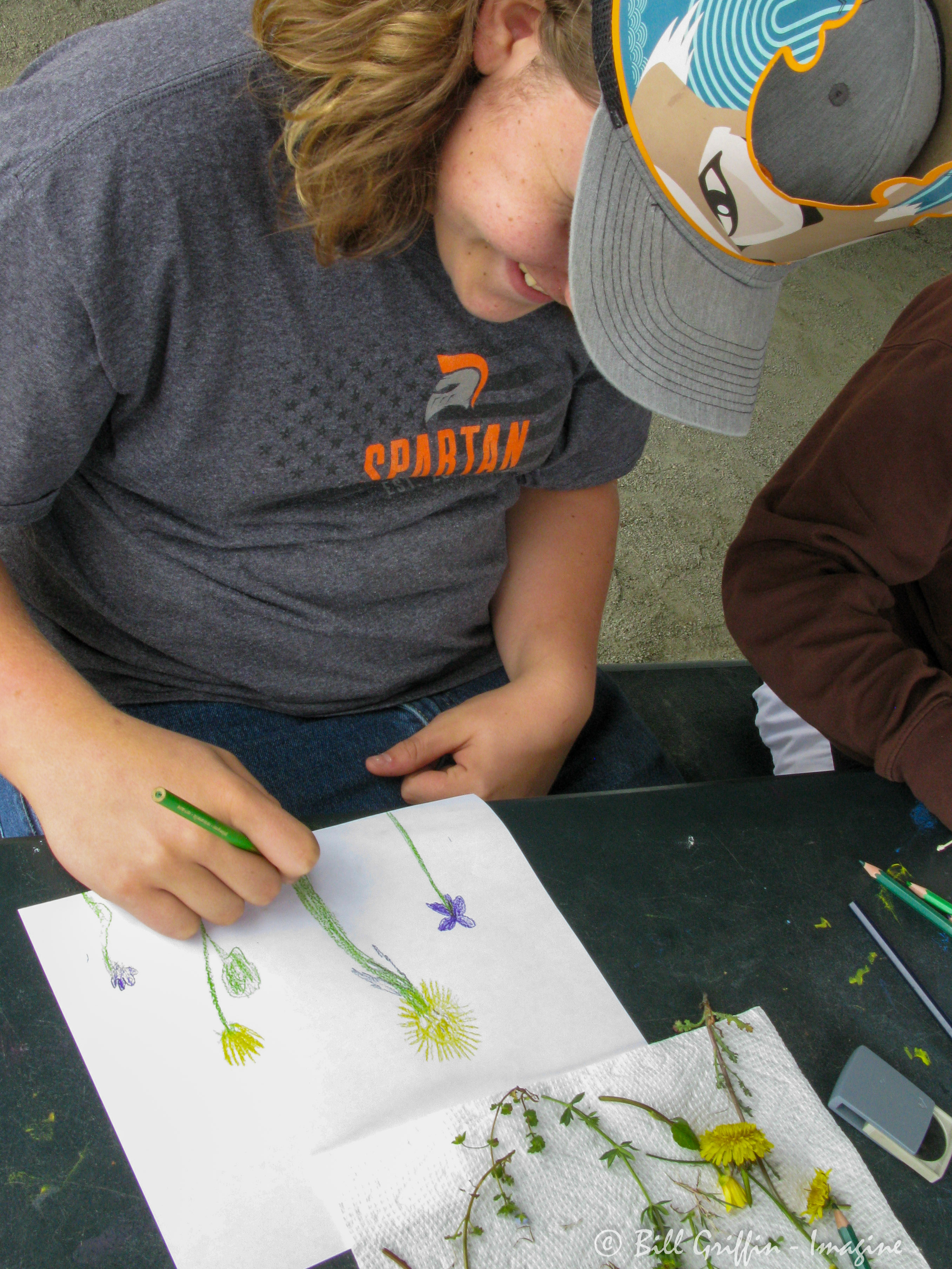
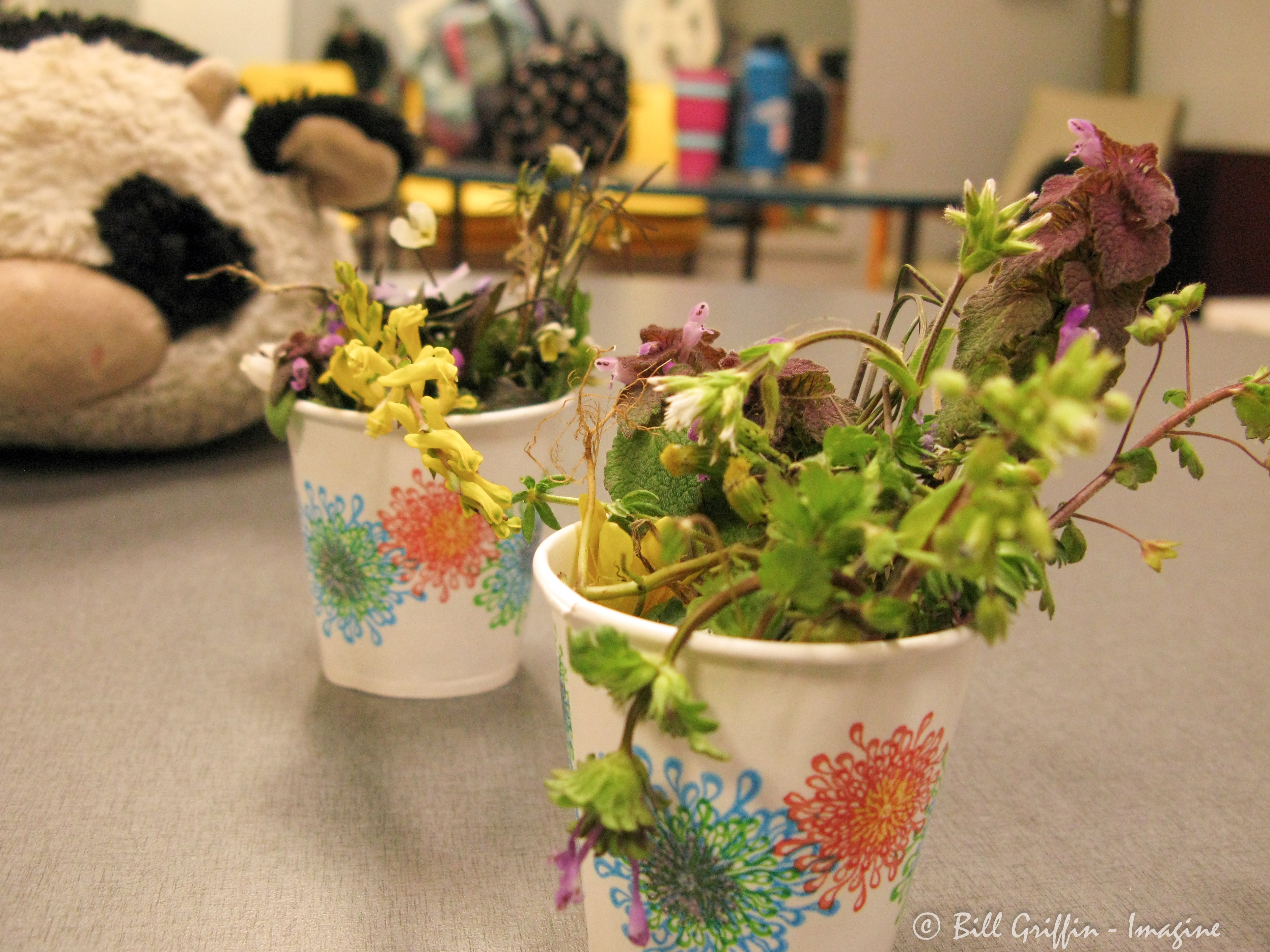
By the time I reach the ball field where the middle schoolers are at recess, I’ve gathered a mini-bouquet of the usual suspects: blue violets, henbit, deadnettle, bittercress. Their teacher turns them over to me and I lay out the plan, an hour and a half of Science Friday. Each takes their little paper cup and we spread out. The neglected. The overlooked. The beautiful in their own tiny tiny way – these are our quarry.
 . 
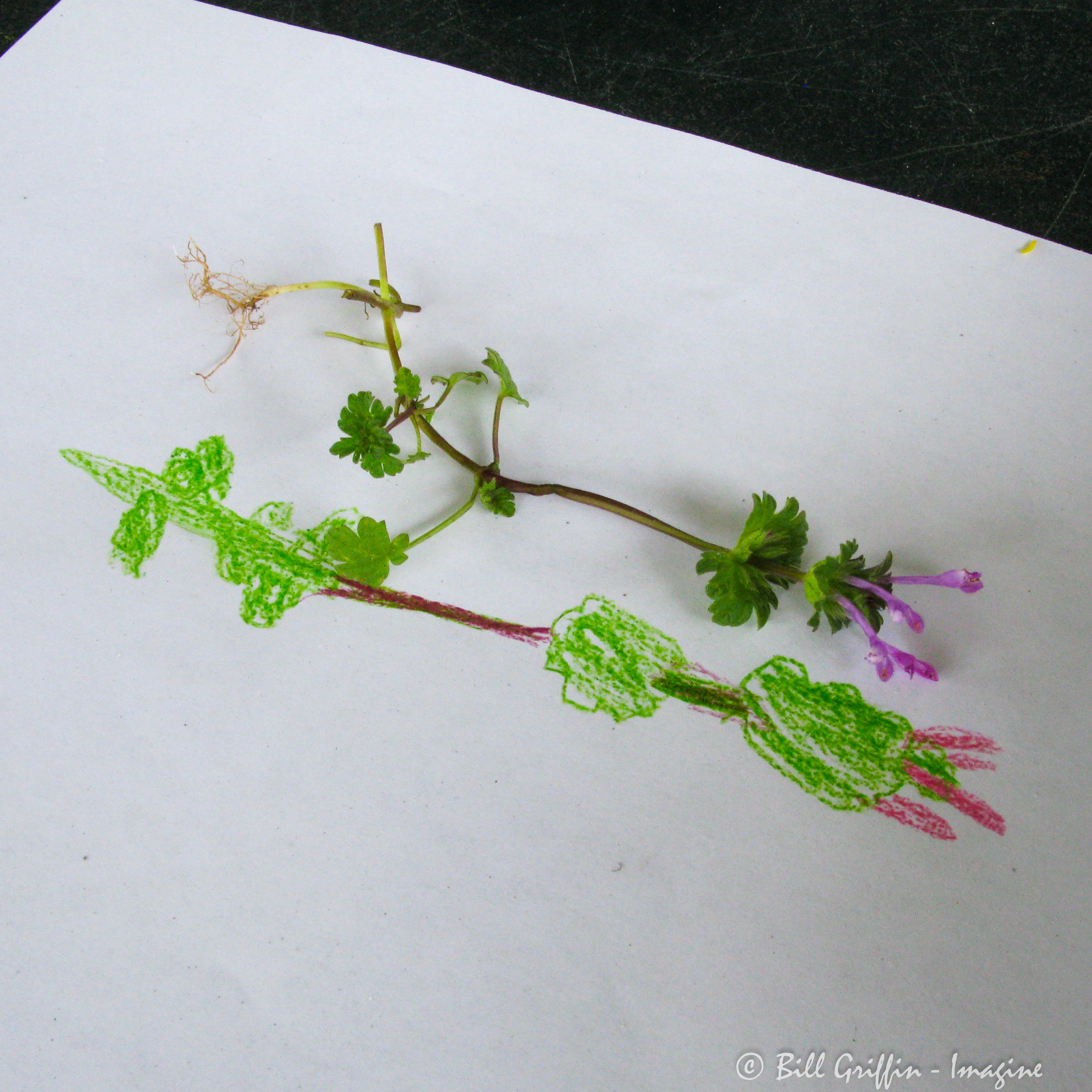
Sure, most folks would say we’re gathering weeds, and in a minute we’ll discuss that word, “weed,” something growing where it isn’t wanted. For now we scour the waste places, along the storage shed and storm fence, within the winter-brown kudzu invading from the ditch. Their cups fill up with yellow, pink, lavender, blue. After half an hour we sit down at the picnic tables behind the school; I pass around magnifying glasses and ask them to draw a tiny tiny flower as large as they can make it. And they do!
 . 
Are these kids listening while I talk about taxonomy and plant families, about native versus introduced, about flower anatomy of the little mints and asters we’ve discovered? Whether they are or not, I’m pretty confident that there will be days in the future when they look down at their feet and notice something they never paid attention to before.
 . 
It becomes a habit, this paying attention. I can’t not see them now. These tiny tiny flowers are not in my lawn – they are my lawn. OK, sometimes I pull up the mock strawberry and the bittercress when they crowd my “flowers,” and I do dig dandelions out of the front walk, but I’ll not curse them for their tenacity. Instead, I’ll do my best not to make them feel unwanted. I’ll resist the impulse to call them weeds.
 . 
 . 
 . 
Here’s what you’d discover in the mini-bouquet from our paper cups:
 . 
Henbit +++++ Lamia amplexicaule
Deadnettle +++++ Lamia purpurea
Creeping Charlie +++++ Glechoma hederacea
Common Blue Violet +++++ Viola sororia
American Field Pansy +++++ Viola bicolor
Common Dandelion +++++ Taraxacum officinale
Common Groundsel +++++ Senecio vulgaris
Hairy Bittercress +++++ Cardamine hirsuta
Smallflower Fumewort +++++ Corydalis micantha
Yellow Fumewort +++++ Corydalis flavula
Cut-leaved Crane’s-bill +++++ Geranium dissectum
Early Buttercup +++++ Ranunculus fascicularis
Mock Strawberry +++++ Potentilla indica
Common Chickweed +++++ Stellaria media
 . 
And my tiny tiny lavender blossom, the one you wouldn’t even notice for a flower within its handful of green if you hadn’t knelt before it?
Field Madder +++++ Sherardia arvensis
A member of the same family as my all time favorite plant genus, Coffea.
 . 
 . ❦ ❦ ❦
 . 
Scilla
 . 
Not I, you idiot, not self, but we, we – waves
of sky blue like
a critique of heaven: why
do you treasure your voice
when to be one thing
is to be next to nothing?
Why do you look up? To hear
an echo like the voice
of god? You are all the same to us,
solitary, standing above us, planning
 . 
your silly lives: you go
where you ware sent, like all things,
where the wind plants you,
one or another of you forever
looking down and seeing some image
of water, and hearing what? Waves,
and over waves, birds singing.
 . 
Louise Glück
from The Ecopoetry Anthology, edited by Ann Fisher Wirth and Laura-Gray Street; Trinity University Press, San Antonio, TX; © 2020
Scilla, in English also called Squill, is a genus of bulb-forming lily-like flowers that spread in a carpet of blossoms.
 . 
❦ ❦ ❦
 . 
The Lilies Break Open Over the Dark Water
 . 
Inside
+ that mud-hive, that gas sponge,
+ + that reeking
+ + + leaf yard, that rippling
 . 
dream-bowl, the leeches’
+ flecked and swirling
+ + broth of life, as rich
+ + + as Babylon,
 . 
the fists crack
+ open and the wands
+ + of the lilies
+ + + quicken, they rise
 . 
like pale poles
+ with their wrapped beaks of lace;
+ + one day
+ + + they tear the surface,
 . 
the next they break open
+ over the dark water.
+ + And there you are,
+ + + on the shore,
 . 
fitful and thoughtful, trying
+ to attach them to an idea –
+ + some news of your own life.
+ + + But the lilies
 . 
are slippery and wild – they are
+ devoid of meaning, they are
+ + simply doing,
+ + + from the deepest
 . 
spurs of their being,
+ what they are impelled to do
+ + every summer.
+ + + And so, dear sorrow, are you.
 . 
Mary Oliver
from The Ecopoetry Anthology, edited by Ann Fisher Wirth and Laura-Gray Street; Trinity University Press, San Antonio, TX; © 2020
 . 
 . 
❦ ❦ ❦
 . 
Tim Seibles (b. 1955) has received fellowships from the National Endowment for the Arts; he teaches at Old Dominion University and in the Stonecoast MFA program, and leads workshops for the Cave Canem Foundation. First Verse appears in Buffalo Head Solos.
Louise Glück (1943-2023) received the Pulitzer Prize for The Wild Iris (1993), in which Scilla appears and won the 2020 Nobel Prize in Literature. She served as US Poet Laureate 2003-2004.
Mary Oliver (1935-2019) received the Pulitzer Prize for American Primitive (1984) and the National Book Award for New and Selected Poems (1992), in which The Lilies Break Open Over the Dark Water appears.
 . 
More about Trinity University Press and The Ecopoetry Anthology HERE
 . 
❦ ❦ ❦
 . 
 . 
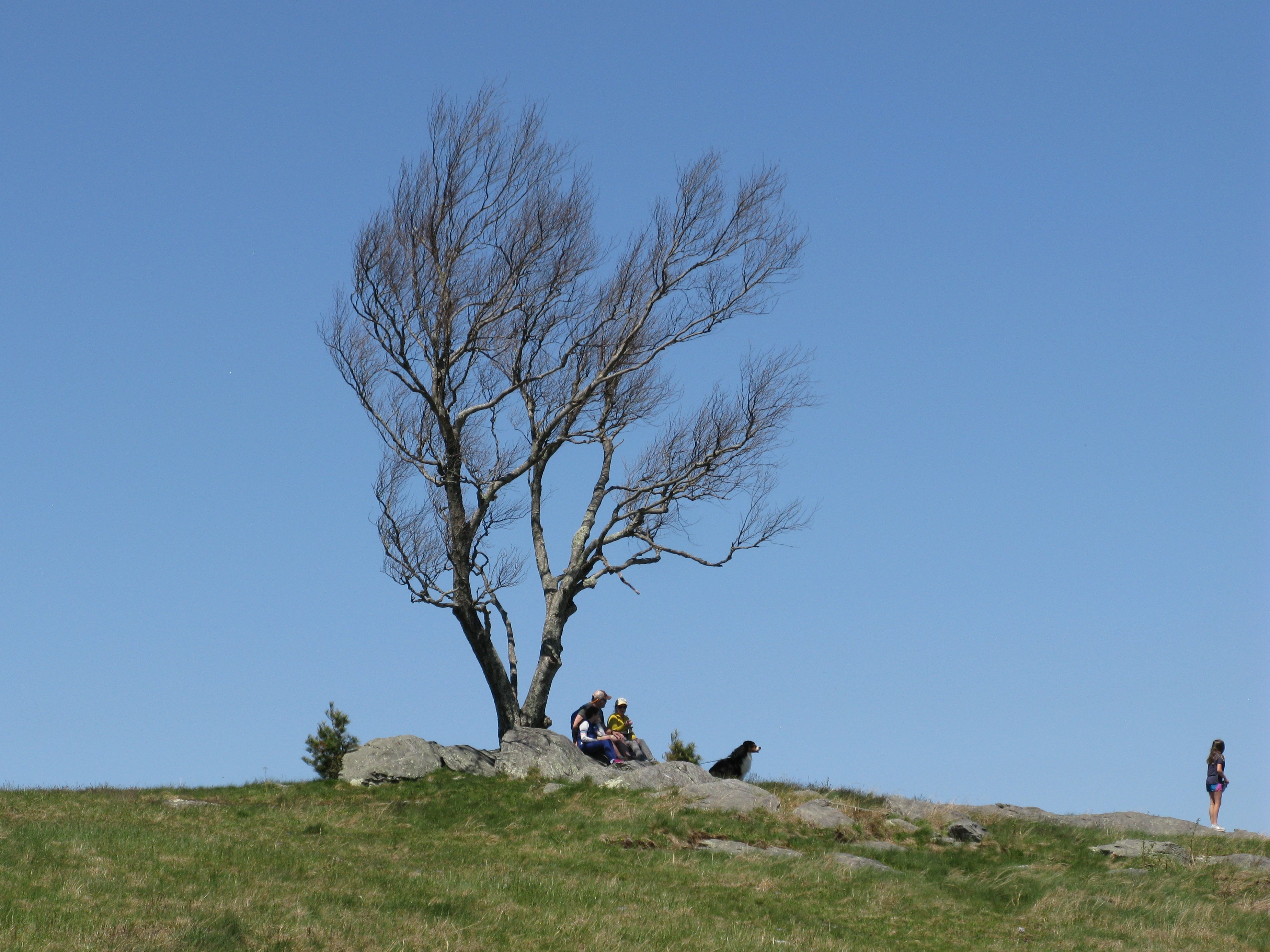
Doughton Park Tree -- 5/1/2021

Read Full Post »

 . 
[with 3 poems by Richard Allen Taylor]
 . 
What’s Happening?
+++ after Choices, a watercolor by Catherine Mainous
 . 
Of course, I recognize it right away,
this landscape where past and present
bleed into future, as I have bled,
as we all do. I start green and work
my way up, grasping at blue. Earth
always reaches for sky, the tiniest seed
pokes through saltmarsh and sawgrass,
green fingers periscopes looking for light.
I always look for dawn. No, that’s wrong.
Sometimes, I search for dark and find it.
The light comes later, after regret, guilt.
See how that diffused orange glare
in the corner blurs into a bridge
to nowhere, skeletal structure
never completed. That’s what
you get with unrequited ambition.
Beginning, middle, no end.
A purple cloud in the distance.
A crane untethered.
An unexpected answer
to an unexpected question.
 . 
Richard Allen Taylor
from Letters to Karen Carpenter, Main Street Rag Publishing, Charlotte NC; © 2023
 . 
❦ ❦ ❦
 . 
She doesn’t believe in inertia. If I take both hands off the wheel for a femtosecond, she’s convinced we will instantly swerve into the embankment.
 . 
She does believe in gravity. Since my last birthday she has forbidden me from using the stepladder to hang Christmas lights on the dwarf spruce in our front yard, much less reach to get the star on top.
 . 
She absolutely rejects Heisenberg’s principal of uncertainty. Whether I can detect them or not, my keys are fixed in place right where I left them.
 . 
She’s a little iffy on the conservation of angular momentum. If I accelerate into a curve to maintain a constant forward velocity, she wants to know why I’m speeding.
 . 
She accepts evolutionary biology without complaint but wanders from the straight and narrow of taxonomic hierarchy. Lizards and toads she seeks out as cute; snakes are OK only behind glass; spiders and gigantic roaches, even millipedes, she captures under a paper cup, slides a birthday card beneath, and relocates into the yard; fruit flies and ants must die.
 . 
And the law of love? It is, of course, not exclusively physics and biology. It also includes the law of culture and connection, of which she is founder and curator. When a particular issue of National Geographic reaches its twentieth birthday, she tears out each article worth saving and files it, astrophysics to zoology. She will let me re-read them if I but ask.
 . 
One more thing about the law of love: it seems to disobey Newton’s third law of motion. For each of my own actions – and how often they do violate something – there is a reaction, but thank God not opposite and equal. However sharp her initial glance and inflection, the ultimate consequence so far has been forgiveness. This is one universe I am happy to live in.
 . 
 . 
❦ ❦ ❦
 . 
The Second Law of the Apple
 . 
If the first law was not to take
the first bite, lest you be banished
from the garden, the second law
ought to be to finish what you start,
 . 
meaning the first bite obligates you
to a second, and a third, and so on
until the apple is eaten, except
for the core, which contains
 . 
the seeds, and sine you will be
traveling anyway, away from
the garden that spit you out,
you might as well learn
 . 
banishment from one place is not
the end, but merely another beginning,
and what you do with the seeds
is everything.
 . 
Richard Allen Taylor
from Letters to Karen Carpenter, Main Street Rag Publishing, Charlotte NC; © 2023
 . 
❦ ❦ ❦
 . 
Richard Allen Taylor is part of the holy jangle of things / fastened to the belt loop of a forgetful world. The poems in Letters to Karen Carpenter and Other Poems are able to weave from the commonplace and humbly wonderful things of this world a sweet sadness . . . droll observations . . . life-giving joy. And some good jokes.
 . 
We knew this first collection since Richard’s wife’s death from leukemia would build a house for grief and healing. Who knew that Karen Carpenter would lend such a hand, but Richard weaves remembrance and biography together into powerful metaphors for attachment and loss. These poems speak to grieving with the whispered voice of his late wife, Julie – a mellow bell rings in the canyon. / And the canyon is me – as well as in Richard’s own sure voice of seeking, his wisdom steadily revealed as one that doesn’t cry for answers but is happy to linger with the important questions. All the old questions / that rise in the wake of storms: each of us must confront and accept these questions if we are to be fully alive. Autumn fades, winter enfolds us, but the seasons continue to turn. At the end of everything is not sadness but wonder, friendship, and love.
 . 
 . 
Letters to Karen Carpenter and Other Poems is available from Main Street Rag HERE
 . 
 . 
❦ ❦ ❦
 . 
I Write to You About Julie, My Wife
 . 
I named a star after her. Astronomers call it
HD 10180. Both Julies—the woman I remember
 . 
and her eponymous star—emit a kind and generous
light. The star deserves a name that twinkles, and she
 . 
deserves the star. I never called her HD 10180,
but often call the star Julie. I chose it out of billions
 . 
because, like you, Julie got along so well with others—
none of that blasting the neighbors with deadly gamma
 . 
ray bursts, the way some pulsars do. And like the star,
my wife, when she was alive, had a family that orbited
 . 
her adoringly. Astronomers have identified a possible
gas giant, designated HD 10180g, residing comfortably
 . 
in Julie’s habitable zone, and—though the giant’s crushing
gravity could never support planetary life, they may find
 . 
moons that do. Suspected of strong winds and colorful
bands, without Julie’s life-giving warmth and shine,
 . 
HD 10180g would be little more than a vast frozen cloud,
a derelict adrift in deep space. I wish I could point out Julie
 . 
to you, but it’s in the constellation Hydrus, which is only
observed from the Southern Hemisphere, and, though
 . 
brighter than our own sun, Julie resides one hundred and
twenty-seven light-years away. We’d need a telescope.
 . 
I understand your concern that the striking similarity
between the designations HD 10180 and HD 10180g
 . 
might confuse some observers. Don’t worry.
To anyone who ever saw us together, it’s obvious
 . 
I am the gas giant, and she is the star.
 . 
Richard Allen Taylor
from Letters to Karen Carpenter, Main Street Rag Publishing, Charlotte NC; © 2023
 . 
❦ ❦ ❦
 . 
 . 
❦ ❦ ❦
 . 
ECOPOETRY FOR EARTH DAY 2024
 . 
When we try to pick out anything by itself, we find it hitched to everything else in the Universe.
  +++ — John Muir
 . 
VERSE & IMAGE is seeking poetry to celebrate Earth Day, April 22, throughout National Poetry Month. Do you have a favorite poem that speaks to universal interconnectedness, as in the above quotation? Send it to ecopoetry@griffinpoetry.com by April 10 and we may share it in one of several posts dedicated to living together on our living planet.
 . 
Please read these guidelines:
 . 
Deadline April 10, 2024, midnight Eastern Daylight Time USA
 . 
Send ONE poem by any author except yourself addressing the theme of connections.
 . 
Include the full text of the poem in the body of an email or as a .DOC or .RTF attachment to ecopoetry@griffinpoetry.com. Please add info about where the poem is published.
 . 
Also include a personal statement – how do you feel connected to this poem? What does it mean to you? How has it connected you to the earth? [suggest 100 words or so; may be edited for length]
 . 
Visit GriffinPoetry.com between April 15 and April 30 to see if your poem has been selected for presentation.
 . 
Optional: if you submit one poem by an author other than yourself, you may also submit one poem on the same theme that you have written. We prefer previously published – include acknowledgments.
 . 
❦ ❦ ❦
 . 
Doughton Park Tree 2021-03-23

Read Full Post »

 . 
[with 3 poems by Czesław Miłosz]
 . 
On Angels
 . 
All was taken away from you: white dresses,
wings, even existence.
Yet I believe you,
messengers.
 . 
There, where the world is turned inside out,
a heavy fabric embroidered with stars and beasts,
you stroll, inspecting the trustworthy seams.
 . 
Short is your stay here:
now and then at a matinal hour, if the sky is clear,
in a melody repeated by a bird,
or in the smell of apples at the close of day
when the light makes the orchards magic.
 . 
They say somebody has invented you
but to me this does not sound convincing
for humans invented themselves as well.
 . 
The voice – no doubt it is a valid proof,
as it can belong only to radiant creatures,
weightless and winged (after all, why not?),
girdled with the lightning.
 . 
I have heard that voice many a time when asleep
and, what is strange, I understood more or less
an order or an appeal in an unearthly tongue:
 . 
+++++++ day draws near
+++++++ another one
+++++++ do what you can
 . 
Czesław Miłosz  (1911-2004)
from The Collected Poems 1931-1987, The Ecco Press, Hopewell, NJ; © 1988
 . 
❦ ❦ ❦
 . 
An advisory pops up from the National Weather Service and all through the night dark birds massive as the crowns of trees flail their wings across the shingles. Leviathan slaps her mighty tail against the shutters and the porch doors invent a banging rhythm that could beat Stan Kenton into a state of awe. Linda and I lie awake and joke about whether the shed roof is moonbound, but we’re not really laughing. We don’t admit to each other what we’re both waiting for, the crash of something big coming through the roof.
 . 
Every time I’ve gone backpacking with my friend Mike, he always scouts our camp site for widow makers. Is there a big dead snag right up there, high above our tent, that might necessitate someone’s sorrowful phone calls to our wives in the morning? More than once we’ve had to pull up stakes, literally, and move to a safer spot. Since then whenever I walk the woods after a storm, besides kicking dead branches off the trail, I notice the meters-long fragments that have speared the earth. Straight down into the piedmont clay, almost quivering still. Glad I wasn’t sleeping there.
 . 
Linda and I lost so many trees to last spring’s “minor” F0 tornado that’s it’s hard to imagine anything left to blow down. Sixty-year old healthy oaks, much less every equivocal and wobbly twig, are matchsticked down the hill below our house. Four meter root balls and half-meter diameter trunks. Maybe we’re tempted to say, “Do your worst, Big Wind. Can’t touch us now.” Who, though, is actually brave enough to speak out loud such a challenge? We don’t even walk the local nature trail any more when there’s a big blow on. Chances are we’re perfectly safe. But are we? Are we really? It may be a long time before we can believe it.
 . 
 . 
❦ ❦ ❦
 . 
How It Should Be in Heaven
 . 
How it should be in Heaven I know, for I was there.
By its river. Listening to its birds.
In its season: in summer, shortly after sunrise.
I would get up and run to my thousand works
And the garden was superterrestrial, owned by imagination.
I spent my life composing rhythmical spells
Not quite aware of what was happening to me.
But striving, chasing without cease
A name and a form. I think the movement of blood
Should continue there to be a triumphant one,
Of a higher, I would say, degree. That the smell of gillyflower,
That a nasturtium and a bee and a ladybug
Or their very essence, stronger than here,
Must summon us just the same to a core, to a center
Beyond the labyrinth of things. For how could the mind
Stop its hunt, if from the Infinite
It takes enchantment, avidity, promise?
But where is our, dear to us, mortality?
Where is time that both destroys and saves us?
This is too difficult for me. Peace eternal
Could have no mornings and no evenings,
Such a deficiency speaks against it.
And that’s too hard a nut for a theologian to crack.
 . 
Czesław Miłosz (1911-2004)
from The Collected Poems 1931-1987, The Ecco Press, Hopewell, NJ; © 1988
 . 
❦ ❦ ❦
 . 
Polish poet Czesław Miłosz lived under National Socialism and then Communism before moving to the United States in 1960, where he spent the remainder of his life. He wrote in Polish, his work translated into English by others and by himself. In 1980 he received the Nobel Prize for Literature.
 . 
More about Czesław Miłosz HERE
More about the Fujitsa Scale for tornadoes HERE
 . 
 . 
❦ ❦ ❦
 . 
Into the Tree
 . 
And he placed at the east of the garden of Eden Cherubim, and a flaming sword which turned every way, to keep the way to the tree of life. +++ – Genesis 3:24
And he looked up and said, “I see men as trees, walking.” +++ – Mark 8:24
 . 
The tree, says good Swedenborg, is a close relative of man.
Its boughs like arms join in an embrace.
The trees in truth are our parents,
We sprang from the oak, or perhaps, as the Greeks maintain, from the ash.
 . 
Our lips and tongue savor the fruit of the tree.
A woman’s breast is called apple or pomegranate.
We love the womb as the tree loves the dark womb of the earth.
Thus, what is most desirable resides in a single tree,
And wisdom tries to touch its coarse-grained bark.
 . 
I learned, says the servant of the New Jerusalem,
That Adam in the garden, i.e., mankind’s Golden Age,
Signifies the generations after the pre-adamites
Who are unjustly scorned though the were gentle,
Kind to each other, savage yet not bestial,
Happy in a land of fruits and springwaters.
 . 
Adam created in the image and in the likeness
Represents the parting of clouds covering the mind.
And Eve, why is she taken from Adam’s rib?
– Because the rib is close to the heart, that’s the name of self-love.
And Adam comes to know Eve, loving himself in her.
 . 
Above those two, the tree. A huge shade tree.
 . 
Of which the counselor of the Royal Mining Commission says the following in his book De amore conjugiali:
 . 
“The Tree of Life signifies a man who lives from God, or God living in man; as love and wisdom, or charity and faith, or good and truth, make the life of God in man, these are signified by the Tree of Life, and hence the eternal life of the man. . . . But the tree of science signifies the man who believes that he lives from himself and not from God; thus that love and wisdom, or charity and faith, or good and truth, are in man from himself and not from God; and he believe this because he thinks, and wills, and speaks and acts, in all likeness and appearance as from himself.”
 . 
Self-love offered the apple and the Golden Age was over.
After it, the Silver Age, the Bronze Age. And the Iron.
 . 
Then a child opens its eyes and sees a tree for the first time.
And people seem to us like walking trees.
 . 
Czesław Miłosz  (1911-2004)
from The Collected Poems 1931-1987, The Ecco Press, Hopewell, NJ; © 1988
 . 
 . 
❦ ❦ ❦
.
.

ECOPOETRY FOR EARTH DAY 2024

When we try to pick out anything by itself, we find it hitched to everything else in the Universe.
— John Muir

 . 


 .Verse & Image is seeking poetry to celebrate Earth Day, April 22, throughout National Poetry Month. Do you have a favorite poem that speaks to universal interconnectedness, as in the above quotation? Send it to ecopoetry@griffinpoetry.com by April 10 and we may share it in one of several posts dedicated to living together on our living planet.

Please read these guidelines:

Θ . . Deadline April 10, 2024, midnight Eastern Daylight Time USA

Θ . . Send ONE poem by any author except yourself addressing the theme of connections.

Θ . . Include the poem in the body of an email or as a .DOC or .RTF attachment to ecopoetry@griffinpoetry.com. Please add info about where the poem is published.

Θ . . Also include a personal statement – how do you feel connected to this poem? What does it mean to you? How has it connected you to the earth? [suggest 100 words or less; may be edited for length]

Θ . . Visit GriffinPoetry.com between April 15 and April 30 to see if your poem has been selected for presentation.

Θ . . Optional: if you submit one poem by an author other than yourself, you may also submit one poem on the same theme that you have written. We prefer previously published – include acknowledgments.

Verse & Image is a weekly blog of poetry, nature photography, personal essay, and ecology.

 . 
2018-02-09 Doughton Park Tree
 . 

Read Full Post »

Older Posts »