Feeds:
Posts
Comments

Archive for January, 2024

 . 
[with 3 poems by Ana Pugatch]
 . 
My Mother’s Visit
 . 
The woman sensed that I now
looked down on her. That the earth
had turned slowly
 . 
into night. That her kin would only be
a distant moon. She watched
shards of light slice through the bamboo
 . 
thicket, the stars’ edges harden
and cool. In daytime she marveled
at the strength of a water buffalo, how
 . 
it shoulders could shift continents.
But I knew it would never be
enough.
 . 
We looked down
from the bamboo raft, and below
the glass surface saw
 . 
what flickered in turbid
darkness. Like my mother I thought
of the day when the river
 . 
would freeze over –
and how I’d give up everything
to feel its final stillness.
 . 
Ana Pugatch
from Engrams, Seven Years in Asia, winner of the 2022 Lena Shull Book Award of the North Carolina Poetry Society; Redhawk Publications, Hickory, NC; © 2023
 . 
❦ ❦ ❦
 . 
Above the river a west-facing ridge, protected, always cool and moist, and a narrow rustic trail that veers from the main — this is the path I take the day after Christmas. Winter brown, mossy stones and lichen, these are all I expect today, but here and there are premonitions. Ruddy toothed leaves, foamflower will bloom in March; bright green variegated heartleaf hides beneath pine needles today but soon will hide its own little brown jugs. So much muted beauty to share, but what is this! Hepatica is blooming!
 . 
Right here along this little path is the first place I ever discovered native hepatica in Elkin. (I still clearly remember where I was standing when I added my first bird to my life list decades ago, a chestnut-sided warbler — do normal people hold onto these sorts of memories?) But this is December — the earliest we ever see hepatica in bloom is late February, preceding even the rush of trout lilies. Nevertheless here is one plant with a flower and two swelling buds. Too, too early. Winter too warm. I can’t say I’m filled with happy thoughts for our planet.
 . 
A few days later I’m back with a camera. I can’t say I’m filled with happy thoughts of botany and phenology. Last night my brother and sister and I had a lengthy conference about our Mom’s decline. Tomorrow I’ll be sitting down with her and Dad to discuss a palliative care consultation and possibly moving to a higher level of care. I have to watch my footing carefully on parts of this trail – exposed stones, roots, erosion. Going downhill is when you’re most likely to fall. Mom’s descent has been steady for years, gradual, but the path ahead appears much steeper.
 . 
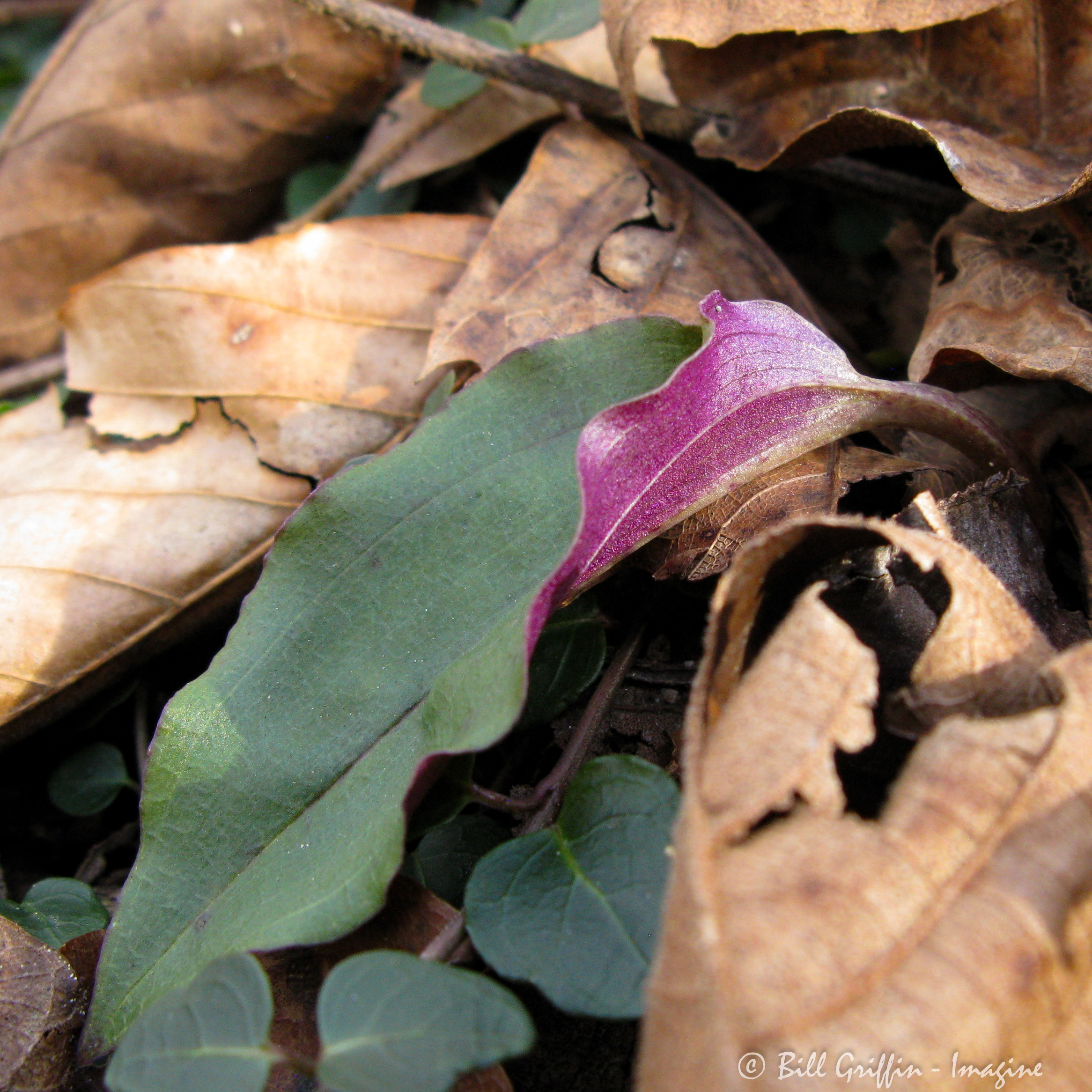
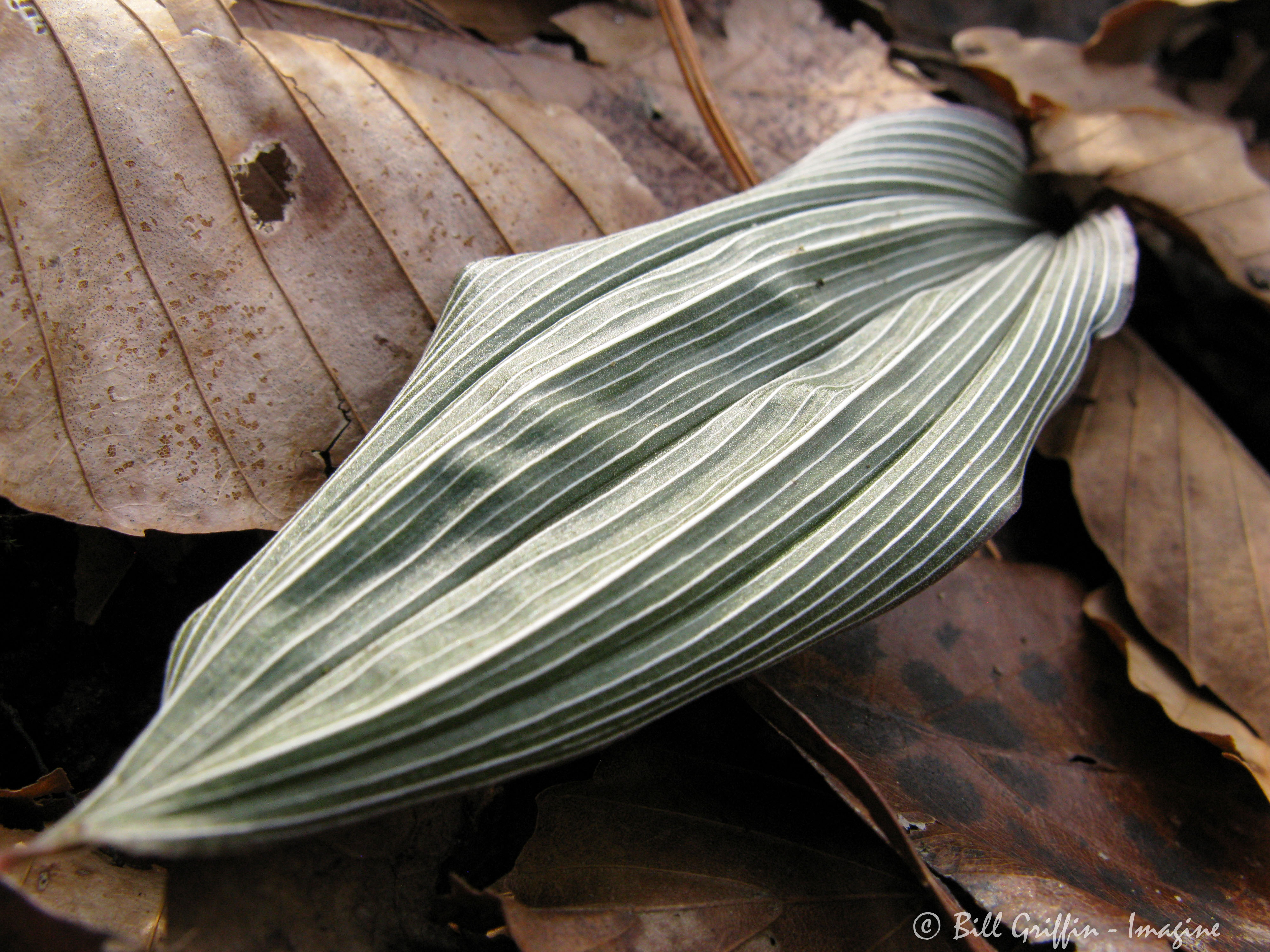
This is interesting – a single clump of pinstriped leaves, Adam-and-Eve Orchid. And Cranefly Orchid with its magenta underleaf is plentiful here. When the surrounding trees lose their leaves these orchids make sugar from winter sun. Their own leaves will fade and disappear before spikes of tiny flowers appear  mid-summer. Similar for the hepatica: last year’s flecked and nibbled liver-lobed leaves are making way for new green even now. Diminished light, cold and frost, life makes what it can of every season. I bend lower for a better look at each delicate yet resolute little family of leaves. Not a single flower to be found today.
 . 
 . 
❦ ❦ ❦
 . 
The Nightjar
+++ for S.
 . 
In the evenings you fold your wings
in a hammock on the porch.
 . 
your jaw clicks in imitation
of car locks. Your hair grows dark
to form a nest, twilight clouds:
 . 
a puff of throat. Mangrove roots
of a slow entanglement; filaments of stars
hang above us.
 . 
Don’t forget you say with the fan-eyes
of your tail as you fly away
 . 
each morning. You’re known
to frequent other lives, exhale their smoke,
catch tiny deaths on the temple’s
 . 
low wall. You’re known
for your camouflage, the concealment
of thoughts in daylight.
 . 
But I’ll still hold you, hoping
you’ll stay. Even if your ones are hollow,
 . 
fragile – I know one day you’ll roost
on steady ground.
 . 
Ana Pugatch
from Engrams, Seven Years in Asia, winner of the 2022 Lena Shull Book Award of the North Carolina Poetry Society; Redhawk Publications, Hickory, NC; © 2023
 . 
❦ ❦ ❦
 . 
Where does a memory live? Where does its root take hold, where is its safe repository? The sudden intake of breath at one sepia photo slipped from a pile of many others? A brief waft of scent upon opening a long-closed drawer? A word spoken in an unknown language ferrying meaning beyond its meaning? A phrase written in a notebook long misplaced? A dream?
 . 
Perhaps our memories are truly embedded in biochemical engrams deep in our hippocampus, hard-wired each in its own bud of synapse, but where is the map to its local address? Ana Pugatch knows to follow the narrow alleys and unmarked streets. Her poems are visions, aromas, sensations that may chill or warm. That may be fearful and unsettling or openly inviting. Her memories weave a world for me. Her world opens me to my own alleys, dim at times but becoming brighter; she opens me to streets I had forgotten. Or have yet to travel.
 . 
 . 
Is it because the world is so big and there are so many of us in it that we react by closing ourselves and retreating? Are we threatened by the rush and clamor of ideas, practices, cultures? Is that why we draw a line around our tribe and push all others away? We imagine that to survive we must deny, even destroy, everything outside our comfortable patch of expectations. To my mind, humankind’s survival depends on just the opposite. We can’t close the door but most open it. Perhaps we do feel frightened when confronted with anything that challenges our assumptions, whether a person, an artifact, an idea. Perhaps. And perhaps responding to novelty with imagination rather than rebuff is what allowed Homo sapiens to expand while Homo neanderthalensis dwindled and disappeared (except for the handful of Neanderthal genes we’ve acquired and still carry!).
 . 
Within poetry is concealed the map to our local memories. And in poetry we encounter shared memory and experience, doorways that may lead us out of our cloister and into the embrace of the different, the foreign, the alien, the frightening. As I read Ana Pugatch’s sensitive and sometimes ephemeral visions of her years in China and Thailand, and now of her presence in North Carolina, I am not an impartial observer watching a travelogue. I connect with those struggles. We are human, she and I and all the people she encounters. From the strangeness I feel a common thread winding around my heart. May that thread continue to pull me forward, and outward.
 . 
 . 
Engrams, Seven Years in Asia is available from Redhawk Publications.
The Lena Shull Book Award for a full length poetry manuscript is sponsored annually by the North Carolina Poetry Society. Submission period opens June 15, 2024.
 . 
 . 
❦ ❦ ❦
 . 
Unfurnished
 . 
I would write down the date if I knew
which day it was.
It’s Tuesday, I think,
and the baby cries upstairs.
 . 
I’ve never seen the family;
I only know them by
the red and gold characters posted
on their door.
 . 
Their laundry hangs
on the lines above mine;
Cantonese echoes through
my empty rooms.
 . 
We share the same view of Zhuhai.
We share that space of sky and trees
and we open our doors
when it rains.
 . 
Ana Pugatch
from Engrams, Seven Years in Asia, winner of the 2022 Lena Shull Book Award of the North Carolina Poetry Society; Redhawk Publications, Hickory, NC; © 2023
 . 
❦ ❦ ❦
 . 
 . 
❦ ❦ ❦
 . 
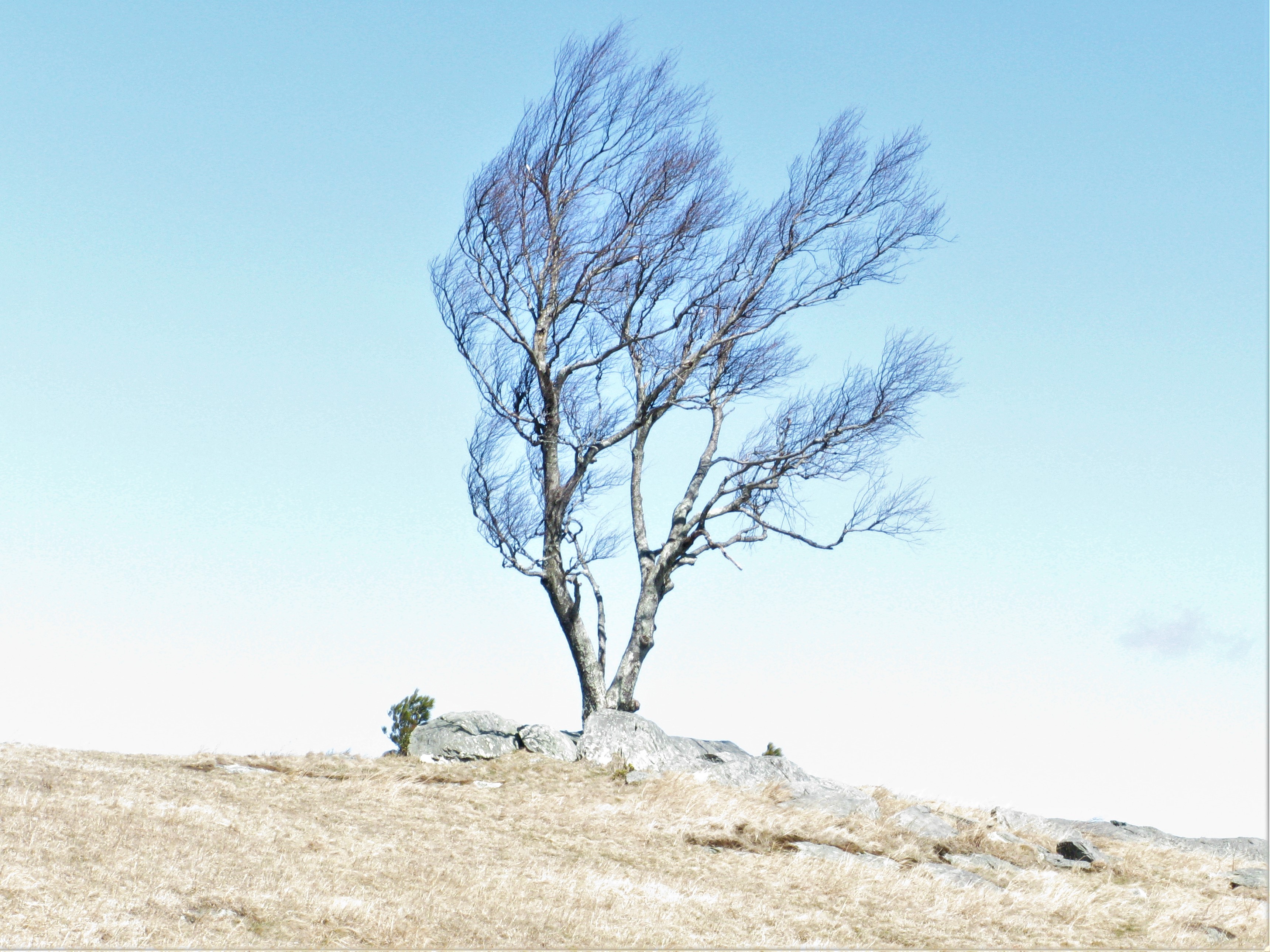
2018-02-09 Doughton Park Tree

Read Full Post »

 . 
[with 3 poems by A. R. Ammons]
 . 
Quibbling the Colossal
 . 
I just had the funniest thought: it’s the
singing of Wales and whales that I like so
 . 
much: you know, have you heard those men’s
groups, those coal miners and church people in
 . 
Wales singing: to be deeply and sweetly undone,
listen in: and the scrawny rising and
 . 
screechings and deep bellowings of whales,
their arias personal (?) and predatory at
 . 
love and prey – that makes up mind for us as
we study to make out mind in them: the reason
 . 
I can’t attain world view or associational
complexity is that when I read I’m asleep by
 . 
the second paragraph: also, my poems come in
dislocated increments, because my spine between
 . 
the shoulderblades gets to hurting when I type:
also my feet swell from sitting still: but
 . 
when the world tilts one way it rights another
which is to say that the disjunctiveness of my
 . 
recent verse cracks up the dark cloud and
covering shield of influence and lets fresh
 . 
light in, more than what little was left, a
sliver along the farthest horizon: room to
 . 
breathe and stretch and not give a shit, room
to turn my armies of words around in or camp
 . 
out and hide (bivouac): height to reach up
through the smoke and busted mirrors to clear
 . 
views of the beginnings high in the oldest
times: but seriously you know, this way of
 . 
seeing things is just a way of seeing things:
time is not crept up on by some accumulative
 . 
designer but percolates afresh every day like
a hot cup of coffee: and Harold, if this is
 . 
an Evening Land, when within memory was it
otherwise, all of civilized time a second in
 . 
the all of time: good lord, we’re all so
recent, we’ve hardly got our ears scrubbed,
 . 
hair unmatted, our teeth root-canaled: so,
shine on, shine on, harvest moon: the computers
 . 
are clicking, and the greatest dawn ever is
rosy in the skies.
 . 
++++++++++ CAST THE OVERCAST
 . 
A. R. Ammons
from Bosh and Flapdoodle, W. W. Norton & Company, New York, NY; © 2005
 . 
❦ ❦ ❦
 . 
January 1: The big round thermometer on the back porch reads 35 degrees Fahrenheit. A long thin coiled spring of two facing layers: each face different metals which contract differently when cooled: the spring’s central attachment a little axle free to rotate: on the axle a needle, a pointer that is able to inscribe an arc three-quarters of a circle: -40 to 140 degrees, currently 35. In 2024 when we can simply inquire of our phone, are we really meant to believe this dubious mechanical contraption?
 . 
My ear lobes, the back of my neck, and my nose hairs believe it. I zip up, pull my cap lower, and walk down the hill toward the river. Jason has pulled in and unlocked the gate. Soon more layered and downed figures arrive. Here we go, twenty-five of us, on our First Day Hike along this newest little section of the Mountains-to-Sea Trail beside the Yadkin River in Surry County.
 . 
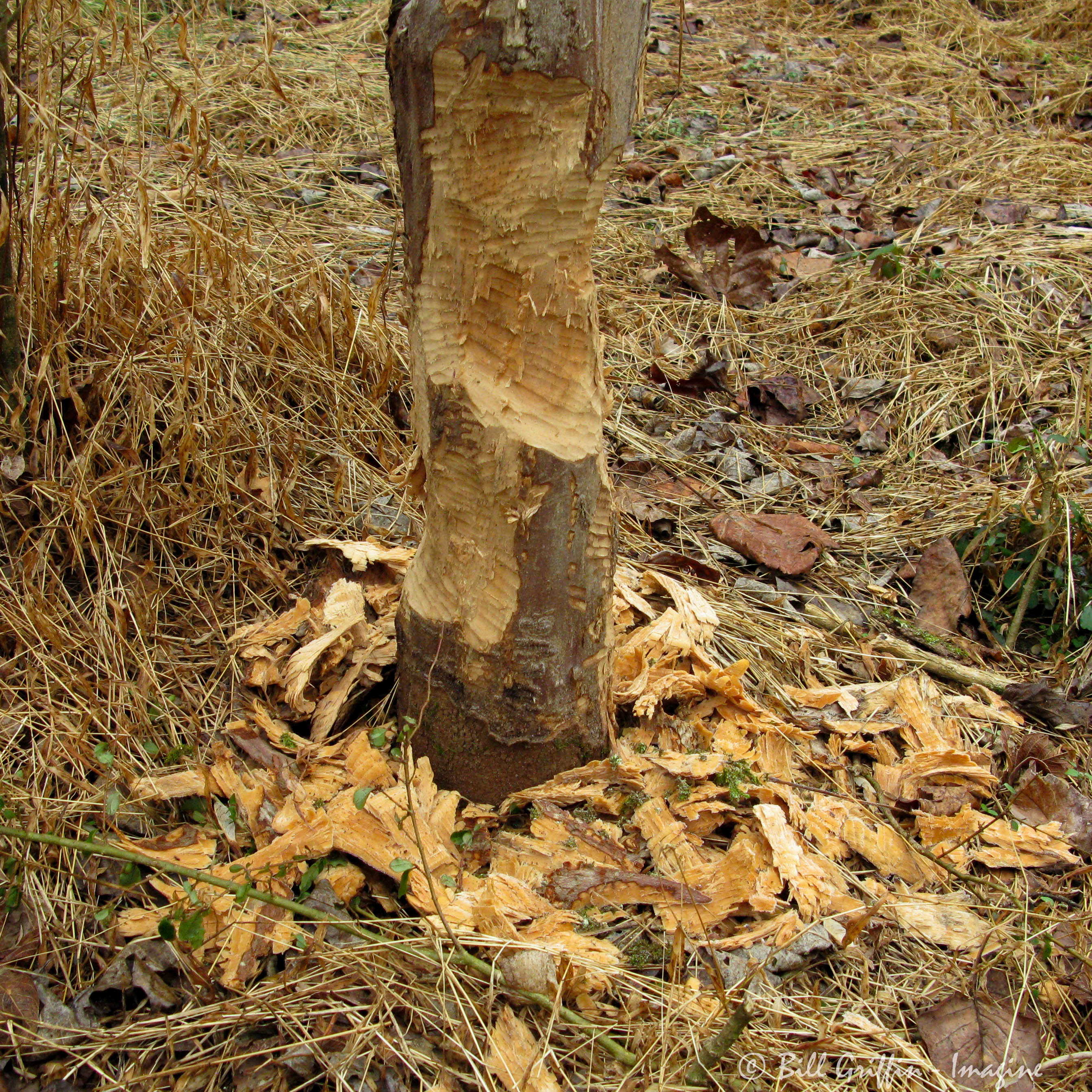
First Day Hikes have sprung up all over, parks and neighborhoods, greenways and rail trails. About half of this morning’s walkers have never before attended an Elkin Valley Trails Association event. Something new to show this old muddy river. Fresh coyote tracks on a sandy bank. In a rotting stump, a big square pileated woodpecker hole that wasn’t here 3 days ago when Jason scouted. Still-moist chips at the base of a girdled tree and bright incisor marks from the beaver.
 . 
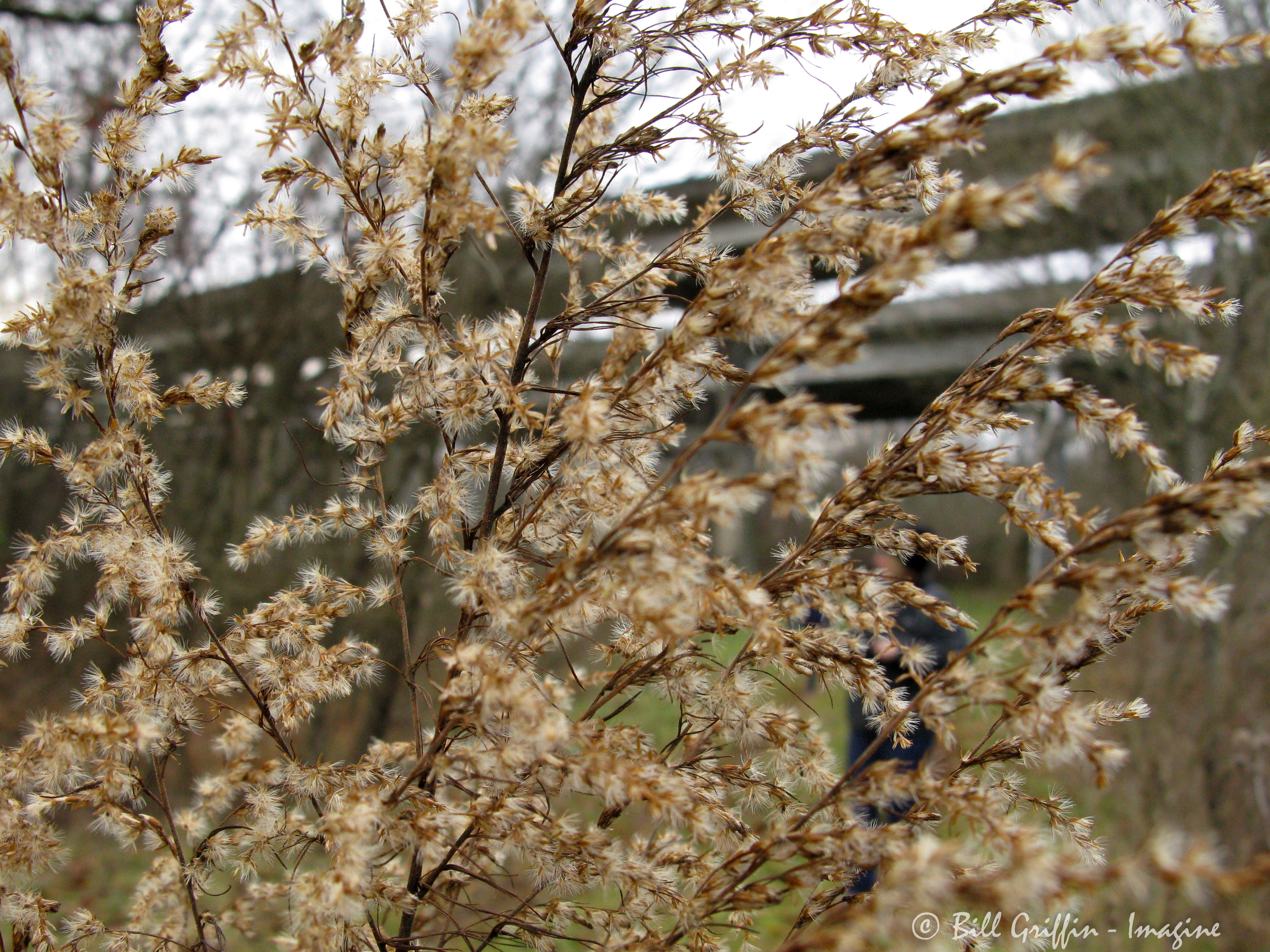
Now we’re crossing a meadow with waving heads of last summer’s asters, dry and higher than our own heads. I’m pulling goldenrod and wingstem seeds to sow on newly bare ground around the new crossing over Dutchman Creek. Dee remarks on the beauty of particular airy feathered fronds – dog fennel, no summer eye-catcher but striking in its winter browns and grays.
 . 
Old? New? Or just a continuous flow of moments like these? I’ll turn away from my mirror. I won’t query my knees. I’ll unzip my jacket, because now we’re moving and I’m plenty warm. I’ll  enjoy a big inhale of the river-moist air. I’ll listen to the chatter of hikers and the whistle of white-throated sparrows. I’ll make myself ready to notice the next new thing before us.
 . 
 . 
❦ ❦ ❦
 . 
Hooliganism
 . 
Once (there was a time when) I was attracted
to, if not attractive to, everybody, starlet
 . 
and streetlet, athlete and bellybag: afire,
I burned anything, including myself: kneedeep
 . 
in ashen brush, even some simmering fagots, I
tried to separate the heat from the flame but
 . 
gave up, pouring it all into the love of a wife
now nearly half a century old – the wife a
 . 
little older: most of those old flames (sweet
people) have flickered away except for the
 . 
corner of my mind where lively they live on in
honor, honorary doctorates circling their
 . 
laureled heads – what schools they founded!
taking what pains, with what tears, they taught
 . 
me how, roaring possibilities and tenderest
glows: love, love, one learns to love, it is
 . 
not easy, yet not to love, even astray, leaves
something left for the grave: burnt out
 . 
completely is ease at last, the trunk honeyed
full as a fall hive: when the light dies out
 . 
at last on the darkening coals, the life
turns to jewels, so expensive, and
 . 
they never give the sparkle up: this was
a fancy, and not half fancy enough and somewhat
 . 
lacking in detail but ever true.
 . 
A. R. Ammons
from Bosh and Flapdoodle, W. W. Norton & Company, New York, NY; © 2005
 . 
❦ ❦ ❦
 . 
My friend Anne gave me Bosh and Flapdoodle. A. R. “Archie” Ammons wrote the collection of poems in 1996, five years before his death, and his son and friends had it published in 2005, all of the poems, as they say, “exactly as Ammons wrote them.” I am always surprised by Ammons. Throughout his life as a writer he demonstrates that poetry is everywhere, and everything. There is nothing mundane or unworthy of being noticed. That itself can be surprising, especially if you have the idea that poetry exists on some elevated plane, but I’m also often taken off guard, like a snow ball to the face, by his sudden deep connections that reveal the reality of our existence.
 . 
from Mouvance
. . . so if you are to get any passion out
 . 
of life, you’ll have to dig it out of narrow
spaces or squeeze all you have into slender,
 . 
if deep, circumstance: I myself have never
known what to do about anything: as I look
 . 
back, I see not even a clown but a clown’s
clothes flapping on the clothesline of some
 . 
tizzy: . . .
 . 
A. R. Ammons and Fred Chappell have been my enduring poetic inspirations. They are alike in that their poetry can be complex and difficult, but they both always return to the earthy assurance of our humanity. Perhaps because they both grew up in rural North Carolina, Archie in the sandhills and Fred in the mountains? This book, more than most any Ammons collection I’ve read, is personal and intimate, and of course as always irreverent, but even more than usually hilarious. He demolishes any grand notion of his greatness (he, one of the greatest 20th century American poets). He crushes any sentimentality about aging or his own approaching death. He invites, I guess he requires, his reader to just look around and really look within and stop for a minute to think about what’s going down. Yeah, it’s bosh and flapdoodle. Yeah, it’s life.
 . 
 . 
More about Archibald Randolf Ammons HERE
Purchase Bosh and Flapdoodle from Bookshop.org HERE
 . 
❦ ❦ ❦
 . 
Way Down Upon the Woodsy Roads
 . 
Don’t you think poetry should be succinct:
not now: I think it should be discinct: it
 . 
should wander off and lose its way back and
then bump into a sign and have to walk home:
 . 
who gives a hoot about those big-Mack trucks
of COMPRESSION: what are the most words for
 . 
the least: take your cute little compact and
don’t tell me anything about it: just turn me
 . 
loose, let me rattle my ole prattle: poetry
springs greatest from deepest depths: well,
 . 
let her whistle: how shallow can anything
get: (rhyming on the front end): I do not
 . 
believe that setting words to rhyme and meter
turns prose into poetry, and having written
 . 
some of the shortest poems, I now like to
write around largely into any precinct (not
 . 
succinct) or pavilion (a favorite word) I fall
in with: I have done my duty: I am a happy
 . 
man: I am at large: life sho is show biz:
make room for the great presence of nothing:
 . 
do you never long to wander off: from the
concentrations: for it is one thing to fail
 . 
of them and another never to have intended
them: the love nest, men becomes a solid
 . 
little (mortgaged) colonial: duty become your
chief commendation: the animal in you, older
 . 
than your kind, longs to undertake the heavy
freedom of going off by himself into the wide
 . 
periphery of chance and surprise, pleasure or
terror: oh, come with me, or go off like me,
 . 
if only in the deep travels of your soul, and
let your howl hold itself in through all the
 . 
forests of the night: it’s the shortest day:
the sun is just now setting behind the branch
 . 
of the crabapple tree it always sets behind
this day of the year. . . .
 . 
++++++++++ DRAB POT
 . 
A. R. Ammons
from Bosh and Flapdoodle, W. W. Norton & Company, New York, NY; © 2005
 . 
 . 
❦ ❦ ❦
 . 
2020-03-07 Doughton Park Tree
 . 

Read Full Post »

« Newer Posts