Feeds:
Posts
Comments

Archive for June, 2023

 . 
[3 poems from The ECOPOETRY Anthology]
 . 
from Song of Myself
 . 
6
A child said What is the grass? fetching it to me with full hands;
How could I answer the child? I do not know what it is any more than he.
 . 
I guess it must be the flag of my disposition, out of hopeful green stuff woven.
 . 
Or I guess it is the handkerchief of the Lord,
A scented gift and remembrancer designedly dropt,
Bearing the owner’s name someway in the corners, that we may see and remark, and say Whose?
 . 
Or I guess the grass is itself a child, the produced babe of the vegetation.
 . 
Or I guess it is a uniform hieroglyphic,
And it means, Sprouting alike in broad zones and narrow zones,
Growing among black folks as among white,
Kanuck, Tuckahoe, Congressman, Cuff, I give them the same, I receive them the same.
 .  . 
And now it seems to me the beautiful uncut hair of graves.
Tenderly will I use you curling grass,
It may be you transpire from the breasts of young men,
It may be if I had known them I would have loved them,
It may be you are from old people, or from offspring taken soon out of their mothers’ laps,
And here you are the mothers’ laps.
 . 
This grass is very dark to be from the white heads of old mothers,
Darker than the colorless beards of old men,
Dark to come from under the faint red roofs of mouths.
 . 
O I perceive after all so many uttering tongues,
And I perceive they do not come from the roofs of mouths for nothing.
 . 
I wish I could translate the hints about the dead young men and women,
And the hints about old men and mothers, and the offspring taken soon out of their laps.
 . 
What do you think has become of the young and old men?
And what do you think has become of the women and children?
 . 
They are alive and well somewhere,
The smallest sprout shows there is really no death,
And if ever there was it led forward life, and does not wait at the end to arrest it,
And ceas’d the moment life appear’d.
 . 
All goes onward and outward, nothing collapses,
And to die is different from what any one supposed, and luckier.
 . 
Walt Whitman (1819-1892)
collected in The Ecopoetry Anthology, Ann Fisher-Wirth & Laura-Gray Street (Trinity University Press, San Antonio, Texas, © 2020)
 . 
❦ ❦ ❦
 . 
They are alive and well somewhere . . . there is really no death
 . 
June 21 is cold and rainy. Perhaps that is why the slug feels confident to patrol the deck rail fully exposed. They (one slug being both male and female) retract their delicate ommatophora when we approach, perhaps because we are large and our movement is easily sensed. After a minute they once again extend those beautiful slender eyestalks, perhaps because we are large and easily overlooked. In a moment their glide and wander will discover a dense patch of algae shaded by a finial. Their many-toothed radula will work hard and satisfy.
 . 
Amelia and I watch until the rain drives us indoors. In a quarter hour it lessens and we return, but the slug has motored out of sight. Who knew it was so speedy? We peer under and around – no slug. She desires more slugs, so we hunt each post and rail of the deck, the green-hazed porch screens, the planters. We reach the far corner and look down into the mud and mangled trunks and branches left by this spring’s severe storm. Amelia asks why there is a layer of straw strewn across a patch of ground there.
 . 
 . 
Seeing the forecast for a week of rain, on Monday morning I had finally taken up my fire rake and attacked the old sandbox site. When April’s tornado uprooted a big maple and white oak next to it (along with a dozen other trees behind our house), it exposed the bones of half-eaten 6×6’s I’d used to build the sandbox for Josh and Margaret in 1983. I dug them up and hacked out chickweed, smartweed, much despised stiltgrass. What had once been white sand was now filled with worms and 40 years of accumulating humus. Delicious.
 . 
June 19-24 was Naturalist Challenge Week, sponsored by Great Smoky Mountain Institute at Tremont. Participate from anywhere on earth; earn points and you can win a prize – 10 points for planting pollinators. I mixed all my leftover native seeds from last fall: a tablespoon of Bluecurl my son-in-law Josh collected for me, four kinds of milkweed, some monarda and coreopsis and who knows what. I sowed them across 200 square feet now newly introduced to sunlight. I  sprinkled with straw as Amelia noticed. And around the edges I planted pumpkin seeds preserved from soup last Christmas, seeds Josh begged from his 100 year-old grandmother, perpetually propagated.
 . 
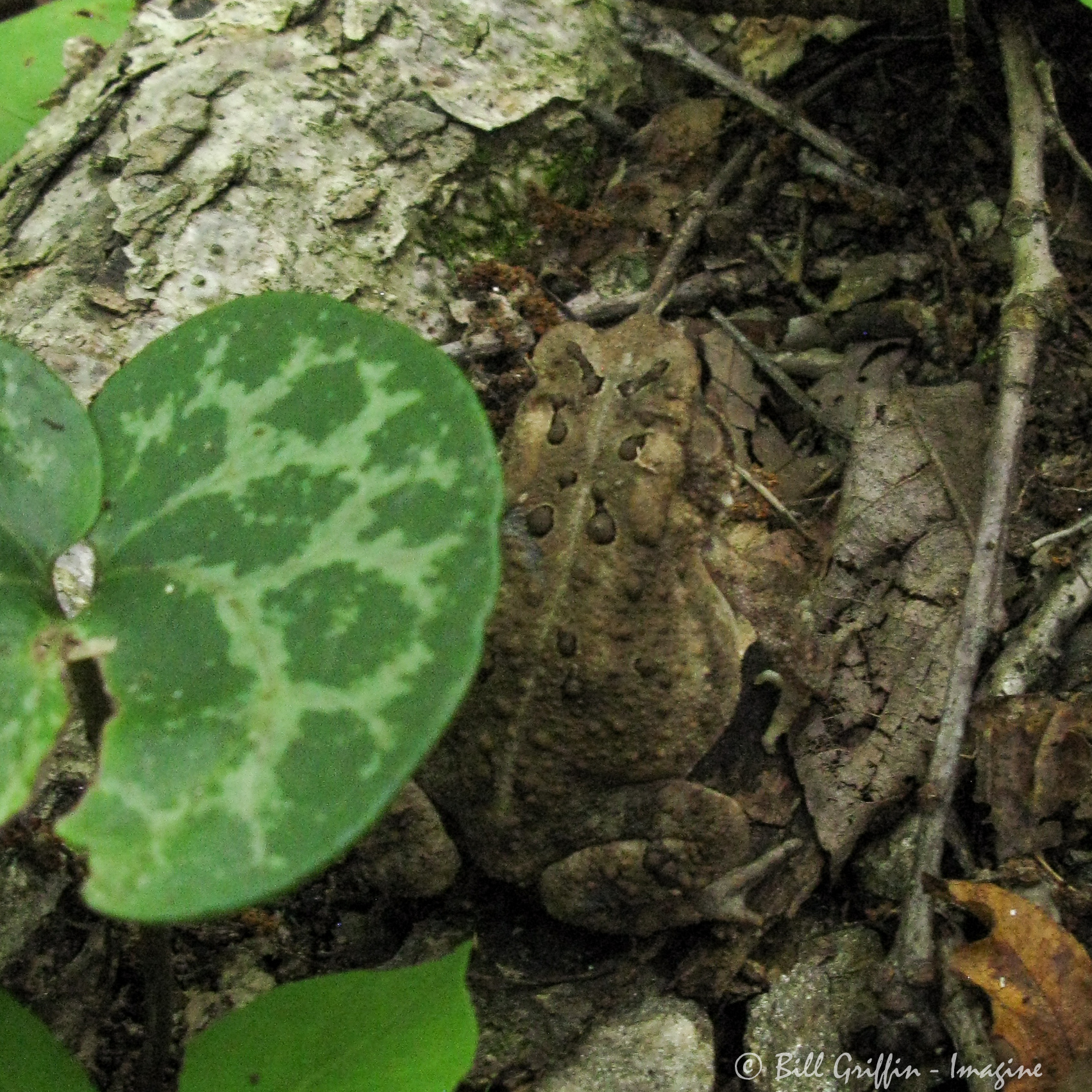
Yes, it’s late in the season for planting. Then again, who knows if we’ll even have frost this winter? Foothills NC, the new tropics. Every week Amelia and I can pause from our slug hunt, peer over the deck rail, and watch a patch of earth turning newly green. More life. I’ll save you a photo.
 . 
 . 
❦ ❦ ❦
 . 
November Cotton Flower
 . 
Boll-weevil’s coming, and the winter’s cold,
Made cotton-stalks look rusty, seasons old,
And cotton, scarce as any southern snow,
Was vanishing; the branch, so pinched and slow,
Failed in its function as the autumn rake;
Drouth fighting soil had caused the soil to take
All water from the streams; dead birds were found
In wells a hundred feet below the ground—
Such was the season when the flower bloomed.
Old folks were startled, and it soon assumed
Significance. Superstition saw
Something it had never seen before:
Brown eyes that loved without a trace of fear,
Beauty so sudden for that time of year.
 . 
Jean Toomer (1894-1967)
collected in The Ecopoetry Anthology, Ann Fisher-Wirth & Laura-Gray Street (Trinity University Press, San Antonio, Texas, © 2020)
 . 
❦ ❦ ❦
 . 
Today’s poems are from The Ecopoetry Anthology, edited by Ann Fisher-Wirth and Laura-Gray Street, with a rousing introduction by Robert Hass (Trinity University Press, San Antonio, Texas, © 2020). It is a comprehensive volume, with over a hundred twentieth- and twenty-first century poets, and the book’s opening Historic section includes, among many others, the three poets in today’s selection:
Walt WhitmanLeaves of Grass was first published in 1855 and by the second edition had doubled in length. Today’s small excerpt from Song of Myself highlights the manifold metaphor of the most common of green living things.
Jean Toomer – moved to the South in 1921 and was inspired to write Cane in 1923, a hybrid work intertwining narrative and poetry, then continued on to pursue a literary career. He became an important figure in the Harlem Renaissance.
Wallace Stevens – the vice president of an insurance company, Stevens wrote poetry late into the night and on vacations. He also wrote treatises which suggested poetry’s ability to supplant religion; his Collected Poems in 1955 won the Pulitzer Prize.
 . 
 . 
❦ ❦ ❦
 . 
from Sunday Morning
 . 
VI
Is there no change of death in paradise?
Does ripe fruit never fall? Or do the boughs
Hang always heavy in that perfect sky,
Unchanging, yet so like our perishing earth,
With rivers like our own that seek for seas
They never find, the same receding shores
That never touch with inarticulate pang?
Why set the pear upon those river-banks
Or spice the shores with odors of the plum?
Alas, that they should wear our colors there,
The silken weavings of our afternoons,
And pick the strings of our insipid lutes!
Death is the mother of beauty, mystical,
Within whose burning bosom we devise
Our earthly mothers waiting, sleeplessly.
 . 
VII
Supple and turbulent, a ring of men
Shall chant in orgy on a summer morn
Their boisterous devotion to the sun,
Not as a god, but as a god might be,
Naked among them, like a savage source.
Their chant shall be a chant of paradise,
Out of their blood, returning to the sky;
And in their chant shall enter, voice by voice,
The windy lake wherein their lord delights,
The trees, like serafin, and echoing hills,
That choir among themselves long afterward.
They shall know well the heavenly fellowship
Of men that perish and of summer morn.
And whence they came and whither they shall go
The dew upon their feet shall manifest.
 . 
Wallace Stevens (1879-1955)
collected in The Ecopoetry Anthology, Ann Fisher-Wirth & Laura-Gray Street (Trinity University Press, San Antonio, Texas, © 2020)
 . 
❦ ❦ ❦
 . 
 . 
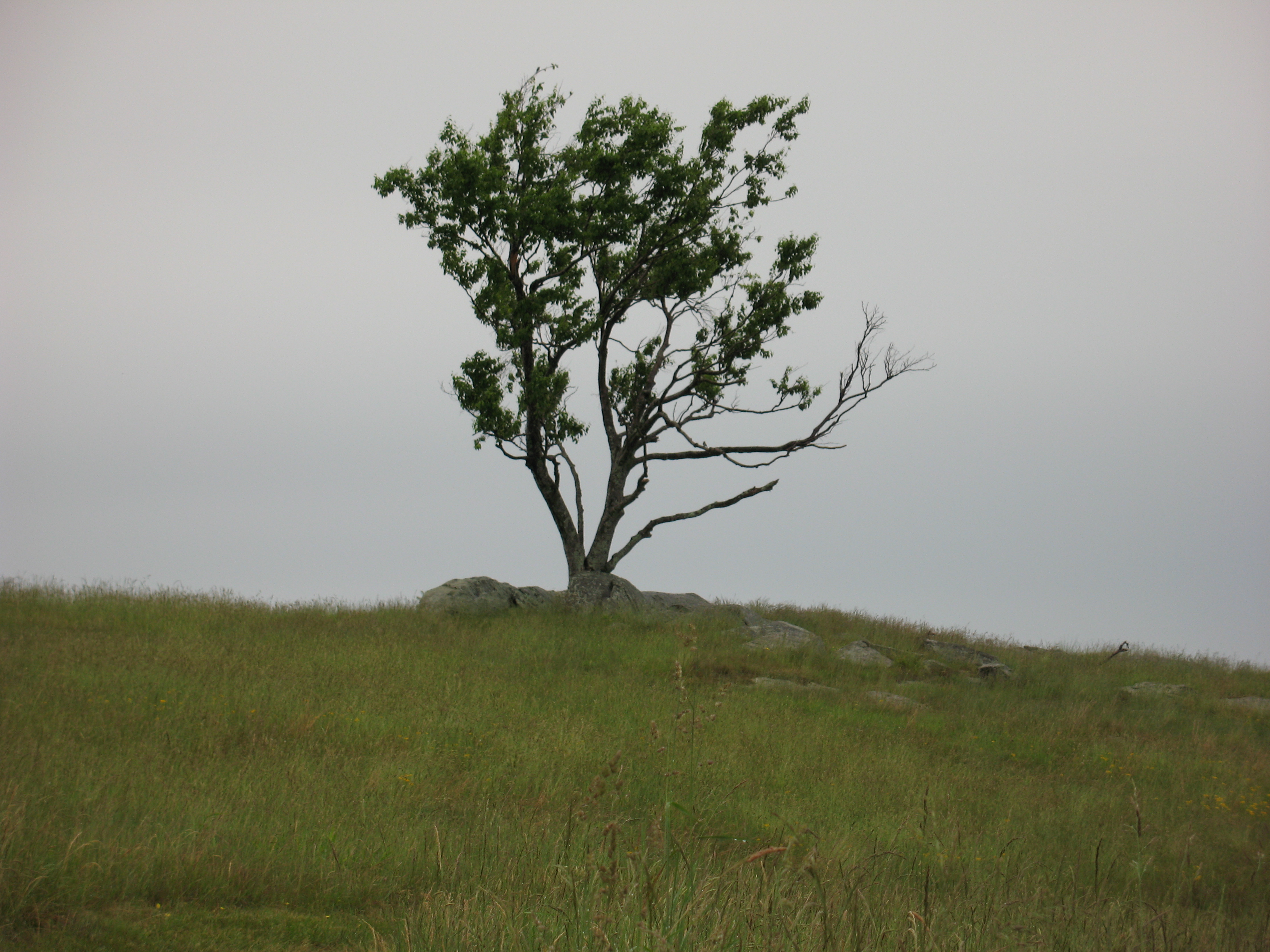
2016-05-08a Doughton Park Tree

Read Full Post »

[with 3 poems from litmosphere
Journal of CHARLOTTE LIT]
 . 
Birds Speak to the Women in My Family
 . 
This time,
+++++ when a trail of feathers
+++++ +++++ leads me into the forest,
+++++ +++++ +++++ I follow.
 . 
Don’t think about where it’s taking me,
only the flightless thing, torn to tufts,
crawling in the underbrush,
but I find no blood, no body.
 . 
Whisper of deep woods
Of gifts and pleasures planted and earthed. What was I
so afraid it would say?
 . 
I’m here,
+++++ arm full of feathers, unsure
+++++ +++++ which of us is the offering,
+++++ +++++ +++++ which way is home.
 . 
My grandmother was told
by an out-of-season swallow
when her mother died.
 . 
We have family in town,
my mother says, pointing to a pair of sandhill cranes
stilt walking through the yard.
 . 
I’ve collected
+++++ so many feathers.
+++++ +++++ I could be mistaken
+++++ +++++ +++++ for wings.
 . 
My mother’s tongue,
her mother’s birdsong
softer with every daughter,
but still a trace, feather by feather
through the old mountains,
disappearing into stone.
 . 
Arielle Hebert
litmosphere, Journal of Charlotte Lit, Charlotte Center for the Literary Arts, © 2023
 . 
❦ ❦ ❦
 . 
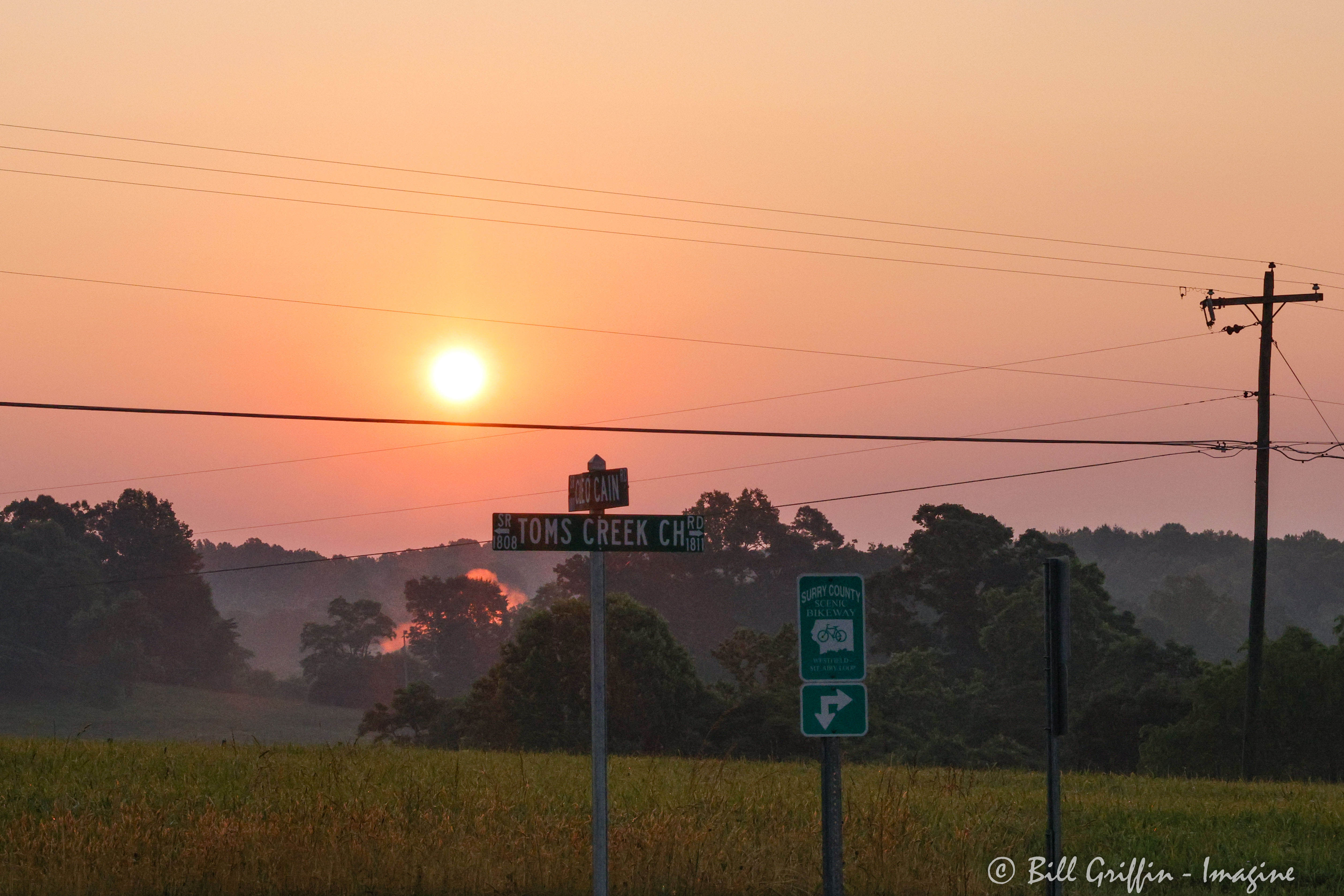
Chilly for June, but after all sunrise isn’t for another half hour. It’s 5:25 AM and Sharon and I are standing in the Surry County foothills a few miles south of the Virginia line. At 5:30 we’ll begin to count. Last year at this very spot a Chuck-Will’s-Widow fired up and sang for 45 seconds before I’d even started the timer. I counted him anyway.
 . 
This year the first voice is a Wood Thrush. Oh, thank you, Audubon’s flute . . . in the summer woods, silver notes pour by the afternoon river. Of all the forest’s music my favorite. Now Catbird, Cardinal, Chipping Sparrow, Indigo Bunting; I call their names when I hear them sing – still too dark to see. Sharon inscribes their presence on our tally sheet. One by one, they fly from mysterious spirit into settled data points.
 . 
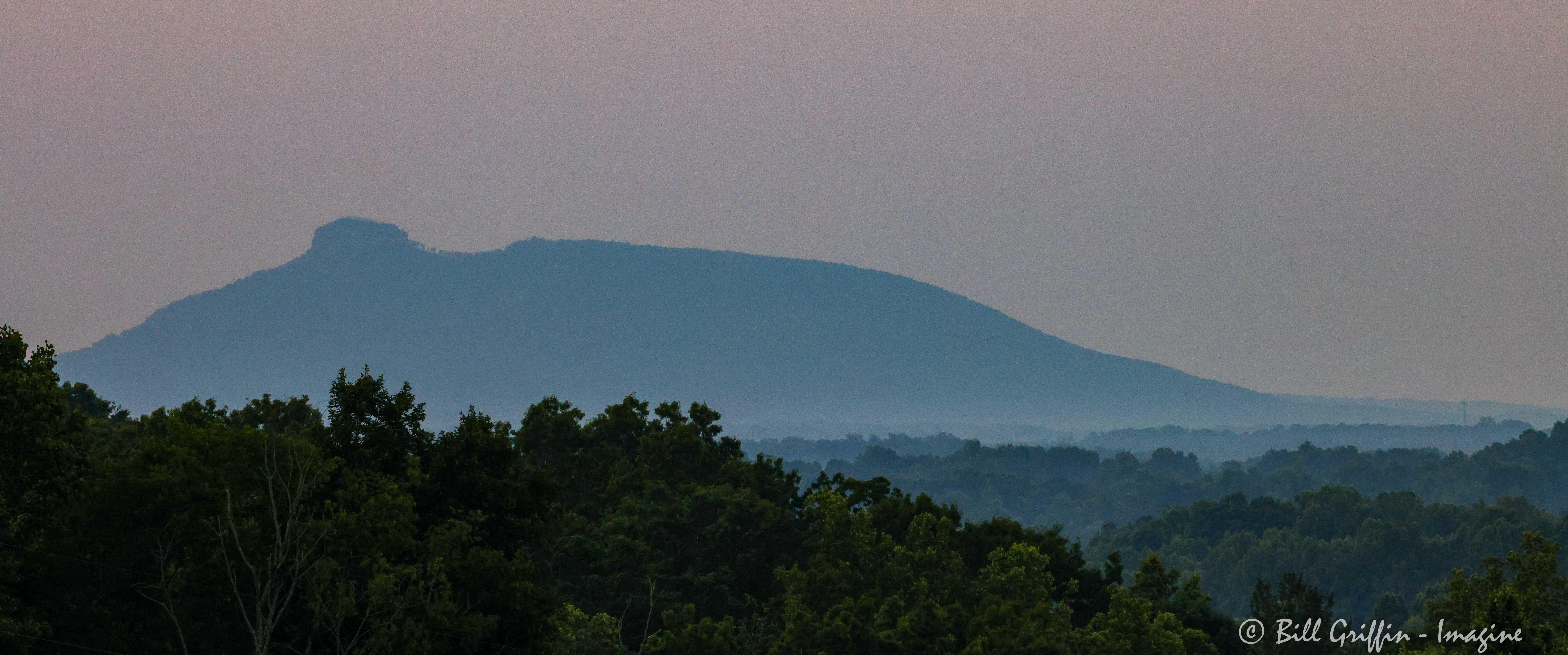
I didn’t really believe Sharon at first. Back in March she asked me to describe these USGS Breeding Bird Surveys and then said, “Can I come?” Really? Pick you up at 5 AM to drive to our first stop? Then 49 more stops, spaced half a mile apart? Set the timer for 3 minutes, count every bird heard or seen, then back in the car and on to the next? Finish late morning somewhere northeast of Pilot Mountain with Hanging Rock looming? You really want to do that?  “Yes! Really! And I’ll bring a picnic!”
 . 
Now we’re at Stop 28. Some of the landmark descriptions, established decades ago when these survey routes were first established, are obscure and changeable: overhead power lines and opening in trees. Well, yes, there is a nice opening in the mixed forest, and yes, there’s an Indigo Bunting as expected. Now we hear a Scarlet Tanager, first one of the morning, but these devious birds love to glean insects at the very apex of the canopy and you could crick your neck trying to spot one. Nevertheless there it appears, flitting to the outer branches of a tall loblolly. Brilliant crimson, stark black wings, pausing to snatch a moth then raise beak in its raucous warble. Sharon gasps. “I’ve glimpsed a Tanager before, but I’ve never seen one in the open. Oh my! This is worth the trip!”
 . 
And we still have 22 more stops. Not to mention the promise of a picnic at Hanging Rock.
 . 
 . 
Enter the litmosphere, a universe of writers and readers. The readers may be physically situated anywhere in the world, same for the writers although they must at some time have lived in North Carolina or one if its four bordering states. Today’s poems appear in the second annual edition of litmosphere as winners, finalists, or semi-finalists in this year’s Lit/South Awards.
 . 
Charlotte Lit, the Lit/South Awards, and the publication of litmosphere are the brainchildren of Kathie Collins (East Bend, NC) and Paul Reali (Charlotte, NC). In establishing the Charlotte Center for Literary Arts, they are creating a community of writers with a unique definition of Southern, and the poetry, essays, and fiction in this year’s journal speak from a creative realm without boundaries. Place and persona are powerfully freed from constraint. I really could not anticipate where the turn of each page would take me. Ever been welcomed into a gathering that challenges you, surprises you, fills empty spots you didn’t even know you had? And leaves you feeling welcomed and ready for more?
 . 
Charlotte Lit, besides its annual contest, offers more than a hundred classes and events every year. Membership information is available here:
 .
 . 
❦ ❦ ❦
 . 
Of Rock Doves
 . 
We call these doves pigeons
because they are many
because we once built them cotes
because we collected their guano
because we spread it on melon
patches and near tomato beds
because they bob their heads
in their staggering walk
like professional wrestlers
at the end of their careers
because they can’t see
straight ahead any other way
because they are easily misled
because no matter what
some find their way back home
because when some vanish
there are always many more
because their name is an echo
of the hungry noises
that come from their flimsy nests
because they raid each other’s nests
they kill their neighbors’ young
because they kill their own young
because together in a group
they are called a deuil
which means mourning in French
because we eat their young
because they taste so sweet
and have very small bones
 . 
Paul Jones
litmosphere, Journal of Charlotte Lit, Charlotte Center for the Literary Arts, © 2023
 . 
❦ ❦ ❦
 . 
When the Universe Told Me You Were Dead
 . 
That very morning, the feral cat left
a dead bluebird on my doorstep,
splayed open.
 . 
Heart gutted, this remained:
a blood-empty chamber
caged behind delicate, shattered bone.
 . 
Newly lifeless, feathers still wet
with morning sky, the orbs of her
eyes set to flight.
 . 
Anita Cantillo
litmosphere, Journal of Charlotte Lit, Charlotte Center for the Literary Arts, © 2023
 . 
 . 
❦ ❦ ❦
 . 
Audubon in the summer woods
by the afternoon river sips
his flute, his fingers swimming on
the silver as silver notes pour
. . .
from Audubon’s Flute by Robert Morgan
[read the entire poem here]
 .
 . 
NOTE: June 19-24, 2023 is NATURALIST WEEK sponsored by Great Smoky Mountains Institute at Tremont. Wherever you are in the world, you can participate in the Naturalist Challenge by spending time outdoors as a naturalist: Pay Attention; Ask Questions; Make Connections; Share. You can also receive a prize if you earn 25 points for your activities! See details here:
 .  . 
 . 
The Breeding Bird Survey is a long-term, large-scale, international avian monitoring program initiated in 1966 to track trends of North American bird populations. There are currently over 4100 courses in the US and Canada, run each spring by volunteer surveyors, and in recent years Mexico has also been added. More than 450 scientific publications have relied heavily, if not entirely, on BBS data; essentially every avian conservation study in North America turns to the BBS in some way.
 . 
In the 1960’s, Chandler Robbins and colleagues at the Patuxent Wildlife Research Center were developing survey techniques to monitor populations of hunted birds: Woodcock, Snipe, Mourning Dove. Inspired by Rachel Carson and her publication of Silent Spring in 1962, Robbins realized that larger surveys were needed to document the effects of DDT, as well as other human and non-human variables affecting bird populations. He invented the roadside survey used today: 50 stops plotted on a 24.5 mile course to be counted once a year. The goal is broad longitudinal observation rather than stop-by-stop variation, and the technique for counting in 2023 is the same as in 1966: a single observer, no “pishing” or other enticements to the birds, no apps or electronics, just two ears and field glasses.
 . 
I ran my first course in 1995: Copeland, southern Surry County. I’ve counted the course every spring except when BBS shut down for COVID in 2020 (because many courses run through parks and federal lands that were closed to visitors that year). In 2022 I added a second course when it became vacant, Mount Airy in northern Surry County. If you’re interested next year, I’ll pick you up at 5 AM. But Sharon has first dibs.
 . 
Bill
 . 
 . 
❦ ❦ ❦
 .  . 
 .
 . 

Read Full Post »

 . 
[with 3 poems by Maya J. Sorini]
 . 
Eavesdropping on the Dead
 . 
Today I heard a man talk to his mother about her eulogy.
They decided on the color of her funeral flowers –
Purple, and white
He kept reminding her to swallow her water
And finished his sentences with “mama,”
So she would remember she was supposed to be listening.
 . 
I watched a woman brush the oily hair from her husband’s forehead
She spoke like velvet,
Telling him how good he looked
With that tube sticking out of his mouth,
Sitting up today!
 . 
There is Arabic music playing down the hall
Because a patriarch is dying
Zaeem, Omar Almadani
Allah ateyk alf afyeeh
The family told the doctors they were so thankful for them.
 . 
The dead tell stories
They forget to swallow
They sign papers
That say they would like to die soon
They listen to music
They pick flowers
They have tubes in their mouths, in their arms, in their bellies,
They laugh and laugh and laugh
 . 
Maya J. Sorini
from The Boneheap in the Lion’s Den, Press 53, Winston-Salem NC, © 2023
 . 
❦ ❦ ❦
 . 
Mostly I dream about being lost. What is this place that seems so dangerously familiar and yet maddeningly strange? How do I get to where I’m going, and just what exactly might that place even be? And how do I, desperate, find what I need among all this that crowds in to thwart me, this collation that confuses and obscures my seeking?
 . 
Last night I walked through a dim building with stairways and many rooms. I was among people I knew: we were a family or a community or somehow connected. As I encountered one person, then another, they all seemed frightened. We knelt together, one by one. I reached to put my arm around each and said, “We will save the world.” Tears in our eyes. “And this is how we will do it.” But I woke suddenly in the dark with no answers.
 . 
 . 
This afternoon I read Maya Sorini’s new book, The Boneheap in the Lion’s Den. A lot of poetry is about pain. This book is pain. Read it and you will succumb. Enter these poems and they may infect your dreams with Sorini’s refrain: Nobody could / help me.
 . 
During the 40 years I practiced medicine the concept of pain steadily evolved. Not only the neuroanatomical patterns of pain and bioneural origin of pain, but new ideas emerged about the nature of pain, this sensation that we all experience but which is impossible to communicate, impossible to share. Pain has become the fifth vital sign (after pulse, blood pressure, respiratory rate, and temp); every time I take my parents to their doctor, the nurse dutifully asks if they are having any pain. Medical practice has attempted to clinically quantify pain with the ubiquitous one-to-ten scale and its familiar smiley faces and frowny faces. The compulsion by doctors to relieve pain (and perhaps the expectation by patients that it will be relieved) is a factor in our national epidemic of opioid addiction.
 . 
But Maya Sorini’s poems are more than the pain of wounds and fractures. They include but exceed the pain of the death of a loved one, the pain of tragedy and grief. As I read these poems, I learned an odd and non-intuitive physics of pain. Clearly we all cope with pain by pushing it away – like gravity, pain’s effect on us diminishes in proportion to the inverse square of distance or some such. Also pain within a certain minimal radius of proximity can be willed into submission: my migraine, my surgical incision, my grief I can encapsulate in denial or repression and with clenched jaw march on.
 . 
But there is a certain critical distance, or rather closeness, of pain that lacerates unrelentingly – the pain of experiencing the pain of another. Maya Sorini wrote these poems from her months of clinical research in a trauma surgery unit at Washington University in St. Louis, standing in emergency rooms and operating suites as blood dripped into her shoes. Perhaps bullets never penetrated her anatomy, but shards of violent metal tore her. Wounded her. It is painful, yes very painful, to share her distress. Is there any hope for healing from these dreams of flight and helplessness? Can Daniel, gradually succumbing to the carnage of the lion’s den until he himself becomes little more than a boneheap, ever rise up again? Can any of us be saved?
 . 
When I finished the final page of Boneheap, I sat for a time in silence. In shock? I wanted to push away the pain but I had read every single word and they would not be denied. Now what? Perhaps I’m awakening from a dream in which answers flit through my fingers like moths then dissolve into mist with the rising day. Perhaps a dream is some subconscious nudge not to give up looking for answers. Is it a tautology to pronounce that pain must be felt before it can be unfelt? Isn’t unfelt actually the precise opposite of what the dream impels us to seek?
 . 

Maya Sorini, what I’ve felt in reading your words is pain which we have now, after all, shared. In sharing with this reader, may the burden of your pain be lightened.

 . 

 . 
❦ ❦ ❦
 . 
Moratorium
 . 
Say what you mean
Stop saying “expired”
Like it is inevitable for the 28-year-old
To die on a Tuesday at noon.
 . 
Stop keeping it a few words away from you,
Using “expired” because “death” forces
you to think about
Your grandfather’s funeral
When you were 16 and had never seen
Your dad cry before.
 . 
Say what you mean exactly –
Do not say, “we did everything we could”
When what you mean is
“I have given every tear and deep breath I have to this job
But the bullets keep winning.
I don’t want to be
The one telling you
That we lose every
Day to scraps of metal.”
 . 
Say what you really mean:
“Your son is dead.”
 . 
Maya J. Sorini
from The Boneheap in the Lion’s Den, Press 53, Winston-Salem NC, © 2023
 . 
❦ ❦ ❦
 . 
Trauma Surgeon Ars Poetica
 . 
This morning a robin collides with the glass windows of our sunroom. It flies into three panes, then four, then the same one many times, looking for different skies, trying to escape the day. With each thump I think, “this is the sort of thing poets write about, those poets who know how to hide the word death inside of a songbird,” but I don’t know how to talk about blood without speaking the scarlet spatter of it. I say nothing to the red-brown bird, the reflection of the sky’s blue face veined with branches, the feathers so light they seem to shirk the responsibility of falling, the dull thunk ringing in the house, the morning so quiet it becomes prayer, the lined triangle of yellow beak, the black moon of the eye intent on its mirage. I cannot write that poem. I am still thinking about blood. When I see the robin throw itself at the window a fifth, sixth, seventh time, I open the door, I wave my arms, I chase it away.
 . 
Maya J. Sorini

from The Boneheap in the Lion’s Den, Press 53, Winston-Salem NC, © 2023

 . 
❦ ❦ ❦
 . 
Maya J. Sorini is a poet, performer, and medical student from Rockville, Maryland. She received her B.A. in Chemistry from Washington University in St. Louis while engaging in clinical trauma surgery research. Since 2005, Press 53 in Winston-Salem, North Carolina has been finding and sharing remarkable voices through collections of poetry and short fiction. The Boneheap in the Lion’s Den is the winner of the 2023 Press 53 Award for Poetry, selected by Tom Lombardo.
 . 
❦ ❦ ❦
 . 
 . 

Read Full Post »

Older Posts »