Feeds:
Posts
Comments

Archive for November, 2022

[with 3 poems from Quiet Diamonds
Bob Wickless, Susan Craig, Bill Griffin]

O narrow track, how I have missed you! O wee well trodden way, favorite mile, little path through pasture and wood that my right knee has refused to let me walk for all these weeks, I am so glad to see you again. Last visit you had all but shed your autumn yellows, not to mention cardinalflower reds and pastel meadowbeauties. Now here you are blowing snow across my path.

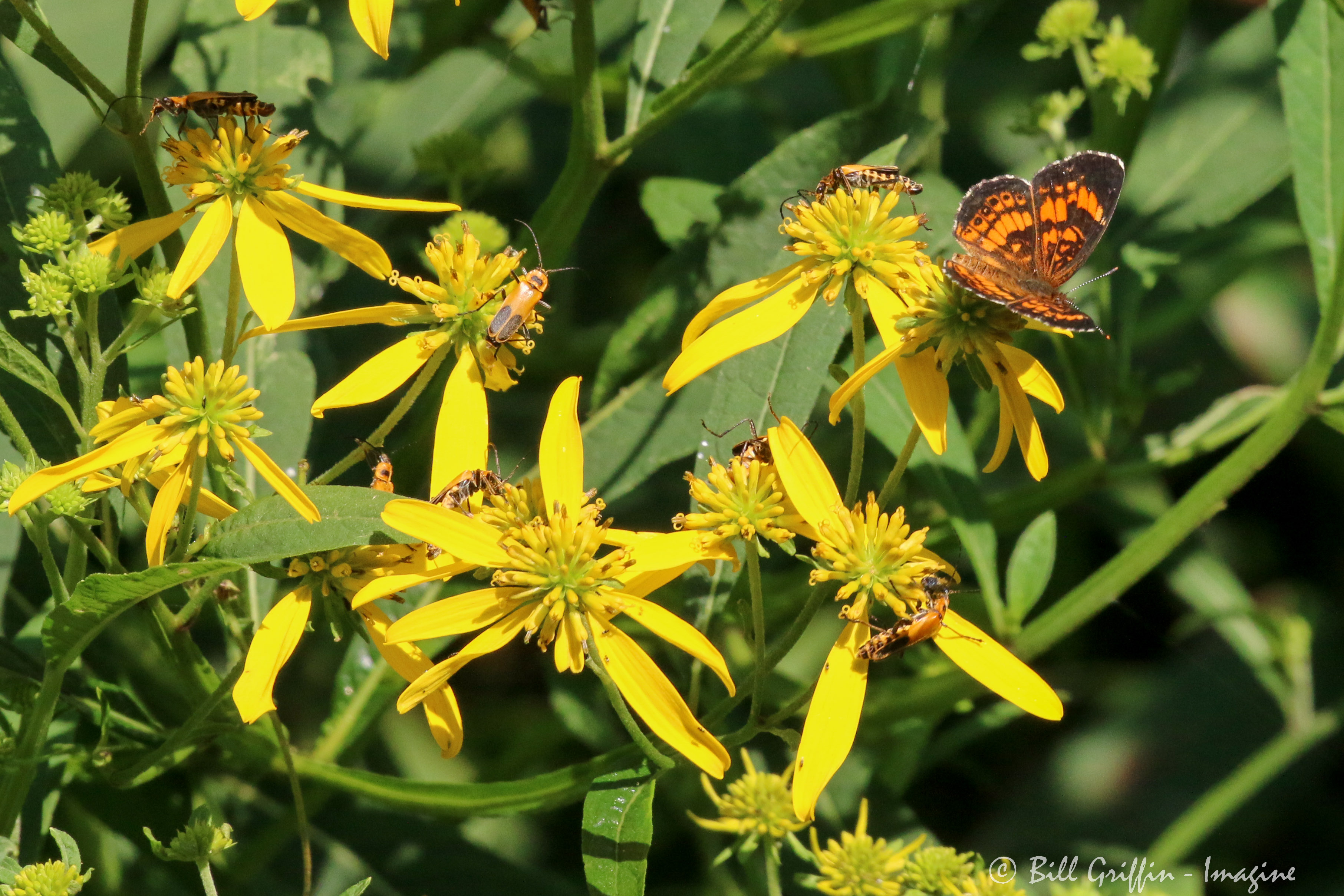
The season has arrived of whites and browns, feathers and fluff, crowns and rounds – seeds! Hello little calico aster whose name I just learned last summer; now your stems are strung with new stars so fine. Hello crownbeard; petals fallen, you lift your regal head. And hello snowy boneset and thoroughwort; one puff of breeze is all it takes to loft your feathered promises across the meadow.

There is a bare patch below my house beneath the powerline. There is an empty bag in my pocket. You won’t mind, prodigal wingstem, goldenrod, ironweed, if I catch a bit of your seedstuff and carry it home to a new bed? You won’t run short of provender when goldfinches and sparrows come to call. You won’t ever hear me, like some others, name you weeds.

❦ ❦ ❦

Prayer in Spring

beginning with a line from Seneca

Not hoping without doubt,
Not doubting without hope,
We enter the slow country
Of change, clad in the garment
Thread through the loom of change,
Woven in green doubt
Though woven in hopes

Greener than any hopes are:
May the clothes of the world
Still fit, in the eye’s mind
And in the mind’s eye, may
Our vision still clear
As the iced eye of the river
Cataracts, loosens, the view

In the breeze of the green flag
That is not failure, in one light
That will melt the white flag
Of surrender – Lord, we had not
Given up though the air had said
Surrender, through the vines, trees
Were all blasted with failure,

Though no light shone
Through the fabric of sky
But one pale and unaccomplished,
Wan, washed out as our vision,
Faded divinity, in the blank
Washed out country called snow,
A world neglected, blue

Now, Lord, even as the sky

Bob Wickless (Reidsville, NC)
from Quiet Diamonds 2022, The Orchard Street Press, Gates Mill OH
❦ ❦ ❦

Today in Elkin this blowing snow is windborne seeds of last summer’s asters, but inches of the cold frozen sort are accumulating in northeastern Ohio around Lake Erie. Snow belt – that’s where Linda and I met, dated, and graduated from the high school we walked to through slush & drifts. Call off school for a “snow day” in Ohio? Bah! The last time we visited Portage County was for Linda’s birthday six years ago. The old Aurora Country Club had been converted to a nature preserve – how many species of goldenrod filled those reclaimed fairways? The Cuyahoga Valley National Recreation Area had since 2000 become a National Park; we still talk about the canal trail, every ten meters another chipmunk to chirp and run across our feet.

Northeastern Ohio lives fondly in our hearts. Just up Chillicothe Road from the Cuyahoga and our old school is the village of Gates Mills and The Orchard Street Press, another font of fondness. OSP editor Jack Kristofco published my chapbook Riverstory : Treestory in 2018, so I most certainly love him, but even more I love the anthology his press produces every year, Quiet Diamonds. This year’s collection is deep and various and moving. The poems can be personal and at the same time universal. I find myself leafing back and forth through the book reading each one several times, in a different sequence, discovering new moods with each passage. So many I would love to feature on this page, wonderfulness from poets all over the US, but here I continue my focus on us Southerners.

Check in with The Orchard Street Press in January for their 2023 contest.

❦ ❦ ❦

Looking for the Banded Sphinx

++++++ I’d seen clutched last night to the railing
its wings of veined mahogany like a master craftsman’s
the way my brother’s finest tables
were inlaid in gold and amber

++++++ yet, only the marsh hawk waits
atop the same wooden rail outside the same glass door
its wing-shoulders brownish-gray
as any familiar relative

++++++ and even its flight, when it senses
the small breeze of my arrival, appears
blasé as a loping dog

++++++++++ Last night, the next-door young couples
played guitar as midnight lapsed into new year
sang Jolene in a lusty chorus
that rose and fell like the distant sea pulled
by a stranger’s violin

++++++ I ask my husband about the banded moth
Gone, he says, at first light
without a hint of nuance
++++++ the same way wonder disappears, the way
dust becomes fugitive

++++++++++ My eyes trace mid-morning’s
pale pentimento of moon
while at the edge of marsh a stalking ibis
is osmosed in plumes of fog
where sun glints cold creek
++++++ and we find no reason to speak
as the hawk melds like another riddle into winter’s
moss-draped bones

Susan Craig (Columbia, SC)
from Quiet Diamonds 2022, The Orchard Street Press, Gates Mill OH

❦ ❦ ❦

We Never Give Up Hoping

Morning frozen hard. Pour
++++boiling water
into the birdbath;
++++ they will come
to drink when I have gone.

++++ God of holy ice, holy
++++++++ steam,
++++ give my children
++++++++ water
++++ that all my hoping
++++++++ can’t.

Sound of wings, splash
++++ diminishing;
find the world again
++++ iced over.
Fill the kettle. Holy water.

Bill Griffin (Elkin, NC)
from Quiet Diamonds 2022, The Orchard Street Press, Gates Mill OH

❦ ❦ ❦

EARLY SNOW: ASTERACEAE

Stare across any random autumn afternoon and soon you’ll notice the jig and curtsey of little airborne tufts. Catch one and see if there isn’t a tiny hard seed hanging from that feathery wisp. The early snowflake you’re holding is a member of family Asteraceae.

Except for Cardinal flower (Bellflower family, Campanulaceae) and Meadowbeauties (Meadow Beauty family, Melastomataceae), all the flowers mentioned in my homage above are members of the Composite family (Asteraceae). This is the largest family of flowering plants in North America and vies for the world title with Orchidaceae. Besides typical species like asters, sunflowers, black-eyed susans, and coneflowers, Asteraceae includes less obvious suspects like Joe-Pye Weed, goldenrod, ragweed.

Study a daisy: you figure you’re seeing one standard flower, right? A ring of petals around the edge (corolla), eye in the center. Basic taxonomy of flowers depends on the configuration of their reproductive apparatus – flowers. But a daisy is a Composite – each “petal” is 3 or more fused petals from a complete individual Ray flower; each spot in the eye is an individual Disc flower with its own minuscule petals, pistil, and stamen, ready to make a seed. (And if that’s not already confusing, some Composites have only Ray flowers, no Disc (Dandelion), and some have only Disc flowers with no Rays (Fireweed).)

So what about this early snow, then? Ah, sepal and pappus . . .

In most flowers, sepals are the layer, just outside the petals, that make up the protective bud cloak. After the bud opens, the ring of sepals is called the calyx. In Composites, each “flower” actually multiple little florets all clumped together with zero elbow room, the calyx is diminished to almost nothing: the pappus, sometimes visible only with a microscope where it’s fixed to the seed. Except . . . those members of Asteraceae whose pappus is a bristle, hair, tendril, feather. For wind dispersal, but also for wonder and delight. When a breeze puffs the boneset or fireweed or lowly dandelion, one might imagine the pasture will soon be knee deep.

❦ ❦ ❦

❦ ❦ ❦
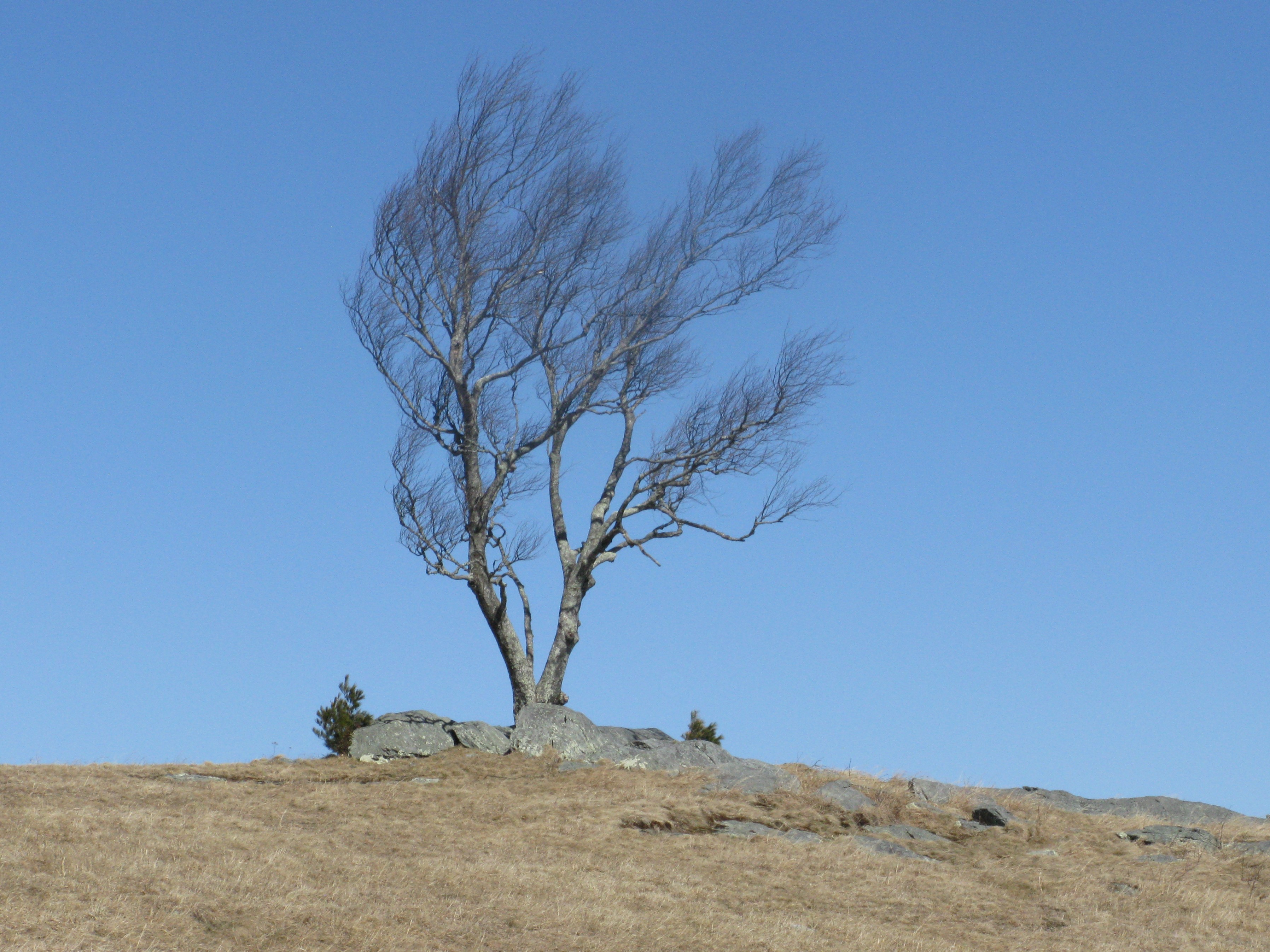
Doughton Park Tree 2021-02-23

Read Full Post »


[with 2 poems by Richard Chess]

Yesterday my teenage grandson reported that he had run into the father of his own father’s best friend at Trader Joe’s. And he told me he’s 82. I can’t believe that. I soberly reminded him that next year on 11 February I will turn 70. When you’re 70, I informed him, I guess you’re officially old.

My grandson nodded. (Did he have to agree with me quite so quickly?) Then he shrugged, But you’re a child at heart, Pappy. You’ll be OK.

When I told this to my wife later for laughs, she agreed at once. Of course. She thinks she knows exactly what our grandson means. Whenever our seven-year old arrives for the afternoon, her immediate mantra is, Play, Pappy! The funny songs I make up, the games invented, the animal voices and dumb jokes – a playmate, that’s me.

No. There’s no connection between childish and child-like. The former is fun and funny, a diversion; the latter is as serious as time and time’s end. I desire to become child-like and it is a struggle. Or I make it a struggle. Self-inflicted pain wakes me after midnight recalling hurts I’ve caused in times past; worries about indeterminate futures refuse to allow sleep to return. Of course. Who doesn’t worry about their children’s choices, their aging parent’s decline? Who doesn’t have drama and bullshit to put up with? Who, after all, sleeps soundly?

Last night I watched my granddaughter sleep. Utterly relaxed, an exhausted kitten. Breathe in, breathe out. May a bit of her child-like flow into me? This morning she is bouncing and singing and I will clearly have to make time much later for any silent meditation or prayer. Hmm, awkward constuct there, making time. Time is making me. The made up songs, the made up worries, may they flow as they will and may I cease my furious resistance to the flow. May a child’s song be the prayer I need. Trust my heart – I will be OK.

❦ ❦ ❦

Tashlikh 5773

++++ “And you will cast all their sins into the
++++ depth of the sea” – Micah 7

++++ Tashlikh: a ritual of symbolically casting
++++ one’s sins into a moving body of water
++++ performed on Rosh Hashanah afternoon

Into this
shallow
creek,
into this
narrow
gesture
of land,
this
slow
discourse
of water,
I empty
my holiday
pockets,
a year’s
crumbs
of gossip,
I empty
my eyes
of lust,
my heart
of unsym-
pathetic joy
over his
fortune,
I empty
my hand
of the fist
and my mouth
of silence
where there
should have
been cries
of injustice,
I empty even
the emptiness
of vows I
made last
night, before
the open
heart of
this synogogue,
this wounded
house of
prayer;
into this
trickle
I empty the
comfort
of ritual
so that I
may stand
stripped to
the bone
of creation,
whthou
a deed
to just
ify my
life, this
life, carried
now only
by the current
of Your mercy.

Richard Chess
from Love Nailed to the Doorpost, University of Tampa Press, (c) 2017

❦ ❦ ❦

A mentor from my days of medical training introduced me to Richard Chess last year. (Thank you, Jessica!). His essays in SLANT invariably lift me from my complacent path and set me back down in fields of thoughts like unfamiliar flora; I spend days exploring, learning. What seemed unfamiliar was really already some part of me waiting to be discovered. The personal searching of Richard’s writing invites me, us, to pass through a door that opens into all that makes us human, into all that makes us unique and at once all we share.

More recently, I’ve read Richard’s poetry in Love Nailed to the Doorpost. Unsettling, provoking, unique and uniquely demanding. His personal moments of awareness entwine and intermingle with spiritual mythmaking and retelling of Torah. It is a journey of confession and redemption, of certainty and profound doubt. By the end of the book I’m exhausted by the struggle with my own doubts. But might not doubt be the beginning of faith? I believe there is a benediction available through these poems – beating, beating, beating our heart, our stubborn, collective heart into submission, into awareness, into life.

Richard Chess directed the Center for Jewish Studies at UNC Asheville for 30 years. He helps lead UNC Asheville’s contemplative inquiry initiative. He is a board member for the Center for Contemplative Mind in Society.
More by Richard Chess . . .

❦ ❦ ❦

The Huppah

In the sixth or seventy year
of their marriage, the huppah
was stolen. I had absorbed
the love that was consecrated
under it, or it had absorbed nothing
and was merely fabric zipped
into a bag of of no value
to the theif, or it ws a thin
blanket to cover his little girl
on an autumn night, or it was a wrap
with a rainbow of stripes
knotted around his woman
before and after a good fuck.

Of no use to a guy looking
for a quick fix of his broken life,
it may have been tossed into bushes
outside a church or into dumpster.

The huppah had no mouth
to sing the bride’s song,
here I am, take me home.
It had no money to pay
for space in a closet or a drawer
in some row-house. Though it looked
like it could have belonged to a magic
act, it knew no tricks, it could not assist
in sleight-of-hand. Though it looked
sacred, ti could not purify human flesh.

It’s been a dozen years
since the huppah was taken from them,
since it went out into a city of mustard
and minute steak, of a cracked bell and hall
of freedom, and whether it was hauled
to a landfill with all the other refuse
of a fat city, or tacked to a wall and draped
over a window to keep a brother, a cop
from stealing a look at a brother’s girl
moving toward him with all that’s good
to eat, or whether it was offered
to an oil drum’s angry fire
around which six day laborers gather
waiting for the dock to open –
it’s all the same to them. The mortgage

is hungry and must be fed. The children
are stupid and must be prodded
toward the pen where they will be civilized
and milked. The marriage is short
on memory and must be consecrated
again and again, with a glance that shoots
from bride to groom, groom to bride
under the huppah of sky
that fills with clouds and empties, that trembles
dark and light, that must be held in place
by some angels, maybe the same angels
that held their original huppah
for the brief ceremony that preceded
the long ordeal and party of love.

Richard Chess
from Love Nailed to the Doorpost, University of Tampa Press, (c) 2017

❦ ❦ ❦


❦ ❦ ❦

Read Full Post »

[with 3 poems by Diana Pinkney]

Oh, I couldn’t possibly eat all that. Thank Heavens I haven’t heard Mom utter those words for quite a while now. For the fifty years prior I believe we heard that phrase with each plate set before her. Some impulse ingrained in the 30’s in the genteel South? A mantra for all the new college girls in the 40’s? How, we would ask ourselves behind her back, could someone forever twig slender so fear gaining a pound?

This week at the doctor’s office I watch the nurse enter Mom’s vitals in the computer to make sure she hasn’t lost a pound. Dad admits he hates to nag her to eat her breakfast – too engaged with the paper or too forgetful to take a bite? Yesterday I cooked them both lunch – calm down, it was just 10 minutes in the skillet from Trader Joe’s – and served the plates. It’s no trick, really, just sit across the table from Mom for long enough and she will finally finish what you’ve given her. Don’t forget the milk! The doctor says you need more fluids.

Grandmother, Dad’s Mom, had her own mantra for us grandkids in the 50’s and 60’s: Children are starving in Europe. Yes, swear to God, she actually said that more than once. Chubby me was more than happy to clean his plate, but one breakfast I recall her disapproval. I had scooped up the last Cheerio but there was still milk in the bowl overlying its substratum of teaspoons of sugar. That evening I washed down my cornbread with a big gulp of sudden sickening sweetness Grandmother had rescued from that bowl.

Now I’m clearing the table while Mom stares at the last of her milk, a layer of ice melt above the 2%. In a few minutes, though, as I stand at the sink rinsing, she walks in carrying the empty. I have to say it. Good job, Mom!

❦ ❦ ❦

Super Cuts, Six Months after My Daughter’s Death

The stylist snips, snips my hair, shorter
and shorter. As she works, we talk.

You have children, she asks. Yes,
I answer. Do you? Oh, I have two girls.

How about you? Three, I say, my voice
tight, clipped as the gray strands covering

the floor. My daughter’s hair was long
and red, until it was blonde. She loved

the sun. A little less on the sides, please.
Why didn’t I say I have two children, sons,

and that would have been that. Except that
will never be that. I will always have three

children. Do they live here, she asks?
The sons do. My daughter lives nowhere

and everywhere. It’s good, she says, you
have a girl, too. Yes, I answer, it is good.

Diana Pinckney
from Hummingbirds & Wine, Main Street Rag Publishing, Charlotte, NC, © 2022

❦ ❦ ❦

How impossible to bear, losing a child to death. How much more impossible to write about it. Diana Pinckney in Hummingbirds and Wine overcomes the paralysis of grief, but not as chronicle or biography or personal therapy. Although she confesses I live / behind a veil, these poems are the bridge that leads her and us beyond the Valei of Teeris. These lines are twisting tracks that connect past and present, parent and child, and that connect poet and reader.

On the tree of suffering there is a twig of joy that grows up from dark earth. The root of happiness is the same / as perhaps, both descendants / / of hap – hazard or chance. Diana’s poetry is not rationalization, not sentimentality, not desperate. These are poems that share one moment, then another and another, along the path she has had to walk and which we can now walk together.

❦ ❦ ❦

Sea Turtles

Loggerhead, Leatherback, Ridley or Green, they all drag
themselves onto a beach. Alone under the same moon
on different shores, in their struggle to lay eggs.
Volunteers like Elizabeth spent hours at dawn

searching for the side, clawed tracks, uncovering
and moving the eggs to sand dunes, staking orange
mesh over the nest. Protection, maybe, she said,
from dogs, crabs, lots of things. Oh, my girl, I couldn’t

protect you, holed up in your house in the company
of bottles. Still, in your best years, you waited weeks
for dozens of thin-shelled eggs to split as the tiny feet
tore an opening, and under nodding sea oats, started

their spill up and out. Each one, no bigger than a silver dollar,
struggling to climb into moonlight, and down to the sea’s white foam.

Diana Pinckney
from Hummingbirds & Wine, Main Street Rag Publishing, Charlotte, NC, © 2022

❦ ❦ ❦

Beach Walker

I can still see her stretching in the hazy sun
each morning, strolling the surf, breathing salt

and the musky scent of creatures curled inside
shells – whelks, clams, conchs – once alive.

She so many miles from y city home.
So many Hey Mom’s when I’d lift the phone.

How is it that a heart so loved could weaken
through the days and weeks, and I never knew.

A heart that beat with the rhythm of the sea
and one bright morning would fail her and me.

Diana Pinckney
from Hummingbirds & Wine, Main Street Rag Publishing, Charlotte, NC, © 2022

❦ ❦ ❦


❦ ❦ ❦


Read Full Post »

Older Posts »