Feeds:
Posts
Comments

Posts Tagged ‘Southern writing’

Fort Macon Beach.  I’m twelve.  Is this dream or memory?  Either way it’s true.  My little sister snatches from the foam’s edge a clump of stringy green seaweed.  Shakes off coquinas and mole crabs.  Drapes it on top of her head and down around her shoulders.  “I’m a mermaid!”

Of course I believe her.  Because what is a mermaid?  A creature that rises from a strange and exotic world to challenge all our comfortable assumptions.  One who challenges and enthralls only to slip from our grasp.  Who breathes a cold hot enfolding incandescent oxygen like no air we’ve been able to imagine.

Any six-year old who will pull ickiness from the surf and adorn herself with it must surely be a mermaid.  It explains a lot.  My sister who cycled the Eastern Seaboard when she was barely a teenager.  My sister more at home in a kayak than a staff meeting (but who can dominate a staff meeting).  Who for her forty-first birthday backpacked a hundred miles of the AT with me. Who works her healing power over mind and spirit with Jung and the Buddha at her shoulder.  I”ve always suspected it — she does breathe from some atmosphere I’m still trying to discover.

.     .     .     .     .

Meet the mermaids of Diana Pinckney’s Green Daughers.  Dream or memory, the poems are true.  The voice of the watery mother whose daughter is struggling, torn — isn’t it the voice of all mothers?  The voice of her daughter tempted by a world out of reach, agonizing for her unknown future — isn’t it the voice of all children?  And poems for each one of us — for which of us does not long for deep roots, for a fundament to which we may always return, for sustaining love?  Yet don’t we gaze at night into the “sky full / of all her gods and animals” and believe that there is mystery beckoning just beyond our perception?

In the way the next receding wavelet parts the shards to reveal a lettered olive, whole, smooth, its cryptic glyphs revealing a message for my eyes alone, in this way I am still discovering the layers of meaning in Diana’s poems.

.     .     .     .     .

DSCN1219

What the Mermaid Wishes for her Daughter

I turn to the land and imagine
your long, strong legs kiking a road
I can’t follow, climbing from lavender valleys
to the highest peaks, the whole blue earth
at your feet.  And those strange
creatures — men who slipped
like minnows from my grasp —

may you unlock the mysteryof at least one
who listens when you laugh
in your sleep, who cares to chart
a woman’s pleasures and pains.  Sailors
have told me love is what
brings the boats home.  From where
I sit, nature decides our days
and turns the wheels at night.

I knew you were borrowed, but
you nourished me the way the shore
feeds the sea each day, a glossy
bond unbroken.  What you
carry from this place is not
lent, but given.

.     .     .     .     .

live oak b+w 02

Diana Pinckney lives in Charlotte, only a few hours drive to the coast when the wind and the traffic are at your back.  She teaches poetry at the Cornwall Center.  Green Daughters is her fourth collection and is available from Lorimer Press.  Get to know Diana and read more of her work at dianapinckney.com.

Diana will be the featured poet at the Sam Ragan Poetry Festival of the NC Poetry Society, March 24, 2012, Weymouth Center for the Arts and Humanities, Southern Pines NC.

 .     .     .     .     .     .
IMG_6432

Read Full Post »

A couple of years ago my friend Mike and I went backpacking in the Slickrock Wilderness,  near Joyce Kilmer Memorial Forest.  On day one we reached our camp site in mid-afternoon, about half-way up the mountain along Little Santeetlah Creek.  With tent pitched and bear bags hung, I lay down in a patch of sun to listen to the chatter and riffle of cold crystal over moss-draped boulders, laughter over smoothworn gravel.

As I dozed, water voices sang to me.  Urgent conversations, reminding, cajoling, the words critical but somehow never clear.  I half-dreamed of the people that had walked these hills.  Native hunters stalking deer where the clamor masks the sound of their approach.  Homesteaders sledging river stones to turn to cornerstones beneath chestnut timbers.  Foresters marking the next stand they’ll cut, somehow never reaching the old growth poplar and hemlock at Joyce Kilmer.

So many voices lost in the creek’s murmurings, yet also brought to life in that mutter. Aren’t we as poets the keepers of lost voices?  We capture in a phrase a moment that would have been forgotten, an image that would fade.  If we can speak for those who have no words they will “bless us with their bones.”

This poem by Margaret Boothe Baddour, For the Lost Poets, speaks to all who would be keepers of lost voices.  Seeking a mountaintop, discovering a new high place, she revivifies those poets whose voices might have been overcome by the clamorous falling water of years.  Before we can say, “We are lost,” we find ourselves in a new place with new breath.  Be still, listen for meaning within the whisper, the murmur, the water, the earth.  Someone wants to speak to you.

DSCN4902

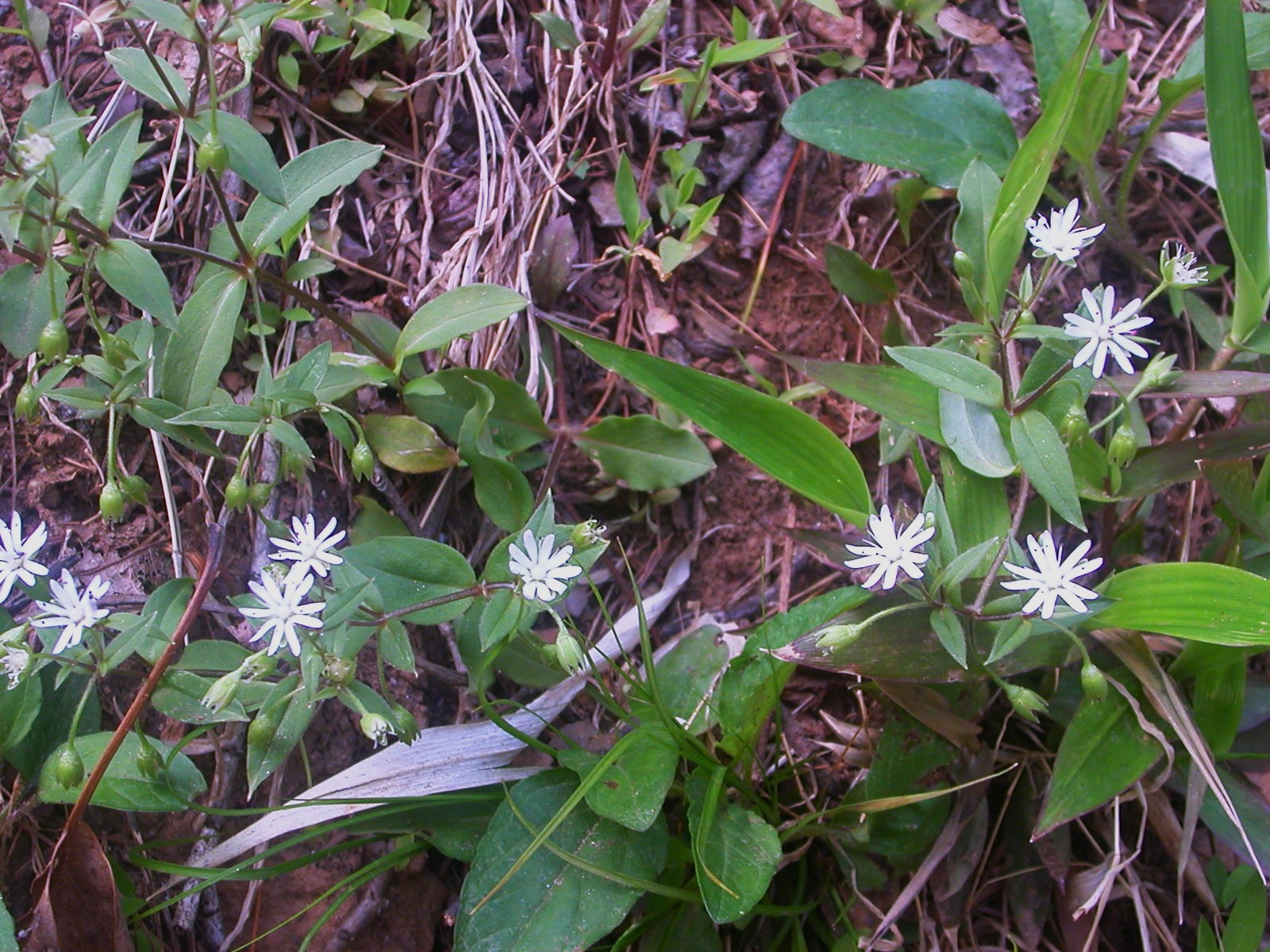
Star Chickweed

For the Lost Poets
           —            Wildacres, 2008

For every day they die among us,
those who knew it was never enough
but hoped to improve a little by living.
             –   W.H.Auden, “In Memory of Freud”

I.  They Whisper to Us
On this mountain top – so high not even birds
fly here and only small, complcated insects
amid the ox-eye daisies and wild yarrow
worry us with their rush-roar-whir –
we brieve for those poets whose rustling voices
the quiet, the strong, even the raucous ones
are lost.  No, not lost.  Only hushed.
They whisper from just over the next hill.

II.  We Are Lost
We lose our way, looking for Roan Mountain
where, folks say, the pale pink laurel grows.
At the crossroads, an old man stand
like a cigar store Indian.  His white mustache
and brogans, his worn overall speak hillbilly
but before we can say, “We are lost, he smiles
gap-toothed and points like a sign: “Turn left,”
he says.  “Three mile uphill to Roan Mountain.”

III.  They Leave Their Words
At the Continental Divide, we glimpse horses
but the cows up here, the cows so black and sleek
where sun shafts the greensward, the water so pure
at the place where it runs downhill to the east
where bugs whir in the clover!  A white moth
brushes our arms.  Like moths, those lost poets
touch, leave their words hanging, alive in the air.

IV.  We Breathe for Them
Flash of fire – a mountain man, wave of water –
an ocean lover, the stillness of stone,
the roar of wind, all those poet friends
whose wise, strong words provoked this world
have now become the earth and air.  They bless us
with their bones.  Now we must breathe for those
who, when they breathed their last, exhaled in verse.

.     .     .     .     .

from Scheherazade and other poems by Margaret Boothe Baddour, Saint Andrews College Press, 2009.

Margaret teaches Humanities, Creative Writing, and Drama at wayne Community College in Goldsboro, NC, where she holds the Bell Distinguished Chair in Teaching.  Among her many awards and honors is the NC Poet Laureate Prize of the NC Poetry Society.

.    .    .    .    .

IMG_0880

Read Full Post »

So they say a distinctive of Southern writing is attention to “place?” If not obsession with? What, you mean like Spanish moss dripping from live oaks on the old plantation? Oh come on, the South has so gotten over Tara. The South is the Doobie Brothers at Merle Fest in North Wilkesboro last weekend. The South is Beer Fest in Raleigh last month, a hundred artisanal microbrews. And the South is the Piedmont Land Conservancy preserving the Mitchell River watershed, or the grand opening on May 21 of the restoration of historic Jennette’s Pier in Nags Head, home of the newest NC Aquarium.

You can say that Southern writing celebrates connection to place, but I’d put the emphasis on the first word in the phrase. Connection. And that’s what I get when I read the poems of Richard Allen Taylor. Connection to a moment — as if the lines I’m reading have just popped into his head and I’m party to the tangled warp of consciousness poised to say, “Ah ha!” Connection to people, not only all manner of ex-lovers but also that tall waitress with the dark hair, and then the rest of the just slightly off-center characters he seems to encounter everywhere he goes. OK, OK, and connection to place, too, especially his hometown of Charlotte: the notorious ice storms, stuck in traffic on the beltway, deep into re-write with his writer’s group. And as the reader, I discover after each poem that I feel more and more connected with Richard. Even when he’s writing about the murkiest wanderings of the heart, and certainly with every tart turn of phrase and crisp newly minted image, he just can’t help but be his quirky crack-me-up self. (Hmmm . . . maybe that’s a distinctive of Southern writing, too.)

So there’s a lot more to geography than getting from here to there or droppin’ in to set a spell. The connections within these poems are personal, revealing; they invite me into the poem and into a relationaship with the poet. He and I, lets take us a rollicking road trip together, through the geography of the heart.

IMG_1677.jpg

Geography of the Heart

She was never happy in Charleston, though I loved
the sultry nights there, silken breezes from the harbor

where the Cooper joins the Ashley and dark ships
plod like old mules past Patriot’s Point,

plow into the fog beyond Fort Sumter,
stern lights fading to nothingness.

She grew bored with the moist softness of the South,
mountains low, lowlands tame. She took me

to her desert, a crackling skillet — wildfires,
burnt sagebrush, soot-blackened ponderosa.

On the way to Tahoe she showed me poles by the road
over Mt. Rose, put there to measure the snow

and guide the plows away from the edge. The Sierras,
in a hurry to fall down, tossed boulders like dice

across the brown valleys. She loved living
where desert and mountain can kill. Nevada — her dream,

not mine. She kissed me goodbye in Reno,
completing my degree in geography of the heart.

Richard Allen Taylor, from Punching Through the Egg of Space, Main Street Rag Publishing, 2010

Richard Allen Taylor, sample poems

IMG_1783

Read Full Post »

« Newer Posts