Feeds:
Posts
Comments

Posts Tagged ‘poetry’

So they say a distinctive of Southern writing is attention to “place?” If not obsession with? What, you mean like Spanish moss dripping from live oaks on the old plantation? Oh come on, the South has so gotten over Tara. The South is the Doobie Brothers at Merle Fest in North Wilkesboro last weekend. The South is Beer Fest in Raleigh last month, a hundred artisanal microbrews. And the South is the Piedmont Land Conservancy preserving the Mitchell River watershed, or the grand opening on May 21 of the restoration of historic Jennette’s Pier in Nags Head, home of the newest NC Aquarium.

You can say that Southern writing celebrates connection to place, but I’d put the emphasis on the first word in the phrase. Connection. And that’s what I get when I read the poems of Richard Allen Taylor. Connection to a moment — as if the lines I’m reading have just popped into his head and I’m party to the tangled warp of consciousness poised to say, “Ah ha!” Connection to people, not only all manner of ex-lovers but also that tall waitress with the dark hair, and then the rest of the just slightly off-center characters he seems to encounter everywhere he goes. OK, OK, and connection to place, too, especially his hometown of Charlotte: the notorious ice storms, stuck in traffic on the beltway, deep into re-write with his writer’s group. And as the reader, I discover after each poem that I feel more and more connected with Richard. Even when he’s writing about the murkiest wanderings of the heart, and certainly with every tart turn of phrase and crisp newly minted image, he just can’t help but be his quirky crack-me-up self. (Hmmm . . . maybe that’s a distinctive of Southern writing, too.)

So there’s a lot more to geography than getting from here to there or droppin’ in to set a spell. The connections within these poems are personal, revealing; they invite me into the poem and into a relationaship with the poet. He and I, lets take us a rollicking road trip together, through the geography of the heart.

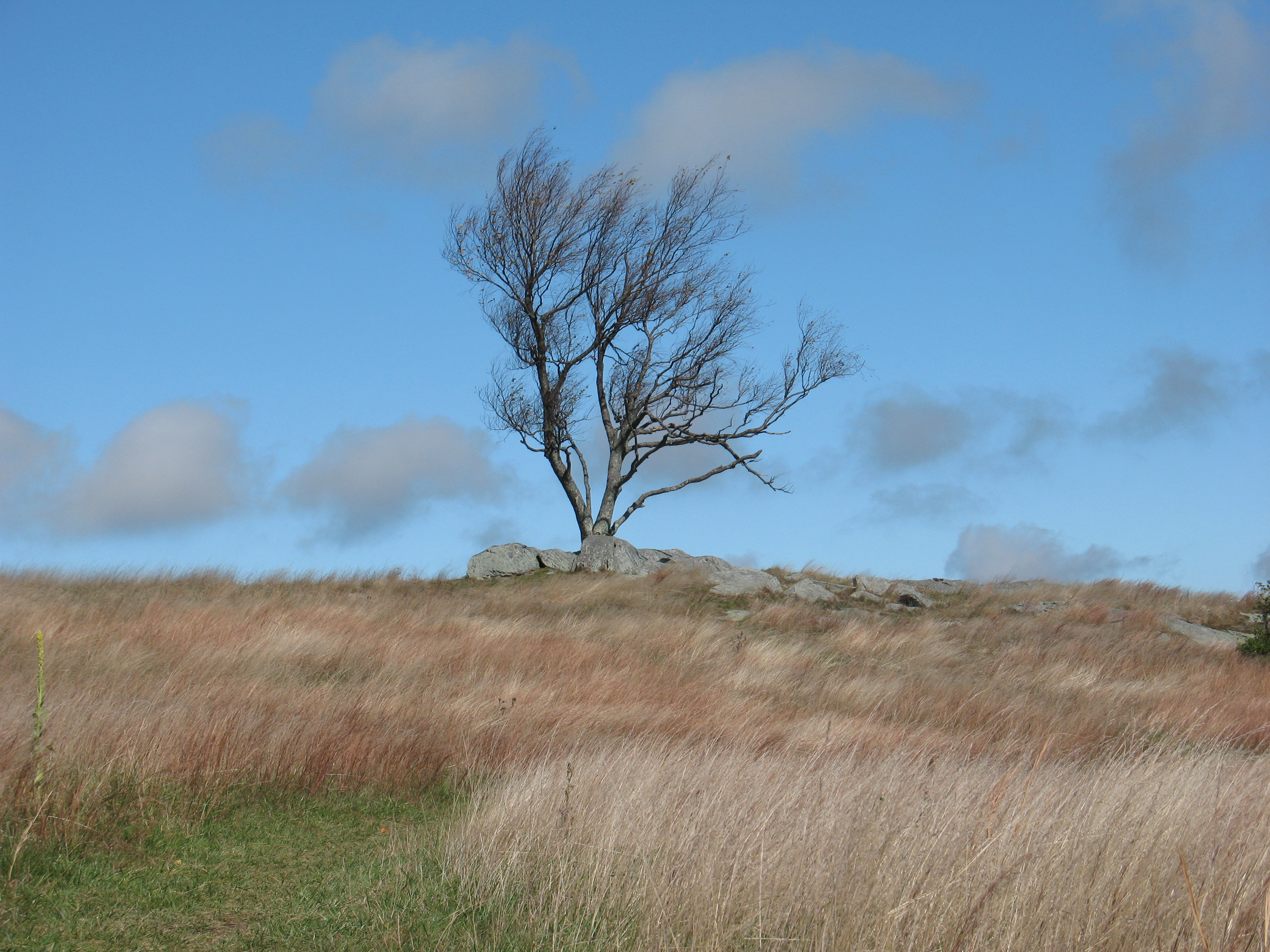
IMG_1677.jpg

Geography of the Heart

She was never happy in Charleston, though I loved
the sultry nights there, silken breezes from the harbor

where the Cooper joins the Ashley and dark ships
plod like old mules past Patriot’s Point,

plow into the fog beyond Fort Sumter,
stern lights fading to nothingness.

She grew bored with the moist softness of the South,
mountains low, lowlands tame. She took me

to her desert, a crackling skillet — wildfires,
burnt sagebrush, soot-blackened ponderosa.

On the way to Tahoe she showed me poles by the road
over Mt. Rose, put there to measure the snow

and guide the plows away from the edge. The Sierras,
in a hurry to fall down, tossed boulders like dice

across the brown valleys. She loved living
where desert and mountain can kill. Nevada — her dream,

not mine. She kissed me goodbye in Reno,
completing my degree in geography of the heart.

Richard Allen Taylor, from Punching Through the Egg of Space, Main Street Rag Publishing, 2010

Richard Allen Taylor, sample poems
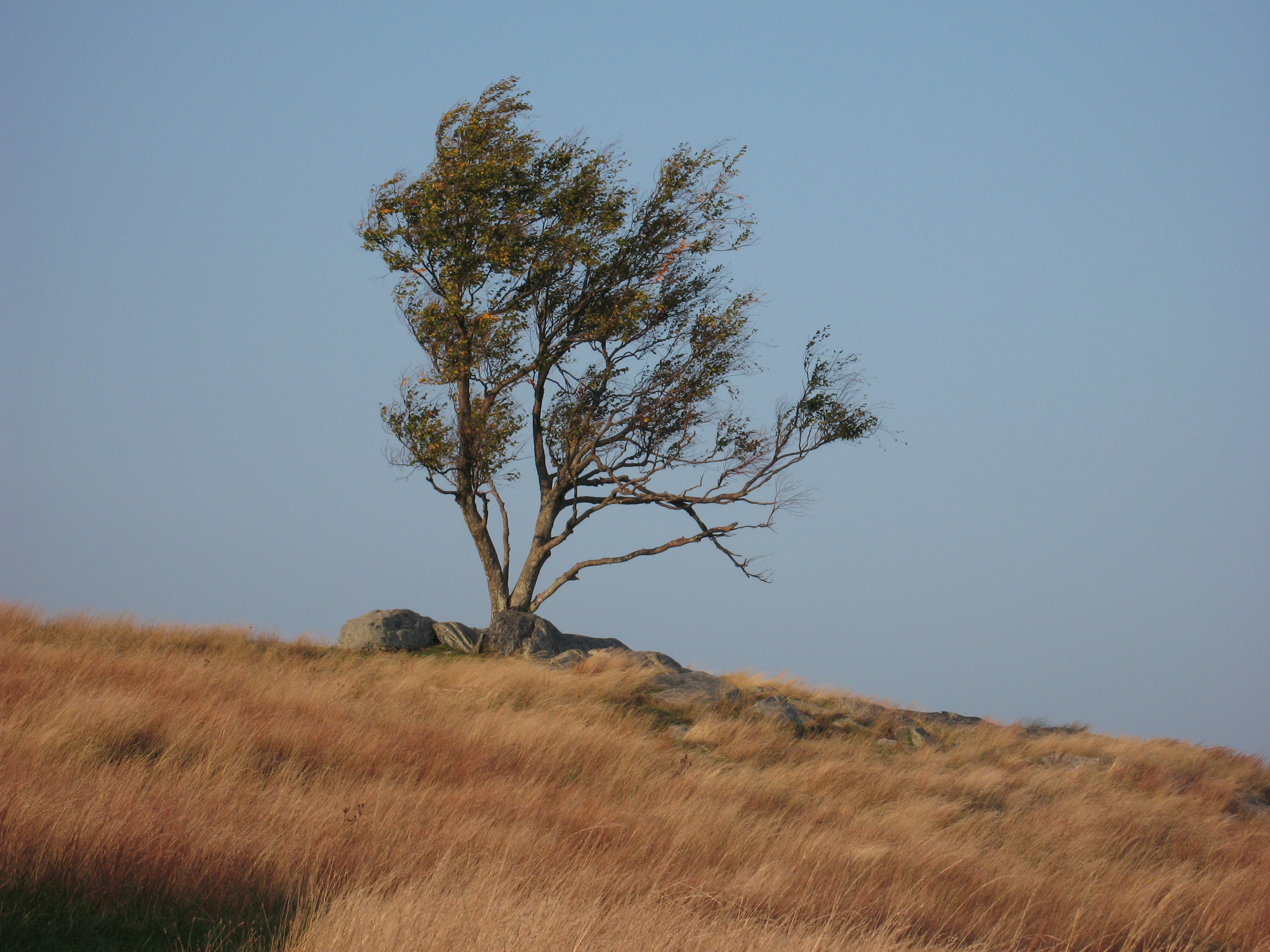
IMG_1783

Read Full Post »

I’m opening the box my parents just sent me.  High-level divestiture (cleaning out their attic).  They’re moving to a condo and discovered this antediluvian stash circa 1970-72: my year as an exchange student in West Berlin and summer job at the XX Olympics in Munich (usher in the volleyball hall).  Here’s the German-Italian/Italian-German dictionary I bought for the trip my host brother and I took to Lugano and Como.  How do you say, “Noch ein Bier, Bitte,” auf Italienisch? *

Apropos, here’s a beer coaster from the REAL Hofbräuhaus in München.  Several volumes of Goethe and Brecht auf Deutsch.  Student passes, trinkets, maps, ticket stubs.  And a fat packet of letters looped with a ponytail holder — Linda and I kept up a transatlantic romance during the twelve months I was in Berlin and then the semester she spent in Hamburg.

But what’s this?  A slim blue cloth-bound volume I don’t recognize at all.  Slightly musty but in good repair. “Fifty Acres and other selected poems.”  By James Larkin Pearson.  I open to the title page, and Linda comes running into the room as I let out a whoop.  1937 . . .  signed by the author.

James Larkin Pearson was appointed by Governor William B. Umstead to a life term as North Carolina’s second Poet Laureate in 1953, the year I was born. I’d never even heard of him until a few years ago when I asked someone why the Poetry Council of NC has a contest named for him.  Where did this little book come from?  My grandfather Cooke grew up one county over from North Wilkesboro, where Pearson was a newspaperman.  Maybe he’d met him and purchased the book?  Or had my Mom bought it at yard sale somewhere while I was overseas and totally forgotten about it?

There’s no telling, but I received the box weeks ago, and I’ve been saving the story until now to share as National Poetry Month winds down.  Maybe it will spark a J. L. Pearson revival.

Pearson lived in Wilkes County from his birth in 1879 until his death at age 101 in 1981.  For most of those years he resided on the “Fifty Acres” in Boomer, NC. To read his poetry is to put down rural roots in another century.  Pearson fills his poems with his love of the land and of his family, and with spiritual longing to become one with God and with the earth.  The brook will take me to its singing heart / And bear me on triumphant to the sea, / Till every land shall claim a little part, / And naught can be identified as me. (Erosion) And always he identifies his work as making the song, as becoming the song.

The poems were published as widely as The New York Times and The Detroit Free Press.  Let me know and I might let you borrow my copy.

FIFTY ACRES

I’ve never been to London,
I’ve never been to Rome;
But on my Fifty Acres
I travel here at home.

The hill that looks upon me
Right here where I was born
Shall be my mighty Jungfrau,
My Alp, my Matterhorn.

A little land of Egypt
My meadow plot shall be,
With pyramids of hay stacks
Along its sheltered lee

My hundred yards of brooklet
Shall fancy’s faith beguile,
And be my Rhine, my Avon,
My Amazon, my Nile.

My humble bed of roses,
My honeysuckle hedge,
Will do for all the gardens
At all the far world’s edge.

In June I find the Tropics
Camped all about the place;
Then white December shows me
The Arctic’s frozen face.

My wood-lot grows an Arden,
My pond a Caspian Sea;
And so my Fifty Acres
Is all the world to me.

Here on my Fifty Acres
I safe at home remain,
And have my own Bermuda,
My Sicily, my Spain.

.

IMG_1948

.

James Larkin Pearson Library at Wilkes Community College

.

.

*   ” “Another beer, please” in Italian “

Read Full Post »

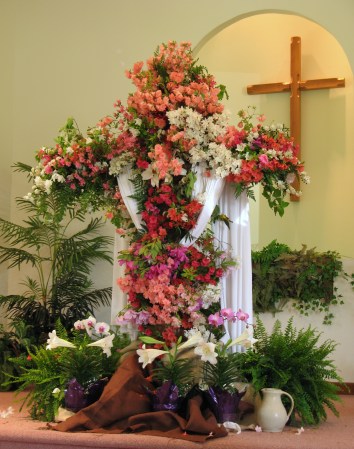
This morning at church we flowered the cross. It’s a tradition we’ve followed every Easter for many years and an act potent with symbolism: restoring the dead , heavy wood with the bright color and fragrance of spring. Our little family of Christ always celebrates this ritual with joy, laughter, a strengthening of our bonds to each other and our faith, but alas – this year winter ended early and Easter arrived so late. Would our gardens still hold flowers to share?

Most years by the end of worship the cross is replete with spring’s full spectrum: daffodils, tulips, hyacinths, even redbud and dogwood. And scent! On Saturday I clipped cuttings from the few azaleas that hadn’t already browned. Oh well. Make do. Such as it is.

Was it the rain we had Friday night? The cool mist Saturday morning and again today? Everyone arrived with azalea sprays bright and retaining all their freshness, every shade of pink, lavender, red, salmon. And now that we have sung and prayed and shared the message of the rock rolled back, now that we’ve each taken our turn in adorning the cross, I see a figure rise before me as I’ve never seen before.

The cross is not hidden by greenery and flowers. Not concealed. Not denied. It is enlarged, towering, perfected. More than a crucifix, it has become a presence with arms stretching out to me. To you. To any one who will see. An attitude of inviting – come, return here every time you need what you find here today. So often life is heavy, deadening. The time of blooming may seem to have passed without recognition or celebration. You may convince yourself you don’t deserve beauty; you don’t deserve renewal, forgiveness. Love. Remember this gesture and this moment – may you live each day in a house where all is good.

IMG_9793_crop

In the Valley of the Elwy
Gerard Manley Hopkins (1844-1889)

I remember a house where all were good
To me, God knows, deserving no such thing:
Comforting smell breathed at very entering,
Fetched fresh, as I suppose, off some sweet wood.
That cordial air made those kind people a hood
All over, as a bevy of eggs the mothering wing
Will, or mild nights the new morsels of Spring:
Why, it seemed of course; seemed of right it should.

Lovely the woods, waters, meadows, combes, vales,
All the air things wear that build this world of Wales;
Only the inmate does not correspond:
God, lover of souls, swaying considerate scales,
Complete thy creature dear O where it fails,
Being mighty a master, being a father and fond.

Read Full Post »

« Newer Posts - Older Posts »