Feeds:
Posts
Comments

Posts Tagged ‘nature’

Sometimes when the latest Audubon arrives in the post I dread reading it.  Unsustainable logging in old growth forests in Oregon threatens the marbled murrelet.  Ground water depletion by development in the San Pedro watershed (the major undammed river corridor in the entire intermountain West) may destroy twenty years of conservation gains.  American eel populations have declined ninety percent in the past four decades because of obstructing dams in Eastern rivers.

Does it ever seem to you that we humans just can’t get along with the other species on this planet?  The neighbors cats have eaten most of “my” house finches.  Just one careless chicken farmer upstream on the Big Elkin Creek is enough to silt up what could have been a decent trout stream.  Last week we had to replace about forty yards of sewer line on the steep ridge behind our house, plowing under at least a tenth of an acre of prime wild red raspberries.

I walked along the scraped red clay and exposed roots under the power lines down to the manhole where our sewer ties into the city.  Given the previously impenetrable briars, it was a new perspective on our little four-acre plot in the woods.  I hadn’t realized how massive that sentinel white oak had become in the thirty years we’ve lived here.  It has a Virginia Creeper hanging from it as thick as my arm.  And since the backhoe has knocked down a dozen or so gangly box elders, there’s enough sunlight seeping into our backyard that I’ve sown a pound of wildflower seed . . . after my daughter Margaret and I had picked about a pint of raspberries from canes we’d never been able to reach before.

In New England, a naturalist named Chris Bowser has set up a citizen stewardship program using net-filled PVC pipe to lift eels above the dams and enable them to complete their migration.  My friend Bill Blackley and a local crew are building hiking trails and restoring Big Elkin Creek to make it trout-worthy.  Virginia letter-carrier Rita Shultz has installed a hundred and ten bluebird houses along her route (in her time off) to prevent the birds from nesting in newspaper boxes, and prevent people from tossing out the nests, eggs, chicks and all.  And since February loggerhead turtles, piping plovers, least terns – and dozens of other nesting species – have a safer home on Hatteras Island: the National Park Service issued a new rule that allows off-road vehicles on 28 miles of shoreline, preserving the other 39 miles for wildness.

We might just get to go on living next door to critters.  We might just be able to pump from our hearts enough compassion for critters to make a place for them to go on living next door to us.

.     .     .     .     .
DSCN0523

Bubble

The heat hunkers trenchant, loud.
Lilies are budding on the lake.
Calf-high grass quivers.

He has wanted this moment to exist:
the insect flares blue on a sticky branch,
opening and closing, the size of his hands.

He heart pumps a bubble over the world:
it holds.

Mark Smith-Soto
© 1990 by Trans Verse Press.

.     .     .     .     .

DSCN5178

Mark Smith-Soto is professor of Spanish at UNC Greensboro and has been chairman of the Department of Romance Languages.  His poems appear frequently in the monthly magazine Sun.  He has served as editor or associate-editor of International Poetry Review since 1992.  His first full-length book of poetry, Our Lives Are Rivers , was published by Florida University Press in the summer of 2003.  Born in Washington, D.C., Mark grew up in his mother’s native Costa Rica.

.     .     .     .     .

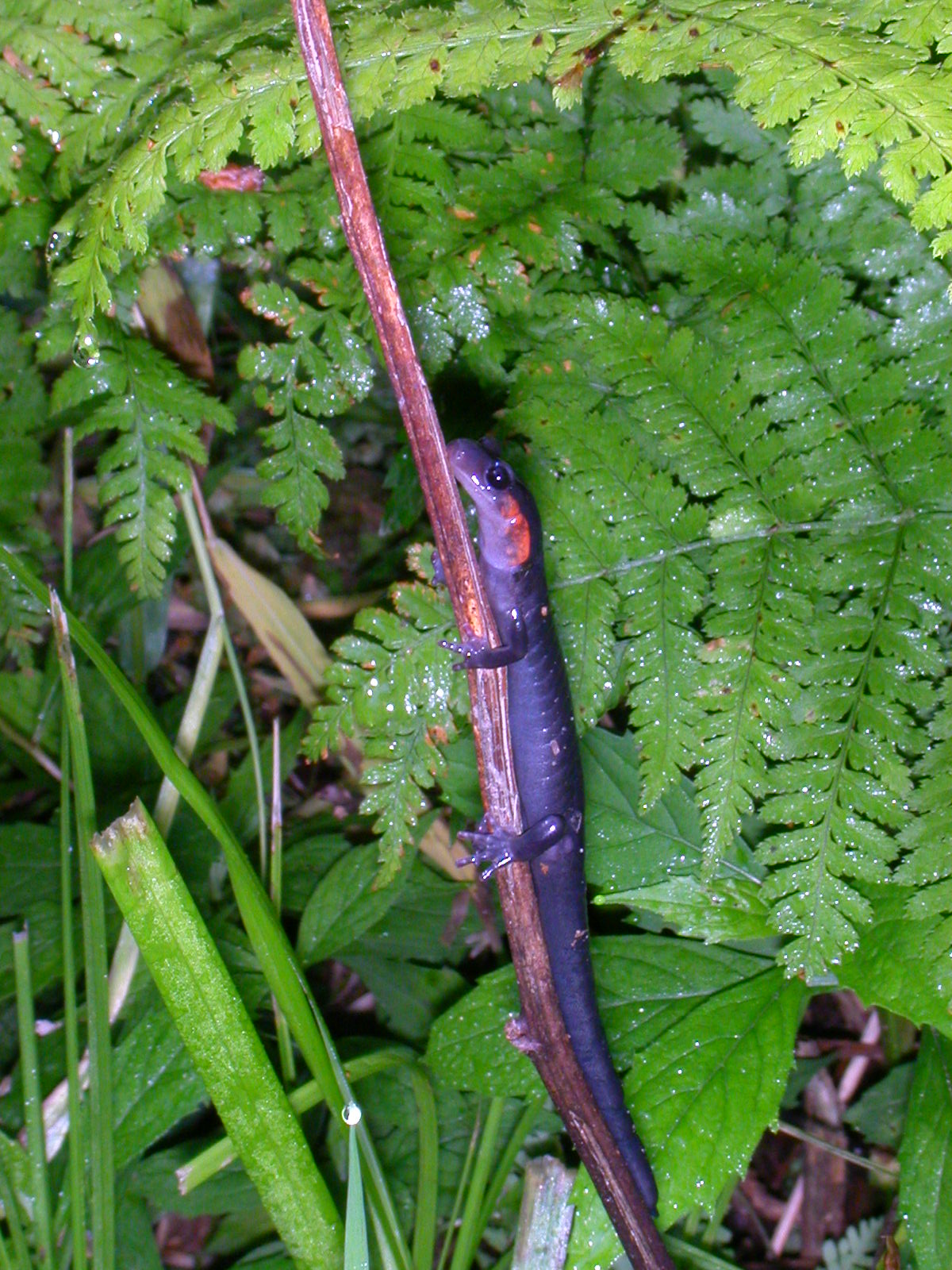
The photo of Jordan’s red-cheeked salamander (Plethodon jordani) was taken near Clingman’s Dome along the Appalachian Trail in 2003.  The cute little Appalachian cottontail (Sylvilagus obscurus) eating jewelweed beneath the stand of bee balm was at Cosby Knob Shelter on the AT (also GSMNP)  in 2007.
IMG_6432

Read Full Post »

June 1, 2012

This is Dan Lawler at Great Smoky Mountains National Park.  May I speak to Bill Griffin?

Hi, I’m Bill.

Listen, Bill, it’s about your back country permit.  You’re not going to be able to stay at Cosby Knob Shelter on June 9.

What is it? Too many hikers?

No, too much bear activity.  A bear tore up a couple of hikers’ . . . packs.  We’re closing the shelter for a month or two until he gets the message and moves on.  Those Cosby Creek bears – ha, ha – they give us problems every spring.

Ah . . . well . . . that’s fine.  I’m not all that fond of sleeping with bears.

IMG_2438

.     .     .     .     .

July 23, 2000

Today Mary Ellen and I embarked on the Great Sibling Bonding Adventure.  My sister and I spent a week backpacking the Appalachian Trail from Springer Mtn., GA to Deep Gap, NC, something shy of 100 miles.  Growing up separated in age by six years we never spent much time together, never had a lot in common.  Now we’re sweating up every steep ridge together, eating out of the same pot, sleeping in the same little tent.

Along the way we count the birds and name the wildflowers, and make up names if we don’t recognize them.  We make supper in pitch dark at Gooch Gap.  We make up funny songs (“Nothing Like a Log” to the tune of “Nothing Like a Dame”).  We make it to Muskrat Creek Shelter on our last night and celebrate Mary Ellen’s thirty-eleventh birthday with a stale cake I’ve stashed in my pack all week.  We make friends.

IMG_2465

.     .     .     .     .

June 8, 2012

Now it’s Friday morning and we’re cinching up our hip belts at Big Creek ranger station to head into the back country again.  Last month Mary Ellen called me and said she was overdue for some big brother quality time.  We broke out the trail maps and chose a non-old-guy-destructive three-day loop in GSMNP.  Since we’ve been shut out of Cosby Knob by the bears, we’ll hike 5 1/2 miles to Walnut Bottom and spend both nights there, Big Creek chuckling beside us.  On Saturday we’ll hike a ten-mile loop that takes us up to the AT and right past the bear-haunted trail shelter (and while we fill our bottles from the spring there we’ll keep whistling the entire time).

We’ll name every flower, tree and shrub — in twelve years damn if Mary Ellen hasn’t learned them all, right down to the Latin binomials.  After supper we’ll hang our food up high, and while dusk settles into Walnut Bottom we’ll sit on mossy creek boulders, sip mint tea with powdered milk, and wonder if the bears have discovered unattended dinners on the Tennessee side of the ridge.  Or if at this very moment they’re watching us from within the dog hobble and rhodies, just waiting for full dark . . .

.     .     .     .     .

Bear

If you hear me, it will be a nut falling
from the buckeye.  If you hear me,
it will be a dry branch
seeking earth,
it will be slender fingers
of mountain ash waving praises
to the ridgelined sky.

If you see me, it will be a shadow
only one breath deeper
than twilight.
If you see me, it will be the twist
of heart that skips
a beat, the stark
of pupils gone abruptly wide.

I am mist that enfolds the laurel.
I am stone that reclines beneath black hemlocks.
I am a rumor at Maddron Bald,
a tremor at Mt. Guyot.

Raven is mistaken – this Ridge is mine.

And if you hear me, it will be the rising chest
of the mountain and its timeless slow
exhale,
and if you hear me
it will only be because
I didn’t hear you first.

.     .     .     .     .

2000_H

IMG_2482

Afterword

In some twenty years of backpacking the Southern Appalachian mountains and Great Smokies, I’ve encounered a bear exactly once.  Mike Barnett and I were hiking without the noisy accompaniment of teenagers.  We’d set up camp one evening and I had walked back up the trail to spot some birds.  I’d been standing completely still for about twenty minutes, waiting for a Pileated Woodpecker I’d been hearing to show itself, when I heard a soft crack behind me.  I figured it was a buckeye falling.  Crack again.  I turned.  Slowly.  Twenty feet from me a large black mass with a pointed nose was staring towards camp where Mike was fixing supper.

And where did that happen?  Cosby Knob shelter.  That night I wrote the first draft of Bear in the AT log book and next morning left it in the shelter.

.     .     .     .     .

IMG_2490

and a p.s. . . .

Hey Sister — I’m looking closer at all the wildflower photos we took and I believe we saw BOTH lesser and greater purple fringed orchids!   (Platanthera psychodes and grandiflora).    —    your Bro

.     .     .     .     .

[Bear first appeared in the journal Cave Wall, and was the first poem I wrote in the collection Snake Den Ridge, a Bestiary (March Street Press, 2009.]

Bear Crop 02

IMG_7491

Read Full Post »

[for the first post in this series of four, see May 8]

Years ago, before I’d reached my fortieth birthday, I remember talking to a friend who was looking pretty darn glum about his fiftieth. “Oh come on,” I said, “Just think of it as the half-way point.” I couldn’t understand why that didn’t cheer him up. Now my own fiftieth has got dust and flyspecks on the binding, and apparently I still haven’t memorized its aphorisms. If it’s impossible, as must seem obvious to any rational being, to put right all the mistakes I’ve made, why do I keep looking back? Why do all the possible futures unfolding out of my particular Heisenbergian uncertainty seem to have edges of creeping tarnish?

In this second section of my poem Leave and Come Home, I am struggling with uncertainty. Will our future relationship, mine and my son’s, be bright as the Firethroat or remain out of reach? I think of my own Dad, turning 85 this year. So much of our communication in my younger years was subterranean, never quite reaching the surface. How much angst did I cause him with my long hair and Grateful Dead? (Some other day I’ll share about how Linda helped us re-learn how to hug.) So much I didn’t know about my father, and so long before it occurred to me that I didn’t.

DSCN4536

Several year’s ago Aunt Ellen (Dad’s sister) was going through boxes of papers from their parents’ home and discovered a letter Dad had written to his Mom from Boy Scout camp. He must have been thirteen. He had just passed the requirements to earn Birdwatching Merit Badge and was describing the birds he’d identified. Wait a minute! Big Momso is the bird watcher! You sneaky Dad, you, looking up into those branches all that time and never telling me what you were seeing. Well, I’m telling.

.  .  .  .  .

Leave and Come Home

Horseshoe Island, Newfound Lake, Boundary Waters Canoe Area Wilderness, Minnesota

Last night a pair of Bald Eagles scrawled their wild script
along the silver lake. We lay on high rocks above the water, waited
for the final stars of our adventure to ignite.
Only Hermit Thrush spoke – silence
unaccustomed from our Scouts but habitual
for Josh and me.

This morning I leave him to goad
the younger ones to break our last camp –
when he leaves for college will he goad himself?
I follow the island trails, aim field glasses high
as if the warblers I’ve learned this trip might bestow
some special unction. When I pause they gather
in low branches and cock their heads, a query
I can’t answer. They leave me there.

Almost finished now, this last solitude, this last trail that has tried
to lead back to my son, close enough to hear
the tink of scrubbed pots; high in the spruce
another unnamed voice reedy and ascending
into emptiness. I search, it flees; I scan, it eludes until
on a gray limb in the gray-green canopy with a gray moth
in its needle beak it blazes: Firethroat. Blackburnian Warbler.
And if I rush to camp and pull Josh back in time
will we look up and share the prize
or stare into empty branches?

.  .  .  .  .

[Leave and Come Home won the 2009 Poet Laureate Award of the NC Poetry Society. In four sections, it covers fifty some years of being a son and father to a son. Each section covers a different geography, the sighting of a different warbler, and a new phase in our relationship as a family. I posted section 1 on 5/8; I will post section 3 on 5/22 and section 4 on 5/29.]

.

.

Read Full Post »

« Newer Posts - Older Posts »