Feeds:
Posts
Comments

Posts Tagged ‘nature’

[with two poems by Malaika King Albrecht]

Charismatic Megafauna is what people hope to see when they visit Great Smoky Mountains National Park. If traffic barely creeps approaching Cades Cove there must be a black bear feeding near a pullout; if traffic stops altogether Mama has cubs. And if cars are pulled over for a mile along the prairie verge leading to Oconaluftee Visitor Center it means elk are grazing the pasture.

From the center lane I saw the big bull with six-foot rack and a harem of twenty and I slowed but I didn’t stop: the gate into Tremont would only be open from 4:00 to 5:00. It takes at least an hour up and over New Found Gap down to Sugarlands and on west into the Park. Fifteen of us will be arriving for a naturalist course on this final weekend in August, hoping to get personal with that other charismatic Kingdom – Plantae.

Lobelia cardinalis; Cardinal Flower; Campanulaceae

Trees, ferns, and flowers certainly draw many to the Smokies, if only for the deep summer shade and restorative air. Some people are even known to kneel. As winter unscrews her frozen vice we hurry to see ephemerals – trailing arbutus, hepatica, bloodroot. Then arrives the princess of spring’s reign, Trillium, including uncommon Catesby’s and Vasey’s. As we wind through the seasons we lust for phacelia, fringed orchids, lady’s slippers. But what about now at the tail end of summer?

Summer, the season of yellow: asters, wild sunflowers, goldenrod (19 species in the Park), but driving west on I-40 didn’t every weedy median present us with all these and more Asteraceae? Solid gold at 70 mph. Time to slow down. The hour for Latin and Linnaeus is after vespers with our books and guides. In this moment the growl of Harleys on Little River Road can’t penetrate the glade. The rumble of the river into its Sinks reaches us only as subsonic reassurance through our soles. All light has slipped bent drifted through tuliptree and hemlock to recline with us among shaggy green. We are crouched among the ferns.

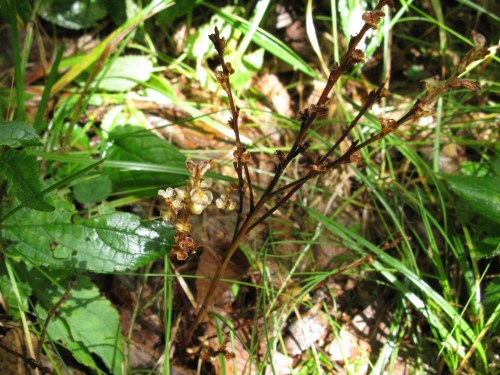
Botrychium dissectum; Common Grape Fern; Ophioglossaceae

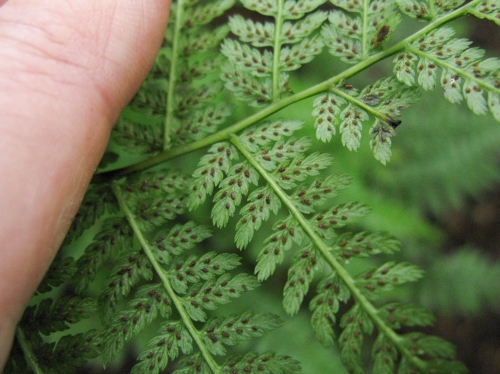
So many different kinds of ferns. Notice blade and stipe, dimensions and symmetries. We “frondle” them to read the hieroglyphics of their spores. We smell them. We struggle to know their names.

But here’s another fern-like frond, toothed and divided but with a tell-tale: a spike of yellow flowers like sequins in the wildwood. Lean closer. Five-petaled, many threads of stamens, Rose family. Agrimonia, harvestlice, swamp agrimony, but let us name it rose-among-the-ferns. Let us name ourselves sit-and-notice. Call us one-more-among-all-small-things. Look closely. Kneel. The least among the most is what we have come here to discover.

Agrimonia parviflora; Harvestlice Agrimony; Rosaceae

.     .     .     .     .     .     .

Before, during, and after my summer visit to Great Smoky Mountains Institute at Tremont I have been reading Malaika King Albrecht’s newest book of poetry, The Stumble Fields. If a work of art could be a facial expression her book would be a quiet, welcoming smile – the kind that lets you know she is about to share a great confidence. Her poems are revealing in the way sitting patiently in a quiet glade will gradually begin to reveal its true life.

And the spirit that often winds among her lines is, to me, that same spirit that leads us to desire to live truly in this world. Not to skip along its edges but to draw fully and be drawn deeply into it, discovering our selves as we discover the truths of our co-travelers. It is the naturalist urge – to find our connections at every stratum and station.

I am thankful to be connected to Malaika through her words.

.     .     .     .     .     .     .

Lactuca floridana; Florida Blue Lettuce; Asteraceae

Loftin Woods

I’ve wanted to be a single story,
so I could tell you a happy ending
but every breath’s different.
In these woods I’m lost enough
to notice but not lost enough to care.
I find my body when the barred owl
startles the air. I find
my body where white trillium
catches light. I find my body
in the music of cantering horses
singing to sky. Today I could fall
right through this fabric of grass.

.     .     .     .     .     .     .

Prunella vulgaris; Heall All; Lamiaceae

Silver Tangle of Brambles at Midnight

Late night you remember God’s first language
is silence. The space between heart beats,

the pause before someone says, Yes,
a brief moment before ebb becomes flow.

So you say, Fine. Don’t talk to me
like God’s a stubborn ghost.

You say, I’ll hear messages
whether you speak or not.

Every closed-door signals detour,
and each broken heart demands

sitting quietly for a time.

.     .     .     .     .     .     .

From The Stumble Fields, Malaika King Albrecht. Main Street Rag Publishing Company, Charlotte, North Carolina. © 2020.

Vernonia flaccidifolia; Tennessee Iron Weed; Asteraceae

.     .     .     .     .     .     .

IMG_0880


Read Full Post »

Let’s meet at Grandview above the New River Gorge while the sun is still working its way through the pine and bare hickory. The hardcore birders left from Shelter #4 hours ago but we will follow the same course down the abandoned mining road to the River. We will follow the wild flowers. We will walk into Spring.

We don’t see a lot blooming up here at the end of April, elevation 2,500 feet in the West Virginia Appalachians. Beneath the trees and in the sunny patches the landscape is still mostly brown, but that doesn’t hold for long. Trailing arbutus and trout lily greet us in the first quarter mile, wake robin and four more species of trillium pop up along the course of the trail, wild iris and asters appear by the time we’ve descended 1,000 feet to river’s edge – all of Spring blooming in one morning.

And just in case we miss something we have a guide: my wife’s sister Jodi French-Burr, National Park Service ranger, naturalist, and interpreter. She’ll be kneeling in the duff gently parting the leaves so we can see the wild ginger blossoms. She’ll have at the tip of her tongue the name of every growing thing we discover. She’ll tell us the history of this winding trail and point out relics and landmarks along the way. And she will usually laugh at my jokes.

Come and convince yourself that the earth is filled with beauty.

Bring water and a snack. RESERVATIONS requested by April 21, 2020: 304-465-2632 or jodi_french-burr@nps.gov.

[UPDATE 3/23/2020 — due to the COVID-19 Pandemic many NPS and New River Gorge activities may have to be canceled or rescheduled. Be sure the check this site for the latest info:

https://www.nps.gov/neri/planyourvisit/wildflower-weekend.htm

BUT . . . outdoor activities with family and small groups (maintaining your social distancing) are just what THIS doctor orders! Get out into nature! Viruses hate sunlight! . . . . . . . . Bill G  ]


Erythronium americana — Trout Lily (Dog-tooth Violet, yellow adder’s tongue, fawn lily)

.     .     .     .     .     .     .

Deborah H. Doolittle has created a unique botanical and poetic experience with her collection Floribunda, a true garden of verse. The focal point of each poem is a particular flower, from Cowslip to Gardenia, but the speaker or the style of each poem is a giant of literature, from William Blake and Lewis Carroll to Sylvia Plath and Wallace Stevens. To wander the garden path of Deborah’s poetry is to smell the fragrance and delight in the colors but also to abide in the company of great writers, Deborah H. Doolittle not the least of them. Open to any page and converse.

[all selections are from Floribunda, © Deborah H. Doolittle, Main Street Rag Publishing Company, 2017]

Hepatica americana — Round-lobed Hepatica

.     .     .     .     .     .     .

Emily Dickinson’s Wild Flowers

The way she dressed a flower was
just that extravagant.
The haute couture of wild flowers!
wild flowers! her element.

To that pale cheek she called petal,
she pressed both stem and leaf –
the lupine, like crinoline; sweet
clover, tight Damascus weave.

She had played the part of Botanist,
a child’s specialty.
Swamp candles shed no brighter light
in Latin for the bee.

Grasses of Parnassus, skullcap
of the tiny laces,
she pressed herself soft as a moth
treading through her pages.

Antennaria solitaria — Solitary Pussytoes

.     .     .     .     .     .     .

Henry David Thoreau and the Sunflower

Who among us has not followed the sun
and hated the clouds that hid its shining face?
Who else but us can claim that we have traced
across the sky the very path it runs?

We’ve traveled much through Concord, you and I.
The widest fields are fenced and most contain
cattle or corn or the stock of kitchen
gardens. The farmers never wonder why

your seeds proliferate upon their grounds.
I know how the wind blows the smallest crumb
and how the bees and birds know where to come.
The two of us, like them, know no such bounds.

The hedgerows and stonewalls can’t grow taller.
The sun is but a star and you’re its flower.

Sanguinaria canadensis — Bloodroot

.     .     .     .     .     .     .

Sylvia Plath and the Impatiens

Unlike my empty hands,
it does not just lie there
with its flowers opening

upon white bed linen.
All its seeds jettisoned,
its future guaranteed

for at least another
season, this jewel-weed,
asks for nothing that I

cannot give it. It basks
in my sunlight, breathes in
my exhalations as fast

as I can breathe them out,
again. Still, we are both
waiting for the nurses

to make their rounds, the sun
to rise up, then subside,
for the moon and the stars

to appear and disappear,
for winter’s frost to turn
us into limp black rags.

Asarum virginicum – Heart-leaf Ginger (Little Brown Jugs)

.     .     .     .     .     .     .

The other way to walk into Spring, although it takes a month or two, is to stroll along the same trail every day. Linda and I walk the Elkin Valley Trail Association Nature Trail along Big Elkin Creek at least three days a week. First appears trout lily, hepatica close behind, then every day or two there’s a new species in sequence: pussy-toes, wild ginger, bloodroot, rue anemone, star chickweed. In a month there will be foamflower, bellwort, jewel-weed, jack-in-the-pulpit. The photos in this post were all blooming on the same day, March 16, 2020.

Anemonella thalictroides — Rue Anemone

.     .     .     .     .     .     .

Deborah H. Doolittle moved from her birthplace in Hartford, Connecticutt through many different landscapes and gardens before settling in Jacksonville, North Carolina. She has an MA in Women’s Studies and and MFA in Creative Writing and teaches at Coastal Carolina Community College. She serves on the Board of the North Carolina Poetry Society and she loves flowers.

Stellaria pubera – Star Chickweed

.     .     .     .     .     .     .

IMG_0880

Read Full Post »

[After the fashion of Ralph Waldo Emerson, with apologies; and also with admiration and gratitude to Emily Stein, educator, naturalist, and instructor who prompted, “Make me care about an apple.”]

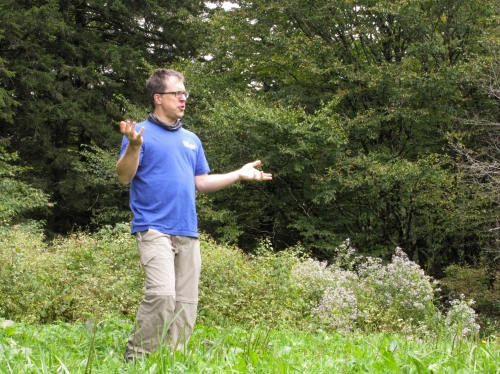
Behold! [the speaker lifts high in his right hand a bright green globe] Behold . . . the unnamed spheroid before us, orb, minor planetoid, imperfect representation of 4/3 π r3. What shall we call it? What is it?!

Is it Creature? Shall it pick itself up, scuttle about of its own motivation, turn itself ‘round to display its obverse hemisphere presently concealed from our vision?

Is it Mineral, thus created and apportioned and ever so to remain for millennia save it be worked and reworked by wind, water, the abrasion of ever degrading time?

Or is it perhaps . . . Vegetable, and now a revelation of its true nature leaps into my consciousness: is it not Fruit? May we not so surmise when we detect the telltale declivity at its northern pole from whose depth protrudes a brown and spiraled worm so very like a stem? YES, its roundiness, its gloss, its green green GREEN sings life and liveliness, living fruit, fresh, taut, shiny, reflecting what meager light may penetrate these benighted chambers to inspire our minds even as we are inspired by the light of our own great yellow star.

That star which nurtures us has also nurtured our green fruit’s life and growth to this size, this heft, wide in diameter as my four fingers, rounder in circumference than my fist can grasp. Firm and solid it appears, clean and whole, but upon finer inspection decorated with speckles and freckles, minute specks not blemishes but marks of its natural beauty, painted by creation to elevate our perception that Beauty and Truth and even Life itself are not ideal forms that reside solely in the imaginings of philosophers but are real, here before us, weighty, textured, worthy of adulation with all their variations and imperfections, with all their uncertainties, with all our own doubts about how to discover them and what to name them.

But what is Life that we should esteem it so? Life is bruises when we fall. If you prick us, do we not bleed? Life is clamor and confusion that fill the senses to bursting, sight and sound and scent sometimes sweet but oftentimes so foul. Can you convince me that Life is not suffering? Days and years unremitting even such that some might in despair willingly choose to forsake their life?

And yet . . . and yet, where can suffering prevail when we, my fellows, stand together? Where can the horror of decay and decrepitude persist when there is yet Beauty in the world?

Look again upon my treasure’s smiling green visage! Look to the living green that buds and swells and streams through hills and valleys where Life insists it must return to the gray and blasted earth. Look to the green water that calls down from the rocky slopes lithe creatures that hop and slither and find each other, there emphatically to declare their confidence in Life as we discover the motile forms of tadpole and eft.

Look, my friends, into your own hearts and discover there some fresh green shoot arising, a green hope that may yet draw you anew into this day of wonder, a hope that may, my friends, just may [here the speaker bites into the green apple] may taste this sweet! This is what I choose and this is what I treasure – this Life.

I care not what you name my green friend here – seed pod, drupe, jampot, pie bait, cider berry. I name it LIFE. And this rose by any other name would smell as sweet.

.     .     .     .     .     .     .

Mitchella repens – Partridge Berry

This essay was prepared as an oral class presentation for “Skills for Sharing Nature,” Southern Appalachian Naturalist Certification Program, Great Smokies Institute at Tremont, February 23, 2020.

.

Thinking, for Emerson, was not the contemplation of final Truth, but the daily encounter of an active mind with its environment; it was not a special activity but life itself.

Stephen E Whicher, editor
Selections from Ralph Waldo Emerson, Houghton Mifflin, © 1957

.     .     .     .     .     .     .

Apple, genus Malus, is the largest fruit in the family Rosaceae, which also includes plums, pears, cherries, apricots, peaches, quince, blackberries, strawberries, raspberries, almonds, rowan, hawthorne and . . . roses.

.     .     .     .     .     .     .

Viola rostrata – Beaked Violet or Longspurred Violet

The Rhodora
On Being Asked, Whence is the Flower?

In May, when sea-winds pierced our solitudes,
I found the fresh Rhodora in the woods,
Spreading its leafless blooms in a damp nook,
To please the desert and the sluggish brook.
The purple petals, fallen in the pool,
Mad e the black water with their beauty gay;
Her might the red-bird come his plumes to cool,
And court the flower that cheapens his array.
Rhodora! if the sages ask they why
This charm is wasted on the earth and sky,
Tell them, dear, that if eyes were made for seeing,
Then Beauty is its own excuse for being:
Why thou wert there, O rival of the rose!
I never thought to ask, I never knew:
But, in my simple ignorance suppose
The self-same Power that brought me there brought you.

Ralph Waldo Emerson, 1839

.     .     .     .     .     .     .

Middle Prong Little River

The Apology

Think me not unkind and rude
That I walk alone in grove and glen;
I go to the god of the wood
To fetch his word to men.

Tax not my sloth that I
Fold my arms beside the brook;
Each cloud that floated in the sky
Writes a letter in my book.

Chide me not, laborious band,
For the idle flowers I brought;
Every aster in my hand
Goes home loaded with a thought.

There was never mystery
But ‘tis figured in the flowers;
Was never secret history
But birds tell it in the bowers.

One harvest from thy field
Homeward brought the oxen strong;
A second crop thine acres yield,
Which I gather in a song.

Ralph Waldo Emerson, 1846

.     .     .     .     .     .     .

Gyrinophilus porphyriticus -spring salamander

The Southern Appalachian Naturalist Certification Program is administered by Great Smokies Institute at Tremont within Great Smoky Mountains National Park (near Townsend, Tennessee) and offers weekend intensive programs towards a certificate from the University of Tennessee. More information at www.gsmit.org

.     .     .     .     .     .     .


.     .     .     .     .     .     .

IMG_0877

Read Full Post »

« Newer Posts - Older Posts »