
.
[With poetry by Joy Harjo and Wendell Berry]
.
For Calling the Spirit Back from Wandering the Earth in Its Human Feet
.
Put down that bag of potato chips, that white bread, that bottle of pop.
.
Turn off that cellphone, computer, and remote control.
.
Open the door, then close it behind you.
.
Take a breath offered by friendly winds. They travel the earth gathering essences of plants to clean.
.
Give it back with gratitude.
.
If you sing it will give your spirit lift to fly to the stars’ ears and back.
.
Acknowledge this earth who has cared for you since you were a dream planting itself precisely within your parents’ desire.
.
Let your moccasin feet take you to the encampment of the guardians who have known you before time, who will be there after time. They sit before the fire that has been there without time.
.
Let the earth stabilize your postcolonial insecure jitters.
.
Be respectful of the small insects, birds and animal people who accompany you.
Ask their forgiveness for the harm we humans have brought down upon them.
.
Don’t worry.
The heart knows the way though there may be high-rises, interstates, checkpoints, armed soldiers, massacres, wars, and those who will despise you because they despise themselves.
.
The journey might take you a few hours, a day, a year, a few years, a hundred, a thousand or even more.
.
Watch your mind. Without training it might run away and leave your heart for the immense human feast set by the thieves of time.
.
Do not hold regrets.
.
When you find your way to the circle, to the fire kept burning by the keepers of your soul, you will be welcomed.
.
You must clean yourself with cedar, sage, or other healing plant.
.
Cut the ties you have to failure and shame.
.
Let go the pain you are holding in your mind, your shoulders, your heart, all the way to your feet. Let go the pain of your ancestors to make way for those who are heading in our direction.
.
Ask for forgiveness.
.
Call upon the help of those who love you. These helpers take many forms: animal, element, bird, angel, saint, stone, or ancestor.
.
Call your spirit back. It may be caught in corners and creases of shame, judgment, and human abuse.
.
You must call in a way that your spirit will want to return.
.
Speak to it as you would to a beloved child.
.
Welcome your spirit back from its wandering. It may return in pieces, in tatters. Gather them together. They will be happy to be found after being lost for so long.
.
Your spirit will need to sleep awhile after it is bathed and given clean clothes.
.
Now you can have a party. Invite everyone you know who loves and supports you. Keep room for those who have no place else to go.
.
Make a giveaway, and remember, keep the speeches short.
.
Then, you must do this: help the next person find their way through the dark.
.
Joy Harjo
from Conflict Resolution for Holy Beings by Joy Harjo. Copyright © 2015 by Joy Harjo.
.
❦ ❦ ❦
.
[Great Smoky Mountains National Park bids Bill farewell during the last moments of the Tremont Writers’ Conference:]
.
Goodbye, Love. Thanks for dropping by. This is your last chance to slurp up the prompts you were thinking you might be handed while you’re here. Your last opportunity to be inspired. Which means what, exactly? Inspire, breathe in, be filled with spirit. But did you think I’d tip you up like a funnel and just pour right down? Think back to that little exercise in your application and cull one word – community. This is something I know all about, I the Queen of Connections, I the web of interactions, whether in a gram of soil beneath your feet or spanning the entire watershed of this Middle Prong that flows past you right now – community.
.
I’m more than willing to speak. I live to show myself to you. Take a closer look at my image in that postcard and read the fine print: International Biosphere Reserve. But did you notice how small those letters are compared to the beech and oak overtowering? The subtext is, you don’t have to be such a geek about it. Oh sure, learn my names, my histories, my ecologies, but please, for at least one moment, forget about words on paper, Human Person, and just look around you.
.
Right around you – seven faces peering back (eight, if you count Jeremy arriving with the coffee delivery). What have you found here, and what will you keep? It’s more than friendship, it’s more than a shared task and a common goal. It’s connection. Don’t drop it. Don’t lose it. And what I’m really saying is . . . See you later!
.
.
❦
.
More than a week has passed and I’m straining hard to hear the Middle Prong. Where has that connection flown? What was the sound of that beckoning? Have I traveled too far beyond its reach, too many highway miles, too many turnings within?
.
Here I am surrounded by books and papers, electronics and plastics, literally surrounded: Amelia says, “Your office is a big mess, Pappy.” Surrounded and cumbered by the “should’s” and “got to’s” that no doubt fill your world as well. First phone calls of the day: a change in tomorrow’s doctor appointments for Mom and Dad; on hold and digital assistant waiting for their financial manager; negotiating the week’s schedule. If only the tinnitus I constantly live with sounded more like wind in the pines and rushing water.
.
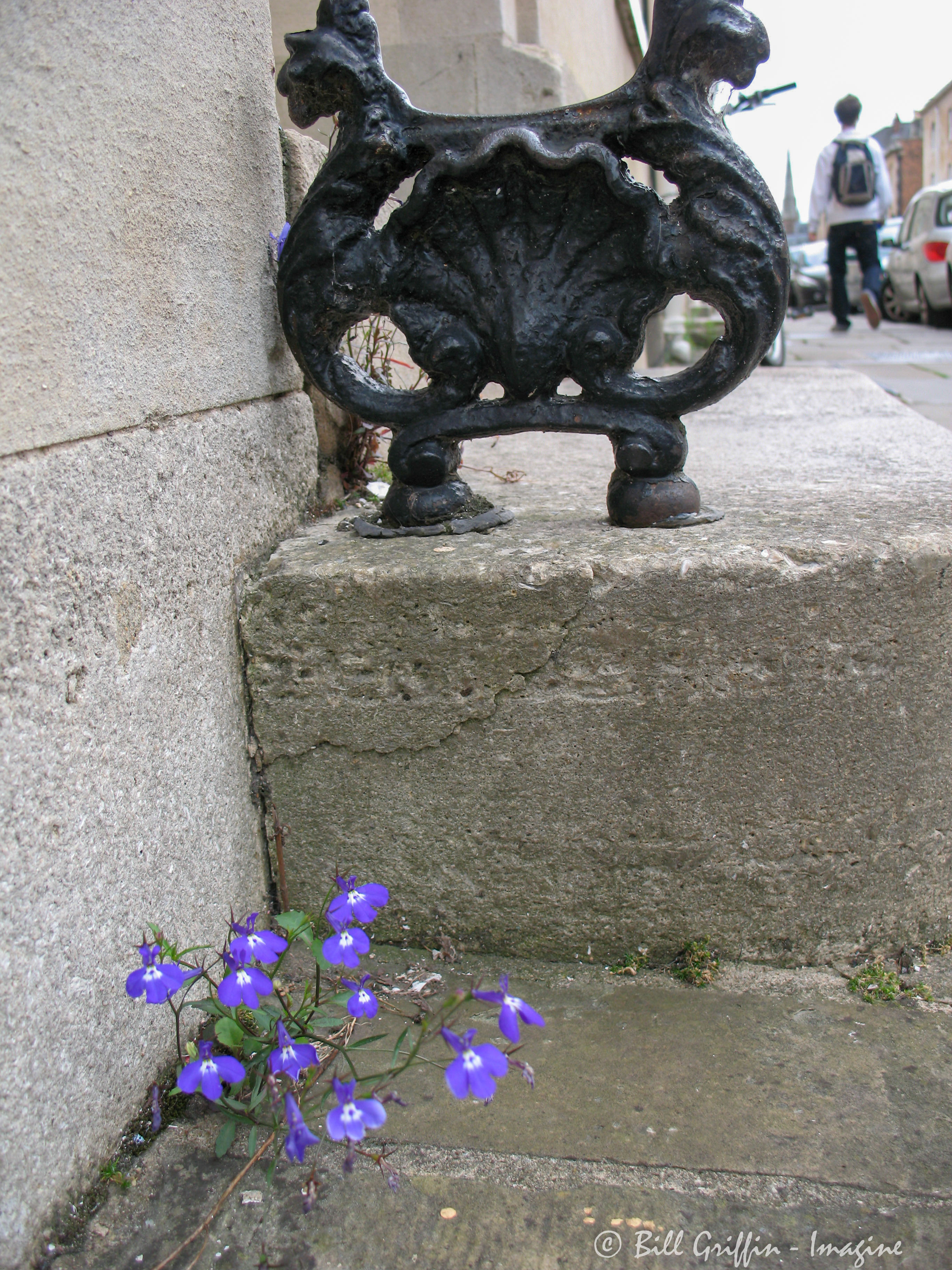
But right now a female cardinal is craning to reach the suet feeder I’ve hidden in the center of the holly outside my window. In an hour, Linda and I will take our first walk together on a new little sprig of MST I helped work on this month. I am rich in these connections and many more. I grieve for those who don’t experience community. Who walk past the little purple flower sprouted through the concrete and never see it. Who feel mostly alienation and suspicion for the human beings around them, much less the non-bipedal creatures. Who cut themselves off from the voice of wind that wants to fill them and let them breathe deep. Philosophers and poets write heavy volumes about the sickness in our human spirits when we separate ourselves from the earth. What is our reply?
.
Perhaps this Voice is saying, “C’mon, little Man. You know some folks who need to hear me. Spin a few connections!” See you later. See you now!
.
❦ ❦ ❦
.

.
.
❦ ❦ ❦
.
Manifesto: The Mad Farmer Liberation Front
.
Love the quick profit, the annual raise,
vacation with pay. Want more
of everything ready-made. Be afraid
to know your neighbors and to die.
And you will have a window in your head.
Not even your future will be a mystery
anymore. Your mind will be punched in a card
and shut away in a little drawer.
When they want you to buy something
they will call you. When they want you
to die for profit they will let you know.
So, friends, every day do something
that won’t compute. Love the Lord.
Love the world. Work for nothing.
Take all that you have and be poor.
Love someone who does not deserve it.
Denounce the government and embrace
the flag. Hope to live in that free
republic for which it stands.
Give your approval to all you cannot
understand. Praise ignorance, for what man
has not encountered he has not destroyed.
Ask the questions that have no answers.
Invest in the millennium. Plant sequoias.
Say that your main crop is the forest
that you did not plant,
that you will not live to harvest.
Say that the leaves are harvested
when they have rotted into the mold.
Call that profit. Prophesy such returns.
Put your faith in the two inches of humus
that will build under the trees
every thousand years.
Listen to carrion — put your ear
close, and hear the faint chattering
of the songs that are to come.
Expect the end of the world. Laugh.
Laughter is immeasurable. Be joyful
though you have considered all the facts.
So long as women do not go cheap
for power, please women more than men.
Ask yourself: Will this satisfy
a woman satisfied to bear a child?
Will this disturb the sleep
of a woman near to giving birth?
Go with your love to the fields.
Lie easy in the shade. Rest your head
in her lap. Swear allegiance
to what is nighest your thoughts.
As soon as the generals and the politicos
can predict the motions of your mind,
lose it. Leave it as a sign
to mark the false trail, the way
you didn’t go. Be like the fox
who makes more tracks than necessary,
some in the wrong direction.
Practice resurrection.
.
Wendell Berry
Copyright © 1971, 1972, 1973 by Wendell Berry. Excerpted from The Country of Marriage. Reprinted in THE SUN June, 2014
.
.
❦ ❦ ❦
.
Today’s poems were offered as direction for meditation while visiting our “secret spots” during several days at Great Smoky Mountains Institute at Tremont. Any program at Tremont always includes space for quiet reflection while outdoors in nature, whether your secret spot is halfway up the Lumber Ridge Trail or a big smooth rock beside the Little River.
.
Joy Harjo (born 1951) was appointed the new United States poet laureate in 2019. Born in Tulsa, Oklahoma, in 1951, Harjo is a member of the Mvskoke/Creek Nation. She is the author of several books of poetry, including An American Sunrise, (W. W. Norton, 2019), and Conflict Resolution for Holy Beings (W. W. Norton, 2015). She is a current Chancellor of the Academy of American Poets and lives in Tulsa, Oklahoma.
.
Wendell Berry (born 1934) is an American novelist, poet, essayist, environmental activist, cultural critic, and farmer. He is an elected member of the Fellowship of Southern Writers and a recipient of The National Humanities Medal, along with many other awards and honors. On January 28, 2015, he became the first living writer to be inducted into the Kentucky Writers Hall of Fame.
.
❦ ❦ ❦
.

. .
❦ ❦ ❦
.





Thanks Jenny. Glad you liked this visit to the archives. Kathryn Byer brought incredible riches to NC poetry. --B