Feeds:
Posts
Comments

Posts Tagged ‘Mary Oliver’

 . 
[with 3 poems from The Ecopoetry Anthology]
 . 
First Verse
 . 
I admit the world remains almost beautiful.
The dung beetles snap on their iridescent jackets
despite the canine holiness of the Vatican
and, despite the great predatory surge of industry,
two human hands still mate like butterflies
when buttoning a shirt.
++++++++++++++++ Some mornings
I take myself away from the television
and go outside where the only news comes
as fresh air folding over the houses.
And I feel glad for an hour in which race
and power and all the momentum of history
add up to nothing
 . 
As if from all the mad grinding
in my brain, a single blue lily had grown –
my skull open like a lake. I can hear
an insect sawing itself into what must be
a kind of speech.
++++++++++++ I know there is little
mercy to be found among us, that we have
already agreed to go down fighting, but
I should be more amazed: look
at the blood and guess who’s holding
the knives. Shouldn’t we be more
amazed? Doesn’t the view
just blister your eyes?
 . 
To have come this long way, to stand
on two legs, to be ++ not tarantulas
or chimpanzees ++ but soldiers of our own
dim-witted enslavement. To utterly miss the door
to the enchanted palace. To see myself
coined into a stutter. To allow the money
to brand us ++ and the believers
to blindfold our lives.
+++++++++++++++ In the name
of what? If that old book was true
the first verse would say ++ Embrace
 . 
the world. ++ Be friendly. ++ The forests
are glad you breathe.
 . 
I see now
The Earth itself does have a face.
If it could say I ++ it would
plead with the universe, the way
dinosaurs once growled
at the stars.
++++++++ It’s like
the road behind us is stolen
completely ++ so the future can
never arrive. So, look at this: look
what we’ve done. With all
we knew.
With all we knew
that we knew.
 . 
Tim Seibles
from The Ecopoetry Anthology, edited by Ann Fisher Wirth and Laura-Gray Street; Trinity University Press, San Antonio, TX; © 2020
 . 
❦ ❦ ❦
 . 
I bend to pinch off a few stems as I walk down the drive beside the school. What is this tiny blossom? Four petals no bigger than a sliver of fingernail, lavender, pointed and neat. Whorl of slender leaves. Poking up through asphalt where it hugs the brick wall. I finger the hand lens in my pocket.
 . 
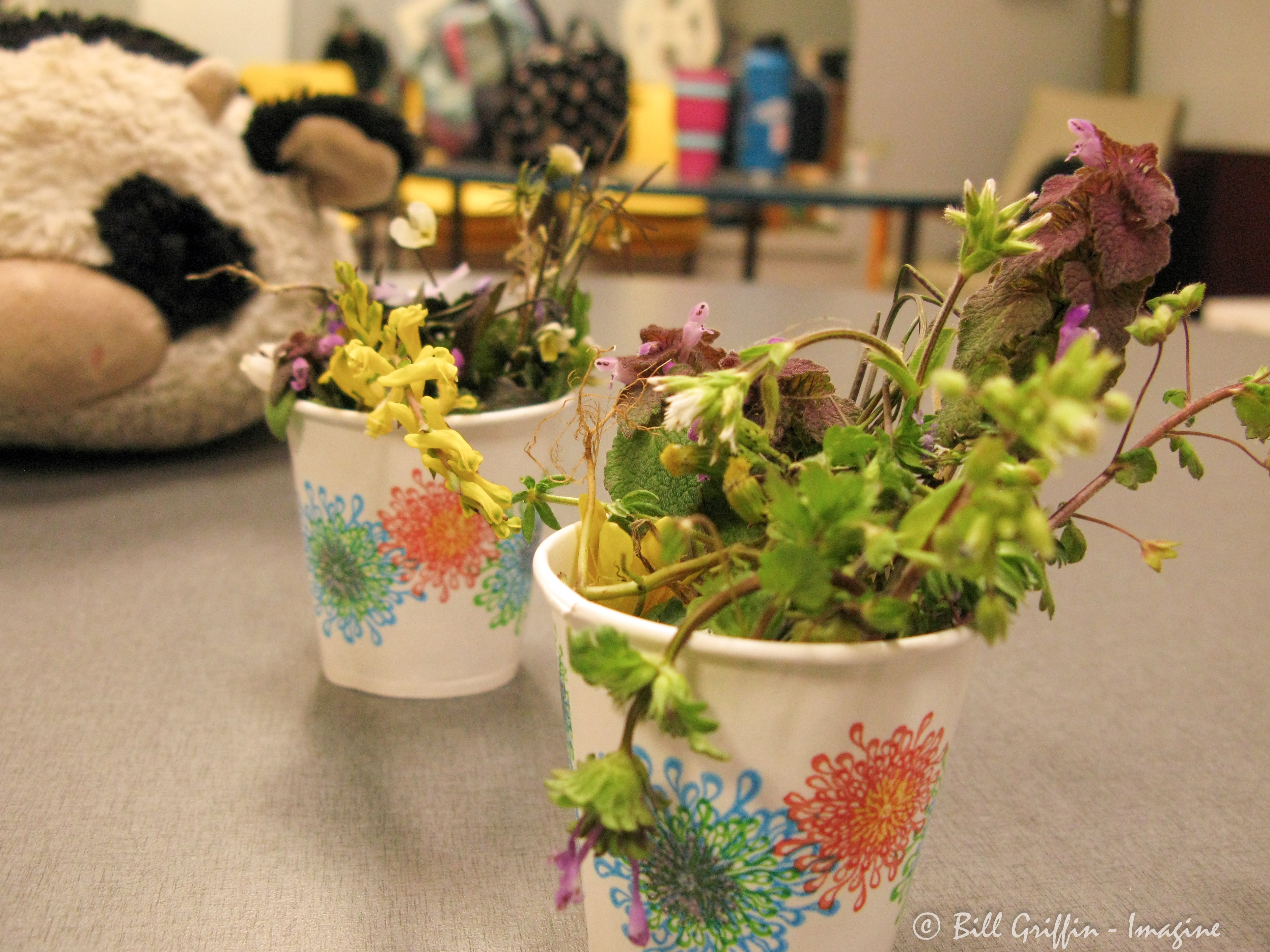
By the time I reach the ball field where the middle schoolers are at recess, I’ve gathered a mini-bouquet of the usual suspects: blue violets, henbit, deadnettle, bittercress. Their teacher turns them over to me and I lay out the plan, an hour and a half of Science Friday. Each takes their little paper cup and we spread out. The neglected. The overlooked. The beautiful in their own tiny tiny way – these are our quarry.
 . 
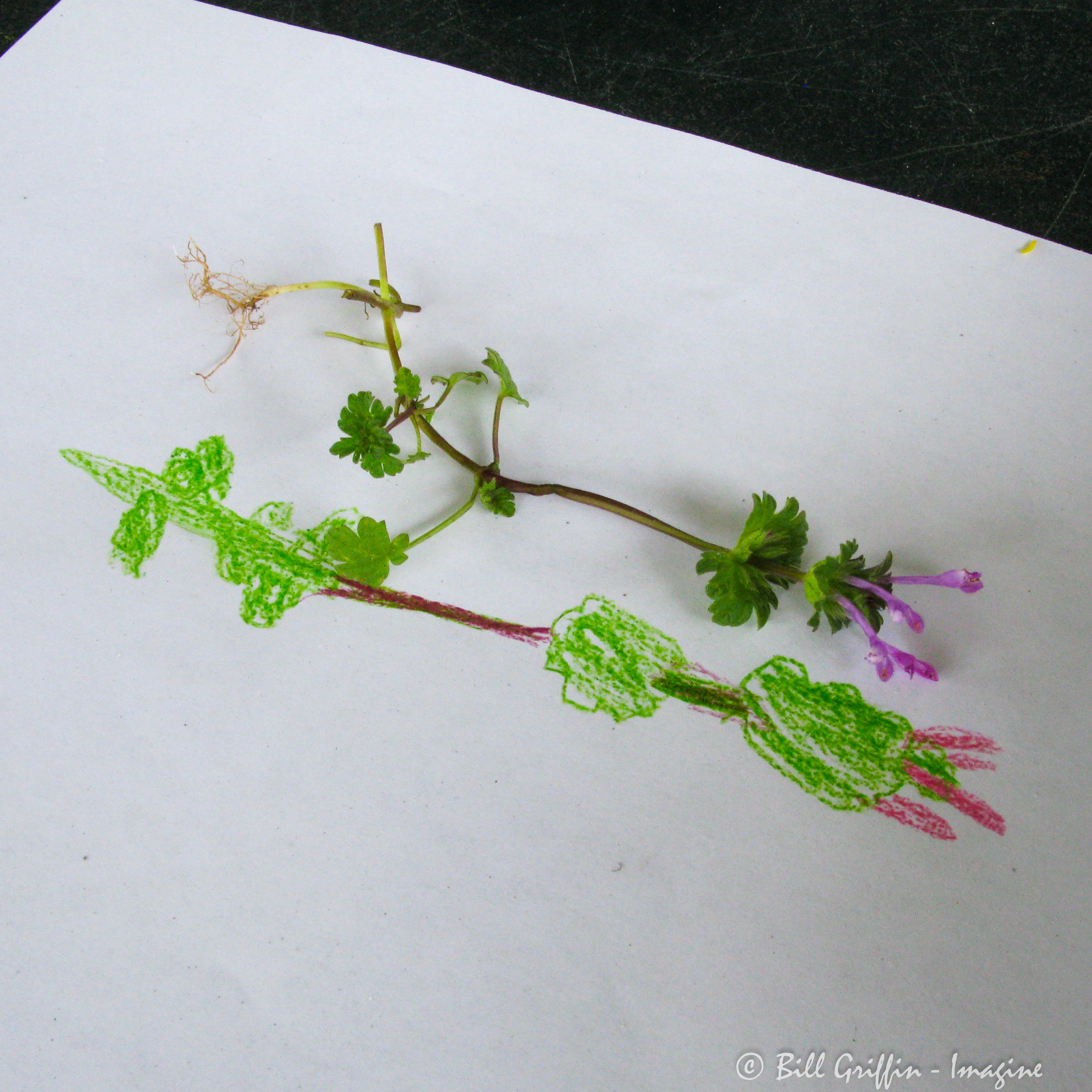
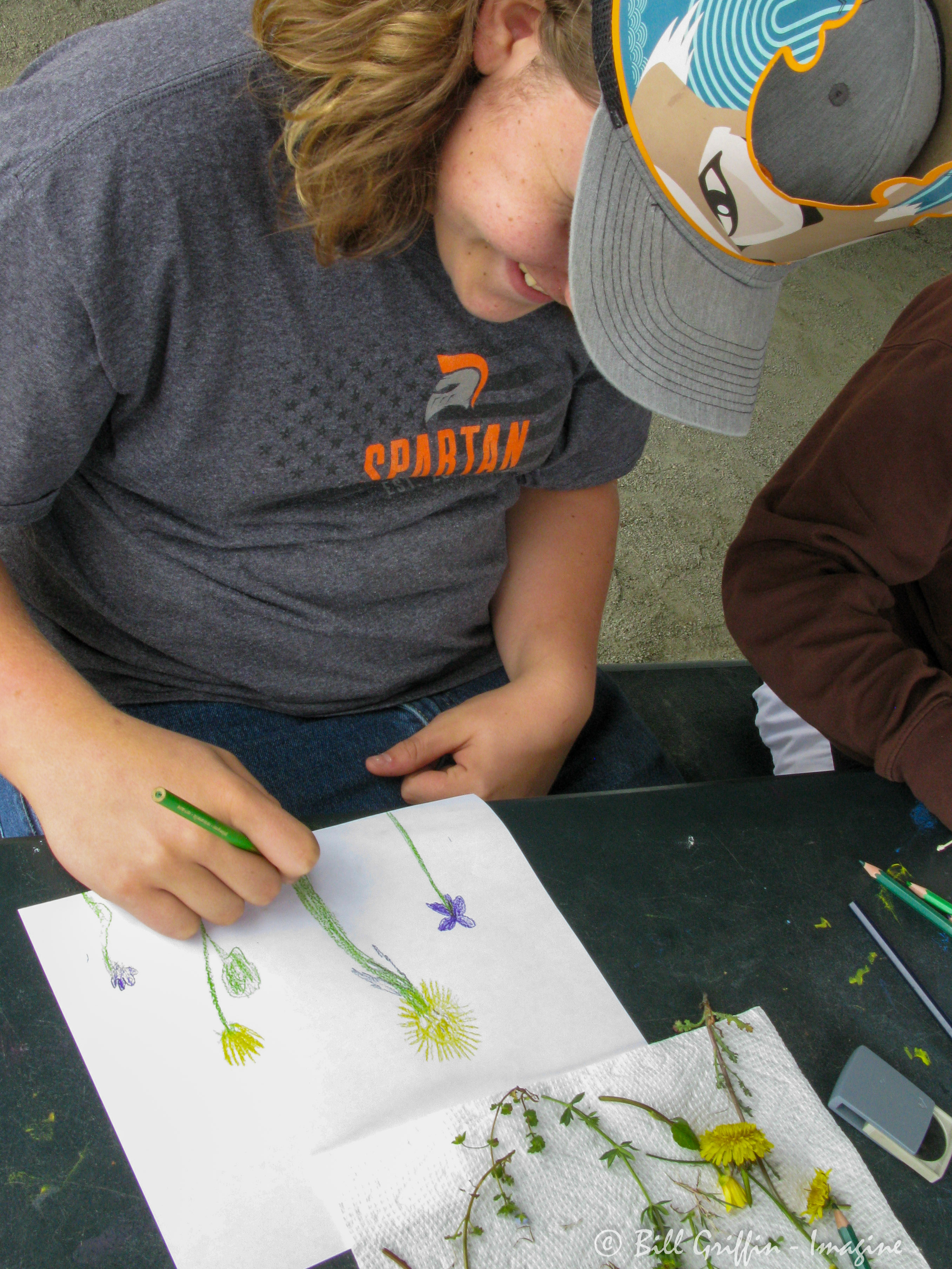
Sure, most folks would say we’re gathering weeds, and in a minute we’ll discuss that word, “weed,” something growing where it isn’t wanted. For now we scour the waste places, along the storage shed and storm fence, within the winter-brown kudzu invading from the ditch. Their cups fill up with yellow, pink, lavender, blue. After half an hour we sit down at the picnic tables behind the school; I pass around magnifying glasses and ask them to draw a tiny tiny flower as large as they can make it. And they do!
 . 
Are these kids listening while I talk about taxonomy and plant families, about native versus introduced, about flower anatomy of the little mints and asters we’ve discovered? Whether they are or not, I’m pretty confident that there will be days in the future when they look down at their feet and notice something they never paid attention to before.
 . 
It becomes a habit, this paying attention. I can’t not see them now. These tiny tiny flowers are not in my lawn – they are my lawn. OK, sometimes I pull up the mock strawberry and the bittercress when they crowd my “flowers,” and I do dig dandelions out of the front walk, but I’ll not curse them for their tenacity. Instead, I’ll do my best not to make them feel unwanted. I’ll resist the impulse to call them weeds.
 . 
 . 
 . 
Here’s what you’d discover in the mini-bouquet from our paper cups:
 . 
Henbit +++++ Lamia amplexicaule
Deadnettle +++++ Lamia purpurea
Creeping Charlie +++++ Glechoma hederacea
Common Blue Violet +++++ Viola sororia
American Field Pansy +++++ Viola bicolor
Common Dandelion +++++ Taraxacum officinale
Common Groundsel +++++ Senecio vulgaris
Hairy Bittercress +++++ Cardamine hirsuta
Smallflower Fumewort +++++ Corydalis micantha
Yellow Fumewort +++++ Corydalis flavula
Cut-leaved Crane’s-bill +++++ Geranium dissectum
Early Buttercup +++++ Ranunculus fascicularis
Mock Strawberry +++++ Potentilla indica
Common Chickweed +++++ Stellaria media
 . 
And my tiny tiny lavender blossom, the one you wouldn’t even notice for a flower within its handful of green if you hadn’t knelt before it?
Field Madder +++++ Sherardia arvensis
A member of the same family as my all time favorite plant genus, Coffea.
 . 
 . ❦ ❦ ❦
 . 
Scilla
 . 
Not I, you idiot, not self, but we, we – waves
of sky blue like
a critique of heaven: why
do you treasure your voice
when to be one thing
is to be next to nothing?
Why do you look up? To hear
an echo like the voice
of god? You are all the same to us,
solitary, standing above us, planning
 . 
your silly lives: you go
where you ware sent, like all things,
where the wind plants you,
one or another of you forever
looking down and seeing some image
of water, and hearing what? Waves,
and over waves, birds singing.
 . 
Louise Glück
from The Ecopoetry Anthology, edited by Ann Fisher Wirth and Laura-Gray Street; Trinity University Press, San Antonio, TX; © 2020
Scilla, in English also called Squill, is a genus of bulb-forming lily-like flowers that spread in a carpet of blossoms.
 . 
❦ ❦ ❦
 . 
The Lilies Break Open Over the Dark Water
 . 
Inside
+ that mud-hive, that gas sponge,
+ + that reeking
+ + + leaf yard, that rippling
 . 
dream-bowl, the leeches’
+ flecked and swirling
+ + broth of life, as rich
+ + + as Babylon,
 . 
the fists crack
+ open and the wands
+ + of the lilies
+ + + quicken, they rise
 . 
like pale poles
+ with their wrapped beaks of lace;
+ + one day
+ + + they tear the surface,
 . 
the next they break open
+ over the dark water.
+ + And there you are,
+ + + on the shore,
 . 
fitful and thoughtful, trying
+ to attach them to an idea –
+ + some news of your own life.
+ + + But the lilies
 . 
are slippery and wild – they are
+ devoid of meaning, they are
+ + simply doing,
+ + + from the deepest
 . 
spurs of their being,
+ what they are impelled to do
+ + every summer.
+ + + And so, dear sorrow, are you.
 . 
Mary Oliver
from The Ecopoetry Anthology, edited by Ann Fisher Wirth and Laura-Gray Street; Trinity University Press, San Antonio, TX; © 2020
 . 
 . 
❦ ❦ ❦
 . 
Tim Seibles (b. 1955) has received fellowships from the National Endowment for the Arts; he teaches at Old Dominion University and in the Stonecoast MFA program, and leads workshops for the Cave Canem Foundation. First Verse appears in Buffalo Head Solos.
Louise Glück (1943-2023) received the Pulitzer Prize for The Wild Iris (1993), in which Scilla appears and won the 2020 Nobel Prize in Literature. She served as US Poet Laureate 2003-2004.
Mary Oliver (1935-2019) received the Pulitzer Prize for American Primitive (1984) and the National Book Award for New and Selected Poems (1992), in which The Lilies Break Open Over the Dark Water appears.
 . 
More about Trinity University Press and The Ecopoetry Anthology HERE
 . 
❦ ❦ ❦
 . 
 . 
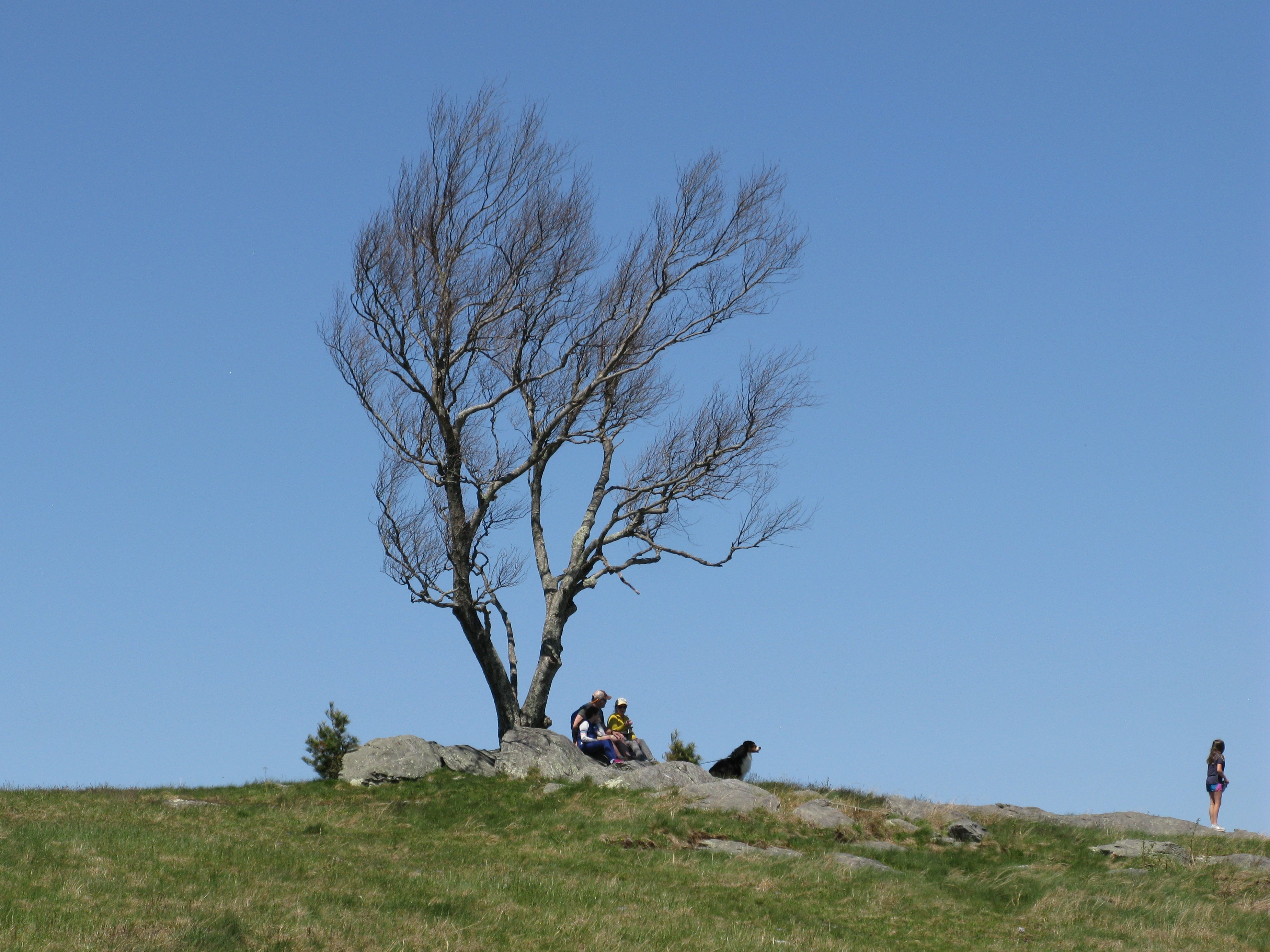
Doughton Park Tree -- 5/1/2021

Read Full Post »

[New Year’s Eve, poems by Mary Oliver and Jane Mead]

“Are spirits’ lives so short?” asked Scrooge.
“My life upon this globe is very brief,” replied the Ghost. “It ends to-night.”

The worm Ouroboros eats its tail, every day renewed, ever renewing. Cycles unending. The Neuse River snakes to New Bern, clouds lift inland, each little feeder stream is filled. Rain, ice, lichen eat the stone, phosphate creeps its migration through generations: rock to soil, leaf to masticator, herbivore to predator and all decomposing back to soil. I breathe out what the tree breathes in and breathes out for me to breathe. And the cycle we mark today: the dying Year gives birth to the New.

So many cycles. One enormous round. Every thing connected, interconnected, and we sense ourselves as spokes of the wheel or sometimes the never-ceasing motion of its rim that grinds along the path that is our life. As daylight diminishes it grows harder to hold onto our imagining of that wheel, its endless turning, that path it pursues still stretching on beyond the horizon. Harder to hold onto hope that the path’s end is indeterminate and out of sight.

Yes, it grows harder in these years of death’s overwhelming harvest to push aside imagining our own death. Too many deaths, COVID and otherwise, to pay attention; too many deaths to ignore a single one. In a few minutes I’ll set this page aside when my son arrives. He’ll leave Amelia here while the rest of the family attends their next-door neighbor’s funeral. A sudden death – our friend M was not old or ill. A shock to the fragile wall we build around our own mortality. Linda and I find ourselves tallying all the deaths that have touched us this month. The man who fixes our cars. A friend’s best friend. Names and faces more than we ever expect, doesn’t it seem? Death hunches at our shoulder, sometimes intrusive, sometimes silently lingering, sometimes perched like a moth that’s invisible until it flies into our face.

Tonight at midnight we will celebrate the Newborn Year but perhaps with even more enthusiasm we’ll celebrate a moment’s permission to ignore its haggard, dissipated forebear. The Old Year dies in winter darkness; death, the ultimate consuming dark. But notice – twelve days enfold the span of solstice to new year’s morning. The Ghost of Christmas Present senescent and dying yet retains some presence within us. Twelve days already lengthening, light seeping in even before the old year succumbs. Perhaps endings and beginnings are false markings along the ever-flowing course. Perhaps encircled by death it is possible, vital even, to engage with life. Perhaps death itself is not darkness but enfolding light.

.     .     .     .     .     .     .

.     .     .     .     .     .     .

White Owl Flies Into and Out of the Field

Coming down out of the freezing sky
with its depths of light,
like an angel, or a Buddha with wings,
it was beautiful, and accurate,
striking the snow and whatever was there
with a force that left the imprint
of the tips of its wings — five feet apart —
and the grabbing thrust of its feet,
and the indentation of what had been running
through the white valleys of the snow —
and then it rose, gracefully,
and flew back to the frozen marshes
to lurk there, like a little lighthouse,
in the blue shadows —
so I thought:
maybe death isn’t darkness, after all,
but so much light wrapping itself around us —

as soft as feathers —
that we are instantly weary of looking, and looking,
and shut our eyes, not without amazement,
and let ourselves be carried,
as through the translucence of mica,
to the river that is without the least dapple or shadow,
that is nothing but light — scalding, aortal light —
in which we are washed and washed
out of our bones.

Mary Oliver  — 1935-2019
this poem first appeared in The New Yorker, January 2, 1989


.     .     .     .     .     .     .

I Wonder if I Will Miss the Moss

I wonder if I will miss the moss
after I fly off as much as I miss it now
just thinking about leaving.

There were stones of many colors.
There were sticks holding both
lichen and moss.
There were red gates with old
hand-forged hardware.
There were fields of dry grass
smelling of first rain
then of new mud. There was mud,
and there was the walking,
all the beautiful walking,
and it alone filled me –
the smells, the scratchy grass heads.
All the sleeping under bushes,
once waking to vultures above, peering down
with their bent heads they way they do,
caricatures of interest and curiosity.
Once too a lizard.
Once too a kangaroo rat.
Once too a rat.
They did not say I belonged to them,
but I did.

Whenever the experiment on and of
my life begins to draw to a close
I’ll go back to the place that held me
and be held. It’s O.K. I think
I did what I could. I think
I sang some, I think I held my hand out.

Jane Mead — 1958-2019
this poem first appeared in The New Yorker, September 20, 2021

.     .     .     .     .     .     .

Mary Oliver was a guide to the intersection between human life and the natural world; her voice affirms the expression of person in nature in person and affirms that no voice can fully express that oneness. Jane Mead, who for years was Poet-in-Residence at Wake Forest University in Winston-Salem, NC, expected poetry to move people to preserve the earth; at the end of her life she was a guide to the landscape and ecology of dying.

.     .     .     .     .     .     .


Doughton Park Tree 2021-10-23

Read Full Post »

[including poems by Mary Oliver and Bill Griffin]

Because they are themselves and we have begun to see that they are,
++++because we are not humble but have been humbled,
++++because we can’t begin to love ourselves until we love them,
++++because we can’t love them unless we know them,
++++because in a world that scoffs at the word “sacred” we have
++++++++ accepted a sacred calling,
for all these reasons and more we protect them from us.

We are going to count the salamanders in Dorsey Creek. Before we leave Tremont and hike to their watershed we spray our boots with weak bleach (to kill the Ranavirus). We wear gloves so that we don’t smear them with our own flora (they have a rich commensal surface bacterial that keeps them healthy). We touch them only briefly and hold them in water in bags, not in our hands (a scant few grams of flesh, thin and magical skin, even the heat of our palms would stress them). Just a few minutes to check for gills if they’re still larvae, to count their spots and markings, look for cheek chevrons, flip and inspect the tint of their bellies, then we take them back to the leaf litter or flashing stream where we found them. Perhaps each one may be counted again, perhaps dozens of times over a ripe salamander lifespan of 20 years.

And perhaps, rising from our knees with new names in our mouths (Desmognathus monticola, quadramaculatus, conanti) and something sacred in our hearts, perhaps we will see the world as if for the second time, the way it really is.

.     .     .     .     .     .     .

.     .     .     .     .     .     .

Alligator Poem
++++ Mary Oliver (1935-2019)

I knelt down
at the edge of the water,
and if the white birds standing
in the tops of the trees whistled any warning
I didn’t understand,
I drank up to the very moment it came
crashing toward me,
its tail flailing
like a bundle of swords,
slashing the grass,
and the inside of its cradle-shaped mouth
gaping,
and rimmed with teeth –
and that’s how I almost died
of foolishness
in beautiful Florida.
But I didn’t.
I leaped aside, and fell,
and it streamed past me, crushing everything in its path
as it swept down to the water
and threw itself in,
and, in the end,
this isn’t a poem about foolishness
but about how I rose from the ground
and saw the world as if for the second time,
the way it really is.
The water, that circle of shattered glass,
healed itself with a slow whisper
and lay back
with the back-lit light of polished steel,
and the birds, in the endless waterfalls of the trees,
shook open the snowy pleats of their wings, and drifted away,
while, for a keepsake, and to steady myself,
I reached out,
I picked the wild flowers from the grass around me –
blue stars
and blood-red trumpets
on long green stems –
for hours in my trembling hands they glittered
like fire.

from New and Selected Poems, © 1992 by Mary Oliver, Beacon Press, Boston. Reprinted in The Ecopoetry Anthology, edited by Ann Fisher-Wirth and Laura-Gray Street, © 2013, Trinity University Press, San Antonio, Texas.

.     .     .     .     .     .     .


.     .     .     .     .     .     .

Sorceress’ lizard, bellows breath, fire worm, winged dog – O, little salamander, how you inspire us with your magic! Pliny the Elder recognized that you are not a lizard but ancient Greeks still rumored that you quench fire with the chill of your body. The Talmud explains you are a product of fire and immune to its harm. Perhaps during the long winters of the Middle Ages you emerged miraculously from the log thrown onto the hearth to substantiate your reputation. Marco Polo believed your true nature to be an “incombustible substance found in the earth.” And let’s not forget the fearful excretions of your skin, poisonous enough to kill the entire village if you fall into the well, fundamental ingredient of witches’ brews, irresistible aphrodisiac.

Little wriggling Caudata, the reality of your nature is more wondrous than myth. You eat small things that would starve larger creatures and yet you thrive; your biomass exceeds that of all the mammals in Great Smoky Mountains National Park. Your skin breathes – most of you don’t even have lungs! – and brews up a constellation of compounds that confound the biochemist. Some of you live 4 years with gills in the swift chill stream before becoming adults, others metamorphose within your eggs beneath forest duff and emerge fully formed, but all of you with your efficient ectothermic life plan grow and grow, make eggs, survive perhaps for decades. And Great Smokies holds more of your diversity than any other place in the world.

We are amazed! We students of SANCP Reptiles and Amphibians Course of 2021 are just astonished and awestruck. You are the coolest of the cool (ectotherms, that is)! We thank your Chief Sorcerer of Knowledge, Professor John Maerz, and Acolyte of Hands-On, Graduate Research Assistant Jade Samples, for sharing their lore, showing us how to find you, leading us to love you.

Salamanders – you rule!

.     .     .     .     .     .     .

Salamander
++++ Bill Griffin

This is my gift –
++++++++ to change.
From Inadu Creek I leave behind
my frilly gills and climb
the spire of blue-eyed grass.
Having become a creature of air bathing
myself in dew, am I not still
a creature of water?

I invite you to discover
in each of my family our variations,
discern that every runnel, every spring,
every palm-sized cup of moisture
holds its lithe expectation, for this
is my gift to you –
++++++++ to notice changes.

I will let you lightly touch
the welcome of my smoothness
while I drink a little warmth
from your hand. Now count
the dapples down my length,
measure the blush of my cheek,

then find when you descend
the eastern face of Snake Den Ridge
those subtle alterations my cousins
are accumulating until finally
they acquire a new name.

And when you have returned me
to my bed of blue-bead lily, then touch
a smooth place within yourself
and carry with you into the world
++++++++ your own changes.


from Snake Den Ridge: a bestiary, © 2008 by Bill Griffin, March Street Press, Greensboro, NC. Illustrations and historical preface by Linda French Griffin.

.     .     .     .     .     .     .


.     .     .     .     .     .     .

The Southern Appalachian Naturalist Certification Program is an adult education endeavor of Great Smoky Mountains Institute at Tremont and the University of Tennessee, Knoxville. Their mission of connecting people with nature continues even during pandemics! The science-based educational programs have evolved with science-based precautions and modifications to allow small communities to form for a weekend at a time.

Many thanks to John DiDiego, GSMIT Education Director, and to the awe-inspiring instructors for the July, 2021 SANCP Reptiles and Amphibians course, Dr. John Charles Maerz from University of Georgia, and his intrepid research assistant, Jade Samples. We crammed a semester’s worth of herpetology into 36 hours out of doors in the Smokies. (Did I sleep? Maybe a little.)

All photographs by Bill Griffin. Plethodon jordani on blue-eyed grass by Linda French Griffin. Header art also by Linda Griffin.

.     .     .     .     .     .     .

2014-06-30a Doughton Park Tree

Read Full Post »

« Newer Posts - Older Posts »