.
[with poems from LITMOSPHERE 2024]
.
The evening darkens and comes on
+++ for James Wright
.
++++++++++ 1
.
I have a good friend who doesn’t like birds.
She says it’s the flapping. I say how can you,
a first grade public school teacher, not like birds?
I say it every time we meet at the bar
for a French 75 served in a crystal flute – How
Can You. Not Like. Birds. They’re too loud,
she says. God. I need her to be reasonable.
.
++++++++++ 2
.
Three cardinals in the hedge have fledged.
They peep in surround sound, one in a flower pot,
one on the low branch of the magnolia, one smack
in the middle of the street, the mother hopping
like mad to nudge it to the safety of boxwoods,
her waxy orange beak a crayon of devotion,
her road baby terrified out of its bird brain.
.
++++++++++ 3
.
I’m sorry, Mr. Wright, I ever called your poem
worthless, the famous one with the hammock
and the horse shit flaring like gold in the waning
of day. I hear your voice read through the night.
We have not paid attention. Birds slam into glass,
into windows we are not looking out of. Every
new poem, every new life, such a warning.
.
Jenny Hubbard
from Litmosphere: Journal of Charlotte Lit, Charlotte NC; © 2024.
.
❦ ❦ ❦
.
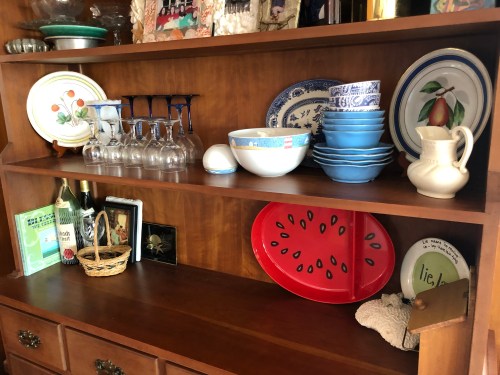
I can picture it lying on the hutch where she laid it not long after they bought the beach house in 1993, and where it has lain ever since. A novelty dinner plate, memento of her years as a teacher, sometimes buried under other plates or the detritus of grandkids visiting and large noisy family groups dining together. There it lies yet, solid and steadfast, secure in its lesson. Every year or two we rediscover it and laugh, so obscure, so obvious, the motto glazed in its simple school marm font: Lie, Lay, Lain. Who but a school teacher actually knows the correct usage, Lie vs. Lay, much less uses it consistently in conversation? Who but a teacher or a teacher’s child?
.
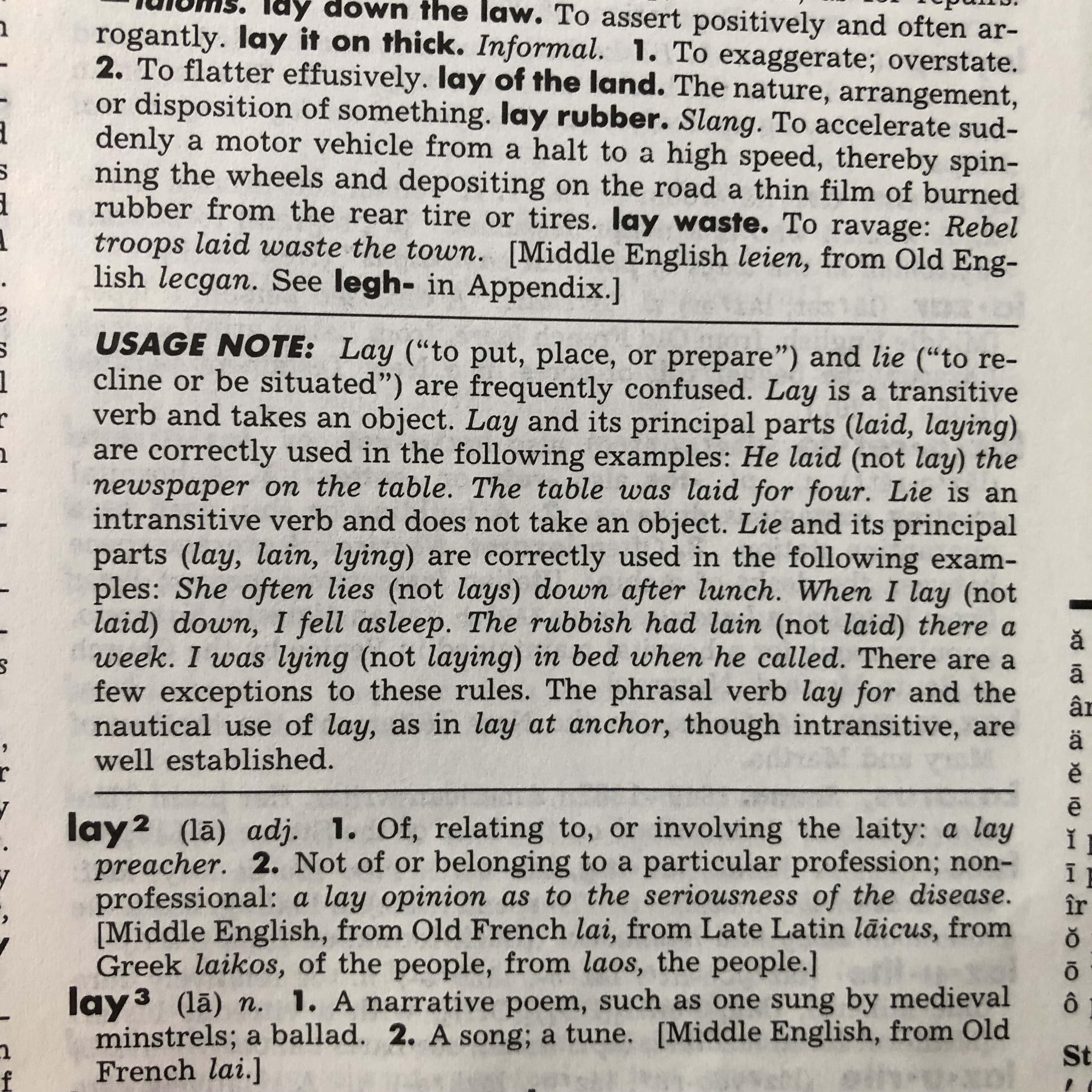
Linda jabs me in the ribs when the murder suspect on TV says, “I left the gun laying right there” and I expostulate, “Lying!” The gun, not the suspect. Am I such an ostentatious stickler that I have to correct every grammatical impropriety I encounter? Or am I maybe saying it out loud to re-teach myself? I check its feel on my tongue as the intransitive slides across. An homage to mom and all she taught me. Never forget, never forsake your upbringing. In 100 years the OED will list “Lay, laid, laid: verb, intransitive” as acceptable common usage, but until then I’m not going to lay around waiting.
.

.
❦
.
This evening, behind me, Dad is lying immobile where the nurses have laid him. Wake Forest Baptist Hospital- we’ve finally settled into his tenth floor room after 36 hours in the Emergency Department. He’s asleep, comfortable, the hard collar that is protecting his fractured cervical vertebra no longer agitating him. I’m reading a little poster beside his bed , the Johns Hopkins Mobility Goal Calculator. Level 5 is stand unsupported; Level 10 is walk 250 feet. Oh no, not Level 1: lay in bed! We’ve laid Dad in bed but he will have to do the rest of his lying there on his own with no help from Johns Hopkins. Lie still, Dad. Tomorrow I hope we can say that you lay restfully all night and will have lain free of pain throughout the day. I’ll be sure I say that right when I report to Mom.

.

.
. ❦ ❦ ❦
.
A Universe, in Revolution
.
My patient thinks he’s the new messiah.
++++ He’s got the key to the cosmos,
just had to listen to the signals
++++ ++++ ++++ ++++ ++++ ‘til they harmonized.
.
He says that I am part of the plan, play a role
++++ in his rise
++++ ++++ ++++ if I will only read the scripture
he sent me off the Internet,
.
if I will only hear him out tomorrow. I should believe
++++ he’s delusional, but this night
++++ ++++ ++++ ++++ ++++ makes all thinks possible.
A sound in the sleeping house and my heart races,
.
as though the prophecy is already here, rolling
++++ like mist beneath my door.
Who is this, speaking
++++ ++++ ++++ from the wilderness?
.
Through the passage, a small boy kneels
++++ on his bed, facing away, fully asleep. Not wanting
to wake him and afraid not to,
++++ ++++ ++++ ++++ ++++ I kneel beside him.
.
He holds the corner of the blind, looks out the window
++++ where a new moon blackens the street, the driveway,
the neighbor’s yard.
++++ ++++ ++++ I want that, he says. I see nothing.
.
What do you want?
.
I want that, he says, resting one finger on the windowsill.
++++ I should believe he’s imagining things,
but this night
++++ ++++ makes all things possible, dreams
.
existent on a perceptive continuum and not the ghetto
++++ of reality. I lay my son upon his pillow, aspect slack.
In sleep, we are possibility,
++++ ++++ ++++ ++++ emptied of our devices.
.
In the morning, he’ll ask me to play. Nascent diction
++++ blurs diphthong, implores me
++++ ++++ ++++ ++++ ++++ to pray with him instead.
Thank God, this understanding. My patient awaits
.
with his urgent need. And what am I, on this brink?
++++ A windowsill. A secret dark. A universe,
++++ ++++ ++++ ++++ ++++ ++++ in revolution.
My son’s cheek. My lips pressed deep.
.
Morrow Dowdle
from Litmosphere: Journal of Charlotte Lit, Charlotte NC; © 2024.
.
❦ ❦ ❦
.
Language. Usage. To get all hot and bothered when someone writes he ‘laid in bed all morning” is maybe as silly as rejecting on principle the dozens, hundreds of new words that enter the lexicon each year. English, world language, is endlessly pleomorphic, evolutional, contortionist, lush. Nourishing and delicious – relish it! And what better way to serve up novelty, invention, and sweet surprise than a healthy helping of poem?
.
The poems, fiction, and non-fiction in LITMOSPHERE 2024 have been selected from Charlotte Lit’s final Lit/South contest. As of July 1, 2024 Charlotte Center for the Literary Arts has discontinued the contest but expanded LITMOSPHERE to a twice yearly open submission journal. Submissions are open NOW, July1-31! New horizons and new opportunities are growing from something already strong and rich. Even a newly coined word will show its roots in some sound or utterance, some offshoot from fertile linguistic loam; a new poem also sprouts from the deep soil of music, rhythm, image. It may leave formal gardens to weave and sprawl across the page as a new thing; it may branch and bud into some unexpected inflorescence never before smelled or tasted.
.
This current LITMOSPHERE is a meadow, a forest, diverse and fruitful. It is the best of Southern creativity. This verse is not just fresh and new, it is biting and piercing. It makes me think new thoughts. It takes me into new places. Like language, poetry must be ever changing if it hopes to remain necessary and alive. To remain vital – from protoitalic gwīwō, to be alive, through Latin vivo, I live, into vita, a way of life: viable, vitality, revitalizing. This poetry is vital – relating to or characteristic of life . . . absolutely necessary.
.
.
❦ ❦ ❦
.
High John (Ipomoea Jalapa,
Bindeweed, Jalop Root)
.
Like King Arthur of England, he has served his people. And, like King Arthur, he is not dead. He waits to return when his people shall call him again. . . . High John de Conquer went back to Africa, but he lift his power here, and placed his American dwelling in the root of a certain plant. Only possess that root, and he can be summoned at any time. – Zora Neale Hurston in “High John De Conquer”
.
High John manifests
running wild in fields
crouching low in gardens
eve burrowing underground
heeding whispers and chants
for more, for better, ignoring
those who doubt his power
to restore health, to improve
conditions, to bear the fortune, to find courage
He has followed those stolen, those sorrowed,
those steadily holding hope that he will find
them, and his power will transcend their trouble
.
Over here, High John
.
High John, so high
the Saints still call him
The Orishas cry out, rumble ‘round
to find him, to guide him, to reveal
him, he, unassuming, lowly, powerful and
holy, he moves through, from tall grass to clearing
and arrives holding fortune in one hand and
healing in the other, pours assurance from his
mouth and illuminates love to the seeking
and the scorned from lips dripping in honey and humility
.
Oh, High John
.
High John come
He could’ve stayed away
but he could not leave his
people, as they entreated, danced
in clearings stump drums thumping in the night
.
Yea, High John
.
High John arrives
Golden straw crown gleaming
Making ways for his people who
have wailed, wandered, waited watched
fatigued and faltering . . . He still sees the holes to fill
that they might somehow become whole, as whole as he who has scoured
the lands and the seas
.
Draw near, High John
.
High John finds and fixes
and pulls from robes a
.
Conqueror’s Cure
.
Regina Garcia
from Litmosphere: Journal of Charlotte Lit, Charlotte NC; © 2024.
.
❦ ❦ ❦
.
A Long Time Ago This Was a Rich Man’s Backyard
.
Now the trees own their dirt
This morning, a woman and her dog wear silent circles in the pavement
We struggle to make a meager living
In the meadow
I watch a spider thread gossamer between two trees
A collection of crushed paper cups in the brambles
and the spit of the ghosts who gummed them
Anyway, it’s an ant’s world now and always will be
Everyone is pregnant and sharing articles about how to parent through an apocalypse
Of course I want meaning, too
And by that I mean a child of my very own
To walk with through these trees
My child who gathers leaves and never speaks
Maybe at the end there will be no sound
Just gestures of love and violence
The grass shifting slightly to accommodate the breeze
.
Rebecca Valley
from Litmosphere: Journal of Charlotte Lit, Charlotte NC; © 2024.
.
❦ ❦ ❦
.
Jenny Hubbard (Salisbury, NC) manages a used bookshop that raises money for her local public library.
Morrow Dowdle (Hillsborough, NC) hosts “Weave & Spin,” a performance and open mic series featuring marginalized voices.
Regina Garcia (Greenville, NC) has contributed poetic and vocal content to the Sacred 9 Project of Tulane University.
Rebecca Valley (Durham, NC) has written a collection of true crime stories for children which include dognapping, museum heists, and cryptozoology.
.

.
❦ ❦ ❦
.

.





 V E R S E and I M A G E
[…] About/Submit […]