[with poems by Stan Absher, Kathleen Wakefield, Bill Griffin]
How does science work? What does it mean for me to think scientifically? I notice something (empirical observation); I draw a conclusion (hypothesis via inductive reasoning); I check it out (experimentation, testing the hypothesis); it doesn’t all hang together so I try again, maybe noticing a little more closely (refining the hypothesis).
That final bit is the kicker. Even scientists can be seduced by their theories. Scientific knowledge, however, is never fixed and final. The most beautiful deduction can be proven false by the more precise observation. A posteriori trumps a priori. Anyone can be wrong.
The Naturalist Method is a subset of the Scientific Method. When I lead a nature hike, I advise folks, “Pay attention . . . ask questions . . . make connections . . . share.” And I am not the least bit shy about announcing that I myself don’t know everything. Not knowing (but wanting to!) is my defining characteristic. Semper Plus Discere – Always More to Learn. Bring books!
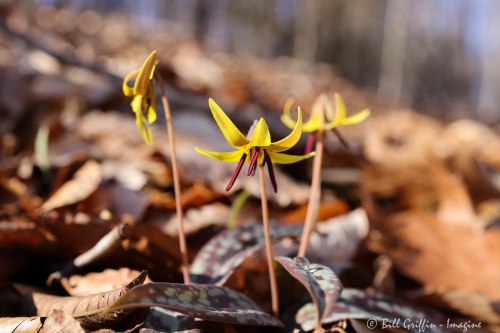
Which bit me on the butt a few weeks ago. For years I’ve walked a little section of trail where trout lilies carpet the banks every March. The first time I saw them – mottled fish-scale leaves, bright yellow recurved tepals, pendulant maroon anthers – I opened my trusty old field guide and confidently proclaimed, “Yellow Trout Lily, Erythronium americanum.” Firm, final, and correct. Never even gave it a second thought until this spring, when I decided to photograph some prime specimens in my SEEK app to add to my iNaturalist log. Click. Searching. Erythronium umbilicatum flashes up on my screen. No, no, that’s not right. Just shot ‘em from the wrong angle, try again. Every flower, every time the same – Dimpled Trout Lily.
When I got home I tore open my newer guides and references and discovered this: some thirty years ago taxonomists split the one species into two. And this: of the two, Dimpled is by far the most common in the foothills where I live. So how do you tell them apart? After a couple of hours on the NC State plant science websites, and after tracking down online photos (which I ultimately determined were mislabeled as americanum 52.3% of the time) I had my armamentarium. Back to the woods, this time with a hiking group I enlisted to find all the Trout Lily they could, especially ones gone to seed.
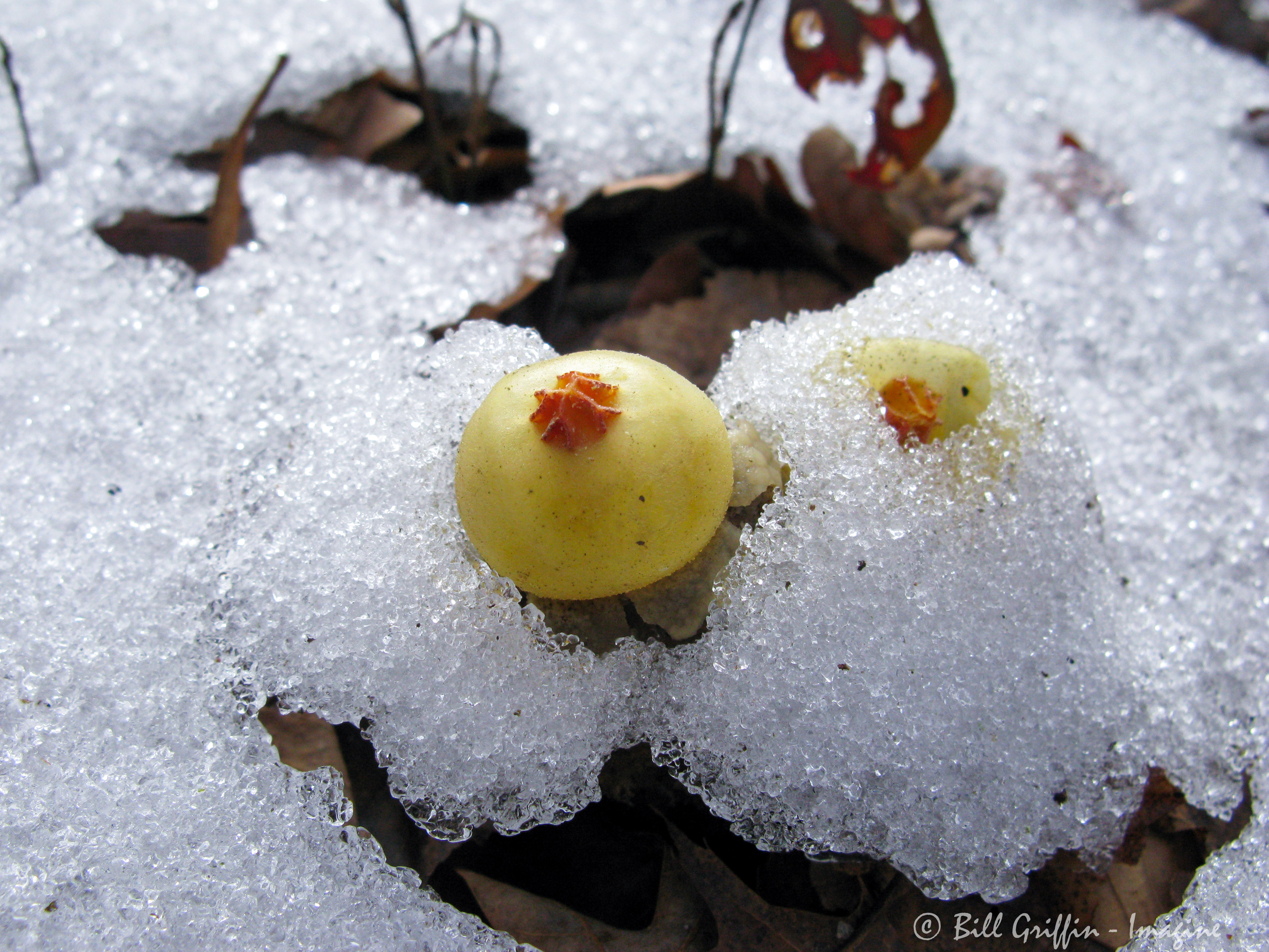
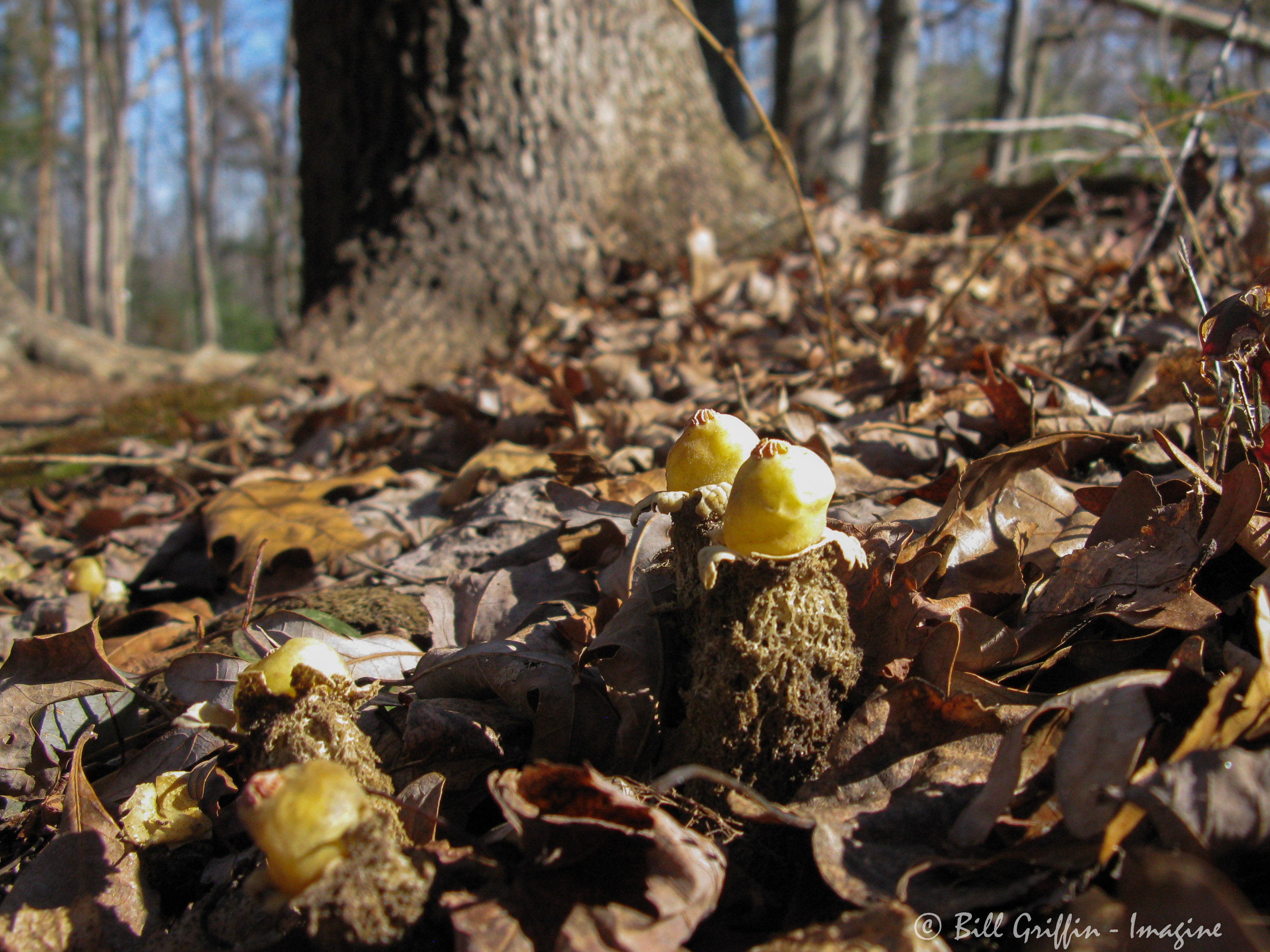
And what we observed was this — if still in bloom, no auricle (“ear”) at the base of the inner tepals; if gone to seed, a distinct dimple at the end of the ovary, and often lying prone on the ground. Every dang plant we found was Erythronium umbilicatum. I stand humbled and corrected.
But here is another observation to add to the guide books. Yellow Trout Lily is described as holding onto its style, still attached to the ovary after forming seeds. Many, even most, of the Dimpled we found also retained their style. Maybe we’ll come back in a week and observe again. Maybe notice a little closer.
❦ ❦ ❦
Heifer
Destined for slaughter
she wades into the water
to the belly and drinks deep.
Does she see her own sad eyes
wide and innocent in the pool
looking up out of the sky?
Soon fear will make her bellow,
but now her muzzle is cool
and wet. Her skin twitches,
scattering flies; her switch
brushes them off. Across the water
she sees a pasture
she will never graze
a clump of trees
that will never give her shade.
J. S. Absher
from Visions International #107, Black Buzzard Press, © 2023 Visions International Arts Synergy

Erythronium umbilicatum

Erythronium americanum
❦ ❦ ❦
Thirty or so poems in a modest package; writers from Europe, Asia, the Americas; no page numbers but a few hand-drawn illustrations – all this and a remarkable meditative companionability create the magic of each issue of Visions International. I ask myself how editor Bradley R. Strahan manages to pull me into these pages so warmly. Some insistent human voice calls us, the readers, to encounter distant circumstances and experiences and realize they have become close, familiar, our own. How has Brad, through the decades, made this so?
My friend Stan Absher suggests: Because he often publishes poets over a long period of years, Bradley’s readers can get to know some poets rather well. I’ll mention only the late Michael Mott (he died in 2019) and Nikolaï Kantchev, a Bulgarian poet who died in 2007 and whom Brad continues to publish in translation, but there are several others.
And Kathleen Wakefield, after reading Issue #107, commented this to Bradley: I love the cadence of these poems, their subjects and very particular visions, language that skewers you or lures you in. Some are simply magical to me, others have the strangeness and dark absurdity, fused with love, that points me back to Simic, one of my favorite poets. So glad you honored him and are always including poets from other parts of the world who write of something vital at stake. All of these poems jar me out of my usual forms of speech. That is a very good thing. It’s not just mental; the heart is altered.
I am honored to appear in these particular pages with two friends I’ve come to know through shared poetry, Stan Absher and Kathleen Wakefield. As I continue to read each issue of Visions, my circle of companions expands.
❦
Subscribe to Visions International. For four issues, mail $25 to:
Visions International / Black Buzzard Press / 309 Lakeside Drive / Garner, NC 27529
❦ ❦ ❦
Summons
1.
I am practicing my lying down
beside the stripped spines of jay feathers,
the azures unwinged, seed heads gone to must
and rot, bones of mice cradled in mycelia
tangled and ghostlike.
I am asking the names of wildflowers to ease me into sleep,
saying them over and over, Bloodroot, Evening Lychnis,
Celandine, Enchanter’s Nightshade, Coltsfoot,
Wood Groundsel dissolving
on my tongue.
The faces of those gone before me rise up,
and those I will leave behind, my children
far flung as seeds carried by wind
and pelt and rain.
2.
Go ahead, let the dankness of earth
seep into your thighs, let dust
silt your lungs, your spine
crack like river ice
but the mind pulls you back up through snake skin and mist,
through dry creek and river bed to the trees’
green asylum, rain smacked leaves
waking you to the body’s arterial hum.
Get up while you can, full of your hunger and regret.
Get up from your knees. Taste
what you are, cloudburst, mud, burnt grass,
words buried in iron, bone, lips, and breath,
in this sorrow and honey,
this skin and ash.
Kathleen Wakefield
from Visions International #107, Black Buzzard Press, © 2023 Visions International Arts Synergy
❦ ❦ ❦
Albedo
Rare to discover you
+++++ aloft in the afternoon
your eye so blue
I can see right through
+++++ the curving edge of sight
and your face so bright
+++++ I believe the fire
of your glow must burn
within – but no,
+++++ reflected whole
where you hang on the arm
of your golden man.
Bill Griffin
from Visions International #107, Black Buzzard Press, © 2023 Visions International Arts Synergy

❦ ❦ ❦
EARTH SCIENCE: Albedo is a measure of how much light is reflected by the surface of a planet or moon; an albedo of 1 means all light is reflected; an albedo of 0 means no light is reflected – all light is absorbed by the surface and it will appear dark. The albedo of the moon is 0.12, pretty dark as celestial bodies go. Saturn’s moon Encedalus has an albedo of 0.99 due to its covering of snow and ice.
The albedo of Arctic ice is much higher than the albedo of open ocean. As more of the Arctic becomes ice-free in summer, more light (heat energy) is absorbed by the darker water. This has produced a positive feedback loop so that the Arctic is warming much faster then the remainder of the planet.
PLANT SCIENCE: The female reproductive part of a flower is the pistil, composed of the ovary (containing the ovules), the style, a slender column projecting up from the ovary, which is tipped by the stigma. Pollen lands on the stigma and sprouts tubules down through the style to fertilize the ovules and produce seeds. Of the 450+ families of flowering plants containing more than 260,000 species, each contributes its own variation to the configurations and shapes of flower, pistil, and stamen, and the strategies for insuring that pollen and ovule meet.
When the outer whorl of structures on a flower can’t be sussed out as sepals or petals, the blades are often called tepals. Sepals are the outer whorl that cover and protect the bud and petals are the inner whorl, usually colored to attract pollinators. Especially in many members of the Lily family, Liliaceae, the two layers merge or fuse; the term tepal was compounded to describe them.
❦ ❦ ❦




 V E R S E and I M A G E
[…] About/Submit […]