Feeds:
Posts
Comments

Posts Tagged ‘imagery’

Less is more.      –       Ludwig Mies van der Rohe

My high school art teacher was more than eclectic. I can’t see a cityscape without thinking of Lyonel Feininger, and we did an entire unit on the Bauhaus. Gropius, Kandinsky, Klee, there is music in the names. Years later when I began writing poetry, though, I guess van der Rohe’s aphorism had failed to inform. My early stanzas were little bricks, four-square and chunky, nary a chink much less any breath. Did I imagine the proper density of “condensed language” was that of neutronium?

I trust that my current poems can sometimes walk through the woods without the need for supplemental oxygen, but I am still far from mastering that most ephemeral, jewel-like and perfect poetic form. I have yet to write a decent haiku. I get twitchy wanting to add more painted-on layers of complexity. I want the scarlet oak leaf to become a scarlet tanager. I can’t let the image be the image. How many haiku masters does it take to change a light bulb? None, for they are the light bulb.

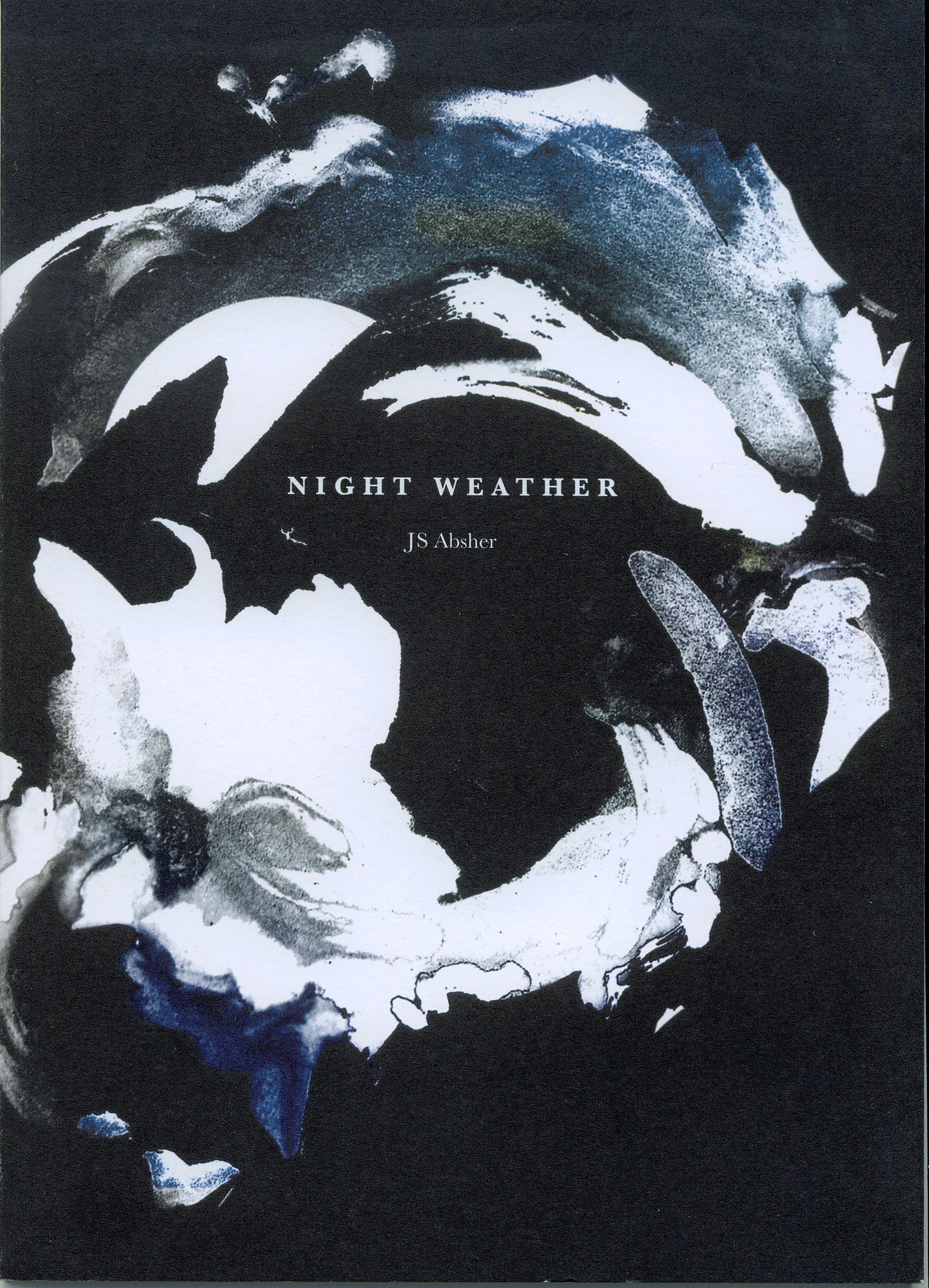
I will have to be content to let that light shine into me by reading Night Weather. Stan Absher’s poems are airy, piercingly bright, yet willing to settle briefly on your palm. Never can they be pinched between thumb and forefinger like a dead specimen. Open to any page, touch your tongue to a line, inhale the pinprick drop of scent as from honeysuckle flower. In the book, the seasons of haiku are punctuated by longer poems, but even these retain the sense of being present in their one precise moment: low sun / raking the leaves / into long shadows.

On your neck, the soft breath of these images. And patiently between the pages, watercolors by Katie Nordt. Also deceptively simple in their color and form. Follow the quiet path that winds among verse and line and season and you discover a deep story unfolding. Complex in its simplicity. From less becomes . . . ever more.

NigntWeather_bamboo01_crop

bamboo

the bamboo grove
glimpse of stray light
butterfly

old house

no one can sleep

the flooring relaxes
on its joists

the downspout
hisses like a snake

in his shorts, Daddy
leans in the open
doorway, smoking

NigntWeather_eno01

Night Weather

JS Absher PoetryNigntWeather_cvr01

Katie Nordt, art and illustrations

.

.

.

.

.

.

.

.

.

.

IMG_0768

Read Full Post »

Last fall I precipitated a lengthy debate when I claimed that all poetry is about death. Well, Richard and Allison, I apologize, but I’ve changed my mind – all poetry is about sex.

Let me rephrase that: all poetry is sensuality. At least I’m convinced that’s true when I re-read Sara Claytor’s Howling on Red Dirt Roads.

Sara’s poems take delight in slipping off their silk blouse and pointing their rosebud nipples at the moon. In a buttery drawl the poems say, “Damn the saturated fat,” and spoon up a steaming platter of cornbread and collards. They are magnolia perfume on a muggy afternoon. Salt and beachsand and waves at night. The stanzas are tactile, gustatory, aromatic – oh hell, let’s just say they drench the senses. Presence and immediacy – the characters rise up from the page and breathe.  And oh my, we are there with them and we are red and we are howling.

You’ve experienced sensory memory – just a hint of the smell of your Grandmother’s talcum and there you are playing on the floor in her living room. [It’s synapses firing in the hippocampus and cingulate gyrus, but forget I said that.] Sara’s poetry is born in memory. Her memories become ours. The smell of July sun on pine needles, squeak of the porch swing, the sound of butter beans falling into a chipped enamel basin . . .

DSCN4899

Dog Hobble

Blue Rocking Chair

She lost her leg,
wanted to return to her tin-roofed cabin
with the blue rocking chair on the porch.
Working daily in a cotton mill, Claudine
spent nights with her. I was in Zimbabwe,
a Peace Corps teacher,
when I received Claudine’s letter
detailing the 2-month-old news of Julia’s death.

Perhaps Julia rolled her wheelchair to the kitchen,
boiling water for coffee, loose sleeves brushed
against a heated stove coil.
By the time the fire department arrived —
the old wooden structure eaten by flames,
tin roof buckled and flattened,
blue rocking chair reduced to blistered sticks.

During the next year, I recovered,
feeling more black than white,
my skin & hair darkened by fierce African sun,
my heart involved with 15 black children
who called me ‘Mama Blanche,’ who learned
to speak English with a Southern accent,
celebrated my 23rd birthday singing Dixie.

In each face, I saw myself on a day
when I sat in the blue porch rocking chair
beside a tin bucket of pink petunias,
helping Julie shell butter beans,
smiling in the sun while she hummed hymns,
dropped the empty hulls
into a brown paper bag.

Sara Claytor, from Howling on Red Dirt Roads, Main Street Rag Editor’s Select Poetry Series, 2008

Sara featured on Katherine Stripling Byer’s blog
http://ncpoetlaureate.blogspot.com/2009/09/poet-of-week-sara-claytor.html

Sample poems at Main Street Rag
http://www.mainstreetrag.com/SClaytor.html

Sara’s web site
http://www.saraclaytor.com/

Read Full Post »

The tree which moves some to tears of joy is in the eyes of others only a green thing that stands in the way.  Some see nature all ridicule and deformity, and some scarce see nature at all.  But to the eyes of the man of imagination, nature is imagination itself.    —   William Blake

You can’t write what you don’t notice.    —   Peter Makuck

When I was sixteen I spent ten days backpacking with the Boy Scouts in the southern Rockies.  Twenty-four years later I hiked some of those same trails again with my son’s Scout troop.  This time the climb over Abreu Mesa and up along the Cimarron River was punctuated by green-tailed towhees, Stellar’s jays, the sudden flame of western tanagers.  Where had all those birds come from?  Where were they last time I was there?  The difference was the dog-eared copy of Peterson’s Guide to Western Birds in my pocket.  And looking.  Noticing is intentional.

On April 9 at Barton College Walking into April Peter Makuck read from his new and selected poems, Long Lens.  An apt title.  The poems invite us to accompany the writer during a long career as a poet.  They focus for us the quotidian observations that suddenly blossom into meaning.  And most of all the poems’ images bring things up close — a ladybug that reminds of leaving home; a pelican to release us from bondage; a hawk killing a squirrel on a college campus —  or rather the poems bring us closer so that we can begin to notice.  To notice like the poet notices.

DSCN4910

Wild Ginger

Prey

Coming from the pool
where I’ve just done laps, letting water bring me back,
I’m already elsewhere, thinking
about Tennyson and my two o’clock class
when a squirrel appears
ten feet from the concrete walk, by an oak.

Then a loud ruffle at my shoulder,
like an umbrella unfurled, before a flash glide
makes the Redtail seem to emerge from me

and nail the squirrel with a clatter of wings —
a long scream that strips varnish from my heart
before the sound goes limp.

She presides with mantling wings
over the last twitches of gray as I
edge closer to her golden eye.
She hackles her head freathers, tightens her talons,

holds me prey to what I see, watches me
as she lifts off , rowing hard for height, the squirrel
drooped in her clutch.

Now skimming a lake
of cartops in the south lot, making for the break
between Wendy’s and Kinko’s, she swerves up

sharply to land on the roofpeak of a frat house
over on Tenth.

Some noise from the world snaps me back.
I look about, but nobody has stopped
to look at me or where she stood by the tree,
only ten feet away.  Slowly released,
I move ahead with the passing student crowd,
holding fast to what I have seen.

Prey, Peter Makuck, from Long Lens: New & Selected Poems, BOA Editions Ltd., 2010

IMG_7491

Peter Makuck
http://www.makuck.com/

Featured at Kathryn Stripling Byer’s NC Poet Laureate Site:
http://ncpoetlaureate.blogspot.com/2009/10/poet-of-week-peter-makuck.html

Some persons seem to have opened more eyes than others, they see with such force and distinctness; their vision penetrates the tangle and obscurity where that of others fails . . . How many eyes did Thoreau open?  How many did Audubon?  Not outward eyes, but inward.  We open another eye whenever we see beyond the first general features or outlines of things — whenever we grasp the special details and characteristic markings that this mask covers.  Science confers new powers of vision.  Whenever you have learned to discriminate the birds, or the plants, or the geological features of a country, it is as if new and keener eyes were added.  John Burroughs

Read Full Post »

« Newer Posts - Older Posts »