Feeds:
Posts
Comments

Posts Tagged ‘imagery’

Here’s a sobering thought: even when you receive that wondrous acceptance letter (or email) telling you that The Editor has decided to publish one of the poems you sent him or her, she or he is still rejecting the other two or three or four that were in the envelope (or .PDF). I hear the trombones going, “WAH Wah wah.” And equally sobering: if anyone is reading the poem once it does get published, they’re not calling you to tell you how much they like it. How not sexy is that?

But no, wait a minute, I take that back. I have a special friend who always tells me she likes my poems. (I won’t reveal her name, but her initials are “Caren Stuart.”) If she finds something I’ve written appearing in a regional journal or anthology she shoots me the kind of email that is 100% guaranteed to improve posture, dissolve scowl lines, and overcome even the most stubborn case of writer’s block. For several years she and I and Nancy King had a monthly email poetry critique session going. We’d share one poem apiece and comment. CS could find something wonderful in my lamest efforts, which inspired me to keep hacking away at them until they really were wonderful. Thanks, Kiddo – I write a lot better when you’re in the world.

Give it a try yourself. Lot’s of times I’ve discovered a poem by someone I know, picked out my favorite line, and sent them a little message about why I like it. Such an act never fails to reverse entropy and slow down global warming.

IMG_1405

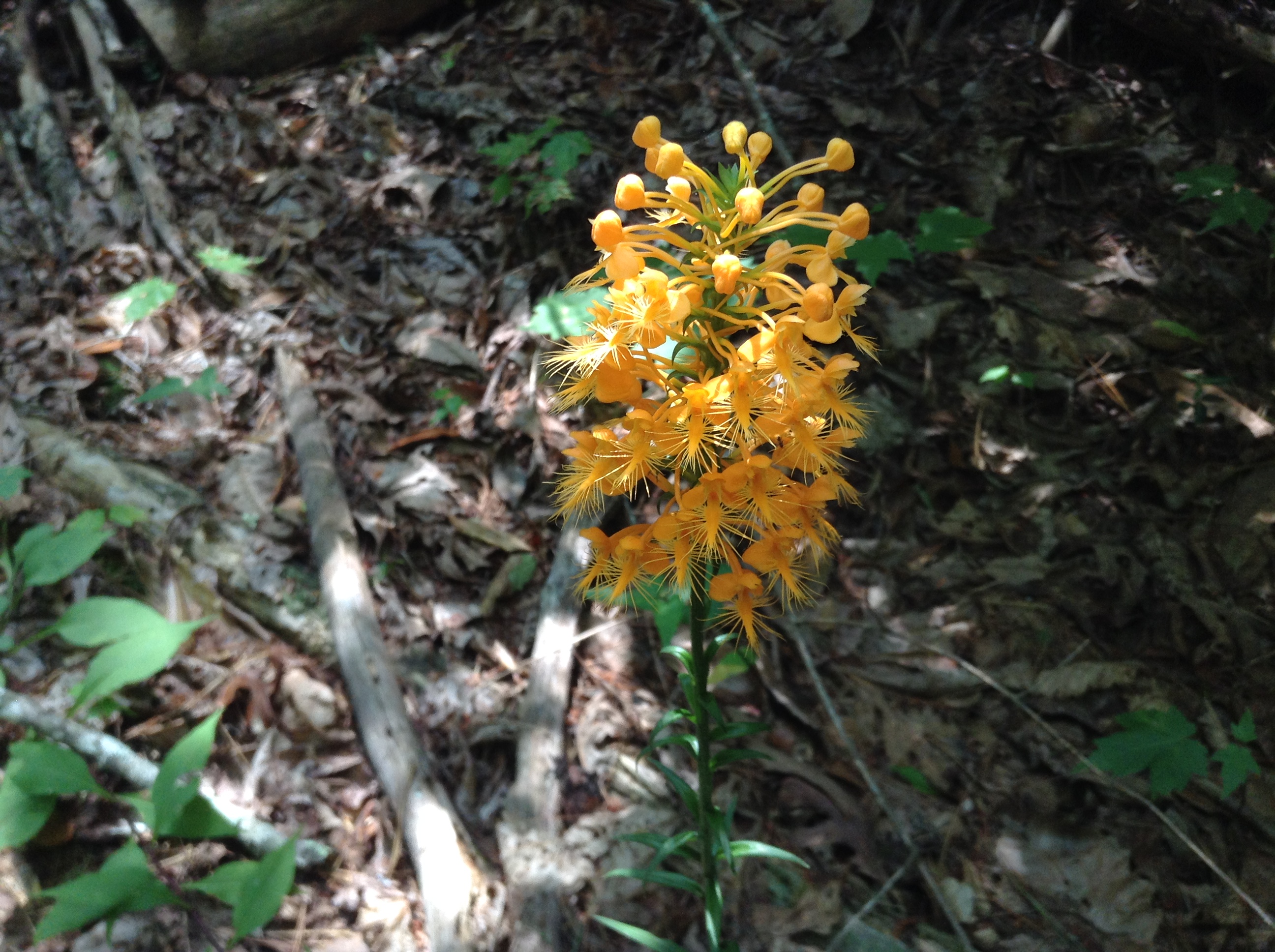
Yellow Fringed Orchid, Patanthera ciliaris — Gorges State Park NC, 8/2015

 *     *      *     *     *

I confess that for a few years I’ve almost quit submitting poems for publication. Who needs the fame, right? But in 2015 the tide is turning. Maybe I’m beginning to see that my personal journey as poet is developing a more unifying theme or gestalt. Maybe I’m feeling more comfortable in the community of poets. And it certainly helps that so many journals accept online submissions – I’ve got a roll of 100 “second ounce” postage stamps I’ve hardly touched. I’m sending my little darlings out to the Mercy of Editors again.

AND . . . I’ve got a new system. Which I am going to share with you.

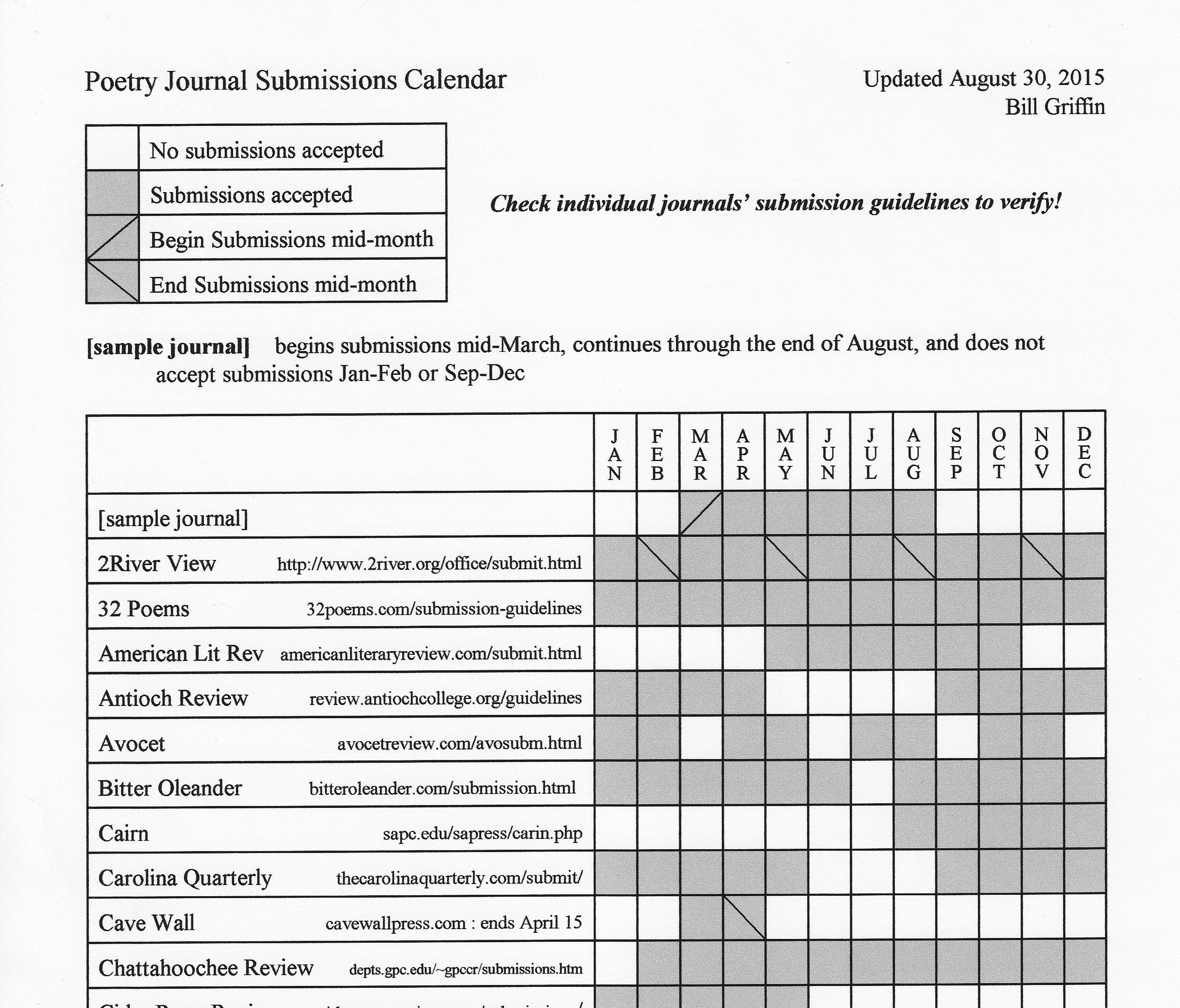
Ever get all fired up with a sheaf of poems, stuffing them into a .PDF only to discover the journal you’ve envisioned for them closed its annual submission period last week? Grieve no longer. Check out the creation below (which has been made possible by dozens of hours on the computer and a constant infusion of what CS calls my “Type A-ness”):

Submission Calendar Page 1_crop

This table shows the months when various journals accept submissions, plus how to research their submssions guidelines. Just look down the column of the current month to pick a journal that’s currently open to submissions!

 *     *      *     *     *

Click the link below for the entire .PDF. As of March, 2016 I have about 75+ journals and contests listed. I’d like to keep expanding– my email address is listed in the document so you can send me your suggestions and additions, plus any corrections. I’ll keep the updated document linked to this page.

Click  below for .PDF file with the FULL LIST:
[Last updated 3/6/2016]

. . . . . . . . . . . !!Submissions Calendar 2016-03 . . . . . . . . . .

 *     *      *     *     *

IMG_1431

Luna Moth, Actias luna — Gorges State Park NC, 8/2015

After Shelby Stephenson published Orange Cap in Pembroke Magazine in 2005 I didn’t submit again for a few years, and now he has turned over the reins to the new Editor, Jessica Pitchford. Last year I had written a poem about my paternal grandmother that I thought my aunt and cousins might enjoy. Whenever we’re together we usually share a story or two about Grandmother (no lesser title could ever suffice), the stoic matriarch and proud link to the Weatherspoon side of the family, now to be captured for posterity in a sonnet. But before I sent the poem to the family I sent it to Pembroke. Thanks, Jessica! The family is indeed enjoying this. (And it explains why I bought four extra copies of Pembroke #47.)

 *     *      *     *     *

Sonnet for the Woman Who Fried 10,000 Chickens

And don’t forget about a bazillion quail,
each three bites for breakfast with biscuits and grits
and gravy über Alles thanks to red setters’ skill,
Granddaddy’s gun, and us willing to pick little nits
of birdshot out of our teeth, but save that fat pullet
for this Sunday’s dinner, piled crisp high and brown
as pecans shelled last night for green jello salad.
The triumphal platter Grandmother sets down,
we pray Come Lord Jesus, me and Brother grab
for the juiciest piece ‘til we backpeddle before
her Presbyterian eye – Boys, what will you have?
and Finish your greens before you ask for more.
.     No one says thigh or breast here: Grandmother will offer
.     only second joint, white meat, and everything proper.

[First appeared in Pembroke Magazine number forty-seven, 2015]

*     *      *     *     *

IMG_1562

Extremely hungry millipede, Narceus americanus, trying to untie my bear bag & steal the goodies. Gorges State Park NC, 8/2015

Post Script – One other reason to send out a poem: last year I wrote a poem about a friend and patient who had died at the age of 98. It placed in a contest and appeared in an anthology. This summer I took a copy of the book to his widow, herself 98, read her the poem and just reminisced for a while about the many great stories her husband had shared with me over the years. About a month later she mailed me a thank you note, said all her kids had enjoyed the poem about their daddy, and she had read my other poem that appeared in the same book and commented on it.

It doesn’t take a thousand readers to make the writing worth the effort. One will do.

*     *      *     *     *

IMG_1783

Read Full Post »

Keep close to Nature’s heart, yourself;
and break clear away 
once in a while,
and climb a mountain
or spend a week in the woods.
Wash your spirit clean.
John Muir
IMG_3937

.     .     .     .    .

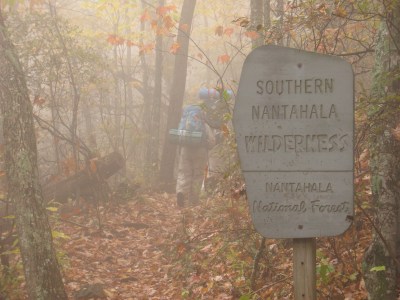
Why have they come?  Why have they driven hundreds of miles of highway and another twenty of Forest Service gravel to this Deep Gap?  Why have they tracked down my friend Mike Barnett and persuaded him to share with them everything they will need to know to spend a few nights on the trail? Why forsake comfort for mist, rain, steep switchbacks, cold nights, hard ground?  Why have they come here?

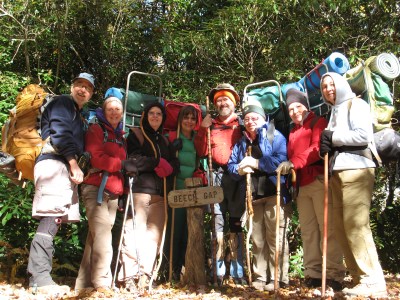
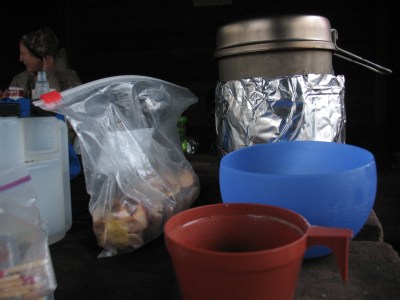
Now they huddle at the trail head – Judy, Nora, Cathy, Gloria, Joan, Nancy – median age 65 (just a wild guess, Ladies!).  They pull on fleece and rain gear because we’re already above 3,000 feet and it’s mid-October.  Mist condenses on the leaves and drips like rain.  The plan is to hike the AT for three days with everything we need to survive on our backs: food, stove, water & filter, tent, mummy bags, and lots of layers for nights just above freezing.  We’ll reward ourselves the third night with a short side hike to Albert Mountain and hope to catch the sunset and sunrise from the 5,280 foot summit and fire tower.

That sunrise seems a long way off as we hunker down for the first night half-way up Standing Indian Mountain.  It’s pitch dark , a “hunter moon,” first new moon after equinox, but what does absent moon matter when we are engulfed in cloud with thunder echoing ridge to ridge as lightning strikes the summit?  Kids, I just want to let you know that your grandmothers are some tough-ass mountain women – they wake up the next morning joking that the howl of wind and rain had caused them to miss George Clooney’s surprise midnight visit.  And the only complaint I hear is when Joan comes back from digging a cat hole just as the mist lifts to reveal a nice rainproof privy not twenty yards from our camp site.
IMG_4128

Our second night we stop at Beech Gap, a saddle between peaks with a good spring and level tent sites.  The stars burn cold as diamond just above our shoulders; we are wearing every layer of clothing we’ve carried.  I ask, “Why?  Why did you go to so much trouble to put this trek together?”

Judy was the instigator.  She told Nora she wanted to hike at least one stretch of the Appalachian Trail before she died.  Nora replied, “Gee, I know someone who’s been taking kids on high adventure hikes in the mountains for twenty years, and his sister-in-law Carol is my good friend.”  Nora called Carol, Carol called Mike, and Mike said, “OK.”  (I still haven’t asked him why he said yes!)  Wheels began to turn.  It began to look like Judy’s promise to herself that she’d have something big to to tell her grandchildren would be fulfilled.

Nora invited others, and Mike’s wife Nancy makes six.  One had hiked with her family as a child and wanted to recapture that feeling.  One walked miles every day and wondered if she could handle the challenge of doing it uphill with a pack.  Another had become concerned about her stamina and embarked on a course to improve her fitness; now she wanted to kick it up a notch. One had never experienced mountain wilderness.  All of the women had come with a frank openness to experiencing something new.  Something challenging.
IMG_3985

There are plenty of obvious physical challenges to spending a night on a mountain.  Just deciding what you’re willing to carry vs. what you’re willing to live without can become a metaphysical exercise.  Then there’s the trail itself.  Where will I find water?  Will the spring be dry?  How many uphill miles before my buns turn to steel?  How much huffing and puffing before I have a heart attack?

Physical challenges are obvious, but they are illusory.  I may be thirsty now, but I will drink later.  When the trail is steep, I walk more slowly.  I stop and rest.  Tired and sore?  Leaves are falling that I may scrape together for a bower.  Strange noises in the night?  My companions are close by.

I’m guessing there are still more reasons we’ve come to these mountains that none of us have yet spoken.  I’m certain there are reasons we couldn’t even have named until after we took this walk together.  There are reasons we’ll discover only with days and weeks of contemplation to come.  A taste of wildness – remote, unforgiving, pristine, elemental.  An assurance of self – I made it, I persevered.  Connection, unvarnished and unabashed – each one of us making our small offering to the survival, and the joy, of the group.  And a much larger connection – wind, trees, slopes, stars . . .  we are part of this living realm and can’t exist without it.

Why have we come here?  That’s exactly what we’re still discovering.

IMG_3921_crop

.     .     .     .     .

Final question: Why did Mike ask me if I’d like to come and lend a hand as general schlepper, filter pumper, water boiler, story teller?  Because he knew as soon as the word “mountains” left his lips I would be saying, “YES!”

.     .     .     .     .

Forever Mountain
Fred Chappell

for J.T.Chappell, 1912-1978

Now a lofty smoke has cleansed my vision.

I see my father has gone to climb
Lightly the Pisgah slope, taking the time
He’s got a world of, making spry headway
In the fresh green mornings, stretching out
Noontimes in the groves of beech and maple.
He has cut a walking stick of second-growth hickory
And through the amber afternoon he measures
Its shadow and his own shadow on a sunny rock.
Not marking the hour, but observing
The quality of light come over him.
He is alone, except what voices out of time
Swarm to his head like bees to the bee-tree crown,
The voices of former life as indistinct as heat.

By the clear trout pool he builds his fire at twilight,
And in the night a granary of stars
Rises in the water and spreads from edge to edge.
He sleeps, to dream the tossing dream
Of the horses of pine trees, their shoulders
Twisting like silk ribbon in the breeze.

He rises glad and early and goes his way,
Taking by plateaus the mountain that possesses him.

My vision blurs blue with distance,
I see no more.
Forever Mountain has become a cloud
That light turns gold, that wind dislimns.

This is continually a prayer.

.     .     .     .     .

from The Fred Chappell Reader, St. Martin’s Press, (c) 1987 by Fred Chappell
IMG_4192_crop

.     .     .     .     .

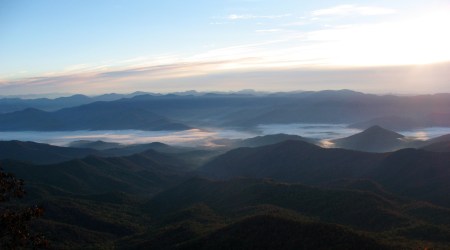
A brief postscript: Mike has told me several times of his instructions to Nancy that his ashes are to be strewn from the top of Standing Indian Mountain.  By noon on our second day the mist had lifted, and we ate lunch at that summit with glorious views of the autumn-hued ridges extending to an infinite horizon.  Mike, I hope it’s years in our future, but I can’t think of a better spot to lend the flora a little potash and calcium for all eternity.

.      .     .     .     .

Our true home lies outside, deep in the wilderness of forest and mountain, river and desert and sea, the source of our being and the destiny of our great meandering blundering dreaming journey through time. Like Odysseus in his wanderings, we are homeward bound whether we know it or not.
Edward Abbey

IMG_4021

.     .     .     .     .

IMG_1948

Read Full Post »

Linda and I take walks.

Take?  The walking gives itself to us.  We talk, catch up on the hours, days sometimes.  We list things that need to get done, places that must be gone, eroding detritus of stuff that clamors to be fixed.  We laugh at the last cute thing Saul did, the cute thing he said that we’ve smiled at twenty times already.  We discover small things along the path – what is the name of that little blue flower? – and rediscover things that have brought us small delights in the past.  And we hope we burn up some calories and coax some blood to run its circuit a little faster.

Throughout the breeding season American Avocet pairs greet each other by rubbing along the length of their long recurved bills while the male drapes a wing over the female’s back.  Cozy.  Most birds that form lasting pairs, for a season or for life, have some sort of bonding display – preening, mock-feeding, a dance, aerobatics.  Evolutionary biologists conjecture that these instinctive behaviors strengthen the pair-bond and increase the chance of reproductive success.  More eggs, more chicks, more offspring successfully fledged.  Survival.

Linda and I take walks.

IMG_3770

.     .     .     .     .

Yesterday afternoon Linda and I walked Old Man’s Gorge in the Hocking Hills of southern Ohio.  Over thirty years ago Linda’s Mom and Dad bought a little farm in the woods near there.   It’s been close to twenty years since we last visited Old Man’s Cave.  During that time the new trail markers, new bridges, steps, railings, everything has a moist green fuzz of moss, as if the three-hundred million year old blackhand sandstone has invited all things in the Gorge to appear as old is it does.  Linda and I keep remarking to each other, “Was this here last time we came?  I don’t recognize this stone wall, but it looks ancient.”

IMG_3746

.     .     .     .     .

Overcast, damp, ten degrees cooler than its summit, the basin of Old Man Gorge just feels like Ohio.  Maples have begun to turn color along the rim, but in the shade of the grand overhangs all hues become muted.  The eroded walls are a hundred variations of gray and rock-green, a lichen wash of winter sky. The shades of our Ohio roots:

.     .     .     .     .

 Twenty‑Three Grays

The first is crossing the Ohio into Marietta,
not the green river yearning west
but each of its scalloped reflections
like scales on a crappy, and at each ripple’s
lip a premonition of ice.

Next: passing the first car southbound
salt‑encrusted with two hundred miles
of I‑77 — what color is it really?  A casual visitor
to this state still our home may claim
there is no color here, but doesn’t gray
enfold the possibility of every color?
Sky layered in bands dark and darker
preserving as in a comforter some memory,
warm purple; fingery hawthorn
and buckeye almost yellow; cattails
coyly pink; dark earth chocolate
between cream snowcrests —
all of them holding everything within.

In Canton the window eyes of Mercy
Hospital passing no judgement.
In Akron, the stone walls of Rockne’s,
frost like stale beer foam; peeling letters
at the exit sign: Peninsula/Hudson.
Geese in the ditch beside a Cape Cod;
rust‑gray girders where we drive beneath
tank cars, coal cars, and then the Turnpike
overpass.  And as we reach your driveway,
rime, old tears the wipers can’t beat back.

Those who’ve never left here, do they notice?
And we who return, can we name
what comforts us?  Only in his eighties
did your Dad’s hair surrender to the shades
of sky and winter fields, and now when I hold
you this close full of days recalled, stories
we=re sharing as if for the first time,
the good full color of Dad’s life now passed
fully into our hearts, I see in your hair thin streams
coalescing, bands of evening sky and highway,
winters we will hold together, and the springs.

© Bill Griffin.  First appeared online in John Hoppenthaler’s Congeries at Connotation Press, June, 2011.

IMG_3744

American Avocet — Recurvirostra americana

.     .     .     .     .

IMG_3810

.     .     .     .     .

IMG_6432

…………………

Read Full Post »

« Newer Posts - Older Posts »