Feeds:
Posts
Comments

Posts Tagged ‘GSMIT’

[with 4 poems by Jane Mead]

What is Leafy yet has no Leaves?

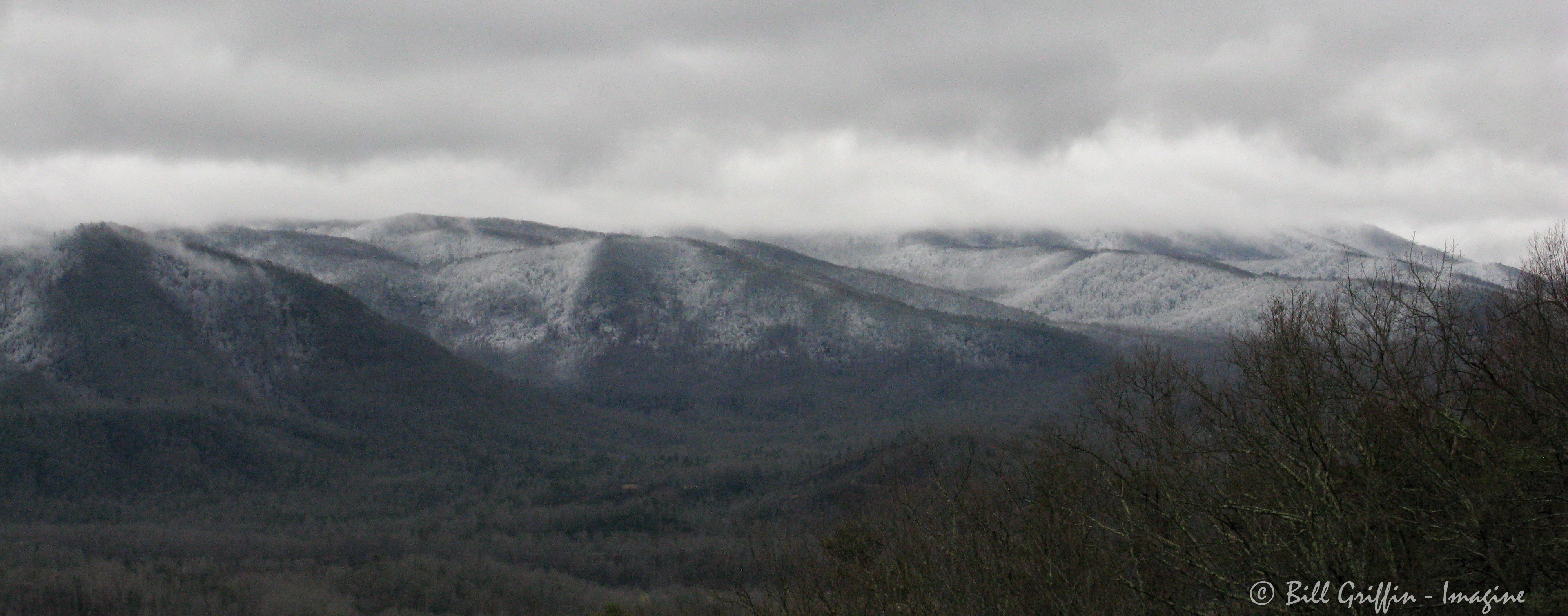
On our way home Mike and I pull over at Newfound Gap but not for the Appalachian vistas: it’s our last stop to hunt lichens before we leave the Smokies. And maybe an opportunity to spread some lichen joy.

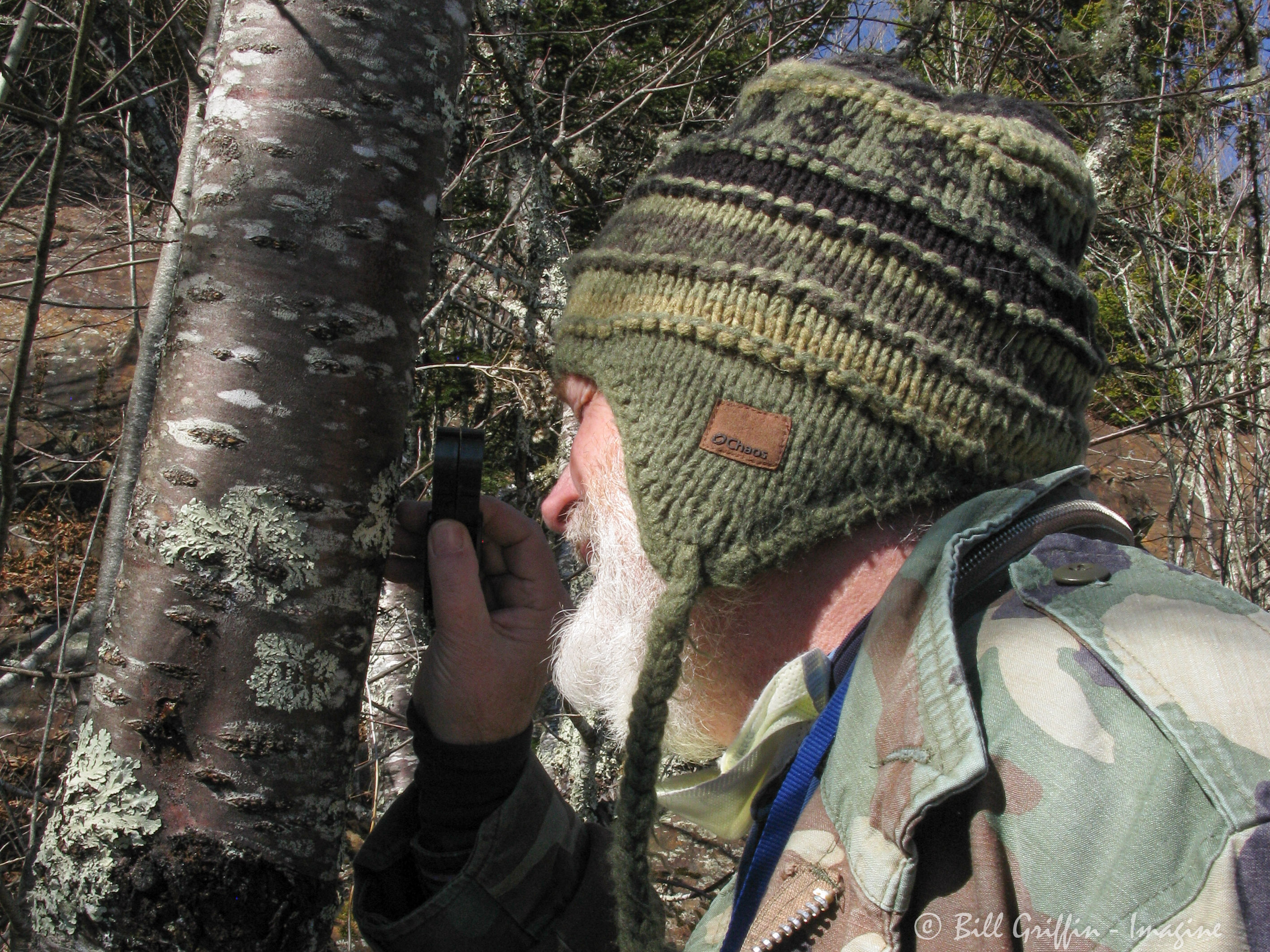
No need to hunt – stop moving long enough and a lichen will find you. Two old guys squinting through magnifying glasses at rocks and bark, though, and it also isn’t long before a passing family asks, “What gives?” “Looking at all the lichens,” Mike answers. “What’s a lichen?” Jackpot! Mike begins to tell their story . . . “a whole little world of fungus and algae” . . . while I wander on.

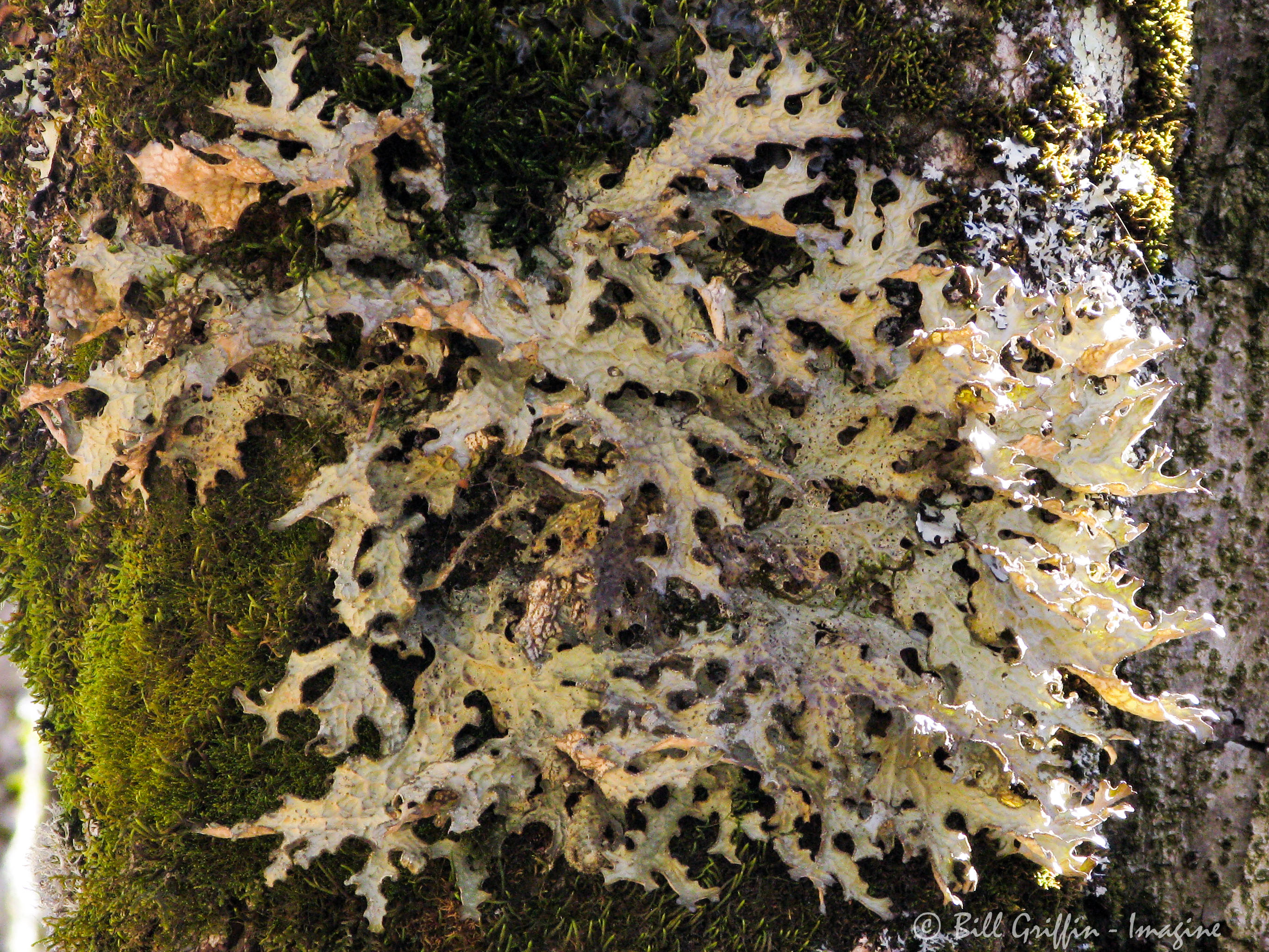
Now a couple asks me why I’ve raised my camera toward this one tree among the millions. Spreading from its bark are crooked fingers, hands of crones, veined, flattened, beseeching. “That’s lichen?” says the woman when I tell her. “I thought it looked like wind had plastered leaves against the trunk.” Exactly, that’s just how it looks. But it has no leaves!

Lobaria pulmonaria: Lungwort, you need a new name. Not even remotely kin to spiderworts, toothworts, liverworts, you are no wort at all – though your presence is atmosphere’s benediction. Draw deeply, my lungs! Exhale wonder! What shall we call you, Leafy without Leaves? Troll’s Greeting? Across the Aisle? Or maybe simply Lichen Welcome.

.     .     .     .     .     .     .
.     .     .     .     .     .     .

Three Candles
And a Bowerbird

I do not know why
the three candles must sit
before this oval mirror,

but they must. –
I do not know much
about beauty, though

its consequences
are clearly great – even
to the animals:

to the bowerbird
who steals what is blue,
decorates, paints

his house; to the peacock
who loves the otherwise
useless tail of the peacock –

the tail we love.
The feathers we steal.
Perhaps even to the sunflowers

turning in their Fibonacci
spirals the consequences
are great, or to the mathematical

dunes with ripples
in the equation of all things
windswept. Perhaps

mostly, then, to the wind.
Perhaps mostly to the bowerbird.
I cannot say.

But I light the candles: there is
joy in it. And in the mirror
also, there is joy.

Jane Mead (1958-2019)

.     .     .     .     .     .     .

These poems by Jane Mead appear in To the Wren: Collected & New Poems (Alice James Books, Farmington ME, © 2019). The book spans three decades of Mead’s life: running her family’s vineyards in Napa Valley; the death of her mother; her own cancer which ultimately took her life. All through her poetry there is a fierce seeking for identity – But always it’s either I or world. / World or I.  Relentlessly she seeks justice for the earth, for creatures, for the self. Poet Gerald Stern writes, “Jane Mead’s mission is to rescue—to search and rescue; and the mind, above all, does the work…. Her poems are a beautiful search for liberation and rebirth.” Nature is not something we write about; nature is what we are.

[Above poem excerpt by Jane Mead is from In Need of a World.
Three bright yellow lichens of the Smokies found at Newfound Gap:
= Xanthomendoza weberi
= Caloplaca falvovirescens, “Colonel Mustard”
= Caloplaca flavocitrina, “Continental Firecrackers”
++++  – – Species identification revised 2/28/2022 after review by Dr. Lendemer]

.     .     .     .     .     .     .

The Argument Against Us

The line of a man’s neck, bent
over welding, torchlight breaking
shadows on his face, hands cracked
into a parched map of fields he has woken –
the gods wanted us.

Think of their patient preparation:
the creature who left the rocking waves behind,
crawling up on some beach, the sun
suddenly becoming clear. Small thing
abandoning water for air, crooked body
not quite fit for either world, but the one
that finally made it. Think of all the others.

Much later, spine uncurls, jaw pulls back, brow-bone
recedes, and as day breaks over the dry plain
a rebellious boy takes an upright step
where primitive birds are shrieking above him.

He did it for nothing. He did it
against all odds. Bone of wrist, twist
of tooth, angel of atoms – an infinity
of courage sorted into fact
against the shining backdrop of the world.

The line of one man’s neck, bent –
torchlight breaking shadows on his face.

There was a creature who left the waves behind
and a naked child on a windy plain:
when the atom rips out into our only world
and we’re carried away on a wave of hot wind
I will love them no less: they are just how much
the gods wanted us.

Jane Mead (1958-2019)

.     .     .     .     .     .     .

The Geese

slicing this frozen sky know
where they are going –
and want to get there.

Their call, both strange
and familiar, calls
to the strange and familiar

heart, and the landscape
become the landscape
of being, which becomes

the bright silos and snowy
fields over which the nuanced
and muscular geese are calling.

Jane Mead (1958-2019)

.     .     .     .     .     .     .

To the Wren, No Difference
No Difference to the Jay

I came a long
way to believe
in the blue jay

and I did not cheat
anyone. I
came a long way –

through complexities
of bird-sound and calendar
to believe in nothing

before I believed
in the jay.

Jane Mead (1958-2019)

.     .     .     .     .     .     .
.     .     .     .     .     .     .

When Mike Barnett and I stopped at Newfound Gap (on US 441 smack in the middle of Great Smoky Mountains National Park) we were returning from the weekend lichens course at Tremont, part of the Southern Appalachian Naturalist Certification Program. We bow down in gratitude to John DiDiego, Education Director at Great Smoky Mountains Institute at Tremont, for convincing Dr. James Lendemer to teach this course. Dr. Lendemer is chief lichenologist at New York Botanical Gardens and literally wrote the book: Field Guide to the Lichens of Great Smoky Mountains National Park (which weighs 1.48 kg, not so much a “field guide” as an entire encyclopedia!).

Dr. Lendemer in his book names L. pulmonaria “Crown Jewel of America” – it is the biggest baddest lichen of them all. Thank you, James – we love lichens! Thank you GSMIT and SANCP and GSMNP. And thanks to all you little fungal hyphae, algal photobionts, cyanobacteria – you look mah-velous.

Resources:

More by and about Jane Mead at Poetry Foundation.

Field Guide to the Lichens of Great Smoky Mountains National Park, Erin A. Tripp and James C. Lendemer, University of Tennessee Press, Knoxville, © 2020.

Great Smoky Mountains Institute at Tremont, Southern Appalachian Naturalist Certification Program.

.     .     .     .     .     .     .

2019-02-09 Doughton Park Tree

Read Full Post »

[with poems by Dana Gioia, Eric Tretheway, Raymond Carver]

Do unto those downstream as you would have those upstream do unto you.
++++++++++++ — Wendell Berry

Upstream a hemlock is dying. Riparian giant, it drops needles, roots loosen, and during a thunderstorm it crashes. No more cloak of deep shade for the musical first order stream. Warming water can’t carry oxygen. At the next rainfall the current clouds with silt.

Stonefly and mayfly nymphs smother. Every gilled thing diminishes. Shiners depart their riffles or starve. Brookies follow.

We are all downstream. Maybe the hemlock was maimed by acid rain, sulfur oxides from a power plant 500 miles north. Maybe it couldn’t withstand the attack of invaders (adelgids) from 5,000 miles east. Maybe cycles of heat and drought had robbed its resilience.

All connected. Not a metaphor – a gut truth. That first order stream feeds the Chattahoochee and Atlanta’s millions drink. This morning I made my coffee from a cloud stalled over the Blue Ridge. We are all downstream. Watchful, listening, thirsty.

.     .     .     .     .     .     .

Stonefly nymph, shed skin after emergence of adult


.     .     .     .     .     .     .

Becoming a Redwood
++++ Dana Gioia

Stand in a field long enough, and the sounds
start up again. The crickets, the invisible
toad who claims that change is possible,

And all the other life too small to name.
First one, then another, until innumerable
they merge into the single voice of a summer hill.

Yes, it’s hard to stand still, hour after hour,
fixed as a fencepost, hearing the steers
snort in the dark pasture, smelling the manure.

And paralyzed by the mystery of how a stone
can bear to be a stone, the pain
the grass endures breaking through the earth’s crust.

Unimaginable the redwoods on the far hill,
rooted for centuries, the living wood grown tall
and thickened with a hundred thousand days of light.

The old windmill creaks in perfect time
to the wind shaking the miles of pasture grass,
and the last farmhouse light goes off.

Something moves nearby. Coyotes hunt
these hills and packs of feral dogs.
But standing here at night accepts all that.

You are your own pale shadow in the quarter moon,
moving more slowly than the crippled stars,
part of the moonlight as the moonlight falls,

Part of the grass that answers the wind,
part of the midnight’s watchfulness that knows
there is no silence but when danger comes.

from The Gods of Winter. Copyright © 1991 by Dana Gioia. Graywolf Press, St. Paul, Minnesota, http://www.graywolfpress.org. Reprinted in Poems for a Small Planet: Contemporary American Nature Poetry. Edited by Robert Pack & Jay Parini, A Bread Loaf Anthology, © 1993, Middlebury College Press.

.     .     .     .     .     .     .

Resurrection at West Lake
++++ Eric Tretheway (1943-2014)

Ringed by dark palisades
of spruce and this cold, black
bowl of water, I understand again
about words, how folded wings

can open, lift into flight:
love, when it batters us,
or death, when we sense its swoop,
a wendigo stirring in shadows.

This one-crow sky leans on my bowels.
My eyes are admonished
by witch fingers of naked poplars
forming their mute adjurations.

And social voices fall silent too:
crows, chickadees, whiskeyjacks
contain their clatter, squirrels
grow mute as pinecones.

Up on the ridge behind me
thin, bone-white remnants
of the deepest snowdrifts glow,
skeletal under the hackmatacks.

Out of these enigmatic evergreens,
around imponderable granite mounds,
beneath one flapping black rag
of crow, spring’s surge begins again.

from Poems for a Small Planet: Contemporary American Nature Poetry, edited by Robert Pack & Jay Parini, A Bread Loaf Anthology, © 1993, Middlebury College Press.

.     .     .     .     .     .     .

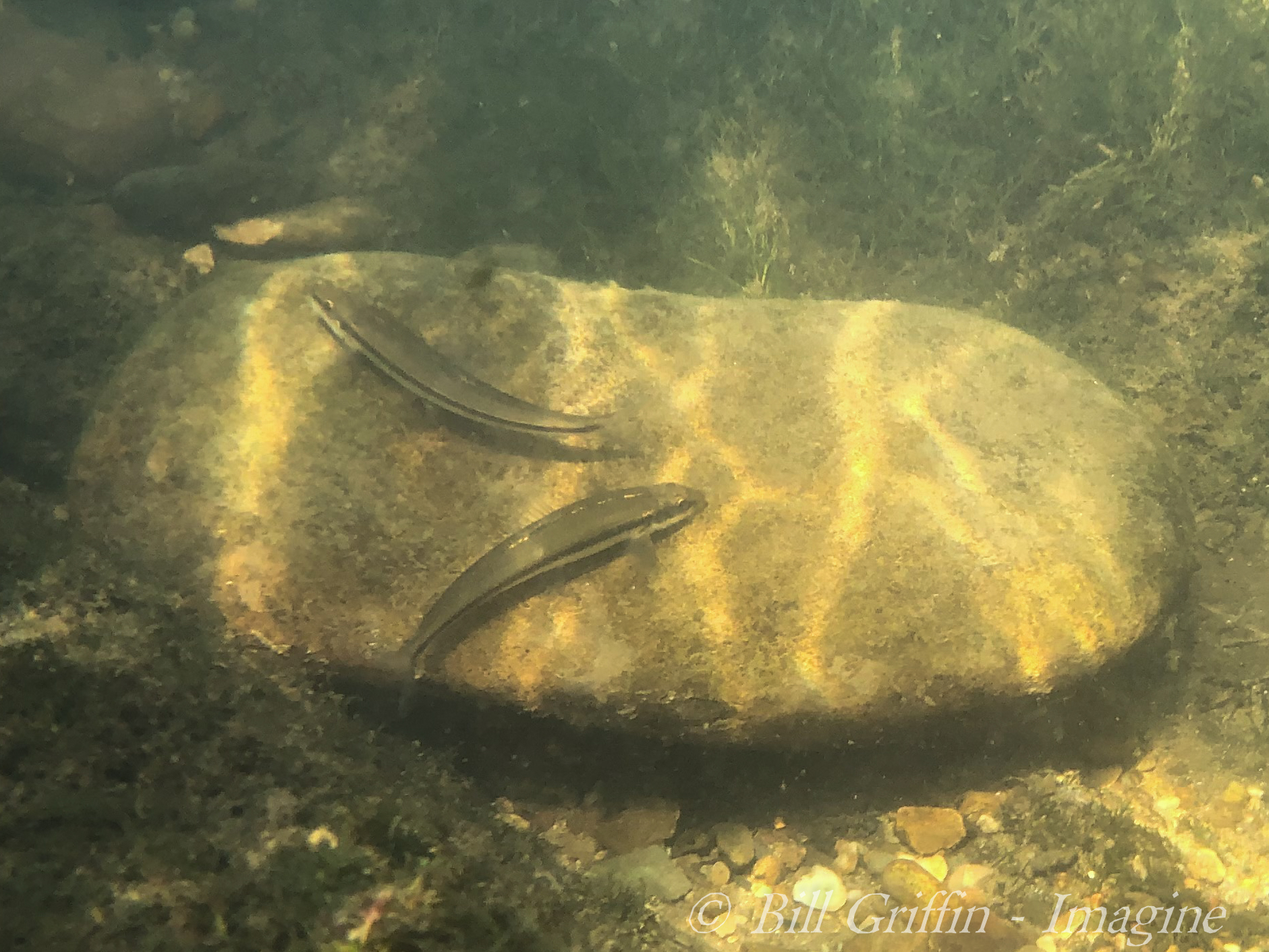
Whitetail Shiner, Cyprinella galactura

.     .     .     .     .     .     .

Three days is about the longest I could live without water. You too. Aquatic ecology – it’s all about us. For our final class exercise, Erin gives us twelve factors and has us draw lines to depict how each impacts the other. Swirls and waves and cycles. I used green ink to show beneficial effects and red for detrimental:


Add your own lines and circles!

.     .     .     .     .     .     .

The River
++++ Raymond Carver (1938-1988)

I waded, deepening, into the dark water.
Evening, and the push
and swirl of the river as it closed
around my legs and held on.
Young grisle broke water.
Parr darted one way, smolt another.
Gravel turned under my boots as I edged out.
Watched by the furious eyes of king salmon.
Their immense heads turned slowly,
eyes burning with fury, as they hung
in the deep current.
They were there. I felt them there,
and my skin prickled. But
there was something else.
I braced with the wind on my neck.
Felt the hair rise
as something touched my boot.
Grew afraid at what I couldn’t see.
Then of everything that filled my eyes –
that other shore hung with heavy branches,
the dark mountain range behind.
And this river that had suddenly
grown black and swift.
I drew breath and cast anyway.
Prayed nothing would strike.

from POETRY, June, 1986. The Poetry Foundation.

.     .     .     .     .     .     .

Measuring Turbidity — Little River


Measuring dissolved oxygen


Measuring pH


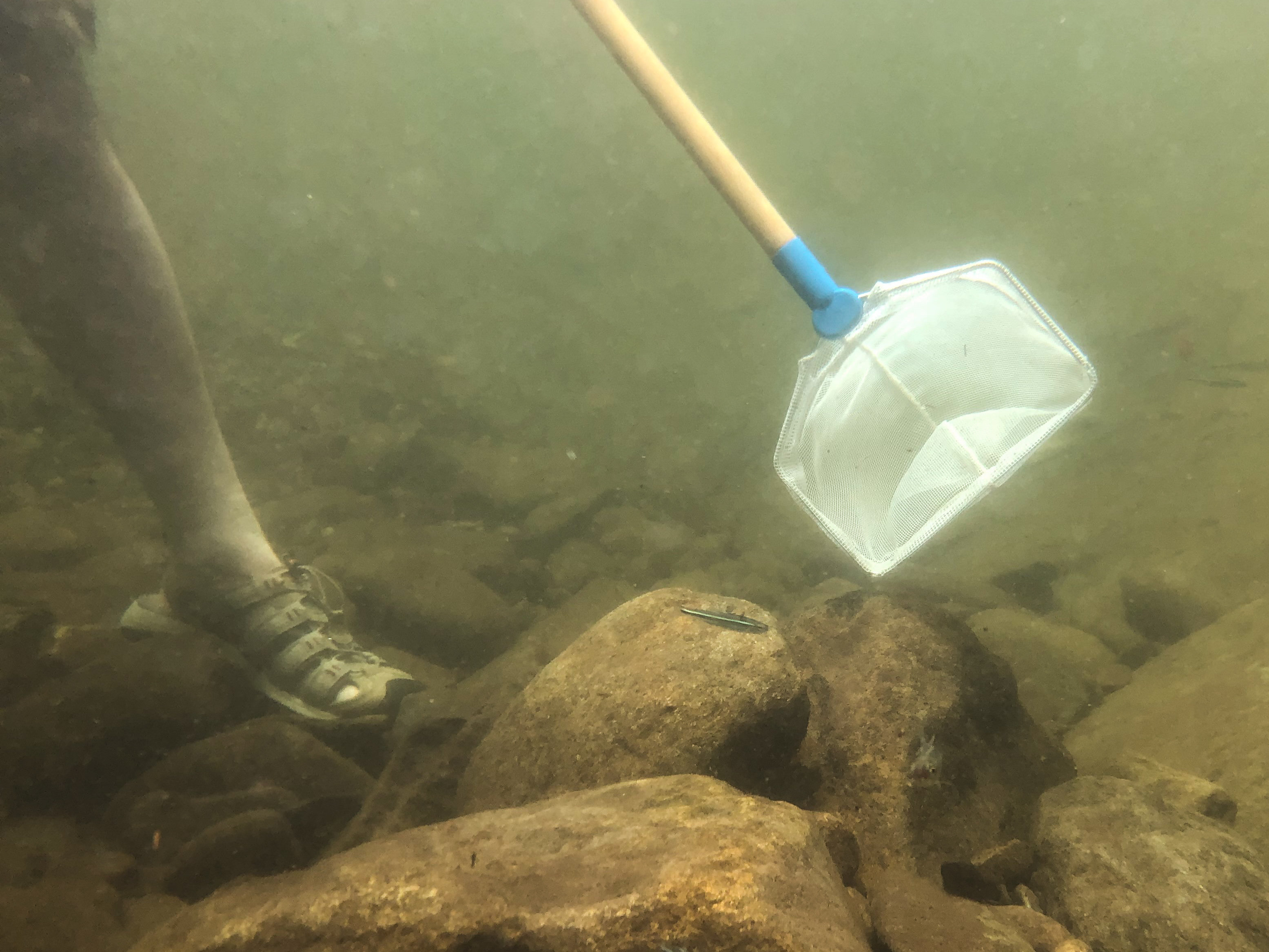
The Southern Appalachian Naturalist Certification Program is an adult education opportunity created and administered by Great Smoky Mountains Institute at Tremont and the University of Tennessee, Knoxville. Their mission – connecting people with nature. SANCP certification requires completing eight weekend-long courses; I took my first course, Birds of the Smokies, in May, 2017, and finished my final course, Aquatic Ecology, on July 25, 2021.

Many thanks to the ecology superpowers of Erin Canter, Manager of Science Literacy and Research and master of making connections; to John DiDiego, GSMIT Education Director; and to Jeremy Lloyd, Manager of Field and College Programs.

Field diagram by Bill Griffin. All photographs by Bill Griffin. Header art by Linda French Griffin.

.     .     .     .     .     .     .

2020-09-08b Doughton Park Tree

Read Full Post »

Warpaint Shiner – Luxilus coccogenis

[with poems by Robert Wrigley and Kenneth Rexroth]

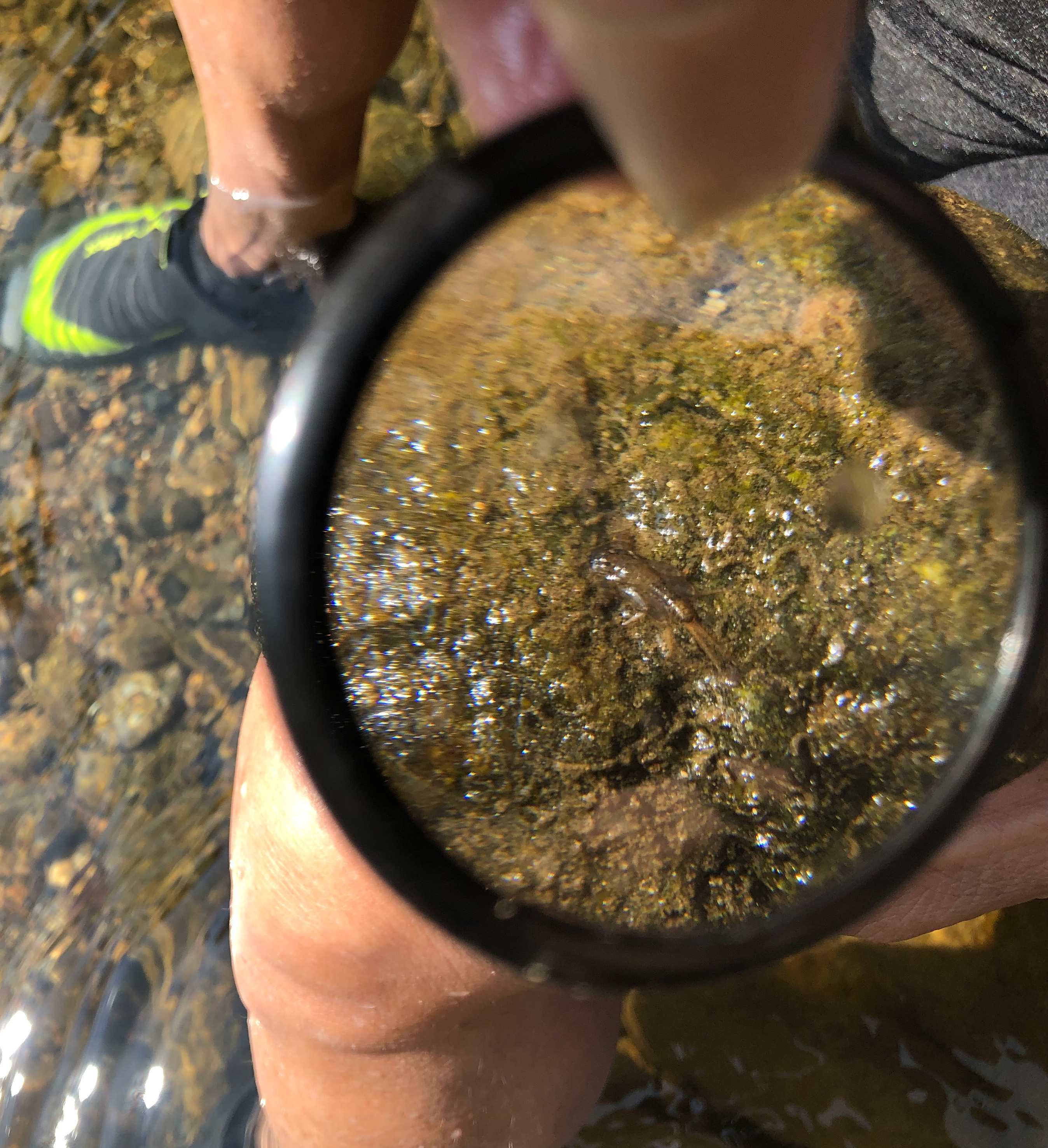
Rheophilic. Current loving. The shiners and darters face upstream while the swift clear river fetches them good things to eat. Nymphs of dragonfly, stonefly, alderfly have hooks on their feet to creep after prey across the slick stones. Salamander larvae protected in the cobbles breathe oxygen washed over their gills by the flow.

And the most unexpected, the strangest, the most fully adapted to current: the water penny – one with the rock, clinger and creeper, beetle larva, flexible carapace completely shielding it from the torrent. One among multitudes in the punch and spray, swirl and eddy, immersed in the flash and grasp of water from which all make their living.

All things flow. The first ancestors of all mayflies clung or crept or climbed or burrowed and now there are 600 species of mayfly. Symbols and images spin an unbroken thread which if I think about it I call thinking. Words whirl into new meanings. Today we dunk our faces in the Middle Prong to share its life. Tonight the current will fetch us good things to dream. Tomorrow will be a whole new river.

[* 600 species of Mayfly in the United States, 3,000 species worldwide.]

.     .     .     .     .     .     .

Anything the River Gives
++++Robert Wrigley

Basalt, granite, tourmaline, the male wash
of off-white seed from an elderberry,
the fly’s-eye, pincushion nubbins yellow
balsamroot extrudes from hot spring soil,
confetti of eggshell on a shelf of stone.
Here’s a flotilla of beaver-peeled branches,
a cottonwood mile the shade of your skin.
Every day I bring some small offering
from my morning walk along the river:
something steel, blackened amber with rust,
an odd pin or bushing shed by the train
or torqued loose from the track, a mashed penny,
the muddy bulge of snowmelt current.
I lie headlong on a bed of rocks,
dip my cheek in the shallows,
and see the water mid-channel three feet
above my eyes. Overhead the swallows
loop for hornets, stinkbugs, black flies and bees,
gone grass shows a snakeskin shed last summer.
The year’s first flowers are always yellow,
dogtooth violet dangling downcast and small.
Here is fennel, witches’ broom, and bunchgrass,
an ancient horseshoe nailed to a cottonwood
and halfway swallowed in its punky flesh.
Here is an agate polished over years,
a few bones picked clean and gnawed by mice.
Here is every beautiful rock I’ve seen
in my life, here is my breath still singing
from a reedy flute, here the river
telling my blood your name without end.
Take the sky and wear it, take the moon’s skid
over waves, that monthly jewel.
If there are wounds in this world no love heals,
then the tings I haul up – feather and bone,
tonnage of stone and pale green trumpets
of stump lichens – are ounce by ounce
a weight to counterbalance your doubts.
In another month there won’t be room left
on the windowsills and cluttered shelves,
and still you’ll see me, standing before you,
presenting some husk or rusty souvenir,
anything the river gives, and I believe
you will love.

from Earthly Meditations: New and Selected Poems by Robert Wrigley, © 2006, Penguin. Reprinted in The Ecopoetry Anthology, edited by Ann Fisher-Wirth and Laura-Gray Street, © 2013, Trinity University Press, San Antonio, Texas.

.     .     .     .     .     .     .

Common Snapping Turtle – Chelydra serpentina

.     .     .     .     .     .     .

Lyell’s Hypothesis Again
++++ Kenneth Rexroth (1905-1982)

An Attempt to Explain the Former
Changes of the Earth’s Surface by
Causes Now in Operation — subtitle of Lyell: Principles of Geology

The mountain road ends here,
Broken away in the chasm where
The bridge washed out years ago.
The first scarlet larkspur glitters
In the first patch of April
Morning sunlight. The engorged creek
Roars and rustles like a military
Ball. Here by the waterfall,
Insuperable life, flushed
With the equinox, sentient
And sentimental, falls away
To the sea and death. The tissue
Of sympathy and agony
That binds the flesh in its Nessus’ shirt;
The clotted cobweb of unself
And self; sheds itself and flecks
The sun’s bed with darts of blossom
Like flagellant blood above
The water bursting in the vibrant
Air. This ego, bound by personal
Tragedy and the vast
Impersonal vindictiveness
Of the ruined and ruining world,
Pauses in this immortality,
As passionate, as apathetic,
As the lava flow that burned here once;
And stopped here; and said, ‘This far
And no further.’ And spoke thereafter
In the simple diction of stone.

Naked in the warm April air,
We lie under the redwoods,
In the sunny lee of a cliff.
As you kneel above me I see
Tiny red marks on your flanks
Like bites, where the redwood cones
Have pressed into your flesh.
You can find just the same marks
In the lignite in the cliff
Over our heads. Sequoia
Langsdorfii before the ice,
And sempervirens afterwards,
There is little difference,
Except for all those years.

Here in the sweet, moribund
Fetor of spring flowers, washed,
Flotsam and jetsam together,
Cool and naked together,
Under this tree for a moment,
We have escaped the bitterness
Of love, and love lost, and love
Betrayed. And what might have been,
And what might be, fall equally
Away with what is, and leave
Only these ideograms
Printed on the immortal
Hydrocarbons of flesh and stone.

from The Collected Shorter Poems. Copyright © 1966 by Kenneth Rexroth. New Directions Publishing Corporation, http://www.wwnorton.com/nd/welcome.htm. Reprinted in The Ecopoetry Anthology, edited by Ann Fisher-Wirth and Laura-Gray Street, © 2013, Trinity University Press, San Antonio, Texas.

.     .     .     .     .     .     .

Stargazing Minnows grazing — Phenacobius uranops

Greenside Darter – Etheostoma blennioides

.     .     .     .     .     .     .

.     .     .     .     .     .     .

The Southern Appalachian Naturalist Certification Program is an adult education opportunity created and administered by Great Smoky Mountains Institute at Tremont and the University of Tennessee, Knoxville. Their mission – connecting people with nature. SANCP certification requires completing eight weekend-long courses; I took my first course, Birds of the Smokies, in May, 2017, and finished my final course, Aquatic Ecology, on July 25, 2021.

Many thanks to the ecology superpowers of Erin Canter, Manager of Science Literacy and Research and master of making connections; to John DiDiego, GSMIT Education Director; to Jeremy Lloyd, Manager of Field and College Programs; and to all the educators and staff at Tremont.

Psephenidae field sketch by Bill Griffin. All photographs by Bill Griffin.

.     .     .     .     .     .     .

Mayfly nymph – Order Ephemeroptera

Water Penny – family Psephenidae


.     .     .     .     .     .     .

2020-11-03a Doughton Park Tree

Read Full Post »

« Newer Posts - Older Posts »