Feeds:
Posts
Comments

Posts Tagged ‘Brockman Campbell Award’

 . 
[with poems by Jim Zola, Rhett Trull, Celisa Steele, Nancy Martin-Young,
Khalisa Rae, Joanie McLean
and a special feature by Felicia van Bork and ampydoo]
 . 
Learning to Live
 . 
For years I walked out and heard
rustling in the rhododendron
that blooms each spring and paper-mâchés
the patio with white petals.
 . 
Yet I’ve never seen wings or nest
or bolt of bird such as one might reason.
Just the flurried sound, a semaphore
of leaves and branch, that could be finch
 . 
or swallow, but isn’t.
Not coincidence, I’m convinced,
this signal more subtle than lightning
is grammar for my soul,
 . 
an insistence that I must find
a way to live among the small things
with bones like air and hearts
like small sledgehammers.
 . 
Jim Zola, winner of the 2023 Lena Shull Book Award of the NC Poetry Society for his manuscript It’s the Unremarkable that Will Last, which will be published by Redhawk Press. Learning to Live originally appeared in Rat’s Ass Review.
 . 
❦ ❦ ❦
 . 
Night before last Linda opened the final frontier of jigsaws. Galactically difficult, broad swaths of monochromatic nebulae, the merest quantum fluctuation in individual shapes – I fear that to complete this one I may have to boldly go where no one has gone before.
 . 
I almost give up before I even finish the border, its infinite deep unvarying black. Be logical here, Bill! I array the pieces by subtle color variation, columns and rows, and turn on all the lamps in the room. Still only cold inhospitable vacuum. Suddenly from the depth of blank stare I discover my fingers picking up pieces and fitting them together, six, then eight, little cellules of life spontaneously generating until logic again reaches in and shuts me down.
 . 
Is this how creativity works? A little bit Spock – analyzing patterns and calculating probabilities. A bit more Kirk – impulse, hunch, release to the flow of the subliminal. A prompt, a theme, a roadmap, all good – semper paratus – but I know for myself that the most likely moment for a line to leap up and embrace me is when I’m in free fall in love with a poem I’m reading. Creativity perches just at the periphery longing to show me the piece that will fit, the one I’ve been looking all along.
 . 
 . 
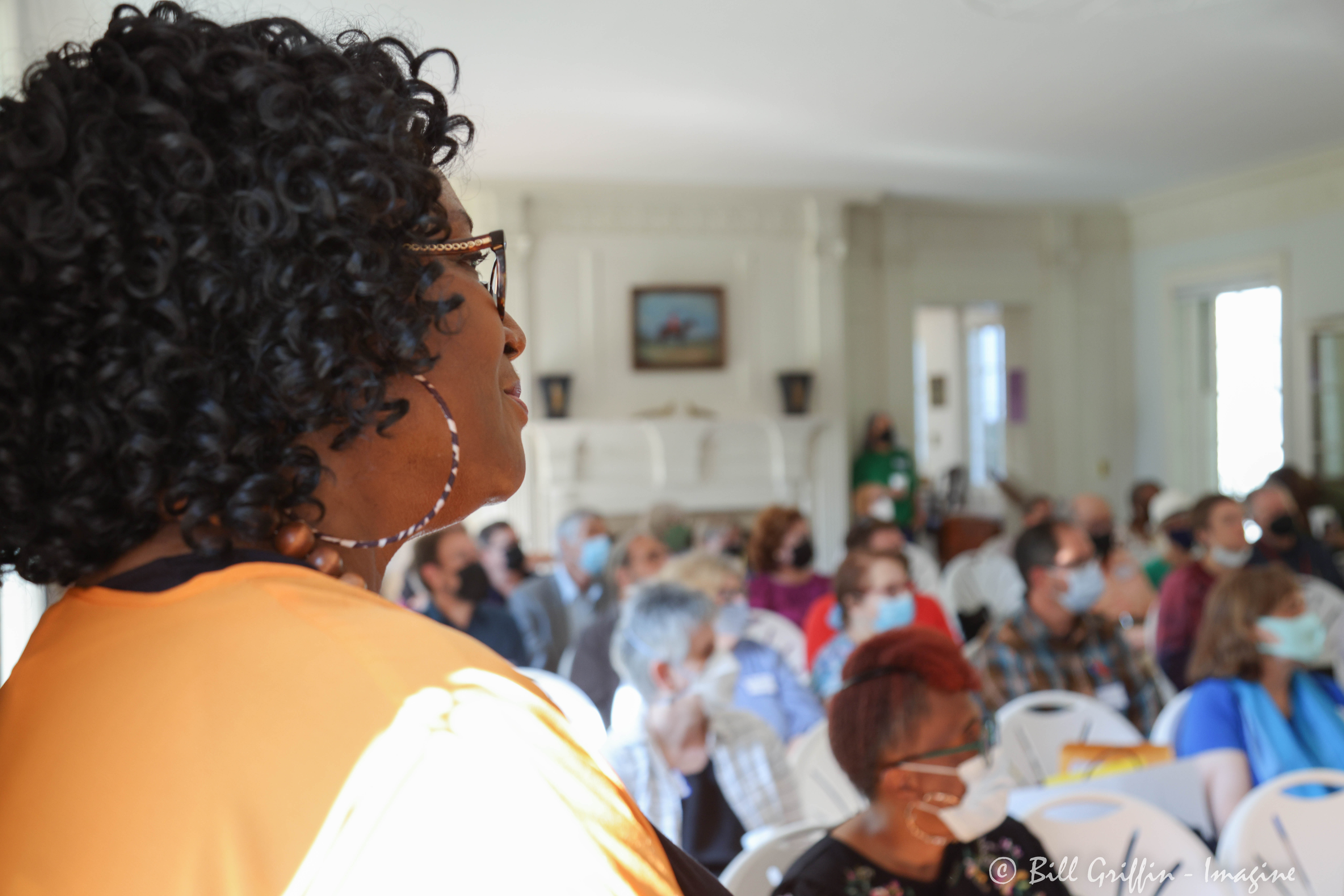
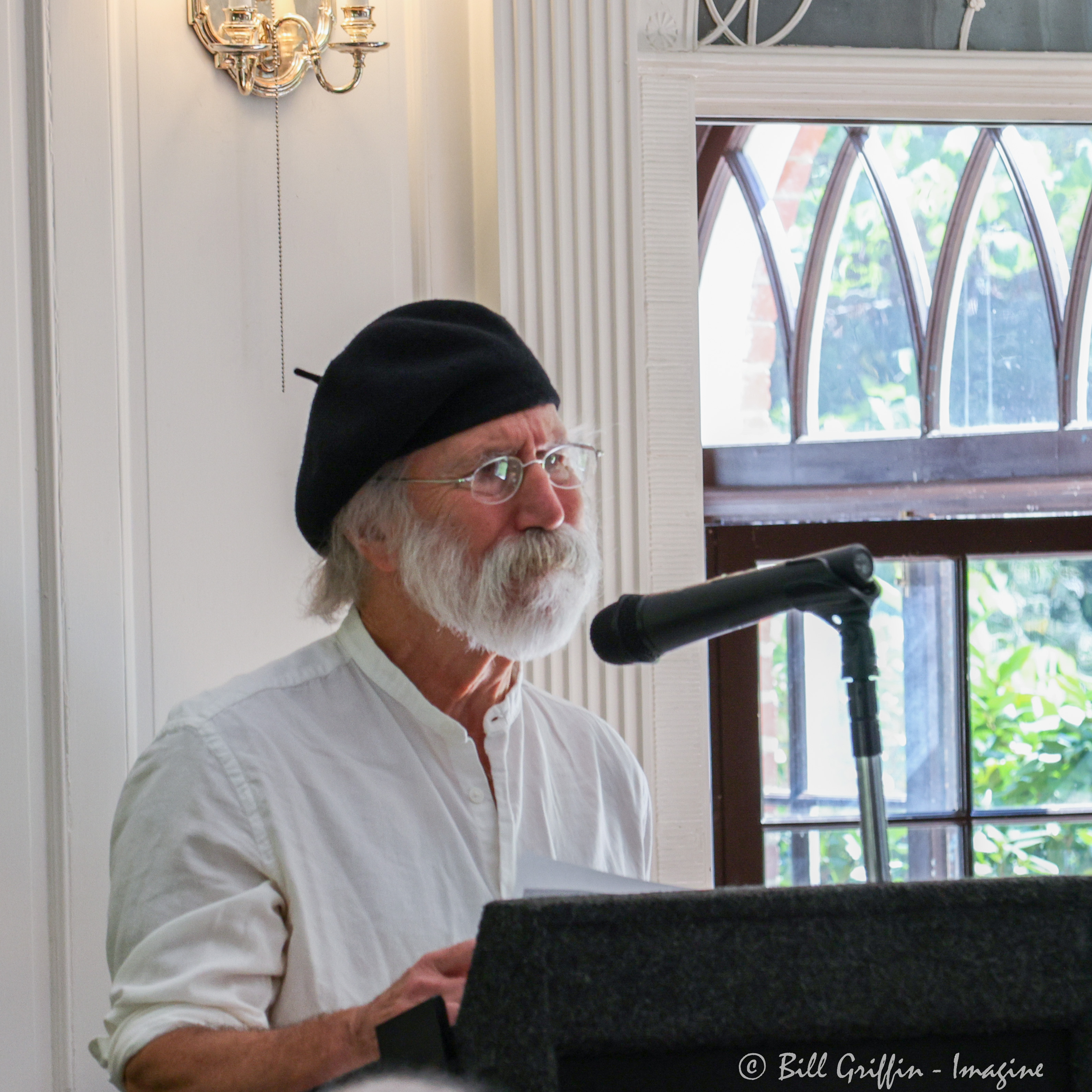
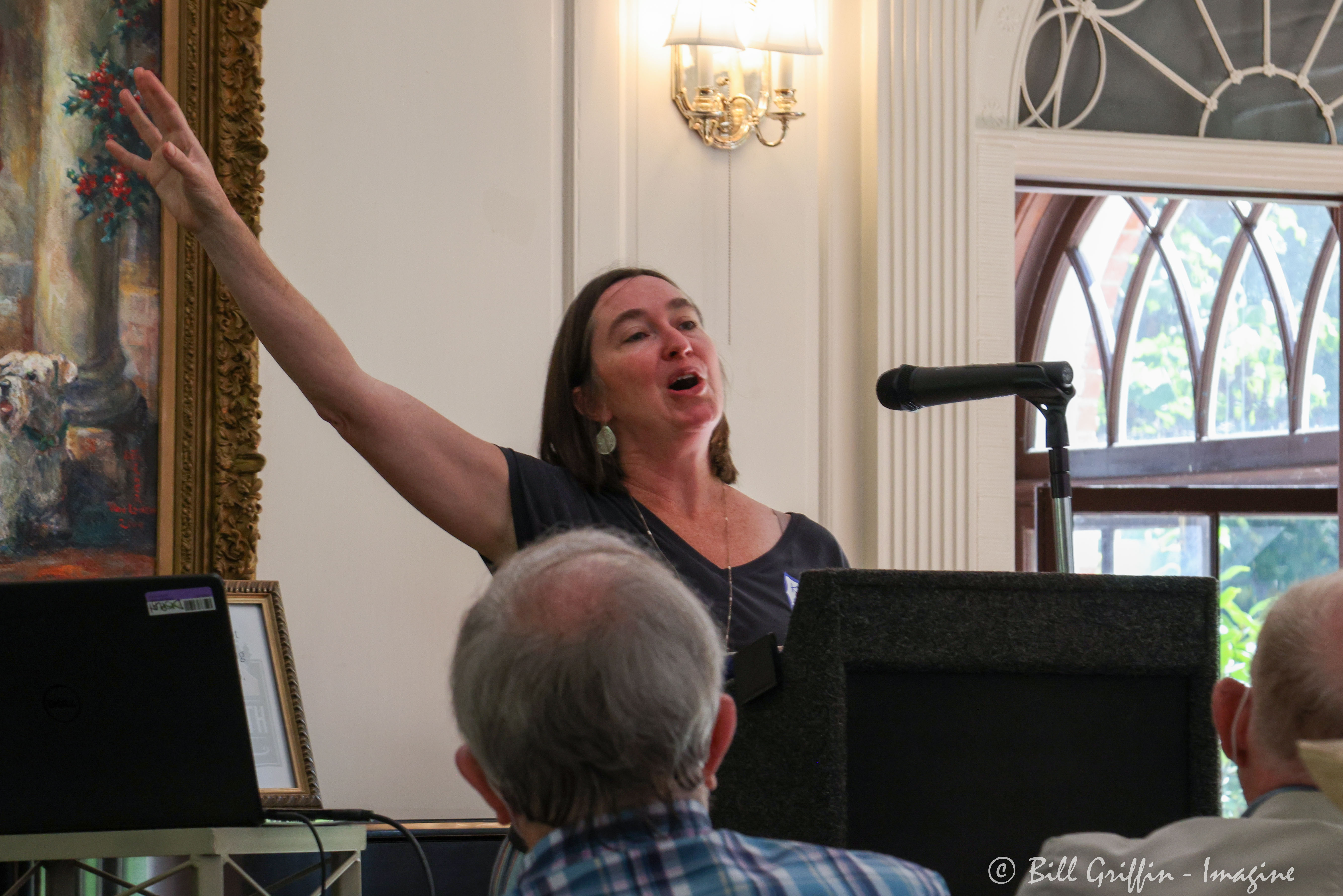
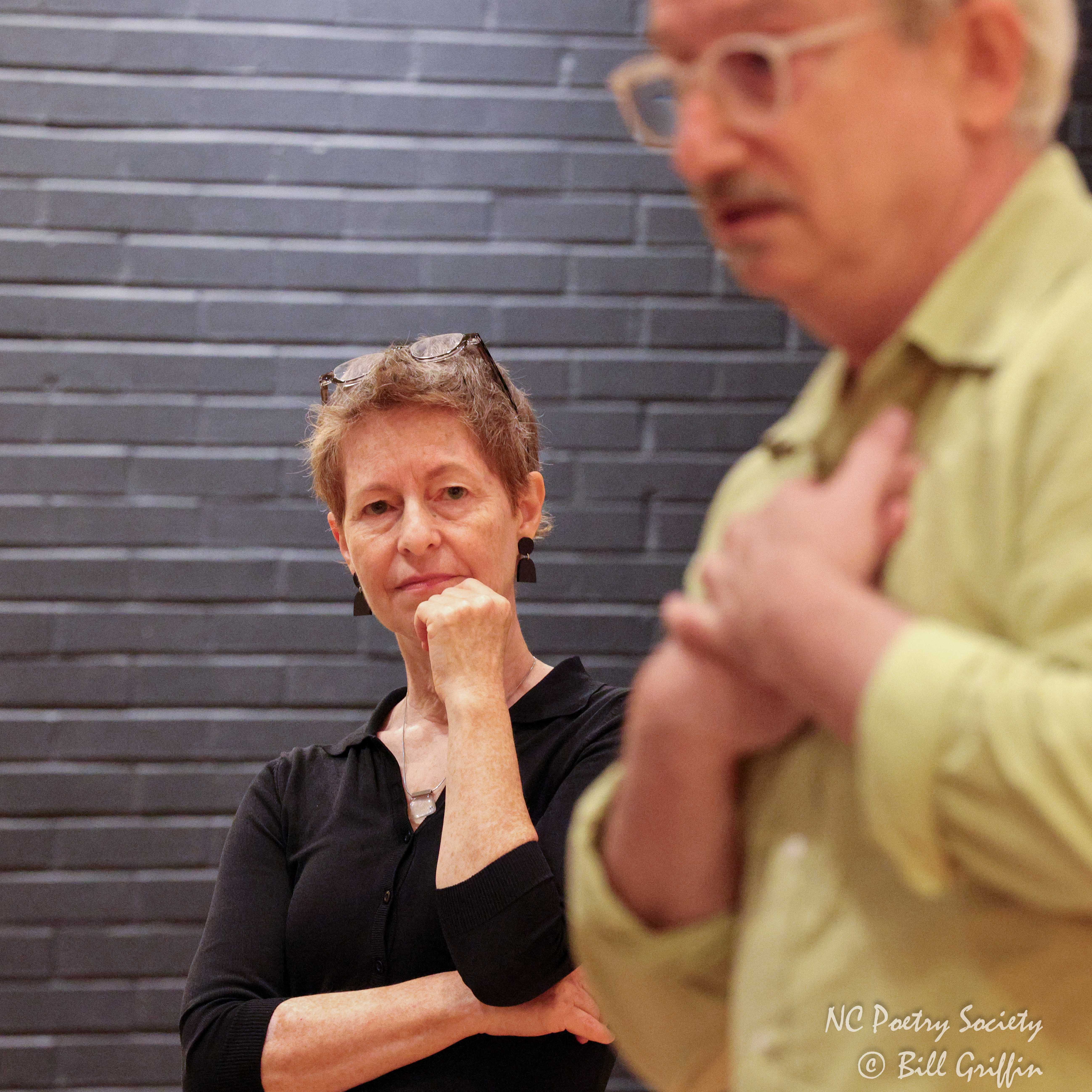
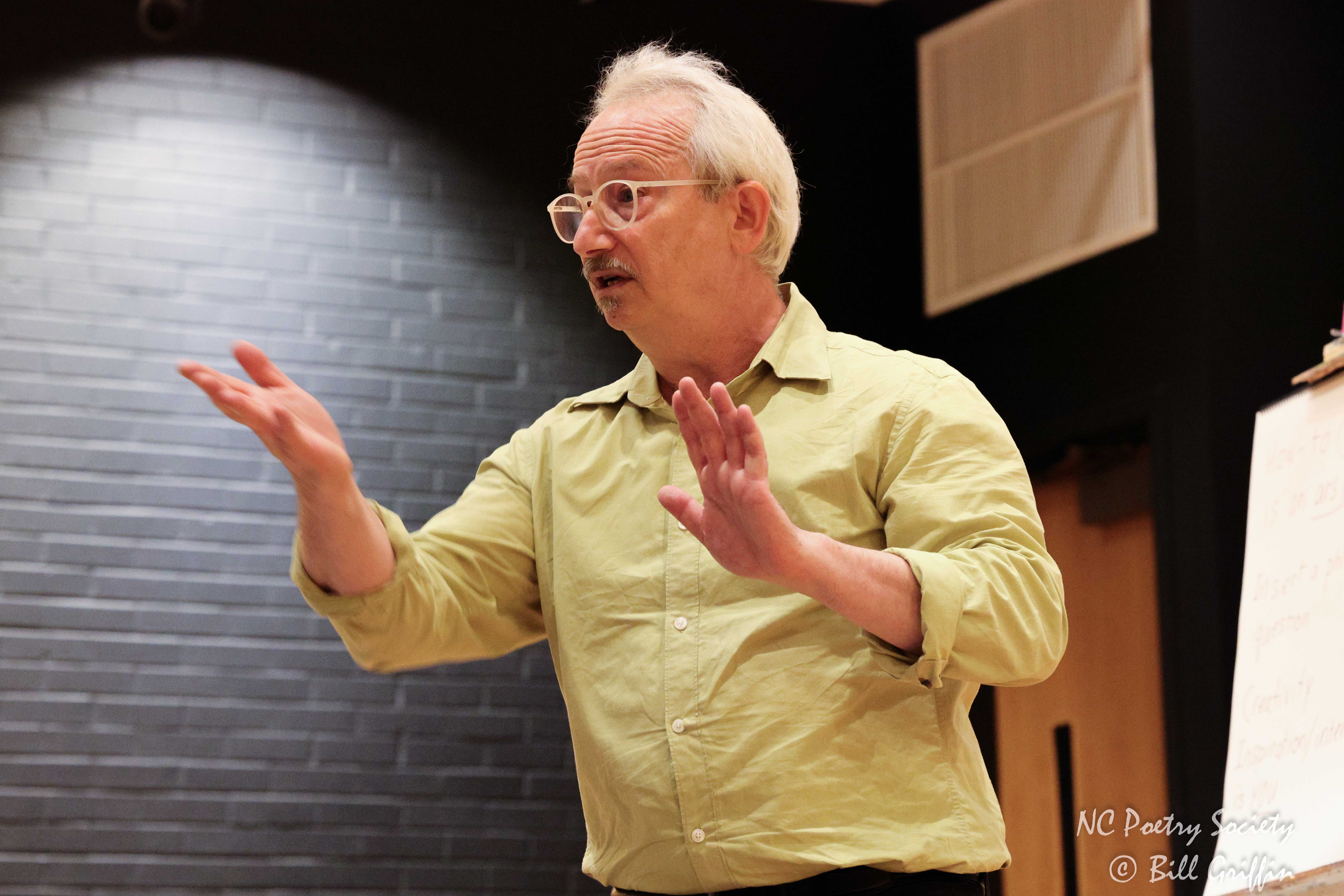
Felicia van Bork and Alan Michael Parker offer to tickle that little perching creature until you feel its firebreath in your ear. Draw a portrait without looking at the page or lifting your pen. Write five things you would never do and pick the most interesting. The two multi-creatives led The Best Creativity Workshop Ever at NC Poetry Society’s September 16 meeting at the NC Museum of Art in Raleigh. Felicia describes her life as a love affair with art. AMP describes his next book as a collection of flash fiction and Bingo cards. And when I asked if they would contribute to this feature on NCPS @ NCMA, I should have expected that they would send something unexpected.
 . 
Drawing Exercise No. 30
 . 
We come in peace.
We are the Are
Me.
Do not be a
Fraid.
Draw with us.
Together we take up
charcoal
and
Touch
the wall up high
Hi!
high as we can.
We draw down with force.
Use more force.
We step back we step forward.
We connect the vertical lines by drawing
Strong
horizontal strokes
again
again
Until we have made a fence a wall
To shelter us from the Fraids
Who will not cannot join the Are
Me.
Trace the outline of the person next to you.
Look, that outline is visible through the fence
That is a Fraid.
Now with your eraser erase the Fraid.
It won’t erase yes it smears.
It becomes more present yes the more we erase it.
Now it is inside the fence with us.
All the Fraids are inside with us.
 . 
Felicia van Bork @draw_felicia_draw
 . 
 . Alan Michael Parker @ampydoo
 . 
❦ ❦ ❦
 . 
 . 
 . 
 . 
❦ ❦ ❦
 . 
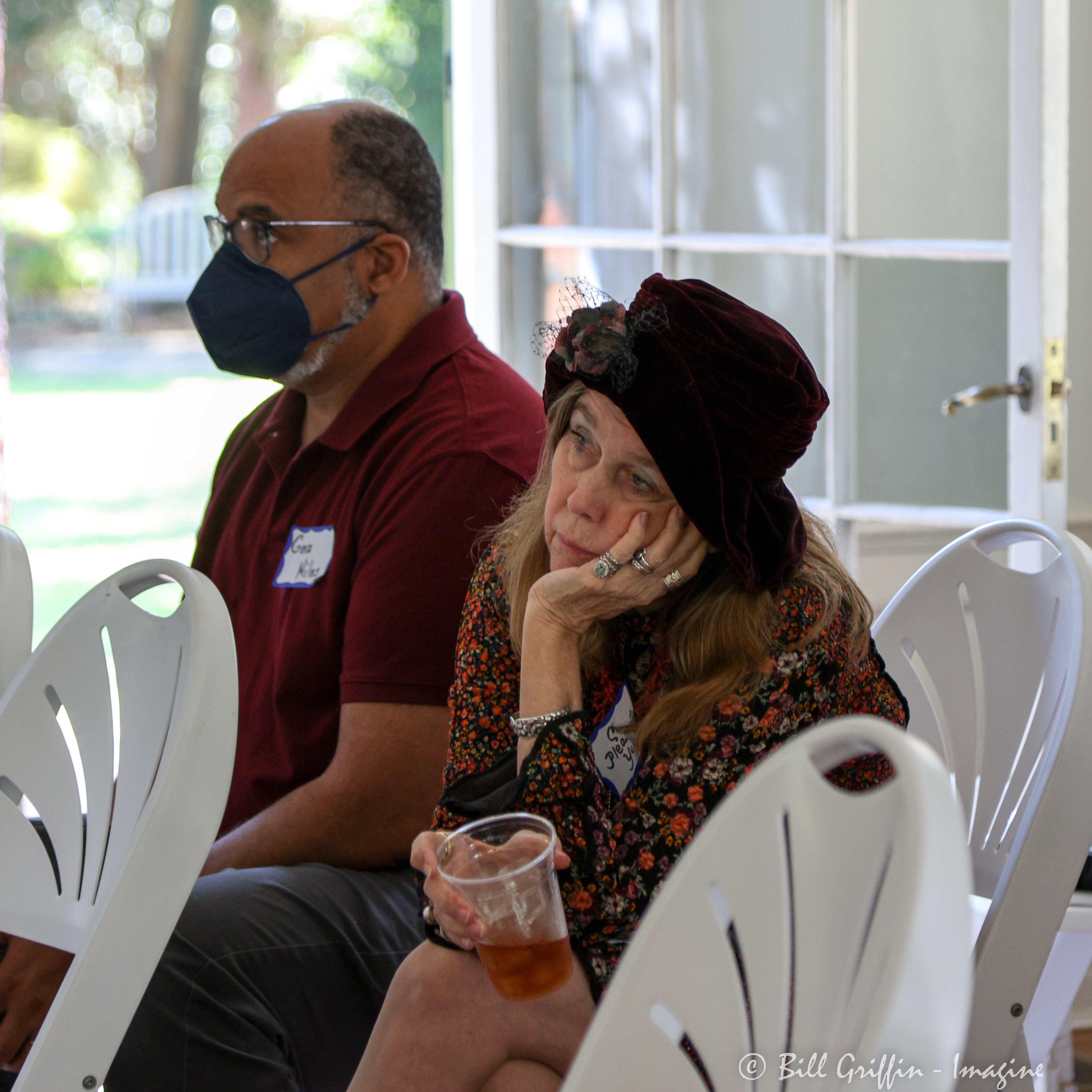
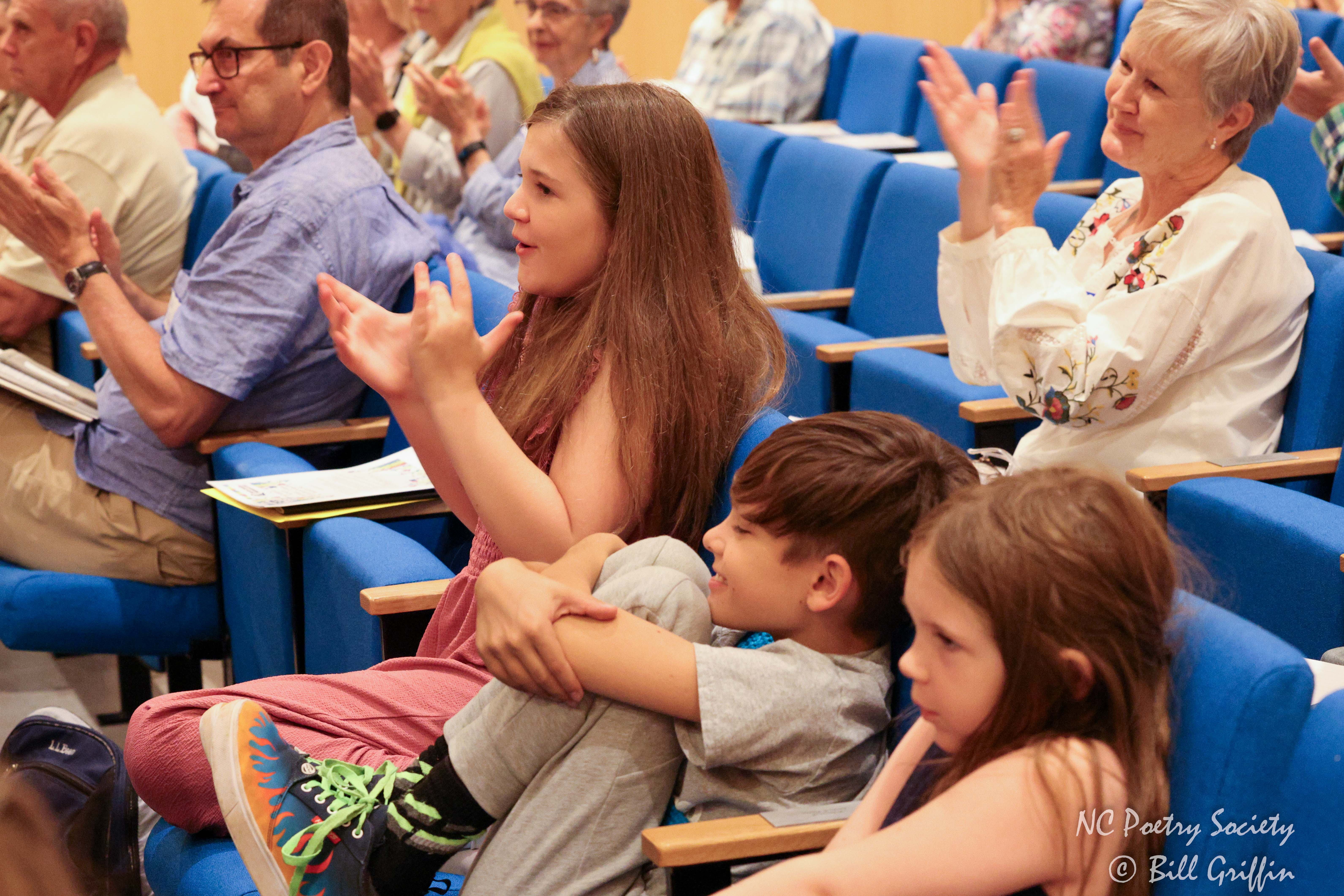
Each September the North Carolina Poetry Society meets to feature readings by winners of the year’s most competitive contests. This year for the first time NCPS has held this meeting at the North Carolina Museum of Art in Raleigh, with a morning of readings, the afternoon workshop, and an open air “pop-up” mic-less open mic hosted by Regina Garcia and Caren Stuart.
 . 
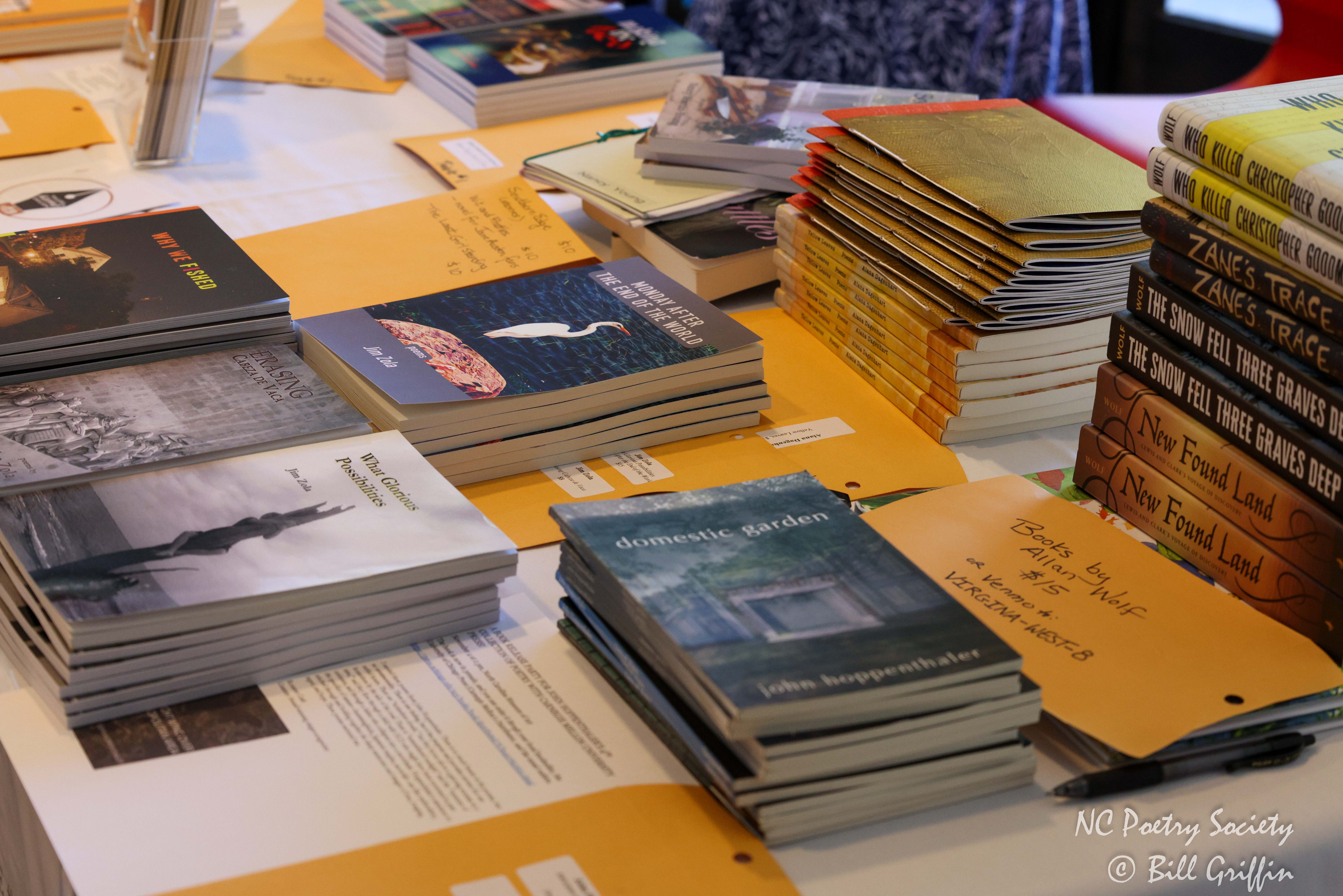
The 2023 Lena M. Shull Book Award for an unpublished manuscript from a North Carolina poet (coordinator Sherry Thrasher) goes to Jim Zola for his collection It’s the Unremarkable that Will Last; finalists are Nancy Martin-Young and Joanie McLean.      INFO
 . 
The Brockman-Campbell Book Contest is for the best volume of poetry published by a native or resident of NC in the previous year (coordinator Preston Martin); the 2023 winner is Joseph Bathanti for Light at the Seam, with finalists Eric Nelson for Horse Not Zebra and Katherine Soniat for Polishing the Glass Storm.      INFO
 . 
The Susan Laughter Meyers Poetry Fellowship (coordinator Steve Cushman) provides an honorarium and a week’s residency at Weymouth Center for the Arts and Humanities. The 2023 winner is Rhett Iseman Trull of Greensboro, with finalists Khalisa Rae, Celisa Steele, Anne Myles, and RK Fauth.      INFO
 . 
The Randall Jarrell Poetry Competition is sponsored by the North Carolina Writer’s Network coordinated by Terry L. Kennedy. Winning entries are published in storySouth and will be available to read there in the coming months. The 2023 winner is Joshua Martin, with finalists Maria Rouphail and Melinda Thomsen.      INFO
 . 
This is the first year for the Jaki Shelton Green Performance Poetry Prize, co-sponsored by NCPS and North Carolina Literary Review at East Carolina University (coordinator Devra Thomas). Winners’ videos will be posted online; the 2023 winner is Allan Wolf, with finalists Michael Loderstedt, Onyx Bradley, and Janet Ford.      INFO
 . 
 . 
❦ ❦ ❦
 . 
The Stars Align Themselves in Ancient Sisterhoods of Light
 . 
And Jade and I sat on the hood of her car
and didn’t mind the rain, the sun
that ticked on anyway, the sun would not go out.
And Megan held my hair back.
And Molly taught me cigarettes. And Sarah
kept her promise not to tell. And Riley told.
And Coach chased me down—night
we lost the playoffs and I’d planned
to kill myself, out the bus emergency door, took off
for the roof downtown—and she carried me to
Brittney’s and Brittney leant me dry clothes, underwear and all,
and let me sleep beside her, in the morning
bought us donuts, even though
I couldn’t eat, I couldn’t sleep.
And sometimes it was as if there were
a party thrown to save me, devout
committees formed, tasked
with just that job. And
 . 
sometimes there was no one
 . 
but wind off the ocean, the evening
all laid out before me like bedclothes,
and even the gleam in the eye of the wren
and the sunrise all red-dressed and boasting and once
there was this Great Dane, Charlie,
who knew—somehow he knew—
on my lap the full-grown anchor of his body, head
to my shoulder, world I didn’t want
to want to leave.
 . 
And Caleb sewed the captain star
I’d ripped from my letter jacket and
kissed me when I needed to be kissed, Bridge
of Sighs and all of Venice incandescent, inviting me
to drown. And kissing didn’t save me. And anything
might save me. And Karen understood.
And Joy did not. And Lauren grew delphinium,
she said, just for me. And Jenny—when the light spiked
sharp and I forgot the way to breathe—
held me for an hour
outside the party, outside everybody else’s ease
and laughter. And Corey found me in the field.
Her hair like smoke and ribbons. We didn’t need
 . 
to speak or touch, just watched the sky
until the bats delivered twilight. And Eli
deemed my pain divine and let me see
above his bed where he’d drawn a map of his
in a fever of blue ink after watching Fight Club, and did not
take my clothes off, even though he could.
And Brittney brought me everywhere and Brittney
kept me in her Jeep and Brittney did the talking
when I had no words.
 . 
And Nicky gave her lucky coin and Chris
the flannel off his back right after class, right
when I said I loved it. And Janelle at two a.m.,
no hesitation, let me in and shared the Irish whiskey
she’d been saving, lit us candles, until
we were the last, we were sure, awake alive.
And Leah steered us into safety, let me rest
across the back seat, Indigo Girls and yes,
I’m on fire, I’m on fire through the years.
 . 
And Jade couldn’t take it anymore
and turned away. And Heather sent an actual
disinvitation, her stationary tinged the palest pink,
but Lizzie patched me up
in the back of the cathedral and kept
her hand on me all night, even in her sleep.
And Holden stayed past visiting hours
and Vanessa, the night nurse, let him. And
under the oak tree, Stephanie
told me all her secrets.
 . 
And Brittney came each time I called,
even though her date, even though her finals, even though
I take and take and make myself the center
of each story. And Greta wrote me songs
and Katie said crawl in and
Mary did my portrait as a shadow.
And Adrienne pinned me down,
fiercest hug until I promised
not to jump. I didn’t jump. I didn’t
swallow the whole bottle. I threw out
the razor blade, even though I hid it first awhile
and touched it sometimes like a lover.
I’m lucky. And that’s all. I’m lucky
I am loved.
 . 
Rhett Trull, winner of the 2023 Susan Laughter Meyers Poetry Fellowship. Originally published in Litmosphere 2023 of Charlotte Lit.
 . 
 . 
 . 
❦ ❦ ❦
 . 
The Minister of Loneliness
 . 
has no children of her own to entrust
to an aproned au pair, no quick kisses
as she leaves each morning for work. And she
has no spouse who might grow melancholy
like temperamental orchids in the vaulted halls
of the silent house, who might open cupboards, search
neat rows of goods for a jar—just one—graced
with his wife’s precise fingerprints. And she has no
friends waiting for her call, no waggling dog
waiting to be fed. No, she was appointed
to this post because she could give everything
to this Ministry, prepared by the paper
she wrote in college—eons ago—on the geology
of loneliness that proves it doesn’t crumble
like sandstone, isn’t fissile as shale. No,
it’s smooth, she showed, and cold as polished
marble. The kind that won’t be carved into the face
of someone beloved. The kind that remains
blank and empty and clean
as counters in a kitchen where no one ever cooks.
 . 
Celisa Steele, finalist for the 2023 Susan Laughter Meyers Poetry Fellowship. Originally appeared in Southern Poetry Review.
 . 
 . 
 . 
❦ ❦ ❦
 . 
A Suitable Place
Oakwood Cemetery, Raleigh, North Carolina
 . 
I: Pick Up the Wind Phone
First, choose to wander a path with the dead
through the granite gate, past the stone bridge.
There are no signs to point the way.
 . 
Scan the landscape until you notice it, study
how it stands, nearly hidden in a hollow
downhill from the Gothic House of Memory:
a spare wooden booth, its rotary phone
discreetly placed for the disconnected.
 . 
Lift your hand to hold the heavy receiver.
Take a breath and dial the old exchange—
the one made up of words and numbers,
the one you still remember from a time
long before cell phones and contact lists.
 . 
Say hello. Speak their names. Then wait.
Share the news about the house or the baby
or the oak tree that fell in last week’s storm.
Ask forgiveness. Listen for the wind to answer
you, who are left behind, who seek an open line.
 . 
II: Scan the Landscape
Deep shade, open lanes, no traffic,
perfect for power-walking past cool stones
and twisted angels or treading up the hill
of Gettysburg dead, mostly Confederates
come home at last, but six who wore blue
unresting, out of place, as I am.
 . 
Downhill, a doe browses,
tearing faded roses from a funeral wreath.
Twin headstones pop from too-green grass,
names and birthdates freshly carved,
death dates empty, blank and patient.
Most graves are full, but life lingers
on the landscape’s edges.
 . 
While newer graveyards raze markers
to the ground, Oakwood’s monuments tower.
Workers wield weed-whackers daily,
keeping grass at bay. A toy truck,
a mini bottle of Jack—mementos left behind
on plots prove to the living that the dead lived too.
 . 
Today only I
stand in the echoing House of Memory
remembering my father, hacking his last.
His ashes kill time in my sister’s hutch.
Would he rest easy here beneath the oaks?
 . 
I’m a transplanted Yankee
trying to live long,
but in the end
I think I’d like it here
near these protruding stones
that someone has to rake around.
I’d like to have my daughter trace
my name with her finger, leave
a bottle of Malbec and two glasses.
 . 
Nancy Martin-Young, finalist for the 2023 Lena Shull Book Award. This poem first published in Flying South, 2023
 . 
 . 
 . 
 . 
❦ ❦ ❦
 .  . 
Circus Acts: No More Black Girl Magic
 . 
Black woman,
 . 
This world will make you circus,
freak show, tightrope walker,
contort your name from Saartjie
to “Sara Bartman,”
 . 
Hottentot Venus—stage performer.
Look, how they abracadabra the
royal exploitation of your form.
 . 
Watch them dissect your broad
bottom saw you into science experiment.
 . 
Call your mending—magic
your root balm and salve a work
of the devil–sorcery. Go out the trap
door, come back in the body
of Beyoncé—prized possession,
they will spit-shine the stage for you again.
What a spectacular woman—
 . 
two-headed and omnipresent
one foot here, one foot in Houdini-state.
Your magic trick is: “Look at all the wonder
I can do with two hands and twenty-four hours.”
When people say, “That’s Black Girl Magic.”
say, “I have no magic for you. I make meals
 . 
from crumbs, cast demons with just
my tongue, envision possibility
from potential.” That makes me
 . 
scientist, inventor, chemist—
spiritual being. Tell them this is
 . 
not super, this is survival.
When they call you hero,
when they hand you the cape anyway,
ask, “Haven’t I carried enough?”
 . 
When they call your strength otherworldly,
say, it is Venus rising
within me, nothing more.
 . 
Khalisa Rae, finalist for the 2023 Susan Laughter Meyers Poetry Fellowship. This poem is from her debut collection, Ghost in a Black Girl’s Throat (Red Hen Press 2021).
 . 
 .
 . 
 .
❦ ❦ ❦
 . 
Into My Field
 . 
Pete the old bay horse
called to me this morning
 . 
not so that I could hear
but so that I could not look away
 . 
he stood apart from the others
as an old horse will
 . 
his ribs showed a bit
as an old horse’s will
 . 
his russet face
with the white blaze
 . 
held so still– arrested while grazing
held my gaze without effort
 . 
and his black mane so lush
so thoroughly tossed
 . 
gave him a touch of wild
that wild that gathers these days
 . 
these fall days – translucent days
days of transubstantiation
 . 
all those things
in your hands and your lap
 . 
put them away
come into my field
 . 
and stay this time
till you are cold and hungry
 . 
and even then
stay
 . 
Joanie Mclean, finalist for the 2023 Lena Shull Book Award. Her manuscript, Like Wind Into Air, received honorable mention and has been accepted for publication with Redhawk Press.
 . 
 . 
❦ ❦ ❦
 . 
 . 
 . 
 . 
 . 
 . 
❦ ❦ ❦
 . 
 . 
Read Full Post »

[with poems by Kimberly O’Connor]

We walk out of the pines and hear it, a throaty chuff and grumble from somewhere across the corn field. A plume of dust and chaff is one clue but the clincher is the field’s gnawed border twelve rows wide, a swath of brittle stalks and husks eaten and spat out. And a scatter of yellow kernels in the weeds.

After we cross the road our trail re-enters the woods but still parallels the field. The combine is laboring well out of sight but its growling swells and fades. Linda and I hike this particular bit of Mountains-to-Sea trail every week and we’ve been wondering why these acres have been standing so long unharvested. Great day for an answer, this Wednesday before Thanksgiving – school’s out! – and the grandkids with us. Hardwoods now. In the leafless shadows we can smell corn dust even when we can’t see the field through the undergrowth. Saul hangs back to talk philosophy and politics with Linda while Amelia skips ahead and dares me to jump over every rock and root.

At our turning-back-to-the-car point, the trail branches north to Grassy Creek and south into the corn field. Machinery noise has receded; I want to see the carnage. We all walk up the red clay bank. Most of the stalks are now stubble but a few have been pushed over, unconsumed. I wander a few rows and pick up dry ears to show Saul and Amelia. Moldy toward the silks, but mostly each ear is clean hard kernels clinging to cob. I put a few nuggets in my pocket. Saul keeps two unshucked ears to carry home for evidence.

Back at the road crossing the uproar reaches its crescendo. We see the top of the cab as it approaches, pulling rows of stalks into its jutting incisors, and then it finishes its row and roars past us. A man and his son sit high in the glassed-in booth! They wave back to us and we watch for a few more minutes as more of the field is mown down.

When we turn back into the woods, Amelia says, “I’m sure glad they weren’t mad at us for taking some of their corn.” Small miracles – and another is that on today’s hike we heard nary a complaint from the kids even when I confessed I’d forgotten to bring the snacks.

❦ ❦ ❦

Old Dominion

Remove arteries,
veins, and clotted blood
around heart

was the start of a recipe
for chicken pie in
a 1920’s cookbook

I found and read in the house
of friends we were staying with
in Charlottesville. It was

an heirloom. Their whole house
was antique, old fashioned:
mason jars, strawberries

resting in colanders, milk
in a white porcelain pitcher.
Worn embroidered linen dishcloths.

She canned. He cut wood
for fires in winter but
this was summer. The air

almost tropical, unbreathable.
Azaleas. Wisteria. Roses.
When I breathed in, it hurt.

The house hurt me and
I didn’t know why.
Everything was white.

Clotted blood around heart
I wanted that cookbook.
I almost stole it. I was

a terrible houseguest. I wanted
to go home. I cried beside
the clawfoot bathtub

throughout the afternoon.
I wanted to go home and
I wanted to own that house.

Kimberly O’Connor
from White Lung, Saturnalia Books, Ardmore PA, © 2021


❦ ❦ ❦

Kimberly O’Connor’s poetry is the surgeon’s dispassionate blade. Lie straight and still and watch the blood well up. Yes there will be pain, yes invasion, yes you are vulnerable, but what is cut from you may offer your best chance to live.

Kimberly O’Connor’s poetry is the surgeon’s passion and point of compassion. Yes there is pain in our world, both of us know it, both feel it, both of us have at times caused the pain. But here is our best chance for hope, for a world where we dig out the pain, find its roots, put it in a place where we can all see it for what it is. Maybe it won’t have to hurt us forever.

In White Lung, Kimberly explores every painful vein and clot of her Southern heritage and upbringing. She doesn’t flinch, although she cries and so do we, her readers. Several of her poems share the same title, The History of My Silence, which proclaims one of the major themes of the book and can be extended to the silence of not just one individual but of our society and culture: by extension, the silence of our history. Not only are the individual poems tense with emotion and meaning, but the poems communicate with each other to weave a personal story, and interconnect to bring their painful, hopeful, glorious epiphanies into masterful wholeness.

The North Carolina Poetry Society awards its annual Brockman-Campbell Award to the best volume published by a North Carolina writer in the preceding year. Kimberly O’Connor and White Lung are the winner for 2022. Kimberly is a NC native who lives in Golden, Colorado and has over 20 years of experience teaching and working with writers ages eight to adult. This is her first book.

[More information about the Brockman-Campbell Award, White Lung, and another poem by Kimberly O’Connor, available here: ]

❦ ❦ ❦

Portrait of a Lady

her father an electrician her mother
a hairdresser (it’s not that simple)
(you want her to be nice
and quiet) she’s a girl reading
in her tiny bedroom in the trailer
she does not say a word

you don’t want to read the word
n_____ but there it is her mother
says it her father says it the trailer
echoes with its two-syllable
thud & poison you can read
(here) where she wrote it in her diary a nice

(straight white) girl straight hair straight A’s nice
and quiet (like you want) says not a word
sits in the beauty shop reading
spinning a chair while her mother
cuts hair (she imagines she is special)
they drive the dirt road to the trailer

they move out of the trailer
build a house (big wood nice)
when her father wins a sweepstakes
they look at the letter repeating the words
over and over (it’s true) her mother
gives her the letter to read

there it is in red
(one hundred thousand dollars) the trailer
becomes a memory her mother
moves the shop to the new nice
spare room the ladies get shampoo & styles words
hum white nose white ladies scissors

swish you can see it (it’s simple)
a whit girl grows up in the South its red
& pink mimosas dripping scent the words
they say there taking root trailing
tendrils in even nice
girls’ minds (everyone says them even mothers)

Kimberly O’Connor
from White Lung, Saturnalia Books, Ardmore PA, © 2021


❦ ❦ ❦

Untitled (By the End)

By the end, we won’t remember what
happened when. We’ll remember hardly
any of it. The only thing that makes it

bearable is all the blossoming. The trees
turn white, then green. What unfolds
for me unfolds secondhandedly.

While they’re injecting the midazolam,
I am watching little girls in black
leotards play tag. Or it takes longer

than I think and we are already driving
home for dinner. But let’s go back
to before that. There was a murder.

It was violent. It was not an accident.
A young woman died and a young man
went to prison. Elsewhere, unrelated,

I want to be a poet. I fall in love with
someone. He becomes a lawyer.
We become a mother and a father.

We move to Denver. My husband meets
the young man in prison. He’s no longer
young. He becomes a kind of friend.

Of course this takes years. I learn things
like in supermax, the inmates are required
by law to have access to one hour

of sunlight per day. On death row,
the light though a skylight counts.
The men can’t touch their families

or each other. The day before their
executions, their mothers cannot hug
their sons good-bye. No one cares about this.

Why should they? Their victims’ parents
didn’t get to hug their children before—
yes. That is correct. So what’s wrong

with me? My husband sends his client books.
Should I say his name? He likes
vampire books. Mysteries. Thrillers.

When my husband calls him with the news
that the last appeal has been denied,
Clayton says Have a good weekend

when they hang up the phone. My husband
flies to Oklahoma City. I wait.
Amelia’s dance class is in a church.

I sit in the sanctuary and imagine
I am holding Clayton’s hand.
I am ridiculous. But my hand feels

warm for a minute. My husband calls
and he is weeping. Or he is furious.
He’s not dead yet, he says.

They kicked us out. They closed
the curtain and they made us leave.
It’s the end of April; everything’s in bloom.

It snows, then the sun comes back.
By summer, we should feel better.
By autumn, we might forget.

Our garden grows. We harvest. I walk
through the alley carrying vegetables.
When I get home and dump out the cucumbers,

I’m filled suddenly with joy. I pirouette
around the kitchen and imagine Clayton
is dancing with me, his spirit, anyway.

I think he is. I wish for it. I imagine
his victim’s mother wishing deeply
for my death, and I don’t blame her for it.

Kimberly O’Connor
from White Lung, Saturnalia Books, Ardmore PA, © 2021

❦ ❦ ❦

❦ ❦ ❦

2020-09-08b Doughton Park Tree

Read Full Post »

[with poems by Kim O’Connor, AE Hines, Cheryl Wilder, Yvette Murray]

The North Carolina Poetry Society was organized in 1932 at the Charlotte home of Edna Wilcox Talley. The six members present elected Zoe Kincaid Brockman, well known poet and women’s editor of the Gastonia Gazette, as the organization’s first president. Could those six writers have imagined that ninety years later their idealistic endeavor would be thriving, with a membership of over 500 and sometimes more than a hundred persons from all across the state attending meetings? That through the decades the North Carolina Poetry Society would be the forerunner of additional writers’ organizations such as the Poetry Council of North Carolina, NC Writer’s Network, and NC Writer’s Conference, not to mention numerous local and regional groups in NC towns and counties? That poetry would be happening in schools with Poetry Out Loud, in shop windows and on buses through Poetry in Plain Sight, in countless books and journals published in North Carolina every year?

Zoe Brockman, Edna Talley, and friends knew the truth long before Doris Betts coined the phrase: North Carolina is the “writingest state.” Perhaps they wouldn’t have expressed it so eloquently but they would have agreed with Ed Southern, NC Writers’ Network executive director, that “one cannot spit, piss, or throw a rock in the Old North State without hitting a writer.” I like to believe those women of an earlier time would have been pleased but unsurprised at the many poets inducted into the NC Literary Hall of Fame after its inauguration by Sam Ragan at Weymouth Center in 1996; they especially would have applauded when all the inductees in 2014 were poets – Shelby Stephenson, Betty Adcock, Ron Bayes, Jaki Shelton Green. The Charlotte Six would no doubt have volunteered to serve as mentors in the Gilbert-Chappell Distinguished Poet Series, helped set up tables at the Sam Ragan Poetry Festival, and host open mic on Zoom during the pandemic. We who participate in the North Carolina Poetry Society of 2022 benefit from their high ideals, keen vision, and energy – we uphold a worthy tradition, and we have embraced the creativity, inclusion, and diversity that now make this tradition our own.

NCPS gathered to celebrate its 90th anniversary on September 17 at Weymouth Center for the Arts & Humanities, Southern Pines, NC – the first meeting in person in two and a half years. We look back and we look forward. We pay tribute to those who have taught and inspired us, and we open ourselves to the newest voices among us. We listen to the words of poets who dedicated their lives to building the power of literature in North and South Carolina: Joseph Bathanti reading Kathryn Stipling Byer, Shelby Stephenson reading Marty Silverthorne, David Radavich reading Susan Laughter Meyers. And we listen to the words of today’s poets reading the poems of now.

The Brockman-Campbell Book Award is the most prestigious honor bestowed by NCPS, awarded annually for the best book of poetry published by a North Carolina poet in the preceding year. Past winners have included Fred Chappell, AR Ammons, Betty Adcock, and Robert Morgan, among many others. The 2022 winner is Kimberly O’Connor for her book White Lung. Finalists are Anything That Happens by Cheryl Wilder and Any Dumb Animal by AE Hines.

❦ ❦ ❦

The History of My Silence
Hendersonville, North Carolina, 1961

white people sit in the front my great-grandmother
says my mother is angry
she wants to sit in the back

my mother is six years old
her first time on a bus
she wants to sit in the back

why? she stamps her foot

my great-grandmother does not answer the rest of the world
the boycotts the marches the fire
hoses let loose on children burning
crosses any of it does not
exist for them

they sit in the front like good white
women I think that

their silence their
compliance
has flowed into me
a river I have to swim
even as the water turns to flame.

Kimberly O’Connor
from White Lung (Saturnalia Books, Ardmore PA, © 2021)

Kim is a North Carolina native who lives in Golden, Colorado. She received an MFA from the University of Maryland and has taught creative writing and literature in middle school, high school, and college classrooms in Colorado, Maryland, West virginia, and North Carolina.

❦ ❦ ❦

Naturalization

We’d been lucky. I’d made it out of Guatemala
alone with the baby, and the baby still alive.
I hadn’t let him crawl out a hotel window.
I hadn’t let him swallow a button from my sleeve.
Managed to feed him and change him
and carry him in taxis and embassies, through
markets and airports, beneath the electric barbwire
of US Immigration. In Houston, I watched
badged women and men berate
brown men in shackles while they sat
tethered to stiff chairs beside us. Most stared
at their shoes. I am embarrassed to admit
I did nothing. Said nothing. Didn’t catch a man’s
tired eye and offer him even a nod, my feeble Spanish.
Instead, I just called my little son’s name over
and over, and bounced him on my lap.
Then we were ushered back into the land
I’d promised him. Bound together by law,
and off to our next gate without a glance back
at the men on their way to whatever place
they no longer called home.

AE Hines
from Any Dumb Animal (Mainstreet Rag Publishing, Charlotte NC, © 2021)

Earl grew up in rural North Carolina and currently resides in Portland, Oregon where he is pursuing his MFA from Pacific University. He is winner of the Red Wheelbarrow Prize and a finalist for the Montreal International Poetry Prize.

❦ ❦ ❦

Bailed Out

The house stirs with my stirring.
I am the elephant, the devil’s minion.
Secure in my arms a woven afghan

blue and darker blue. I run
fingers through holes and open
like a wish bone but cannot pull

them apart. A wish not wished
establishes habit, like sleep-dancing
or tangling the vacuum cord around my wrist

to make love. I am two people now—
the before and the after; one I’ve already forgotten
the other I have not met. I hear voices whisper

what if—a crossroad so difficult to leave
I build a roadside bench. At some point
I will rise from this bed, speak though I only hear

his curdled breath, allow my first taste of bone
in the broth I can smell, but no one will notice
my stained hands, the bloody prints on the wall.

Cheryl Wilder
from Anything That Happens (A Tom Lombardo Poetry Selection, Press 53, Winston-Salem NC, © 2021.)

Cheryl lives near the Haw River in North Carolina, where she gives talks and workshops on art and writing, serves as president of the Burlington Writers Club, and owns a small web development company. She is co-founder and editor of Waterwheel Review.

❦ ❦ ❦

The Susan Laughter Meyers Fellowship in Poetry was established in 2017 in memory of former president of both the North Carolina and South Carolina Poetry Societies, Susan Meyers. The annual merit-based fellowship for one North Carolina or South Carolina poet requires submission of five poems with blind judging by a three-judge panel. It is co-sponsored by NCPS and the Weymouth Center for the Arts and Humanities, and includes a one-week residency at Weymouth Center plus an honorarium. The 2022 Fellowship recipient is Yvette R. Murray.

Poem In Which Words

don’t deserve this.
They have been around a long time; served us well.
Why then do we use them like poisoned blue darts?
Words have been so kind as to adapt.
They want to stay relevant too.
But we spit them into red plastic cups like
‘bacca juice and leave them on the side of the road.
They never harmed us,

Yet we turn them ugly side out,
Pit them against each other,
Use our fangs to inject venom.

The poor words can’t be unheard,
the ring after of their scent,
makes folk mad.

I hope they don’t cry,
I hope they don’t die by suicide,
I hope they don’t vanish within.

Then we will never again find the words.
They might like that though.
Scrubbed clean with different color hair
They can hold hands,
stroll the streets,
carry their shopping bags,
or look for a bistro
in peace.

Yvette R. Murray
from a gathering together literary journal, Spring 2021

Yvette is a Gullah poet from Charleston, SC. She writes because she has to. The words bump around in her head and give her headaches. Just kidding! For Yvette, Poetry is the most beautiful event space on the planet.

THANK YOU to so many who made this North Carolina Poetry Society 90th Anniversary gathering not only possible but truly worthy of the banner, Infusing Ceremony with Celebration: Poetry with Light, Soul, and Sound: Lynda Rush-Myers, for a year of planning and countless hours of preparation and presentation; Celestine Davis, ever-present ever-encouraging ever keeping the wheels on the bus; Regina Garcia, heart and soul and thrilling Tribute introductions, and Romeo Garcia making sure we all got lunch; the entire NCPS Board of Directors, setting up, hanging signs, welcoming and greeting, picking up the trash; and special thanks to the staff of Weymouth Center and Executive Director Katie Wyatt, we/you couldn’t do it without you/us.

NEXT WEEK: NCPS 90th Anniversary celebrations continue with the Lena Shull Manuscript Prize: poems by winner Ana Pugatch, finalists David Poston and Maureen Sherbondy, and workshop presenter Joan Leotta

❦ ❦ ❦

Portions adapted from The North Carolina Poetry Society: Part 5 – 2012-2022, Ninety Years of Creativity, Challenge, and Change; compiled and composed by Bill Griffin with special collaborator David Radavich; © 2022 The North Carolina Poetry Society.

Why We Are “The Writingest State”; Southern, Ed. North Carolina Literary Review; Greenville NC, Nr. 25 (2016): 92-99.


Read Full Post »

Older Posts »