Feeds:
Posts
Comments

New

[with 3 poems by Katherine Soniat]

This morning is the thirteenth day of the first month in the Gregorian calendar. Outside my window the sunlight is thin and pale and all the birds wear their winter flannels. New Year, you say? Seems pretty frayed and achy this morning. Like me.

Not every culture celebrates the new year in the depths of Winter. Chinese New Year, based on a lunisolar calender, arrives with the new moon between January 21 and February 20. In much of Asia this timing includes the first glimmers of Spring, so New Year is a celebration of new growth and new arrivals. In 2023 that date is January 22.

The Islamic calendar is strictly lunar; the new year commemorates the Hijrah, the migration of Mohammed from Mecca to Medina (year 622 in the Gregorian). This can fall in any season of the year; for 2023 it’s Summer, July 19.

Rosh Hashanah (“head of the year”) is the Jewish New Year. By tradition this is the anniversary of the creation of Adam and Eve. It is celebrated 163 days after first day of Passover at the new moon closest to the Autumn equinox, between Sept 5 and Oct 5. For 2023 that’s September 15.

In every season, a new year. God’s course is one eternal round. Gray, dormant, stuporous, on hold, nothing happening you say? Linda and I enjoy celebrating the New Year with the arrival of our NC Wildlife Federation Journal. On the back page of every issue is a seasonal almanac, “Jeff Beane’s Guide to Natural North Carolina.” Just a sampling –

Dec 25 – Christmas fern, running-cedar, mistletoe — plenty of GREEN
Dec 28 – Winter holly and yaupon berries are RIPE AND READY
Jan 2 – hardy butterflies out & about on warm afternoons:
+++++++++ buckeye, fritillary, red admiral
Jan 7 – Bald Eagles are laying eggs
Jan 12 – Great Horned Owls nesting and hooting up a storm

And my favorite, on my birth date:

Feb 11 – Gray squirrels are having babies

Life goes on. Time is not standing still. The year is no straight line but a circle always new.

❦ ❦ ❦

For Sweet Dreams

Crimson with rash, I’m in bed in a hotel, my box of blue
capsules for sleep labeled: por sueños, dulce y tranquilos

beside me. Swallowing three with red wine, I doze off
to wander from door to door calling – I’m here for sweet dreams

until a figure ushers me into the room where you’re dying. Winter here,
embers smolder in the grate. The scarlet rug with a bear woven at its center
covers you, almost up to the eyes – as if I need a reminder in this room with your
white metal bed on wheels.

Again, I insist that I’ve come only for dreams, knowing that when you’re gone,
part of our darkness will be complete.

From down the hall comes the smell of stew, that domestic porridge,
and I want you, the father of my children, not to die. I promise to stay on the path
with our basket of food as slowly you rise from bed

to hold me from behind. With your hands on my stomach, you say
we’re headed home, and this time it feels right to be going, sundown
in a gold winter day.
++++ ++++ ++++ Then, as if doused,

++++ ++++ ++++ ++++ that dream goes black,

++++ ++++ ++++ ++++ ++++ blank –

++++ ++++ ++++ ++++ ++++ ++++ my basket stone-heavy
++++ ++++ ++++ ++++ ++++ ++++ ++++ and empty.

Katherine Soniat
from Polishing the Glass Storm, Louisiana State University Press, © 2023 Katherine Soniat


❦ ❦ ❦

I’ve been stretched on the couch for an hour reading Polishing the Glass Storm. I close my eyes. Pale lights, words with subtle breath, stalking figures fourstep slowly. They don’t make sense – they are sense. But now I’ve opened my eyes and they release my hands and the dance moves elsewhere. On and back.

Katherine Soniat’s poem sequence is the birthing place of memory, dreams, archetype. Time is fluid; memory shifts, now deceitful, now suddenly tangible. The speaker is child and mother, daughter to the dying, confessor, lover. The poems are conversations with the speechless, conversations of the soul with those living and those past living. Katherine recommends reading each section and its poems in sequence so that context can dissolve and reassemble. The images weave and drift; from an expressionistic landscape emerges the story of a life.

This is a challenging collection but worth the sojourn, the journey. From one comment on the cover: Soniat has the audacity to create a mythic language for the soul’s adventure that is utterly unguaranteed, adamantly open to the unknown . . . . More than a sequence, this is a cycle, a turning into and around. No straight line but a circle always new.

❦ ❦ ❦

In Bed at Night

In my mother’s house there was no heart.
In my mother’s heart she was always looking
for a home.
++++ ++++ I threaded stories of her, ones neither
of us had heard. Soft ones with feathers
at the bottom.

When my son had a daughter, she came into this blueness
knowing details with a past.

In bed at night playing puppets with the covers, she had
the smallest one whisper, You know, there’s so much sadness in this world.
She was three, and I almost didn’t hear that.

It was dark in the room, and inside her head. ++++ She thought in stride
with nothing — humped-up sheet, her cave in a city on earth
that must might go away.

Katherine Soniat
from Polishing the Glass Storm, Louisiana State University Press, © 2023 Katherine Soniat
❦ ❦ ❦
Place Where the Wind is Born

My promise is to stay by the bed, one finger tracing
his forehead into a fountain – up and out of the hospice,
over the garden wall.

He stays and I stay, the loping past, tail to mouth,
circles the room. Feeding. Time twisted about, only hours
left to count forward.
++++ ++++ ++++ Sound disappears. His vocal cords
sigh a bit – the syllabics of this life, done.

Silence enters every muscle. Visceral stillness. His lungs keep
breathing. Little motion but mine that afternoon in the shade-slated
room, the Dalai Lama’s chant playing by another sickbed. The fan
moves back and forth, as I blow breath on him.

He receives me like a sail.
Old Fudo, I tell him, purrs at this feet, the ocean vast and clear –
the tiller in his hand. In a strange, fierce tongue I speak
of what is no more.

Not much to let go – diminished relic of a man, something Franciscan
and medieval about him. ++++ ++++ By the window Buddha sits

with a load on his jade back.

Katherine Soniat
from Polishing the Glass Storm, Louisiana State University Press, © 2023 Katherine Soniat

❦ ❦ ❦

❦ ❦ ❦
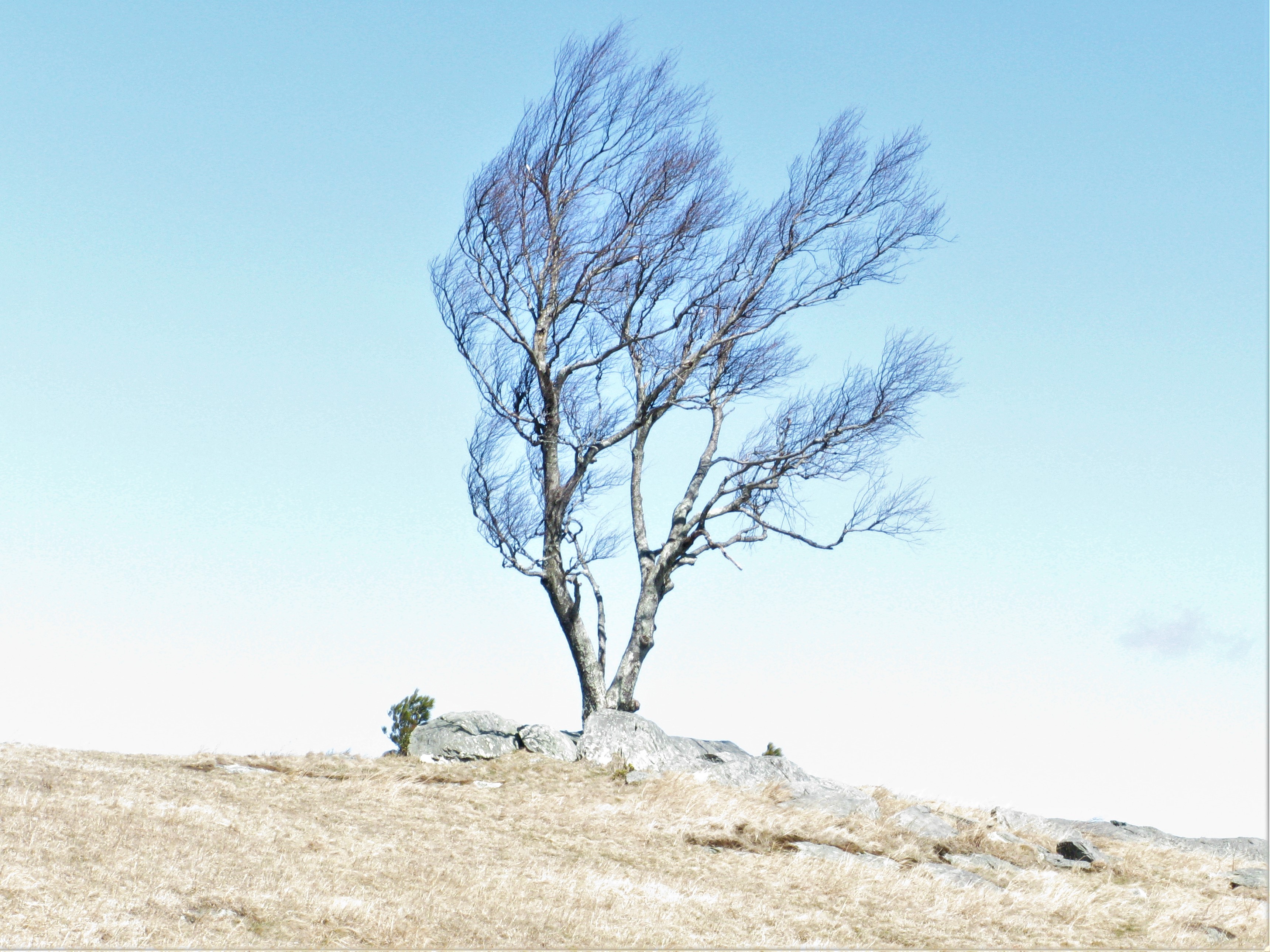
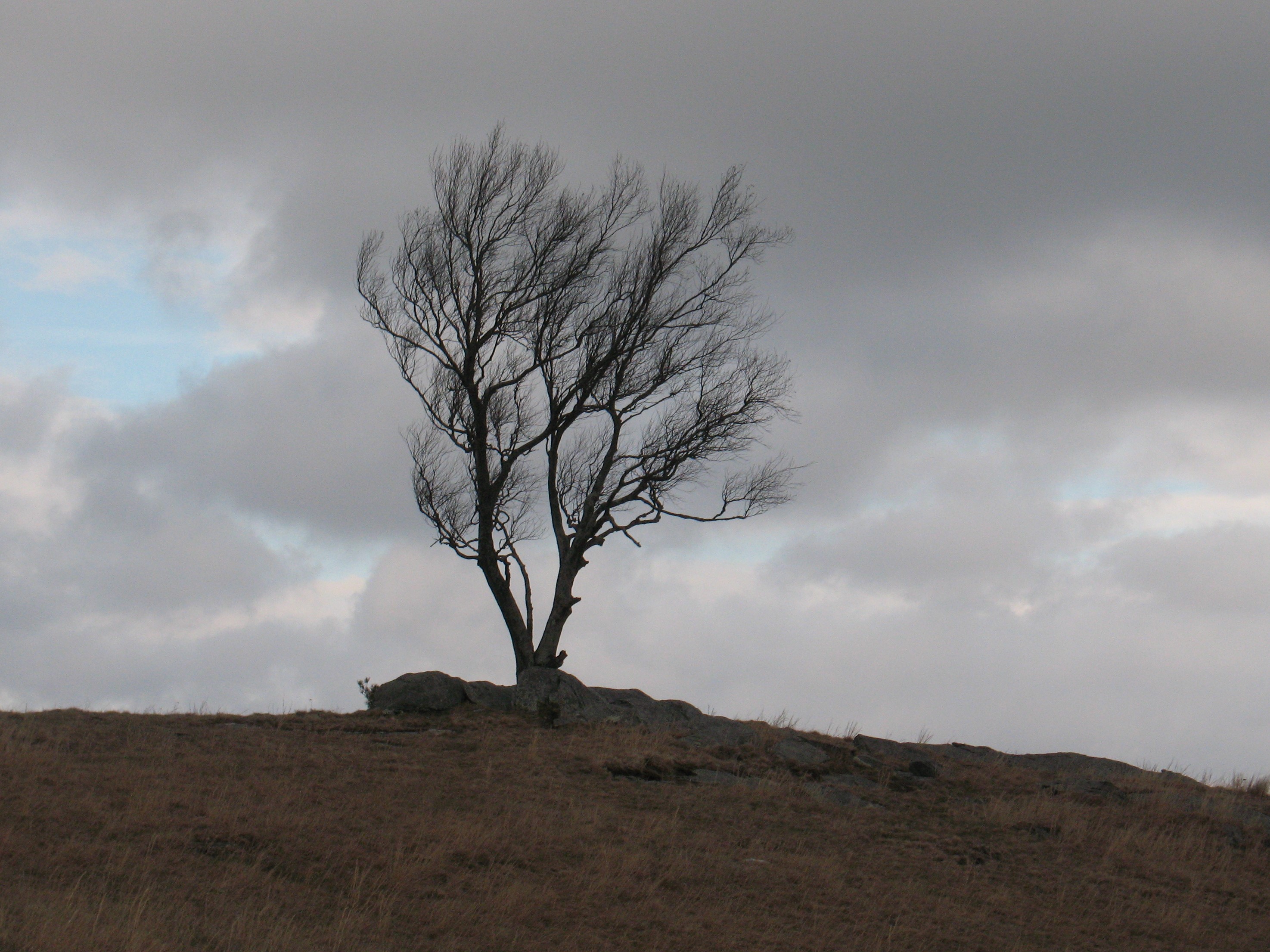
2020-03-07 Doughton Park Tree

Walking Through

[with 3 poems by Scott Owens]

. . . walls that don’t line up, some bricks
uneven, some not quite the right size,
and that’s what the mortar’s for,
the gray areas of tolerance,
forgiveness, understanding,
empathetic appreciation of things
being left imperfect, only as good
as we can stand to make them be.
+++++++ from Reclamation

E&A Nature Trail, Elkin rec center, Mountains-to-Sea, Forest Bathing – none of these trails today. Instead Mom and Dad and I walk their customary course behind the townhouse, traversing maybe 200 meters of blacktop. They tap their canes on the far curb to mark the first turnaround; it’s a little uphill and a lot slower approaching the second turn but then all downhill back to their doorway. Some days we keep going a little farther. This afternoon we feel like it’s been enough.

And why do we spend 45 minutes on our little trek, 3 or 4 careful steps per meter? Just needing the exercise? A breath of fresh air? Halfway through our circuit, Maggie’s owner appears and drops her leash, little fluffdog who gallops to Dad because she knows he always carries biscuits in his pockets. Norris stops to share the latest (oldest) joke. Here’s Peggy to check on how Mom and Dad made it through family travels over New Year’s (and to say Hi to this particular family person still staying with them tonight). Wave at Julia who’s expecting company for supper, wave at the FEDEX guy. Comment on all the little gardens behind each townhouse – Nice wreath! Is that a new bench?

This slow-gaited noticeably-hunched deliberate meander is the mortar of Mom and Dad’s days. These few folks they greet, and never overlook the dogs, are their neighborhood. “I’m going to get better, I’m going to walk farther,” says Dad, but even this afternoon it no doubt strengthens him just as much to hear, “I just can’t believe you’re 96.” Acceptance, understanding, empathy for the relentlessness of aging and decline – these hold the chipped, uneven bricks together. Let’s take another walk tomorrow, no matter how meager, no matter how slow.

And you can keep an eye out with me – I have yet to catch Dad slipping those dog biscuits into his pocket.

❦ ❦ ❦

Common Ground

My brother has never kept a single lake,
a single lost grave to himself.
Always he calls, then waits until I
can come, lets me lead the way,
find it like the first time,
proclaiming the names I know, the shapes
of bird and stone, cloud and tree.

Once in the same day I saw
a kestrel, a mantis, an arrowhead
and took it as a sign, though since
I have seen each in their own days
and miles away from each other.

I do not believe God will bend
to kiss this mouth. I do not believe
the wine will turn to blood. But something
knows the moment of sunflower,
the time of crow’s open wing,
the span of moss growing on rock,
and water washing it away.

In the pictures I remember, there is you
letting me stand on the fallen tree
as if it were mine. There is you
letting my arm rest on top of yours
around our mother. There is you
lifting me up to the limb I couldn’t reach.

This is the faith I’ve wanted, to know
that even now we are capable of such
sacrifice, such willingness to love.

Scott Owens
from Prepositional, New and Selected Poems, Redhawk Publications, The Catawba Valley Community College Press, © 2022 Scott Owens.

❦ ❦ ❦

Scott Owens travels through life in this solid, substantial collection of poems, Prepositional. He is coming from it, being of it, finding its deep inside and its dark under, discovering its thrall over and above. And as Scott sees through and into life, he invites us to accompany, to courageously push things forward.

As the newest in a long line of books from a prolific poet, this collection yet seems to be an inflection, an exhalation of breath long held. These poems walked a long way to take their seats here. Some are new but all have been selected to become new. Or maybe it’s their relationships to each other that have grown new, as Scott explains in 13 Ways of Prepositions: every way a squirrel can be / in relation to a tree. These are poems about poetry, its art, its craft, but more so the arising of something greater out of something lesser. These are poems about students and teaching and being a student; these are poems about family ties in every Venn you can imagine. All these poems have gathered here, though, for a common purpose: to water the seeds of relationship; to somehow connect with each other and with you and me, their readers.

When I finished the last poem and laid the book down, this is the reverberation I still heard ringing in my mind: “The world is a wonderful place. You are a wonderful person. I’d like the two of us to sit down and share something of these two wonderful facts.”

❦ ❦ ❦

Words and What They Say

Some say you can’t tell anything
from the language that people use,
that Eskimos in fact have no
more words for snow than we,
nor Anglo-Saxons more
for cut, stab, thrust,
and the fact that our words for animals
when we eat them, beef, pork,
poultry, all come from French
doesn’t prove they’re better
cooks or bigger carnivores,
any more than 23 acronyms
for laughter shows that texting
teens just want to have fun,
but when I hear my carful of 2nd graders
from Sandy Ford Montessori School
making up names for the sun,
and the moon, and the stars that only
come out when you’re camping and the fire
goes out, and you turn off your flashlights
while our mother holds you in her arms,
I can’t help but believe
that not only is there hope for us all
but that the hope we have
is strongest when we find a way
to put it into words.

Scott Owens
from Prepositional, New and Selected Poems, Redhawk Publications, The Catawba Valley Community College Press, © 2022 Scott Owens.


❦ ❦ ❦

Of

Poetry is contrary to productivity.
Poetry encourages idleness.
Poetry stands at the window
because it is curious about the flowers,
this flower with its yellow fringed face
around its one brown eye.
Poetry stands at the window
because it is curious about the trees,
this tree with heart-shaped leaves,
some turning yellow in the first
days of fall, some fallen off and still
the limbs reaching up to the sky.
Poetry stands at the window
because it is curious about the sky,
how it got there, where it goes,
what it’s like where it ends.
Poetry wants the window down.
Poetry walks back and forth
through a field going nowhere.
Poetry thinks it’s okay to look
at the same sky day after day,
sometimes minutes at a time,
sometimes with no other purpose
but remembering blue.

Poetry refuses to follow the rules
of efficiency: get in line,
speak only when spoken to,
never say anything that would embarrass your mother.

The first poem ever written was a drum.
The first poem ever written was a foot
tapping on the side of the crib.
The first poem ever written was a rope
slapping the red clay playground
of William Blake Elementary School.

It is not necessary for poetry
to be beautiful
though sometimes it is.
It is not required of poetry
that it be profound
though it rarely closes its eyes.
It is not expected that the face
of poetry be etched with tears,
the hair dripping with sweat,
the mouth expressing awe.
Poetry owes nothing to anyone.

Still, poetry wakes up each morning,
walks to the edge of the world
and jumps, believing one time
it will fly, believing one time
the dive will not end, believing one time
an answer will rise from somewhere beyond.

Scott Owens
from Prepositional, New and Selected Poems, Redhawk Publications, The Catawba Valley Community College Press, © 2022 Scott Owens.

❦ ❦ ❦

Redhawk Publications; The Catawba Valley Community College Press;
2550 US Hwy 709 SE; Hickory, NC 28602.
Prepositional, New and Selected Poems by Scott Owens.

❦ ❦ ❦

A Parting Glass

[with 3 poems by Brad Strahan]

Though faces fade as years fly past
I raise to you this parting glass.

What shall we keep when the house has shed its bustle and the clock makes known its ticking from the next room? Bright paper discarded, plates stacked, car doors slammed as farewells spiral out into the cold, biting, stark? What shall we keep when not presents but this present settles itself again into the chair beside us, all its remarks past uttering?

My hands in the suds, Linda passes me crockery and remarks, “I wonder what the next year will be like.” “Different from this one,” I say without thinking, but then I start the tally. What gloom do I hope will not be repeated and how shall I number the gathering portents that threaten? Whoa, there. Why does it slip in so easily, no effort at all, this brooding on past troubles and fretting about some foreboding future yet unseen?

Share in the closing refrain from the Irish folk song, “The Parting Glass”:

But since it has so ought to be
By a time to rise and a time to fall
Come fill to me the parting glass
Good night and joy be with you all!

I have no resolutions; so little of this past year seems resolved. I have responsibilities and unfulfilled tasks and hovering demons aplenty, but let us pause a moment in this rare quietude to let the little mice of joy creep in from the corners. A young girl’s laughter, a little boy’s raised eyebrows, an afternoon walk with a teenager grown suddenly voluble, a recollection shared with a beloved companion – there is time enough to fall, time enough to mourn, but time as well for a smile if we but make it so. What we keep and what we carry – may they rest light upon our shoulders tomorrow.

❦ ❦ ❦

What Shall We Keep?
(a moment in Ireland, where the world ends)

And the answer that comes back
is the wind off the Irish sea.
Not to be, not to see,
beyond understanding.

This damaged flesh we hold,
a fortress against nothing,
like the ruined Viking towers;
exclamations left
after the words are erased.

Should we care what wind blows
our dust into tomorrow?
Could we feel the rain
that washes clean the green face
of this unsceptred isle?

Would we matter when
even our names are washed
clean as the stones in those
abandoned churchyards?

Somehow, blessed between green
and gray; sometime, bound between
the blaze of Fall and white Winter
I have loved you and maybe
that is answer enough.

Bradley R. Strahan
from A Parting Glass, BrickHouse Books, Baltimore, MD; © 2014 Bradley R. Strahan

plant, trail

❦ ❦ ❦

“A remembrance of Ireland” is how Brad Strahan describes A Parting Glass, his collection inspired by a year in Mallow, County Cork. His wife Shirley had “filled the long-vacant post of organist” and in addition to the congregation of St. James, Church of Ireland, they were welcomed into the community of poets. These fourteen poems are themselves a spare congregation, the lines spare, reverent, musing, and infused with the philosophy of rain-washed green island and mossed stones in ancient churchyards.

Fitting and more than fitting are these poems for the final few days of another roiling storm-tossed year. These are the days when we plant our feet and hope to feel what anchors us to the turf before the next year launches forth, uncertain, yes, but bright and hopeful for what it may discover. This is the reckoning, the nod of acquiescence when my grandson calls out to me, “Old man!”, the acceptance that a new year is no newer than any day which begins with taking another breath.

Read these poems in the warm companionship of ghosts that welcome your presence. Read and find company with the distant traveler and the warm hearth. With days of green and gray passed, passing, yet to pass. Raise your glass, all of us raise our glasses to the joy that may find each one.

❦ ❦ ❦

Hymn

Winter, solid to the bone,
melts in the music.
Colored light pearls
the faces in the wooden pews.

The news, good or bad,
has no foothold here.
The cold rain and snow
vanish in a flame of song.

Here we robe our tarnish
in vestments of harmony:
snow crystal bells
and a storm of organ-sound.

Here we are, not what we are
but what we would be,
notes on a purer staff,
leaning hard from brass to gold.

Bradley R. Strahan
from A Parting Glass, BrickHouse Books, Baltimore, MD; © 2014 Bradley R. Strahan

❦ ❦ ❦

A Book of Common Prayer
(St. James Church, Mallow)

Let me not for the flowers
by the altar placed.

Let me not for the windows
that gleam with grace.

Let me not for the music,
simple voices raised.

Let me still recall
the goodness that amazed

though nothing follows
being in this state of grace:

no more smiles, no more roses
and none there to embrace.

Bradley R. Strahan
from A Parting Glass, BrickHouse Books, Baltimore, MD; © 2014 Bradley R. Strahan

❦ ❦ ❦

NOTE: if you would like to purchase a copy of A Parting Glass from Bradley Strahan, please comment on this post or email me at comments@griffinpoetry.com.
++++++++++++++++++++++ Thanks! — Bill


❦ ❦ ❦

2017-03-06a Doughton Park Tree