Feeds:
Posts
Comments

Archive for the ‘Imagery’ Category

Remember

[featuring three poems by Valerie Neiman]
What you see, that is what survives.
What you remember is all there is.

Don’t you want to save the world?
+++++++++++ from Catechism by Valerie Neiman

❦

Yesterday I walked and tried to remember. Here beside my foot, what is the name of this so familiar leaf? Distinctive, like no other leaf, for that reason alone I should remember it. Surely I have seen it before and known it. Surely the other things I’ve seen and learned for the first time today have not pushed from my memory an equal number of things I learned yesterday, cargo jettisoned?

Later I found a photo of the leaf and immediately knew it and where and when I’d first learned it, Jumpseed or Virginia Knotweed, Isaac’s Trail (MST), August 2022. It was in bloom then and I recall a definite small joy in learning it – the leaf, after all, is distinctive. Old friend, it is good to see you in your Spring garb.

Lately I’ve been chiding myself for always walking the same trails every week, sometimes every day. Branch out, see something new! But these woods are never quite the same today as they were yesterday. I notice the same things in different light or at a new stage of growth; I see and hear things I’ve never noticed at all in years of passing this way. I suppose I’ll keep walking these trails until I’ve noticed everything. Or perhaps even longer, until memory no longer retains a thing and each day is indeed entirely new.

Except that’s not quite how it ends. There are all the people who’ve walked beside me on these trails, who’ve shared with me and with whom I’ve shared, if only the shapes of leaves. It’s not quite true that what you remember is all there is. What you share is all there is.

❦ ❦ ❦

Out of the Ordinary
## 
My friend mourns the missing thrushes,
ee-o-lay that used to rise
like fireflies at the verge of oak woods.
## 
Her memory saves a space for their song;
others, later, won’t notice the lack,
satisfied by the insistent mockingbird
## 
(his repertoire a hundred songs or more,
including cell phone and cricket chirp),
reweaving a looser web of dawn chorus:
## 
So one bird replaces a canopy of absent
warblers, as a synthesizer sets ghosts
in the chairs of an emptied orchestra.

+++++++++ ❧

Like scissored silhouette
of a child’s shadow, this becomes the is
of that isn’t. What is no longer,

like those ballads that bridged generations.
We no longer lift our quotidian voices
to pace work or ease the idle hours,

now that professionals provide
tunes at the ready, electronically
clipped and smoothed,

like purebred stock at the fair,
not one hair out of place,
not one note quavered.

Valerie Nieman
from Hotel Worthy, Press 53, Winston-Salem NC, © 2015
❦ ❦ ❦

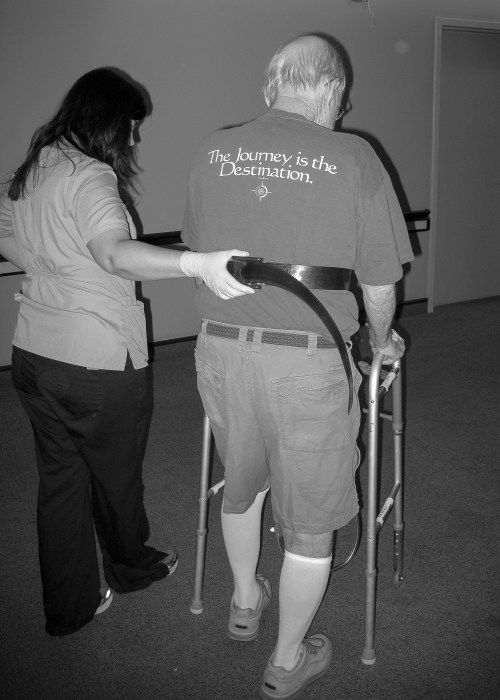
Last week I was helping my wee mother take a little walk – tie her shoes, re-button the pink sweater, find her cane – and as I held her elbow to steady her across the threshold, she looked up and said, “You’re a good boy.” If you are also an oldest child, perhaps you, too, have spent a good chunk of your life doing whatever it took to hear those words (and no, I haven’t had to wait 70 years to hear them for the first time). But doesn’t every child, primogenitor or not, long to gain their parents’ favor? More than to be loved – to be worthy?

Valerie Nieman writes there on the left is the Hotel Worthy and I realize I’ve been trying to check in for years. Many of the poems in Hotel Worthy struggle with conflict – how to be worthy? Or how to be true to yourself? Is there some hallowed doorway that leads to both? Or is it true that The purpose of life is not to be happy. It is / to know every name of every part of the sailboat from gudgeon to headstay and . . .

The purpose of life is a shadow ducking behind a tree in a dark wood. Pursue, pursue! After spending several hours reading Val’s book straight through, I find myself returning to poems that especially entice me on, this one, that one, re-reading and discovering new connections, doorways opening into new places. The archaeologist’s surface stratum is scratched away to reveal a metaphor for human relationships and generations. So many metaphors, each one more true than the last. Valerie’s collection creates a lifeline and a world of knowing that emerges not as a tree, spreading from root to bole to branch, but as a web, nodes across time and place. I scribble a collection of her lines I want to hold on to and learn from. I smile when an awareness dawning in the poet dawns in me as well. I’m glad I accepted the invitation to check into this Hotel – you come, too!

❦

Valerie Nieman is a graduate of West Virginia University and Queens University of Charlotte, and teaches writing at North Carolina A&T State University and at other venues including John C. Campbell Folk School. Hotel Worthy is the second of her three poetry collections which Press 53 in Winston-Salem NC has published; the first is Wake Wake Wake and the third The Leopard Lady. Her Press 53 novel, Blood Clay, received the Eric Hoffer Award, and her fourth novel, To the Bones, was published in 2019 by West Virginia University Press.

❦ ❦ ❦

Stratigraphy
++ In archaeological sites, natural and human-generated material occur together
++ in layers. These layers, called strata, form a record of past events . . .

++++++++++++ – Research Laboratories of Archaeology, UNC

Prehistory
is what has been cut apart
and swallowed,
bite by terrible bite,
and laid down in the body’s lattice.
Small sharp things:
that glance across the table,
those unfinished gestures.
## 
History waits in the antechamber
for the arrival of words:
no documents, no history.
But what’s down inside
the long galleries of the bones
all the while, without any light,
painting aurochs on the walls?
## 
Now if you only want to pry
artifacts out of the generations
of mud, what can be salvaged
for love or for money,
hurry, then, with pick and shovel –
difficult to tell what it all
amounted to, once,
except that sometimes
in the upended clay the light
finds a carved head, a bit of gold,
or flaked edge of obsidian
that might (or not) have been employed
in a clenched fist.
## 
The careful investigator,
with dental pick and bone brush,
would find the same shattered femurs,
the same engraved figures
(vulva and tectiform shelter),
but frame them
in time and meaning:
how high the icy water rose
that spring,
how the deer fled,
how we starved.
## 
Valerie Nieman

from Hotel Worthy, Press 53, Winston-Salem NC, © 2015
❦ ❦ ❦

Dark Matter


Seaweed, scoured from the deep, scatters
its beads upon the beach. Everything broken.
I gather twists and bits, small lives blasted
##
and holed, shoved aside by the waves, a slattern’s
house(un)keeping, fires heaped with trash,
any salutary offerings to one goddess or another
##
scrabbled up by dirty hands, a smidge and a smatter
to feed a momentary appetite. So I kick along the tide
line and analogize, my disappearing domestic
##
bliss no match for weighty issues of war-shatter
everywhere east to west, eruptions staggering the world;
but still, but still, I accumulate little bomblets
##
of disaster and embrace them, the spatter
of heartsblood ready to fly when the least jounce
lets it all come apart, and so the personal
##
etc. holds little hands with the larger all the way up, dark matter
flinging this fine universe outward from one hot bang,
farther, colder, the space-between we imagine.
## 

Valerie Nieman

from Hotel Worthy, Press 53, Winston-Salem NC, © 2015

❦ ❦ ❦

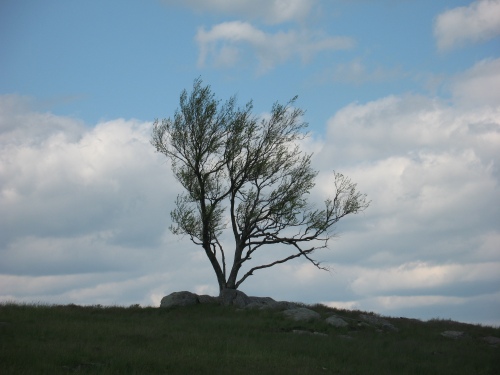
2020-06-11a Doughton Park Tree

Read Full Post »

[This is a re-posting of one of my personal favorites, from July 27, 2020. May we each discover what is most perfectly suited to our individual nature; may we discover the perfect curvature and gravity of the universe. And may we continue to re-discover the poetry of the late David Treadway Manning, one of my favorite human beings.

I am re-posting rather than creating an original offering for this date because our neighborhood is still digging out from a tornado that struck us on April 28, 2023. No people injured, many hundreds of trees down, brighter wider horizons absent their green banners, a few nights of darker skies and brighter stars and the company of the waxing moon.    —-   Bill ]

Young Isaac is strolling through the orchard, another undifferentiated non-linear autumn afternoon of this perplexing equation we call life. Some of the fruit has detached itself and translocated several meters closer to the center of the earth. It has begun, with the help of fermenting microorganisms, to succumb to entropy. Isaac steps in it. He slips.

Isaac’s 70 kilograms, density of water, accelerate at 9.8 meters per second per second. Suddenly prone, the gravity of the situation strikes him. There, 10 centimeters from the tip of his nose, lies a perfect red spheroid. Glossy. Fragrant. The tiny lenticels on its taut unblemished skin are arranged with the symmetry of stars distributed across the heavenly sphere. “What an apple!” young Isaac exclaims, “Artios!” (his years of Greek instruction now finally relevant): That which is perfectly suited to its nature. The essence of appleness.

And how will Isaac’s own essence be transformed by this epiphany? How will yours and mine? No longer undifferentiated, will he discover his many gifts and their ideal trajectory? Will we ours? For are we not each of us an essence, our process of formation either distracted and garbled by the noisy physics of our history and our surroundings or alternatively able to grasp that trajectory perfectly suited to our unique nature? Besides mass and density and the ability to struggle upright against gravity, don’t we human animals also possess the agency of choice and change and discovery?

Isaac sits up and regards the apple. You know where this is headed. It will be 218 years before young Albert slips and falls and realizes that what Isaac experienced is actually the curvature of space. Meanwhile why don’t we all, each of us, sit up and regard our nature. Artios! To become that which is the perfect expression of our nature. It’s about time.

.     .     .     .     .     .     .

I have been a DAVID MANNING fan since I first sat up and discovered poetry. Whether he does it with a compassion that draws me deeper into the circle of human family or with a wry and pointed barb that makes me snort, he regards human nature and tells its truths. I will be the first person in line when his NEW AND SELECTED is released from PRESS 53 later this year.

And I have been favored to preview the manuscript. Wandering these wonderful poems spanning decades I enter an inner landscape and pass from reader to personal companion. There is a deep imagination at work; there is joy and no lack of laughter and sometimes a little weirdness; there are bright moments of insight and connection.

Most of all there is WONDER. No aspect of our human situation or our confounding universe goes unnoticed. David’s artistry gathers a desert landscape, a snatch of opera, a funky conversation and weaves from them with perfect sense and sensitivity an affirmation. When I reach the final page I say, “YES, that is the way it is.”

.     .     .     .     .     .     .

Sailing with Anne

Santa Monica, California, 1950

After her sailing class we cast off
into the ruffled Pacific blue, tide
incoming, echoes of great breakers
lapping the dock. She-the sailor,
the tiller, mine.

As we headed west, tacking
into a strong breeze I remember
marveling at who she was
to do these things. I imagined her
at the helm become Anne Bonny,
running a four-master down,
the setting sun turning red lights
in her hair.

I hope we left something there-
if only a boat paint-scrape
or salt spray from her hair.
Maybe something from that day
was never lost, but joined
the Pacific’s history, some trace
still riding the blue circuit
between the poles, with the sea-grape
and tiny life that make the coral.

.     .     .     .     .     .     .

Star Journey

Sometimes at night I return

to the Griffith Park planetarium

where stars from the surrounding hills

come out to music.

North of Los Feliz

I step from city lights into the night

sky of Patagonia with its wind-swept shores

under the warm lights of Fornax,

Fomalhaut, Alpha Crucis, a bright canopy

of southern stars, to music-Gymnopedie,

Satie’s barefoot dance.

Then, under the soft night sky,

I take off my shoes

and find my way into the stars.

.     .     .     .     .     .     .

David Manning’s NEW AND SELECTED POEMS is anticipated later this year from Press 53.

Star Journey first appeared in KaKalaK 2017 – Anthology of Carolina Poets
Sailing with Anne first appeared in Pinesong: The North Carolina Poetry Society

.     .     .     .     .     .     .

.     .     .     .     .     .     .

IMG_0880

Read Full Post »

[ with 3 poems by Jane Mead]

In Need of a World

Who wouldn’t want a life
made real by the passage of time
or a world, at least,
made real by the mind. Something
solid and outer, though connected.

Who wouldn’t want to know
for certain how to get there?

I’d like to tell you simply
how I passed this day putting tomatoes up,
or how I tied a stern cicada to a string
so I could feel the gentle tug
its flying in frantic circles made.

I’d like to show you the red
worm-shaped burn on my wrist
and in this way claim myself.

Instead I slip out of my every day –
away into the distant and lulling sound
of “once-upon-a-time-there-was-a-woman.”

Will I ever find that perfect stance
of soul and mind from which sparks
a self uttering itself?
I’m always slipping between rows of corn –
through the field that rises toward this ridge
from which I like the houses for their smallness.

Here I lean against a Honey Locust,
feathery tree with its three-inch thorns,
and watch sagging strands of barbed wire
sway slightly in the wind – the clump
of brown fur hanging there, waving.

I watch the field of drying corn beyond,
and beyond that the soccer field
and rows of clean-lined condos.
I wait for the yellow light to flick on
in the white church across the valley.

Will I ever learn the way to love
the ordinary things I love to look at?

I’m always slipping away
between rows of corn, climbing
toward this ridge to think,
when really what I want is a ridge
or a lonely field on the edge of the world
of the mind. A place from which to speak
honestly to that man on the porch, a way
to greet the children who are swinging
on the edge of duck behind chain-link fences.

But always it’s either I or world.
World or I.

And when it’s I, I’m dreaming
on a quiet ridge that the tomatoes
ripened and, though I was missing,
a woman put an apron on and canned them.
And when it’s world, it pushes me back
toward that madness of the soul
which is not a field, nor a ridge, nor a way.

Jane Mead
from To the Wren, collected & new poems 1991-2019; Alice James Books, Farmington, Maine; © 2019

❦ ❦ ❦

I am sitting at the kitchen table reading these poems by Jane Mead when Linda asks me if I have any trash that needs to go out. I am sitting at the kitchen table because if I sit at my desk I will remember all the things that need to be done but that are not reading poems by Jane Mead. Of the things I will remember sitting at my desk some are a chore, like writing checks, and some are sober, like checking in with Dad to see if he is still having pain, and although reading Jane Mead is not a chore the poems are certainly sober. She makes me wonder: will there be a moment later today or tomorrow to sit and stare into the green chapel of April and ponder who I am?

Yesterday walking the Forest Bathing Trail, Linda and I saw three violets that are not the rampant purple violets that fill the rest of the world. One by one during the weeks of April we have learned their three names. They are small, they are just a few, they are precious. Their rampant purple cousins whose flowers are crafty enough to duck beneath the mower blades, who make many, many seeds, and who have perfected the concept of ‘spread’, they, too, are precious. Will there be a moment later today or tomorrow to sit and consider the insignificance of violets and consider whether, perhaps, all things and all moments are precious?

❦ ❦ ❦

Sparrow, My Sparrow

The voice that loves me best when I am dreaming
comes from every corner of the circle of my sleep
speaking in the sound of my own drowning.
She says the body’s just a habit getting old,
a crystal turning on a nerve of ancient longing.
She says I will teach you how to be with yourself
always, she says we do not live in the same world.

All this is just an allegory for the truth.
Truth is, I cannot speak
the voice that I’ve been dreaming.
Truth is, the slate sky darkens,
clouds of sparrows heave in the wind,
the trees are massed with sparrows screaming
and the fields are dotted with them.
The birds are bracing themselves. The birds
are frenzied by something about to happen.

Truth is, I have my feet on the slimy banks.
I look for my face in the murk-green river
and the water’s surface does not change.

But I hear myself in the screech of sparrow
and am panicked by something about to happen.

Slate sky – darkened; sound in wind:
I enter this world like myself as a prayer.
I enter this world as myself.
I cannot help myself.

What is a prayer but a song of longing
turning on the thread of its own history?

I feel myself loved by a voice in the wind –
I cover my ears with my palms.
The whole world rocks and still
the cold green river does not spill.

Jane Mead
from To the Wren, collected & new poems 1991-2019; Alice James Books, Farmington, Maine; © 2019


❦ ❦ ❦

The Man in the Poetry Lounge

at Berkeley is reading English
pastoral poetry with passive
abandon, chewing his thumbnail
aggressively. He wants

to see grass, he wants to
BE grass so badly he can
almost smell it. Outside,
they are cutting the grass—

the man and the mower—they are
dressing and keeping the garden.
They are not far enough away
from my hay fever, but the man

reading pastorals is off—
zeroing in on calmer places.
Have the birds arrived yet?
Have the larks and nightingales

made their appearance? I would like
to ask him to let me know
when he gets to the birds. I would like
to concentrate then and there, and lose

what I have read about Flanders
and Picardy and the trenches of W.W.I:
the larks appearing around the time
of stand-to in the morning,

the nightingales showing up
by stand-to at night. I would like never
to have learned that they were there.
But instead, because my nose is running,

my eyes are getting smaller by the minute,
and I’m edgy, I’ll ask him sweetly
if he’s bothered at home
by bedbugs, rats, or lice,

and justify the question with an explanation:
I myself am bothered by fleas.
This is why I keep scratching—
which act I hope he does not find

distracting because, really,
who am I to ruin his birds.
I who cannot, as you have seen,
follow those trenches to their

logical conclusion. Instead, I too
have searched long, and found
that in the gentle arc
of a pig’s back there really is

a thought to calm the thinker—
if, that is, the pig be tame.
I want to know if this man
loves what he is reading—

and if he loves it enough
in what way it will change him.
Are we onto something real now
or is this all about planting

a false goose in front of the moon?
Do the iambics soothe him? Is he
big on true rhyme and false conclusion,
the sonic hanky—you wipe your eyes

you blow your nose. Which I will
have to leave this room to do.
But not before I’ve resisted
coming right out and asking

if he’s fulfilling the requirements
of heart or mind, and asked instead
what it’s my true right to know
(involving, as it does, the heat

of concentration and the problem
of public safety, as in MY safety):
if his shirt, which I’ll begin
by calling handsome, has passed

the requirements of the Flammable
Fabrics Act. Then I’ll
step out and blow my nose,
at which point I might as well wander

back on down toward Cody’s and try
to receive the world, browsing
and scratching in the poetry section,
after buying a paper poppy for a dollar—

the one you didn’t want to know was coming—
the Flanders—from a veteran of foreign wars
at Telegraph and Durant—not,
of course, looking at his left leg—

because I can’t.
Because it isn’t there.

Jane Mead
from To the Wren, collected & new poems 1991-2019; Alice James Books, Farmington, Maine; © 2019

❦ ❦ ❦

Given the nearly complete destruction of an entire planet, the overpowering by greed of any sense of the basic logic of survival, or valuation of beauty — it would be odd if the urgency of this situation were not reflected in our poetry. But poetry has the potential to move people, which is where the potential for growth and change of a certain kind enters the picture.
+++++++++++++++ Jane, Mead, from a 2014 online interview,
+++++++++++++++ recalled in her obituary in the Los Angeles Times

Jane Mead died in 2019 at the age of 61. She was a Griffin Poetry Prize and Los Angeles Times Book Prize finalist for her 2016 book World of Made and Unmade, about her mother’s death. Her previous book of ecopoetry, Money Money Money Water Water Water, explores the widespread destruction of the natural world.

❦ ❦ ❦


❦ ❦ ❦

IMG_6432

Read Full Post »

« Newer Posts - Older Posts »