Feeds:
Posts
Comments

Archive for the ‘Imagery’ Category

Square Foot

 . 
[with 5 poems by Bradley Strahan]
 . 
Repeatable Pleasures
 . 
A lawn of families;
beach house, beach clothes,
each evening a glissando
of guitar pulling down the sun.
 . 
Down to the sea we run,
the gulls waving to us;
this year, next year,
our interchangeable faces.
 . 
Our interchangeable places:
flashy beach house,
seaworn motel, not one
here just two decades ago.
 . 
Here until the next big blow
takes it all back,
a wavebeat,
between two stormfronts.
 . 
Still we hope for those scents
of another summer, salt tang
and iced coffee; the clang of horseshoes
and one more beer, one more wave to ride.
 . 
Yes, here’s to that roller-coaster ride,
another year with a son
growing, growing
toward his own summer time.
 . 
Maybe that’s why we like rhyme,
like rock and roll, that repeat
and repeat; simple
pleasures you can count on:
 . 
Wet bathing suits that hang on
a line of laughter,
outboard motors in a chorus
that rides the surf of a backbeat.
 . 
Bradley R. Strahan
from This Art of Losing, BrickHouse Books, Baltimore, MD; © 2011
 . 
❦ ❦ ❦
 . 
One hundred sixty-one square foot off-grid UK vacation rental: I’m picturing myself there while I wait here in reception for the endodontist to drill my father’s molar. By my eyeball reckoning, this space I occupy is 10 times that cabin, 1601 square feet. Here there’s free wifi to be slurped up from the Eye Center next suite over; here 80’s soft rock continuum; here high pitched whines through poorly muffled walls, your free hearing test while you wait.
 . 
There near the cabin birds sing from bushes while the woman wheels her gear and provisions down the trail in a child’s red wagon. Through the door, walls mostly windows, narrow mattress in a loft, ingenious shelving. No electric, no phone. What would I pack? Fresh ground, not instant, and my self-contained backpacking filter? Titanium 1 liter pot and little brass stove with a pint of Everclear 190, wonderful dual use distillation? (Fuel and hand sanitizer, or what else might you be thinking?) Vegetables I’ve dried for rehydration; miso and peanut butter and don’t forget chocolate?
 . 
All this I imagine as I scroll through photos and read the article in my Apple News feed. Feed, apt name for the pressurized flow each time I open my phone. Not unlike a late night procedure relegated to us interns on the wards: snort of xylocaine gel in the nostril, slide the large-bore tube up and then waggle down behind the soft palate, on down and down until we hear stomach gurgles from a syringe-full of air; now hang a pre-digested bag of amino acids, simple sugars, fat emulsion & vitamins like turbid gray cyborg milk and watch it drip.
 . 
I’m sated. Stop the drip. Take me off the grid. I can do without calls, texts, alarms, and I’ll vow to make do without keyboards and uploads. Books on paper. These poems by Brad Strahan with their muse reaching out. And don’t forget college-ruled and a ballpoint – the ultimate back to nature.
 . 
 . 
Bradley Strahan has lived and taught and written all over the world and his poems are a world of imagery and metaphor. His collection This Art of Losing is a night train through Germany, a bridge across the Seine, a girl with neon eyes in Amsterdam, rain through an open window in Macedonia. The atmosphere of place is very strong, but even though one of the section titles insists Not Philosophy these poems are all philosophy; place is simply the door through which metaphor enters and sits down across the table.
 . 
Losing what, and why dwell on it? Truth washes up on the reefs of the real. These poems often present as a careful observation or description – they are arresting in their rich musical language, internal rhyme, and stark novel imagery – but each conceals a deeper metaphor. The passage of time; what it conceals and what we grasp to reclaim; the time before us drawing short as we face our inevitable mortality – these are the cold nuclei of our reality. If we ignore them we walk through life as through blue mist. Brad is not morbid in his quest to discover reality but he never turns aside. And the realities that may grant our existence deeper pleasure are like these poems: to be held close, turned over and back, to be fully delved and known.
 . 
❦ ❦ ❦
 . 
In Translation
for Diana Der-Hovanessian
 . 
Eyes blink.
No, I don’t understand.
But truth,
truth is a weary traveler
and what we say
flies out the window
to next in her hair.
 . 
The muse,
silly girl, runs
through our hands like light
through window panes,
like drops
down the window
when it rains.
 . 
Bradley R. Strahan
from This Art of Losing, BrickHouse Books, Baltimore, MD; © 2011
 . 
❦ ❦ ❦
 . 
Merlin’s Song
for Jean Clarence Lambert
 . 
Among the souvenirs
of a life of art
what part has
the art of life?
Where
in this magic act
does the magician
exist?
on what rope
over the Niagara
of history
do we cross
as we toss
our baggage
piece by piece
into the flood?
The blood alone
remembers
autumn’s flames
in late December.
 . 
Bradley R. Strahan
from This Art of Losing, BrickHouse Books, Baltimore, MD; © 2011
 . 
 . 
❦ ❦ ❦
 . 
In a Dry Land
 . 
Water is laughter, children
running through an empty house,
a phantom guitar heard
in cottonwood shade.
 . 
A thread of music weaves
green verses on bleached cloth,
a chorus of crows. Willows sigh,
feet resting in bright water.
 . 
You can hear frogs. Insects sing
as a thousand songs hover
just out of reach
like an iridescent dragonfly.
 . 
We lie on grassy banks
singing the same old words,
a green song in a land
of brass and hard blue silence.
 . 
Bradley R. Strahan
from This Art of Losing, BrickHouse Books, Baltimore, MD; © 2011
 . 
❦ ❦ ❦
 . 
Keepsake
Struga, Macedonia
 . 
Let me wrap this day in cloud,
press it between boards of pewter –
matte pages of lake hammered by rain.
 . 
It will be a whole volume of rain.
The pages will open with thunder
and the sound of water beating on metal.
 . 
It must show how church bells rang
with such a hollow clang, hardly heard
against the shouting of sky and water.
 . 
There will be a line of birds, waterfowl
swimming through a sky of clouds
as if it was just another river.
 . 
For a frame there is a wash of mist
and almost hidden there
the darker forms of hulking mountains.
 . 
But in one corner, a balcony, an iron rail,
a gray poet hammering away
while one lone birds sings far better.
 . 
Bradley R. Strahan
from This Art of Losing, BrickHouse Books, Baltimore, MD; © 2011
 . 
❦ ❦ ❦
 . 
 . ❦ ❦ ❦
 . 
2020-09-08b Doughton Park Tree

Read Full Post »

 . 
[with two poems by Katherine Soniat]
 . 
The Right Frequency
 . 
allows the next stillness to occur. Welcome each space
as it appears but confirm slowly –
++++ ++++ ++++ ++++ ++++ ++++ as if an adage drifting
down through centuries of smoke.
 . 
Try a later roll in summer grass with its sundial fingers
holding you on top the seven-veiled mysteries
of green.
 . 
Above that, motionless clouds predict it’s never lickety-split
to the apparent state that counts.
++++ ++++ ++++ ++++ ++++ Urn, goat, and crimson altar-cloth
are flighty suggestions, hard to pin down despite humans
and their sharpened articles of faith.
 . 
Tie a select few to the calf-bell of dogma, then with due respect
leave the dotted lines.
 . 
Maybe even get off your mount (the high one) and walk beside
those roped or chained, and stumbling.
 . 
Each time you are kind, feel how your breath changes,
the frequency of birds at dusk settling in.
 . 
Be aware. ++++ ++++ ++++ One pivotal moment
++++ does not foreshadow a calmer forever on earth.
 . 
Katherine Soniat
from Starfish Wash-Up
 . 
❦ ❦ ❦
 . 
The fence will squander its energy through juicy longstem grasses, nutsedges, greeny ferns, the unimpeded conduction of their potassium solute intracellular conduit. Grounded, not shocking. And so the cattle farmer may be forgiven for having applied his two-foot swath of herbicide all down the half mile of the fence’s length. Nevertheless, even months later we measure this still brown compacted earth and imagine what’s been lost. We do not expect to find the blossoms of September a year ago.
 . 
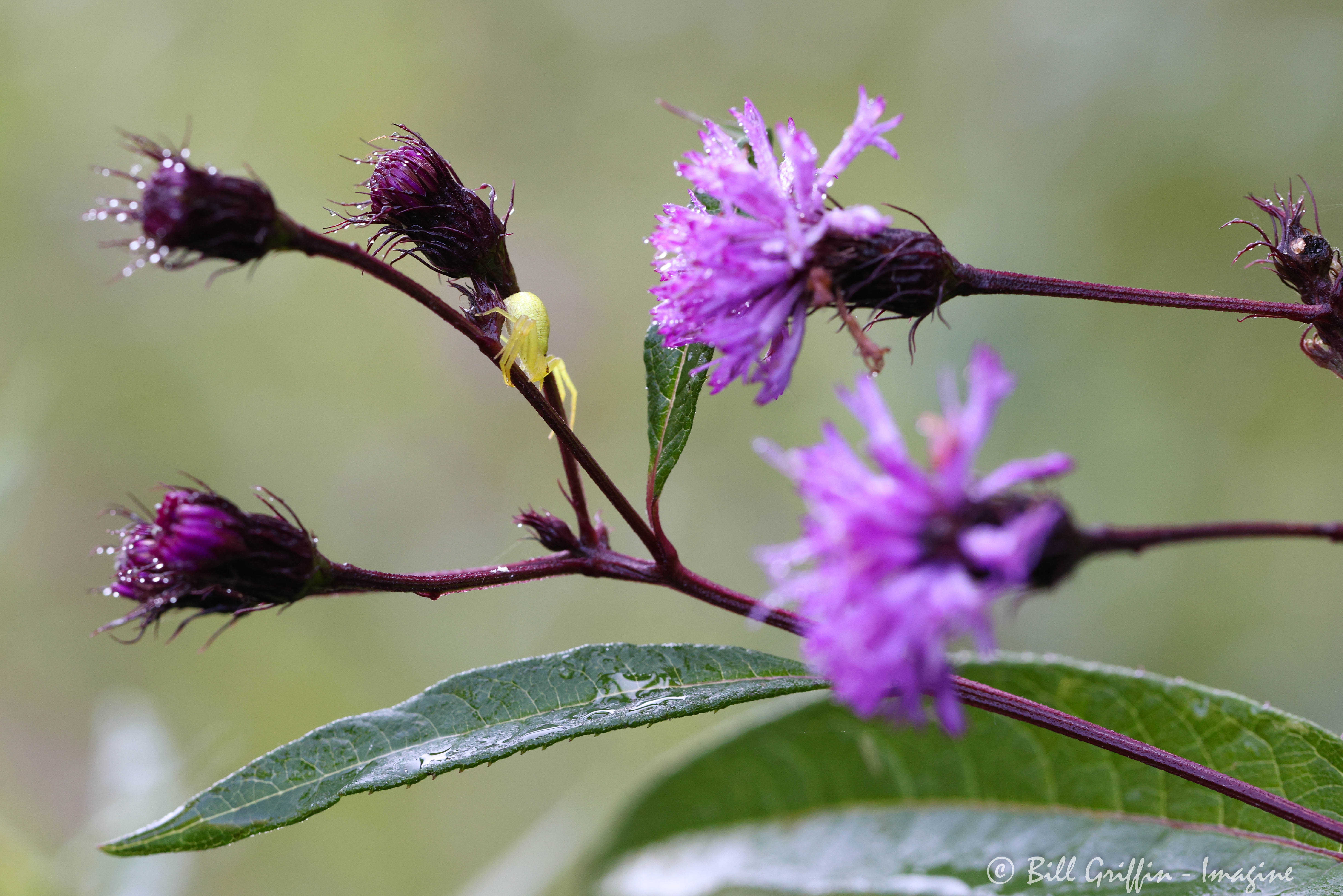
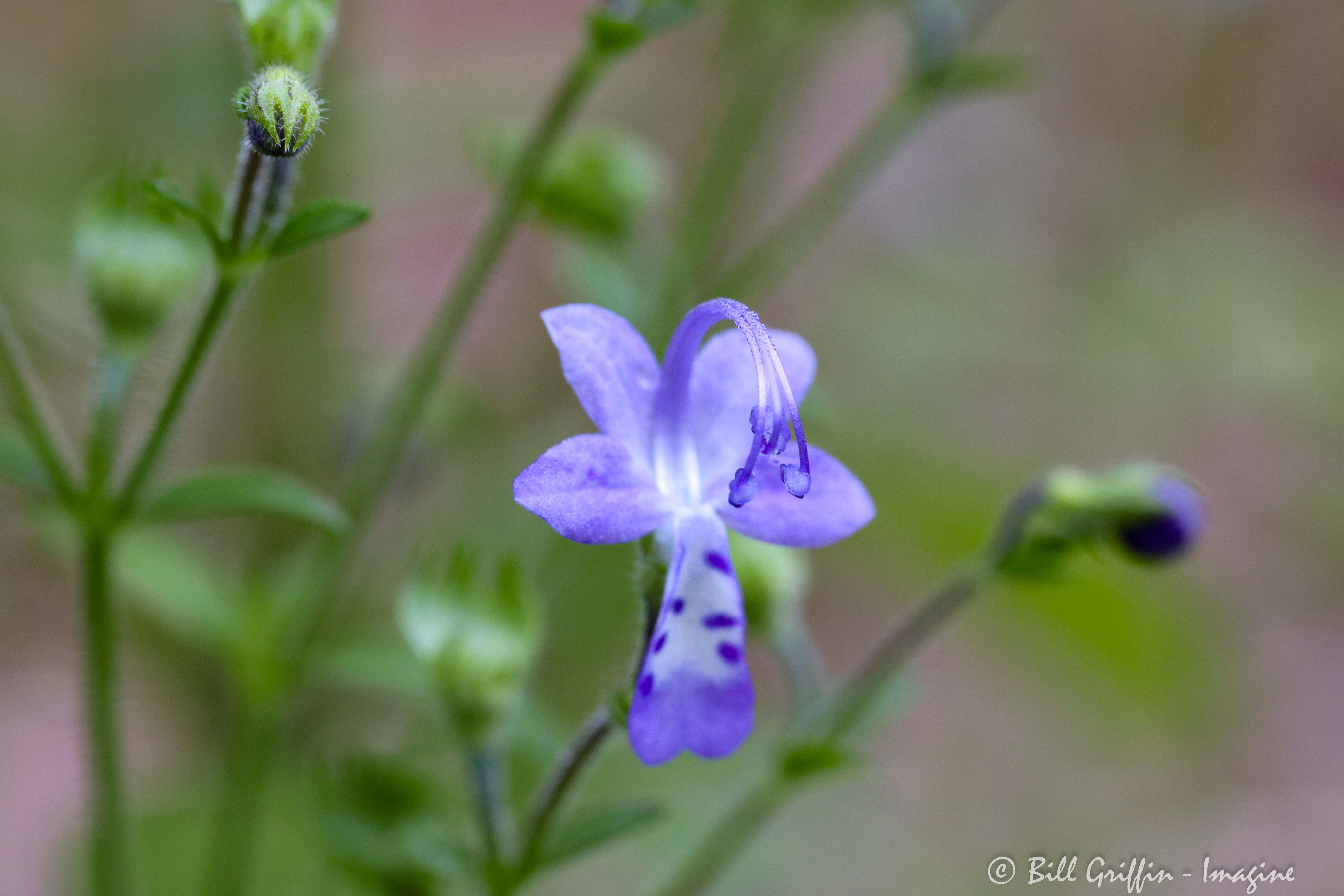
Nevertheless, here they are. Oh yes, beyond the fence’s reach where moisture seeps down from the upslope we find exactly what we expected: Ironweed, Cardinal Flower, Crownbeard. And within the fence’s boundary, where grazers have not been re-introduced this summer, we are not at all surprised to discover swath upon swath of Meadow Beauties. But here before us we suddenly come upon precisely what we had not expected to discover: two low herbs with blue thumbnail flowers.
 . 
The hikers walking up behind me are a little rattled when I shout, “Look at this!” I point out the swoop of curving stamens and the spotted lower petals and they say, “How nice,” then move along down the trail possibly hoping I won’t be following them too closely, but as of this moment I am having a very good day.
 . 
 . 
Katherine Soniat’s poems do not enter at the front door and take a companionable seat at the kitchen table. They shift, they transform, they bury their meaning then suddenly burst forth. To read  Starfish Wash-Up, I find I must lay my expectations aside. If I stare at the lines too hard they elude me, but then pages later the unexpected connection emerges and allows itself to be recognized. Soniat describes this as “a dissolving context in which time and space blur – only to reassemble in as part of the vaguely familiar.” The themes I sense, across time and generations, are father / daughter, separation / blame, searching / belonging. The two poems I’ve chosen here display these in their own right without requiring the context of the entire collection to fully convey meaning. To read most of the poems, though, one must read all the poems.
 . 
This is an unusual and unique book, disturbing at times. The entire volume is titled FATES and it actually includes full-length works by three poets: The Medea Notebooks by Ann Pedone, Starfish Wash-Up by Katherine Soniat, and overflow of an unknown self by D. M. Spitzer. The three collections are completely different in style but their themes and tropes intertwine and challenge. I am repeatedly wrenched from my comfortable perch and yanked into these narratives. As Ann Pedone writes in Jason Confronts Medea, We soak our bodies in the oil of words / all our lives and yet now / after the thousands we have / spoken to each other / you are as strange to me / as the dark-eared goats / feeding on the grasses / beneath your feet.
 . 
FATES: The Medea Notebooks / Starfish Wash-Up / overflow of an unknown self. Ann Pedone, Katherine Soniat, D. M. Spitzer. Etruscan Press, Wilkes-Barre, PA, © 2021.
 .
 . 
 . 
❦ ❦ ❦
 . 
Kingdom
 . 
There could have been time for another life before the strong March wind
swept us from us from all-fours, and dropped us near water.
Mirrors waiting.
 . 
No denying that the Nth degree of the unknown is upon us, and there’s no hint
of direction for our wasted planet. Our run at flamboyantly hot lifestyles shrunk
the ice (and more) to pieces. Huff ant strut, and we’ve about destroyed
the globe.
 . 
We mark time, belch, and remain on the lookout for chatter, though truth is
we are most awkward within the family circle where the food tastes good
bu the term lineage shows ugly signs of meltdown.
++++ ++++ ++++ ++++ ++++ ++++ ++++ ++++ Who sits where
at the last family feast (?) when any mention of disagreement is met
with angular glares of Thou shalt not repeat tales of personal or climate crisis.
And thou shalt instead sip all thy wine then nod at the endlessly grinning?
 . 
My determined place at that annual folly? I doze with my clutch of poems
in the family broom-closet – me, yet another calculated risk to the authenticity
of family history.
++++ ++++ ++++ Cursing in couplets, tweeting of human drift measured in masses:
poor continental wanderers – lost infants, men and women. The elders choking on
water, while in my pine-oiled burrow I grow heavy and sniff broom straw – one
way back to the lost animal kingdom.
 . 
Katherine Soniat
from Starfish Wash-Up
 . 
❦ ❦ ❦
 . 
 . 
❦ ❦ ❦
 . 
Join me in celebrating the release of my newest poetry collection, How We All Fly, from The Orchard Street Press.
 . 
Poet Patricia Hooper comments: “Through close observations of the physical world, these clear, direct poems yield insights into the corresponding life of the spirit.” And Rebecca Baggett says this: “Throughout these poems, but particularly toward the collection’s end, How We All Fly leads the reader up and onward, infusing even inevitable losses with tenderness, trust, and hope.”
 . 
Thank you for your support, both of the writing you discover here in my weekly posts and of the literary arts!
 . 
You may purchase a copy of How We All Fly directly from me by mailing a check for $15 (postage included) to this address:
++++++ 131 Bon Aire Rd.
++++++ Elkin, NC 28621
Please make your check payable to Bill Griffin.
 . 
If you would prefer to pay via PayPal or Zelle, please contact me for transaction details at:
++++++ comments@griffinpoetry.com
 . 
 . 
[Patricia Hooper is author of Wild Persistence, University of Tampa Press. Rebecca Baggett’s most recent book is The Woman Who Lives Without Money, Regal House Publishing.]
 . 
❦ ❦ ❦
 . 
Doughton Park Tree 4/30/2022

Read Full Post »

 . 
[ with 3 poems by Jack Coulehan]
 . 
Darwin’s Prayer
++++ He saw Darwin on his knees, and there
++++ was no difference between prayer and
++++ pulling a worm from the grass.
++++++++ Roger McDonald, Mr. Darwin’s Shooter
 . 
Bright bunches
of gardenias
bloom in November,
 . 
the loam at their feet
moistened by dew
and spongy with debris.
 . 
As I fill my container
with handfuls of earth
alive with these
 . 
marvelous worms,
perfected in being
by the wisdom
 . 
of randomness,
I’m astonished
by gratitude.
 . 
from The Talking Cure: New and Selected Poems. Plain View Press, Austin TX, © 2020
 . 
❦ ❦ ❦
 . 
Last night the storm whispered its secrets into my dreams. A long dryness, a vain hoping. This morning the drought has ended and flood warnings will as well in an hour or so. Linda and I head to the E&A rail trail beside Elkin Creek to laugh and point at the heights reached by frothy current. To breathe in the hot seethe and funk of saturated forest. To celebrate.
 . 
The sadness of the creek slams us, stops us, stills us. Its churning water is the color of pumpkin soup; Spike the Heron does not stalk here; the rattle of Kingfisher is silent, fled. Oh yes, we generally get muddy after a downpour, but never this bad. Miles from here, north of Carter Falls, the dry weeks have parched and cracked 500 acres of tobacco field. No riparian buffer, no catchment pond, not one single fuck does the tobacco farmer give for all of us downstream: when rain eventually returns it can’t slow itself, can’t soak the earth. It has no choice but to sluice foaming into the creek carrying inch-acres of red clay with it.
 . 
 . 
The poems in Jack Coulehan’s The Talking Cure are expansive; they span the human experience and human influence. Many of his poems have arisen from his decades as teacher, physician, healer; the lines are populated by his patients and their struggles. So often these lines also reflect his own struggle, both to heal and be healed. Other poems explore his family through the generations. Others reflect his deep relationship with literary figures that formed him and with teachers who informed him.
 . 
In all of these poems I sense a web of connection. As humans we must all struggle to discover our purpose in being. In this struggle each of us is touched by the people we allow to approach us, to close in, to climb over the wall. And each of us touches others and touches the earth: the human experience and the human influence.
 . 
I selected these three poems in particular for their focused peering into that influence, and also for their universality. Jack Coulehan is a humanist, a person who believes that human beings have it within their power to improve the lives of other people whom they are willing to touch. So often, so easily and thoughtlessly, so many of us focus only on our power to dominate, to harm. We easily destroy the earth itself without even noticing. Let us stop and think. Let us feel. Let us touch and allow ourselves to be touched. Perhaps each of our individual lives can enlarge its span. The power of many begins with the power of one.
 . 
We are all downstream from someone, and all upstream.
 . 
 . 
❦ ❦ ❦
 . 
The Cherry Orchard
++++ If a great many remedies
++++ are suggested for some disease,
++++ it means the disease is incurable.
++++++++ Chekhov, The Cherry Orchard
 . 
The end of the century
has come upon us
without a sign of release
or the beginning of justice.
We’re selling the orchard
to pay our debts
and reminiscing about
love’s excitements,
life’s mistakes. I suspect
a century ago the hearts
of the people sitting here
were just as generous,
intense, and cruel as ours.
 . 
A miniature flower
thrives in the moisture
and dust of a broken
pavement – this is the gist
of the matter. We want
so strongly to believe
the flower will spread
everywhere. How quickly
it dies! If the disease
had a cure, we would not need
so many remedies.
 . 
Jack Coulehan
from The Talking Cure: New and Selected Poems. Plain View Press, Austin TX, © 2020
 . 
❦ ❦ ❦
 . 
Garden of Endurance
++++ Cassia grandis, Costa Rica
 . 
Cassia fruit covers the forest floor,
a blanket of black sausage stinking
in the heat as it decomposes,
a mote in the eye of permanence.
 . 
Built for grinding by gigantic teeth,
Cassia’s fibrous case condemns its seeds
to suffering, with neither mastodon
nor megatherium alive to free them
 . 
and distribute their undigested life
in mounds of shit. Its glory left behind
by climate, tooth, and claw, Cassia
endures by the grace of rodents
 . 
that gnaw its weakest fibers
and let a few fertile seeds escape
before they rot. Anachronistic
fruit, your survival – sweet tickle
 . 
of a breeze, illusion of peace,
diminishment that overcomes
extinction – is an inheritance
for my kind, too. A hopeful omen.
 . 
Jack Coulehan
from The Talking Cure: New and Selected Poems. Plain View Press, Austin TX, © 2020
 . 
For additional poems by Jack Coulehan, see last week’s post, Plow Straight, from August 25, 2023.
 . 
 . 
❦ ❦ ❦
 . 
Join me in celebrating the release of my newest poetry collection, How We All Fly, from The Orchard Street Press.
 . 
Poet Patricia Hooper comments: “Through close observations of the physical world, these clear, direct poems yield insights into the corresponding life of the spirit.” And Rebecca Baggett says this: “Throughout these poems, but particularly toward the collection’s end, How We All Fly leads the reader up and onward, infusing even inevitable losses with tenderness, trust, and hope.”
You may sample the opening poem from the collection here:
Thank you for your support, both of the writing you discover here and of the literary arts!
 . 
You may purchase a copy of How We All Fly directly from me by mailing a check for $15 (postage included) to this address:
++++++ 131 Bon Aire Rd.
++++++ Elkin, NC 28621
Please make your check payable to Bill Griffin.
 . 
If you would prefer to pay via PayPal, please contact me for transaction details at:
++++++ comments@griffinpoetry.com
 . 
 . 
[Patricia Hooper is author of Wild Persistence, University of Tampa Press. Rebecca Baggett’s most recent book is The Woman Who Lives Without Money, Regal House Publishing.]
 . 
❦ ❦ ❦
 . 
IMG_0880, tree
 . 

Read Full Post »

« Newer Posts - Older Posts »