Feeds:
Posts
Comments

Archive for the ‘poetry’ Category

[with 3 poems from litmosphere
Journal of CHARLOTTE LIT]
 . 
Birds Speak to the Women in My Family
 . 
This time,
+++++ when a trail of feathers
+++++ +++++ leads me into the forest,
+++++ +++++ +++++ I follow.
 . 
Don’t think about where it’s taking me,
only the flightless thing, torn to tufts,
crawling in the underbrush,
but I find no blood, no body.
 . 
Whisper of deep woods
Of gifts and pleasures planted and earthed. What was I
so afraid it would say?
 . 
I’m here,
+++++ arm full of feathers, unsure
+++++ +++++ which of us is the offering,
+++++ +++++ +++++ which way is home.
 . 
My grandmother was told
by an out-of-season swallow
when her mother died.
 . 
We have family in town,
my mother says, pointing to a pair of sandhill cranes
stilt walking through the yard.
 . 
I’ve collected
+++++ so many feathers.
+++++ +++++ I could be mistaken
+++++ +++++ +++++ for wings.
 . 
My mother’s tongue,
her mother’s birdsong
softer with every daughter,
but still a trace, feather by feather
through the old mountains,
disappearing into stone.
 . 
Arielle Hebert
litmosphere, Journal of Charlotte Lit, Charlotte Center for the Literary Arts, © 2023
 . 
❦ ❦ ❦
 . 
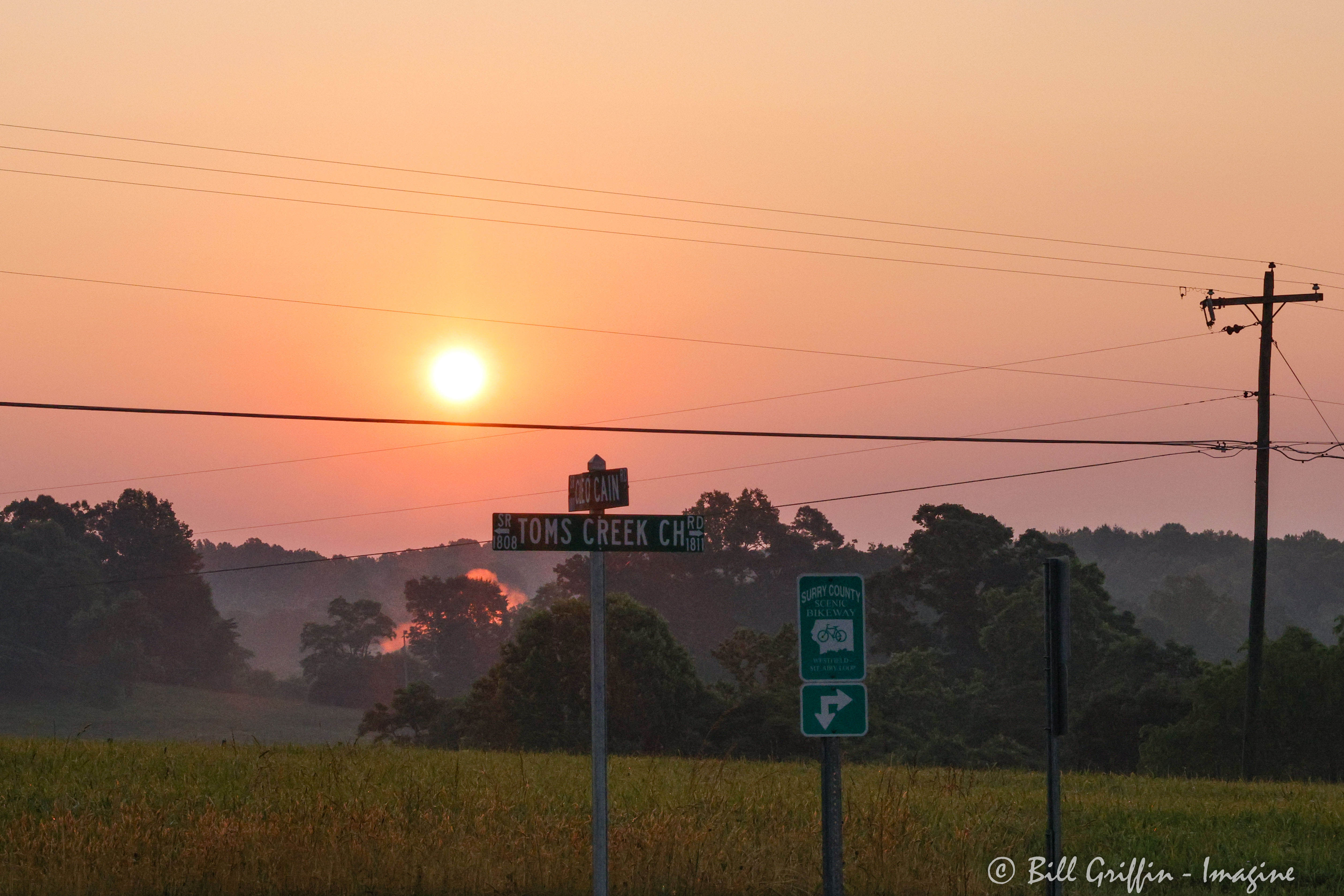
Chilly for June, but after all sunrise isn’t for another half hour. It’s 5:25 AM and Sharon and I are standing in the Surry County foothills a few miles south of the Virginia line. At 5:30 we’ll begin to count. Last year at this very spot a Chuck-Will’s-Widow fired up and sang for 45 seconds before I’d even started the timer. I counted him anyway.
 . 
This year the first voice is a Wood Thrush. Oh, thank you, Audubon’s flute . . . in the summer woods, silver notes pour by the afternoon river. Of all the forest’s music my favorite. Now Catbird, Cardinal, Chipping Sparrow, Indigo Bunting; I call their names when I hear them sing – still too dark to see. Sharon inscribes their presence on our tally sheet. One by one, they fly from mysterious spirit into settled data points.
 . 
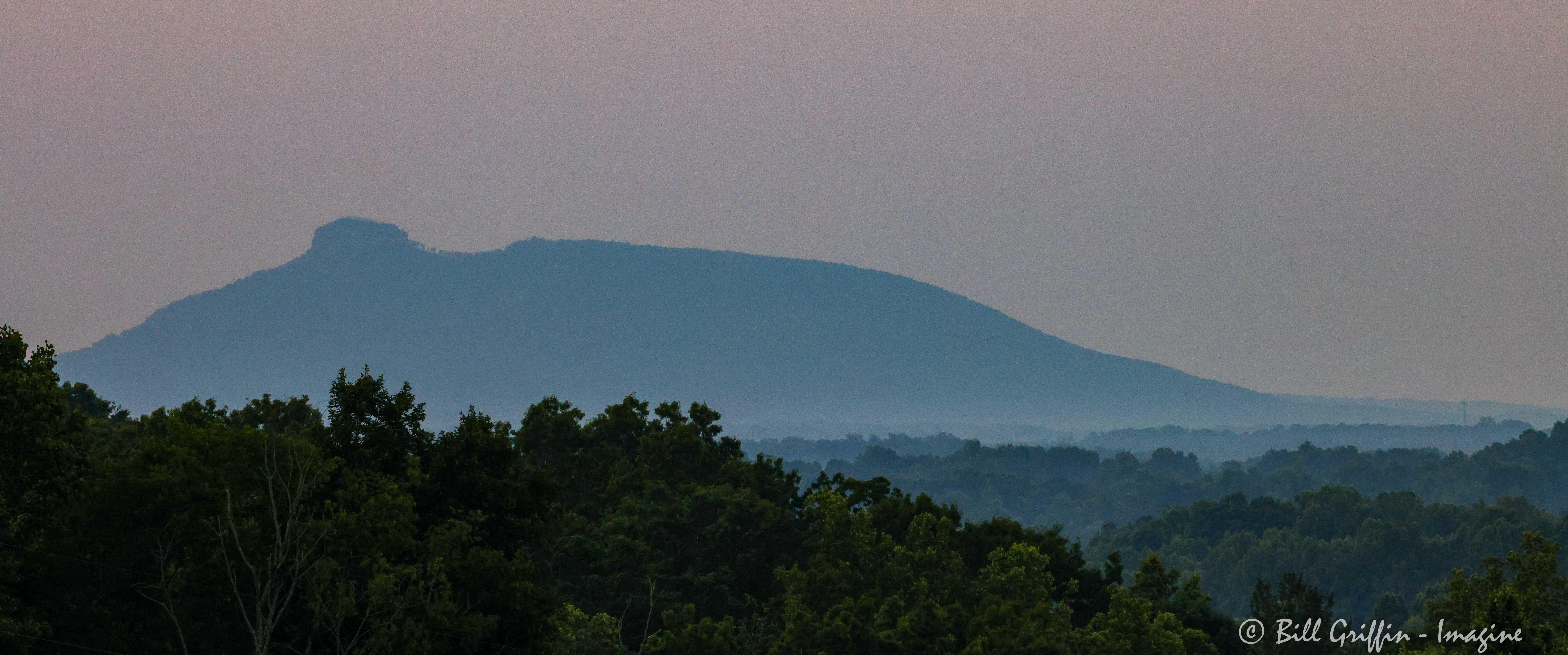
I didn’t really believe Sharon at first. Back in March she asked me to describe these USGS Breeding Bird Surveys and then said, “Can I come?” Really? Pick you up at 5 AM to drive to our first stop? Then 49 more stops, spaced half a mile apart? Set the timer for 3 minutes, count every bird heard or seen, then back in the car and on to the next? Finish late morning somewhere northeast of Pilot Mountain with Hanging Rock looming? You really want to do that?  “Yes! Really! And I’ll bring a picnic!”
 . 
Now we’re at Stop 28. Some of the landmark descriptions, established decades ago when these survey routes were first established, are obscure and changeable: overhead power lines and opening in trees. Well, yes, there is a nice opening in the mixed forest, and yes, there’s an Indigo Bunting as expected. Now we hear a Scarlet Tanager, first one of the morning, but these devious birds love to glean insects at the very apex of the canopy and you could crick your neck trying to spot one. Nevertheless there it appears, flitting to the outer branches of a tall loblolly. Brilliant crimson, stark black wings, pausing to snatch a moth then raise beak in its raucous warble. Sharon gasps. “I’ve glimpsed a Tanager before, but I’ve never seen one in the open. Oh my! This is worth the trip!”
 . 
And we still have 22 more stops. Not to mention the promise of a picnic at Hanging Rock.
 . 
 . 
Enter the litmosphere, a universe of writers and readers. The readers may be physically situated anywhere in the world, same for the writers although they must at some time have lived in North Carolina or one if its four bordering states. Today’s poems appear in the second annual edition of litmosphere as winners, finalists, or semi-finalists in this year’s Lit/South Awards.
 . 
Charlotte Lit, the Lit/South Awards, and the publication of litmosphere are the brainchildren of Kathie Collins (East Bend, NC) and Paul Reali (Charlotte, NC). In establishing the Charlotte Center for Literary Arts, they are creating a community of writers with a unique definition of Southern, and the poetry, essays, and fiction in this year’s journal speak from a creative realm without boundaries. Place and persona are powerfully freed from constraint. I really could not anticipate where the turn of each page would take me. Ever been welcomed into a gathering that challenges you, surprises you, fills empty spots you didn’t even know you had? And leaves you feeling welcomed and ready for more?
 . 
Charlotte Lit, besides its annual contest, offers more than a hundred classes and events every year. Membership information is available here:
 .
 . 
❦ ❦ ❦
 . 
Of Rock Doves
 . 
We call these doves pigeons
because they are many
because we once built them cotes
because we collected their guano
because we spread it on melon
patches and near tomato beds
because they bob their heads
in their staggering walk
like professional wrestlers
at the end of their careers
because they can’t see
straight ahead any other way
because they are easily misled
because no matter what
some find their way back home
because when some vanish
there are always many more
because their name is an echo
of the hungry noises
that come from their flimsy nests
because they raid each other’s nests
they kill their neighbors’ young
because they kill their own young
because together in a group
they are called a deuil
which means mourning in French
because we eat their young
because they taste so sweet
and have very small bones
 . 
Paul Jones
litmosphere, Journal of Charlotte Lit, Charlotte Center for the Literary Arts, © 2023
 . 
❦ ❦ ❦
 . 
When the Universe Told Me You Were Dead
 . 
That very morning, the feral cat left
a dead bluebird on my doorstep,
splayed open.
 . 
Heart gutted, this remained:
a blood-empty chamber
caged behind delicate, shattered bone.
 . 
Newly lifeless, feathers still wet
with morning sky, the orbs of her
eyes set to flight.
 . 
Anita Cantillo
litmosphere, Journal of Charlotte Lit, Charlotte Center for the Literary Arts, © 2023
 . 
 . 
❦ ❦ ❦
 . 
Audubon in the summer woods
by the afternoon river sips
his flute, his fingers swimming on
the silver as silver notes pour
. . .
from Audubon’s Flute by Robert Morgan
[read the entire poem here]
 .
 . 
NOTE: June 19-24, 2023 is NATURALIST WEEK sponsored by Great Smoky Mountains Institute at Tremont. Wherever you are in the world, you can participate in the Naturalist Challenge by spending time outdoors as a naturalist: Pay Attention; Ask Questions; Make Connections; Share. You can also receive a prize if you earn 25 points for your activities! See details here:
 .  . 
 . 
The Breeding Bird Survey is a long-term, large-scale, international avian monitoring program initiated in 1966 to track trends of North American bird populations. There are currently over 4100 courses in the US and Canada, run each spring by volunteer surveyors, and in recent years Mexico has also been added. More than 450 scientific publications have relied heavily, if not entirely, on BBS data; essentially every avian conservation study in North America turns to the BBS in some way.
 . 
In the 1960’s, Chandler Robbins and colleagues at the Patuxent Wildlife Research Center were developing survey techniques to monitor populations of hunted birds: Woodcock, Snipe, Mourning Dove. Inspired by Rachel Carson and her publication of Silent Spring in 1962, Robbins realized that larger surveys were needed to document the effects of DDT, as well as other human and non-human variables affecting bird populations. He invented the roadside survey used today: 50 stops plotted on a 24.5 mile course to be counted once a year. The goal is broad longitudinal observation rather than stop-by-stop variation, and the technique for counting in 2023 is the same as in 1966: a single observer, no “pishing” or other enticements to the birds, no apps or electronics, just two ears and field glasses.
 . 
I ran my first course in 1995: Copeland, southern Surry County. I’ve counted the course every spring except when BBS shut down for COVID in 2020 (because many courses run through parks and federal lands that were closed to visitors that year). In 2022 I added a second course when it became vacant, Mount Airy in northern Surry County. If you’re interested next year, I’ll pick you up at 5 AM. But Sharon has first dibs.
 . 
Bill
 . 
 . 
❦ ❦ ❦
 .  . 
 .
 . 

Read Full Post »

 . 
[with 3 poems by Maya J. Sorini]
 . 
Eavesdropping on the Dead
 . 
Today I heard a man talk to his mother about her eulogy.
They decided on the color of her funeral flowers –
Purple, and white
He kept reminding her to swallow her water
And finished his sentences with “mama,”
So she would remember she was supposed to be listening.
 . 
I watched a woman brush the oily hair from her husband’s forehead
She spoke like velvet,
Telling him how good he looked
With that tube sticking out of his mouth,
Sitting up today!
 . 
There is Arabic music playing down the hall
Because a patriarch is dying
Zaeem, Omar Almadani
Allah ateyk alf afyeeh
The family told the doctors they were so thankful for them.
 . 
The dead tell stories
They forget to swallow
They sign papers
That say they would like to die soon
They listen to music
They pick flowers
They have tubes in their mouths, in their arms, in their bellies,
They laugh and laugh and laugh
 . 
Maya J. Sorini
from The Boneheap in the Lion’s Den, Press 53, Winston-Salem NC, © 2023
 . 
❦ ❦ ❦
 . 
Mostly I dream about being lost. What is this place that seems so dangerously familiar and yet maddeningly strange? How do I get to where I’m going, and just what exactly might that place even be? And how do I, desperate, find what I need among all this that crowds in to thwart me, this collation that confuses and obscures my seeking?
 . 
Last night I walked through a dim building with stairways and many rooms. I was among people I knew: we were a family or a community or somehow connected. As I encountered one person, then another, they all seemed frightened. We knelt together, one by one. I reached to put my arm around each and said, “We will save the world.” Tears in our eyes. “And this is how we will do it.” But I woke suddenly in the dark with no answers.
 . 
 . 
This afternoon I read Maya Sorini’s new book, The Boneheap in the Lion’s Den. A lot of poetry is about pain. This book is pain. Read it and you will succumb. Enter these poems and they may infect your dreams with Sorini’s refrain: Nobody could / help me.
 . 
During the 40 years I practiced medicine the concept of pain steadily evolved. Not only the neuroanatomical patterns of pain and bioneural origin of pain, but new ideas emerged about the nature of pain, this sensation that we all experience but which is impossible to communicate, impossible to share. Pain has become the fifth vital sign (after pulse, blood pressure, respiratory rate, and temp); every time I take my parents to their doctor, the nurse dutifully asks if they are having any pain. Medical practice has attempted to clinically quantify pain with the ubiquitous one-to-ten scale and its familiar smiley faces and frowny faces. The compulsion by doctors to relieve pain (and perhaps the expectation by patients that it will be relieved) is a factor in our national epidemic of opioid addiction.
 . 
But Maya Sorini’s poems are more than the pain of wounds and fractures. They include but exceed the pain of the death of a loved one, the pain of tragedy and grief. As I read these poems, I learned an odd and non-intuitive physics of pain. Clearly we all cope with pain by pushing it away – like gravity, pain’s effect on us diminishes in proportion to the inverse square of distance or some such. Also pain within a certain minimal radius of proximity can be willed into submission: my migraine, my surgical incision, my grief I can encapsulate in denial or repression and with clenched jaw march on.
 . 
But there is a certain critical distance, or rather closeness, of pain that lacerates unrelentingly – the pain of experiencing the pain of another. Maya Sorini wrote these poems from her months of clinical research in a trauma surgery unit at Washington University in St. Louis, standing in emergency rooms and operating suites as blood dripped into her shoes. Perhaps bullets never penetrated her anatomy, but shards of violent metal tore her. Wounded her. It is painful, yes very painful, to share her distress. Is there any hope for healing from these dreams of flight and helplessness? Can Daniel, gradually succumbing to the carnage of the lion’s den until he himself becomes little more than a boneheap, ever rise up again? Can any of us be saved?
 . 
When I finished the final page of Boneheap, I sat for a time in silence. In shock? I wanted to push away the pain but I had read every single word and they would not be denied. Now what? Perhaps I’m awakening from a dream in which answers flit through my fingers like moths then dissolve into mist with the rising day. Perhaps a dream is some subconscious nudge not to give up looking for answers. Is it a tautology to pronounce that pain must be felt before it can be unfelt? Isn’t unfelt actually the precise opposite of what the dream impels us to seek?
 . 

Maya Sorini, what I’ve felt in reading your words is pain which we have now, after all, shared. In sharing with this reader, may the burden of your pain be lightened.

 . 

 . 
❦ ❦ ❦
 . 
Moratorium
 . 
Say what you mean
Stop saying “expired”
Like it is inevitable for the 28-year-old
To die on a Tuesday at noon.
 . 
Stop keeping it a few words away from you,
Using “expired” because “death” forces
you to think about
Your grandfather’s funeral
When you were 16 and had never seen
Your dad cry before.
 . 
Say what you mean exactly –
Do not say, “we did everything we could”
When what you mean is
“I have given every tear and deep breath I have to this job
But the bullets keep winning.
I don’t want to be
The one telling you
That we lose every
Day to scraps of metal.”
 . 
Say what you really mean:
“Your son is dead.”
 . 
Maya J. Sorini
from The Boneheap in the Lion’s Den, Press 53, Winston-Salem NC, © 2023
 . 
❦ ❦ ❦
 . 
Trauma Surgeon Ars Poetica
 . 
This morning a robin collides with the glass windows of our sunroom. It flies into three panes, then four, then the same one many times, looking for different skies, trying to escape the day. With each thump I think, “this is the sort of thing poets write about, those poets who know how to hide the word death inside of a songbird,” but I don’t know how to talk about blood without speaking the scarlet spatter of it. I say nothing to the red-brown bird, the reflection of the sky’s blue face veined with branches, the feathers so light they seem to shirk the responsibility of falling, the dull thunk ringing in the house, the morning so quiet it becomes prayer, the lined triangle of yellow beak, the black moon of the eye intent on its mirage. I cannot write that poem. I am still thinking about blood. When I see the robin throw itself at the window a fifth, sixth, seventh time, I open the door, I wave my arms, I chase it away.
 . 
Maya J. Sorini

from The Boneheap in the Lion’s Den, Press 53, Winston-Salem NC, © 2023

 . 
❦ ❦ ❦
 . 
Maya J. Sorini is a poet, performer, and medical student from Rockville, Maryland. She received her B.A. in Chemistry from Washington University in St. Louis while engaging in clinical trauma surgery research. Since 2005, Press 53 in Winston-Salem, North Carolina has been finding and sharing remarkable voices through collections of poetry and short fiction. The Boneheap in the Lion’s Den is the winner of the 2023 Press 53 Award for Poetry, selected by Tom Lombardo.
 . 
❦ ❦ ❦
 . 
 . 

Read Full Post »

[with 3 selections from Tar River Poetry]
Letter to the Archaeologists of the Post-Anthropocene
You know already what fools we were,
how like the dog that starts itself awake
we jumped and bared our teeth
and turned to chase our tail, our fury
rising as we spun – and how, unlike the dog,
we did not hold our caught selves
gently, surprised to be at once the captive
and the captor, but chewed our own flesh
bloody, sure we were destroying that
which would destroy us. You already know
we killed our saviors, set fire
to our home, and ate
our bitter hearts. We said
because we owned what we destroyed
it was ours for the destruction,
and we destroyed it
to prove that it was ours.
You know all that.
You may not know, however,
just how much
we loved what we destroyed, how much
we longed to have it love us –
how even the cruelest among us
would stop sometimes to watch
the polluted sky at sunset
turning gold then pink then indigo.
Shane Sheely
from Tar River Poetry, Volume 62, Number 2. Spring 2023. © 2023 TRP
❦ ❦ ❦
Some ten years ago I became a phyto-heterotroph. Many people have asked whether it was a difficult transition and whether I have regrets. Not at all! To borrow a phrase from the general domain of heterotrophs, “Life is good.”
This week I’ve been reintroduced to a community of fellow heterotrophs after a year’s absence. We met in the woods on Grassy Creek’s Forest Bathing trail as they emerged  from the shady gloom, pale as the moon, a little creepy. Their scaly jointed fingers that are not fingers poked up from the leaf mould. They nodded their heads which are not heads. Not human, not fungus. What?
These are plants, flowering plants, but stark white, utterly absent chlorophyll : Ghost Pipes (Heath family, Ericaceae, same family as rhododendron, azalea, huckleberry, but so eerily different). Kneel to inspect the nodding head and you’ll see that it’s a flower, one at the apex of each stem, and indeed shaped like the flowers on my blueberry bushes beside the driveway. I remember the first time I saw these odd creatures in the southern Appalachians, thriving in rich mesic woodland, clustered in deep shade with no need for photons. I was taught that they are white because they’re parasitic, taking nourishment from the roots of trees.
Heterotrophic – fed by others. The opposite of autotrophic, feeding oneself. Most of the Plant Kingdom are autotrophs, industriously creating sugar and cellulose from the nothing of light and CO2. Quite a number in Kingdom Protist are autotrophs (algae, for example), and even a few in the Bacteria Kingdom (cyanobacteria). All the rest of us are unable to feed ourselves. I can make Vitamin D when sunlight strikes my skin, but as an obligate heterotroph I must consume autotrophs to survive.
Personal and Planetary Health—The Connection With Dietary Choices. This is the title of a feature editorial in the Journal of the American Medical Society (June 6, 2023; Volume 329, Number 21). It isn’t difficult to imagine the message the editorialist will promote, but it is novel to emphasize the connection between choices that lead to personal well-being and and choices that promote global health. To quote: Physicians have historically focused on patient health and relegated planetary health to environmentalists and lawmakers. However, dietary choices are the largest driver of chronic diseases. National surveys indicate less than 5% of the US population meets dietary fiber recommendations due to inadequate plant-based food intake. Plant-based diets are also associated with reduced incidence of chronic diseases such as obesity, cardiovascular disease, diabetes, chronic kidney disease, and cancer in multiple studies.
I became a phyto-heterotroph (it’s easier to spell vegetarian) not for personal health but to reduce my ecological footprint. Eating plants instead of eating things that eat plants has a frankly unbelieveable impact on agricultural water consumption, loss of habitat to grazing and animal feedstock production, and methane and nitrous oxide production (25 times and 298 times more potent greenhouse gases than CO2). Even the most diehard omni-heterotroph could probably tolerate a phyto-heterotroph diet one or two days a week.
And those Ghost Pipes (Monotropa uniflora) – I read this week that they are actually myco-heterotrophs. Their roots entangle with and suck sugar from the fungal filaments of the mycorrhizal network that permeates all healthy soil. Alas, all fungi are themselves heterotrophs. They reciprocate with green plants to provide minerals and water in exchange for sugar, some of which they evidently pass on to the Ghost Pipes. Without GREEN, none of us would be here.
❦ ❦ ❦
Because the Demented World Repeats Itself
In Europe again tonight,
a human being is dying
under a bombed-to-rubble house
or in the street – bicycle basket
spilling its loaf of bread.
This particular human is dying
whose dying makes me despair
though I’m no one in particular
and they’re no one in particular
to me. I’m just another human
who will be dying, but not yet,
and who lies warm under my quilt
of many blessings, wondering
what can be done about humans
when I can’t dissuade the sparrow
who attacks our window
slamming and slamming
his reflection – the enemy
he keeps seeing but not
seeing as himself.
Susan Cohen
from Tar River Poetry, Volume 62, Number 2. Spring 2023. © 2023 TRP
❦ ❦ ❦
I don’t subscribe to many literary journals, but I don’t let my Tar River Poetry lapse. Volume 62/Number 2 arrived last week containing a few familiar names but many more names that I now want to remain familiar with. Micro-themes seem to weave through its fifty pages of poetry like a carrier wave that fills the room with music. A few poems juxtaposed are having a conversation, but when the next in line picks up the thread the color and texture have suddenly shifted again. Always something new, always engaging, deeply felt, deeply connecting. Thank you to Luke Whisnant and all the perceptive editors who send me a fresh volume twice a year.
Tar River Poetry is published twice yearly with the support of the Department of English, East Carolina University. http://tarriverpoetry.com. 113 Erwin Hall, Mail Stop 159, ECU, East Fifth Street, Greenville NC 27858-4353.
Shane Sheely has published three books of poetry and directs and teaches in the creative writing MFA program at University of Missouri-St. Louis.
Susan Cohen, author of three full-length poetry collections, is a former journalist living in Berkeley, California.
Steve Cushman’s first poetry collection, How Birds Fly, won the 2018 Lena Shull Book Award of the North Carolina Poetry Society.
❦ ❦ ❦
The Candiru Fish is So Small It Could Swim Up Your Urethra
is what Mrs. Hart, my 9th grade biology teacher, said
thirty-some years ago, so when Julie says let’s go skinny
dipping, instead of being excited I’m transported back to
Mrs. Hart’s class in St. Petersburg where all we had to cool
us off on those Florida afternoons was one lone window unit,
so we sweated through her lectures until the day we sat up
straight and listened as she discussed urethras and penises
and the dangers lurking beneath the surface. Come on, Julie
is saying, naked now, her clothes in a stack at the shore,
her pale shoulders bouncing up and down at the water’s surface.
I strip bare, tell myself we’re nowhere near the Amazon River,
run with everything I have into the water, into Julie’s arms,
and again she’s rescuing me from myself, from my silly fears,
and those murky, dangerous things, seen and unseen.
Steve Cushman
from Tar River Poetry, Volume 62, Number 2. Spring 2023. © 2023 TRP
❦ ❦ ❦
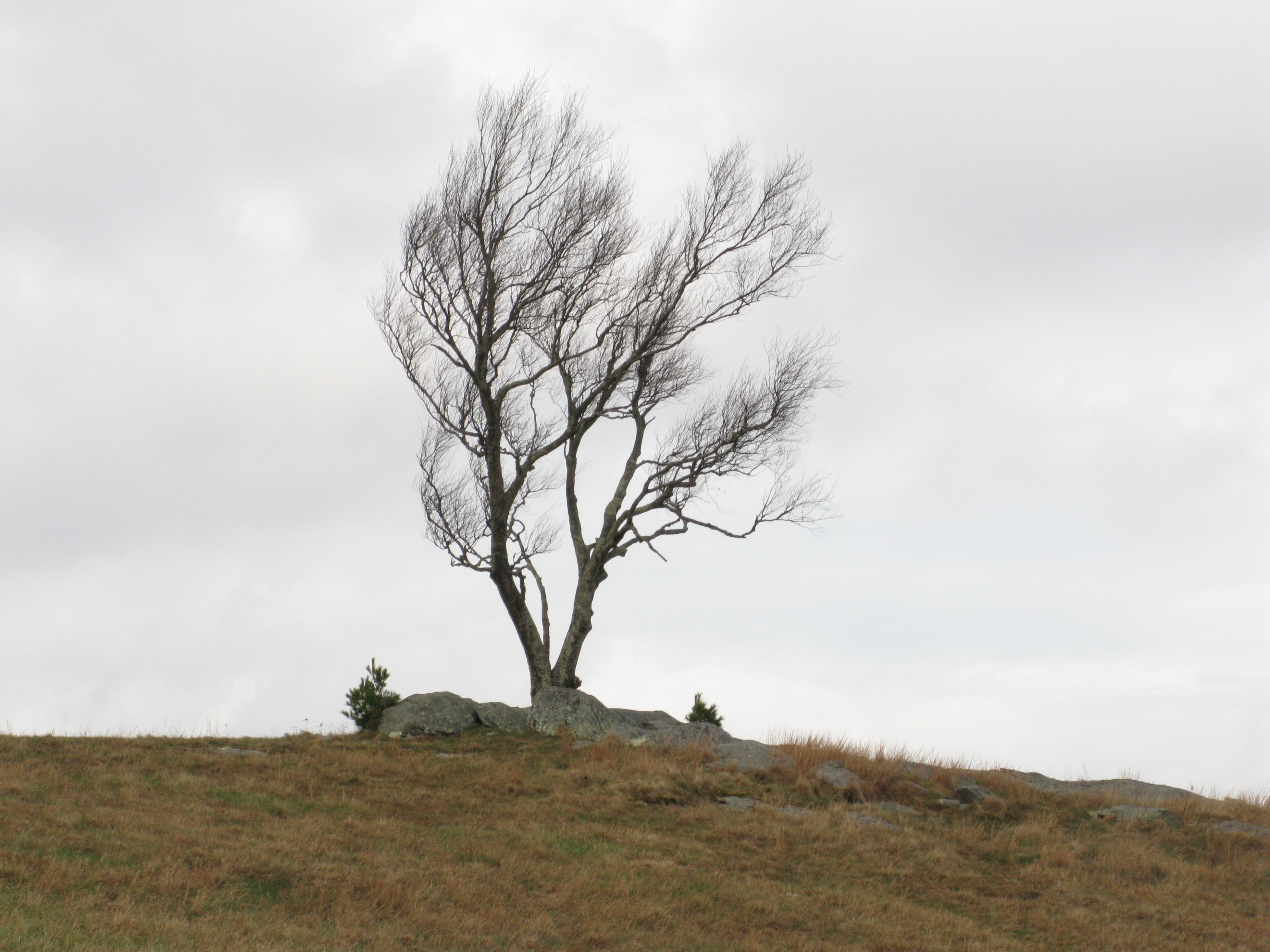
Doughton Park Tree 2020-11-22

Read Full Post »

« Newer Posts - Older Posts »